Radial Categories
and Polysemy
Franklin de la Cruz M.
Radial Category
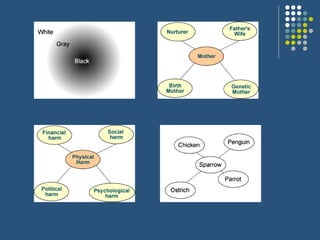
A RADIAL CATEGORY is a conceptual category in
which the range of concepts are organised relative
to a central or prototypical concept
Evans and Green 2006
A radial category is a classification of things
ordinarily understood in terms of some clearly
imagined subcategory, called a prototype.
There is some reason to think that most if not
all of our ordinary concepts are about
categories like this.
Garret Jann 2004
Carachteristics:
 The Semantic network of the radial category is structured around a
CORE MEANING
 The lexical item has VARIABILITY (fortis/lenis) --> Specialized meaning
COUNTERFACTUALITY
 Its meaning is Non-predictable from rules but motivated by
CONVENTIONS
 The meaning is stored in the semantic memory
 Sometimes the lexical item presents overextension
 So RADIALITY is a type of linguistic and conceptual category property
Lexical items are conceptual categories: a word represents a
category of distinct yet related meanings that exhibit
typicality effects.
Lakoff: the lexical item represents radial categories.
It is structured with respect to a composite prototype, and the
various category members are related to the prototype by
convention rather than being 'generated' by predictable
rules.
Evans and Green 2006
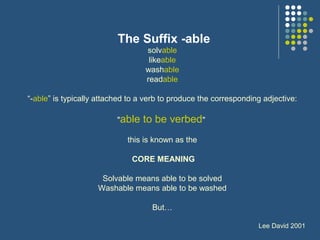
The Suffix -able
solvable
likeable
washable
readable
“-able” is typically attached to a verb to produce the corresponding adjective:
"able to be verbed"
this is known as the
CORE MEANING
Solvable means able to be solved
Washable means able to be washed
But…
Lee David 2001
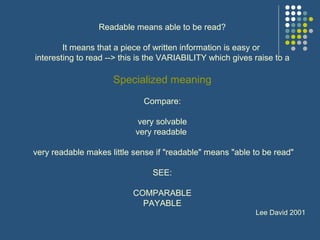
Readable means able to be read?
It means that a piece of written information is easy or
interesting to read --> this is the VARIABILITY which gives raise to a
Specialized meaning
Compare:
very solvable
very readable
very readable makes little sense if "readable" means "able to be read"
SEE:
COMPARABLE
PAYABLE
Lee David 2001
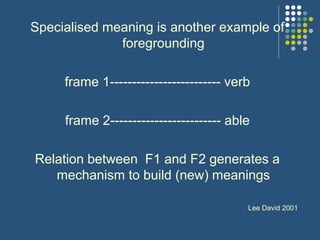
Specialised meaning is another example of
foregrounding
frame 1------------------------- verb
frame 2------------------------- able
Relation between F1 and F2 generates a
mechanism to build (new) meanings
Lee David 2001
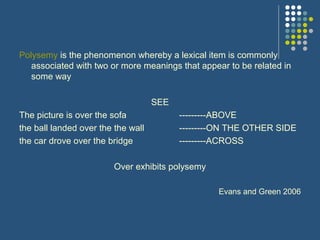
Polysemy is the phenomenon whereby a lexical item is commonly
associated with two or more meanings that appear to be related in
some way
SEE
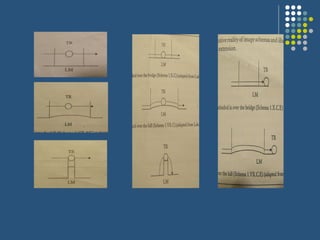
The picture is over the sofa ---------ABOVE
the ball landed over the the wall ---------ON THE OTHER SIDE
the car drove over the bridge ---------ACROSS
Over exhibits polysemy
Evans and Green 2006
Polysemy and homonymy
Homonymy: two different words that happen to share the
same form in sound (homophones)
and /or in writing (homographs)
Example:
bank--------- financial institution: italian, banca 'money
changer's table'
bank--------- of a river: Old Icelandic for "hill“
Evans and Green 2006
According to some views, polysemy emerges from
monosemy (Ruhl 1989; Pustejovsky 1995):
A single abstract meaning from which other senses are derived on the
basis of context, speaker intention, recognition of the intention by
the hearer and so on.
This may be true when over has a spatial sense but:
Jane has a strange power over him ------- over means control
Is this over a distinct word, an homonym?
Or a single abstract underlying sense licenses both, the spacial and the
non-spacial sense???monosemy???
Evans and Green 2006
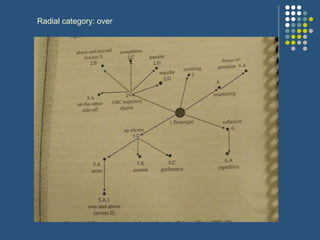
RADIAL CATEGORY MODEL OF POLYSEMY
Claudia Brugman (1981) Brugman and Lakoff (1988) Lakoff (1987)
They claim that over is stored as a category of distinct polysemous
senses rather than a single abstract monosemous sense
Over constitutes a conceptual category of distinct but related
(polysemous) senses
These senses as part of a single category, they can be judged as more
prototypical (central) or less prototypical (peripheral)
While the prototypical ABOVE sense of over relates to a spatial
configuration, the CONTROL sense does not --- it is derived
metaphorically
Evans and Green 2006
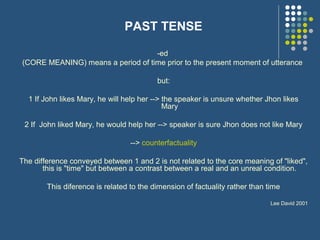
PAST TENSE
-ed
(CORE MEANING) means a period of time prior to the present moment of utterance
but:
1 If John likes Mary, he will help her --> the speaker is unsure whether Jhon likes
Mary
2 If John liked Mary, he would help her --> speaker is sure Jhon does not like Mary
--> counterfactuality
The difference conveyed between 1 and 2 is not related to the core meaning of "liked",
this is "time" but between a contrast between a real and an unreal condition.
This diference is related to the dimension of factuality rather than time
Lee David 2001
WILL/WOULD
I will talk to him
I would talk to him
By locating a situation in a past time, the speaker
locates it in a conceptual space that is distinc from
the present and is this property that relates it to
conterfactual situation
Lee David 2001
SEE:
If John Knew Mary last year, he didn't tell me
If John had known Mary last year, he would
have told me
Lee David 2001
It's time we left!
Possible event of leaving in the near future
Cunterfactuality is the property (some words
posses) of making a contrast between
facts and events and
hypotetical facts and events
Politenes
I wonder ---present (factual) state--- if you would help?
I wonder ---present state--- ed --past state/ counterfactual-- if you
would help?
The difference is not related to time--> the reference to
the past existence of a mental state does not
preclude the possibility that it continues up to the
present.
This extension in the period of time of the events is
characteristic of politenes or indirectedness.
Lee David 2001
SEE:
Will you close the door? --> hypothetical future state
"in a future I imagine you close the door"
Would you close de door? -->counterfactual
Can you close the door? -->counterfactual
Could you close the door? --> counterfactual
The contrast does not involve a difference of time, but
politeness
Lee David 2001
Attribute radiality
Adjectives
Example: strong  core meaning: physical strength
A strong man / horse
But:
a strong argument /claim/ beer/ smell
Observation: An entity possessed of physical strength is one that
has the potential to impinge on its surroundings, overpower other
entities or to move objects that are not easily moved
Lee David 2001
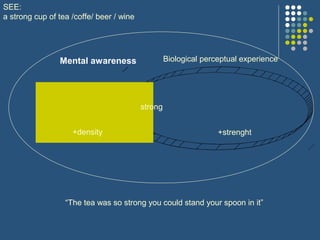
Mental awareness Biological perceptual experience
strong
SEE:
a strong cup of tea /coffe/ beer / wine
“The tea was so strong you could stand your spoon in it”
+strenght+density
strong taste / smel / light
but:
a strong noise???
 A strong woman (is someone who has the potential to endure
hardship)
 A strong man (man are naturaly stronger than women)
A strong woman (fortis)
A strong man (lenis)
Lee David 2001
Example: good
a good child/ boy/ dog/ book/ pen
See:
A good dog
Here good means: it behaves as we expect it to behave:
obedient, friendly, loyal, well-behaved
But:
A good cat/ goldfish
A good door/ window
Lee David 2001
PROCESS RADIALITY
EXAMPLE:TURN
CORE MEANING:
the rotation of an entity about and axis:
the wheels are turning
Mary turned the doorknob
But:
He turned from Mary to John
The car turned into the high street
John turned back (opposite direction)
She turned up at the party
the liquid turned red
John's face turned quite green
Lee David 2001
THING RADIALITY
In nouns, radiality is pervasive
see children
“Dog” is any four legged animal
“daddy” is any adult male -------------> overextension
"I didn't know that cows laid eggs"
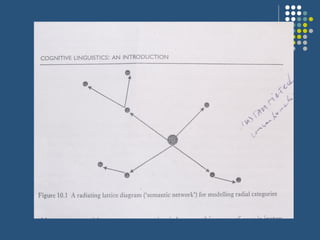
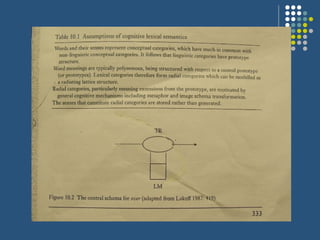
Radial category: over
Conclusion
Since the semantic networks associated to
words and morphemes on the basis of
perceived similarities, new phenomena can
be assimilated to existing categories
References
 Evans V. & Green M. 2006. Cognitive Linguistics, an Introduction.
Lawrence Erlbaum Associates, Publishers. London.
 Garret, Jan. 2005. Oppression as a Radial Category and the
Search for a Definition. Consulted in:
http://www.wku.edu/~jan.garrett/320/oppressn.htm
 Lee, David. 2001.Cognitive Linguistics, an Introduction. Oxford
University Press. New York.
 http://www.linguistics.ucsb.edu/faculty/cumming/ling50/radial_categories.h

Radial categories franklin delacruz

  • 1.
  • 2.
    Radial Category A RADIALCATEGORY is a conceptual category in which the range of concepts are organised relative to a central or prototypical concept Evans and Green 2006
  • 4.
    A radial categoryis a classification of things ordinarily understood in terms of some clearly imagined subcategory, called a prototype. There is some reason to think that most if not all of our ordinary concepts are about categories like this. Garret Jann 2004
  • 5.
    Carachteristics:  The Semanticnetwork of the radial category is structured around a CORE MEANING  The lexical item has VARIABILITY (fortis/lenis) --> Specialized meaning COUNTERFACTUALITY  Its meaning is Non-predictable from rules but motivated by CONVENTIONS  The meaning is stored in the semantic memory  Sometimes the lexical item presents overextension  So RADIALITY is a type of linguistic and conceptual category property
  • 6.
    Lexical items areconceptual categories: a word represents a category of distinct yet related meanings that exhibit typicality effects. Lakoff: the lexical item represents radial categories. It is structured with respect to a composite prototype, and the various category members are related to the prototype by convention rather than being 'generated' by predictable rules. Evans and Green 2006
  • 8.
    The Suffix -able solvable likeable washable readable “-able”is typically attached to a verb to produce the corresponding adjective: "able to be verbed" this is known as the CORE MEANING Solvable means able to be solved Washable means able to be washed But… Lee David 2001
  • 9.
    Readable means ableto be read? It means that a piece of written information is easy or interesting to read --> this is the VARIABILITY which gives raise to a Specialized meaning Compare: very solvable very readable very readable makes little sense if "readable" means "able to be read" SEE: COMPARABLE PAYABLE Lee David 2001
  • 10.
    Specialised meaning isanother example of foregrounding frame 1------------------------- verb frame 2------------------------- able Relation between F1 and F2 generates a mechanism to build (new) meanings Lee David 2001
  • 11.
    Polysemy is thephenomenon whereby a lexical item is commonly associated with two or more meanings that appear to be related in some way SEE The picture is over the sofa ---------ABOVE the ball landed over the the wall ---------ON THE OTHER SIDE the car drove over the bridge ---------ACROSS Over exhibits polysemy Evans and Green 2006
  • 12.
    Polysemy and homonymy Homonymy:two different words that happen to share the same form in sound (homophones) and /or in writing (homographs) Example: bank--------- financial institution: italian, banca 'money changer's table' bank--------- of a river: Old Icelandic for "hill“ Evans and Green 2006
  • 13.
    According to someviews, polysemy emerges from monosemy (Ruhl 1989; Pustejovsky 1995): A single abstract meaning from which other senses are derived on the basis of context, speaker intention, recognition of the intention by the hearer and so on. This may be true when over has a spatial sense but: Jane has a strange power over him ------- over means control Is this over a distinct word, an homonym? Or a single abstract underlying sense licenses both, the spacial and the non-spacial sense???monosemy??? Evans and Green 2006
  • 14.
    RADIAL CATEGORY MODELOF POLYSEMY Claudia Brugman (1981) Brugman and Lakoff (1988) Lakoff (1987) They claim that over is stored as a category of distinct polysemous senses rather than a single abstract monosemous sense Over constitutes a conceptual category of distinct but related (polysemous) senses These senses as part of a single category, they can be judged as more prototypical (central) or less prototypical (peripheral) While the prototypical ABOVE sense of over relates to a spatial configuration, the CONTROL sense does not --- it is derived metaphorically Evans and Green 2006
  • 16.
    PAST TENSE -ed (CORE MEANING)means a period of time prior to the present moment of utterance but: 1 If John likes Mary, he will help her --> the speaker is unsure whether Jhon likes Mary 2 If John liked Mary, he would help her --> speaker is sure Jhon does not like Mary --> counterfactuality The difference conveyed between 1 and 2 is not related to the core meaning of "liked", this is "time" but between a contrast between a real and an unreal condition. This diference is related to the dimension of factuality rather than time Lee David 2001
  • 17.
    WILL/WOULD I will talkto him I would talk to him By locating a situation in a past time, the speaker locates it in a conceptual space that is distinc from the present and is this property that relates it to conterfactual situation Lee David 2001
  • 18.
    SEE: If John KnewMary last year, he didn't tell me If John had known Mary last year, he would have told me Lee David 2001
  • 19.
    It's time weleft! Possible event of leaving in the near future Cunterfactuality is the property (some words posses) of making a contrast between facts and events and hypotetical facts and events
  • 20.
    Politenes I wonder ---present(factual) state--- if you would help? I wonder ---present state--- ed --past state/ counterfactual-- if you would help? The difference is not related to time--> the reference to the past existence of a mental state does not preclude the possibility that it continues up to the present. This extension in the period of time of the events is characteristic of politenes or indirectedness. Lee David 2001
  • 21.
    SEE: Will you closethe door? --> hypothetical future state "in a future I imagine you close the door" Would you close de door? -->counterfactual Can you close the door? -->counterfactual Could you close the door? --> counterfactual The contrast does not involve a difference of time, but politeness Lee David 2001
  • 22.
    Attribute radiality Adjectives Example: strong core meaning: physical strength A strong man / horse But: a strong argument /claim/ beer/ smell Observation: An entity possessed of physical strength is one that has the potential to impinge on its surroundings, overpower other entities or to move objects that are not easily moved Lee David 2001
  • 23.
    Mental awareness Biologicalperceptual experience strong SEE: a strong cup of tea /coffe/ beer / wine “The tea was so strong you could stand your spoon in it” +strenght+density
  • 24.
    strong taste /smel / light but: a strong noise???  A strong woman (is someone who has the potential to endure hardship)  A strong man (man are naturaly stronger than women) A strong woman (fortis) A strong man (lenis) Lee David 2001
  • 25.
    Example: good a goodchild/ boy/ dog/ book/ pen See: A good dog Here good means: it behaves as we expect it to behave: obedient, friendly, loyal, well-behaved But: A good cat/ goldfish A good door/ window Lee David 2001
  • 26.
    PROCESS RADIALITY EXAMPLE:TURN CORE MEANING: therotation of an entity about and axis: the wheels are turning Mary turned the doorknob But: He turned from Mary to John The car turned into the high street John turned back (opposite direction) She turned up at the party the liquid turned red John's face turned quite green Lee David 2001
  • 27.
    THING RADIALITY In nouns,radiality is pervasive see children “Dog” is any four legged animal “daddy” is any adult male -------------> overextension "I didn't know that cows laid eggs"
  • 29.
  • 30.
    Conclusion Since the semanticnetworks associated to words and morphemes on the basis of perceived similarities, new phenomena can be assimilated to existing categories
  • 31.
    References  Evans V.& Green M. 2006. Cognitive Linguistics, an Introduction. Lawrence Erlbaum Associates, Publishers. London.  Garret, Jan. 2005. Oppression as a Radial Category and the Search for a Definition. Consulted in: http://www.wku.edu/~jan.garrett/320/oppressn.htm  Lee, David. 2001.Cognitive Linguistics, an Introduction. Oxford University Press. New York.  http://www.linguistics.ucsb.edu/faculty/cumming/ling50/radial_categories.h