Clustering for new discovery in data
Mean shift clustering
Hierarchical clustering
- Kunal Parmar
Houston Machine
Learning Meetup
1/21/2017
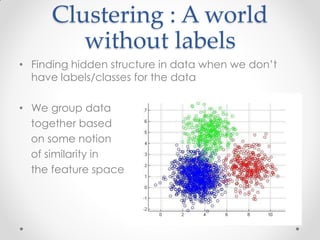
Clustering : A world
without labels
• Finding hidden structure in data when we don’t
have labels/classes for the data
• We group data
together based
on some notion
of similarity in
the feature space
Clustering approaches
covered in previous lecture
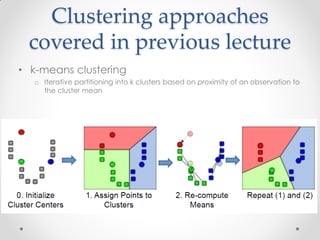
• k-means clustering
o Iterative partitioning into k clusters based on proximity of an observation to
the cluster mean
Clustering approaches
covered in previous lecture
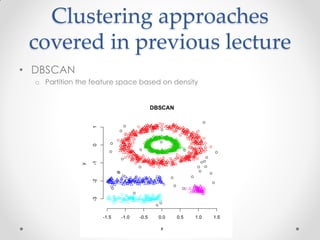
• DBSCAN
o Partition the feature space based on density
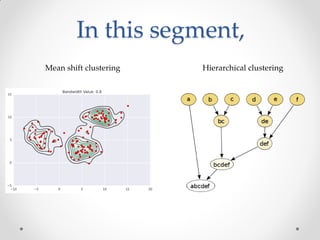
In this segment,
Mean shift clustering Hierarchical clustering
Mean shift clustering
• Mean shift clustering is a non-parametric iterative
mode-based clustering technique based on kernel
density estimation.
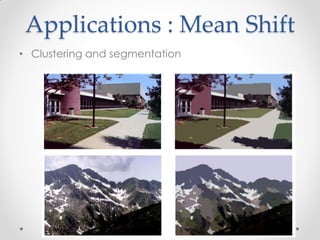
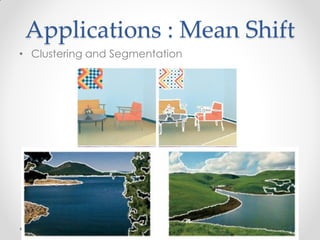
• It is very commonly used in the field of computer
vision because of it’s high efficiency in image
segmentation.
Mean shift clustering
• It assumes that our data is sampled from an
underlying probability distribution
• The algorithm finds out the modes(peaks) of the
probability distribution. The underlying kernel
distribution at the mode corresponds to a cluster
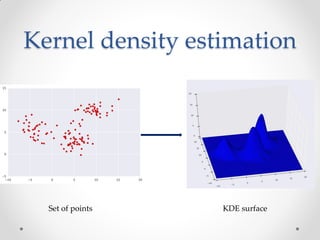
Kernel density estimation
Set of points KDE surface
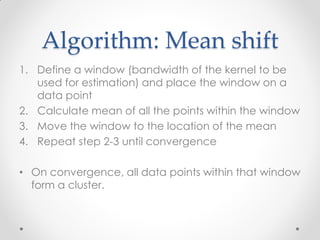
Algorithm: Mean shift
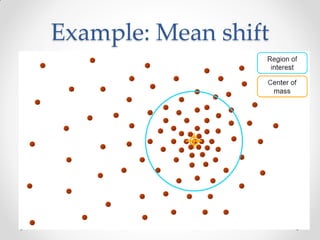
1. Define a window (bandwidth of the kernel to be
used for estimation) and place the window on a
data point
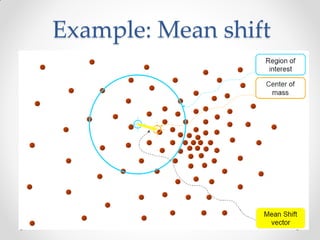
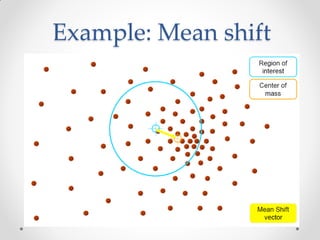
2. Calculate mean of all the points within the window
3. Move the window to the location of the mean
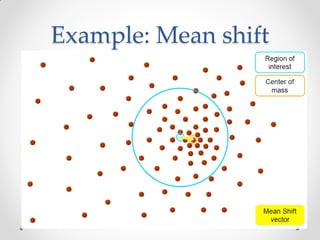
4. Repeat step 2-3 until convergence
• On convergence, all data points within that window
form a cluster.
Example: Mean shift
Example: Mean shift
Example: Mean shift
Example: Mean shift
Types of kernels
• Generally, a Gaussian kernel is used for probability
estimation in mean shift clustering.
• However, other kinds of kernels that can be used
are,
o Rectangular kernel
o Flat kernel, etc.
• The choice of kernel affects the clustering result
Types of kernels
• The choice of the bandwidth of the kernel(window)
will also impact the clustering result
o Small kernels will result in lots of clusters, some even being individual data
points
o Big kernels will result in one or two huge clusters
Pros and cons : Mean Shift
• Pros
o Model-free, doesn’t assume predefined shape of clusters
o Only relies on one parameter: kernel bandwidth h
o Robust to outliers
• Cons
o The selection of window size is not trivial
o Computationally expensive; O(𝑛2
)
o Sensitive to selection of kernel bandwidth; small h will slow down convergence,
large h speeds it up but might merge two modes
Applications : Mean Shift
• Clustering and segmentation
• dfsn
Applications : Mean Shift
• Clustering and Segmentation
Hierarchical Clustering
• Hierarchical clustering creates clusters that have a
predetermined ordering from top to bottom.
• There are two types of hierarchical clustering:
o Divisive
• Top to bottom approach
o Agglomerative
• Bottom to top approach
Algorithm:
Hierarchical agglomerative clustering
1. Place each data point in it’s own singleton group
2. Iteratively merge the two closest groups
3. Repeat step 2 until all the data points are merged
into a single cluster
• We obtain a dendogram(tree-like structure) at the
final step. We cut the dendogram at a certain level
to obtain the final set of clusters.
Cluster similarity or
dissimilarity
• Distance metric
o Euclidean distance
o Manhattan distance
o Jaccard index, etc.
• Linkage criteria
o Single linkage
o Complete linkage
o Average linkage
Linkage criteria
• It is the quantification of the distance between sets
of observations/intermediate clusters formed in the
agglomeration process
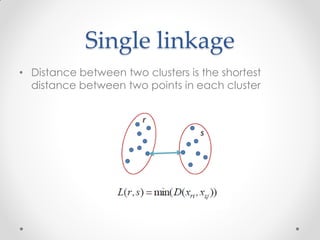
Single linkage
• Distance between two clusters is the shortest
distance between two points in each cluster
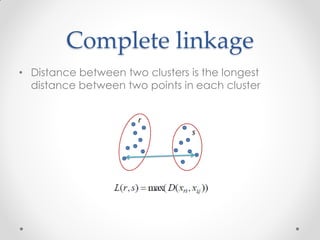
Complete linkage
• Distance between two clusters is the longest
distance between two points in each cluster
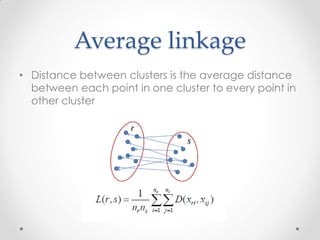
Average linkage
• Distance between clusters is the average distance
between each point in one cluster to every point in
other cluster
Example: Hierarchical
clustering
• We consider a small dataset with seven samples;
o (A, B, C, D, E, F, G)
• Metrics used in this example
o Distance metric: Jaccard index
o Linkage criteria: Complete linkage
Example: Hierarchical
clustering
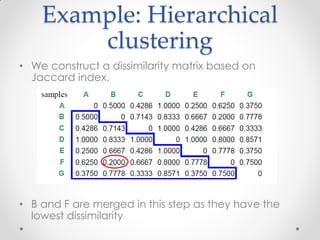
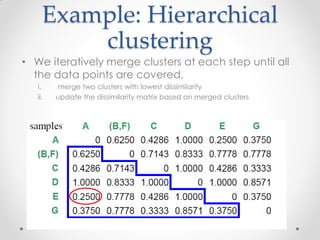
• We construct a dissimilarity matrix based on
Jaccard index.
• B and F are merged in this step as they have the
lowest dissimilarity
Example: Hierarchical
clustering
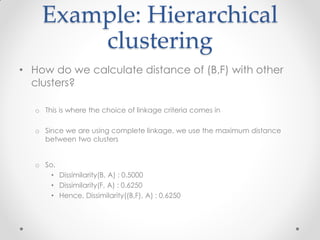
• How do we calculate distance of (B,F) with other
clusters?
o This is where the choice of linkage criteria comes in
o Since we are using complete linkage, we use the maximum distance
between two clusters
o So,
• Dissimilarity(B, A) : 0.5000
• Dissimilarity(F, A) : 0.6250
• Hence, Dissimilarity((B,F), A) : 0.6250
Example: Hierarchical
clustering
• We iteratively merge clusters at each step until all
the data points are covered,
i. merge two clusters with lowest dissimilarity
ii. update the dissimilarity matrix based on merged clusters
o sfs
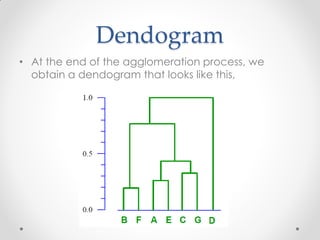
Dendogram
• At the end of the agglomeration process, we
obtain a dendogram that looks like this,
• sfdafdfsdfsd
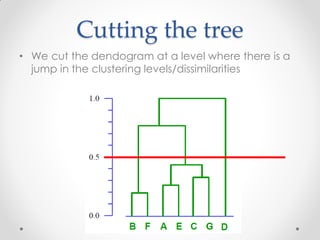
Cutting the tree
• We cut the dendogram at a level where there is a
jump in the clustering levels/dissimilarities
Cutting the tree
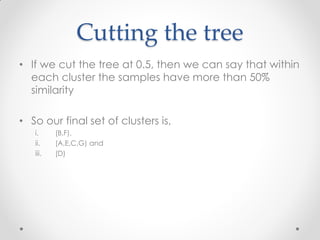
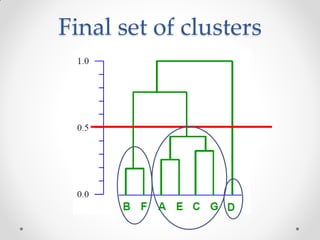
• If we cut the tree at 0.5, then we can say that within
each cluster the samples have more than 50%
similarity
• So our final set of clusters is,
i. (B,F),
ii. (A,E,C,G) and
iii. (D)
Final set of clusters
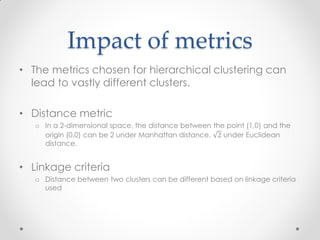
Impact of metrics
• The metrics chosen for hierarchical clustering can
lead to vastly different clusters.
• Distance metric
o In a 2-dimensional space, the distance between the point (1,0) and the
origin (0,0) can be 2 under Manhattan distance, 2 under Euclidean
distance.
• Linkage criteria
o Distance between two clusters can be different based on linkage criteria
used
Linkage criteria
• Complete linkage is the most popular metric used
for hierarchical clustering. It is less sensitive to
outliers.
• Single linkage can handle non-elliptical shapes. But,
single linkage can lead to clusters that are quite
heterogeneous internally and it more sensitive to
outliers and noise
Pros and Cons :
Hierarchical Clustering
• Pros
o No assumption of a particular number of clusters
o May correspond to meaningful taxonomies
• Cons
o Once a decision is made to combine two clusters, it can’t be undone
o Too slow for large data sets, O(𝑛2
log(𝑛))
References
i. https://spin.atomicobject.com/2015/05/26/mean-
shift-clustering/
ii. http://vision.stanford.edu/teaching/cs131_fall1314
_nope/lectures/lecture13_kmeans_cs131.pdf
iii. http://84.89.132.1/~michael/stanford/maeb7.pdf
Thank you!

Mean shift and Hierarchical clustering

  • 1.
    Clustering for newdiscovery in data Mean shift clustering Hierarchical clustering - Kunal Parmar Houston Machine Learning Meetup 1/21/2017
  • 2.
    Clustering : Aworld without labels • Finding hidden structure in data when we don’t have labels/classes for the data • We group data together based on some notion of similarity in the feature space
  • 3.
    Clustering approaches covered inprevious lecture • k-means clustering o Iterative partitioning into k clusters based on proximity of an observation to the cluster mean
  • 4.
    Clustering approaches covered inprevious lecture • DBSCAN o Partition the feature space based on density
  • 5.
    In this segment, Meanshift clustering Hierarchical clustering
  • 6.
    Mean shift clustering •Mean shift clustering is a non-parametric iterative mode-based clustering technique based on kernel density estimation. • It is very commonly used in the field of computer vision because of it’s high efficiency in image segmentation.
  • 7.
    Mean shift clustering •It assumes that our data is sampled from an underlying probability distribution • The algorithm finds out the modes(peaks) of the probability distribution. The underlying kernel distribution at the mode corresponds to a cluster
  • 8.
    Kernel density estimation Setof points KDE surface
  • 9.
    Algorithm: Mean shift 1.Define a window (bandwidth of the kernel to be used for estimation) and place the window on a data point 2. Calculate mean of all the points within the window 3. Move the window to the location of the mean 4. Repeat step 2-3 until convergence • On convergence, all data points within that window form a cluster.
  • 10.
  • 11.
  • 12.
  • 13.
  • 14.
    Types of kernels •Generally, a Gaussian kernel is used for probability estimation in mean shift clustering. • However, other kinds of kernels that can be used are, o Rectangular kernel o Flat kernel, etc. • The choice of kernel affects the clustering result
  • 15.
    Types of kernels •The choice of the bandwidth of the kernel(window) will also impact the clustering result o Small kernels will result in lots of clusters, some even being individual data points o Big kernels will result in one or two huge clusters
  • 16.
    Pros and cons: Mean Shift • Pros o Model-free, doesn’t assume predefined shape of clusters o Only relies on one parameter: kernel bandwidth h o Robust to outliers • Cons o The selection of window size is not trivial o Computationally expensive; O(𝑛2 ) o Sensitive to selection of kernel bandwidth; small h will slow down convergence, large h speeds it up but might merge two modes
  • 17.
    Applications : MeanShift • Clustering and segmentation • dfsn
  • 18.
    Applications : MeanShift • Clustering and Segmentation
  • 19.
    Hierarchical Clustering • Hierarchicalclustering creates clusters that have a predetermined ordering from top to bottom. • There are two types of hierarchical clustering: o Divisive • Top to bottom approach o Agglomerative • Bottom to top approach
  • 20.
    Algorithm: Hierarchical agglomerative clustering 1.Place each data point in it’s own singleton group 2. Iteratively merge the two closest groups 3. Repeat step 2 until all the data points are merged into a single cluster • We obtain a dendogram(tree-like structure) at the final step. We cut the dendogram at a certain level to obtain the final set of clusters.
  • 21.
    Cluster similarity or dissimilarity •Distance metric o Euclidean distance o Manhattan distance o Jaccard index, etc. • Linkage criteria o Single linkage o Complete linkage o Average linkage
  • 22.
    Linkage criteria • Itis the quantification of the distance between sets of observations/intermediate clusters formed in the agglomeration process
  • 23.
    Single linkage • Distancebetween two clusters is the shortest distance between two points in each cluster
  • 24.
    Complete linkage • Distancebetween two clusters is the longest distance between two points in each cluster
  • 25.
    Average linkage • Distancebetween clusters is the average distance between each point in one cluster to every point in other cluster
  • 26.
    Example: Hierarchical clustering • Weconsider a small dataset with seven samples; o (A, B, C, D, E, F, G) • Metrics used in this example o Distance metric: Jaccard index o Linkage criteria: Complete linkage
  • 27.
    Example: Hierarchical clustering • Weconstruct a dissimilarity matrix based on Jaccard index. • B and F are merged in this step as they have the lowest dissimilarity
  • 28.
    Example: Hierarchical clustering • Howdo we calculate distance of (B,F) with other clusters? o This is where the choice of linkage criteria comes in o Since we are using complete linkage, we use the maximum distance between two clusters o So, • Dissimilarity(B, A) : 0.5000 • Dissimilarity(F, A) : 0.6250 • Hence, Dissimilarity((B,F), A) : 0.6250
  • 29.
    Example: Hierarchical clustering • Weiteratively merge clusters at each step until all the data points are covered, i. merge two clusters with lowest dissimilarity ii. update the dissimilarity matrix based on merged clusters o sfs
  • 30.
    Dendogram • At theend of the agglomeration process, we obtain a dendogram that looks like this, • sfdafdfsdfsd
  • 31.
    Cutting the tree •We cut the dendogram at a level where there is a jump in the clustering levels/dissimilarities
  • 32.
    Cutting the tree •If we cut the tree at 0.5, then we can say that within each cluster the samples have more than 50% similarity • So our final set of clusters is, i. (B,F), ii. (A,E,C,G) and iii. (D)
  • 33.
    Final set ofclusters
  • 34.
    Impact of metrics •The metrics chosen for hierarchical clustering can lead to vastly different clusters. • Distance metric o In a 2-dimensional space, the distance between the point (1,0) and the origin (0,0) can be 2 under Manhattan distance, 2 under Euclidean distance. • Linkage criteria o Distance between two clusters can be different based on linkage criteria used
  • 35.
    Linkage criteria • Completelinkage is the most popular metric used for hierarchical clustering. It is less sensitive to outliers. • Single linkage can handle non-elliptical shapes. But, single linkage can lead to clusters that are quite heterogeneous internally and it more sensitive to outliers and noise
  • 36.
    Pros and Cons: Hierarchical Clustering • Pros o No assumption of a particular number of clusters o May correspond to meaningful taxonomies • Cons o Once a decision is made to combine two clusters, it can’t be undone o Too slow for large data sets, O(𝑛2 log(𝑛))
  • 37.
  • 38.