Mean Shift A Robust Approach to Feature Space Analysis Kalyan Sunkavalli 04/29/2008 ES251R
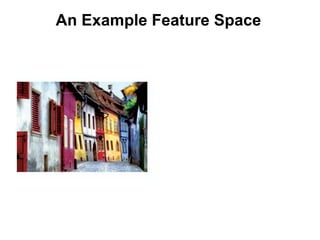
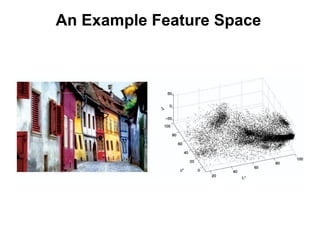
An Example Feature Space
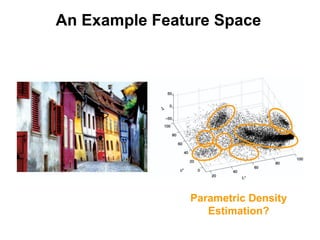
An Example Feature Space Parametric Density Estimation?
Mean Shift A non-parametric technique for analyzing complex multimodal feature spaces and estimating the stationary points (modes) of the underlying probability density function  without explicitly estimating it .
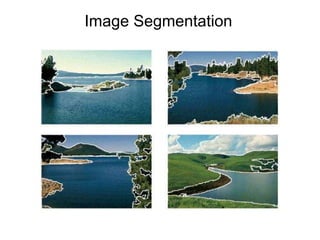
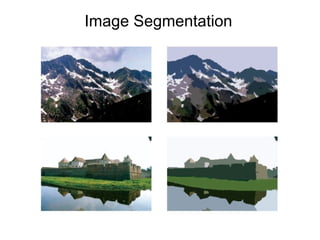
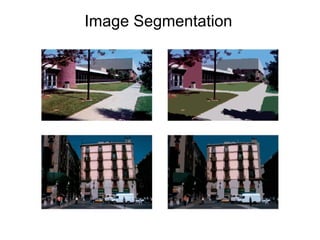
Outline Mean Shift An intuition Kernel Density Estimation Derivation Properties Applications of Mean Shift Discontinuity preserving Smoothing Image Segmentation
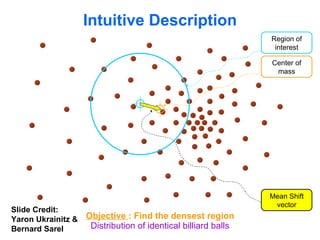
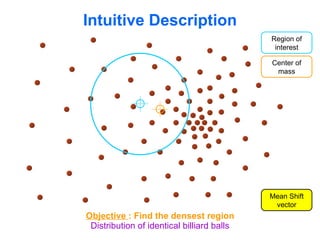
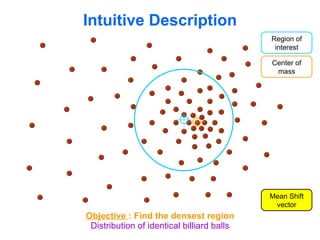
Intuitive Description Distribution of identical billiard balls Region of interest Center of mass Mean Shift vector Objective  : Find the densest region Slide Credit: Yaron Ukrainitz & Bernard Sarel
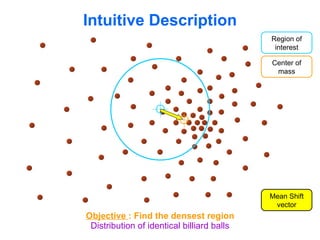
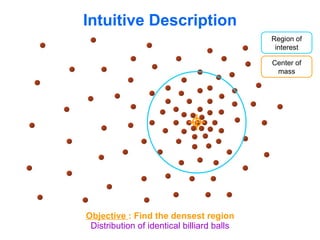
Intuitive Description Distribution of identical billiard balls Region of interest Center of mass Mean Shift vector Objective  : Find the densest region
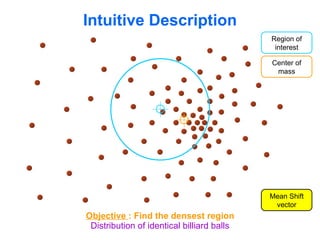
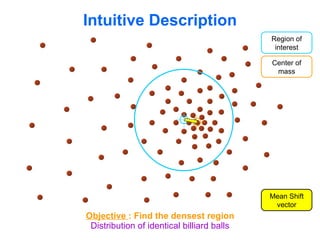
Intuitive Description Distribution of identical billiard balls Region of interest Center of mass Objective  : Find the densest region
Outline Mean Shift An intuition Kernel Density Estimation Derivation Properties Applications of Mean Shift Discontinuity preserving Smoothing Image Segmentation
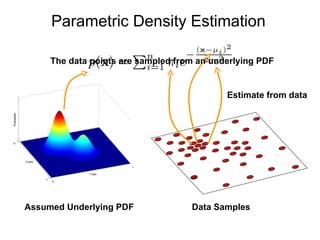
Assumed Underlying PDF Estimate from data Data Samples Parametric Density Estimation The data points are sampled from an underlying PDF
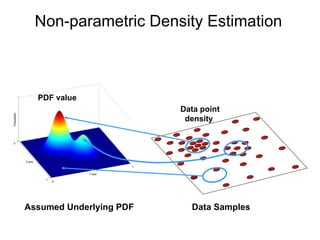
Assumed Underlying PDF Data Samples Data point density   Non-parametric Density Estimation PDF value
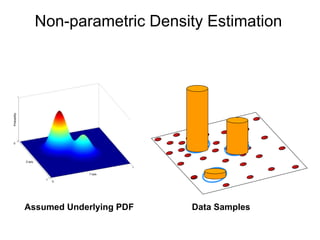
Assumed Underlying PDF Data Samples Non-parametric Density Estimation
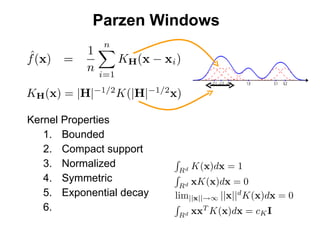
Parzen Windows  Kernel Properties Bounded Compact support Normalized Symmetric Exponential decay
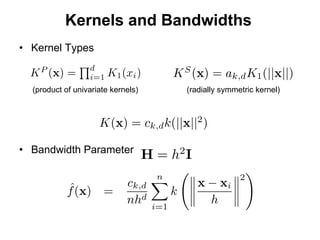
Kernels and Bandwidths Kernel Types Bandwidth Parameter (product of univariate kernels) (radially symmetric kernel)
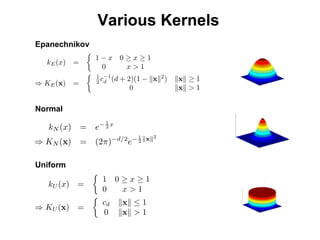
Various Kernels Epanechnikov Normal Uniform
Outline Mean Shift An intuition Kernel Density Estimation Derivation Properties Applications of Mean Shift Discontinuity preserving Smoothing Image Segmentation
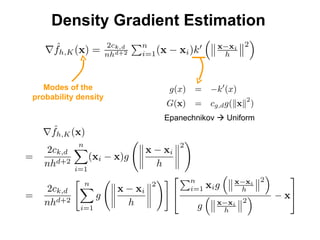
Density Gradient Estimation Epanechnikov    Uniform  Normal    Normal Modes of the probability density
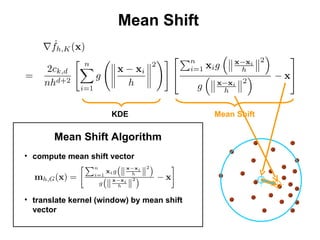
Mean Shift KDE Mean Shift Mean Shift Algorithm compute mean shift vector translate kernel (window) by mean shift vector
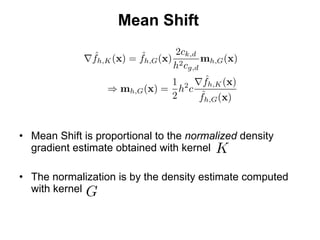
Mean Shift Mean Shift is proportional to the  normalized  density gradient estimate obtained with kernel The normalization is by the density estimate computed with kernel
Outline Mean Shift An intuition Kernel Density Estimation Derivation Properties Applications of Mean Shift Discontinuity preserving Smoothing Image Segmentation
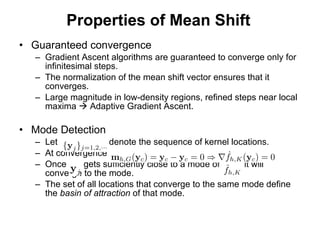
Properties of Mean Shift Guaranteed convergence Gradient Ascent algorithms are guaranteed to converge only for infinitesimal steps. The normalization of the mean shift vector ensures that it converges.  Large magnitude in low-density regions, refined steps near local maxima    Adaptive Gradient Ascent. Mode Detection Let  denote the sequence of kernel locations. At convergence Once  gets sufficiently close to a mode of  it will converge to the mode. The set of all locations that converge to the same mode define the  basin of attraction  of that mode.
Properties of Mean Shift Smooth Trajectory The angle between two consecutive mean shift vectors computed using the normal kernel is always less that 90° In practice the convergence of mean shift using the normal kernel is very slow and typically the uniform kernel is used.
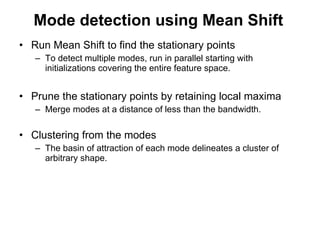
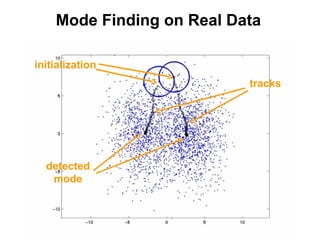
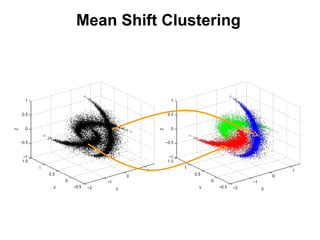
Mode detection using Mean Shift Run Mean Shift to find the stationary points To detect multiple modes, run in parallel starting with initializations covering the entire feature space. Prune the stationary points by retaining local maxima Merge modes at a distance of less than the bandwidth. Clustering from the modes The basin of attraction of each mode delineates a cluster of arbitrary shape.
Mode Finding on Real Data initialization detected mode tracks
Mean Shift Clustering
Outline Mean Shift Density Estimation What is mean shift? Derivation Properties Applications of Mean Shift Discontinuity preserving Smoothing Image Segmentation
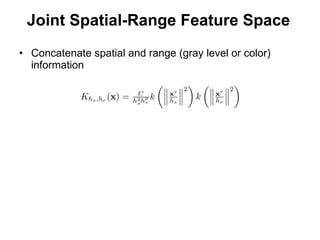
Joint Spatial-Range Feature Space Concatenate spatial and range (gray level or color) information
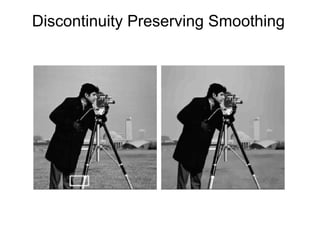
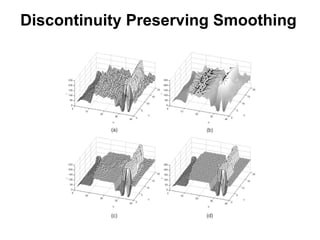
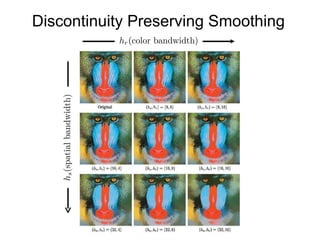
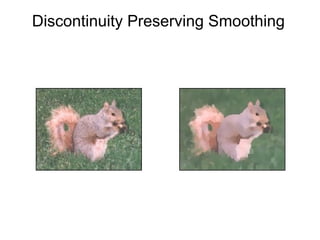
Discontinuity Preserving Smoothing
Outline Mean Shift Density Estimation What is mean shift? Derivation Properties Applications of Mean Shift Discontinuity preserving Smoothing Image Segmentation
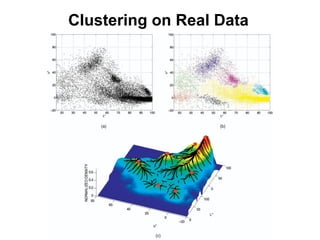
Clustering on Real Data
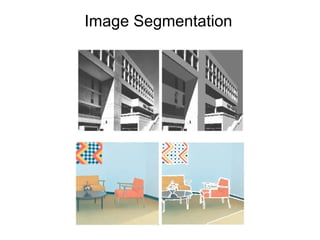
Image Segmentation
Image Segmentation
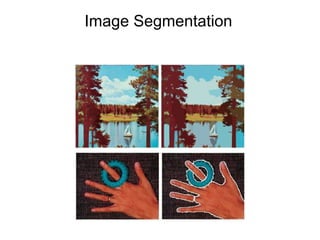
Image Segmentation
Image Segmentation
Image Segmentation
Acknowledgements Mean shift: A robust approach toward feature space analysis. D Comaniciu, P Meer  Pattern Analysis and Machine Intelligence, IEEE Transactions on , Vol. 24, No. 5. (2002), pp. 603-619. http://www.caip.rutgers.edu/riul/research/papers.html Slide credits: Yaron Ukrainitz & Bernard Sarel
Thank You

★Mean shift a_robust_approach_to_feature_space_analysis

  • 1.
    Mean Shift ARobust Approach to Feature Space Analysis Kalyan Sunkavalli 04/29/2008 ES251R
  • 2.
  • 3.
  • 4.
    An Example FeatureSpace Parametric Density Estimation?
  • 5.
    Mean Shift Anon-parametric technique for analyzing complex multimodal feature spaces and estimating the stationary points (modes) of the underlying probability density function without explicitly estimating it .
  • 6.
    Outline Mean ShiftAn intuition Kernel Density Estimation Derivation Properties Applications of Mean Shift Discontinuity preserving Smoothing Image Segmentation
  • 7.
    Outline Mean ShiftAn intuition Kernel Density Estimation Derivation Properties Applications of Mean Shift Discontinuity preserving Smoothing Image Segmentation
  • 8.
    Intuitive Description Distributionof identical billiard balls Region of interest Center of mass Mean Shift vector Objective : Find the densest region Slide Credit: Yaron Ukrainitz & Bernard Sarel
  • 9.
    Intuitive Description Distributionof identical billiard balls Region of interest Center of mass Mean Shift vector Objective : Find the densest region
  • 10.
    Intuitive Description Distributionof identical billiard balls Region of interest Center of mass Mean Shift vector Objective : Find the densest region
  • 11.
    Intuitive Description Distributionof identical billiard balls Region of interest Center of mass Mean Shift vector Objective : Find the densest region
  • 12.
    Intuitive Description Distributionof identical billiard balls Region of interest Center of mass Mean Shift vector Objective : Find the densest region
  • 13.
    Intuitive Description Distributionof identical billiard balls Region of interest Center of mass Mean Shift vector Objective : Find the densest region
  • 14.
    Intuitive Description Distributionof identical billiard balls Region of interest Center of mass Objective : Find the densest region
  • 15.
    Outline Mean ShiftAn intuition Kernel Density Estimation Derivation Properties Applications of Mean Shift Discontinuity preserving Smoothing Image Segmentation
  • 16.
    Assumed Underlying PDFEstimate from data Data Samples Parametric Density Estimation The data points are sampled from an underlying PDF
  • 17.
    Assumed Underlying PDFData Samples Data point density Non-parametric Density Estimation PDF value
  • 18.
    Assumed Underlying PDFData Samples Non-parametric Density Estimation
  • 19.
    Parzen Windows Kernel Properties Bounded Compact support Normalized Symmetric Exponential decay
  • 20.
    Kernels and BandwidthsKernel Types Bandwidth Parameter (product of univariate kernels) (radially symmetric kernel)
  • 21.
  • 22.
    Outline Mean ShiftAn intuition Kernel Density Estimation Derivation Properties Applications of Mean Shift Discontinuity preserving Smoothing Image Segmentation
  • 23.
    Density Gradient EstimationEpanechnikov  Uniform Normal  Normal Modes of the probability density
  • 24.
    Mean Shift KDEMean Shift Mean Shift Algorithm compute mean shift vector translate kernel (window) by mean shift vector
  • 25.
    Mean Shift MeanShift is proportional to the normalized density gradient estimate obtained with kernel The normalization is by the density estimate computed with kernel
  • 26.
    Outline Mean ShiftAn intuition Kernel Density Estimation Derivation Properties Applications of Mean Shift Discontinuity preserving Smoothing Image Segmentation
  • 27.
    Properties of MeanShift Guaranteed convergence Gradient Ascent algorithms are guaranteed to converge only for infinitesimal steps. The normalization of the mean shift vector ensures that it converges. Large magnitude in low-density regions, refined steps near local maxima  Adaptive Gradient Ascent. Mode Detection Let denote the sequence of kernel locations. At convergence Once gets sufficiently close to a mode of it will converge to the mode. The set of all locations that converge to the same mode define the basin of attraction of that mode.
  • 28.
    Properties of MeanShift Smooth Trajectory The angle between two consecutive mean shift vectors computed using the normal kernel is always less that 90° In practice the convergence of mean shift using the normal kernel is very slow and typically the uniform kernel is used.
  • 29.
    Mode detection usingMean Shift Run Mean Shift to find the stationary points To detect multiple modes, run in parallel starting with initializations covering the entire feature space. Prune the stationary points by retaining local maxima Merge modes at a distance of less than the bandwidth. Clustering from the modes The basin of attraction of each mode delineates a cluster of arbitrary shape.
  • 30.
    Mode Finding onReal Data initialization detected mode tracks
  • 31.
  • 32.
    Outline Mean ShiftDensity Estimation What is mean shift? Derivation Properties Applications of Mean Shift Discontinuity preserving Smoothing Image Segmentation
  • 33.
    Joint Spatial-Range FeatureSpace Concatenate spatial and range (gray level or color) information
  • 34.
  • 35.
  • 36.
  • 37.
  • 38.
    Outline Mean ShiftDensity Estimation What is mean shift? Derivation Properties Applications of Mean Shift Discontinuity preserving Smoothing Image Segmentation
  • 39.
  • 40.
  • 41.
  • 42.
  • 43.
  • 44.
  • 45.
    Acknowledgements Mean shift:A robust approach toward feature space analysis. D Comaniciu, P Meer Pattern Analysis and Machine Intelligence, IEEE Transactions on , Vol. 24, No. 5. (2002), pp. 603-619. http://www.caip.rutgers.edu/riul/research/papers.html Slide credits: Yaron Ukrainitz & Bernard Sarel
  • 46.