Mean Comparison2
Desmond Ayim-Aboagye, Ph.D.
F Ratio
F Ratio
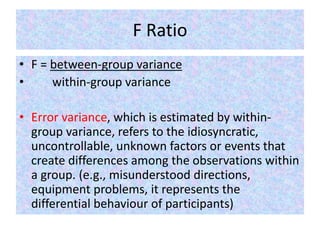
• F = between-group variance
• within-group variance
• Error variance, which is estimated by within-
group variance, refers to the idiosyncratic,
uncontrollable, unknown factors or events that
create differences among the observations within
a group. (e.g., misunderstood directions,
equipment problems, it represents the
differential behaviour of participants)
F Ratio
• When calculating an F ratio, the estimate of
within-group variance or error variance is
based on the average variance of the
observations within each sample.
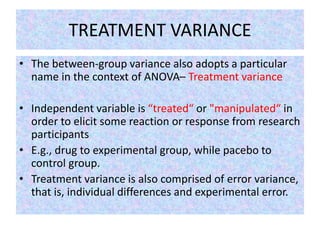
TREATMENT VARIANCE
• The between-group variance also adopts a particular
name in the context of ANOVA– Treatment variance
• Independent variable is “treated“ or "manipulated“ in
order to elicit some reaction or response from research
participants
• E.g., drug to experimental group, while pacebo to
control group.
• Treatment variance is also comprised of error variance,
that is, individual differences and experimental error.
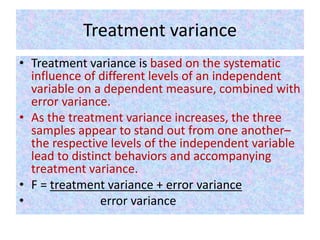
Treatment variance
• Treatment variance is based on the systematic
influence of different levels of an independent
variable on a dependent measure, combined with
error variance.
• As the treatment variance increases, the three
samples appear to stand out from one another–
the respective levels of the independent variable
lead to distinct behaviors and accompanying
treatment variance.
• F = treatment variance + error variance
• error variance
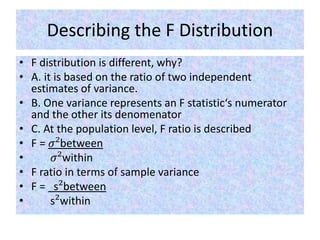
Describing the F Distribution
• F distribution is different, why?
• A. it is based on the ratio of two independent
estimates of variance.
• B. One variance represents an F statistic‘s numerator
and the other its denomenator
• C. At the population level, F ratio is described
• F = 𝜎²between
• 𝜎²within
• F ratio in terms of sample variance
• F = s²between
• s²within
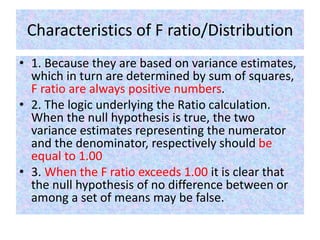
Characteristics of F ratio/Distribution
• 1. Because they are based on variance estimates,
which in turn are determined by sum of squares,
F ratio are always positive numbers.
• 2. The logic underlying the Ratio calculation.
When the null hypothesis is true, the two
variance estimates representing the numerator
and the denominator, respectively should be
equal to 1.00
• 3. When the F ratio exceeds 1.00 it is clear that
the null hypothesis of no difference between or
among a set of means may be false.
ANOVA DISTINCTIVENESS
• How does the ANOVA differ from prior
statistical tests examined? 3 ways.
• 1. It compares means
• 2. Protect against Type 1 error
• 3. Enables researchers to think about complex
causal relationships among variables.
Omnibus Test: Comparing More than
Two Means Simultaneously
• ANOVA is known as Omnibus Statistical Test
• It enables the investigator to detect significant
differences between two means or among
more than two means.
• The availability of the ANOVA as an analytic
tool invites researchers to theorize more
broadly, to tackle more complex questions
empirically.
One-Factor Analysis of Variance
• A one-way analysis of variance (one-way
ANOVA) is a statistical technique for analyzing
the variation found within the various levels of
a single independent or treatment variable. A
one-way ANOVA will compare the means of
two or more levels with one another in order
to determine if any significant difference(s)
exist(s) between or among them.
A factor analysis
• A factor is a synonym for a treatment or
independent variable within an ANOVA. To be
analytically viable, a factor must have two or
more levels within in it.
• Used example from your work
• Ambient light as Independent variable
• Aspects of behaviour as dependent measure
e.g., work productivity, books read or check
out.

Mean comparison2

  • 1.
  • 2.
    F Ratio • F= between-group variance • within-group variance • Error variance, which is estimated by within- group variance, refers to the idiosyncratic, uncontrollable, unknown factors or events that create differences among the observations within a group. (e.g., misunderstood directions, equipment problems, it represents the differential behaviour of participants)
  • 3.
    F Ratio • Whencalculating an F ratio, the estimate of within-group variance or error variance is based on the average variance of the observations within each sample.
  • 4.
    TREATMENT VARIANCE • Thebetween-group variance also adopts a particular name in the context of ANOVA– Treatment variance • Independent variable is “treated“ or "manipulated“ in order to elicit some reaction or response from research participants • E.g., drug to experimental group, while pacebo to control group. • Treatment variance is also comprised of error variance, that is, individual differences and experimental error.
  • 5.
    Treatment variance • Treatmentvariance is based on the systematic influence of different levels of an independent variable on a dependent measure, combined with error variance. • As the treatment variance increases, the three samples appear to stand out from one another– the respective levels of the independent variable lead to distinct behaviors and accompanying treatment variance. • F = treatment variance + error variance • error variance
  • 6.
    Describing the FDistribution • F distribution is different, why? • A. it is based on the ratio of two independent estimates of variance. • B. One variance represents an F statistic‘s numerator and the other its denomenator • C. At the population level, F ratio is described • F = 𝜎²between • 𝜎²within • F ratio in terms of sample variance • F = s²between • s²within
  • 7.
    Characteristics of Fratio/Distribution • 1. Because they are based on variance estimates, which in turn are determined by sum of squares, F ratio are always positive numbers. • 2. The logic underlying the Ratio calculation. When the null hypothesis is true, the two variance estimates representing the numerator and the denominator, respectively should be equal to 1.00 • 3. When the F ratio exceeds 1.00 it is clear that the null hypothesis of no difference between or among a set of means may be false.
  • 8.
    ANOVA DISTINCTIVENESS • Howdoes the ANOVA differ from prior statistical tests examined? 3 ways. • 1. It compares means • 2. Protect against Type 1 error • 3. Enables researchers to think about complex causal relationships among variables.
  • 9.
    Omnibus Test: ComparingMore than Two Means Simultaneously • ANOVA is known as Omnibus Statistical Test • It enables the investigator to detect significant differences between two means or among more than two means. • The availability of the ANOVA as an analytic tool invites researchers to theorize more broadly, to tackle more complex questions empirically.
  • 10.
    One-Factor Analysis ofVariance • A one-way analysis of variance (one-way ANOVA) is a statistical technique for analyzing the variation found within the various levels of a single independent or treatment variable. A one-way ANOVA will compare the means of two or more levels with one another in order to determine if any significant difference(s) exist(s) between or among them.
  • 11.
    A factor analysis •A factor is a synonym for a treatment or independent variable within an ANOVA. To be analytically viable, a factor must have two or more levels within in it. • Used example from your work • Ambient light as Independent variable • Aspects of behaviour as dependent measure e.g., work productivity, books read or check out.