Assessment N° 3 
MDD 4 
Gary Torres 
Professional Practicum
Standard 4: 
Evaluation Plan 
Standard: The teacher proposes an evaluation plan for monitoring students’ process of learning before, during and at the end of the unit, including methods and instruments related with the learning aims. 
Task 1: 
Diseñe un plan de evaluación que le permita recoger evidencias para monitorear el progreso de los estudiantes y determinar el nivel de logro alcanzado en cada una de las metas de aprendizaje. 
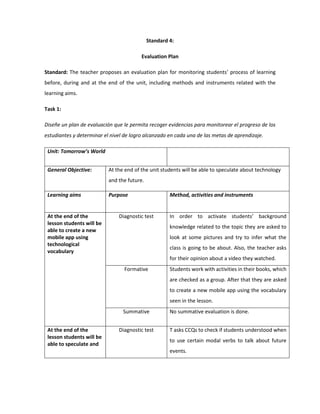
Unit: Tomorrow’s World 
General Objective: 
At the end of the unit students will be able to speculate about technology and the future. 
Learning aims 
Purpose 
Method, activities and instruments 
At the end of the lesson students will be able to create a new mobile app using technological vocabulary 
Diagnostic test 
In order to activate students’ background knowledge related to the topic they are asked to look at some pictures and try to infer what the class is going to be about. Also, the teacher asks for their opinion about a video they watched. 
Formative 
Students work with activities in their books, which are checked as a group. After that they are asked to create a new mobile app using the vocabulary seen in the lesson. 
Summative 
No summative evaluation is done. 
At the end of the lesson students will be able to speculate and 
Diagnostic test 
T asks CCQs to check if students understood when to use certain modal verbs to talk about future events.
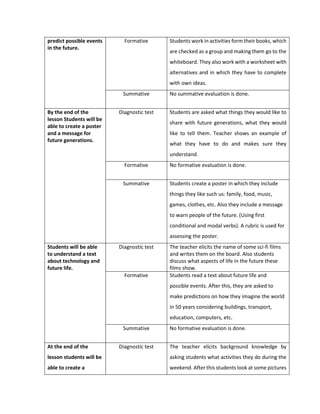
predict possible events in the future. 
Formative 
Students work in activities form their books, which are checked as a group and making them go to the whiteboard. They also work with a worksheet with alternatives and in which they have to complete with own ideas. 
Summative 
No summative evaluation is done. 
By the end of the lesson Students will be able to create a poster and a message for future generations. 
Diagnostic test 
Students are asked what things they would like to share with future generations, what they would like to tell them. Teacher shows an example of what they have to do and makes sure they understand. 
Formative 
No formative evaluation is done. 
Summative 
Students create a poster in which they include things they like such us: family, food, music, games, clothes, etc. Also they include a message to warn people of the future. (Using first conditional and modal verbs). A rubric is used for assessing the poster. 
Students will be able to understand a text about technology and future life. 
Diagnostic test 
The teacher elicits the name of some sci-fi films and writes them on the board. Also students discuss what aspects of life in the future these films show. 
Formative 
Students read a text about future life and possible events. After this, they are asked to make predictions on how they imagine the world in 50 years considering buildings, transport, education, computers, etc. 
Summative 
No formative evaluation is done. 
At the end of the lesson students will be able to create a 
Diagnostic test 
The teacher elicits background knowledge by asking students what activities they do during the weekend. After this students look at some pictures
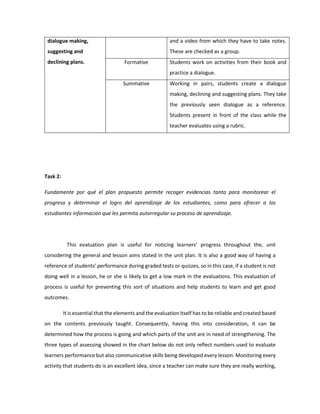
dialogue making, suggesting and declining plans. 
and a video from which they have to take notes. These are checked as a group. 
Formative 
Students work on activities from their book and practice a dialogue. 
Summative 
Working in pairs, students create a dialogue making, declining and suggesting plans. They take the previously seen dialogue as a reference. Students present in front of the class while the teacher evaluates using a rubric. 
Task 2: 
Fundamente por qué el plan propuesto permite recoger evidencias tanto para monitorear el progreso y determinar el logro del aprendizaje de los estudiantes, como para ofrecer a los estudiantes información que les permita autorregular su proceso de aprendizaje. 
This evaluation plan is useful for noticing learners’ progress throughout the, unit considering the general and lesson aims stated in the unit plan. It is also a good way of having a reference of students’ performance during graded tests or quizzes, so in this case, if a student is not doing well in a lesson, he or she is likely to get a low mark in the evaluations. This evaluation of process is useful for preventing this sort of situations and help students to learn and get good outcomes. 
It is essential that the elements and the evaluation itself has to be reliable and created based on the contents previously taught. Consequently, having this into consideration, it can be determined how the process is going and which parts of the unit are in need of strengthening. The three types of assessing showed in the chart below do not only reflect numbers used to evaluate learners performance but also communicative skills being developed every lesson. Monitoring every activity that students do is an excellent idea, since a teacher can make sure they are really working,
clarify doubts and also help them with pronunciation, spelling or meaning. Besides, group checking is useful since students can correct their mistakes easily and without uncomfortable situations such as in those where they have to speak aloud or in front of the entire class. However, this does not mean that they are never going to experience this. 
Getting to know what students already know about topics related to the lesson has always been a good way of starting, here students can relate concepts which they know with new information. Moreover, the use of contextualisation makes it better for them, since they can relate what they are learning to what they are living. In this way it becomes easier to recall that information whenever they want. 
Rubrics are an important tool for assessing students’ work. They have a clear layout and as longs as it is related to the aim of the lesson, they are a reliable way of evaluating different features of the same work. However, it is recommendable to make sure learners know what is going to be assessed from posters, dialogues or letters, otherwise they may focus on features that are not thought to be considered in the work, which is what commonly happens. 
Task 3: 
Reflexione en torno a las características de los estudiantes que pueden impactar la efectividad del plan de evaluación. 
One drawback of this evaluation plan is the fact that students and teachers are obsessed with marks. Sometimes when learners are asked to do some activities, they ask if they are going to be graded for doing that, if they will get a mark or an extra point for that. Also, teachers have a certain amount of marks they need to have at the end of the semester, so they usually are in a hurry when the semester is coming to an end. In these cases, formative evaluations are left overshadowed making students extremely interested in marks and motivating them only in exchange of a mark.

Mdd 4

  • 1.
    Assessment N° 3 MDD 4 Gary Torres Professional Practicum
  • 2.
    Standard 4: EvaluationPlan Standard: The teacher proposes an evaluation plan for monitoring students’ process of learning before, during and at the end of the unit, including methods and instruments related with the learning aims. Task 1: Diseñe un plan de evaluación que le permita recoger evidencias para monitorear el progreso de los estudiantes y determinar el nivel de logro alcanzado en cada una de las metas de aprendizaje. Unit: Tomorrow’s World General Objective: At the end of the unit students will be able to speculate about technology and the future. Learning aims Purpose Method, activities and instruments At the end of the lesson students will be able to create a new mobile app using technological vocabulary Diagnostic test In order to activate students’ background knowledge related to the topic they are asked to look at some pictures and try to infer what the class is going to be about. Also, the teacher asks for their opinion about a video they watched. Formative Students work with activities in their books, which are checked as a group. After that they are asked to create a new mobile app using the vocabulary seen in the lesson. Summative No summative evaluation is done. At the end of the lesson students will be able to speculate and Diagnostic test T asks CCQs to check if students understood when to use certain modal verbs to talk about future events.
  • 3.
    predict possible eventsin the future. Formative Students work in activities form their books, which are checked as a group and making them go to the whiteboard. They also work with a worksheet with alternatives and in which they have to complete with own ideas. Summative No summative evaluation is done. By the end of the lesson Students will be able to create a poster and a message for future generations. Diagnostic test Students are asked what things they would like to share with future generations, what they would like to tell them. Teacher shows an example of what they have to do and makes sure they understand. Formative No formative evaluation is done. Summative Students create a poster in which they include things they like such us: family, food, music, games, clothes, etc. Also they include a message to warn people of the future. (Using first conditional and modal verbs). A rubric is used for assessing the poster. Students will be able to understand a text about technology and future life. Diagnostic test The teacher elicits the name of some sci-fi films and writes them on the board. Also students discuss what aspects of life in the future these films show. Formative Students read a text about future life and possible events. After this, they are asked to make predictions on how they imagine the world in 50 years considering buildings, transport, education, computers, etc. Summative No formative evaluation is done. At the end of the lesson students will be able to create a Diagnostic test The teacher elicits background knowledge by asking students what activities they do during the weekend. After this students look at some pictures
  • 4.
    dialogue making, suggestingand declining plans. and a video from which they have to take notes. These are checked as a group. Formative Students work on activities from their book and practice a dialogue. Summative Working in pairs, students create a dialogue making, declining and suggesting plans. They take the previously seen dialogue as a reference. Students present in front of the class while the teacher evaluates using a rubric. Task 2: Fundamente por qué el plan propuesto permite recoger evidencias tanto para monitorear el progreso y determinar el logro del aprendizaje de los estudiantes, como para ofrecer a los estudiantes información que les permita autorregular su proceso de aprendizaje. This evaluation plan is useful for noticing learners’ progress throughout the, unit considering the general and lesson aims stated in the unit plan. It is also a good way of having a reference of students’ performance during graded tests or quizzes, so in this case, if a student is not doing well in a lesson, he or she is likely to get a low mark in the evaluations. This evaluation of process is useful for preventing this sort of situations and help students to learn and get good outcomes. It is essential that the elements and the evaluation itself has to be reliable and created based on the contents previously taught. Consequently, having this into consideration, it can be determined how the process is going and which parts of the unit are in need of strengthening. The three types of assessing showed in the chart below do not only reflect numbers used to evaluate learners performance but also communicative skills being developed every lesson. Monitoring every activity that students do is an excellent idea, since a teacher can make sure they are really working,
  • 5.
    clarify doubts andalso help them with pronunciation, spelling or meaning. Besides, group checking is useful since students can correct their mistakes easily and without uncomfortable situations such as in those where they have to speak aloud or in front of the entire class. However, this does not mean that they are never going to experience this. Getting to know what students already know about topics related to the lesson has always been a good way of starting, here students can relate concepts which they know with new information. Moreover, the use of contextualisation makes it better for them, since they can relate what they are learning to what they are living. In this way it becomes easier to recall that information whenever they want. Rubrics are an important tool for assessing students’ work. They have a clear layout and as longs as it is related to the aim of the lesson, they are a reliable way of evaluating different features of the same work. However, it is recommendable to make sure learners know what is going to be assessed from posters, dialogues or letters, otherwise they may focus on features that are not thought to be considered in the work, which is what commonly happens. Task 3: Reflexione en torno a las características de los estudiantes que pueden impactar la efectividad del plan de evaluación. One drawback of this evaluation plan is the fact that students and teachers are obsessed with marks. Sometimes when learners are asked to do some activities, they ask if they are going to be graded for doing that, if they will get a mark or an extra point for that. Also, teachers have a certain amount of marks they need to have at the end of the semester, so they usually are in a hurry when the semester is coming to an end. In these cases, formative evaluations are left overshadowed making students extremely interested in marks and motivating them only in exchange of a mark.