Lesson planning
Today’s activities Follow up on  e-lesson on lesson planning Factors to consider when planning Components of lesson planning “ Think-pair-share” critique of a lesson plan Start discussing demo projects; include a lesson plan
Recap Dimensions of meaningful learning Learn by doing/participating/experiencing  Engage students’ prior knowledge Self-directed learning Use of real world contexts Collaborative learning
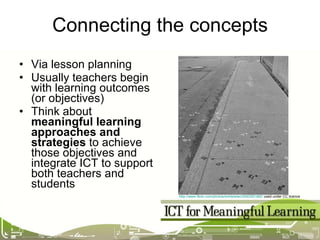
Connecting the concepts Via lesson planning Usually teachers begin with learning outcomes (or objectives) Think about  meaningful learning approaches and strategies  to achieve those objectives and integrate ICT to support both teachers and students http://www.flickr.com/photos/emilybean/2540261482/  used under CC licence
Some points to note when writing objectives
Considerations Acceptable : The P5 student will be able to label all the continents of the world on an unlabelled map Unacceptable: The English teacher will present a video on the world’s continents Objectives should be stated from an INDIVIDUAL LEARNER'S point of view,  NOT   the teacher’s
Considerations Acceptable: The algebra student will be able to use the quadratic formula to correctly solve 8 of 10 second-degree polynomial equations in a paper & pencil test Unacceptable: At the end of instruction, the pupil will have successfully completed 10 mathematics homework questions Objectives should state what knowledge, skills, or attitudes a learner should have attained by the END of instruction,  NOT  the activities or lessons which occurred  DURING the instruction
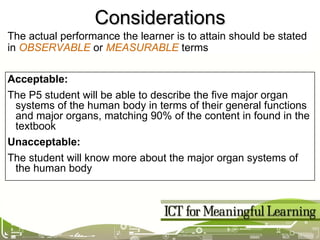
Considerations Acceptable: The P5 student will be able to describe the five major organ systems of the human body in terms of their general functions and major organs, matching 90% of the content in found in the textbook Unacceptable: The student will know more about the major organ systems of the human body The actual performance the learner is to attain should be stated in  OBSERVABLE  or  MEASURABLE  terms
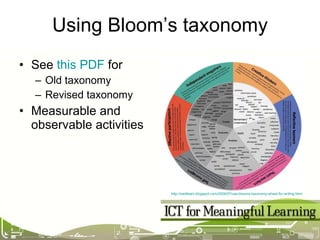
Using Bloom’s taxonomy See  this PDF  for Old taxonomy Revised taxonomy Measurable and observable activities http://zaidlearn.blogspot.com/2009/07/use-blooms-taxonomy-wheel-for-writing.html
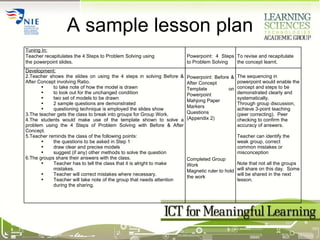
A sample lesson plan Tuning In: Teacher recapitulates the 4 Steps to Problem Solving using the powerpoint slides. Powerpoint: 4 Steps to Problem Solving To revise and recapitulate the concept learnt. Development: Teacher shows the slides on using the 4 steps in solving Before & After Concept involving Ratio. to take note of how the model is drawn to look out for the unchanged condition two set of models to be drawn 2 sample questions are demonstrated questioning technique is employed the slides show The teacher gets the class to break into groups for Group Work. The students would make use of the template shown to solve a problem using the 4 Steps of Problem Solving with Before & After Concept. Teacher reminds the class of the following points: the questions to be asked in Step 1 draw clear and precise models suggest (if any) other methods to solve the question The groups share their answers with the class. Teacher has to tell the class that it is alright to make mistakes. Teacher will correct mistakes where necessary. Teacher will take note of the group that needs attention during the sharing. Powerpoint: Before & After Concept Template on Powerpoint Mahjong Paper Markers Questions (Appendix 2) Completed Group Work Magnetic ruler to hold the work The sequencing in powerpoint would enable the concept and steps to be demonstrated clearly and systematically. Through group discussion, achieve 3-point teaching (peer correcting).  Peer  checking to confirm the accuracy of answers.  Teacher can identify the weak group, correct common mistakes or misconception   Note that not all the groups will share on this day.  Some will be shared in the next lesson.
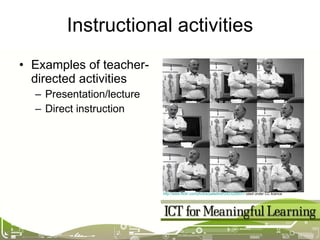
Instructional activities Examples of teacher-directed activities Presentation/lecture Direct instruction http://www.flickr.com/photos/paladinsf/2423226031/  used under CC licence
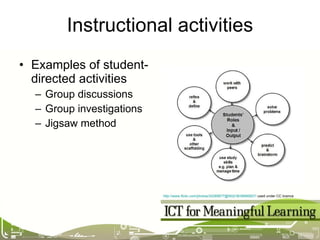
Instructional activities Examples of student-directed activities Group discussions Group investigations Jigsaw method http://www.flickr.com/photos/24289877@N02/3638995827/  used under CC licence
Activity 1: Critique lesson plan Pair up with someone with the same CS and exchange the lesson plans you brought Use  the template provided  and analyse the lesson In your blog, share your opinions and reflections using the 3-2-1 strategy: 3  “things that I have learnt” from the process 2  “things that I can apply” 1  “thing that I want to know more about”
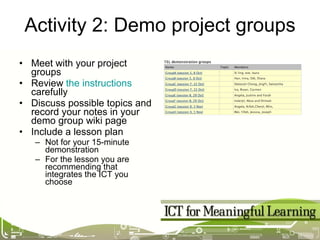
Activity 2: Demo project groups Meet with your project groups Review  the instructions  carefully Discuss possible topics and record your notes in your demo group wiki page Include a lesson plan Not for your 15-minute demonstration For the lesson you are recommending that integrates the ICT you choose
References Chai, C. S., Wang, Q. (Eds.) (2010). ICT for  Self-directed learning and Collaborative learning.   Singapore: Prentice Hall . Chapter 6. Divaharan, S. & Choy, D. (2007). Designing and facilitating student-centred learning. In Quek, C.L., Wong, A.F.L. & Tay, M.Y. (Eds.),  Engaging and managing learners: Practitioners perspectives.  (pp. 135-150). Singapore: Pearson:Prentice-Hall.
References Wong, A.F.L., & Divaharan, S. (2007). Delivering and managing whole class teaching. In Quek, C. L., Wong, A.F.L., & Tay, M. Y. (Eds.),  Engaging and managing learners: Practitioners' perspectives  (pp. 83-104). Singapore: Pearson: Prentice-Hall.  Wong, H. K. & Wong, R. T. (1998).  The first days of school .  Singapore: Harry K. Wong publications Arends, R. I. (2004).  Learning to teach . (6th Ed.). New York: McGraw-Hill
Next phase of the course TELs: Technology-Enabled Learning From Session 5 to Session 10, we will be exploring more ICTs to enable meaningful learning activities You and I teach the course!  We meet in the  MxL  next week (NIE5-01-06) Reminder: Your Individual Assignment is due in Session 6

Session04 ICT for Meaningful Learning (Lesson Planning)

  • 1.
  • 2.
    Today’s activities Followup on e-lesson on lesson planning Factors to consider when planning Components of lesson planning “ Think-pair-share” critique of a lesson plan Start discussing demo projects; include a lesson plan
  • 3.
    Recap Dimensions ofmeaningful learning Learn by doing/participating/experiencing Engage students’ prior knowledge Self-directed learning Use of real world contexts Collaborative learning
  • 4.
    Connecting the conceptsVia lesson planning Usually teachers begin with learning outcomes (or objectives) Think about meaningful learning approaches and strategies to achieve those objectives and integrate ICT to support both teachers and students http://www.flickr.com/photos/emilybean/2540261482/ used under CC licence
  • 5.
    Some points tonote when writing objectives
  • 6.
    Considerations Acceptable :The P5 student will be able to label all the continents of the world on an unlabelled map Unacceptable: The English teacher will present a video on the world’s continents Objectives should be stated from an INDIVIDUAL LEARNER'S point of view, NOT the teacher’s
  • 7.
    Considerations Acceptable: Thealgebra student will be able to use the quadratic formula to correctly solve 8 of 10 second-degree polynomial equations in a paper & pencil test Unacceptable: At the end of instruction, the pupil will have successfully completed 10 mathematics homework questions Objectives should state what knowledge, skills, or attitudes a learner should have attained by the END of instruction, NOT the activities or lessons which occurred DURING the instruction
  • 8.
    Considerations Acceptable: TheP5 student will be able to describe the five major organ systems of the human body in terms of their general functions and major organs, matching 90% of the content in found in the textbook Unacceptable: The student will know more about the major organ systems of the human body The actual performance the learner is to attain should be stated in OBSERVABLE or MEASURABLE terms
  • 9.
    Using Bloom’s taxonomySee this PDF for Old taxonomy Revised taxonomy Measurable and observable activities http://zaidlearn.blogspot.com/2009/07/use-blooms-taxonomy-wheel-for-writing.html
  • 10.
    A sample lessonplan Tuning In: Teacher recapitulates the 4 Steps to Problem Solving using the powerpoint slides. Powerpoint: 4 Steps to Problem Solving To revise and recapitulate the concept learnt. Development: Teacher shows the slides on using the 4 steps in solving Before & After Concept involving Ratio. to take note of how the model is drawn to look out for the unchanged condition two set of models to be drawn 2 sample questions are demonstrated questioning technique is employed the slides show The teacher gets the class to break into groups for Group Work. The students would make use of the template shown to solve a problem using the 4 Steps of Problem Solving with Before & After Concept. Teacher reminds the class of the following points: the questions to be asked in Step 1 draw clear and precise models suggest (if any) other methods to solve the question The groups share their answers with the class. Teacher has to tell the class that it is alright to make mistakes. Teacher will correct mistakes where necessary. Teacher will take note of the group that needs attention during the sharing. Powerpoint: Before & After Concept Template on Powerpoint Mahjong Paper Markers Questions (Appendix 2) Completed Group Work Magnetic ruler to hold the work The sequencing in powerpoint would enable the concept and steps to be demonstrated clearly and systematically. Through group discussion, achieve 3-point teaching (peer correcting). Peer checking to confirm the accuracy of answers. Teacher can identify the weak group, correct common mistakes or misconception   Note that not all the groups will share on this day. Some will be shared in the next lesson.
  • 11.
    Instructional activities Examplesof teacher-directed activities Presentation/lecture Direct instruction http://www.flickr.com/photos/paladinsf/2423226031/ used under CC licence
  • 12.
    Instructional activities Examplesof student-directed activities Group discussions Group investigations Jigsaw method http://www.flickr.com/photos/24289877@N02/3638995827/ used under CC licence
  • 13.
    Activity 1: Critiquelesson plan Pair up with someone with the same CS and exchange the lesson plans you brought Use the template provided and analyse the lesson In your blog, share your opinions and reflections using the 3-2-1 strategy: 3 “things that I have learnt” from the process 2 “things that I can apply” 1 “thing that I want to know more about”
  • 14.
    Activity 2: Demoproject groups Meet with your project groups Review the instructions carefully Discuss possible topics and record your notes in your demo group wiki page Include a lesson plan Not for your 15-minute demonstration For the lesson you are recommending that integrates the ICT you choose
  • 15.
    References Chai, C.S., Wang, Q. (Eds.) (2010). ICT for Self-directed learning and Collaborative learning. Singapore: Prentice Hall . Chapter 6. Divaharan, S. & Choy, D. (2007). Designing and facilitating student-centred learning. In Quek, C.L., Wong, A.F.L. & Tay, M.Y. (Eds.), Engaging and managing learners: Practitioners perspectives. (pp. 135-150). Singapore: Pearson:Prentice-Hall.
  • 16.
    References Wong, A.F.L.,& Divaharan, S. (2007). Delivering and managing whole class teaching. In Quek, C. L., Wong, A.F.L., & Tay, M. Y. (Eds.), Engaging and managing learners: Practitioners' perspectives (pp. 83-104). Singapore: Pearson: Prentice-Hall. Wong, H. K. & Wong, R. T. (1998). The first days of school . Singapore: Harry K. Wong publications Arends, R. I. (2004). Learning to teach . (6th Ed.). New York: McGraw-Hill
  • 17.
    Next phase ofthe course TELs: Technology-Enabled Learning From Session 5 to Session 10, we will be exploring more ICTs to enable meaningful learning activities You and I teach the course! We meet in the MxL next week (NIE5-01-06) Reminder: Your Individual Assignment is due in Session 6

Editor's Notes

  • #7 (It is not important what the teacher does. It’s what the student does that matters.)
  • #8 (What skills did the learner attain in this example? Impossible to tell! A test score by itself or the completion of instructional units tells us nothing about what the student actually learned !)
  • #9 (In this example, it is difficult to have an idea what to look for to know if the student has learned the content. The main focus should be to see an actual application task included in the objective)