Assessment N° 4 
MDD 5 
Gary Torres 
Professional Practicum
STANDARD 5 
Decision taking and analysis of results 
Standard: The teacher makes changes to the lesson planning taking decisions and considering students’ learning results and communicates the analysis and conclusions about the effectiveness of teaching. 
Task 1 
Describa las modificaciones que realizó a la planificación de la unidad durante el proceso de enseñanza-aprendizaje, explique qué lo llevó a realizar dichos cambio y evalúe la eficacia de estas modificaciones. 
Subject: English 
Group: 2 M B 
Lesson 1 
Aim: At the end of the lesson students will be able to create a new mobile app using technological vocabulary. 
The changes made in this lesson were mainly because of time. In the last activity, in which students had to create and present a new mobile app, there was not enough time for every group to present in front of the class. Also, some students and the teacher started making questions about certain apps, generating a chain of opinions and extending the presentation time from 15 minutes to more than 30 minutes. Consequently, almost half of the class had to present the following lesson. This decision was alright, since students did not feel under pressure because of time, so they had a considerable amount of time to present and answer questions. 
Lesson 2 
Aim: By the end of the lesson Students will be able to create a poster and a message for future generations. 
Similar to lesson 1, in this lesson there were time issues. Supposedly, students had one lesson to prepare and present their posters, however the process of making the posters took almost the entire lesson. The students asked lots of questions which the teacher answered immediately, the instructions were repeated twice and a sample poster was showed o students had a clear idea of what they had to do. Because of the previous reasons is why the teacher let the entire lesson to prepare the poster, and the following lesson to present. This change was good since learners had a considerable amount of work to do, which included looking for pictures, writing the message and putting everything together, so they could prepare the posters and themselves to present it, obtaining then excellent results.
Task 2 
Analice, sintetice y comunique los logros de aprendizaje obtenidos por sus estudiantes. 
Goals assessed in lesson 1 
At the end of the lesson students will be able to create a new mobile app using technological vocabulary. 
Instruments: rubric 
Type of evaluation: summative 
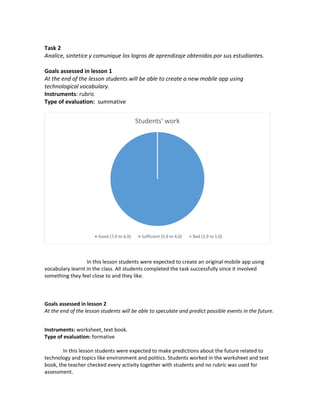
In this lesson students were expected to create an original mobile app using vocabulary learnt in the class. All students completed the task successfully since it involved something they feel close to and they like. 
Goals assessed in lesson 2 
At the end of the lesson students will be able to speculate and predict possible events in the future. 
Instruments: worksheet, text book. 
Type of evaluation: formative 
In this lesson students were expected to make predictions about the future related to technology and topics like environment and politics. Students worked in the worksheet and text book, the teacher checked every activity together with students and no rubric was used for assessment. 
Students' work 
Good (7,0 to 6,0) 
Sufficient (5,9 to 4,0) 
Bad (3,9 to 1,0)
Goals assessed in lesson 3 
By the end of the lesson Students will be able to create a poster and a message for future generations. 
Instruments: rubric 
Type of evaluation: summative 
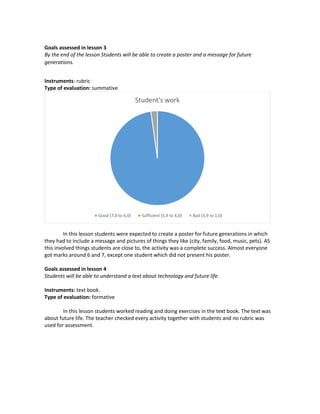
In this lesson students were expected to create a poster for future generations in which they had to include a message and pictures of things they like (city, family, food, music, pets). AS this involved things students are close to, the activity was a complete success. Almost everyone got marks around 6 and 7, except one student which did not present his poster. 
Goals assessed in lesson 4 
Students will be able to understand a text about technology and future life. 
Instruments: text book. 
Type of evaluation: formative 
In this lesson students worked reading and doing exercises in the text book. The text was about future life. The teacher checked every activity together with students and no rubric was used for assessment. 
Student's work 
Good (7,0 to 6,0) 
Sufficient (5,9 to 4,0) 
Bad (3,9 to 1,0)
Goals assessed in lesson 5 
At the end of the lesson students will be able to create a dialogue making, suggesting and declining plans. 
Instruments: rubric 
Type of evaluation: summative 
Criteria 
4 
3 
2 
1 
Memorisation 
Memorisation of the complete dialogue. 
Memorisation of most parts of the dialogue. 
Memorisation of some parts of the dialogue. 
No memorisation of the dialogue. 
Intonation 
Use of a good intonation according to what is being expressed during the whole dialogue. 
Use of a good intonation according to what is being expressed most of the time during the dialogue 
Use of a good intonation according to what is being expressed occasionally. 
Their intonation is not according to what is being expressed. 
Fluency 
Capable of expressing themselves naturally and without unnecessary pauses. 
Capable of expressing themselves 
naturally but a few pauses are made. 
Students speak slowly and with unnecessary pauses. 
There is no fluency and there are multiple pauses. 
Pronunciation 
Students speak clearly and with a good pronunciation during the entire dialogue. 
Students speak clearly and with a good pronunciation in most parts of the dialogue. 
Students speak clearly and with a good pronunciation occasionally. 
Their pronunciation is difficult to understand. 
Students' performance 
Good (7,0 to 6,0) 
Sufficient (5,9 to 4,0) 
Bad (3,9 to 1,0)
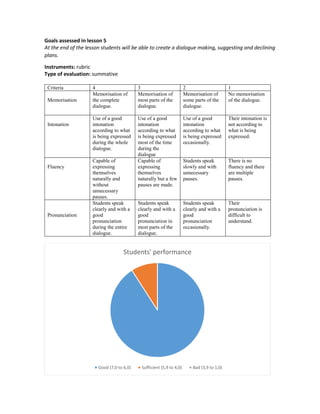
In this lesson students had to create a dialogue talking about future plans. They had to make, suggest and decline invitations. 91% of students did a very good work, except a few which did not do a complete dialogue or had problems with memorisation and fluency. (9%) 
Goals assessed in lesson 6 
Instruments: Written test 
Type of evaluation: summative 
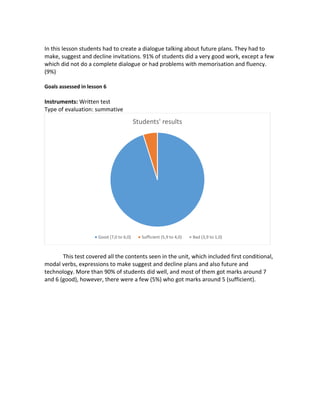
This test covered all the contents seen in the unit, which included first conditional, modal verbs, expressions to make suggest and decline plans and also future and technology. More than 90% of students did well, and most of them got marks around 7 and 6 (good), however, there were a few (5%) who got marks around 5 (sufficient). 
Students' results 
Good (7,0 to 6,0) 
Sufficient (5,9 to 4,0) 
Bad (3,9 to 1,0)
Task 3 
Evalúe la efectividad de su enseñanza en los logros de aprendizaje de todos sus estudiantes. A la luz de los resultados de las evaluaciones, juzgue qué tan efectivos fueron los planes diseñados (metas de aprendizaje, planes de clases y plan de evaluación) y las modificaciones a la planificación durante el desarrollo de la unidad. 
As always, expectations are not necessarily the reality that we face in the classroom. Teachers are often making changes and, in my case, I had to make a few. Time was always an issue for me since it is difficult, at the beginning, to set a certain amount of time for certain activities, but with time and experience in the classroom I think I have managed to set my own times. However, students sometimes take longer than expected on doing activities, and it becomes more when the activity involves the use of materials like colour papers, scissors, glue as a poster, magazine or some presentations require. In this case, giving the entire class to prepare the poster was good because it helped them to clarify doubts, ask questions related to grammar and spelling and also to produce something which I consider more complete than a ‘’one-class’’ work. 
At the end of the unit students felt good with the marks they got, and this was very important for me because I did not want my students to get bad marks. For this reason it is relevant to remark that some extra points given lessons before were taken into account for grading the test. Fortunately, the results obtained in the activities and tests made were mostly excellent, since the group has a really good level of English it was challenging to make activities to which they could engage without getting bored or distracted, focusing on communicative functions. Moreover, their productive skills are so well developed that sometimes it was difficult to have them busy with activities. For this reason I think my lesson plans were good, but sometimes a little boring, as it was the case of my lesson to teach reported speech (not included in this unit) which was too grammar focused and not as communicative as I would have liked. For assessing I used mostly rubrics and I think that was a really good way of evaluating the kind of activities I prepared, such as dialogues, posters, magazines and every activity which implied a product. I believe if the teacher knows what he has to evaluate and actually gets to consider these features in the rubric, the process of assessment will be accurate and precise. 
It is important to note that one of the major factors which influences student’s performance is the change of teachers, since my guide teacher has a specific way of teaching which students were used to, and then I have a different, yet in development, style of teaching which students were not used to, this is way there were a few variants in marks of some students, but most of learners were quickly in getting used to my way of teaching, and despite this seemed to be an issue for me when I was in high school, it was not for this group.

Mdd 5

  • 1.
    Assessment N° 4 MDD 5 Gary Torres Professional Practicum
  • 2.
    STANDARD 5 Decisiontaking and analysis of results Standard: The teacher makes changes to the lesson planning taking decisions and considering students’ learning results and communicates the analysis and conclusions about the effectiveness of teaching. Task 1 Describa las modificaciones que realizó a la planificación de la unidad durante el proceso de enseñanza-aprendizaje, explique qué lo llevó a realizar dichos cambio y evalúe la eficacia de estas modificaciones. Subject: English Group: 2 M B Lesson 1 Aim: At the end of the lesson students will be able to create a new mobile app using technological vocabulary. The changes made in this lesson were mainly because of time. In the last activity, in which students had to create and present a new mobile app, there was not enough time for every group to present in front of the class. Also, some students and the teacher started making questions about certain apps, generating a chain of opinions and extending the presentation time from 15 minutes to more than 30 minutes. Consequently, almost half of the class had to present the following lesson. This decision was alright, since students did not feel under pressure because of time, so they had a considerable amount of time to present and answer questions. Lesson 2 Aim: By the end of the lesson Students will be able to create a poster and a message for future generations. Similar to lesson 1, in this lesson there were time issues. Supposedly, students had one lesson to prepare and present their posters, however the process of making the posters took almost the entire lesson. The students asked lots of questions which the teacher answered immediately, the instructions were repeated twice and a sample poster was showed o students had a clear idea of what they had to do. Because of the previous reasons is why the teacher let the entire lesson to prepare the poster, and the following lesson to present. This change was good since learners had a considerable amount of work to do, which included looking for pictures, writing the message and putting everything together, so they could prepare the posters and themselves to present it, obtaining then excellent results.
  • 3.
    Task 2 Analice,sintetice y comunique los logros de aprendizaje obtenidos por sus estudiantes. Goals assessed in lesson 1 At the end of the lesson students will be able to create a new mobile app using technological vocabulary. Instruments: rubric Type of evaluation: summative In this lesson students were expected to create an original mobile app using vocabulary learnt in the class. All students completed the task successfully since it involved something they feel close to and they like. Goals assessed in lesson 2 At the end of the lesson students will be able to speculate and predict possible events in the future. Instruments: worksheet, text book. Type of evaluation: formative In this lesson students were expected to make predictions about the future related to technology and topics like environment and politics. Students worked in the worksheet and text book, the teacher checked every activity together with students and no rubric was used for assessment. Students' work Good (7,0 to 6,0) Sufficient (5,9 to 4,0) Bad (3,9 to 1,0)
  • 4.
    Goals assessed inlesson 3 By the end of the lesson Students will be able to create a poster and a message for future generations. Instruments: rubric Type of evaluation: summative In this lesson students were expected to create a poster for future generations in which they had to include a message and pictures of things they like (city, family, food, music, pets). AS this involved things students are close to, the activity was a complete success. Almost everyone got marks around 6 and 7, except one student which did not present his poster. Goals assessed in lesson 4 Students will be able to understand a text about technology and future life. Instruments: text book. Type of evaluation: formative In this lesson students worked reading and doing exercises in the text book. The text was about future life. The teacher checked every activity together with students and no rubric was used for assessment. Student's work Good (7,0 to 6,0) Sufficient (5,9 to 4,0) Bad (3,9 to 1,0)
  • 5.
    Goals assessed inlesson 5 At the end of the lesson students will be able to create a dialogue making, suggesting and declining plans. Instruments: rubric Type of evaluation: summative Criteria 4 3 2 1 Memorisation Memorisation of the complete dialogue. Memorisation of most parts of the dialogue. Memorisation of some parts of the dialogue. No memorisation of the dialogue. Intonation Use of a good intonation according to what is being expressed during the whole dialogue. Use of a good intonation according to what is being expressed most of the time during the dialogue Use of a good intonation according to what is being expressed occasionally. Their intonation is not according to what is being expressed. Fluency Capable of expressing themselves naturally and without unnecessary pauses. Capable of expressing themselves naturally but a few pauses are made. Students speak slowly and with unnecessary pauses. There is no fluency and there are multiple pauses. Pronunciation Students speak clearly and with a good pronunciation during the entire dialogue. Students speak clearly and with a good pronunciation in most parts of the dialogue. Students speak clearly and with a good pronunciation occasionally. Their pronunciation is difficult to understand. Students' performance Good (7,0 to 6,0) Sufficient (5,9 to 4,0) Bad (3,9 to 1,0)
  • 6.
    In this lessonstudents had to create a dialogue talking about future plans. They had to make, suggest and decline invitations. 91% of students did a very good work, except a few which did not do a complete dialogue or had problems with memorisation and fluency. (9%) Goals assessed in lesson 6 Instruments: Written test Type of evaluation: summative This test covered all the contents seen in the unit, which included first conditional, modal verbs, expressions to make suggest and decline plans and also future and technology. More than 90% of students did well, and most of them got marks around 7 and 6 (good), however, there were a few (5%) who got marks around 5 (sufficient). Students' results Good (7,0 to 6,0) Sufficient (5,9 to 4,0) Bad (3,9 to 1,0)
  • 7.
    Task 3 Evalúela efectividad de su enseñanza en los logros de aprendizaje de todos sus estudiantes. A la luz de los resultados de las evaluaciones, juzgue qué tan efectivos fueron los planes diseñados (metas de aprendizaje, planes de clases y plan de evaluación) y las modificaciones a la planificación durante el desarrollo de la unidad. As always, expectations are not necessarily the reality that we face in the classroom. Teachers are often making changes and, in my case, I had to make a few. Time was always an issue for me since it is difficult, at the beginning, to set a certain amount of time for certain activities, but with time and experience in the classroom I think I have managed to set my own times. However, students sometimes take longer than expected on doing activities, and it becomes more when the activity involves the use of materials like colour papers, scissors, glue as a poster, magazine or some presentations require. In this case, giving the entire class to prepare the poster was good because it helped them to clarify doubts, ask questions related to grammar and spelling and also to produce something which I consider more complete than a ‘’one-class’’ work. At the end of the unit students felt good with the marks they got, and this was very important for me because I did not want my students to get bad marks. For this reason it is relevant to remark that some extra points given lessons before were taken into account for grading the test. Fortunately, the results obtained in the activities and tests made were mostly excellent, since the group has a really good level of English it was challenging to make activities to which they could engage without getting bored or distracted, focusing on communicative functions. Moreover, their productive skills are so well developed that sometimes it was difficult to have them busy with activities. For this reason I think my lesson plans were good, but sometimes a little boring, as it was the case of my lesson to teach reported speech (not included in this unit) which was too grammar focused and not as communicative as I would have liked. For assessing I used mostly rubrics and I think that was a really good way of evaluating the kind of activities I prepared, such as dialogues, posters, magazines and every activity which implied a product. I believe if the teacher knows what he has to evaluate and actually gets to consider these features in the rubric, the process of assessment will be accurate and precise. It is important to note that one of the major factors which influences student’s performance is the change of teachers, since my guide teacher has a specific way of teaching which students were used to, and then I have a different, yet in development, style of teaching which students were not used to, this is way there were a few variants in marks of some students, but most of learners were quickly in getting used to my way of teaching, and despite this seemed to be an issue for me when I was in high school, it was not for this group.