Daniel and Anna
PROMOTING ACTIVE STUDENT
LEARNING
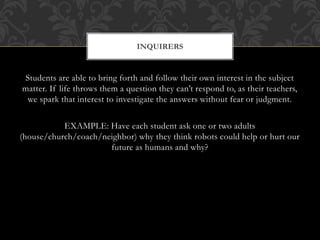
Students are able to bring forth and follow their own interest in the subject
matter. If life throws them a question they can’t respond to, as their teachers,
we spark that interest to investigate the answers without fear or judgment.
EXAMPLE: Have each student ask one or two adults
(house/church/coach/neighbor) why they think robots could help or hurt our
future as humans and why?
INQUIRERS
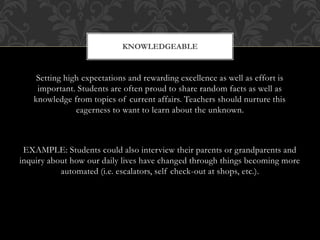
Setting high expectations and rewarding excellence as well as effort is
important. Students are often proud to share random facts as well as
knowledge from topics of current affairs. Teachers should nurture this
eagerness to want to learn about the unknown.
EXAMPLE: Students could also interview their parents or grandparents and
inquiry about how our daily lives have changed through things becoming more
automated (i.e. escalators, self check-out at shops, etc.).
KNOWLEDGEABLE
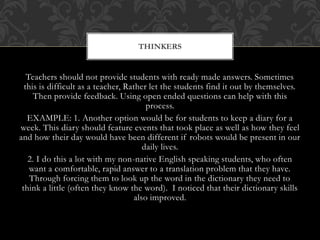
Teachers should not provide students with ready made answers. Sometimes
this is difficult as a teacher, Rather let the students find it out by themselves.
Then provide feedback. Using open ended questions can help with this
process.
EXAMPLE: 1. Another option would be for students to keep a diary for a
week. This diary should feature events that took place as well as how they feel
and how their day would have been different if robots would be present in our
daily lives.
2. I do this a lot with my non-native English speaking students, who often
want a comfortable, rapid answer to a translation problem that they have.
Through forcing them to look up the word in the dictionary they need to
think a little (often they know the word). I noticed that their dictionary skills
also improved.
THINKERS
Learning to put yourself in someone else's shoes is a key aspect of an IB
Learner. As a student engages with others and increasing this skill they are
then able to understand many view points and perspectives of those around
them. Whether they agree on a subject or not.
EXAMPLE: 1. Propose a group discussion then have each student write on
the board one plus or one negative on their views about robots teaching
students versus humans teaching.
2. I am a strong believer in asking students to hold presentations to the class.
Thus, this one is an easy one for me. Presentations require so many skills
(passion for a subject, persistency to research and make something
presentable, knowledge and ability to summarize, presentation skills, time
management - just to name a few...).
COMMUNICATORS
Again, this is a topic where the whole school should pull together. However, within the
classroom there are many situations where students can show how principled they are.
Teachers should set up essential agreements together with the students. These should be
signed by all class members and hung up in the classroom. Principled behavior can be
recognized during Homeroom, assemblies etc.
This concept could be integrated with anti-bullying units and campaigns. Teaching students
how to live a life of integrity and honesty will carry them through many situations
throughout their lives.
EXAMPLE: Having gained some insight into the students' views towards this unit, a class
debate involving two groups - one arguing why a world with robots brings society benefits,
and one counter-arguing this position - could take place. Some of the debate preparation
could be allocated as homework. In my experience students enjoy these debates and it
always makes for an interesting lesson to observe how some students get so involved - in
some cases even continuing the debate during break time. A conclusion based on the debate
session could provide food for thought for the next homework assignment.
PRINCIPLED
This can be lived within the classroom and the school. However, teachers can
influence this through the texts they choose, the stories they share and the
tasks they set. This is a great key to to start the year off on the right foot.
Having students getting to know each other and gaining respect for each other
can be an eye opener
EXAMPLE: Show a short video clip of the newest winners of a robotics
competition for middle or high schools students. One that shows the robot
and its capabilities to spark interest in unit subject.
OPEN-MINDED
Apart from fostering a caring environment in the classroom as well as in the
school, the teacher can steer the development of this trait through things like
group work, collaboration etc.
As a counselor this is discussed before any group begins. I discuss with students
that the group began because each member has something in common that we will
be working on/thru together. We talk about the safe space, confidentiality and
caring for their fellow members in order to have a successful group.
EXAMPLE: Start with handing out 30 cards (one for each student). I like using a
set from a paring game, that way the students have to get up and find the card that
matches theirs. It helps them to work with a new partner each time. Then, with
their new partner, brainstorm things they know and would like to learn about
robots. After a given amount of time they are to join up with another pair. Have
them discuss their answers and as a whole group write down X number of each.
CARING
The teacher should ask rather than tell. Thus the students' independence will
be promoted, requiring them to be greater risk-takers as opposed to each step
being explained and checked by the teacher (spoon-feeding). Yes, sometimes
they will get it wrong... But that is part of the process. This is a great tool to
face fears in life.
EXAMPLE: I would also start with something along the lines of a unit
discussion and provide students with a couple of options as to how they
would like to be assessed. In terms of the introduction, the unit discussion
could also involve a creative assignment linked to art, where the students are
able to portray their views of a robot world by creating wall murals.
RISK-TAKERS
I see this as one where the school shares a large responsibility. It is important
for students to have a balanced curriculum in order to experience success as
well as areas to further develop. Within each subject however, teachers can
vary their program in order to demand a variety of different skills.
EXAMPLE: 1. Students can prepare a presentation including pros and cons
on how robots are influencing today’s society.
2. Also, vocabulary can be represented in many different ways (definitions,
example sentences, illustrations, cartoon strips etc.)
BALANCED
A culture of evaluating their own work as well as the work of their peers will
help them to take advice on board and act upon it. Self-evaluation should be
carried out for most assessments.
EXAMPLE: 1. Unit discussion (I think you mentioned this is a previous
discussion): Give three choices to students on how they would like to be
formally assessed at the end of unit. Examples: PowerPoint presentation,
research paper, 3D diagram, etc. The subject difficulty would depend on
grade.
2. Journaling throughout the year is a great tool to help student become
reflective in school and personally. I worked with a lot of at risk students that
gained a lot from this daily task. They we able to vent what was going on at
home/church/sports/peers. After purging negative thoughts they were able to
focus more energy on the classroom lessons.
REFLECTIVE

FINAL #1: Learner profiles

  • 1.
    Daniel and Anna PROMOTINGACTIVE STUDENT LEARNING
  • 2.
    Students are ableto bring forth and follow their own interest in the subject matter. If life throws them a question they can’t respond to, as their teachers, we spark that interest to investigate the answers without fear or judgment. EXAMPLE: Have each student ask one or two adults (house/church/coach/neighbor) why they think robots could help or hurt our future as humans and why? INQUIRERS
  • 3.
    Setting high expectationsand rewarding excellence as well as effort is important. Students are often proud to share random facts as well as knowledge from topics of current affairs. Teachers should nurture this eagerness to want to learn about the unknown. EXAMPLE: Students could also interview their parents or grandparents and inquiry about how our daily lives have changed through things becoming more automated (i.e. escalators, self check-out at shops, etc.). KNOWLEDGEABLE
  • 4.
    Teachers should notprovide students with ready made answers. Sometimes this is difficult as a teacher, Rather let the students find it out by themselves. Then provide feedback. Using open ended questions can help with this process. EXAMPLE: 1. Another option would be for students to keep a diary for a week. This diary should feature events that took place as well as how they feel and how their day would have been different if robots would be present in our daily lives. 2. I do this a lot with my non-native English speaking students, who often want a comfortable, rapid answer to a translation problem that they have. Through forcing them to look up the word in the dictionary they need to think a little (often they know the word). I noticed that their dictionary skills also improved. THINKERS
  • 5.
    Learning to putyourself in someone else's shoes is a key aspect of an IB Learner. As a student engages with others and increasing this skill they are then able to understand many view points and perspectives of those around them. Whether they agree on a subject or not. EXAMPLE: 1. Propose a group discussion then have each student write on the board one plus or one negative on their views about robots teaching students versus humans teaching. 2. I am a strong believer in asking students to hold presentations to the class. Thus, this one is an easy one for me. Presentations require so many skills (passion for a subject, persistency to research and make something presentable, knowledge and ability to summarize, presentation skills, time management - just to name a few...). COMMUNICATORS
  • 6.
    Again, this isa topic where the whole school should pull together. However, within the classroom there are many situations where students can show how principled they are. Teachers should set up essential agreements together with the students. These should be signed by all class members and hung up in the classroom. Principled behavior can be recognized during Homeroom, assemblies etc. This concept could be integrated with anti-bullying units and campaigns. Teaching students how to live a life of integrity and honesty will carry them through many situations throughout their lives. EXAMPLE: Having gained some insight into the students' views towards this unit, a class debate involving two groups - one arguing why a world with robots brings society benefits, and one counter-arguing this position - could take place. Some of the debate preparation could be allocated as homework. In my experience students enjoy these debates and it always makes for an interesting lesson to observe how some students get so involved - in some cases even continuing the debate during break time. A conclusion based on the debate session could provide food for thought for the next homework assignment. PRINCIPLED
  • 7.
    This can belived within the classroom and the school. However, teachers can influence this through the texts they choose, the stories they share and the tasks they set. This is a great key to to start the year off on the right foot. Having students getting to know each other and gaining respect for each other can be an eye opener EXAMPLE: Show a short video clip of the newest winners of a robotics competition for middle or high schools students. One that shows the robot and its capabilities to spark interest in unit subject. OPEN-MINDED
  • 8.
    Apart from fosteringa caring environment in the classroom as well as in the school, the teacher can steer the development of this trait through things like group work, collaboration etc. As a counselor this is discussed before any group begins. I discuss with students that the group began because each member has something in common that we will be working on/thru together. We talk about the safe space, confidentiality and caring for their fellow members in order to have a successful group. EXAMPLE: Start with handing out 30 cards (one for each student). I like using a set from a paring game, that way the students have to get up and find the card that matches theirs. It helps them to work with a new partner each time. Then, with their new partner, brainstorm things they know and would like to learn about robots. After a given amount of time they are to join up with another pair. Have them discuss their answers and as a whole group write down X number of each. CARING
  • 9.
    The teacher shouldask rather than tell. Thus the students' independence will be promoted, requiring them to be greater risk-takers as opposed to each step being explained and checked by the teacher (spoon-feeding). Yes, sometimes they will get it wrong... But that is part of the process. This is a great tool to face fears in life. EXAMPLE: I would also start with something along the lines of a unit discussion and provide students with a couple of options as to how they would like to be assessed. In terms of the introduction, the unit discussion could also involve a creative assignment linked to art, where the students are able to portray their views of a robot world by creating wall murals. RISK-TAKERS
  • 10.
    I see thisas one where the school shares a large responsibility. It is important for students to have a balanced curriculum in order to experience success as well as areas to further develop. Within each subject however, teachers can vary their program in order to demand a variety of different skills. EXAMPLE: 1. Students can prepare a presentation including pros and cons on how robots are influencing today’s society. 2. Also, vocabulary can be represented in many different ways (definitions, example sentences, illustrations, cartoon strips etc.) BALANCED
  • 11.
    A culture ofevaluating their own work as well as the work of their peers will help them to take advice on board and act upon it. Self-evaluation should be carried out for most assessments. EXAMPLE: 1. Unit discussion (I think you mentioned this is a previous discussion): Give three choices to students on how they would like to be formally assessed at the end of unit. Examples: PowerPoint presentation, research paper, 3D diagram, etc. The subject difficulty would depend on grade. 2. Journaling throughout the year is a great tool to help student become reflective in school and personally. I worked with a lot of at risk students that gained a lot from this daily task. They we able to vent what was going on at home/church/sports/peers. After purging negative thoughts they were able to focus more energy on the classroom lessons. REFLECTIVE