Strategies for Assessment of 
Inquiry Learning in Science 
Eilish McLoughlin 
CASTeL, Dublin City University 
BRUSSELS 
24-26 OCTOBER 
2 0 1 4 
The SAILS project has received funding from 
the European Union’s Seventh Framework 
Programme [FP7/2007-2013] under grant 
agreement n° 289085
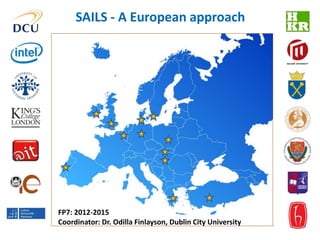
SAILS - A European approach 
FP7: 2012-2015 
Coordinator: Dr. Odilla Finlayson, Dublin City University
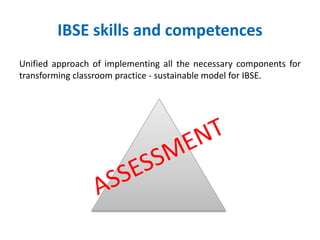
IBSE skills and competences 
Unified approach of implementing all the necessary components for 
transforming classroom practice - sustainable model for IBSE.
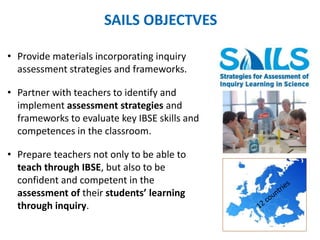
SAILS OBJECTVES 
• Provide materials incorporating inquiry 
assessment strategies and frameworks. 
• Partner with teachers to identify and 
implement assessment strategies and 
frameworks to evaluate key IBSE skills and 
competences in the classroom. 
• Prepare teachers not only to be able to 
teach through IBSE, but also to be 
confident and competent in the 
assessment of their students’ learning 
through inquiry.
SAILS Approach 
Review and Mapping 
• role of inquiry in national curriculum and assessment 
• national projects or initiatives on IBSE 
• links between IBSE and skills/competences 
Assessment frameworks and instruments 
• evaluate inquiry skills, scientific reasoning, scientific 
literacy in a specific context 
• paper-and-pencil / computer-based assessment. 
Piloting and evaluation 
• expert IBSE practitioners 
• physics, chemistry, biology concepts
What is inquiry? 
“[Inquiry is] the intentional process of: 
diagnosing problems, critiquing experiments, 
distinguishing alternatives, planning investigations, 
researching conjectures, searching for information, 
constructing models, discussing with peers 
and forming coherent arguments.” 
Linn, M. C., Davis E.A., & Bell, P. (2004).
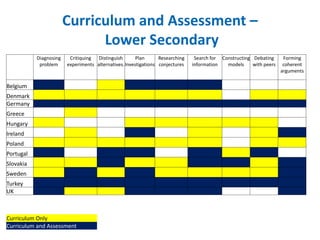
Curriculum and Assessment – 
Lower Secondary 
Diagnosing 
problem 
Critiquing 
experiments 
Distinguish 
alternatives. 
Plan 
Investigations 
Researching 
conjectures 
Search for 
information 
Constructing 
models 
Debating 
with peers 
Forming 
coherent 
arguments 
Belgium 
Denmark 
Germany 
Greece 
Hungary 
Ireland 
Poland 
Portugal 
Slovakia 
Sweden 
Turkey 
UK 
Curriculum Only 
Curriculum and Assessment
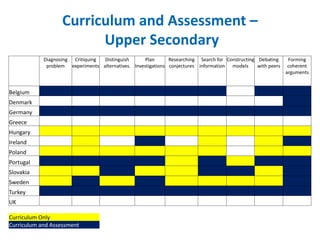
Curriculum and Assessment – 
Diagnosing 
problem 
Critiquing 
experiments 
Distinguish 
alternatives. 
Plan 
Investigations 
Researching 
conjectures 
Search for 
information 
Constructing 
models 
Debating 
with peers 
Forming 
coherent 
arguments 
Belgium 
Denmark 
Germany 
Greece 
Hungary 
Ireland 
Poland 
Portugal 
Slovakia 
Sweden 
Turkey 
UK 
Curriculum Only 
Curriculum and Assessment 
Upper Secondary
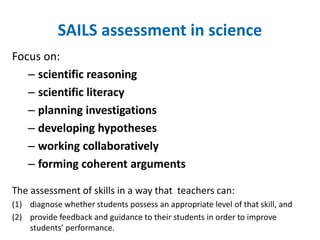
SAILS assessment in science 
Focus on: 
– scientific reasoning 
– scientific literacy 
– planning investigations 
– developing hypotheses 
– working collaboratively 
– forming coherent arguments 
The assessment of skills in a way that teachers can: 
(1) diagnose whether students possess an appropriate level of that skill, and 
(2) provide feedback and guidance to their students in order to improve 
students’ performance.
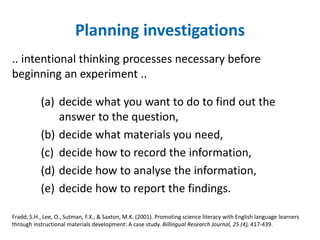
Planning investigations 
.. intentional thinking processes necessary before 
beginning an experiment .. 
(a) decide what you want to do to find out the 
answer to the question, 
(b) decide what materials you need, 
(c) decide how to record the information, 
(d) decide how to analyse the information, 
(e) decide how to report the findings. 
Fradd, S.H., Lee, O., Sutman, F.X., & Saxton, M.K. (2001). Promoting science literacy with English language learners 
through instructional materials development: A case study. Billingual Research Journal, 25 (4), 417-439.
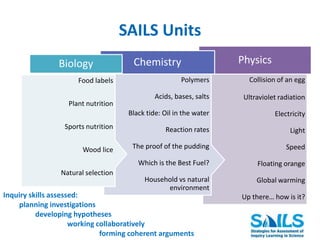
SAILS Units 
Physics 
Collision of an egg 
Ultraviolet radiation 
Electricity 
Light 
Speed 
Floating orange 
Global warming 
Up there… how is it? 
Chemistry 
Polymers 
Acids, bases, salts 
Black tide: Oil in the water 
Reaction rates 
The proof of the pudding 
Which is the Best Fuel? 
Household vs natural 
environment 
Biology 
Food labels 
Plant nutrition 
Sports nutrition 
Wood lice 
Natural selection 
Inquiry skills assessed: 
planning investigations 
developing hypotheses 
working collaboratively 
forming coherent arguments
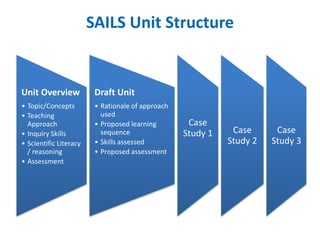
Unit Overview 
• Topic/Concepts 
• Teaching 
Approach 
• Inquiry Skills 
• Scientific Literacy 
/ reasoning 
• Assessment 
Draft Unit 
• Rationale of approach 
used 
• Proposed learning 
sequence 
• Skills assessed 
• Proposed assessment 
Case 
Study 1 Case 
Study 2 
Case 
Study 3 
SAILS Unit Structure
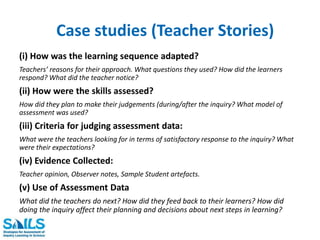
Case studies (Teacher Stories) 
(i) How was the learning sequence adapted? 
Teachers’ reasons for their approach. What questions they used? How did the learners 
respond? What did the teacher notice? 
(ii) How were the skills assessed? 
How did they plan to make their judgements (during/after the inquiry? What model of 
assessment was used? 
(iii) Criteria for judging assessment data: 
What were the teachers looking for in terms of satisfactory response to the inquiry? What 
were their expectations? 
(iv) Evidence Collected: 
Teacher opinion, Observer notes, Sample Student artefacts. 
(v) Use of Assessment Data 
What did the teachers do next? How did they feed back to their learners? How did 
doing the inquiry affect their planning and decisions about next steps in learning?
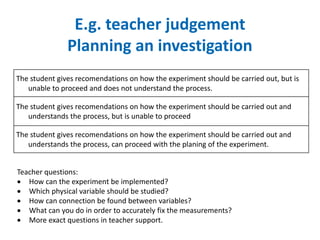
E.g. teacher judgement 
Planning an investigation 
The student gives recomendations on how the experiment should be carried out, but is 
unable to proceed and does not understand the process. 
The student gives recomendations on how the experiment should be carried out and 
understands the process, but is unable to proceed 
The student gives recomendations on how the experiment should be carried out and 
understands the process, can proceed with the planing of the experiment. 
Teacher questions: 
 How can the experiment be implemented? 
 Which physical variable should be studied? 
 How can connection be found between variables? 
 What can you do in order to accurately fix the measurements? 
 More exact questions in teacher support.
E.g. teacher feedback, Electricity Unit 
Skill: 
Student can formulate hypothesis (predictions) based on a 
question. Hypothesis may include comparisons (eg. metal 
will provide brighter light than graphite). 
Teacher Oral Feedback: 
• Student can formulate an appropriate hypothesis and state it 
appropriately (eg. gold will provide the brightest lamp). 
• Student can formulate a hypothesis but with an inappropriate 
statement (e.g. lamp will light with salty water) 
• Students cannot formulate a good hypothesis.
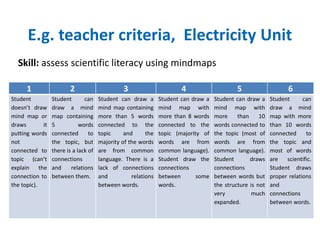
E.g. teacher criteria, Electricity Unit 
1 2 3 4 5 6 
Student 
doesn’t draw 
mind map or 
draws it 
putting words 
not 
connected to 
topic (can’t 
explain the 
connection to 
the topic). 
Student can 
draw a mind 
map containing 
5 words 
connected to 
the topic, but 
there is a lack of 
connections 
and relations 
between them. 
Student can draw a 
mind map containing 
more than 5 words 
connected to the 
topic and the 
majority of the words 
are from common 
language. There is a 
lack of connections 
and relations 
between words. 
Student can draw a 
mind map with 
more than 8 words 
connected to the 
topic (majority of 
words are from 
common language). 
Student draw the 
connections 
between some 
words. 
Student can draw a 
mind map with 
more than 10 
words connected to 
the topic (most of 
words are from 
common language). 
Student draws 
connections 
between words but 
the structure is not 
very much 
expanded. 
Student can 
draw a mind 
map with more 
than 10 words 
connected to 
the topic and 
most of words 
are scientific. 
Student draws 
proper relations 
and 
connections 
between words. 
Skill: assess scientific literacy using mindmaps
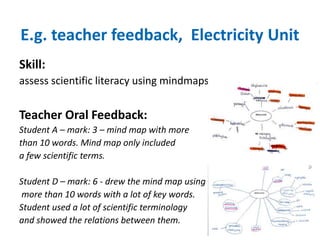
E.g. teacher feedback, Electricity Unit 
Skill: 
assess scientific literacy using mindmaps 
Teacher Oral Feedback: 
Student A – mark: 3 – mind map with more 
than 10 words. Mind map only included 
a few scientific terms. 
Student D – mark: 6 - drew the mind map using 
more than 10 words with a lot of key words. 
Student used a lot of scientific terminology 
and showed the relations between them.
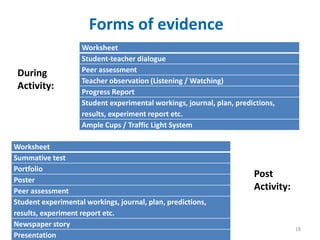
Forms of evidence 
18 
Worksheet 
Student-teacher dialogue 
Peer assessment 
Teacher observation (Listening / Watching) 
Progress Report 
Student experimental workings, journal, plan, predictions, 
results, experiment report etc. 
Ample Cups / Traffic Light System 
During 
Activity: 
Worksheet 
Summative test 
Portfolio 
Poster 
Peer assessment 
Student experimental workings, journal, plan, predictions, 
results, experiment report etc. 
Newspaper story 
Presentation 
Post 
Activity:
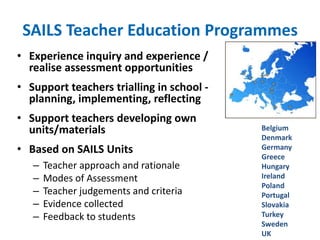
SAILS Teacher Education Programmes 
• Experience inquiry and experience / 
realise assessment opportunities 
• Support teachers trialling in school - 
planning, implementing, reflecting 
• Support teachers developing own 
units/materials 
• Based on SAILS Units 
– Teacher approach and rationale 
– Modes of Assessment 
– Teacher judgements and criteria 
– Evidence collected 
– Feedback to students 
Belgium 
Denmark 
Germany 
Greece 
Hungary 
Ireland 
Poland 
Portugal 
Slovakia 
Turkey 
Sweden 
UK
Getting Involved - SAILS CoP 
Overall Purpose 
To encourage practitioners throughout 
Europe in the use of IBSE and the assessment 
frameworks developed in the project. 
COP members avail of the following benefits: 
– Publications Access to units and other publication from 
the SAILS project 
– Forums Discuss Inquiry-based Science Education (IBSE) 
issues with other likeminded contributors (nationally and 
internationally) 
– Events Access to information on upcoming events as well 
as the opportunity to promote them 
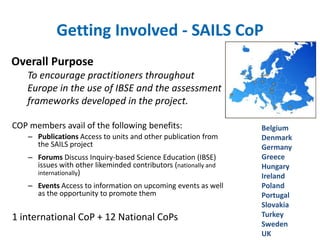
1 international CoP + 12 National CoPs 
Belgium 
Denmark 
Germany 
Greece 
Hungary 
Ireland 
Poland 
Portugal 
Slovakia 
Turkey 
Sweden 
UK
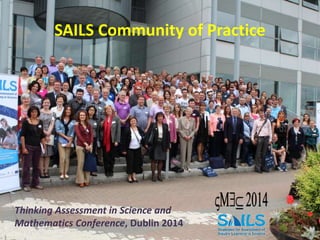
SAILS Community of Practice 
All Contributions 
Thinking Assessment in Science and 
Mathematics Conference, Dublin 2014
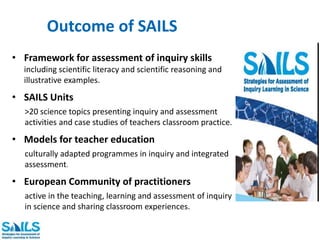
Outcome of SAILS 
• Framework for assessment of inquiry skills 
including scientific literacy and scientific reasoning and 
illustrative examples. 
• SAILS Units 
>20 science topics presenting inquiry and assessment 
activities and case studies of teachers classroom practice. 
• Models for teacher education 
culturally adapted programmes in inquiry and integrated 
assessment. 
• European Community of practitioners 
active in the teaching, learning and assessment of inquiry 
in science and sharing classroom experiences.
SAILS Collaborators 
• Odilla Finlayson, Eilish McLoughlin, Paul van Kampen, James Lovatt, Sarah 
Brady, Deirdre McCabe, Dublin City University 
• Marian Kires, Zuzana Jeskova, et al, Safarik University in Košice, Slovakia; 
• Pawel Bernard, Dagmara Sokolowska et al, Jagiellonian University Poland; 
• Paul Black, Christine Harrison, Brian Matthews, King's College London, UK; 
• Beno Csapo, Csaba Csíkos, et al, University of Szeged, Hungary; 
• Gunnar Friege, Maximilian Barth, Universität Hannover Germany; 
• Mats Lundström, Malmö University, Anders Jönsson, 
Kristianstad University, Sweden; 
• Claus Michelsen, Morten Rask Petersen, University of South Denmark, 
• Cecília Galvão, Cláudia Gonçalves, Instituto de Educação da Universidade 
de Lisboa, Portugal; 
• Gultekin Cakmakci , Yalcin et al Hacettepe University Turkey; 
• Simeos Retalis, Yannis Psaromiligkos, University of Piraeus, Greece; 
• Sally Reynolds, Joasia van Kooten, Mathy Vanbuel, ATiT; Wim Peeters, 
Belgium; 
• Mark Melia, Joe Greene, Intel PLS Limited, Ireland. 
www.sails-project.eu

Strategies for Assessment of Inquiry Learning in Science (SAILS), Eilish McLoughlin

  • 1.
    Strategies for Assessmentof Inquiry Learning in Science Eilish McLoughlin CASTeL, Dublin City University BRUSSELS 24-26 OCTOBER 2 0 1 4 The SAILS project has received funding from the European Union’s Seventh Framework Programme [FP7/2007-2013] under grant agreement n° 289085
  • 2.
    SAILS - AEuropean approach FP7: 2012-2015 Coordinator: Dr. Odilla Finlayson, Dublin City University
  • 3.
    IBSE skills andcompetences Unified approach of implementing all the necessary components for transforming classroom practice - sustainable model for IBSE.
  • 4.
    SAILS OBJECTVES •Provide materials incorporating inquiry assessment strategies and frameworks. • Partner with teachers to identify and implement assessment strategies and frameworks to evaluate key IBSE skills and competences in the classroom. • Prepare teachers not only to be able to teach through IBSE, but also to be confident and competent in the assessment of their students’ learning through inquiry.
  • 5.
    SAILS Approach Reviewand Mapping • role of inquiry in national curriculum and assessment • national projects or initiatives on IBSE • links between IBSE and skills/competences Assessment frameworks and instruments • evaluate inquiry skills, scientific reasoning, scientific literacy in a specific context • paper-and-pencil / computer-based assessment. Piloting and evaluation • expert IBSE practitioners • physics, chemistry, biology concepts
  • 6.
    What is inquiry? “[Inquiry is] the intentional process of: diagnosing problems, critiquing experiments, distinguishing alternatives, planning investigations, researching conjectures, searching for information, constructing models, discussing with peers and forming coherent arguments.” Linn, M. C., Davis E.A., & Bell, P. (2004).
  • 7.
    Curriculum and Assessment– Lower Secondary Diagnosing problem Critiquing experiments Distinguish alternatives. Plan Investigations Researching conjectures Search for information Constructing models Debating with peers Forming coherent arguments Belgium Denmark Germany Greece Hungary Ireland Poland Portugal Slovakia Sweden Turkey UK Curriculum Only Curriculum and Assessment
  • 8.
    Curriculum and Assessment– Diagnosing problem Critiquing experiments Distinguish alternatives. Plan Investigations Researching conjectures Search for information Constructing models Debating with peers Forming coherent arguments Belgium Denmark Germany Greece Hungary Ireland Poland Portugal Slovakia Sweden Turkey UK Curriculum Only Curriculum and Assessment Upper Secondary
  • 9.
    SAILS assessment inscience Focus on: – scientific reasoning – scientific literacy – planning investigations – developing hypotheses – working collaboratively – forming coherent arguments The assessment of skills in a way that teachers can: (1) diagnose whether students possess an appropriate level of that skill, and (2) provide feedback and guidance to their students in order to improve students’ performance.
  • 10.
    Planning investigations ..intentional thinking processes necessary before beginning an experiment .. (a) decide what you want to do to find out the answer to the question, (b) decide what materials you need, (c) decide how to record the information, (d) decide how to analyse the information, (e) decide how to report the findings. Fradd, S.H., Lee, O., Sutman, F.X., & Saxton, M.K. (2001). Promoting science literacy with English language learners through instructional materials development: A case study. Billingual Research Journal, 25 (4), 417-439.
  • 11.
    SAILS Units Physics Collision of an egg Ultraviolet radiation Electricity Light Speed Floating orange Global warming Up there… how is it? Chemistry Polymers Acids, bases, salts Black tide: Oil in the water Reaction rates The proof of the pudding Which is the Best Fuel? Household vs natural environment Biology Food labels Plant nutrition Sports nutrition Wood lice Natural selection Inquiry skills assessed: planning investigations developing hypotheses working collaboratively forming coherent arguments
  • 12.
    Unit Overview •Topic/Concepts • Teaching Approach • Inquiry Skills • Scientific Literacy / reasoning • Assessment Draft Unit • Rationale of approach used • Proposed learning sequence • Skills assessed • Proposed assessment Case Study 1 Case Study 2 Case Study 3 SAILS Unit Structure
  • 13.
    Case studies (TeacherStories) (i) How was the learning sequence adapted? Teachers’ reasons for their approach. What questions they used? How did the learners respond? What did the teacher notice? (ii) How were the skills assessed? How did they plan to make their judgements (during/after the inquiry? What model of assessment was used? (iii) Criteria for judging assessment data: What were the teachers looking for in terms of satisfactory response to the inquiry? What were their expectations? (iv) Evidence Collected: Teacher opinion, Observer notes, Sample Student artefacts. (v) Use of Assessment Data What did the teachers do next? How did they feed back to their learners? How did doing the inquiry affect their planning and decisions about next steps in learning?
  • 14.
    E.g. teacher judgement Planning an investigation The student gives recomendations on how the experiment should be carried out, but is unable to proceed and does not understand the process. The student gives recomendations on how the experiment should be carried out and understands the process, but is unable to proceed The student gives recomendations on how the experiment should be carried out and understands the process, can proceed with the planing of the experiment. Teacher questions:  How can the experiment be implemented?  Which physical variable should be studied?  How can connection be found between variables?  What can you do in order to accurately fix the measurements?  More exact questions in teacher support.
  • 15.
    E.g. teacher feedback,Electricity Unit Skill: Student can formulate hypothesis (predictions) based on a question. Hypothesis may include comparisons (eg. metal will provide brighter light than graphite). Teacher Oral Feedback: • Student can formulate an appropriate hypothesis and state it appropriately (eg. gold will provide the brightest lamp). • Student can formulate a hypothesis but with an inappropriate statement (e.g. lamp will light with salty water) • Students cannot formulate a good hypothesis.
  • 16.
    E.g. teacher criteria,Electricity Unit 1 2 3 4 5 6 Student doesn’t draw mind map or draws it putting words not connected to topic (can’t explain the connection to the topic). Student can draw a mind map containing 5 words connected to the topic, but there is a lack of connections and relations between them. Student can draw a mind map containing more than 5 words connected to the topic and the majority of the words are from common language. There is a lack of connections and relations between words. Student can draw a mind map with more than 8 words connected to the topic (majority of words are from common language). Student draw the connections between some words. Student can draw a mind map with more than 10 words connected to the topic (most of words are from common language). Student draws connections between words but the structure is not very much expanded. Student can draw a mind map with more than 10 words connected to the topic and most of words are scientific. Student draws proper relations and connections between words. Skill: assess scientific literacy using mindmaps
  • 17.
    E.g. teacher feedback,Electricity Unit Skill: assess scientific literacy using mindmaps Teacher Oral Feedback: Student A – mark: 3 – mind map with more than 10 words. Mind map only included a few scientific terms. Student D – mark: 6 - drew the mind map using more than 10 words with a lot of key words. Student used a lot of scientific terminology and showed the relations between them.
  • 18.
    Forms of evidence 18 Worksheet Student-teacher dialogue Peer assessment Teacher observation (Listening / Watching) Progress Report Student experimental workings, journal, plan, predictions, results, experiment report etc. Ample Cups / Traffic Light System During Activity: Worksheet Summative test Portfolio Poster Peer assessment Student experimental workings, journal, plan, predictions, results, experiment report etc. Newspaper story Presentation Post Activity:
  • 19.
    SAILS Teacher EducationProgrammes • Experience inquiry and experience / realise assessment opportunities • Support teachers trialling in school - planning, implementing, reflecting • Support teachers developing own units/materials • Based on SAILS Units – Teacher approach and rationale – Modes of Assessment – Teacher judgements and criteria – Evidence collected – Feedback to students Belgium Denmark Germany Greece Hungary Ireland Poland Portugal Slovakia Turkey Sweden UK
  • 20.
    Getting Involved -SAILS CoP Overall Purpose To encourage practitioners throughout Europe in the use of IBSE and the assessment frameworks developed in the project. COP members avail of the following benefits: – Publications Access to units and other publication from the SAILS project – Forums Discuss Inquiry-based Science Education (IBSE) issues with other likeminded contributors (nationally and internationally) – Events Access to information on upcoming events as well as the opportunity to promote them 1 international CoP + 12 National CoPs Belgium Denmark Germany Greece Hungary Ireland Poland Portugal Slovakia Turkey Sweden UK
  • 21.
    SAILS Community ofPractice All Contributions Thinking Assessment in Science and Mathematics Conference, Dublin 2014
  • 22.
    Outcome of SAILS • Framework for assessment of inquiry skills including scientific literacy and scientific reasoning and illustrative examples. • SAILS Units >20 science topics presenting inquiry and assessment activities and case studies of teachers classroom practice. • Models for teacher education culturally adapted programmes in inquiry and integrated assessment. • European Community of practitioners active in the teaching, learning and assessment of inquiry in science and sharing classroom experiences.
  • 23.
    SAILS Collaborators •Odilla Finlayson, Eilish McLoughlin, Paul van Kampen, James Lovatt, Sarah Brady, Deirdre McCabe, Dublin City University • Marian Kires, Zuzana Jeskova, et al, Safarik University in Košice, Slovakia; • Pawel Bernard, Dagmara Sokolowska et al, Jagiellonian University Poland; • Paul Black, Christine Harrison, Brian Matthews, King's College London, UK; • Beno Csapo, Csaba Csíkos, et al, University of Szeged, Hungary; • Gunnar Friege, Maximilian Barth, Universität Hannover Germany; • Mats Lundström, Malmö University, Anders Jönsson, Kristianstad University, Sweden; • Claus Michelsen, Morten Rask Petersen, University of South Denmark, • Cecília Galvão, Cláudia Gonçalves, Instituto de Educação da Universidade de Lisboa, Portugal; • Gultekin Cakmakci , Yalcin et al Hacettepe University Turkey; • Simeos Retalis, Yannis Psaromiligkos, University of Piraeus, Greece; • Sally Reynolds, Joasia van Kooten, Mathy Vanbuel, ATiT; Wim Peeters, Belgium; • Mark Melia, Joe Greene, Intel PLS Limited, Ireland. www.sails-project.eu