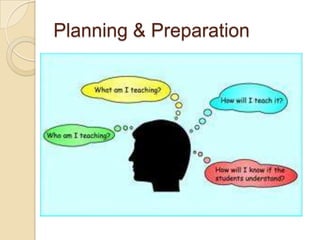
PLANNING & ASSESSMENTWhat do you want your students to know and be able to do?
How will you know they have learned it?
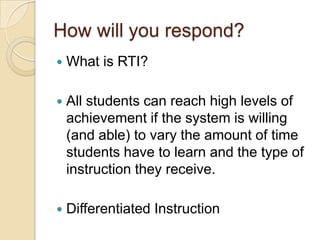
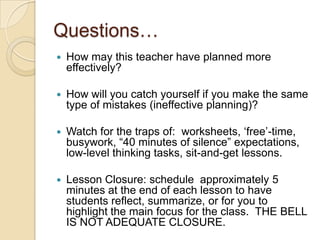
What will you do when students struggle with the learning?
Plan with the end in mind…Backwards design (UBD)What is the Purpose ?Formative   Diagnostic, Pre Assessments,  quick, in-the moment, ‘dipstick’ checks for student understanding, ongoing, purposeful, provide opportunities to improve learning, room for improvement, inform teacher instruction and next steps.SummativeFinal evaluations on student learning
Types of AssessmentsPerformance – students required to demonstrate understanding and skills by actually performing a task (e.g., write a story, give a speech, operate a machine)Authentic – kind of performance assessment that stresses application of understanding and skills to real problems in ‘real-world’ contextual settings (e.g., student teaching)
Types of AssessmentsAlternative – non-traditional methods (no paper/pencil tests) used to assessTraditional – Tests/ quizzes
Pre AssessmentsUse Pre Assessments to find out what your students already know.
Use Pre Assessments to find out the misconceptions of students.
Use data from Pre Assessments to plan for the next steps in learning.Pre Assessment: Placemat Activity…
Pre Assessment: Journal Writing…
Pre Assessments…KWL charts (Graphic Organizers)Grafitti WallYes/No CardsWord SplashTurn and TalkSource: http://www.saskschools.ca/curr_content/constructivism/how/preassessment.html
Assessments…
Planning & Preparation
What do you want your students to know & be able to do?Clear expectations
What do you want?  Don’t make the students guess
What makes a good/bad response
How will the student know they have reached the goal?
Give constructive/timelyfeedback Planning using KUDWhenever planning a unit/lesson you should be able to answer these 3 key questions: What do I want my students toKnow?What do I want my students toUnderstand? What do I want my student to be able toDo?
What is a KUD?
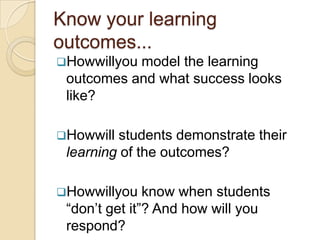
Know your learning outcomes...Howwillyou model the learning outcomes and what success looks like?
Howwill students demonstrate their learning of the outcomes?
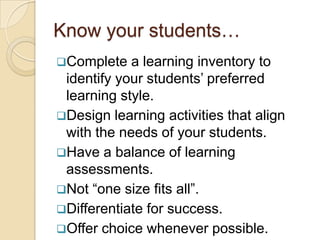
Howwillyou know when students “don’t get it”? And how will you respond?Know your students…Complete a learning inventory to identify your students’ preferred learning style.

Assessment Session for New Teachers

  • 1.
    PLANNING & ASSESSMENTWhatdo you want your students to know and be able to do?
  • 2.
    How will youknow they have learned it?
  • 3.
    What will youdo when students struggle with the learning?
  • 4.
    Plan with theend in mind…Backwards design (UBD)What is the Purpose ?Formative Diagnostic, Pre Assessments, quick, in-the moment, ‘dipstick’ checks for student understanding, ongoing, purposeful, provide opportunities to improve learning, room for improvement, inform teacher instruction and next steps.SummativeFinal evaluations on student learning
  • 5.
    Types of AssessmentsPerformance– students required to demonstrate understanding and skills by actually performing a task (e.g., write a story, give a speech, operate a machine)Authentic – kind of performance assessment that stresses application of understanding and skills to real problems in ‘real-world’ contextual settings (e.g., student teaching)
  • 6.
    Types of AssessmentsAlternative– non-traditional methods (no paper/pencil tests) used to assessTraditional – Tests/ quizzes
  • 7.
    Pre AssessmentsUse PreAssessments to find out what your students already know.
  • 8.
    Use Pre Assessmentsto find out the misconceptions of students.
  • 9.
    Use data fromPre Assessments to plan for the next steps in learning.Pre Assessment: Placemat Activity…
  • 10.
  • 11.
    Pre Assessments…KWL charts(Graphic Organizers)Grafitti WallYes/No CardsWord SplashTurn and TalkSource: http://www.saskschools.ca/curr_content/constructivism/how/preassessment.html
  • 12.
  • 13.
  • 14.
    What do youwant your students to know & be able to do?Clear expectations
  • 15.
    What do youwant? Don’t make the students guess
  • 16.
    What makes agood/bad response
  • 17.
    How will thestudent know they have reached the goal?
  • 18.
    Give constructive/timelyfeedback Planningusing KUDWhenever planning a unit/lesson you should be able to answer these 3 key questions: What do I want my students toKnow?What do I want my students toUnderstand? What do I want my student to be able toDo?
  • 19.
  • 20.
    Know your learningoutcomes...Howwillyou model the learning outcomes and what success looks like?
  • 21.
    Howwill students demonstratetheir learning of the outcomes?
  • 22.
    Howwillyou know whenstudents “don’t get it”? And how will you respond?Know your students…Complete a learning inventory to identify your students’ preferred learning style.

Editor's Notes

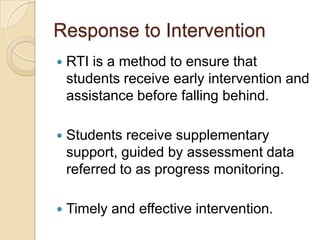
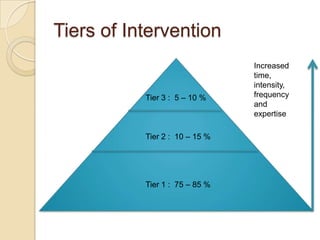
  • #18 Response to Intervention