Curriculum Pathways
Shark Start Training
May-June 2014
1
Agenda
• Characteristics of effective Academic Pathways
• What’s new for Fall 2014
• Supplemental webinar training on pathways
scenarios
• Additional support for students enrolling in
MAT1033
Academic Pathways: The Rationale
 Students with clear curriculum pathways stay motivated, take
fewer excess credits and complete their programs of study quicker
and more effectively.
 This is even more important as financial aid eligibility is decreased
by federal and state governments
 Multiple disciplines have created/revised their curriculum
pathways
 Others have program sheets that can be used in the interim
 Pathways and program sheets are available at
https://bit.ly/MDCsharkstart
3
Academic Pathways: The Definition
Focused and integrated set of courses and
sequences designed to increase transfer
success and degree completion
– A.A. pathway includes all pre-requisites
for transfer as a junior to baccalaureate
program at MDC or another institution
– A.S. pathway includes all requirements
to enter occupation or transfer to a
B.A.S. program
Academic Pathways: The Purpose
• Map academic goals and progress
• Connect academic and student services
• Guide course planning, selection and
sequencing, semester by semester
• Provide continuity and consistency in
advising, coaching and mentoring
• Prompt students to complete math, English,
FYE/SLS, and other general education
requirements early on—in sequence (ideally
in first year at MDC).
• Prompt students who fail or withdraw from
a course to take it again immediately in the
next semester.
Academic Pathways: The Contents
• Course requirements and sequences
for full-time and part-time study
– general education requirements
– program-specific courses
• Notes that explain common Florida
requirements that articulate to state-
approved B.A. or B.A.S degrees
• Interdisciplinary recommendations
that identify recommended general
education courses
What’s New for Fall 2014
• 14 new pathways in Allied Health and Nursing
– Health Information Management
– Dental Hygiene
– Diagnostic Medical Sonography
– Nuclear Medicine
– Physical Therapy Assistant
– Radiography
– Respiratory Care
– Opticianry
– Vet Tech
– Physician Assistant
– Nursing Generic
– Nursing Transitional
– Clinical Lab Sciences
– Histologic Technology
What’s New for Fall 2014
• 4 new pathways in Arts and Humanities
– Art
– Philosophy
– Music
– Theater/Drama
• 5 new pathways in Social Sciences
– International Relations
– Political Science
– History
– Anthropology
– Sociology
What’s New for Fall 2014
• 10 additional new pathways in
– Architecture
– Early Childhood Education (3)
– Exceptional Student Education
– Hospitality Administration
– Hospitality and Tourism Management
– Interior Design
– Mass Communications/Journalism
– Mathematics
What’s New for Fall 2014
Program sheets for most remaining AS programs
• Available at https://bit.ly/MDCsharkstart
New SLS requirement
• SLS 1106 (FYE): 1 credit course for students with
college-level course load; must be satisfied by 16th
college credit benchmark
• SLS 1505: 1 credit course for students with1
developmental course
• SLS 1510: 3 credit course for students with 2 or more
developmental courses
What’s New for Fall 2014
• New foreign language requirement
– Requirement is 8 credit hours
– Required for both AA degree AND admission to
baccalaureate programs in Florida
– Students can meet with proof of proficiency (CLEP)
– Students who test out of foreign languages choose the
next course listed on pathway to complete semester load
What’s New for Fall 2014
• Some baccalaureate programs require additional course
work beyond 60 credits for junior standing
• These additional courses are listed in a separate section
below the 60 credit hours on the templates
– As long as they meet FLVC requirements for
baccalaureate admissions
– For questions go to:
http://ss.flvc.org/flvc/portal/Home_Page/Student%20Servi
ces/College_Transfer_Center/common_Preqrequiste_Man
ual
Academic Pathways: The Template
• All pathways follow the same format
• All AA pathways reflect the 60 credits required for
completion of degree
• Slight differences between the AA and AS pathways
• Students SHOULD to take the courses listed on the pathways
IN THESE SEQUENCES
– Best prepare students for further study in transfer major
at transfer institution
• Important to discuss with students what their academic and
professional goals are, and intended transfer programs.
Pathways Contain Important Notes
• Note 1: MAT1033 counts towards the 24 credit
Elective block but does not fulfill General Education
math requirement
• Note 2: SLS 1106 must be taken by 16th earned
credit for AA degree for FTIC students. It also counts
towards the 24 credit Elective block
• Note 3: credits for Natural Science lab courses will
count towards the General Education elective and/or
the 24 credit Elective block
Pathways contain Important Notes
• Note 4: Credits earned by taking CGS1060 are split
between the General Education elective and/or the
24 credit Elective Block
• Remember that the Gordon Rule requires six
semester hours of English and six additional hours of
approved courses where student demonstrates
college-level writing skills
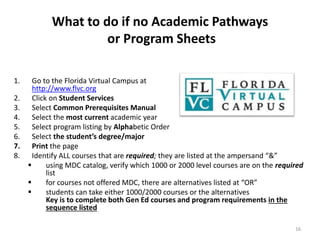
What to do if no Academic Pathways
or Program Sheets
1. Go to the Florida Virtual Campus at
http://www.flvc.org
2. Click on Student Services
3. Select Common Prerequisites Manual
4. Select the most current academic year
5. Select program listing by Alphabetic Order
6. Select the student’s degree/major
7. Print the page
8. Identify ALL courses that are required; they are listed at the ampersand “&”
 using MDC catalog, verify which 1000 or 2000 level courses are on the required
list
 for courses not offered MDC, there are alternatives listed at “OR”
 students can take either 1000/2000 courses or the alternatives
Key is to complete both Gen Ed courses and program requirements in the
sequence listed
16
Pathways Webinars: Week of June 9
• Additional training for reading and interpreting pathways via multiple
interactive webinars will be held from June 9-13
– How to use the Notes
– How to schedule SLS requirement
– What to do if student chooses to take developmental courses first
– How to use part-time pathways
– What to do when pathways courses not available
– Which courses to take if foreign language requirement met via CLEP
– How to identify additional courses required for baccalaureate
program admission
• Registration information will be available May 30
Additional support for students enrolling
in MAT 1033

MDC Pathways

  • 1.
    Curriculum Pathways Shark StartTraining May-June 2014 1
  • 2.
    Agenda • Characteristics ofeffective Academic Pathways • What’s new for Fall 2014 • Supplemental webinar training on pathways scenarios • Additional support for students enrolling in MAT1033
  • 3.
    Academic Pathways: TheRationale  Students with clear curriculum pathways stay motivated, take fewer excess credits and complete their programs of study quicker and more effectively.  This is even more important as financial aid eligibility is decreased by federal and state governments  Multiple disciplines have created/revised their curriculum pathways  Others have program sheets that can be used in the interim  Pathways and program sheets are available at https://bit.ly/MDCsharkstart 3
  • 4.
    Academic Pathways: TheDefinition Focused and integrated set of courses and sequences designed to increase transfer success and degree completion – A.A. pathway includes all pre-requisites for transfer as a junior to baccalaureate program at MDC or another institution – A.S. pathway includes all requirements to enter occupation or transfer to a B.A.S. program
  • 5.
    Academic Pathways: ThePurpose • Map academic goals and progress • Connect academic and student services • Guide course planning, selection and sequencing, semester by semester • Provide continuity and consistency in advising, coaching and mentoring • Prompt students to complete math, English, FYE/SLS, and other general education requirements early on—in sequence (ideally in first year at MDC). • Prompt students who fail or withdraw from a course to take it again immediately in the next semester.
  • 6.
    Academic Pathways: TheContents • Course requirements and sequences for full-time and part-time study – general education requirements – program-specific courses • Notes that explain common Florida requirements that articulate to state- approved B.A. or B.A.S degrees • Interdisciplinary recommendations that identify recommended general education courses
  • 7.
    What’s New forFall 2014 • 14 new pathways in Allied Health and Nursing – Health Information Management – Dental Hygiene – Diagnostic Medical Sonography – Nuclear Medicine – Physical Therapy Assistant – Radiography – Respiratory Care – Opticianry – Vet Tech – Physician Assistant – Nursing Generic – Nursing Transitional – Clinical Lab Sciences – Histologic Technology
  • 8.
    What’s New forFall 2014 • 4 new pathways in Arts and Humanities – Art – Philosophy – Music – Theater/Drama • 5 new pathways in Social Sciences – International Relations – Political Science – History – Anthropology – Sociology
  • 9.
    What’s New forFall 2014 • 10 additional new pathways in – Architecture – Early Childhood Education (3) – Exceptional Student Education – Hospitality Administration – Hospitality and Tourism Management – Interior Design – Mass Communications/Journalism – Mathematics
  • 10.
    What’s New forFall 2014 Program sheets for most remaining AS programs • Available at https://bit.ly/MDCsharkstart New SLS requirement • SLS 1106 (FYE): 1 credit course for students with college-level course load; must be satisfied by 16th college credit benchmark • SLS 1505: 1 credit course for students with1 developmental course • SLS 1510: 3 credit course for students with 2 or more developmental courses
  • 11.
    What’s New forFall 2014 • New foreign language requirement – Requirement is 8 credit hours – Required for both AA degree AND admission to baccalaureate programs in Florida – Students can meet with proof of proficiency (CLEP) – Students who test out of foreign languages choose the next course listed on pathway to complete semester load
  • 12.
    What’s New forFall 2014 • Some baccalaureate programs require additional course work beyond 60 credits for junior standing • These additional courses are listed in a separate section below the 60 credit hours on the templates – As long as they meet FLVC requirements for baccalaureate admissions – For questions go to: http://ss.flvc.org/flvc/portal/Home_Page/Student%20Servi ces/College_Transfer_Center/common_Preqrequiste_Man ual
  • 13.
    Academic Pathways: TheTemplate • All pathways follow the same format • All AA pathways reflect the 60 credits required for completion of degree • Slight differences between the AA and AS pathways • Students SHOULD to take the courses listed on the pathways IN THESE SEQUENCES – Best prepare students for further study in transfer major at transfer institution • Important to discuss with students what their academic and professional goals are, and intended transfer programs.
  • 14.
    Pathways Contain ImportantNotes • Note 1: MAT1033 counts towards the 24 credit Elective block but does not fulfill General Education math requirement • Note 2: SLS 1106 must be taken by 16th earned credit for AA degree for FTIC students. It also counts towards the 24 credit Elective block • Note 3: credits for Natural Science lab courses will count towards the General Education elective and/or the 24 credit Elective block
  • 15.
    Pathways contain ImportantNotes • Note 4: Credits earned by taking CGS1060 are split between the General Education elective and/or the 24 credit Elective Block • Remember that the Gordon Rule requires six semester hours of English and six additional hours of approved courses where student demonstrates college-level writing skills
  • 16.
    What to doif no Academic Pathways or Program Sheets 1. Go to the Florida Virtual Campus at http://www.flvc.org 2. Click on Student Services 3. Select Common Prerequisites Manual 4. Select the most current academic year 5. Select program listing by Alphabetic Order 6. Select the student’s degree/major 7. Print the page 8. Identify ALL courses that are required; they are listed at the ampersand “&”  using MDC catalog, verify which 1000 or 2000 level courses are on the required list  for courses not offered MDC, there are alternatives listed at “OR”  students can take either 1000/2000 courses or the alternatives Key is to complete both Gen Ed courses and program requirements in the sequence listed 16
  • 17.
    Pathways Webinars: Weekof June 9 • Additional training for reading and interpreting pathways via multiple interactive webinars will be held from June 9-13 – How to use the Notes – How to schedule SLS requirement – What to do if student chooses to take developmental courses first – How to use part-time pathways – What to do when pathways courses not available – Which courses to take if foreign language requirement met via CLEP – How to identify additional courses required for baccalaureate program admission • Registration information will be available May 30
  • 18.
    Additional support forstudents enrolling in MAT 1033