Road Map to College
Parent Workshop
GPISD Post Secondary Readiness Department
•What is College Readiness & why is it important?
•How to Build a College Readiness Culture
-Parent & District Partnership
•The Road Map to College
- Rigorous Courses
-College Readiness Assessment Programs
•Q&A
What is College
Readiness?
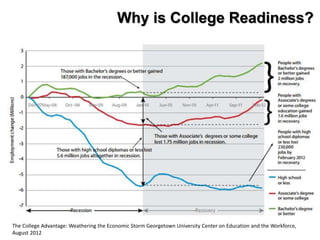
Why is College
Readiness important?
The College Advantage: Weathering the Economic Storm Georgetown University Center on Education and the Workforce,
August 2012
Why is College Readiness?
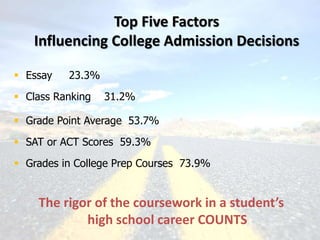
Top Five Factors
Influencing College Admission Decisions
 Grade Point Average 53.7%
 Class Ranking 31.2%
 SAT or ACT Scores 59.3%
The rigor of the coursework in a student’s
high school career COUNTS
 Essay 23.3%
 Grades in College Prep Courses 73.9%
It is important that parents and families be
part of the process to build a college-going
culture, and that connections are made
between schools and students’ families and
their community.
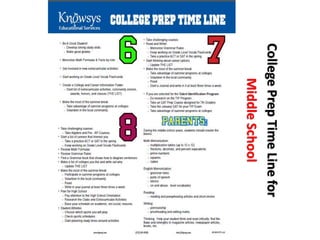
CollegePrepTimeLinefor
MiddleSchool
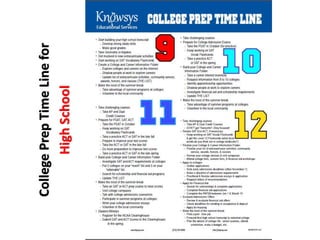
CollegePrepTimeLinefor
HighSchool
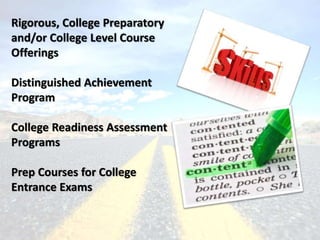
Rigorous, College Preparatory
and/or College Level Course
Offerings
Distinguished Achievement
Program
College Readiness Assessment
Programs
Prep Courses for College
Entrance Exams
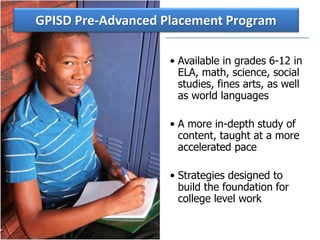
• Available in grades 6-12 in
ELA, math, science, social
studies, fines arts, as well
as world languages
• A more in-depth study of
content, taught at a more
accelerated pace
• Strategies designed to
build the foundation for
college level work
GPISD Pre-Advanced Placement Program
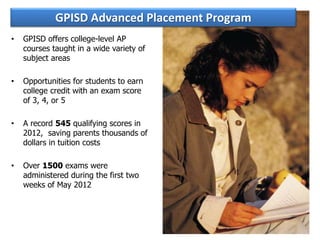
• GPISD offers college-level AP
courses taught in a wide variety of
subject areas
• Opportunities for students to earn
college credit with an exam score
of 3, 4, or 5
• A record 545 qualifying scores in
2012, saving parents thousands of
dollars in tuition costs
• Over 1500 exams were
administered during the first two
weeks of May 2012
GPISD Advanced Placement Program
Dual Credit Opportunities
Dallas County Community Colleges
tuition for GPISD students
• Courses offered on high school campus
as well as on the community college
campuses
UTA Honors College
• GPISD began a partnership in 1999 as
the inaugural district to offer college
courses to high achieving high school
students
• If students meet the following criteria,
they may receive
to UTA
• 1200 on the SAT
• completion of at least 6 hours of
UTA credit prior to graduation
• maintaining at least a “B” average
in each UTA course
Understanding Weighted Grade Point Average
• Beginning the Grade Point Average (GPA)
– Taking high school courses in middle school begins a
student’s GPA (grade point average)
– Once a credit has been awarded, courses cannot be
re-taken for a higher grade
• Weighted GPA
– Regular classes are weighted on a 4.0 scale
– Pre-AP classes are weighted on a 4.5 scale
– AP and Dual Credit classes are weighted on a 5.0 scale
Distinguished Achievement Program (DAP)
Requirements
Students must receive credit for
the following course.
• 4 ELA credits including English I, II, III, IV
• 4 Math credits including Algebra I,
Geometry, Algebra II
• 4 Science credits including Biology,
Chemistry, Physics
• 4 Social Studies credits including World
Geography, World History, US History, US
Government, Economics
• 3 years of the same Foreign Language
• 1 credit of PE
• ½ credit of Speech
• 1 credit of Technology Applications
• 1 credit of Fine Arts
• 4 ½ credits of Elective courses
Students must also meet the
following standards.
• cumulative score requirement in each of
the four basic content areas.
• Achieve Advanced Academic Performance
on the Algebra II and English III Reading
and Writing assessments
To achieve a DAP Diploma, a student must also achieve any
combination of four of the following advanced measures:
 Original research /project that is:
Judged by a panel of professionals in the field,
conducted under the direction of mentors and
reported to an appropriate audience, and
related to the required curriculum (Essential
Knowledge and Skills)
AP Spanish Literature V –
10th or 11th
AP Spanish Language IV – 8th
Cultural and Linguistic Topics 9th
Pre-AP Spanish III– 7th or 8th
Articulation of Spanish Courses
SPANISH
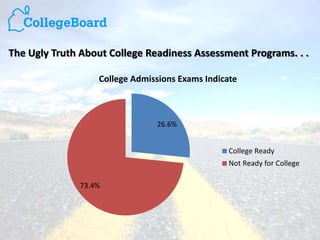
The Ugly Truth About College Readiness Assessment Programs. . .
26.6%
73.4%
College Admissions Exams Indicate
College Ready
Not Ready for College
DUKE TIP at 7th Grade
• Students take the SAT or ACT test
• High enough ceiling to determine their actual
abilities
• Opportunity for state and national recognition
Readi-Step at 8th Grade
• Low stakes assessment
• Critical Reading, Math, Writing
• Score range 2-7
• critical feedback on student strengths and
weaknesses
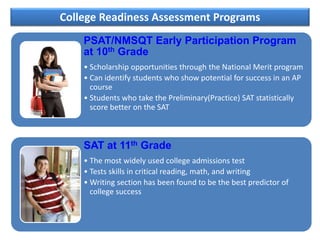
College Readiness Assessment Programs
PSAT/NMSQT Early Participation Program
at 10th Grade
• Scholarship opportunities through the National Merit program
• Can identify students who show potential for success in an AP
course
• Students who take the Preliminary(Practice) SAT statistically
score better on the SAT
SAT at 11th Grade
• The most widely used college admissions test
• Tests skills in critical reading, math, and writing
• Writing section has been found to be the best predictor of
college success
GPISD Prep Courses for College Entrance Exams
• PSAT Prep Academy
– Offered to 10th graders who demonstrate the
potential to be recognized by the National Merit
Scholars program
– 47 students were invited to participate in
summer/fall 2009
– Intensive course allows students to develop
deeper understanding of content in critical
reading, math, and writing
– Average 16 point gain
– Average score for GPISD PSAT Prep Academy
students as juniors: 190
– Average National PSAT score for juniors: 142
– Six of the 18 participants scored over 200 (in the
top 4% of the nation)
– One National Merit Finalist for 2010-2011 and a
number of other National Merit scholars to be
recognized
Apply Texas www.applytexas.org
Minnie Stevens Piper Foundation
www.everychanceeverytexan.org/about/scholars/
Texas College and Career Readiness Program:
www.txccrs.org/
College Portraits: www.collegeportraits.org/
The Texas Higher Education Coordinating Board
www.thecb.state.tx.us/
AP Potential: www.appotential.collegeboard.org
The College Board: www.collegeboard.com/
You Can Go: youcango.collegeboard.org/
Big Future: bigfuture.collegeboard.org/
Common Application www.commonapp.org/CommonApp/default.aspx
TOPCAT: www.collegefortexans.com/
The Launch of College Board’s New Site
for College Readiness: bigfuture
Contact Information
Jeffrey Miller
Executive Director of Post
Secondary Readiness
Jerry Burkett
Director of College
Readiness Partnerships
Cathy Shaver
Director of Secondary
College Readiness
Debbie Midkiff
Director of Elementary
College Readiness
Jeffrey.Miller@gpisd.org Jerry.Burkett@gpisd.org Cathy.Shaver@gpisd.org Debbie.Midkiff@gpisd.org
972-237-4039 972-237-4024 972-237-4036 972-237-4032
@JeffreyEducator @DrJerryRBurkett

Road Map to College

  • 1.
    Road Map toCollege Parent Workshop GPISD Post Secondary Readiness Department
  • 2.
    •What is CollegeReadiness & why is it important? •How to Build a College Readiness Culture -Parent & District Partnership •The Road Map to College - Rigorous Courses -College Readiness Assessment Programs •Q&A
  • 3.
  • 4.
  • 5.
    The College Advantage:Weathering the Economic Storm Georgetown University Center on Education and the Workforce, August 2012 Why is College Readiness?
  • 6.
    Top Five Factors InfluencingCollege Admission Decisions  Grade Point Average 53.7%  Class Ranking 31.2%  SAT or ACT Scores 59.3% The rigor of the coursework in a student’s high school career COUNTS  Essay 23.3%  Grades in College Prep Courses 73.9%
  • 8.
    It is importantthat parents and families be part of the process to build a college-going culture, and that connections are made between schools and students’ families and their community.
  • 9.
  • 10.
  • 12.
    Rigorous, College Preparatory and/orCollege Level Course Offerings Distinguished Achievement Program College Readiness Assessment Programs Prep Courses for College Entrance Exams
  • 14.
    • Available ingrades 6-12 in ELA, math, science, social studies, fines arts, as well as world languages • A more in-depth study of content, taught at a more accelerated pace • Strategies designed to build the foundation for college level work GPISD Pre-Advanced Placement Program
  • 15.
    • GPISD offerscollege-level AP courses taught in a wide variety of subject areas • Opportunities for students to earn college credit with an exam score of 3, 4, or 5 • A record 545 qualifying scores in 2012, saving parents thousands of dollars in tuition costs • Over 1500 exams were administered during the first two weeks of May 2012 GPISD Advanced Placement Program
  • 16.
    Dual Credit Opportunities DallasCounty Community Colleges tuition for GPISD students • Courses offered on high school campus as well as on the community college campuses UTA Honors College • GPISD began a partnership in 1999 as the inaugural district to offer college courses to high achieving high school students • If students meet the following criteria, they may receive to UTA • 1200 on the SAT • completion of at least 6 hours of UTA credit prior to graduation • maintaining at least a “B” average in each UTA course
  • 17.
    Understanding Weighted GradePoint Average • Beginning the Grade Point Average (GPA) – Taking high school courses in middle school begins a student’s GPA (grade point average) – Once a credit has been awarded, courses cannot be re-taken for a higher grade • Weighted GPA – Regular classes are weighted on a 4.0 scale – Pre-AP classes are weighted on a 4.5 scale – AP and Dual Credit classes are weighted on a 5.0 scale
  • 19.
    Distinguished Achievement Program(DAP) Requirements Students must receive credit for the following course. • 4 ELA credits including English I, II, III, IV • 4 Math credits including Algebra I, Geometry, Algebra II • 4 Science credits including Biology, Chemistry, Physics • 4 Social Studies credits including World Geography, World History, US History, US Government, Economics • 3 years of the same Foreign Language • 1 credit of PE • ½ credit of Speech • 1 credit of Technology Applications • 1 credit of Fine Arts • 4 ½ credits of Elective courses Students must also meet the following standards. • cumulative score requirement in each of the four basic content areas. • Achieve Advanced Academic Performance on the Algebra II and English III Reading and Writing assessments
  • 20.
    To achieve aDAP Diploma, a student must also achieve any combination of four of the following advanced measures:  Original research /project that is: Judged by a panel of professionals in the field, conducted under the direction of mentors and reported to an appropriate audience, and related to the required curriculum (Essential Knowledge and Skills)
  • 21.
    AP Spanish LiteratureV – 10th or 11th AP Spanish Language IV – 8th Cultural and Linguistic Topics 9th Pre-AP Spanish III– 7th or 8th Articulation of Spanish Courses SPANISH
  • 23.
    The Ugly TruthAbout College Readiness Assessment Programs. . . 26.6% 73.4% College Admissions Exams Indicate College Ready Not Ready for College
  • 24.
    DUKE TIP at7th Grade • Students take the SAT or ACT test • High enough ceiling to determine their actual abilities • Opportunity for state and national recognition Readi-Step at 8th Grade • Low stakes assessment • Critical Reading, Math, Writing • Score range 2-7 • critical feedback on student strengths and weaknesses College Readiness Assessment Programs
  • 25.
    College Readiness AssessmentPrograms PSAT/NMSQT Early Participation Program at 10th Grade • Scholarship opportunities through the National Merit program • Can identify students who show potential for success in an AP course • Students who take the Preliminary(Practice) SAT statistically score better on the SAT SAT at 11th Grade • The most widely used college admissions test • Tests skills in critical reading, math, and writing • Writing section has been found to be the best predictor of college success
  • 26.
    GPISD Prep Coursesfor College Entrance Exams • PSAT Prep Academy – Offered to 10th graders who demonstrate the potential to be recognized by the National Merit Scholars program – 47 students were invited to participate in summer/fall 2009 – Intensive course allows students to develop deeper understanding of content in critical reading, math, and writing – Average 16 point gain – Average score for GPISD PSAT Prep Academy students as juniors: 190 – Average National PSAT score for juniors: 142 – Six of the 18 participants scored over 200 (in the top 4% of the nation) – One National Merit Finalist for 2010-2011 and a number of other National Merit scholars to be recognized
  • 27.
    Apply Texas www.applytexas.org MinnieStevens Piper Foundation www.everychanceeverytexan.org/about/scholars/ Texas College and Career Readiness Program: www.txccrs.org/ College Portraits: www.collegeportraits.org/ The Texas Higher Education Coordinating Board www.thecb.state.tx.us/ AP Potential: www.appotential.collegeboard.org The College Board: www.collegeboard.com/ You Can Go: youcango.collegeboard.org/ Big Future: bigfuture.collegeboard.org/ Common Application www.commonapp.org/CommonApp/default.aspx TOPCAT: www.collegefortexans.com/
  • 28.
    The Launch ofCollege Board’s New Site for College Readiness: bigfuture
  • 29.
    Contact Information Jeffrey Miller ExecutiveDirector of Post Secondary Readiness Jerry Burkett Director of College Readiness Partnerships Cathy Shaver Director of Secondary College Readiness Debbie Midkiff Director of Elementary College Readiness Jeffrey.Miller@gpisd.org Jerry.Burkett@gpisd.org Cathy.Shaver@gpisd.org Debbie.Midkiff@gpisd.org 972-237-4039 972-237-4024 972-237-4036 972-237-4032 @JeffreyEducator @DrJerryRBurkett

Editor's Notes

  • #7 In a survey of college admissions officers, they were asked what factors played the most significant roles in determining a student’s college admission. In order of importance, these factors were: Essay 23.3% Class Ranking 31.2% Grade Point Average 53.7% SAT/ACT Scores 59.3% Grades in Rigorous College Prep Courses 73.9% The rigor of the coursework in a student’s high school career COUNTS
  • #15 Open to all students who are motivated and willing to develop the scholarly habits of mind needed to succeed in an advanced course. Study skills Time management Problem solving and higher level thinking Persistence Reasoning Analysis
  • #16 545 x $765 (avg cost per 3 hour course) = $416,925 dollars in potential savings to GPISD parents from the May 2010 exams!!! 7665 divided by 30 hours = $255 per hour x 3 = $765
  • #17 GPISD would like to increase the number community college courses taught on campus by GPISD teachers. In order to teach a community college course, a teacher must have a Master’s degree or a minimum of 18 graduate hours in their content area. 7 GPISD students are currently receiving the UTA Honors College Scholarship – more qualified, but went on to attend other colleges or universities GPISD is investigating the possibility of an Early College High School – which allows students to graduate from high school with 2 years of college credit under their belt.
  • #18 It is important to understand that taking a high school course in middle school begins a student’s GPA – a student’s GPA acculumates over the course of his/her high school career and determines class ranking The GPA determines whether a student is in the top 10% of his/her graduating class – which is required for automatic admission in to state universities in Texas The GPA determines who is valedictorian and salutatorian in each class A grade point average is the cumulative points gained in each high school course accumulated over the course of a student’s high school career Getting into college is more than GPA Weighted GPA A B in a PreAP/AP course is better than an A in a regular course For example – if you have taken Algebra early - early high school math courses, will mean you will be taking AP Calculus /AP Stats – which will help you get into college – stopping at PreCal puts you equal with everyone else – as opposed to moving onto AP level courses If you just chase the GPA without considering 1. taking the more rigorous path – of AP courses 2. taking the exam and taking it seriously 3. applying yourself to the learning – not just the weighted GPA Many kids get into college but cannot make it. What you learn in your AP courses is more important in that it helps you succeed in college. Exam scores of 3+ mean $$ in your pocket – this can bring scholarships and college credit before you graduate You could take AP Lang, AP Lit, AP World, AP US and get 12 hours of college credit
  • #20 The difference here between distinguished and recommended plan is 3 credits vs 2 credits in LOTE And 2 ½ elective credits vs 3 ½ elective credits But the DAP also requires additional measures . . . .
  • #21 Original research /project that is: Judged by a panel of professionals in the field, Conducted under the direction of mentors and Reported to an appropriate audience, and Related to the required curriculum (Essential Knowledge and Skills)
  • #22 Students who take and make a 5 on AP Spanish earn up to 21 hours of college credit at University of Texas at Austin. If they go on to take AP Spanish Lit and earn a 5 on the exam, they earn an additional 27 hours of college credit – giving them 48 hours of credit by the time they are in 10th or 11th grades! And enough college credit to earn a minor in Spanish. Think of the $$ that this will save a parent!
  • #24 College Admissions tests like the SAT and ACT indicate that only about 26% of students are college ready upon graduation from high school.
  • #25 Grand Prairie ISD has demonstrated its commitment to building a culture of college readiness by funding the ReadiStep for all 8th grade students and the PSAT for all 10th grade students. Students and parents can use the results to determine where they are on the path to college readiness and to build on strengths and target weaknesses. DUKE TIP: The 7th Grade Talent Search identifies academically talented seventh graders based on standardized test scores achieved while attending elementary or middle school. Candidates are invited to take the ACT or the SAT college entrance exam as seventh graders, which allows them greater insight into their academic abilities. Traditional testing often fails to measure the variation among many gifted students who reach the upper limits of scoring on grade-level exams. Above-level testing at least two years above a student's current grade placement offers gifted students and their families a far better understanding of how the student compares to his or her gifted peers and what level of educational challenge is appropriate. Students who participate in the DUKE Talent Search also have opportunities for state and national recognition. Students who participate in the DUKE TIP Program Take the SAT or ACT test with high school juniors and seniors Take part in a test with a high enough ceiling to determine their actual abilities Have an opportunity for state and national recognition Grand Prairie ISD will administer the Readi-Step this October to all 8th graders This low stakes assessment helps provide students with the steps they need to set them on the path to college Tests Critical Reading, Math, Writing Score range 2-8 It gives students critical feedback on their strengths and weaknesses and enables teachers to make informed decisions about instruction in the classroom
  • #26 PSAT/NMSQT is the early PSAT program given to all 10th grade students Critical Reading, Math, Writing Score range of 20-80 This preliminary SAT gives students practice on an SAT-like assessment – they get critical skills feedback, and have scholarship opportunities through the national merit program. The PSAT can identify students who show potential for success in an AP course. Students who take the Preliminary (Practice) SAT statistically score better on the SAT. SAT is the most widely used college admissions test and gives students the opportunity to show their skills in critical reading, math, and writing – the same skills identified for college success Score range of 200-800 It is aligned with state standards and current high school and college curricula Although fairly new, the Writing section has been found to be the best predictor of college success – the writing section gives colleges information they need about admissions and placement Grand Prairie’s commitment to giving students the tools to determine where they are on the college pathway will over time help families make important decisions about preparing for college and will help establish a college-going culture in our community.
  • #27 PSAT Academy For National Merit potential students Average score gain on PSAT 16 points 52 students were invited in 2010 - 27 are participating 3 National Merit hopefuls in the current group
  • #29 Find colleges Find out about paying for college Find out about college admission policies Start a plan for getting there Don’t know where to begin? There is a button for that too.