Colorado Developmental
Education Redesign
January 15, 2013
The problem
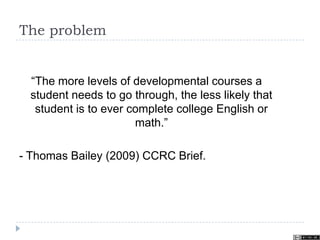
“The more levels of developmental courses a
student needs to go through, the less likely that
student is to ever complete college English or
math.”
- Thomas Bailey (2009) CCRC Brief.
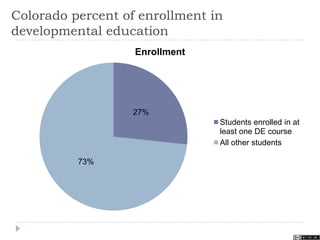
Colorado percent of enrollment in
developmental education
27%
73%
Enrollment
Students enrolled in at
least one DE course
All other students
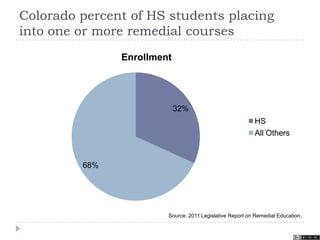
Colorado percent of HS students placing
into one or more remedial courses
32%
68%
Enrollment
HS
All Others
Source: 2011 Legislative Report on Remedial Education,
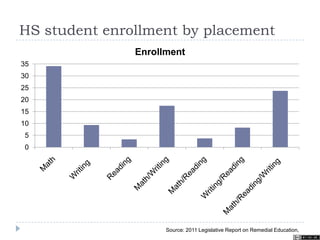
HS student enrollment by placement
0
5
10
15
20
25
30
35
Enrollment
Source: 2011 Legislative Report on Remedial Education,
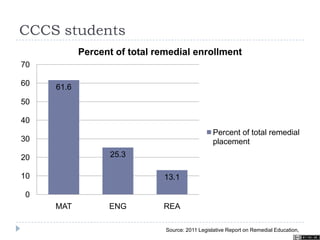
CCCS students
61.6
25.3
13.1
0
10
20
30
40
50
60
70
MAT ENG REA
Percent of total remedial enrollment
Percent of total remedial
placement
Source: 2011 Legislative Report on Remedial Education,
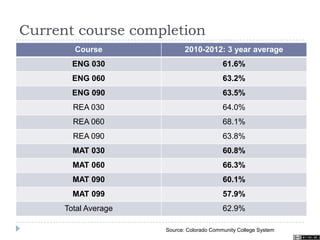
Current course completion
Course 2010-2012: 3 year average
ENG 030 61.6%
ENG 060 63.2%
ENG 090 63.5%
REA 030 64.0%
REA 060 68.1%
REA 090 63.8%
MAT 030 60.8%
MAT 060 66.3%
MAT 090 60.1%
MAT 099 57.9%
Total Average 62.9%
Source: Colorado Community College System
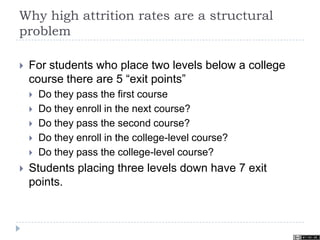
Why high attrition rates are a structural
problem
 For students who place two levels below a college
course there are 5 “exit points”
 Do they pass the first course
 Do they enroll in the next course?
 Do they pass the second course?
 Do they enroll in the college-level course?
 Do they pass the college-level course?
 Students placing three levels down have 7 exit
points.
Why high attrition rates are a structural
problem
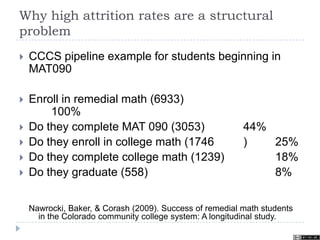
 CCCS pipeline example for students beginning in
MAT090
 Enroll in remedial math (6933)
100%
 Do they complete MAT 090 (3053) 44%
 Do they enroll in college math (1746 ) 25%
 Do they complete college math (1239) 18%
 Do they graduate (558) 8%
Nawrocki, Baker, & Corash (2009). Success of remedial math students
in the Colorado community college system: A longitudinal study.
The goal of our recommendations
Move students quickly and effectively through their
first college level course.
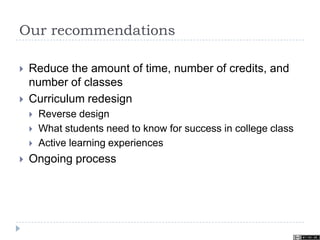
Our recommendations
 Reduce the amount of time, number of credits, and
number of classes
 Curriculum redesign
 Reverse design
 What students need to know for success in college class
 Active learning experiences
 Ongoing process
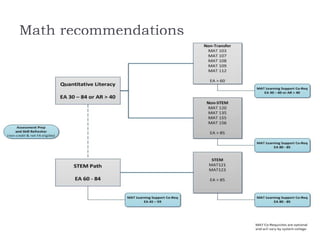
Math recommendations
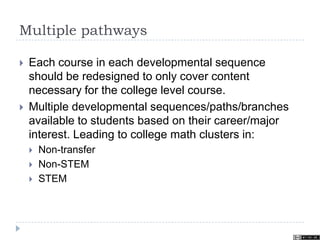
Multiple pathways
 Each course in each developmental sequence
should be redesigned to only cover content
necessary for the college level course.
 Multiple developmental sequences/paths/branches
available to students based on their career/major
interest. Leading to college math clusters in:
 Non-transfer
 Non-STEM
 STEM
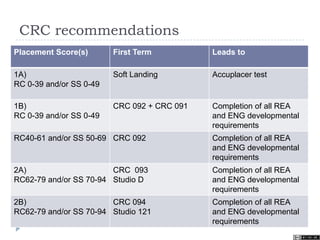
CRC recommendations
Placement Score(s) First Term Leads to
1A)
RC 0-39 and/or SS 0-49
Soft Landing Accuplacer test
1B)
RC 0-39 and/or SS 0-49
CRC 092 + CRC 091 Completion of all REA
and ENG developmental
requirements
RC40-61 and/or SS 50-69 CRC 092 Completion of all REA
and ENG developmental
requirements
2A)
RC62-79 and/or SS 70-94
CRC 093
Studio D
Completion of all REA
and ENG developmental
requirements
2B)
RC62-79 and/or SS 70-94
CRC 094
Studio 121
Completion of all REA
and ENG developmental
requirements
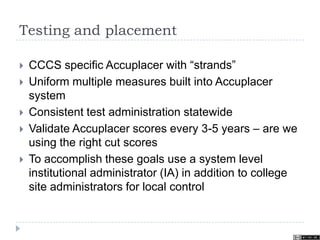
Testing and placement
 CCCS specific Accuplacer with “strands”
 Uniform multiple measures built into Accuplacer
system
 Consistent test administration statewide
 Validate Accuplacer scores every 3-5 years – are we
using the right cut scores
 To accomplish these goals use a system level
institutional administrator (IA) in addition to college
site administrators for local control
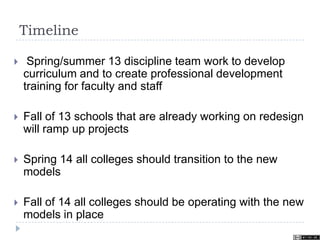
Timeline
 Spring/summer 13 discipline team work to develop
curriculum and to create professional development
training for faculty and staff
 Fall of 13 schools that are already working on redesign
will ramp up projects
 Spring 14 all colleges should transition to the new
models
 Fall of 14 all colleges should be operating with the new
models in place
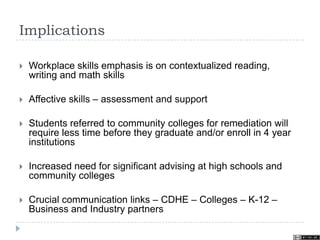
Implications
 Workplace skills emphasis is on contextualized reading,
writing and math skills
 Affective skills – assessment and support
 Students referred to community colleges for remediation will
require less time before they graduate and/or enroll in 4 year
institutions
 Increased need for significant advising at high schools and
community colleges
 Crucial communication links – CDHE – Colleges – K-12 –
Business and Industry partners
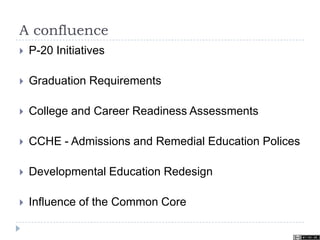
A confluence
 P-20 Initiatives
 Graduation Requirements
 College and Career Readiness Assessments
 CCHE - Admissions and Remedial Education Polices
 Developmental Education Redesign
 Influence of the Common Core
Questions?
Resources
C o n t a c t s :
C a s e y S a c k s c a s e y. s a c k s @ c c c s . e d u
B i t s y C o h n b i t s y. c o h n @ c c c s . e d u
D e ve l o p m e n t a l E d u c a t i o n Ta s k F o r c e
w w w.cccs.edu/detf
C o m m u n i t y C o l l e g e R e s e a r c h C e n t e r
http: //ccrc.tc.columbia.edu/
C o m p l e t e C o l l e g e Am e r i c a
http: //w ww.completecollege.org/
G e t t i n g P a s t G o
http: //gettingpastgo.org
Colorado Commission on Higher Education. 2011 Legislative
Report on Remedial Education . February 2012.
http://highered.colorado.gov/Publications/Reports/Remedial/FY2011/2011_
Remedial_relfeb12.pdf. Accessed 01/14/13.
Creative Commons
Attribution
This work by Colorado Community College System COETC Grant is licensed under a Creative Commons Attribution 3.0 Unported License.
The material was created with funds from the Trade Adjustment Assistance Community College and Career Training (TAACCCT) Grant
awarded to the Colorado Online Energy Training Consortium (COETC).Based on a work at www.cccs.edu.Permissions beyond the scope of
this license may be available at www.cccs.edu.

Acec 1 15 13

  • 1.
  • 2.
    The problem “The morelevels of developmental courses a student needs to go through, the less likely that student is to ever complete college English or math.” - Thomas Bailey (2009) CCRC Brief.
  • 3.
    Colorado percent ofenrollment in developmental education 27% 73% Enrollment Students enrolled in at least one DE course All other students
  • 4.
    Colorado percent ofHS students placing into one or more remedial courses 32% 68% Enrollment HS All Others Source: 2011 Legislative Report on Remedial Education,
  • 5.
    HS student enrollmentby placement 0 5 10 15 20 25 30 35 Enrollment Source: 2011 Legislative Report on Remedial Education,
  • 6.
    CCCS students 61.6 25.3 13.1 0 10 20 30 40 50 60 70 MAT ENGREA Percent of total remedial enrollment Percent of total remedial placement Source: 2011 Legislative Report on Remedial Education,
  • 7.
    Current course completion Course2010-2012: 3 year average ENG 030 61.6% ENG 060 63.2% ENG 090 63.5% REA 030 64.0% REA 060 68.1% REA 090 63.8% MAT 030 60.8% MAT 060 66.3% MAT 090 60.1% MAT 099 57.9% Total Average 62.9% Source: Colorado Community College System
  • 8.
    Why high attritionrates are a structural problem  For students who place two levels below a college course there are 5 “exit points”  Do they pass the first course  Do they enroll in the next course?  Do they pass the second course?  Do they enroll in the college-level course?  Do they pass the college-level course?  Students placing three levels down have 7 exit points.
  • 9.
    Why high attritionrates are a structural problem  CCCS pipeline example for students beginning in MAT090  Enroll in remedial math (6933) 100%  Do they complete MAT 090 (3053) 44%  Do they enroll in college math (1746 ) 25%  Do they complete college math (1239) 18%  Do they graduate (558) 8% Nawrocki, Baker, & Corash (2009). Success of remedial math students in the Colorado community college system: A longitudinal study.
  • 10.
    The goal ofour recommendations Move students quickly and effectively through their first college level course.
  • 11.
    Our recommendations  Reducethe amount of time, number of credits, and number of classes  Curriculum redesign  Reverse design  What students need to know for success in college class  Active learning experiences  Ongoing process
  • 12.
  • 13.
    Multiple pathways  Eachcourse in each developmental sequence should be redesigned to only cover content necessary for the college level course.  Multiple developmental sequences/paths/branches available to students based on their career/major interest. Leading to college math clusters in:  Non-transfer  Non-STEM  STEM
  • 14.
    CRC recommendations Placement Score(s)First Term Leads to 1A) RC 0-39 and/or SS 0-49 Soft Landing Accuplacer test 1B) RC 0-39 and/or SS 0-49 CRC 092 + CRC 091 Completion of all REA and ENG developmental requirements RC40-61 and/or SS 50-69 CRC 092 Completion of all REA and ENG developmental requirements 2A) RC62-79 and/or SS 70-94 CRC 093 Studio D Completion of all REA and ENG developmental requirements 2B) RC62-79 and/or SS 70-94 CRC 094 Studio 121 Completion of all REA and ENG developmental requirements
  • 15.
    Testing and placement CCCS specific Accuplacer with “strands”  Uniform multiple measures built into Accuplacer system  Consistent test administration statewide  Validate Accuplacer scores every 3-5 years – are we using the right cut scores  To accomplish these goals use a system level institutional administrator (IA) in addition to college site administrators for local control
  • 16.
    Timeline  Spring/summer 13discipline team work to develop curriculum and to create professional development training for faculty and staff  Fall of 13 schools that are already working on redesign will ramp up projects  Spring 14 all colleges should transition to the new models  Fall of 14 all colleges should be operating with the new models in place
  • 17.
    Implications  Workplace skillsemphasis is on contextualized reading, writing and math skills  Affective skills – assessment and support  Students referred to community colleges for remediation will require less time before they graduate and/or enroll in 4 year institutions  Increased need for significant advising at high schools and community colleges  Crucial communication links – CDHE – Colleges – K-12 – Business and Industry partners
  • 18.
    A confluence  P-20Initiatives  Graduation Requirements  College and Career Readiness Assessments  CCHE - Admissions and Remedial Education Polices  Developmental Education Redesign  Influence of the Common Core
  • 19.
  • 20.
    Resources C o nt a c t s : C a s e y S a c k s c a s e y. s a c k s @ c c c s . e d u B i t s y C o h n b i t s y. c o h n @ c c c s . e d u D e ve l o p m e n t a l E d u c a t i o n Ta s k F o r c e w w w.cccs.edu/detf C o m m u n i t y C o l l e g e R e s e a r c h C e n t e r http: //ccrc.tc.columbia.edu/ C o m p l e t e C o l l e g e Am e r i c a http: //w ww.completecollege.org/ G e t t i n g P a s t G o http: //gettingpastgo.org Colorado Commission on Higher Education. 2011 Legislative Report on Remedial Education . February 2012. http://highered.colorado.gov/Publications/Reports/Remedial/FY2011/2011_ Remedial_relfeb12.pdf. Accessed 01/14/13.
  • 21.
    Creative Commons Attribution This workby Colorado Community College System COETC Grant is licensed under a Creative Commons Attribution 3.0 Unported License. The material was created with funds from the Trade Adjustment Assistance Community College and Career Training (TAACCCT) Grant awarded to the Colorado Online Energy Training Consortium (COETC).Based on a work at www.cccs.edu.Permissions beyond the scope of this license may be available at www.cccs.edu.

Editor's Notes

  • #13 Note that this is largely adapted from the Dana Center model. But that the mainstreaming options for colleges incorporate best practices from English and our current local successes in mainstreaming particularly at CCD in Fast Start.
  • #15 Review handout