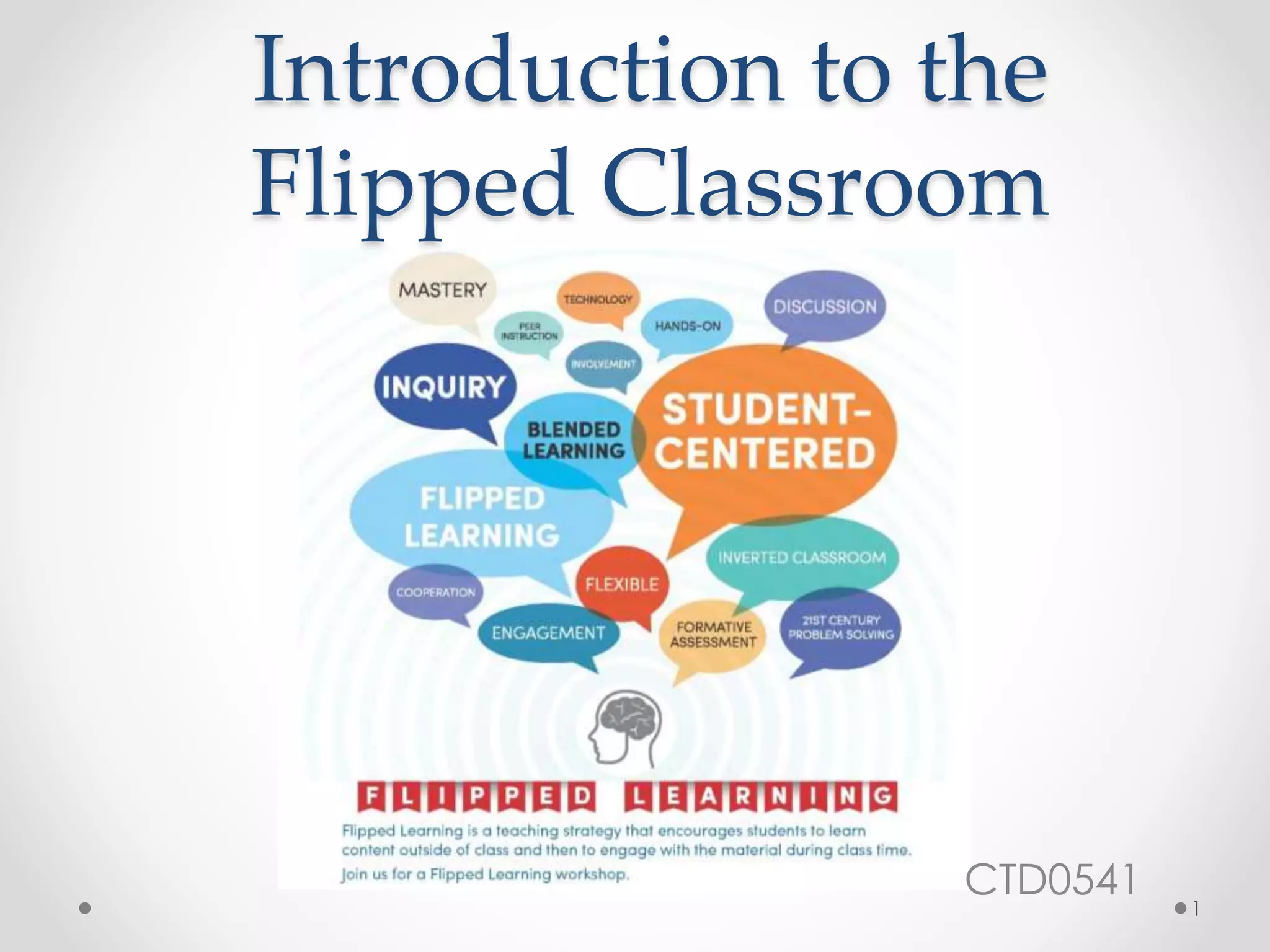
Introduction to the 
Flipped Classroom 
CTD0541 
1
What is Flipped 
Classroom? 
“The flipped classroom refers to a model of learning 
that rearranges how time is spent both in and out of 
class to shift the ownership of learning from the 
educators to the students.” 
NMC Horizon Report: 2014 Higher Education Edition 
2
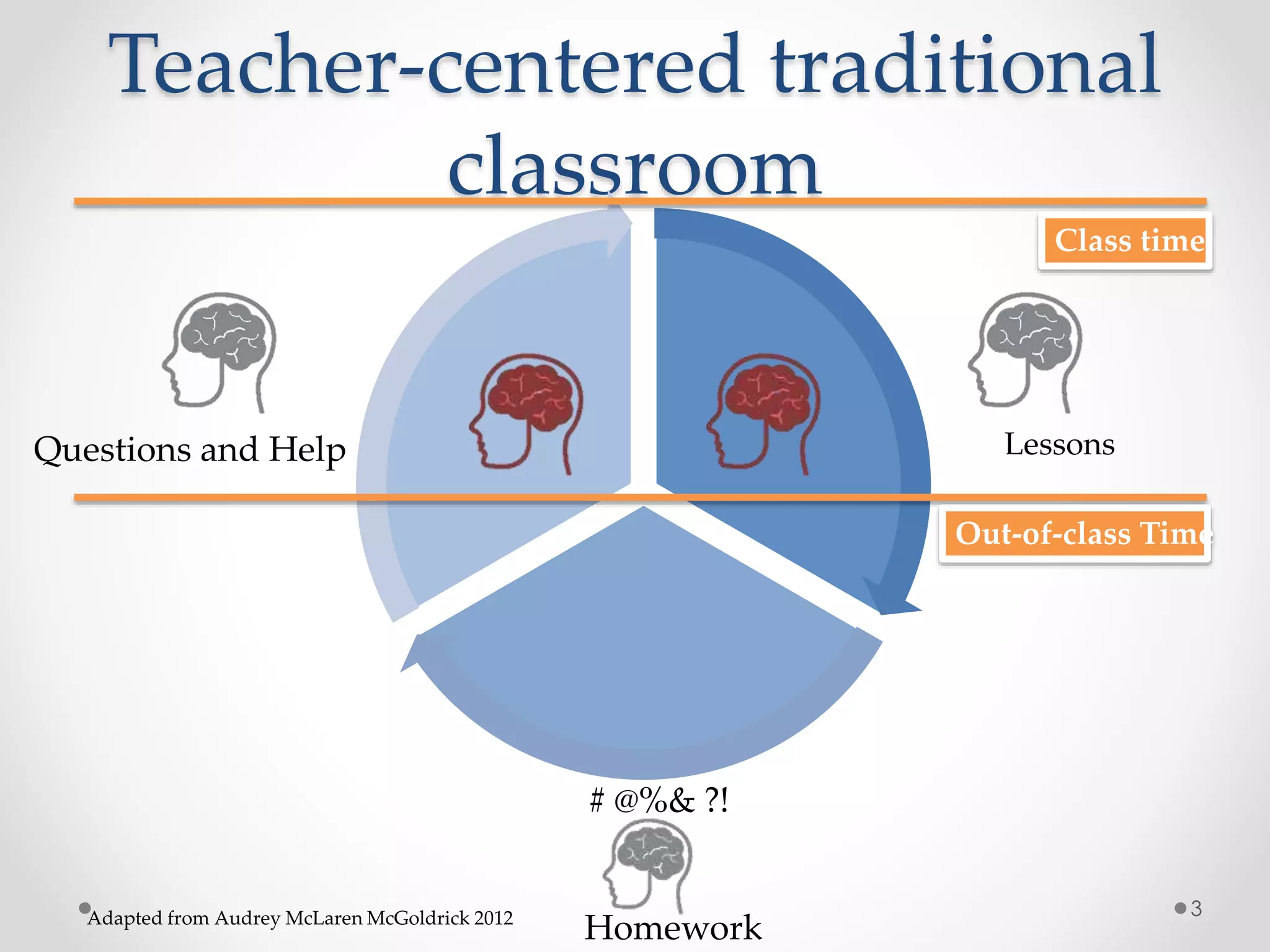
Teacher-centered traditional 
classroom 
Class time 
Questions and Help Lessons 
# @%& ?! 
Homework 
Adapted from Audrey McLaren McGoldrick 2012 
Out-of-class Time 
3
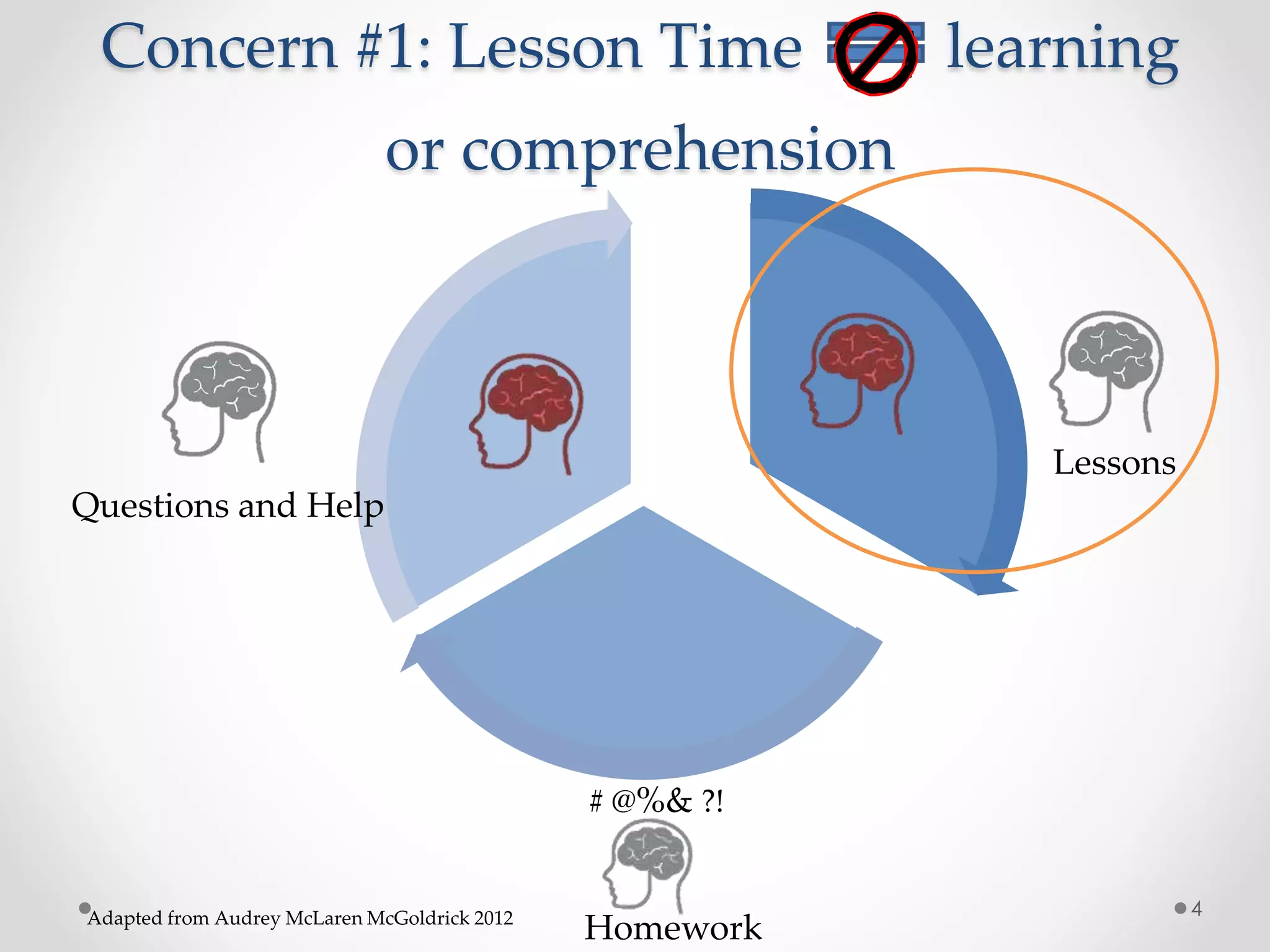
Concern #1: Lesson Time learning 
or comprehension 
Questions and Help 
Lessons 
# @%& ?! 
Adapted from Audrey McLaren McGoldrick 2012 4 
Homework
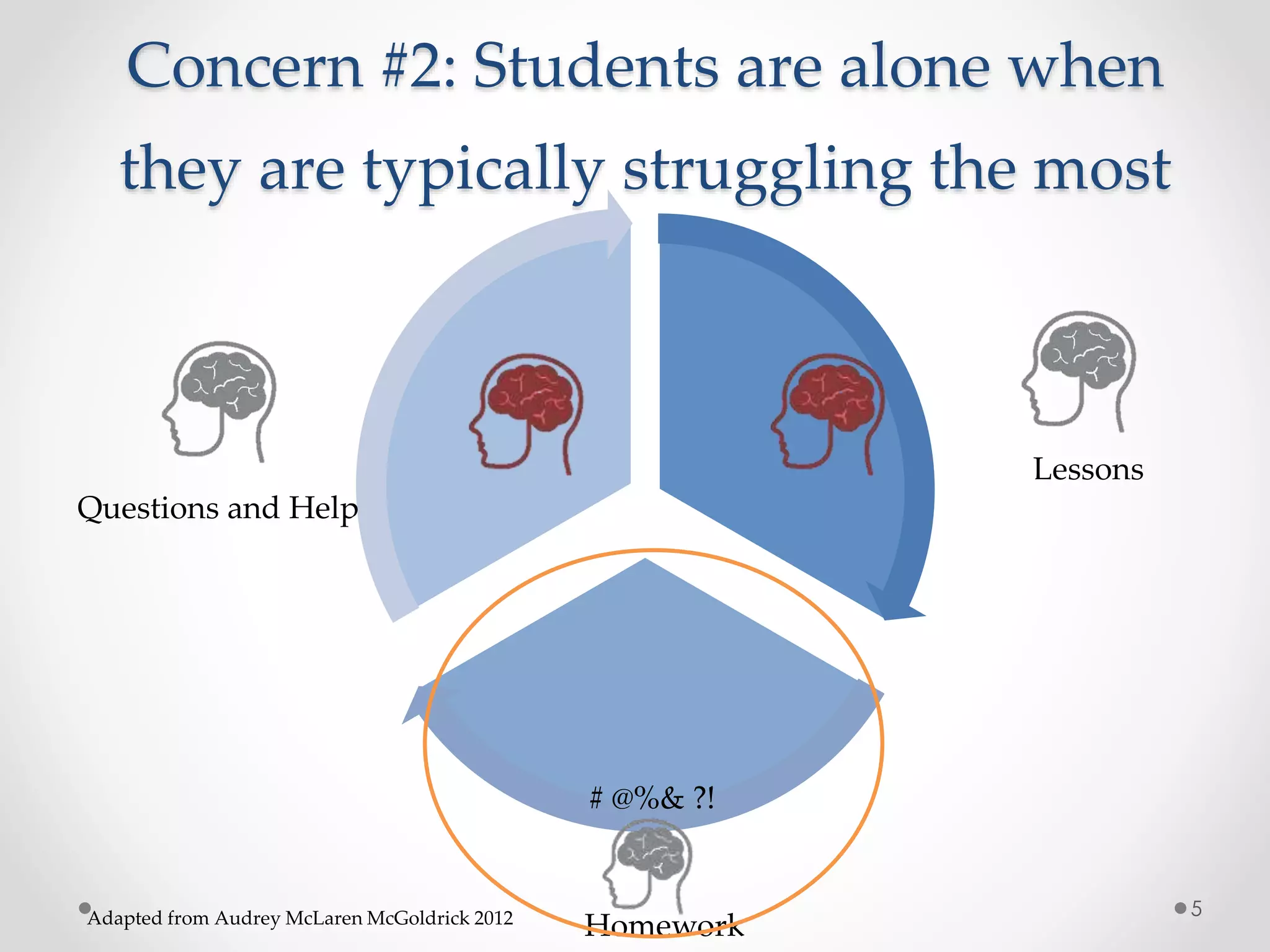
Concern #2: Students are alone when 
they are typically struggling the most 
Questions and Help 
Lessons 
# @%& ?! 
Adapted from Audrey McLaren McGoldrick 2012 5 
Homework
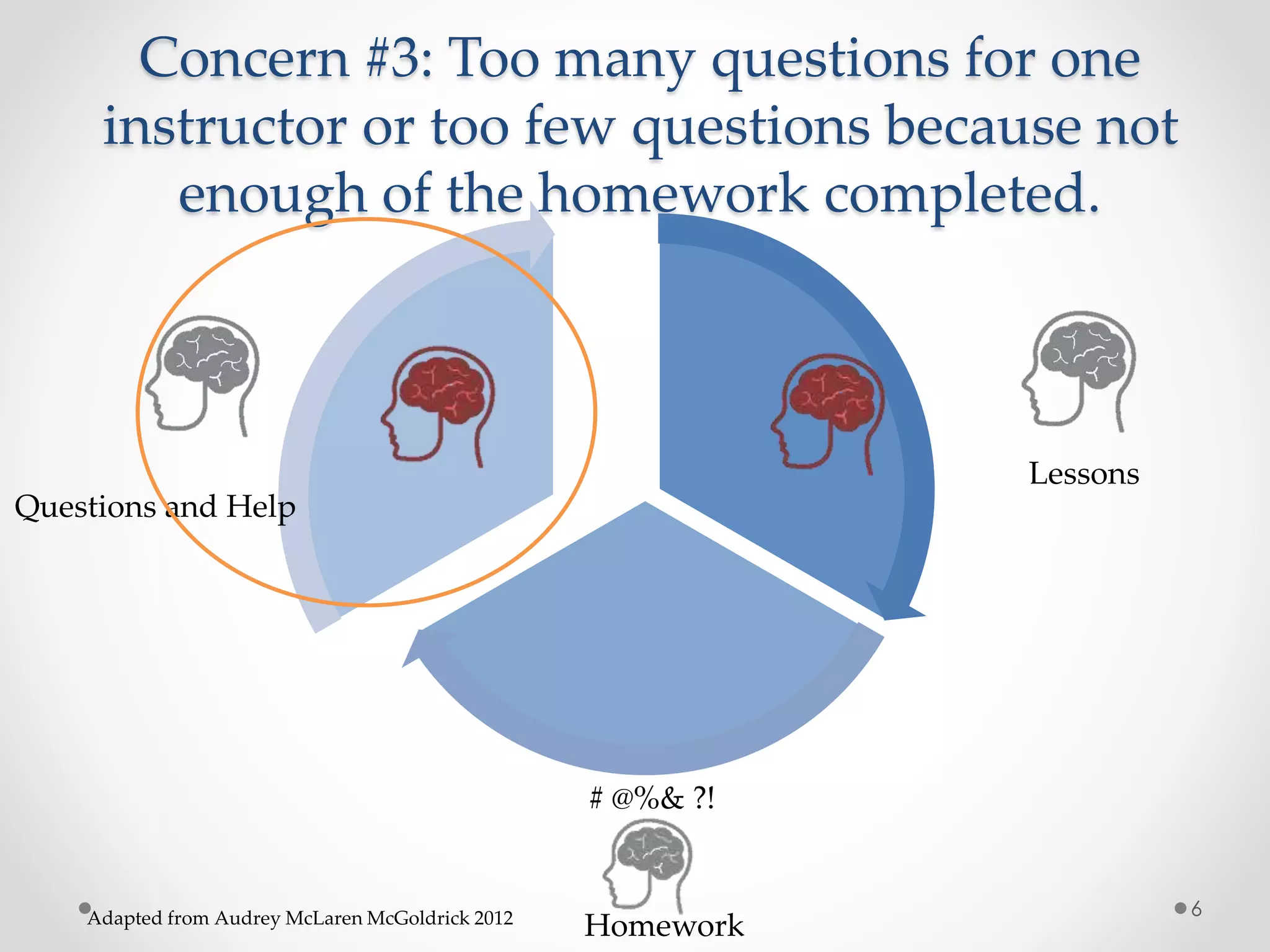
Concern #3: Too many questions for one 
instructor or too few questions because not 
enough of the homework completed. 
Questions and Help 
Lessons 
# @%& ?! 
Adapted from Audrey McLaren McGoldrick 2012 6 
Homework
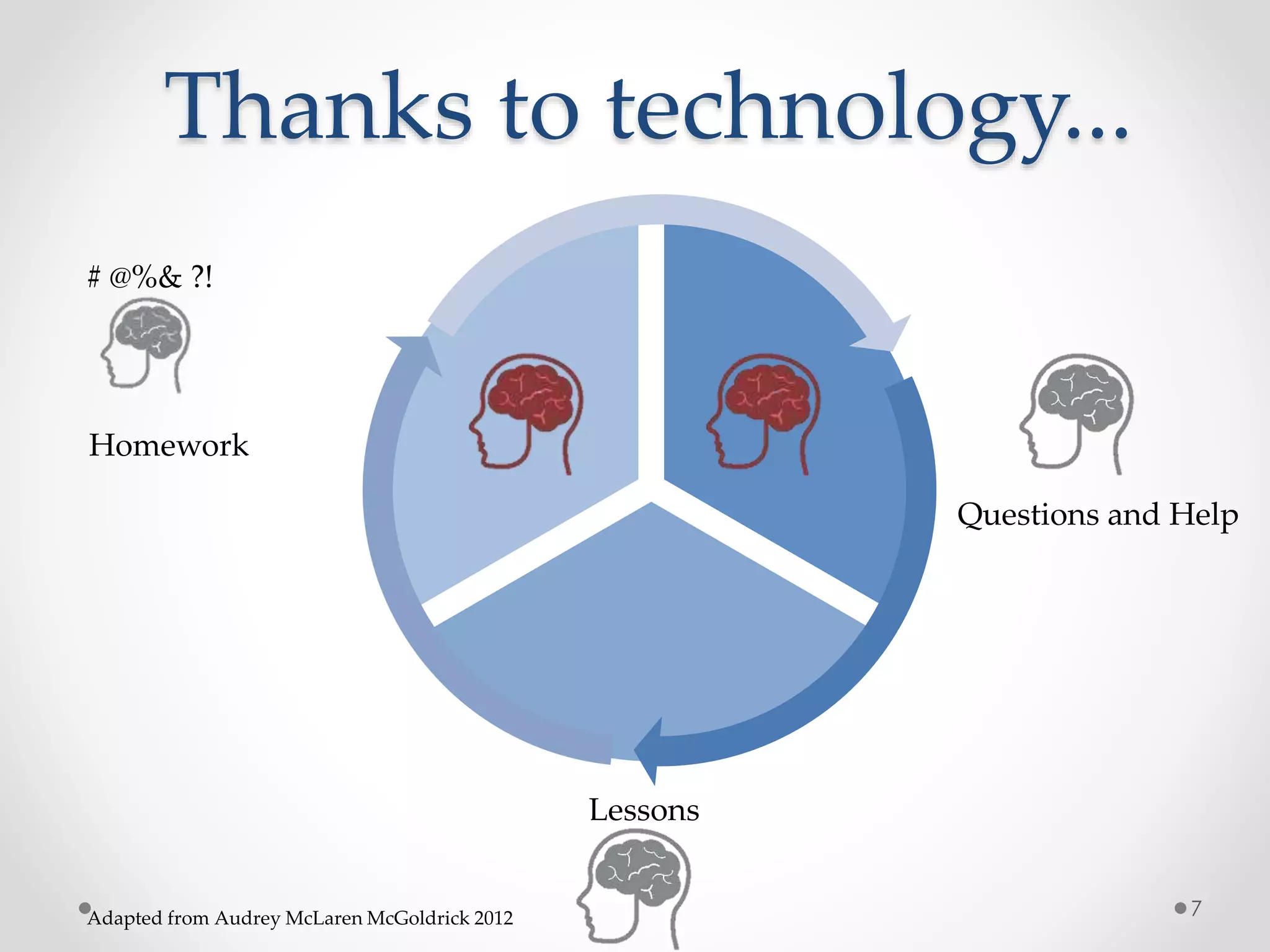
Thanks to technology... 
Questions and Help 
Lessons 
# @%& ?! 
Homework 
Adapted from Audrey McLaren McGoldrick 2012 7
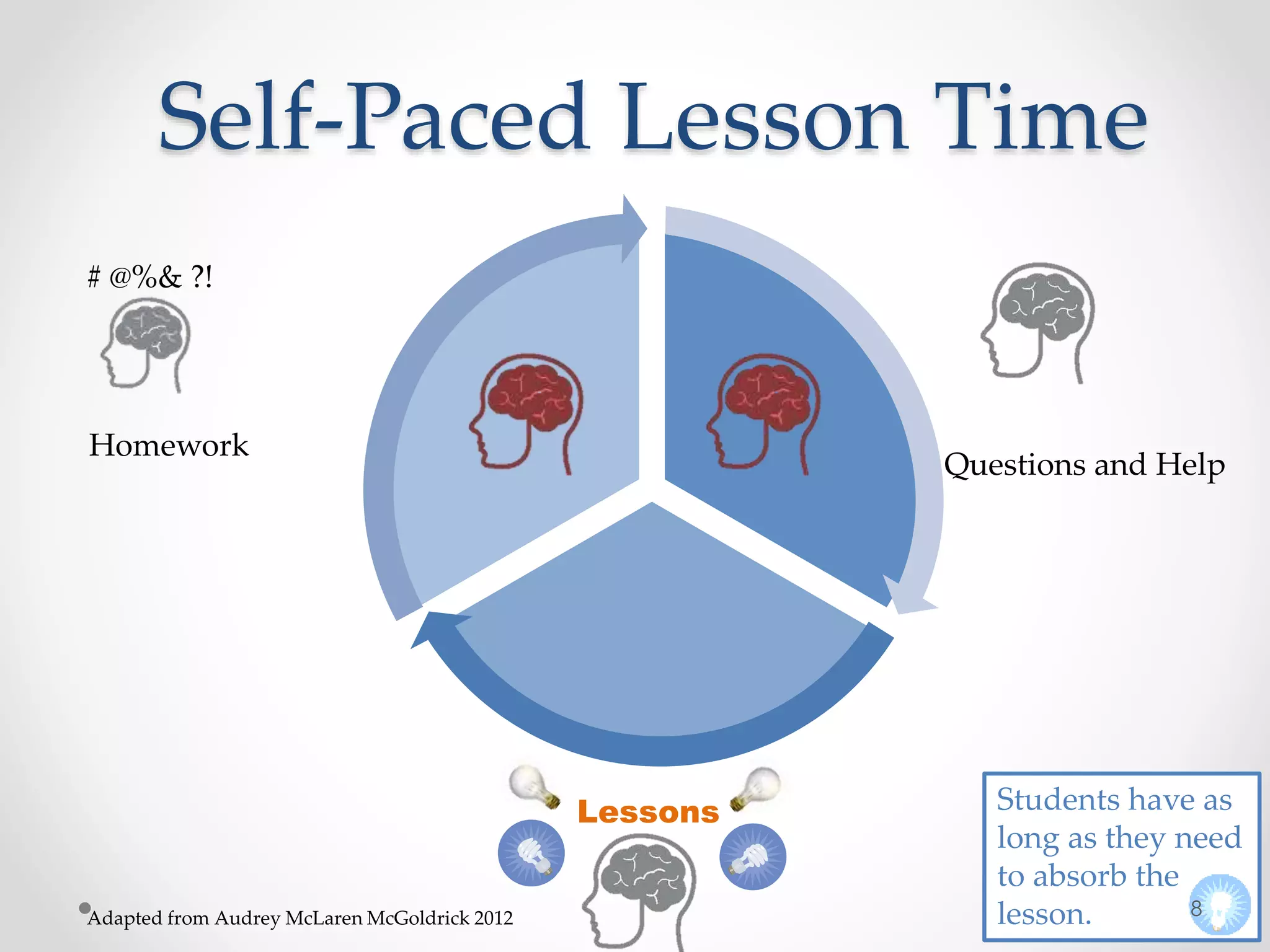
Self-Paced Lesson Time 
Questions and Help 
Lessons 
# @%& ?! 
Homework 
Adapted from Audrey McLaren McGoldrick 2012 
Students have as 
long as they need 
to absorb the 
lesson. 8
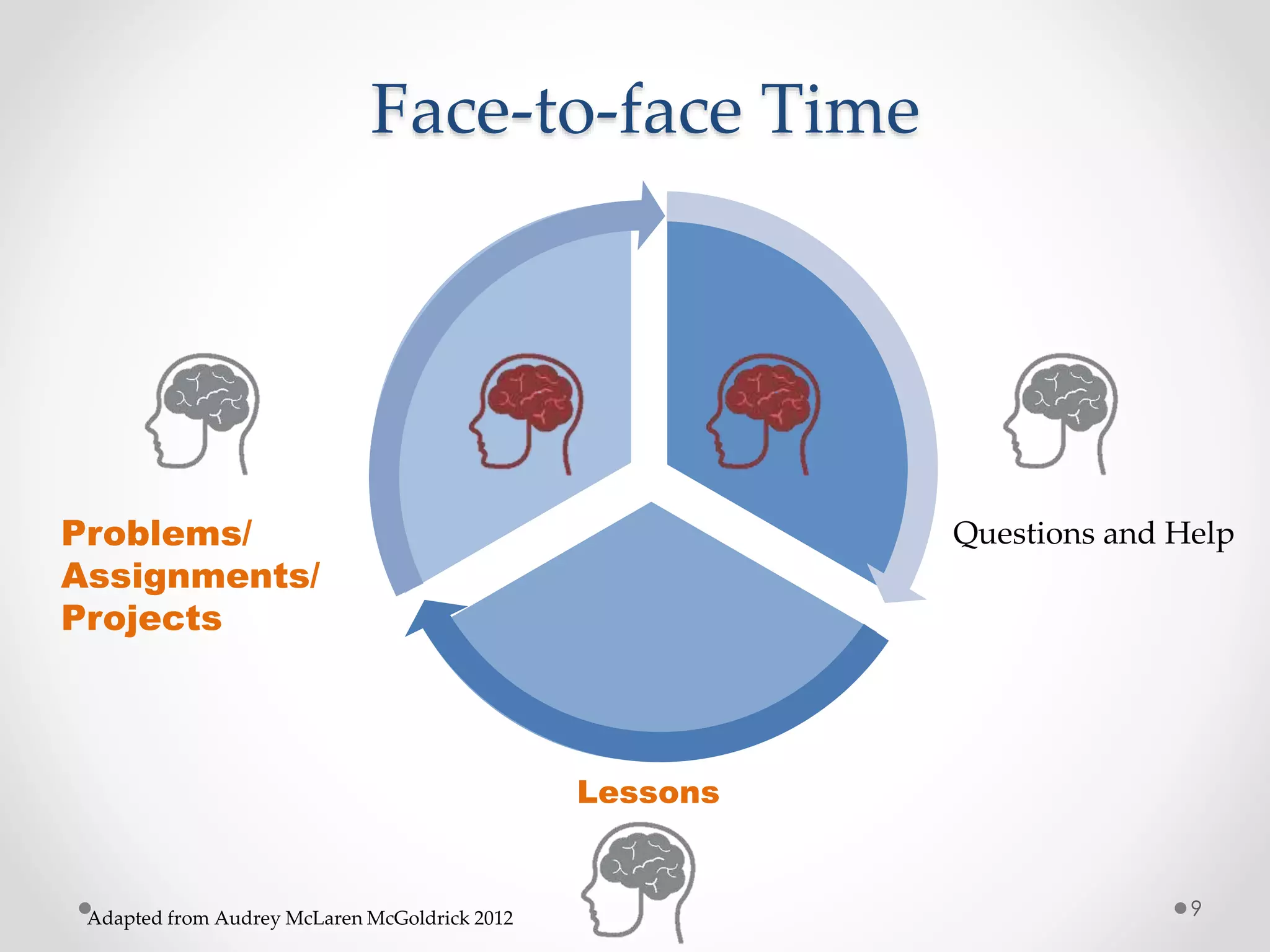
Face-to-face Time 
Problems/ Questions and Help 
Assignments/ 
Projects 
Adapted from Audrey McLaren McGoldrick 2012 
Lessons 
9
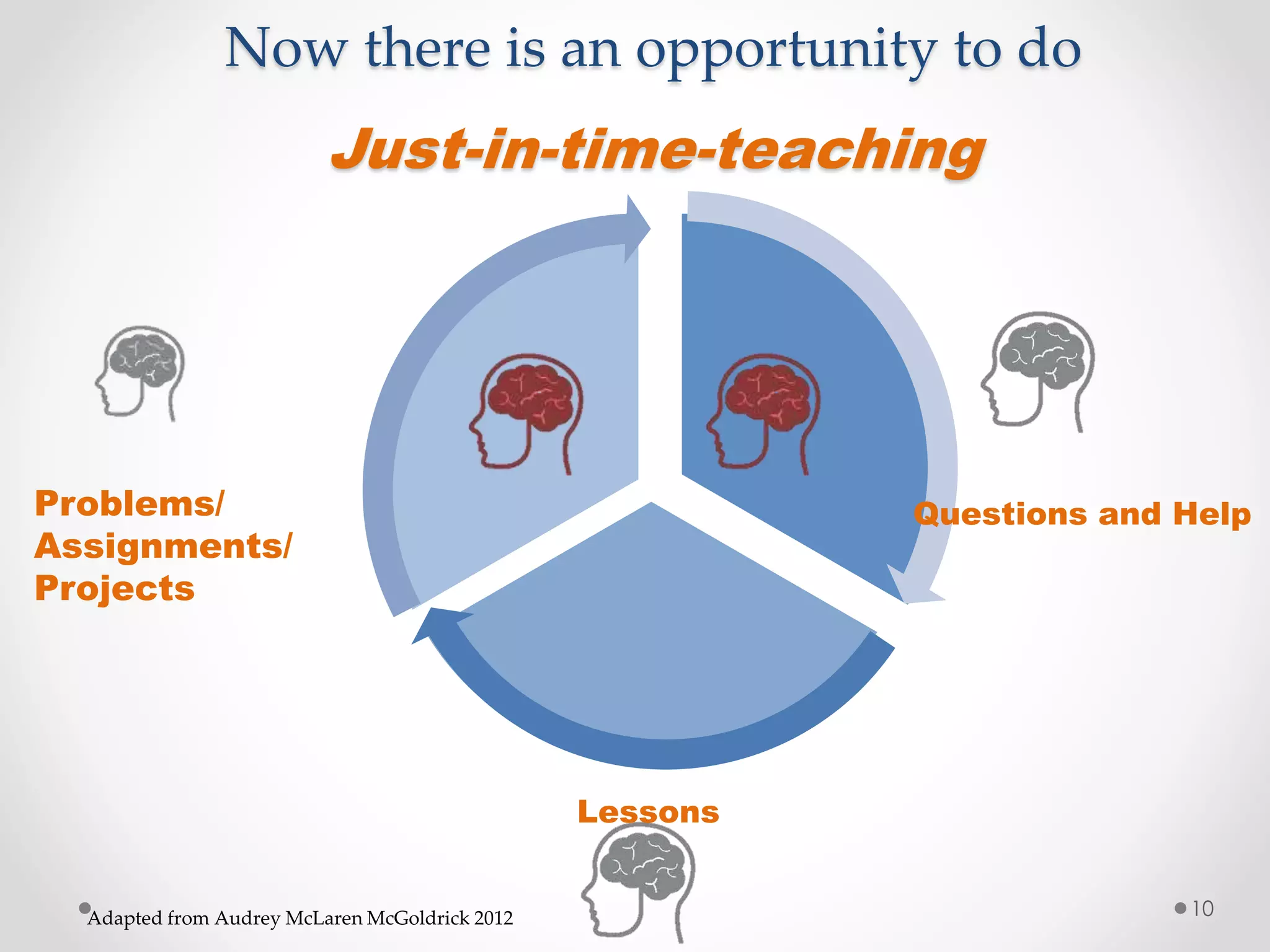
Now there is an opportunity to do 
Just-in-time-teaching 
Questions and Help 
Adapted from Audrey McLaren McGoldrick 2012 
Lessons 
Problems/ 
Assignments/ 
Projects 
10
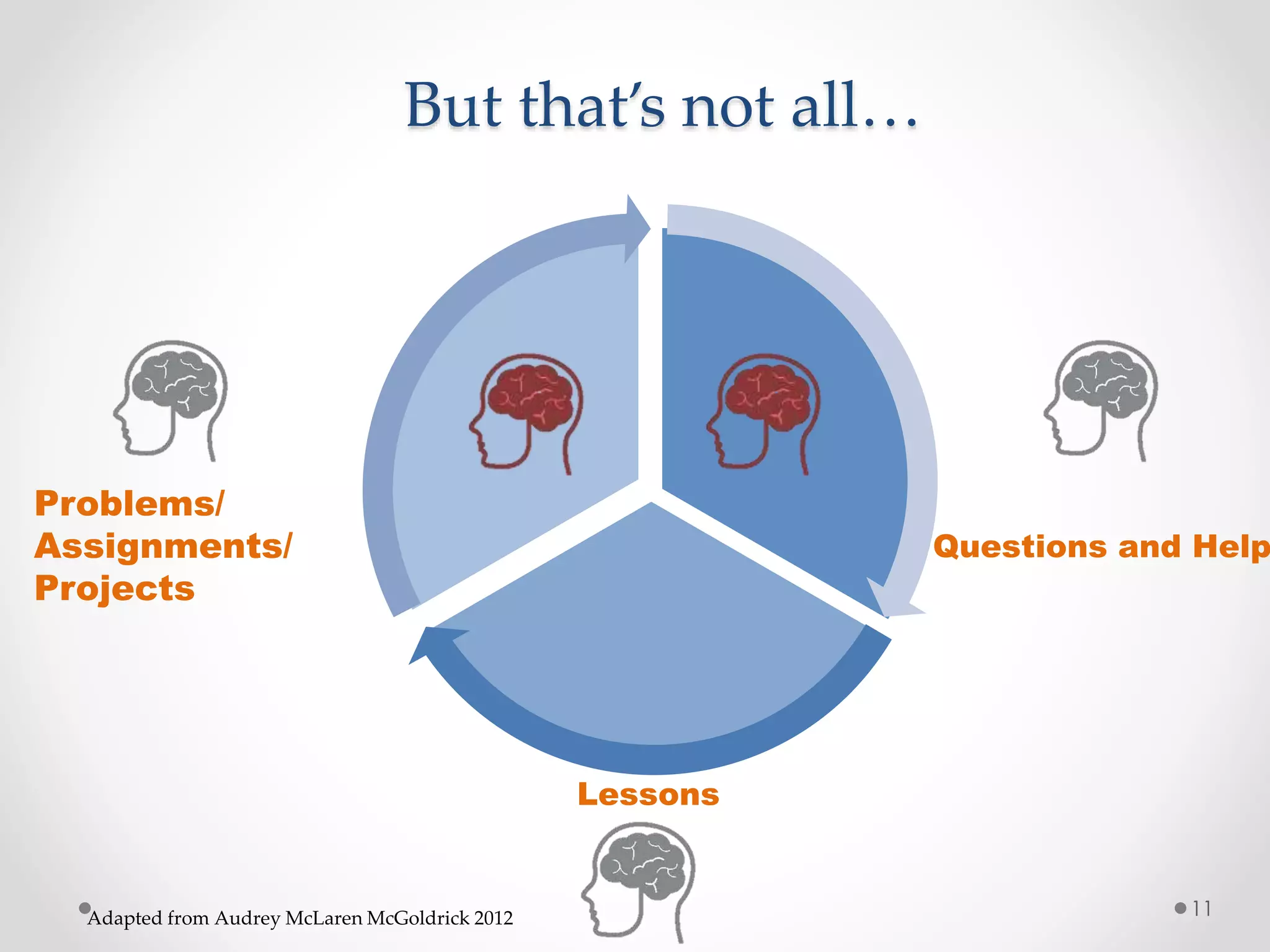
But that’s not all… 
Questions and Help 
Adapted from Audrey McLaren McGoldrick 2012 
Lessons 
Problems/ 
Assignments/ 
Projects 
11
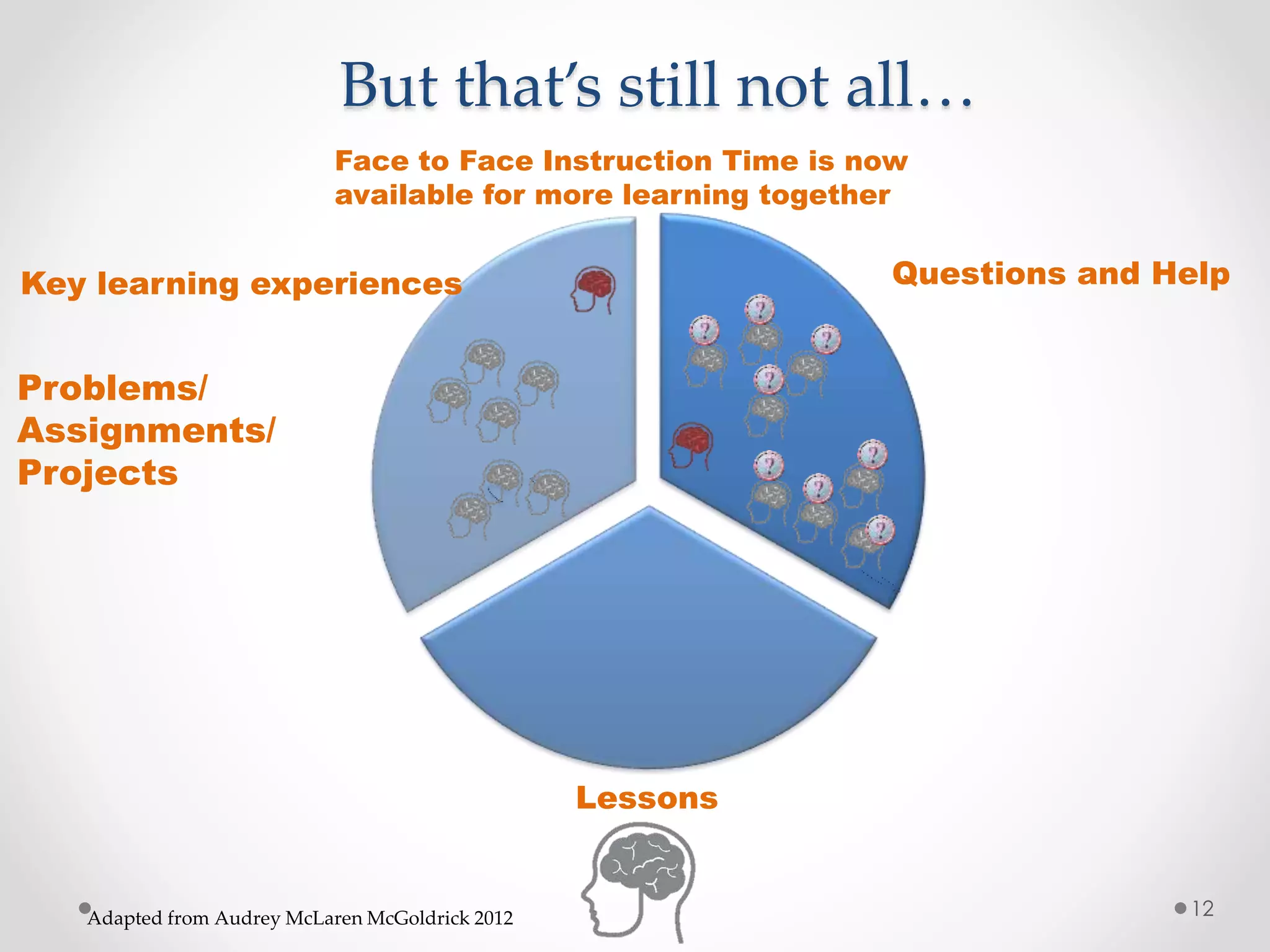
But that’s still not all… 
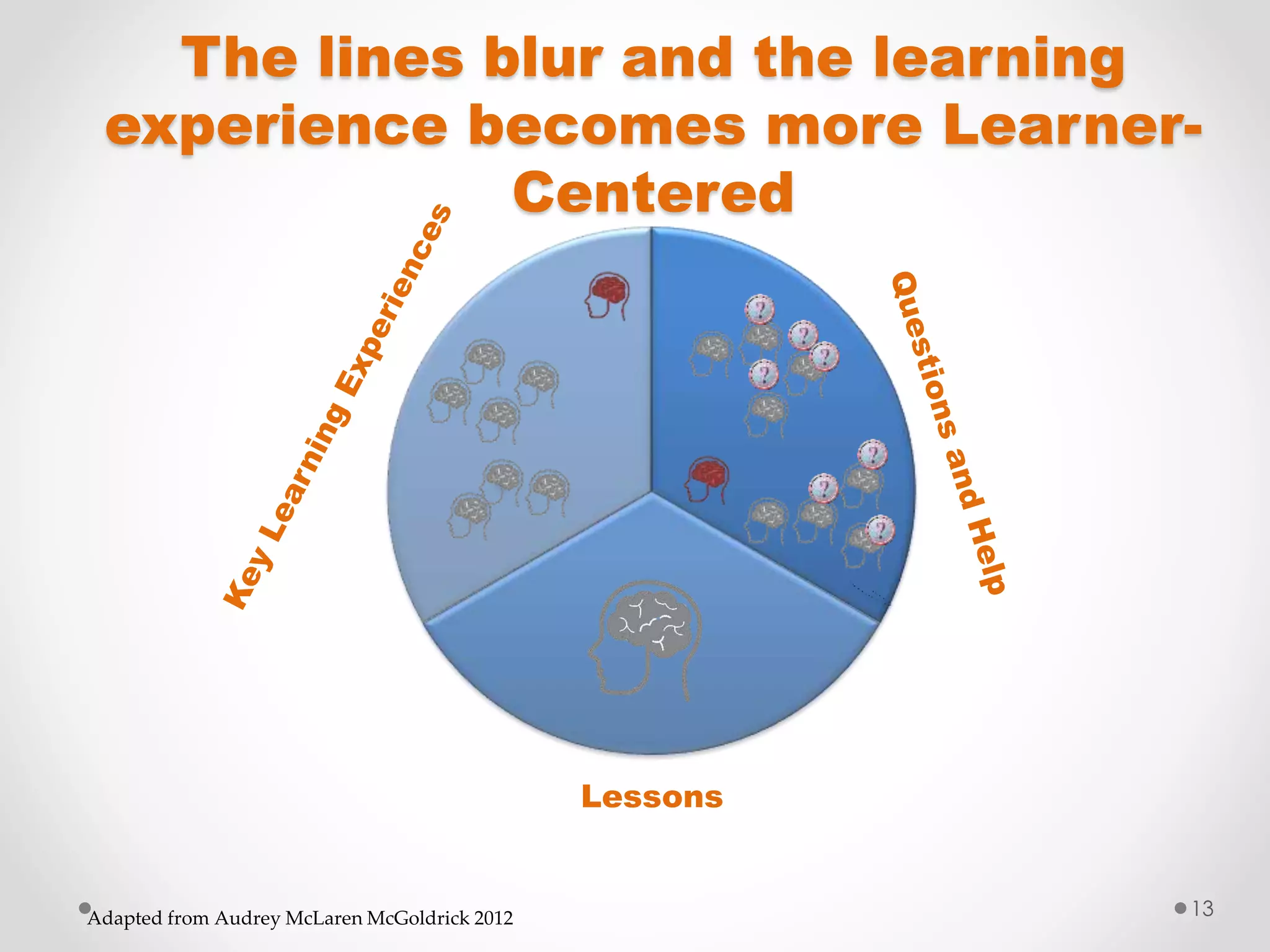
Face to Face Instruction Time is now 
Questions and Help 
available for more learning together 
Adapted from Audrey McLaren McGoldrick 2012 
Lessons 
Key learning experiences 
Problems/ 
Assignments/ 
Projects 
12
The lines blur and the learning 
experience becomes more Learner- 
Centered 
Adapted from Audrey McLaren McGoldrick 2012 
Lessons 
13
“Rather than the teacher using class time to dispense 
information, that work is done by each student before 
class, and could take the form of watching video 
lectures, listening to podcasts, perusing enhanced e-book 
content, and collaborating with peers in online 
communities.” 
NMC Horizon Report: 2014 Higher Education Edition 
14
Can you see it… 
15 
Flipped that is?
So...when should I flip? 
• You should FLIP right now 
o Start with what you have 
• Lessons 
• Activities 
o Whole Group 
o Individual 
16
17
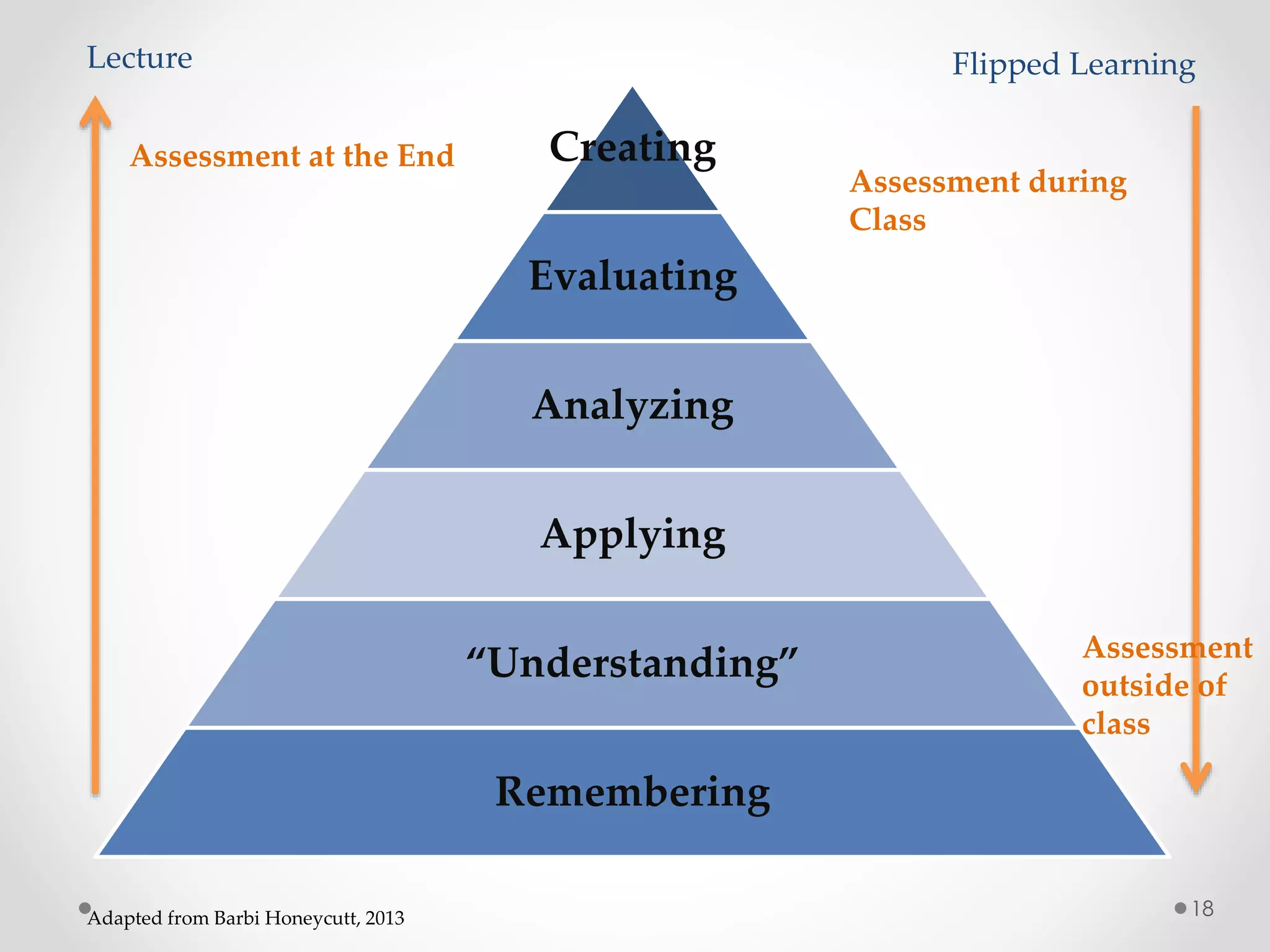
Lecture Flipped Learning 
Creating 
Evaluating 
Analyzing 
Applying 
“Understanding” 
Remembering 
Assessment at the End 
Assessment during 
Class 
Assessment 
outside of 
class 
Adapted from Barbi Honeycutt, 2013 18
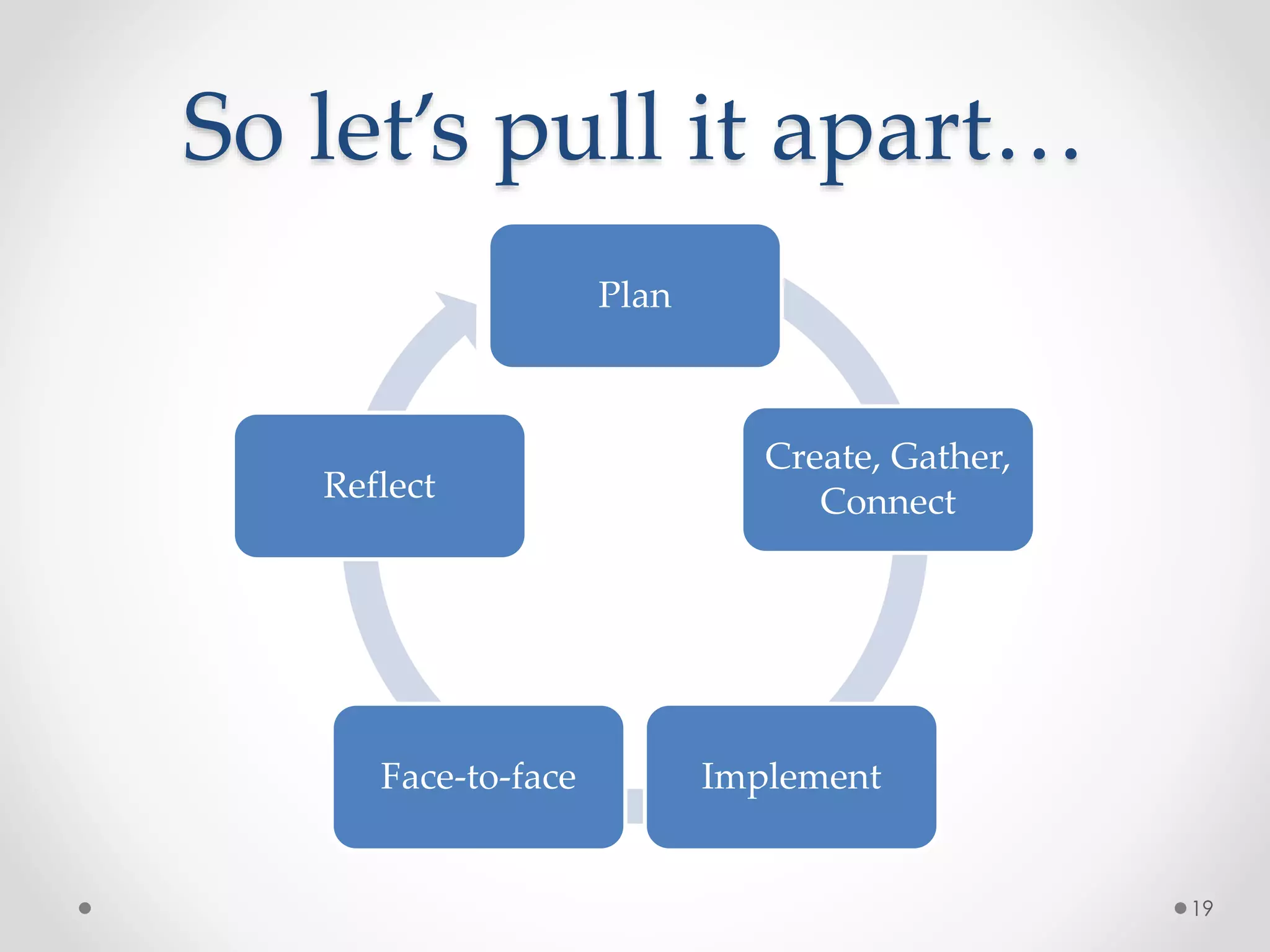
So let’s pull it apart… 
Plan 
Create, Gather, 
Connect 
Reflect 
Face-to-face Implement 
19
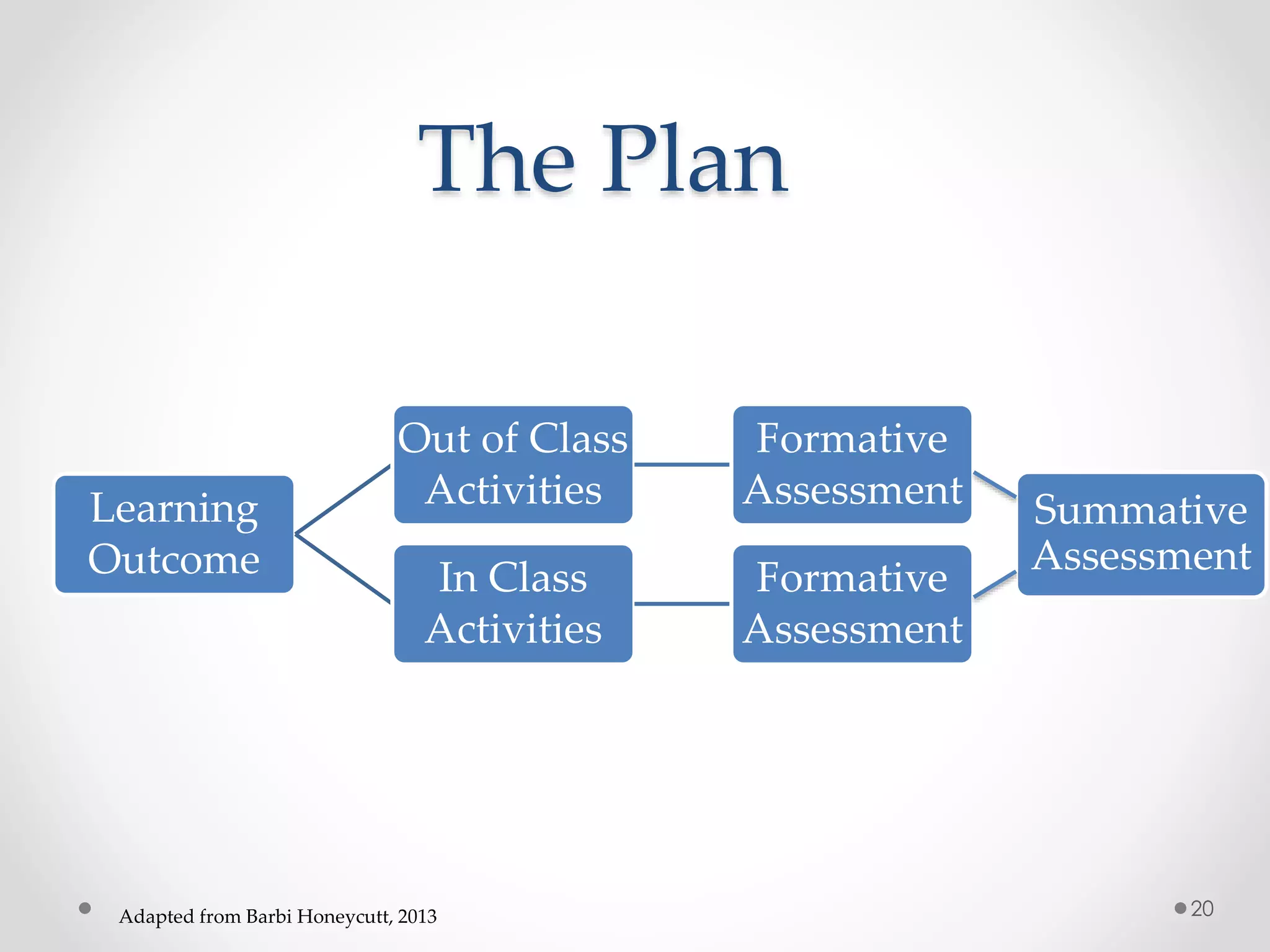
The Plan 
Learning 
Outcome 
Out of Class 
Activities 
Formative 
Assessment 
In Class 
Activities 
Formative 
Assessment 
Summative 
Assessment 
Adapted from Barbi Honeycutt, 2013 20
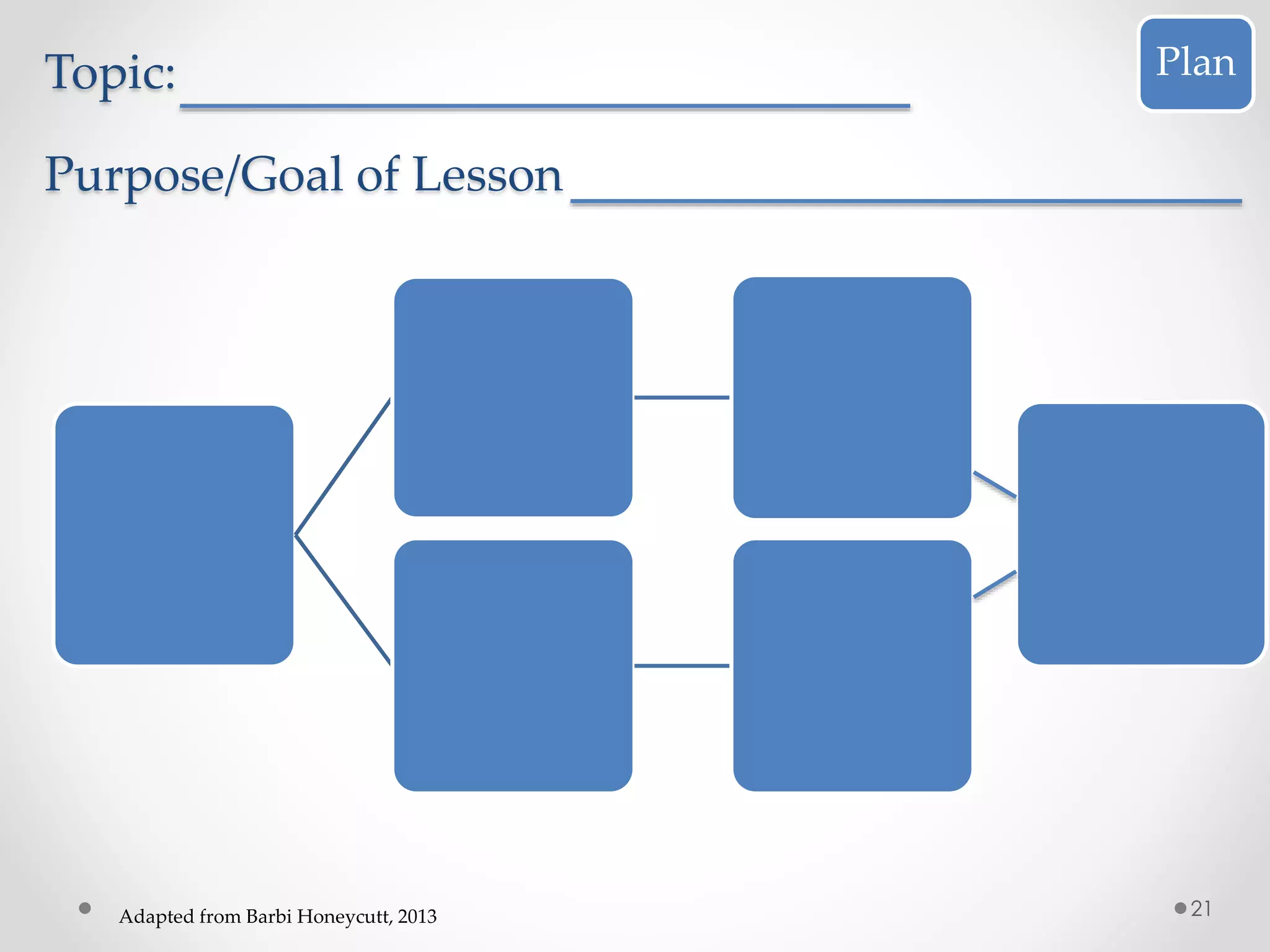
Topic: 
Purpose/Goal of Lesson 
Plan 
Adapted from Barbi Honeycutt, 2013 21
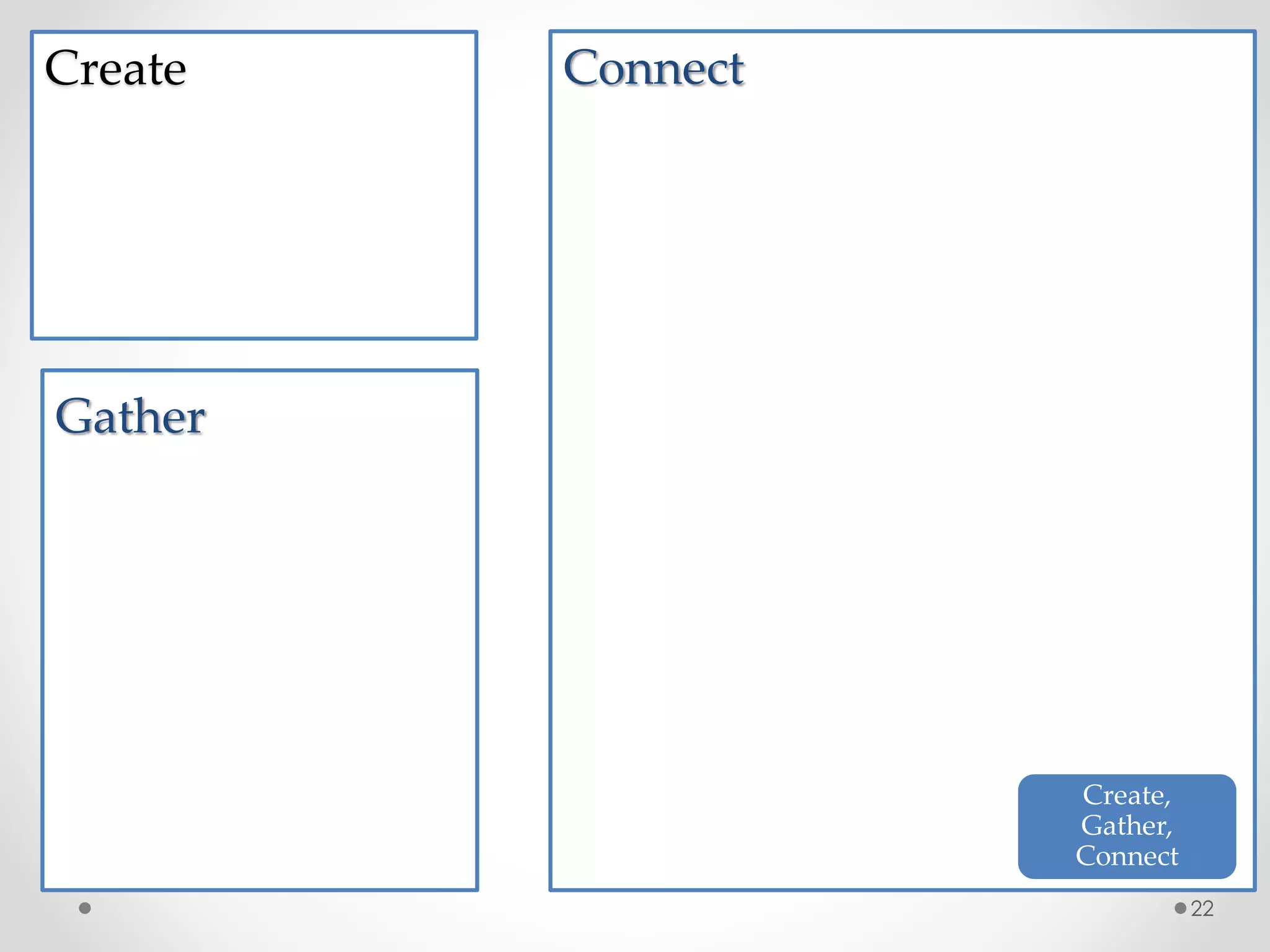
Create Connect 
Gather 
22 
Create, 
Gather, 
Connect
Tips from the Pros 
• Chunk material 
o 10min intervals 
• Build in formative assessments 
• Decide what to do in class and what to do out-of-class 
• Use a script to help manage content and activities 
23
• What are some of things flipped learning would 
allow me to do differently? 
• What do I need to let go of? 
• What do students need to let go of? 
24
Flipped Learning—Part II 
25
Think of the single best 
word that describes what 
happens in a traditional 
classroom lecture. 
http://www.wordle.net/create 
26
Visual Activity 
Select a picture that 
represents flipped 
learning. 
27
The Refresher 
28 
“The flipped classroom refers to a model of learning 
that rearranges how time is spent both in and out of 
class to shift the ownership of learning from the 
educators to the students.” 
NMC Horizon Report: 2014 Higher Education Edition
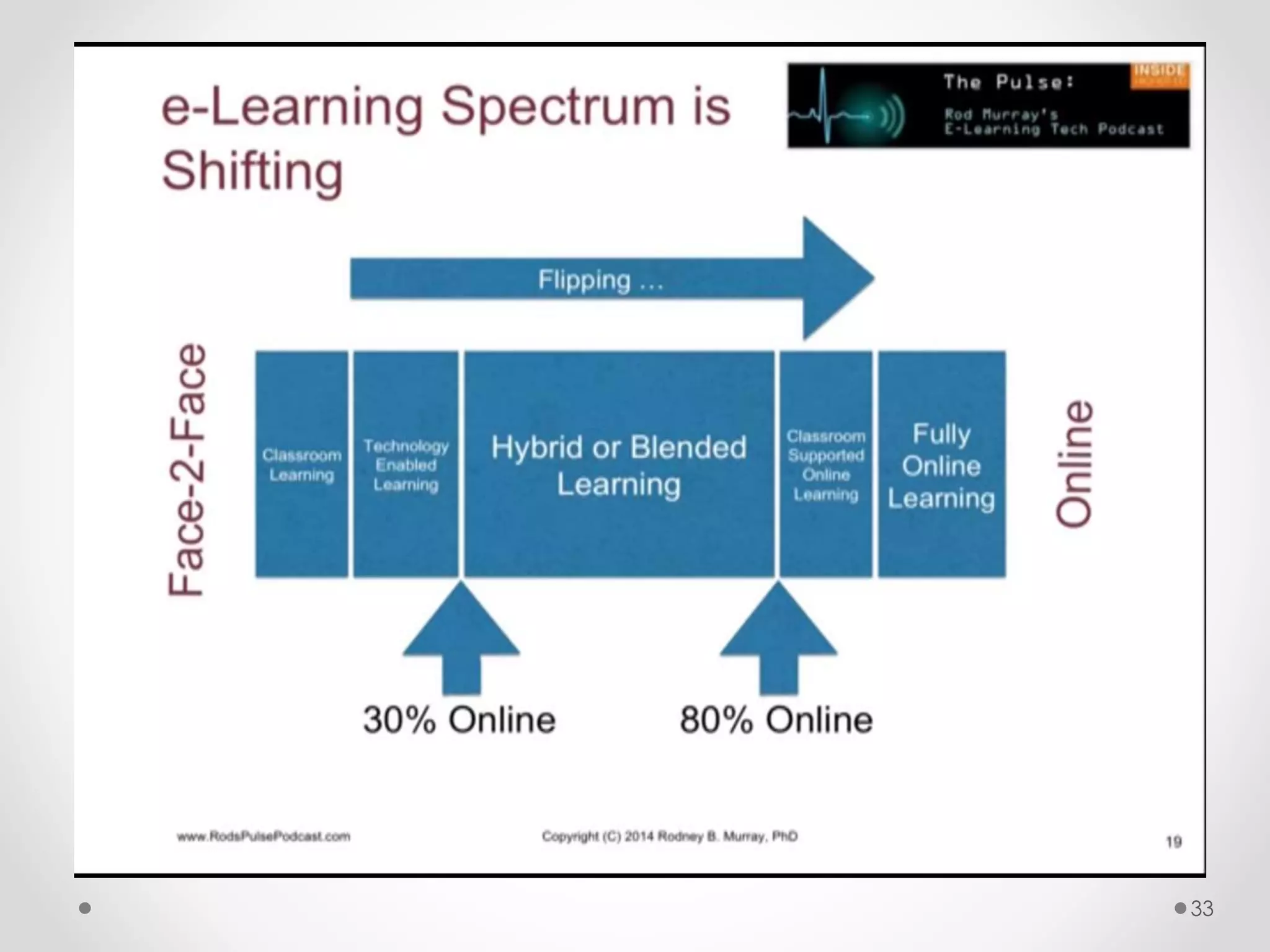
32
33
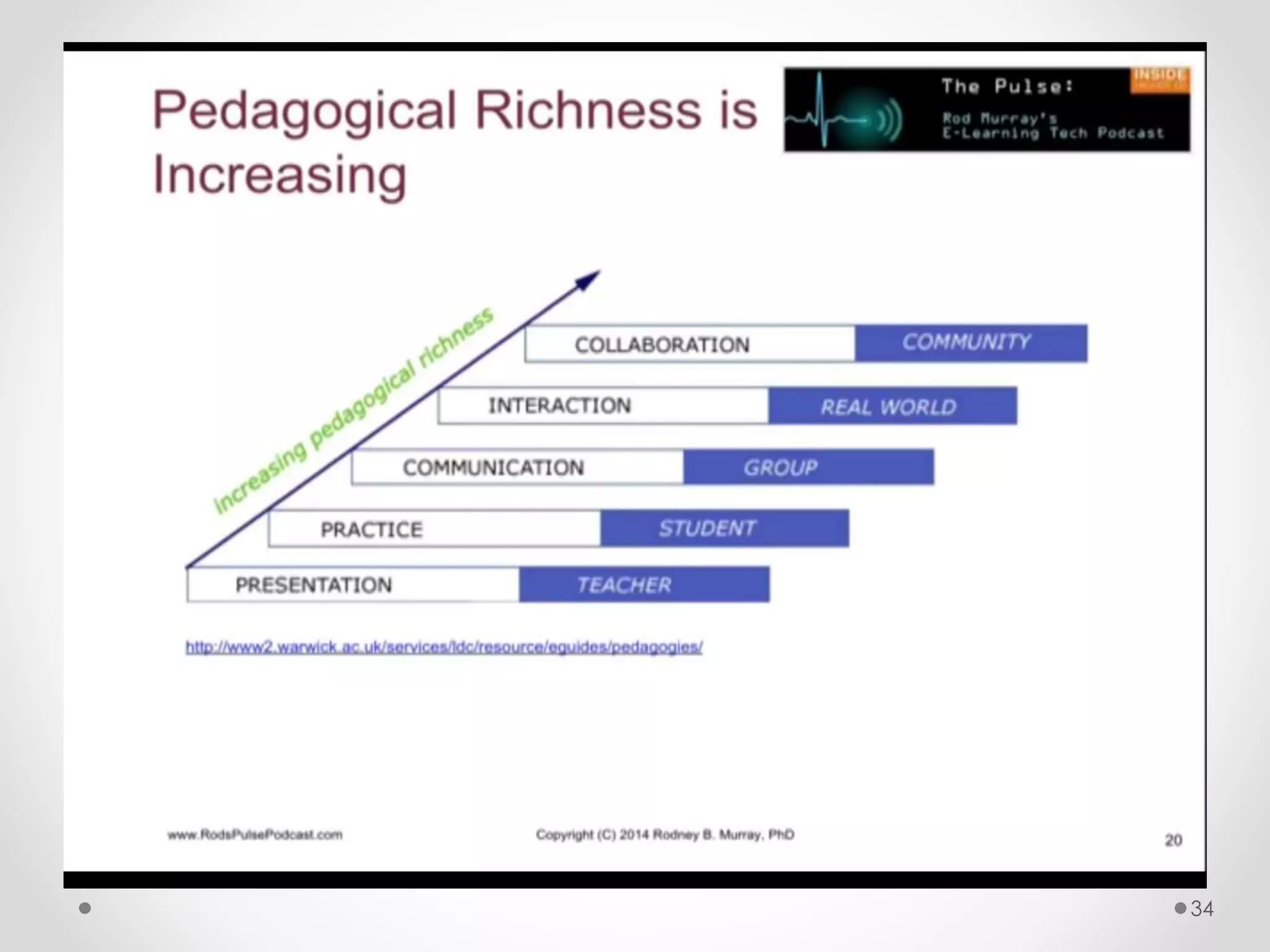
34
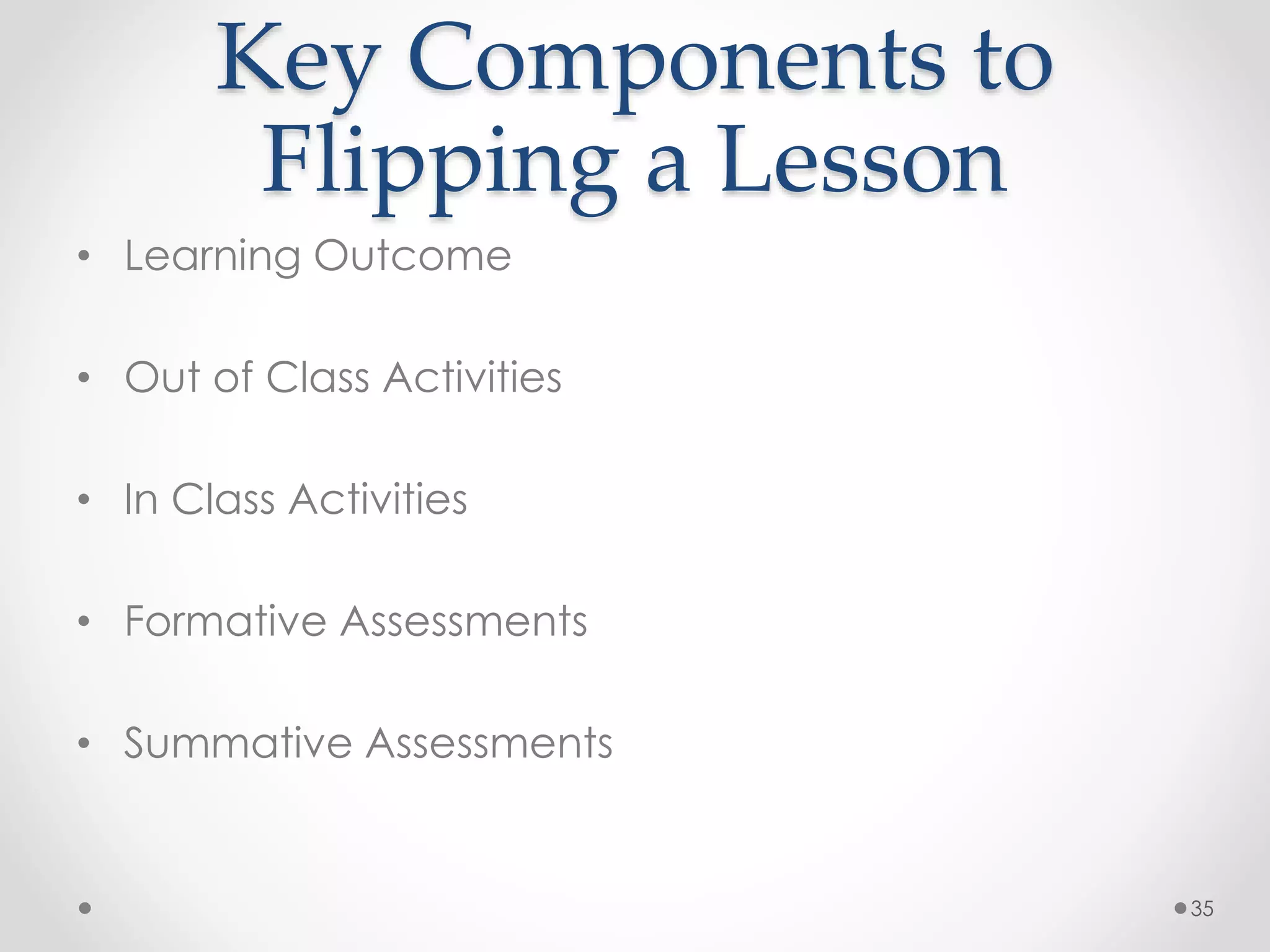
Key Components to 
Flipping a Lesson 
• Learning Outcome 
• Out of Class Activities 
• In Class Activities 
• Formative Assessments 
• Summative Assessments 
35
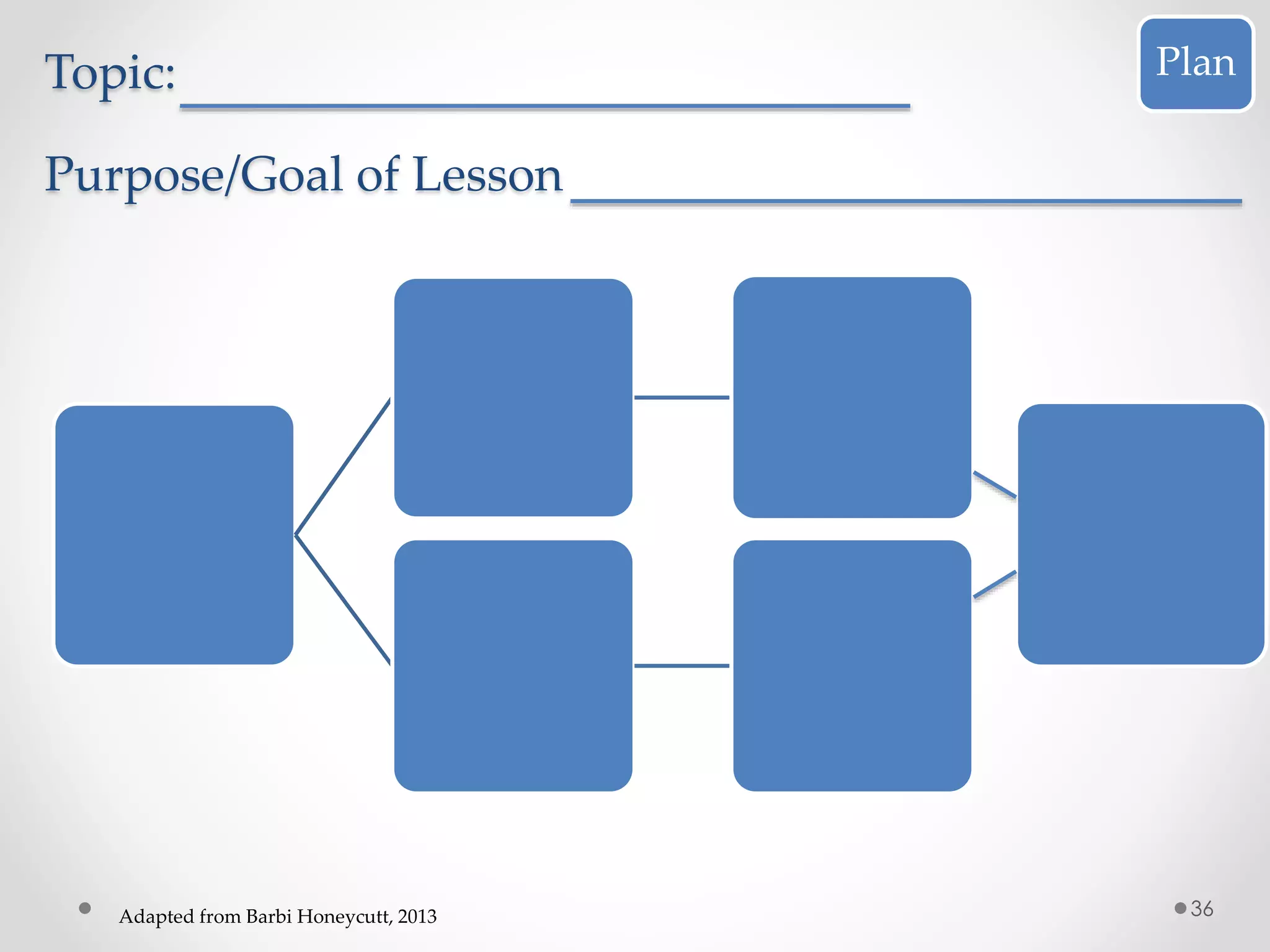
Topic: 
Purpose/Goal of Lesson 
Plan 
Adapted from Barbi Honeycutt, 2013 36
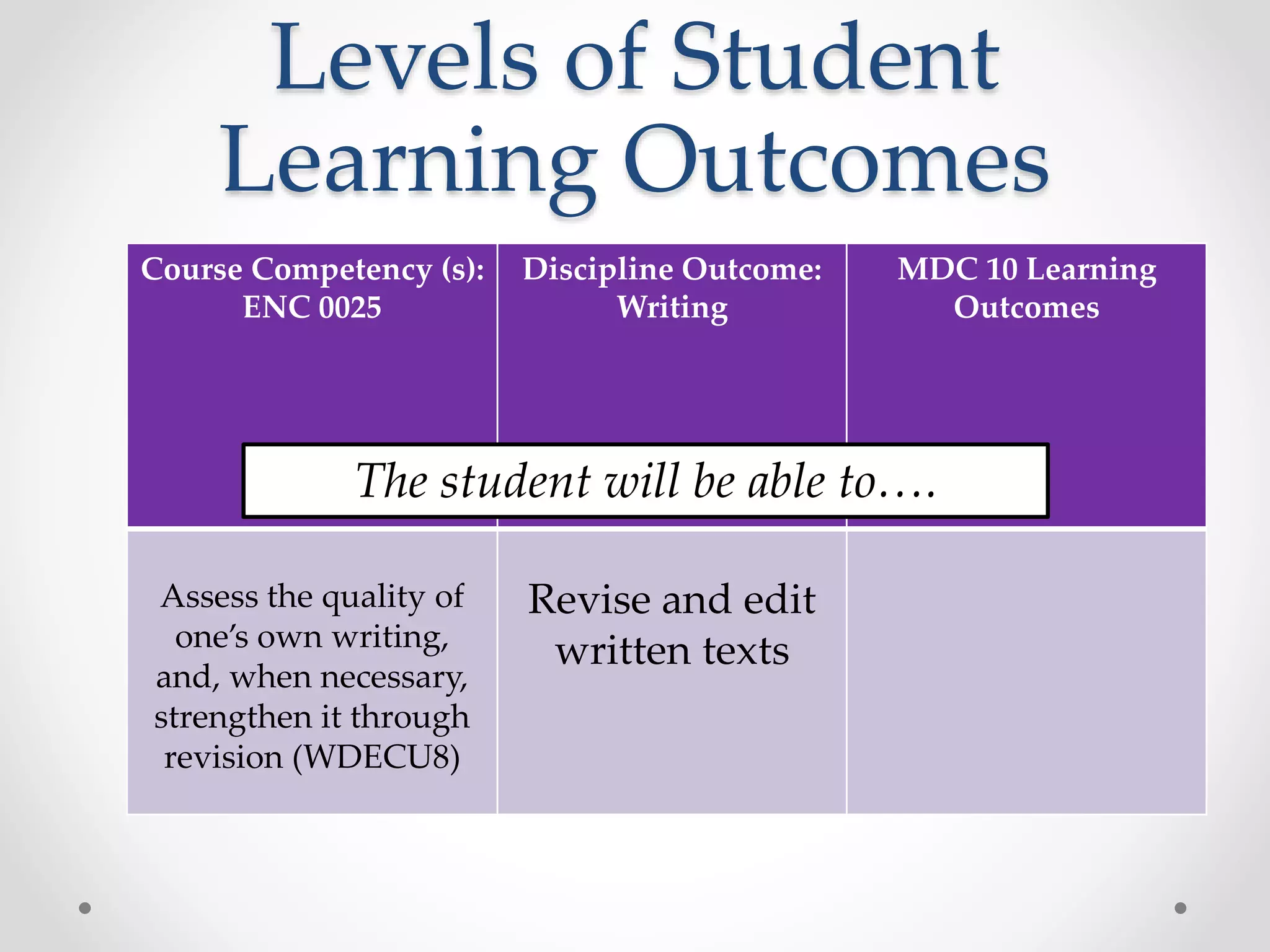
Levels of Student 
Learning Outcomes 
Course Competency (s): 
ENC 0025 
Discipline Outcome: 
Writing 
MDC 10 Learning 
Outcomes 
The student will be able to…. 
Assess the quality of 
one’s own writing, 
and, when necessary, 
strengthen it through 
revision (WDECU8) 
Revise and edit 
written texts
When writing Learning Outcomes (SLOs)… 
1) Focus on outcomes not processes 
2) Start each outcome with an action verb 
3) Use only one action verb per learning outcome 
4) Avoid vague verbs such as ‘know’, ‘understand’ or 
‘comprehend’ 
5) Check that the verbs used reflect the level of learning 
required 
6) Ensure that outcomes are observable and measurable 
7) Write the outcomes in terms of what the learner does, not 
what the instructor does 
8) Check that the outcomes reflect knowledge, skills, or 
attitudes required in the next level of instruction or workplace 
9) Include outcomes that are woven into the entire course 
10) Check that there are the appropriate number of outcomes 
11) Check that the course outcomes and program outcomes 
align with college wide outcomes 
38
Out of Class of Activities 
• The transfer of information 
39
Finding Resources for 
Out-of-Class Activities 
https://sites.google.com/a/mymdc.net/ctd/flipped-classroom 
40 
Flipped Learning is a vast ocean that is ripe for 
exploration and navigation. ~ Aaron Sams, 2013
Formative Assessment for 
Out of Class Activities 
• Think-Pair-Share Activity 
41
In-Class Activities 
• The assimilation of information 
• Students work Individually 
• Students work in groups 
42
Finding Resources for In- 
Class Activities 
• Start with what you already have 
• Discuss with colleagues 
• Professional Organizations 
• Active Learning Articles and Books 
43
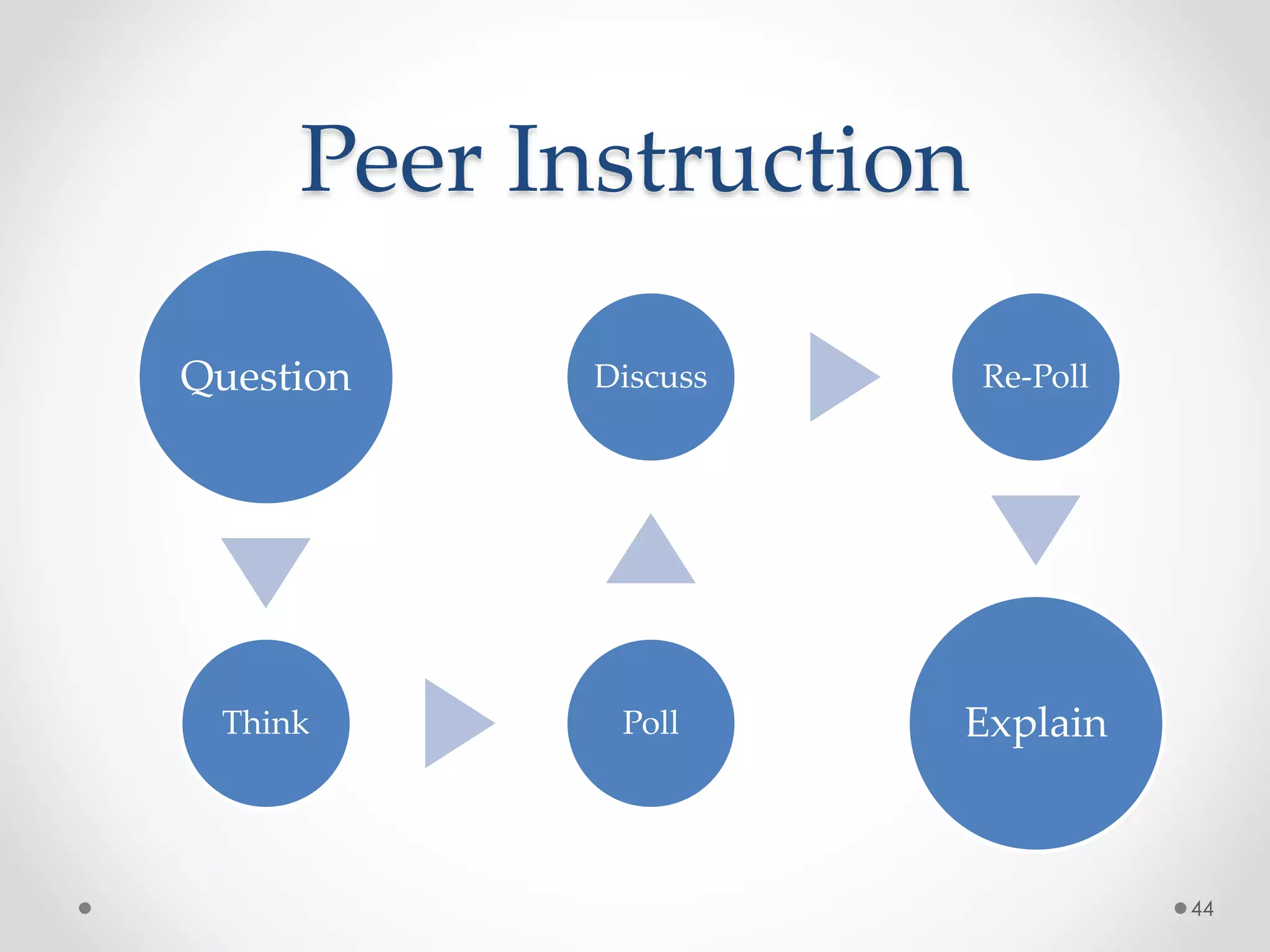
Peer Instruction 
44 
Question 
Discuss Re-Poll 
Think Poll 
Explain
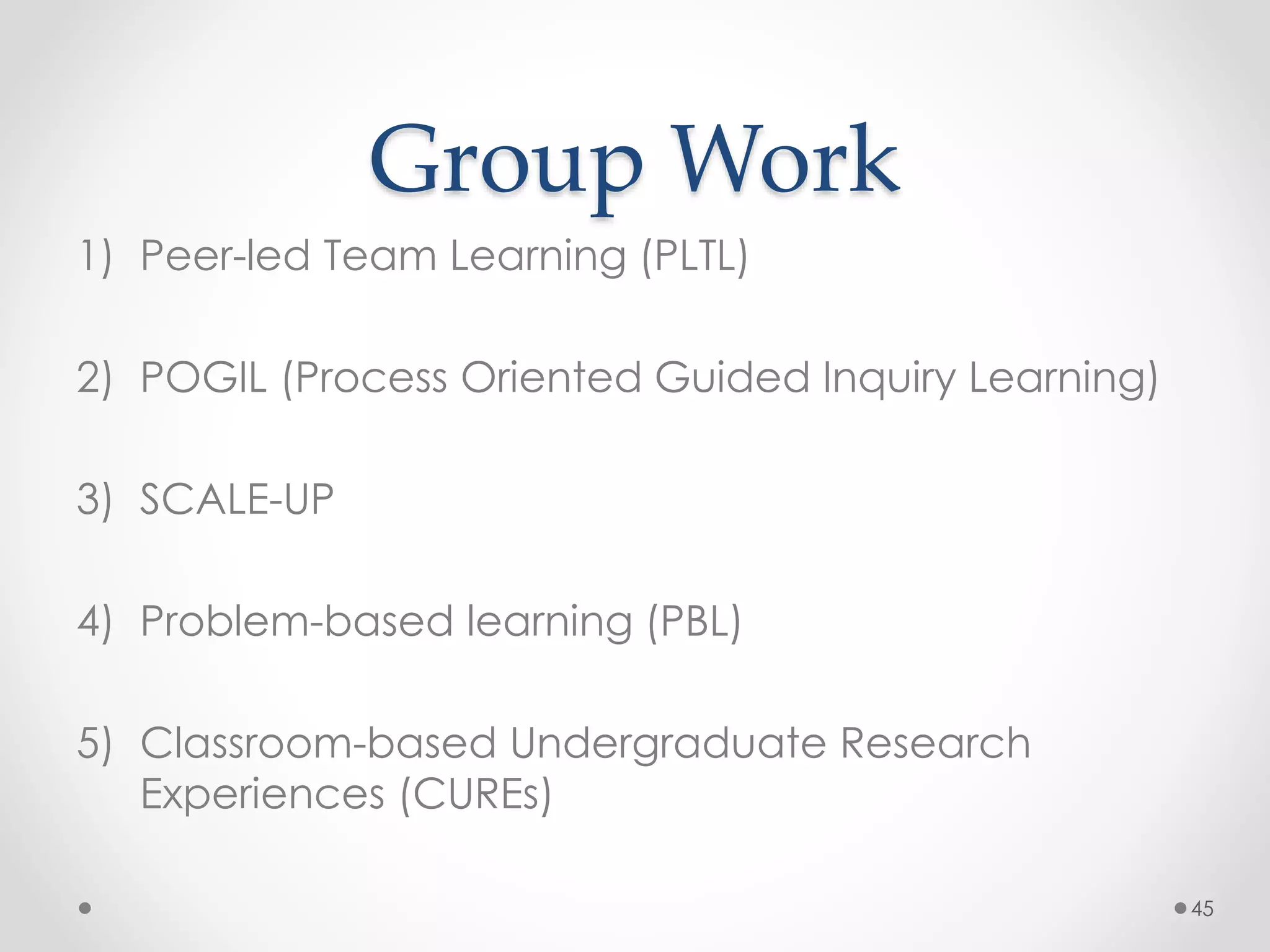
Group Work 
1) Peer-led Team Learning (PLTL) 
2) POGIL (Process Oriented Guided Inquiry Learning) 
3) SCALE-UP 
4) Problem-based learning (PBL) 
5) Classroom-based Undergraduate Research 
Experiences (CUREs) 
45
Formative Assessment for 
In-Class Activities 
48
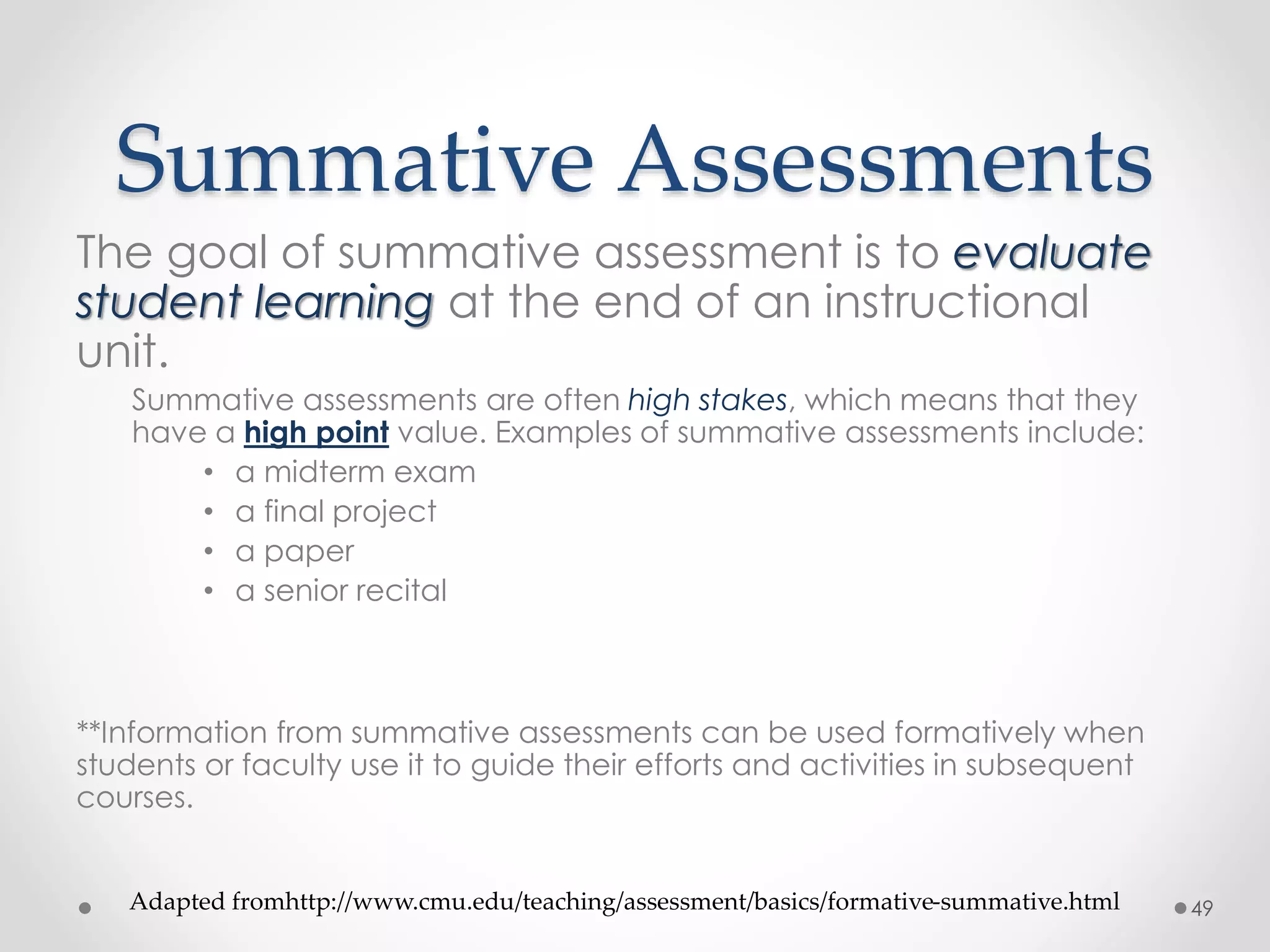
Summative Assessments 
The goal of summative assessment is to evaluate 
student learning at the end of an instructional 
unit. 
Summative assessments are often high stakes, which means that they 
have a high point value. Examples of summative assessments include: 
• a midterm exam 
• a final project 
• a paper 
• a senior recital 
**Information from summative assessments can be used formatively when 
students or faculty use it to guide their efforts and activities in subsequent 
courses. 
Adapted fromhttp://www.cmu.edu/teaching/assessment/basics/formative-summative.html 49
Brace Yourself 
• There will be resistance 
• There will be extra work 
• There will be a learning curve 
• There will be hard choices 
50
“Students forced to take major 
responsibility for their own learning 
go through some or all of the steps 
psychologists associate with trauma 
and grief: Shock, Denial, Strong 
emotion, Resistance and withdrawal, 
Struggle and exploration, Return of 
confidence, and Integration and 
success” (Felder & Brent, 1996, p. 43.) 
51
Tips for dealing with student 
resistance to flipped learning 
1) Introduce active learning on the first day of class. 
2) Show the evidence 
3) Start small. 
4) Keep the learning outcomes achievable in the 
beginning of the course. 
5) Assess often. 
52
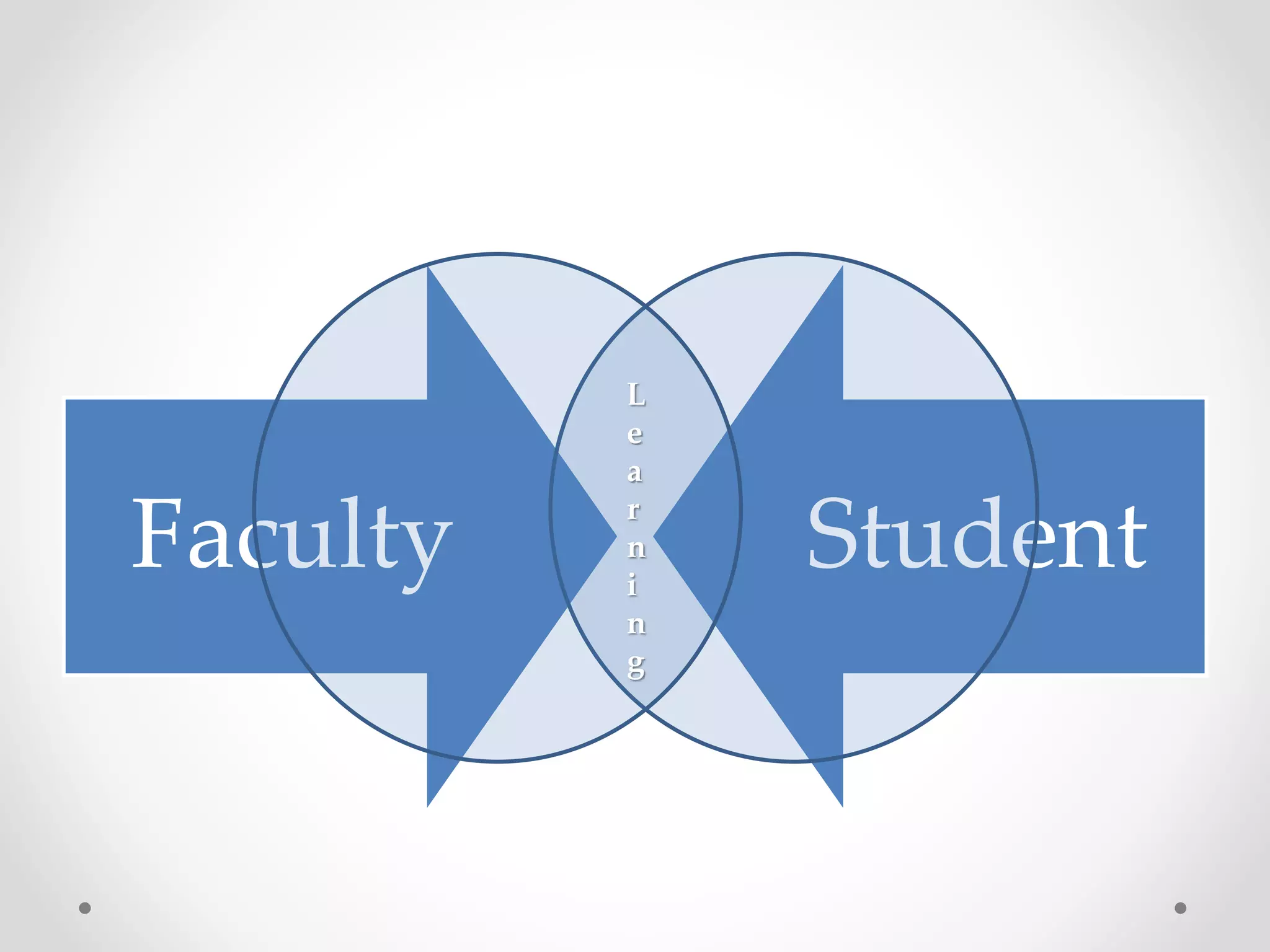
L 
e 
a 
r 
n 
i 
n 
g 
Faculty Student
Transition Techniques 
• Pausing 
• Chunking 
• Solving 
• Interacting 
• Cooperating 
54
Reflect 
• What are some of things flipped learning would 
allow me to do differently? 
• What do I need to let go of? 
• What do students need to let go of? 
57
How would you 
implement some of 
today’s ideas? 
58

Flipped Learning CTD

  • 1.
    Introduction to the Flipped Classroom CTD0541 1
  • 2.
    What is Flipped Classroom? “The flipped classroom refers to a model of learning that rearranges how time is spent both in and out of class to shift the ownership of learning from the educators to the students.” NMC Horizon Report: 2014 Higher Education Edition 2
  • 3.
    Teacher-centered traditional classroom Class time Questions and Help Lessons # @%& ?! Homework Adapted from Audrey McLaren McGoldrick 2012 Out-of-class Time 3
  • 4.
    Concern #1: LessonTime learning or comprehension Questions and Help Lessons # @%& ?! Adapted from Audrey McLaren McGoldrick 2012 4 Homework
  • 5.
    Concern #2: Studentsare alone when they are typically struggling the most Questions and Help Lessons # @%& ?! Adapted from Audrey McLaren McGoldrick 2012 5 Homework
  • 6.
    Concern #3: Toomany questions for one instructor or too few questions because not enough of the homework completed. Questions and Help Lessons # @%& ?! Adapted from Audrey McLaren McGoldrick 2012 6 Homework
  • 7.
    Thanks to technology... Questions and Help Lessons # @%& ?! Homework Adapted from Audrey McLaren McGoldrick 2012 7
  • 8.
    Self-Paced Lesson Time Questions and Help Lessons # @%& ?! Homework Adapted from Audrey McLaren McGoldrick 2012 Students have as long as they need to absorb the lesson. 8
  • 9.
    Face-to-face Time Problems/Questions and Help Assignments/ Projects Adapted from Audrey McLaren McGoldrick 2012 Lessons 9
  • 10.
    Now there isan opportunity to do Just-in-time-teaching Questions and Help Adapted from Audrey McLaren McGoldrick 2012 Lessons Problems/ Assignments/ Projects 10
  • 11.
    But that’s notall… Questions and Help Adapted from Audrey McLaren McGoldrick 2012 Lessons Problems/ Assignments/ Projects 11
  • 12.
    But that’s stillnot all… Face to Face Instruction Time is now Questions and Help available for more learning together Adapted from Audrey McLaren McGoldrick 2012 Lessons Key learning experiences Problems/ Assignments/ Projects 12
  • 13.
    The lines blurand the learning experience becomes more Learner- Centered Adapted from Audrey McLaren McGoldrick 2012 Lessons 13
  • 14.
    “Rather than theteacher using class time to dispense information, that work is done by each student before class, and could take the form of watching video lectures, listening to podcasts, perusing enhanced e-book content, and collaborating with peers in online communities.” NMC Horizon Report: 2014 Higher Education Edition 14
  • 15.
    Can you seeit… 15 Flipped that is?
  • 16.
    So...when should Iflip? • You should FLIP right now o Start with what you have • Lessons • Activities o Whole Group o Individual 16
  • 17.
  • 18.
    Lecture Flipped Learning Creating Evaluating Analyzing Applying “Understanding” Remembering Assessment at the End Assessment during Class Assessment outside of class Adapted from Barbi Honeycutt, 2013 18
  • 19.
    So let’s pullit apart… Plan Create, Gather, Connect Reflect Face-to-face Implement 19
  • 20.
    The Plan Learning Outcome Out of Class Activities Formative Assessment In Class Activities Formative Assessment Summative Assessment Adapted from Barbi Honeycutt, 2013 20
  • 21.
    Topic: Purpose/Goal ofLesson Plan Adapted from Barbi Honeycutt, 2013 21
  • 22.
    Create Connect Gather 22 Create, Gather, Connect
  • 23.
    Tips from thePros • Chunk material o 10min intervals • Build in formative assessments • Decide what to do in class and what to do out-of-class • Use a script to help manage content and activities 23
  • 24.
    • What aresome of things flipped learning would allow me to do differently? • What do I need to let go of? • What do students need to let go of? 24
  • 25.
  • 26.
    Think of thesingle best word that describes what happens in a traditional classroom lecture. http://www.wordle.net/create 26
  • 27.
    Visual Activity Selecta picture that represents flipped learning. 27
  • 28.
    The Refresher 28 “The flipped classroom refers to a model of learning that rearranges how time is spent both in and out of class to shift the ownership of learning from the educators to the students.” NMC Horizon Report: 2014 Higher Education Edition
  • 29.
  • 30.
  • 31.
  • 32.
    Key Components to Flipping a Lesson • Learning Outcome • Out of Class Activities • In Class Activities • Formative Assessments • Summative Assessments 35
  • 33.
    Topic: Purpose/Goal ofLesson Plan Adapted from Barbi Honeycutt, 2013 36
  • 34.
    Levels of Student Learning Outcomes Course Competency (s): ENC 0025 Discipline Outcome: Writing MDC 10 Learning Outcomes The student will be able to…. Assess the quality of one’s own writing, and, when necessary, strengthen it through revision (WDECU8) Revise and edit written texts
  • 35.
    When writing LearningOutcomes (SLOs)… 1) Focus on outcomes not processes 2) Start each outcome with an action verb 3) Use only one action verb per learning outcome 4) Avoid vague verbs such as ‘know’, ‘understand’ or ‘comprehend’ 5) Check that the verbs used reflect the level of learning required 6) Ensure that outcomes are observable and measurable 7) Write the outcomes in terms of what the learner does, not what the instructor does 8) Check that the outcomes reflect knowledge, skills, or attitudes required in the next level of instruction or workplace 9) Include outcomes that are woven into the entire course 10) Check that there are the appropriate number of outcomes 11) Check that the course outcomes and program outcomes align with college wide outcomes 38
  • 36.
    Out of Classof Activities • The transfer of information 39
  • 37.
    Finding Resources for Out-of-Class Activities https://sites.google.com/a/mymdc.net/ctd/flipped-classroom 40 Flipped Learning is a vast ocean that is ripe for exploration and navigation. ~ Aaron Sams, 2013
  • 38.
    Formative Assessment for Out of Class Activities • Think-Pair-Share Activity 41
  • 39.
    In-Class Activities •The assimilation of information • Students work Individually • Students work in groups 42
  • 40.
    Finding Resources forIn- Class Activities • Start with what you already have • Discuss with colleagues • Professional Organizations • Active Learning Articles and Books 43
  • 41.
    Peer Instruction 44 Question Discuss Re-Poll Think Poll Explain
  • 42.
    Group Work 1)Peer-led Team Learning (PLTL) 2) POGIL (Process Oriented Guided Inquiry Learning) 3) SCALE-UP 4) Problem-based learning (PBL) 5) Classroom-based Undergraduate Research Experiences (CUREs) 45
  • 43.
    Formative Assessment for In-Class Activities 48
  • 44.
    Summative Assessments Thegoal of summative assessment is to evaluate student learning at the end of an instructional unit. Summative assessments are often high stakes, which means that they have a high point value. Examples of summative assessments include: • a midterm exam • a final project • a paper • a senior recital **Information from summative assessments can be used formatively when students or faculty use it to guide their efforts and activities in subsequent courses. Adapted fromhttp://www.cmu.edu/teaching/assessment/basics/formative-summative.html 49
  • 45.
    Brace Yourself •There will be resistance • There will be extra work • There will be a learning curve • There will be hard choices 50
  • 46.
    “Students forced totake major responsibility for their own learning go through some or all of the steps psychologists associate with trauma and grief: Shock, Denial, Strong emotion, Resistance and withdrawal, Struggle and exploration, Return of confidence, and Integration and success” (Felder & Brent, 1996, p. 43.) 51
  • 47.
    Tips for dealingwith student resistance to flipped learning 1) Introduce active learning on the first day of class. 2) Show the evidence 3) Start small. 4) Keep the learning outcomes achievable in the beginning of the course. 5) Assess often. 52
  • 48.
    L e a r n i n g Faculty Student
  • 49.
    Transition Techniques •Pausing • Chunking • Solving • Interacting • Cooperating 54
  • 50.
    Reflect • Whatare some of things flipped learning would allow me to do differently? • What do I need to let go of? • What do students need to let go of? 57
  • 51.
    How would you implement some of today’s ideas? 58

Editor's Notes

  • #3 In the flipped classroom model, valuable class time is devoted to more active, project-based learning where students work together to solve local or global challenges — or other real-world applications — to gain a deeper understanding of the subject.”
  • #8 Because of innovation and human creativity we are able to deliver a better product.
  • #9 Essentially “homework” is introduction to the new concept The traditional classroom moves students at a fixed pace. However the flipped classroom allows for a mastery learning and the self-paced mastery.
  • #10 And then class time reinforces that content with 100% dedicated to learner-centered active learning strategies Now class time is focused on guided practice; group work; individual work and other key learning activities. This is sometimes know as the inversion Key assignments are done during face to face instruction with the instructor there.
  • #11 Empowers the teacher to do direct problem solving with the student
  • #12 It also opens up the classroom for creative activities and deeper exploration of mastery Promoting deep learning
  • #13 Teacher comes alongside and helps the students Parallel in groups
  • #14 Establishing an environment for Group and individual self-learners; student centric model- they teach themselves and they teach each other This model bring new benefits to both teachers and students Reference http://demo.hosted.panopto.com/Panopto/Pages/Viewer.aspx?id=d8b12f6c-669b-4de7-ad66-c1734e85b451&__hstc=231909632.e27853f42ca4e0e56212d5cec3a4a123.1401833490769.1402501966808.1402505968645.16&__hssc=231909632.50.1402505968645&__hsfp=177871209
  • #17 There are degrees to flipped learning flip a lesson; flip a unit or flip a whole course
  • #20 So let’s go back a moment because the flipped model is not about technology, isn’t not about the videos. It is about what you do after the introduction to the content. Some have suggested that flipped is a rebranding of inverted learning In the end the concept of flipped isn’t new. However flipped learning really might be a step beyond some of what has already been done in this area because even though it isn’t new—its also not that old
  • #24 Keep in mind that a 10min video watch time might actually take students 30-45mins to get thru Its not about the technology it is about active learning and the way in which students practice with the material/concepts/skills in the course When deciding what to move to in-class vs. out-of class: higher order thinking=needs support; passive learning=can be done on own time
  • #25 When we think about how old some of the teaching methods in higher education are Flipped learning model is in its infancy by comparison And when we make further comparisons we see that the whole world is changed around it but that education has evolved very little by comparison. Flipping is a way to continuously update and add activities to teaching
  • #41 What we are providing for you here is a rough map a starting point for you to conduct your own exploration. You Tube Educational Channel Khan Academy Brain Pop (paid service) NBC Learn Learner.org Web-page content analysis Upload power points Screenr.com (free)
  • #48 The Jigsaw is one of my favorite activities to use for reading comprehension with English language learners. It allows them to organize information they have read in a visual way, thereby helping them process the material more deeply. (The picture above is a link to a generic graphic organizer for a jigsaw activity.) Here’s an example of how you might direct group work using this handout: Sample topic:  American Revolutionary War 1.  Divide students into 3 groups of 3-5 (depending on class size). Each group should have the same number if possible.  Give these groups a number. 2.  Determine a subtopic to the main topic for the day, and assign to each group.  For example, if you are discussing the American Revolutionary War, the subtopics could be:  1) Causes, 2) Major Events, 3) Results. 3.  Students then discuss their assigned topic to determine 3 main ideas.  Each group member should each record these on the front side of the handout. 4.  Once students complete these steps, they will change groups entirely and form a new group with members from the other 3 groups.  (If you number the groups, you can tell them that there should be one member from groups 1, 2, 3, and 4) in each new group. 5)  In Group #2, students will begin to put together the big picture of the topic.  Each member reports their findings from Group #1 and students in Group #2 take notes on the second part of the graphic organizer.  Students take turns reporting until they are done. I love jigsaw activities because they are student-centered and combine a variety of speaking, reading, writing, and listening skills.  They also help students identify the most important information and condense it into language they understand.  Make sure to visit http://www.jigsaw.org for more information on jigsaw activities.
  • #51 First and foremost count on there being resistance and disorientation No one told students they were suppose to hate lecture Students are experiencing a paradigm shift—you’re the instructor you are suppose to lecture this chaotic classroom where I can no longer hide is not what I signed up for. You will have to explain how the roles of the flipped classroom change Cant just throw them in might have to ease into it Share example: rules for flipping Seigel, M. 2014 p14: Flipping 2.0
  • #52 Change is a process not an event.
  • #54 Cognitive Processes that students What students think are important The way faculty set up and operate the teaching and learning environment affects the students balance between deep and surface learning
  • #56 Be patient with yourself. You are learning how to teach in a new environment and learning to re-think the delivery of your content to build a foundation for more active learning.
  • #58 When we think about how old some of the teaching methods in higher education are Flipped learning model is in its infancy by comparison And when we make further comparisons we see that the whole world is changed around it but that education has evolved very little by comparison. Flipping is a way to continuously update and add activities to teaching