Elaine DeLott Baker and Marilyn Smith
Colorado Community Colleges
Presented at the 2014 ALP Conference
 Representatives of Colorado Community
Colleges met for 18 months to design a new
model for developmental education in
Colorado Community colleges
 Approved by the Board in February 2013
 Full implementation by all thirteen system
colleges by fall 2014
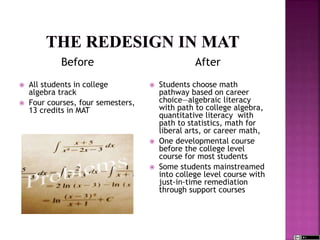
Before
 All students in college
algebra track
 Four courses, four semesters,
13 credits in MAT
After
 Students choose math
pathway based on career
choice—algebraic literacy
with path to college algebra,
quantitative literacy with
path to statistics, math for
liberal arts, or career math,
 One developmental course
before the college level
course for most students
 Some students mainstreamed
into college level course with
just-in-time remediation
through support courses
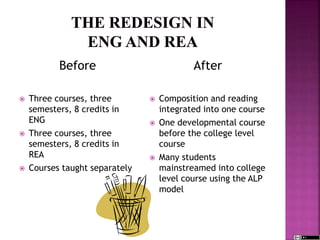
Before
 Three courses, three
semesters, 8 credits in
ENG
 Three courses, three
semesters, 8 credits in
REA
 Courses taught separately
After
 Composition and reading
integrated into one course
 One developmental course
before the college level
course
 Many students
mainstreamed into college
level course using the ALP
model
Successful outcomes:
 Math – Successful completion of any college level
(100+)
math course
 English/reading – Successful completion of any
college level (100+) English course or any college
level
course in a discipline strand.
The redesigned courses, which are mandated
for all CCCS colleges as of fall, 2014, represent
uncharted territory for the majority of faculty
who will be assigned to teach these courses.
The experiences of early
adopters who have been
involved in the design and
implementation of redesigned
courses could be collected and
made available as a resource
for faculty who are poised to
enter this new arena of
practice.
A collection of reflections
based on the classroom
experiences of faculty who
have been involved in the
development and piloting of
redesigned courses
 Specific instructional strategies that were
implemented in the classroom
 Student responses to the new curriculum
 Professional development strategies within
college departments
 Unintended consequences
 An introduction detailing the redesign
process, with a description of the new model
 A collection of faculty reflections (1-3 pages)
 Syllabi and supporting class materials
 Short faculty biographies and photos of
authors
 A qualitative analysis of the common
struggles and successes of early
implementation.
 An advisory board, comprised of faculty who
have been involved in the development of
the redesign, meets to outline the process
 “Calling All Faculty”- an e-mail invitation to
all developmental faculty, describing the
project and soliciting interest
 Interested faculty, and/or faculty teams,
respond with a short description of their
proposed submission
 FV staff (Marilyn and Elaine) hold individual
phone calls with faculty to discuss
prospective topics, the publication’s
purpose, proposed audience and project
guidelines
 Faculty submit first drafts
 Authors receive feedback from advisory
board members and FV staff
 Final drafts are submitted, along with
syllabi, short bios and photos of the authors
 Final editing and compilation of the
publication
“What has been fascinating to watch is how seamlessly
this has played out in the classroom. On the first day,
and often for the rest of the semester, no one in the 121
classroom knows who is "ready" for it and who isn't.
There is no great divide, either socially or academically.
If one were to look at our 121 grade books or an average
day in class, it would be hard to tell which students are
also in the Studio class because they are rising to the
challenge. They are performing as well as their 121
peers, and often are even outperforming them, both in
classroom participation and assignment quality. They are
often leaders in class discussions, do the most valuable
process work, and show the most awareness of the
course's goals. More often than not, the Studio students
are the first in English 121 to volunteer to share their
essay drafts with the class and to ask productive
questions.” Excerpt from a Faculty Voice submission
Review the selection and
discuss, from your experience,
how you think a faculty
publication might be used as a
professional development
vehicle at your college.
Elaine DeLott Baker
elaine.baker@cccs.edu
720-560-6774
Marilyn Smith, Developmental Education
Coordinator
marilyn.smith@cccs.edu
720-858-2328
Faculty Voices Presentation, a Workforce Solution, funded by a
Dept. of Labor TAACCCT grant by Elaine DeLott Baker and
Marilyn Smith is licensed under a Creative Commons
Attribution 4.0 International License.
Based on a work athttps://resources.cccs.edu/education-
services/developmental-education-task-force/.
Permissions beyond the scope of this license may be available
at https://www.cccs.edu/partnering-for-success/trade-
adjustment-assistance/taa-coetc/.

Faculty voices presentation at ALP Baltimore June 2014

  • 1.
    Elaine DeLott Bakerand Marilyn Smith Colorado Community Colleges Presented at the 2014 ALP Conference
  • 2.
     Representatives ofColorado Community Colleges met for 18 months to design a new model for developmental education in Colorado Community colleges  Approved by the Board in February 2013  Full implementation by all thirteen system colleges by fall 2014
  • 3.
    Before  All studentsin college algebra track  Four courses, four semesters, 13 credits in MAT After  Students choose math pathway based on career choice—algebraic literacy with path to college algebra, quantitative literacy with path to statistics, math for liberal arts, or career math,  One developmental course before the college level course for most students  Some students mainstreamed into college level course with just-in-time remediation through support courses
  • 4.
    Before  Three courses,three semesters, 8 credits in ENG  Three courses, three semesters, 8 credits in REA  Courses taught separately After  Composition and reading integrated into one course  One developmental course before the college level course  Many students mainstreamed into college level course using the ALP model
  • 5.
    Successful outcomes:  Math– Successful completion of any college level (100+) math course  English/reading – Successful completion of any college level (100+) English course or any college level course in a discipline strand.
  • 6.
    The redesigned courses,which are mandated for all CCCS colleges as of fall, 2014, represent uncharted territory for the majority of faculty who will be assigned to teach these courses.
  • 7.
    The experiences ofearly adopters who have been involved in the design and implementation of redesigned courses could be collected and made available as a resource for faculty who are poised to enter this new arena of practice.
  • 8.
    A collection ofreflections based on the classroom experiences of faculty who have been involved in the development and piloting of redesigned courses
  • 9.
     Specific instructionalstrategies that were implemented in the classroom  Student responses to the new curriculum  Professional development strategies within college departments  Unintended consequences
  • 10.
     An introductiondetailing the redesign process, with a description of the new model  A collection of faculty reflections (1-3 pages)  Syllabi and supporting class materials  Short faculty biographies and photos of authors  A qualitative analysis of the common struggles and successes of early implementation.
  • 11.
     An advisoryboard, comprised of faculty who have been involved in the development of the redesign, meets to outline the process  “Calling All Faculty”- an e-mail invitation to all developmental faculty, describing the project and soliciting interest  Interested faculty, and/or faculty teams, respond with a short description of their proposed submission
  • 12.
     FV staff(Marilyn and Elaine) hold individual phone calls with faculty to discuss prospective topics, the publication’s purpose, proposed audience and project guidelines  Faculty submit first drafts  Authors receive feedback from advisory board members and FV staff  Final drafts are submitted, along with syllabi, short bios and photos of the authors  Final editing and compilation of the publication
  • 13.
    “What has beenfascinating to watch is how seamlessly this has played out in the classroom. On the first day, and often for the rest of the semester, no one in the 121 classroom knows who is "ready" for it and who isn't. There is no great divide, either socially or academically. If one were to look at our 121 grade books or an average day in class, it would be hard to tell which students are also in the Studio class because they are rising to the challenge. They are performing as well as their 121 peers, and often are even outperforming them, both in classroom participation and assignment quality. They are often leaders in class discussions, do the most valuable process work, and show the most awareness of the course's goals. More often than not, the Studio students are the first in English 121 to volunteer to share their essay drafts with the class and to ask productive questions.” Excerpt from a Faculty Voice submission
  • 14.
    Review the selectionand discuss, from your experience, how you think a faculty publication might be used as a professional development vehicle at your college.
  • 15.
    Elaine DeLott Baker elaine.baker@cccs.edu 720-560-6774 MarilynSmith, Developmental Education Coordinator marilyn.smith@cccs.edu 720-858-2328
  • 16.
    Faculty Voices Presentation,a Workforce Solution, funded by a Dept. of Labor TAACCCT grant by Elaine DeLott Baker and Marilyn Smith is licensed under a Creative Commons Attribution 4.0 International License. Based on a work athttps://resources.cccs.edu/education- services/developmental-education-task-force/. Permissions beyond the scope of this license may be available at https://www.cccs.edu/partnering-for-success/trade- adjustment-assistance/taa-coetc/.

Editor's Notes

  • #2 Faculty Voices Elaine DeLott Baker and Marilyn Smith Colorado Community Colleges Presented at the 2014 ALP Conference
  • #3 Context: Redesign of Developmental Education Representatives of Colorado Community Colleges met for 18 months to design a new model for developmental education in Colorado Community colleges Approved by the Board in February 2013 Full implementation by all thirteen system colleges by fall 2014
  • #4 Redesign in MAT Before All students in college algebra track Four courses, four semesters, 13 credits in MAT After Students choose math pathway based on career choice—algebraic literacy with path to college algebra, quantitative literacy with path to statistics, math for liberal arts, or career math, One developmental course before the college level course for most students Some students mainstreamed into college level course with just-in-time remediation through support courses
  • #5 The Redesign in Eng and REA Before Three courses, three semesters, 8 credits in ENG Three courses, three semesters, 8 credits in REA Courses taught separately After Composition and reading integrated into one course One developmental course before the college level course Many students mainstreamed into college level course using the ALP model
  • #6 Measures of Success Successful outcomes: Math – Successful completion of any college level (100+) math course English/reading – Successful completion of any college level (100+) English course or any college level course in a discipline strand.
  • #7 The Problem The redesigned courses, which are mandated for all CCCS colleges as of fall, 2014, represent uncharted territory for the majority of faculty who will be assigned to teach these courses.
  • #8 The Idea The experiences of early adopters who have been involved in the design and implementation of redesigned courses could be collected and made available as a resource for faculty who are poised to enter this new arena of practice.
  • #9 Faculty Voices: A Publication A collection of reflections based on the classroom experiences of faculty who have been involved in the development and piloting of redesigned courses
  • #10 Sample Topics Specific instructional strategies that were implemented in the classroom Student responses to the new curriculum Professional development strategies within college departments Unintended consequences
  • #15 Small Group WorkReview the selection and discuss, from your experience, how you think a faculty publication might be used as a professional development vehicle at your college.
  • #16 Contact Information Elaine DeLott Baker elaine.baker@cccs.edu 720-560-6774 Marilyn Smith, Developmental Education Coordinator marilyn.smith@cccs.edu 720-858-2328
  • #17  Creative Commons Attribution Faculty Voices Presentation, a Workforce Solution, funded by a Dept. of Labor TAACCCT grant byElaine DeLott Baker and Marilyn Smith is licensed under a Creative Commons Attribution 4.0 International License. Based on a work athttps://resources.cccs.edu/education-services/developmental-education-task-force/. Permissions beyond the scope of this license may be available at https://www.cccs.edu/partnering-for-success/trade-adjustment-assistance/taa-coetc/.