Early College Academy: A Competitive
Dual Enrollment Pathway
Mary Michaels, Dr. Diane Lane, Diena Gischel
Cecil College
AFACCT ‘17 Conference, Harford Community College
Session 7.11
January 6, 2016, 1:40 p.m.- 2:40 p.m.
mmichaels@cecil.edu
Presentation Abstract
Mary Michaels
Cecil College, Early College Academy Director
‘Early College Academy, a competitive dual enrollment pathway’
Session 7.11: January 6, 2016
Oxford Area School District and Cecil College, in partnership, established an Early College Academy that enables students the
opportunity to receive a high school diploma and an associate degree concurrently. Students, through a cohort approach, are
scheduled for courses that fulfill the requirements of both the high school and the college. Attendees received an overview of the
Early College Academy program including how students are provided with career awareness, college level study, and community
support while they pursue the initial steps of their postsecondary education before high school completion. In addition, presenters
detailed a cost effective plan for students, progressively rigorous curriculum, and implemented student supports that allow students
to be competitive after high school.
Early College Academy
“A transformational strategy that provides a combination of
high school and college classes that result in many
transferable credits, leading to an associate degree.”
Source: (Middle College National Consortium, 2015)
Program Overview
• True dual enrollment in high school and college
• Dual Graduation: high school/college
• Cohort learning model
• College credits transferrable to 4-year universities
• Parental access to college records
• Courses offered on-site and online at Oxford and Cecil
• School district and college scholarships provided
Program Concept
High School
Coursework
Academic
Skills BuildingCollege
Coursework
Student
Success
College prep focus, while
fulfilling graduation requirements
Continuous support
throughout program
Career focus, while fulfilling
degree requirements
ECA Goals
• Offer a progressively rigorous academic experience
• Increase college completion rates among a
predominantly first-generation college community
• Develop awareness of collegiate culture
• Reduce and amortize the cost of a college degree
Institutional Goals
• Address college completion goals
• Decrease time to degree
• Integrate career and college readiness
• Create an alternative pathway to college for select
students
• Generate a cohort structure that promotes predictive
enrollment
Admissions Criteria
During the spring of 8th grade, students should provide the
following application materials for admission:
• Middle School transcript with a minimum GPA of 3.0
• Early College Academy admissions application
• College skills assessment test results (sophomore/junior years)
• Early College Academy Questionnaire
• Parent/Guardian Consent Form
Academic Features
• Traditional course enrollments with limited electives
• Satisfies MHEC, Cecil, Pennsylvania Department of
Education, and Oxford academic requirements
• College faculty on-site at Oxford
• Students must maintain at least a 2.0 GPA in college
coursework
• Required academic milestones:
o College-level writing at conclusion of sophomore year of high school
o College-level math at conclusion of junior year of high school
ECA Curriculum
Grade
Level
OAHS
Coursework
Cecil College
Coursework
Academic
Seminars
9 English
Mathematics
Social Studies
Science
Health
Fitness (2 courses)
Career Development
Freshman Seminar
Academic Technology
Study Habits & Strategies
Test Taking Techniques
10 English
Mathematics
Social Studies
Science
Computer Science
Sociology
Public Speaking
Humanities
Writing Competencies
Critical Thinking Skills
11 Mathematics English (2 courses)
Concentration Electives (2)
History (2 courses)
Physical Science
Math Competencies
Problem Solving Techniques
12 Statistics and/or Pre-Calc
Social Science Elective
Philosophy
Concentration Electives (2)
Lab Science
Structured Study Hall &
Tutoring
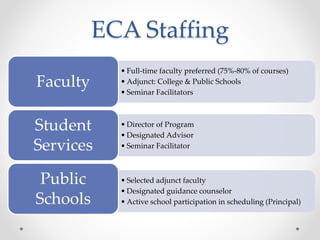
ECA Staffing
• Full-time faculty preferred (75%-80% of courses)
• Adjunct: College & Public Schools
• Seminar Facilitators
Faculty
• Director of Program
• Designated Advisor
• Seminar Facilitator
Student
Services
• Selected adjunct faculty
• Designated guidance counselor
• Active school participation in scheduling (Principal)
Public
Schools
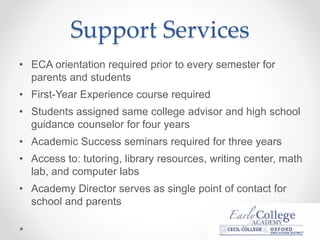
Support Services
• ECA orientation required prior to every semester for
parents and students
• First-Year Experience course required
• Students assigned same college advisor and high school
guidance counselor for four years
• Academic Success seminars required for three years
• Access to: tutoring, library resources, writing center, math
lab, and computer labs
• Academy Director serves as single point of contact for
school and parents
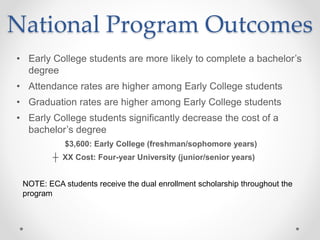
National Program Outcomes
• Early College students are more likely to complete a bachelor’s
degree
• Attendance rates are higher among Early College students
• Graduation rates are higher among Early College students
• Early College students significantly decrease the cost of a
bachelor’s degree
$3,600: Early College (freshman/sophomore years)
┼ XX Cost: Four-year University (junior/senior years)
NOTE: ECA students receive the dual enrollment scholarship throughout the
program
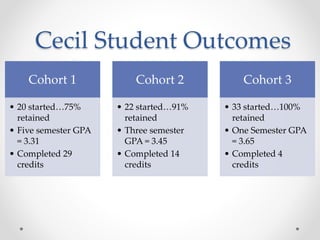
Cecil Student Outcomes
Cohort 1
• 20 started…75%
retained
• Five semester GPA
= 3.31
• Completed 29
credits
Cohort 2
• 22 started…91%
retained
• Three semester
GPA = 3.45
• Completed 14
credits
Cohort 3
• 33 started…100%
retained
• One Semester GPA
= 3.65
• Completed 4
credits
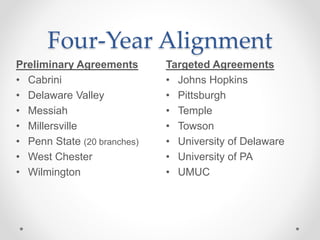
Four-Year Alignment
Targeted Agreements
• Johns Hopkins
• Pittsburgh
• Temple
• Towson
• University of Delaware
• University of PA
• UMUC
Preliminary Agreements
• Cabrini
• Delaware Valley
• Messiah
• Millersville
• Penn State (20 branches)
• West Chester
• Wilmington
Looking Forward
Next Steps Future Outlook
• Launch a CCPS Early College
Academy
• Finalize MOU’s and transfer
agreements with designated four-
year colleges
• Pursue more agreements as
students confirm transfer plans
• ECA will generate 53 FTE’s next
year (3.4% of total enrollment)
• Two full Academies will generate
at least 115 FTE’s annually (7%
of enrollment)
• Explore an Academy option for
homeschool students
Thank You!
Questions

7.11.michaels

  • 1.
    Early College Academy:A Competitive Dual Enrollment Pathway Mary Michaels, Dr. Diane Lane, Diena Gischel Cecil College AFACCT ‘17 Conference, Harford Community College Session 7.11 January 6, 2016, 1:40 p.m.- 2:40 p.m. mmichaels@cecil.edu
  • 2.
    Presentation Abstract Mary Michaels CecilCollege, Early College Academy Director ‘Early College Academy, a competitive dual enrollment pathway’ Session 7.11: January 6, 2016 Oxford Area School District and Cecil College, in partnership, established an Early College Academy that enables students the opportunity to receive a high school diploma and an associate degree concurrently. Students, through a cohort approach, are scheduled for courses that fulfill the requirements of both the high school and the college. Attendees received an overview of the Early College Academy program including how students are provided with career awareness, college level study, and community support while they pursue the initial steps of their postsecondary education before high school completion. In addition, presenters detailed a cost effective plan for students, progressively rigorous curriculum, and implemented student supports that allow students to be competitive after high school.
  • 3.
    Early College Academy “Atransformational strategy that provides a combination of high school and college classes that result in many transferable credits, leading to an associate degree.” Source: (Middle College National Consortium, 2015)
  • 4.
    Program Overview • Truedual enrollment in high school and college • Dual Graduation: high school/college • Cohort learning model • College credits transferrable to 4-year universities • Parental access to college records • Courses offered on-site and online at Oxford and Cecil • School district and college scholarships provided
  • 5.
    Program Concept High School Coursework Academic SkillsBuildingCollege Coursework Student Success College prep focus, while fulfilling graduation requirements Continuous support throughout program Career focus, while fulfilling degree requirements
  • 6.
    ECA Goals • Offera progressively rigorous academic experience • Increase college completion rates among a predominantly first-generation college community • Develop awareness of collegiate culture • Reduce and amortize the cost of a college degree
  • 7.
    Institutional Goals • Addresscollege completion goals • Decrease time to degree • Integrate career and college readiness • Create an alternative pathway to college for select students • Generate a cohort structure that promotes predictive enrollment
  • 8.
    Admissions Criteria During thespring of 8th grade, students should provide the following application materials for admission: • Middle School transcript with a minimum GPA of 3.0 • Early College Academy admissions application • College skills assessment test results (sophomore/junior years) • Early College Academy Questionnaire • Parent/Guardian Consent Form
  • 9.
    Academic Features • Traditionalcourse enrollments with limited electives • Satisfies MHEC, Cecil, Pennsylvania Department of Education, and Oxford academic requirements • College faculty on-site at Oxford • Students must maintain at least a 2.0 GPA in college coursework • Required academic milestones: o College-level writing at conclusion of sophomore year of high school o College-level math at conclusion of junior year of high school
  • 10.
    ECA Curriculum Grade Level OAHS Coursework Cecil College Coursework Academic Seminars 9English Mathematics Social Studies Science Health Fitness (2 courses) Career Development Freshman Seminar Academic Technology Study Habits & Strategies Test Taking Techniques 10 English Mathematics Social Studies Science Computer Science Sociology Public Speaking Humanities Writing Competencies Critical Thinking Skills 11 Mathematics English (2 courses) Concentration Electives (2) History (2 courses) Physical Science Math Competencies Problem Solving Techniques 12 Statistics and/or Pre-Calc Social Science Elective Philosophy Concentration Electives (2) Lab Science Structured Study Hall & Tutoring
  • 11.
    ECA Staffing • Full-timefaculty preferred (75%-80% of courses) • Adjunct: College & Public Schools • Seminar Facilitators Faculty • Director of Program • Designated Advisor • Seminar Facilitator Student Services • Selected adjunct faculty • Designated guidance counselor • Active school participation in scheduling (Principal) Public Schools
  • 12.
    Support Services • ECAorientation required prior to every semester for parents and students • First-Year Experience course required • Students assigned same college advisor and high school guidance counselor for four years • Academic Success seminars required for three years • Access to: tutoring, library resources, writing center, math lab, and computer labs • Academy Director serves as single point of contact for school and parents
  • 13.
    National Program Outcomes •Early College students are more likely to complete a bachelor’s degree • Attendance rates are higher among Early College students • Graduation rates are higher among Early College students • Early College students significantly decrease the cost of a bachelor’s degree $3,600: Early College (freshman/sophomore years) ┼ XX Cost: Four-year University (junior/senior years) NOTE: ECA students receive the dual enrollment scholarship throughout the program
  • 14.
    Cecil Student Outcomes Cohort1 • 20 started…75% retained • Five semester GPA = 3.31 • Completed 29 credits Cohort 2 • 22 started…91% retained • Three semester GPA = 3.45 • Completed 14 credits Cohort 3 • 33 started…100% retained • One Semester GPA = 3.65 • Completed 4 credits
  • 15.
    Four-Year Alignment Targeted Agreements •Johns Hopkins • Pittsburgh • Temple • Towson • University of Delaware • University of PA • UMUC Preliminary Agreements • Cabrini • Delaware Valley • Messiah • Millersville • Penn State (20 branches) • West Chester • Wilmington
  • 16.
    Looking Forward Next StepsFuture Outlook • Launch a CCPS Early College Academy • Finalize MOU’s and transfer agreements with designated four- year colleges • Pursue more agreements as students confirm transfer plans • ECA will generate 53 FTE’s next year (3.4% of total enrollment) • Two full Academies will generate at least 115 FTE’s annually (7% of enrollment) • Explore an Academy option for homeschool students
  • 17.