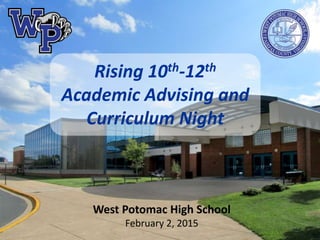
Rising 10th-12th
Academic Advising and
Curriculum Night
West Potomac High School
February 2, 2015
Welcome Class of 2019
Tonight’s Agenda
• 6:00-7:10pm
– Overview of Advanced Academics
– Overview of Academic Advising
• 7:20 – 8:40pm
– Curriculum Breakout Sessions – Quander Rooms
– Electives Open House - Cafeteria
Advanced Academics at
West Potomac High School
Sara Veinbergs
Advanced Academics Coordinator
 Rigorous academic studies
 Open access to all students
 Academic exploration and knowledge beyond the standard
course of study
 Require dedication of time and individual effort beyond
the school day
 College preparatory (Honors) and college-level (AP)
courses
 Visit http://www.fcps.edu/is/aap/index.shtml
What are Advanced Academic
Programs?
 Honors courses are college preparatory
courses courses offered to either prepare
students for AP Courses or are courses
where a comparable AP course does not
exist.
 Students who do well in Honors courses have
a foundation for doing well in AP and
college courses.
The Basics - Honors
5
 Advanced Placement Program® (AP®) courses
are college-level courses offered in high
school. AP courses reflect what is taught in
top introductory college courses
 At the end of course, students take AP
Exams—standardized exams that measure
how well students have mastered college-
level course work. (Some also have an
SOL.)
The Basics - AP
6
 The MOST significant factor leading to success in college is the
rigor of the high school curriculum.
 Advanced academic courses expand student’s ability to read,
write, and think critically; analyze and solve problems; and build
21st century skills.
 Honors and AP courses can bolster a HS transcript and improve
college acceptance.
 Honors courses have .5 and AP courses have 1.0 (with completion
of class and exam) weighted grades which add to a student’s GPA.
 Many colleges grant credit for courses in which students earn a
qualifying score on AP examinations.
Benefits of Participating in
Advanced Academic Programs
 Often the most interesting and fulfilling courses a student takes in
high school
 Students develop confidence, and learn strong study habits and
time management skills
 Colleges rank “Grades in college prep courses” and “Strength of
curriculum” as the top two factors in the admission decision.*
* 2009 State of College Admission, NACAC
Benefits of Participating in
AP Programs
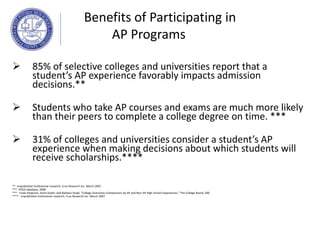
 85% of selective colleges and universities report that a
student’s AP experience favorably impacts admission
decisions.**
 Students who take AP courses and exams are much more likely
than their peers to complete a college degree on time. ***
 31% of colleges and universities consider a student’s AP
experience when making decisions about which students will
receive scholarships.****
** Unpublished institutional research, Crux Research Inc. March 2007
*** IPEDS database, 2008
*** Linda Hargrove, Donn Godin, and Barbara Dodd, “College Outcomes Comparisons by AP and Non-AP High School Experiences.” The College Board, 200
**** Unpublished institutional research, Crux Research Inc. March 2007
Benefits of Participating in
AP Programs
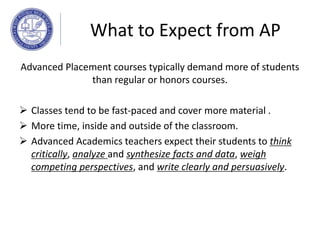
Advanced Placement courses typically demand more of students
than regular or honors courses.
 Classes tend to be fast-paced and cover more material .
 More time, inside and outside of the classroom.
 Advanced Academics teachers expect their students to think
critically, analyze and synthesize facts and data, weigh
competing perspectives, and write clearly and persuasively.
What to Expect from AP
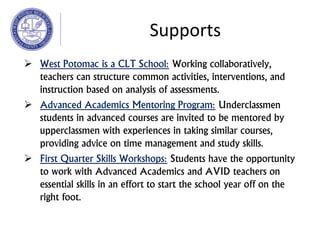
 West Potomac is a CLT School: Working collaboratively,
teachers can structure common activities, interventions, and
instruction based on analysis of assessments.
 Advanced Academics Mentoring Program: Underclassmen
students in advanced courses are invited to be mentored by
upperclassmen with experiences in taking similar courses,
providing advice on time management and study skills.
 First Quarter Skills Workshops: Students have the opportunity
to work with Advanced Academics and AVID teachers on
essential skills in an effort to start the school year off on the
right foot.
Supports
• You! (Parents/Guardians)
– Advanced Academics is for the PREPARED not the
ELITE
– Rigor ≠ More work…BALANCE is key
– Play to strengths and interest areas when
selecting courses
Most Important Support
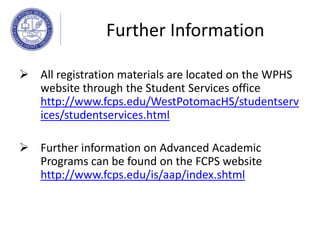
 All registration materials are located on the WPHS
website through the Student Services office
http://www.fcps.edu/WestPotomacHS/studentserv
ices/studentservices.html
 Further information on Advanced Academic
Programs can be found on the FCPS website
http://www.fcps.edu/is/aap/index.shtml
Further Information
Sara Veinbergs
Advanced Academics Coordinator
smveinbergs@fcps.edu
Drew Hamlin
Advanced Academics Assistant Principal
MAhamlin@fcps.edu
Contact Information
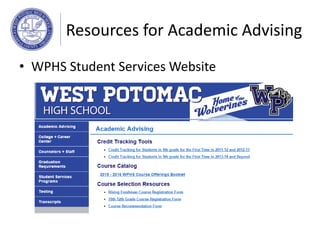
Resources for Academic Advising
• WPHS Student Services Website
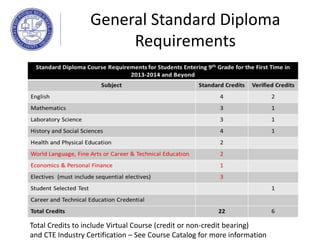
General Standard Diploma
Requirements
Total Credits to include Virtual Course (credit or non-credit bearing)
and CTE Industry Certification – See Course Catalog for more information
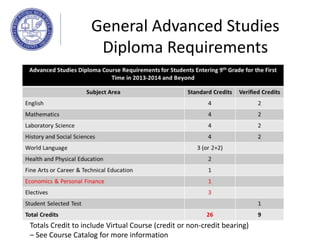
General Advanced Studies
Diploma Requirements
Totals Credit to include Virtual Course (credit or non-credit bearing)
– See Course Catalog for more information
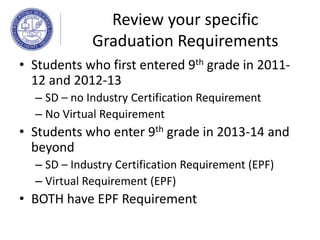
Review your specific
Graduation Requirements
• Students who first entered 9th grade in 2011-
12 and 2012-13
– SD – no Industry Certification Requirement
– No Virtual Requirement
• Students who enter 9th grade in 2013-14 and
beyond
– SD – Industry Certification Requirement (EPF)
– Virtual Requirement (EPF)
• BOTH have EPF Requirement
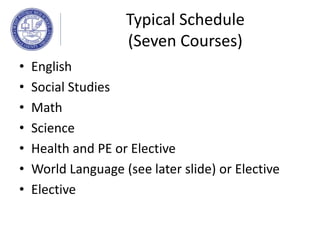
Typical Schedule
(Seven Courses)
• English
• Social Studies
• Math
• Science
• Health and PE or Elective
• World Language (see later slide) or Elective
• Elective
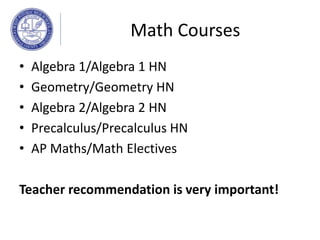
Math Courses
• Algebra 1/Algebra 1 HN
• Geometry/Geometry HN
• Algebra 2/Algebra 2 HN
• Precalculus/Precalculus HN
• AP Maths/Math Electives
Teacher recommendation is very important!
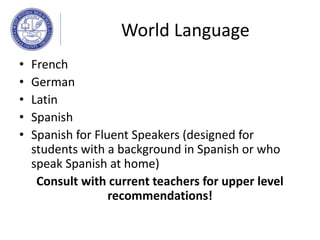
World Language
• French
• German
• Latin
• Spanish
• Spanish for Fluent Speakers (designed for
students with a background in Spanish or who
speak Spanish at home)
Consult with current teachers for upper level
recommendations!
Special Education
• Utilize case manager as support - Case
Manager submits feedback regarding levels of
support based on the student’s IEP
• Level of services (SC, TM, General ed)
• Special Education courses as needed
• (Strategies for Success, Reading, Personal
Development, etc.)
ESOL – English for Speakers of
Other Languages
• ESOL 1
• ESOL 2
• ESOL 2/3 –
• ESOL 3 – Core Math, Science, and Social
Studies are included in schedule
• ESOL 4 – English Core added to schedule
• Students who take English 9 in 9th grade must
complete four years of English
EPF Requirement
• Multiple ways to complete this requirement
– Traditional EPF course (612000)
– AP Micro/Macro Economics
– Self-paced EPF as 8th course/summer course
• $100 fee with course
– Online EPF (full course) – during year or summer
• May have associated fee depending upon when you take it
• Consider all options in determining best for you
• We recommend course in 11th/12th grade
Electives
• Review all options
• Consider your interest areas or areas you may
want to learn more about
• Use High School to explore subjects
• Family Connection has tools to help students
identify areas that may be good fits
• Talk with Teachers – Electives Fair February 4
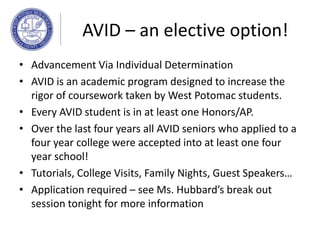
AVID – an elective option!
• Advancement Via Individual Determination
• AVID is an academic program designed to increase the
rigor of coursework taken by West Potomac students.
• Every AVID student is in at least one Honors/AP.
• Over the last four years all AVID seniors who applied to a
four year college were accepted into at least one four
year school!
• Tutorials, College Visits, Family Nights, Guest Speakers…
• Application required – see Ms. Hubbard’s break out
session tonight for more information
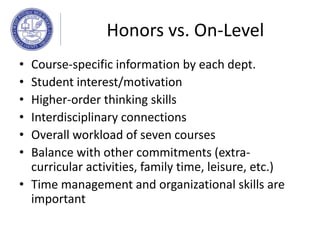
Honors vs. On-Level
• Course-specific information by each dept.
• Student interest/motivation
• Higher-order thinking skills
• Interdisciplinary connections
• Overall workload of seven courses
• Balance with other commitments (extra-
curricular activities, family time, leisure, etc.)
• Time management and organizational skills are
important
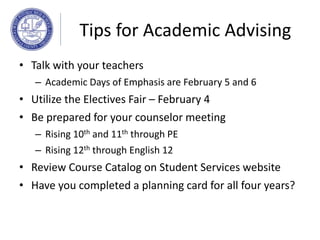
Tips for Academic Advising
• Talk with your teachers
– Academic Days of Emphasis are February 5 and 6
• Utilize the Electives Fair – February 4
• Be prepared for your counselor meeting
– Rising 10th and 11th through PE
– Rising 12th through English 12
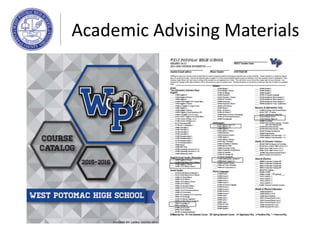
• Review Course Catalog on Student Services website
• Have you completed a planning card for all four years?
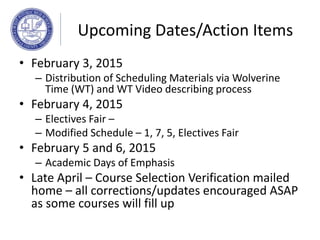
Upcoming Dates/Action Items
• February 3, 2015
– Distribution of Scheduling Materials via Wolverine
Time (WT) and WT Video describing process
• February 4, 2015
– Electives Fair –
– Modified Schedule – 1, 7, 5, Electives Fair
• February 5 and 6, 2015
– Academic Days of Emphasis
• Late April – Course Selection Verification mailed
home – all corrections/updates encouraged ASAP
as some courses will fill up
Academic Advising Materials
What’s Next
What’s Next
Break Out Sessions
• Visit Breakout Sessions
– Beginning at 7:20, 7:40, 8:00, and 8:20pm
• See handout for break out opportunities
– Stop in Cafeteria for Electives Open House
– Have you visited the College and Career Center? It
is open this evening – stop by (door in cafeteria)
and meet Ms. Stewart!

2 2 15 academic advising 10-12th grade presentation

  • 1.
    Rising 10th-12th Academic Advisingand Curriculum Night West Potomac High School February 2, 2015
  • 2.
    Welcome Class of2019 Tonight’s Agenda • 6:00-7:10pm – Overview of Advanced Academics – Overview of Academic Advising • 7:20 – 8:40pm – Curriculum Breakout Sessions – Quander Rooms – Electives Open House - Cafeteria
  • 3.
    Advanced Academics at WestPotomac High School Sara Veinbergs Advanced Academics Coordinator
  • 4.
     Rigorous academicstudies  Open access to all students  Academic exploration and knowledge beyond the standard course of study  Require dedication of time and individual effort beyond the school day  College preparatory (Honors) and college-level (AP) courses  Visit http://www.fcps.edu/is/aap/index.shtml What are Advanced Academic Programs?
  • 5.
     Honors coursesare college preparatory courses courses offered to either prepare students for AP Courses or are courses where a comparable AP course does not exist.  Students who do well in Honors courses have a foundation for doing well in AP and college courses. The Basics - Honors 5
  • 6.
     Advanced PlacementProgram® (AP®) courses are college-level courses offered in high school. AP courses reflect what is taught in top introductory college courses  At the end of course, students take AP Exams—standardized exams that measure how well students have mastered college- level course work. (Some also have an SOL.) The Basics - AP 6
  • 7.
     The MOSTsignificant factor leading to success in college is the rigor of the high school curriculum.  Advanced academic courses expand student’s ability to read, write, and think critically; analyze and solve problems; and build 21st century skills.  Honors and AP courses can bolster a HS transcript and improve college acceptance.  Honors courses have .5 and AP courses have 1.0 (with completion of class and exam) weighted grades which add to a student’s GPA.  Many colleges grant credit for courses in which students earn a qualifying score on AP examinations. Benefits of Participating in Advanced Academic Programs
  • 8.
     Often themost interesting and fulfilling courses a student takes in high school  Students develop confidence, and learn strong study habits and time management skills  Colleges rank “Grades in college prep courses” and “Strength of curriculum” as the top two factors in the admission decision.* * 2009 State of College Admission, NACAC Benefits of Participating in AP Programs
  • 9.
     85% ofselective colleges and universities report that a student’s AP experience favorably impacts admission decisions.**  Students who take AP courses and exams are much more likely than their peers to complete a college degree on time. ***  31% of colleges and universities consider a student’s AP experience when making decisions about which students will receive scholarships.**** ** Unpublished institutional research, Crux Research Inc. March 2007 *** IPEDS database, 2008 *** Linda Hargrove, Donn Godin, and Barbara Dodd, “College Outcomes Comparisons by AP and Non-AP High School Experiences.” The College Board, 200 **** Unpublished institutional research, Crux Research Inc. March 2007 Benefits of Participating in AP Programs
  • 10.
    Advanced Placement coursestypically demand more of students than regular or honors courses.  Classes tend to be fast-paced and cover more material .  More time, inside and outside of the classroom.  Advanced Academics teachers expect their students to think critically, analyze and synthesize facts and data, weigh competing perspectives, and write clearly and persuasively. What to Expect from AP
  • 11.
     West Potomacis a CLT School: Working collaboratively, teachers can structure common activities, interventions, and instruction based on analysis of assessments.  Advanced Academics Mentoring Program: Underclassmen students in advanced courses are invited to be mentored by upperclassmen with experiences in taking similar courses, providing advice on time management and study skills.  First Quarter Skills Workshops: Students have the opportunity to work with Advanced Academics and AVID teachers on essential skills in an effort to start the school year off on the right foot. Supports
  • 12.
    • You! (Parents/Guardians) –Advanced Academics is for the PREPARED not the ELITE – Rigor ≠ More work…BALANCE is key – Play to strengths and interest areas when selecting courses Most Important Support
  • 13.
     All registrationmaterials are located on the WPHS website through the Student Services office http://www.fcps.edu/WestPotomacHS/studentserv ices/studentservices.html  Further information on Advanced Academic Programs can be found on the FCPS website http://www.fcps.edu/is/aap/index.shtml Further Information
  • 14.
    Sara Veinbergs Advanced AcademicsCoordinator smveinbergs@fcps.edu Drew Hamlin Advanced Academics Assistant Principal MAhamlin@fcps.edu Contact Information
  • 15.
    Resources for AcademicAdvising • WPHS Student Services Website
  • 16.
    General Standard Diploma Requirements TotalCredits to include Virtual Course (credit or non-credit bearing) and CTE Industry Certification – See Course Catalog for more information
  • 17.
    General Advanced Studies DiplomaRequirements Totals Credit to include Virtual Course (credit or non-credit bearing) – See Course Catalog for more information
  • 18.
    Review your specific GraduationRequirements • Students who first entered 9th grade in 2011- 12 and 2012-13 – SD – no Industry Certification Requirement – No Virtual Requirement • Students who enter 9th grade in 2013-14 and beyond – SD – Industry Certification Requirement (EPF) – Virtual Requirement (EPF) • BOTH have EPF Requirement
  • 19.
    Typical Schedule (Seven Courses) •English • Social Studies • Math • Science • Health and PE or Elective • World Language (see later slide) or Elective • Elective
  • 20.
    Math Courses • Algebra1/Algebra 1 HN • Geometry/Geometry HN • Algebra 2/Algebra 2 HN • Precalculus/Precalculus HN • AP Maths/Math Electives Teacher recommendation is very important!
  • 21.
    World Language • French •German • Latin • Spanish • Spanish for Fluent Speakers (designed for students with a background in Spanish or who speak Spanish at home) Consult with current teachers for upper level recommendations!
  • 22.
    Special Education • Utilizecase manager as support - Case Manager submits feedback regarding levels of support based on the student’s IEP • Level of services (SC, TM, General ed) • Special Education courses as needed • (Strategies for Success, Reading, Personal Development, etc.)
  • 23.
    ESOL – Englishfor Speakers of Other Languages • ESOL 1 • ESOL 2 • ESOL 2/3 – • ESOL 3 – Core Math, Science, and Social Studies are included in schedule • ESOL 4 – English Core added to schedule • Students who take English 9 in 9th grade must complete four years of English
  • 24.
    EPF Requirement • Multipleways to complete this requirement – Traditional EPF course (612000) – AP Micro/Macro Economics – Self-paced EPF as 8th course/summer course • $100 fee with course – Online EPF (full course) – during year or summer • May have associated fee depending upon when you take it • Consider all options in determining best for you • We recommend course in 11th/12th grade
  • 25.
    Electives • Review alloptions • Consider your interest areas or areas you may want to learn more about • Use High School to explore subjects • Family Connection has tools to help students identify areas that may be good fits • Talk with Teachers – Electives Fair February 4
  • 26.
    AVID – anelective option! • Advancement Via Individual Determination • AVID is an academic program designed to increase the rigor of coursework taken by West Potomac students. • Every AVID student is in at least one Honors/AP. • Over the last four years all AVID seniors who applied to a four year college were accepted into at least one four year school! • Tutorials, College Visits, Family Nights, Guest Speakers… • Application required – see Ms. Hubbard’s break out session tonight for more information
  • 27.
    Honors vs. On-Level •Course-specific information by each dept. • Student interest/motivation • Higher-order thinking skills • Interdisciplinary connections • Overall workload of seven courses • Balance with other commitments (extra- curricular activities, family time, leisure, etc.) • Time management and organizational skills are important
  • 28.
    Tips for AcademicAdvising • Talk with your teachers – Academic Days of Emphasis are February 5 and 6 • Utilize the Electives Fair – February 4 • Be prepared for your counselor meeting – Rising 10th and 11th through PE – Rising 12th through English 12 • Review Course Catalog on Student Services website • Have you completed a planning card for all four years?
  • 29.
    Upcoming Dates/Action Items •February 3, 2015 – Distribution of Scheduling Materials via Wolverine Time (WT) and WT Video describing process • February 4, 2015 – Electives Fair – – Modified Schedule – 1, 7, 5, Electives Fair • February 5 and 6, 2015 – Academic Days of Emphasis • Late April – Course Selection Verification mailed home – all corrections/updates encouraged ASAP as some courses will fill up
  • 30.
  • 31.
  • 32.
  • 33.
    Break Out Sessions •Visit Breakout Sessions – Beginning at 7:20, 7:40, 8:00, and 8:20pm • See handout for break out opportunities – Stop in Cafeteria for Electives Open House – Have you visited the College and Career Center? It is open this evening – stop by (door in cafeteria) and meet Ms. Stewart!

Editor's Notes

  • #4 Sara Veinbergs begins