Print Advertising
Class ObjectivesExplain the pros and cons of magazine advertisingDiscuss the types of magazines & advertisingDescribe how newspapersare categorizedDefine the major types of newspaper advertisingExplain the pros and cons of newspaper advertisingDiscuss print media rates
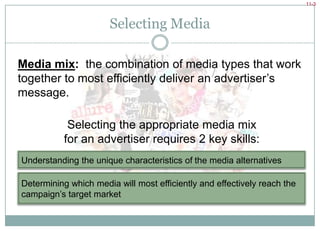
Selecting MediaMedia mix:  the combination of media types that work together to most efficiently deliver an advertiser’s message.Selecting the appropriate media mix for an advertiser requires 2 key skills:Understanding the unique characteristics of the media alternativesDetermining which media will most efficiently and effectively reach the campaign’s target market
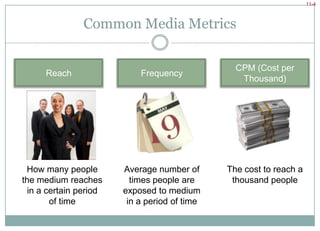
Common Media MetricsReachFrequencyCPM (Cost per Thousand)How many people the medium reaches in a certain period of timeAverage number of times people are exposed to medium in a period of timeThe cost to reach a thousand people
Print MediaMagazines
Newspapers
Directories (e.g. Yellow Pages)
Brochures
Coupon packets
Mail
PostersTop US Magazines by Circulationhttp://en.wikipedia.org/wiki/List_of_magazines_by_circulationMAGAZINES
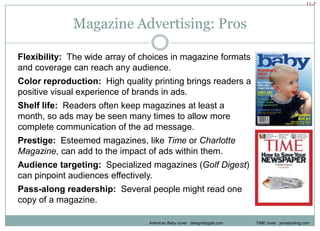
Magazine Advertising: ProsFlexibility:  The wide array of choices in magazine formats and coverage can reach any audience.Color reproduction:  High quality printing brings readers a positive visual experience of brands in ads.Shelf life:  Readers often keep magazines at least a month, so ads may be seen many times to allow more complete communication of the ad message.Prestige:  Esteemed magazines, like Time or Charlotte Magazine, can add to the impact of ads within them.Audience targeting:  Specialized magazines (Golf Digest) can pinpoint audiences effectively.Pass-along readership:  Several people might read one copy of a magazine.American Baby cover:  designsbygab.com	TIME cover:  jamespoling.com
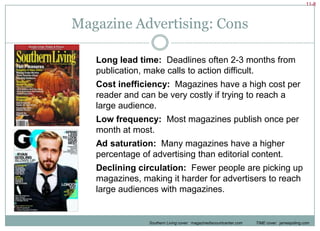
Magazine Advertising: ConsLong lead time:  Deadlines often 2-3 months from publication, make calls to action difficult.Cost inefficiency:  Magazines have a high cost per reader and can be very costly if trying to reach a large audience.  Low frequency:  Most magazines publish once per month at most.Ad saturation:  Many magazines have a higher percentage of advertising than editorial content.Declining circulation:  Fewer people are picking up magazines, making it harder for advertisers to reach large audiences with magazines.Southern Living cover:  magazinediscountcenter.com	TIME cover:  jamespoling.com
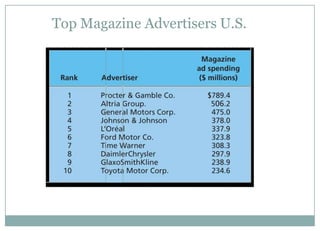
Top Magazine Advertisers U.S.
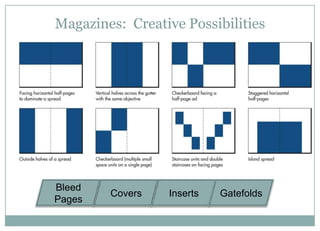
BleedPagesCoversInsertsGatefoldsMagazines:  Creative PossibilitiesMagazine ad positions and sizes
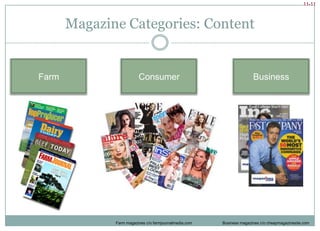
Magazine Categories: ContentConsumerFarmBusinessFarm magazines c/o farmjournalmedia.com	Business magazines c/o cheapmagazinesite.com
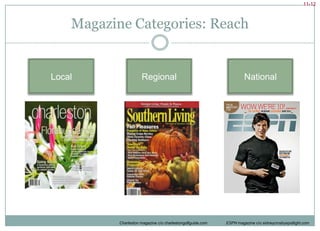
Magazine Categories: ReachLocalRegionalNationalCharleston magazine c/o charlestongolfguide.com	ESPN magazine c/o sidneycrosbyspotlight.com
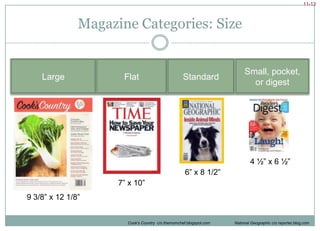
Magazine Categories: SizeLargeFlatStandardSmall, pocket,or digest4 ½” x 6 ½” 6” x 8 1/2”7” x 10”9 3/8” x 12 1/8”Cook’s Country  c/o themomchef.blogspot.com	National Geographic c/o reporter.blog.com
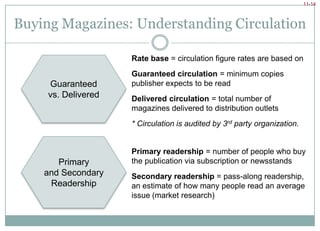
Buying Magazines: Understanding CirculationRate base = circulation figure rates are based onGuaranteed circulation = minimum copies publisher expects to be readDelivered circulation = total number of magazines delivered to distribution outlets* Circulation is audited by 3rd party organization.Guaranteedvs. DeliveredPrimaryand SecondaryReadershipPrimary readership = number of people who buy the publication via subscription or newsstandsSecondary readership = pass-along readership, an estimate of how many people read an average issue (market research)
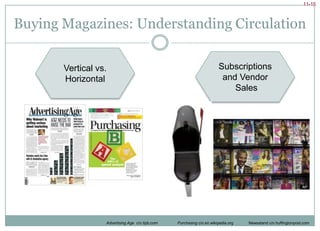
Buying Magazines: Understanding CirculationVertical vs.HorizontalSubscriptionsand Vendor SalesAdvertising Age  c/o tipb.com	Purchasing c/o en.wikipedia.org	Newsstand c/o huffingtonpost.com
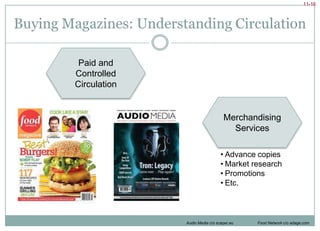
Buying Magazines: Understanding CirculationPaid andControlledCirculationMerchandisingServicesAdvance copies
Market research
Promotions
Etc.Audio Media c/o sceper.eu	Food Network c/o adage.com
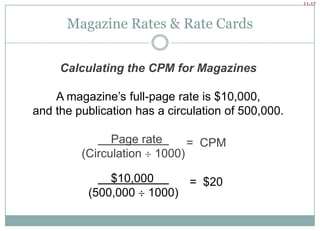
Magazine Rates & Rate CardsCalculating the CPM for Magazines A magazine’s full-page rate is $10,000, and the publication has a circulation of 500,000.     Page rate	(Circulation  1000)    $10,000	(500,000  1000)=  CPM=  $20
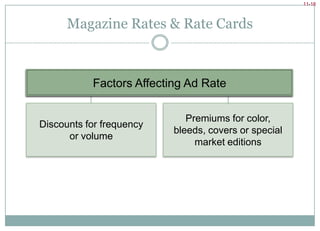
Factors Affecting Ad RateDiscounts for frequency or volumePremiums for color, bleeds, covers or special market editionsMagazine Rates & Rate Cards
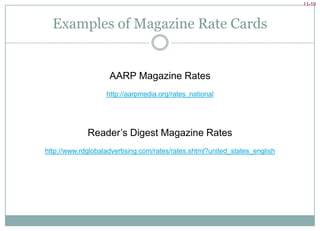
AARP Magazine Rateshttp://aarpmedia.org/rates_nationalReader’s Digest Magazine Rateshttp://www.rdglobaladvertising.com/rates/rates.shtml?united_states_englishExamples of Magazine Rate Cards
Rating Exercise
NEWSPAPERSTop US Newspapers by Circulationhttp://en.wikipedia.org/wiki/List_of_newspapers_in_the_United_States_by_circulation
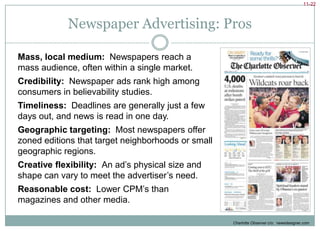
Newspaper Advertising: ProsMass, local medium:  Newspapers reach a mass audience, often within a single market.Credibility:  Newspaper ads rank high among consumers in believability studies.Timeliness:  Deadlines are generally just a few days out, and news is read in one day.Geographic targeting:  Most newspapers offer zoned editions that target neighborhoods or small geographic regions.Creative flexibility:  An ad’s physical size and shape can vary to meet the advertiser’s need.Reasonable cost:  Lower CPM’s than magazines and other media.Charlotte Observer c/o:  newsdesigner.com

Mcom 341-13 Print Advertising

  • 1.
  • 2.
    Class ObjectivesExplain thepros and cons of magazine advertisingDiscuss the types of magazines & advertisingDescribe how newspapersare categorizedDefine the major types of newspaper advertisingExplain the pros and cons of newspaper advertisingDiscuss print media rates
  • 3.
    Selecting MediaMedia mix: the combination of media types that work together to most efficiently deliver an advertiser’s message.Selecting the appropriate media mix for an advertiser requires 2 key skills:Understanding the unique characteristics of the media alternativesDetermining which media will most efficiently and effectively reach the campaign’s target market
  • 4.
    Common Media MetricsReachFrequencyCPM(Cost per Thousand)How many people the medium reaches in a certain period of timeAverage number of times people are exposed to medium in a period of timeThe cost to reach a thousand people
  • 5.
  • 6.
  • 7.
  • 8.
  • 9.
  • 10.
  • 11.
    PostersTop US Magazinesby Circulationhttp://en.wikipedia.org/wiki/List_of_magazines_by_circulationMAGAZINES
  • 12.
    Magazine Advertising: ProsFlexibility: The wide array of choices in magazine formats and coverage can reach any audience.Color reproduction: High quality printing brings readers a positive visual experience of brands in ads.Shelf life: Readers often keep magazines at least a month, so ads may be seen many times to allow more complete communication of the ad message.Prestige: Esteemed magazines, like Time or Charlotte Magazine, can add to the impact of ads within them.Audience targeting: Specialized magazines (Golf Digest) can pinpoint audiences effectively.Pass-along readership: Several people might read one copy of a magazine.American Baby cover: designsbygab.com TIME cover: jamespoling.com
  • 13.
    Magazine Advertising: ConsLonglead time: Deadlines often 2-3 months from publication, make calls to action difficult.Cost inefficiency: Magazines have a high cost per reader and can be very costly if trying to reach a large audience. Low frequency: Most magazines publish once per month at most.Ad saturation: Many magazines have a higher percentage of advertising than editorial content.Declining circulation: Fewer people are picking up magazines, making it harder for advertisers to reach large audiences with magazines.Southern Living cover: magazinediscountcenter.com TIME cover: jamespoling.com
  • 14.
  • 15.
    BleedPagesCoversInsertsGatefoldsMagazines: CreativePossibilitiesMagazine ad positions and sizes
  • 16.
    Magazine Categories: ContentConsumerFarmBusinessFarmmagazines c/o farmjournalmedia.com Business magazines c/o cheapmagazinesite.com
  • 17.
    Magazine Categories: ReachLocalRegionalNationalCharlestonmagazine c/o charlestongolfguide.com ESPN magazine c/o sidneycrosbyspotlight.com
  • 18.
    Magazine Categories: SizeLargeFlatStandardSmall,pocket,or digest4 ½” x 6 ½” 6” x 8 1/2”7” x 10”9 3/8” x 12 1/8”Cook’s Country c/o themomchef.blogspot.com National Geographic c/o reporter.blog.com
  • 19.
    Buying Magazines: UnderstandingCirculationRate base = circulation figure rates are based onGuaranteed circulation = minimum copies publisher expects to be readDelivered circulation = total number of magazines delivered to distribution outlets* Circulation is audited by 3rd party organization.Guaranteedvs. DeliveredPrimaryand SecondaryReadershipPrimary readership = number of people who buy the publication via subscription or newsstandsSecondary readership = pass-along readership, an estimate of how many people read an average issue (market research)
  • 20.
    Buying Magazines: UnderstandingCirculationVertical vs.HorizontalSubscriptionsand Vendor SalesAdvertising Age c/o tipb.com Purchasing c/o en.wikipedia.org Newsstand c/o huffingtonpost.com
  • 21.
    Buying Magazines: UnderstandingCirculationPaid andControlledCirculationMerchandisingServicesAdvance copies
  • 22.
  • 23.
  • 24.
    Etc.Audio Media c/osceper.eu Food Network c/o adage.com
  • 25.
    Magazine Rates &Rate CardsCalculating the CPM for Magazines A magazine’s full-page rate is $10,000, and the publication has a circulation of 500,000. Page rate (Circulation  1000) $10,000 (500,000  1000)= CPM= $20
  • 26.
    Factors Affecting AdRateDiscounts for frequency or volumePremiums for color, bleeds, covers or special market editionsMagazine Rates & Rate Cards
  • 27.
    AARP Magazine Rateshttp://aarpmedia.org/rates_nationalReader’sDigest Magazine Rateshttp://www.rdglobaladvertising.com/rates/rates.shtml?united_states_englishExamples of Magazine Rate Cards
  • 28.
  • 29.
    NEWSPAPERSTop US Newspapersby Circulationhttp://en.wikipedia.org/wiki/List_of_newspapers_in_the_United_States_by_circulation
  • 30.
    Newspaper Advertising: ProsMass,local medium: Newspapers reach a mass audience, often within a single market.Credibility: Newspaper ads rank high among consumers in believability studies.Timeliness: Deadlines are generally just a few days out, and news is read in one day.Geographic targeting: Most newspapers offer zoned editions that target neighborhoods or small geographic regions.Creative flexibility: An ad’s physical size and shape can vary to meet the advertiser’s need.Reasonable cost: Lower CPM’s than magazines and other media.Charlotte Observer c/o: newsdesigner.com