Copyright © 2014 McGraw-Hill Education. All rights reserved. No reproduction or distribution without the prior written consent of 
McGraw-Hill Education. 
Chapter 12 
Evaluation of 
Print Media: 
Magazines 
and 
Newspapers
Magazines and Newspapers 
 Present detailed information that can be processed 
at the reader’s own pace 
 High-involvement media 
 Magazines are the most specialized of all 
advertising media 
Copyright © 2014 McGraw-Hill Education. All rights reserved. No reproduction or distribution without the prior written consent of 
McGraw-Hill Education. 
2
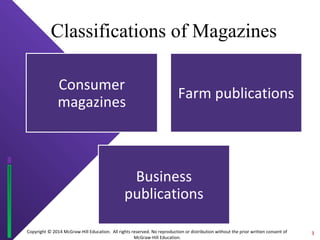
Classifications of Magazines 
Consumer 
magazines Farm publications 
Business 
publications 
Copyright © 2014 McGraw-Hill Education. All rights reserved. No reproduction or distribution without the prior written consent of 
McGraw-Hill Education. 
3
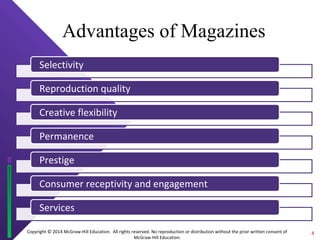
Advantages of Magazines 
Selectivity 
Reproduction quality 
Creative flexibility 
Permanence 
Prestige 
Consumer receptivity and engagement 
Services 
Copyright © 2014 McGraw-Hill Education. All rights reserved. No reproduction or distribution without the prior written consent of 
McGraw-Hill Education. 
4
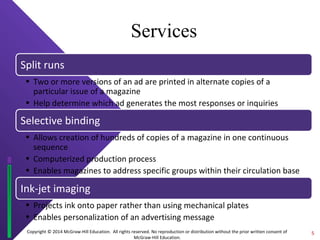
Services 
Split runs 
• Two or more versions of an ad are printed in alternate copies of a 
particular issue of a magazine 
• Help determine which ad generates the most responses or inquiries 
Selective binding 
• Allows creation of hundreds of copies of a magazine in one continuous 
sequence 
• Computerized production process 
• Enables magazines to address specific groups within their circulation base 
Ink-jet imaging 
• Projects ink onto paper rather than using mechanical plates 
• Enables personalization of an advertising message 
Copyright © 2014 McGraw-Hill Education. All rights reserved. No reproduction or distribution without the prior written consent of 
McGraw-Hill Education. 
5
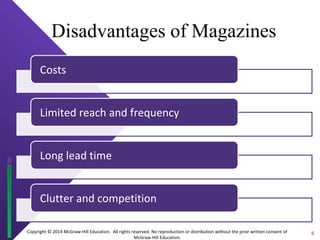
Disadvantages of Magazines 
Copyright © 2014 McGraw-Hill Education. All rights reserved. No reproduction or distribution without the prior written consent of 
McGraw-Hill Education. 
Costs 
Limited reach and frequency 
Long lead time 
Clutter and competition 
6
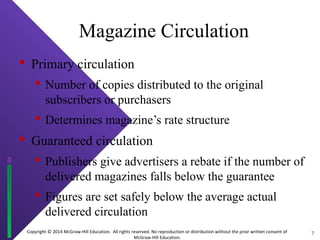
Magazine Circulation 
 Primary circulation 
 Number of copies distributed to the original 
subscribers or purchasers 
 Determines magazine’s rate structure 
 Guaranteed circulation 
 Publishers give advertisers a rebate if the number of 
delivered magazines falls below the guarantee 
 Figures are set safely below the average actual 
delivered circulation 
Copyright © 2014 McGraw-Hill Education. All rights reserved. No reproduction or distribution without the prior written consent of 
McGraw-Hill Education. 
7
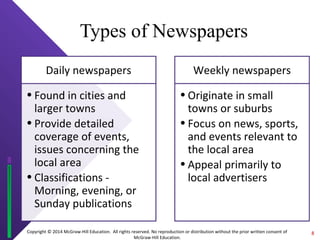
Types of Newspapers 
Copyright © 2014 McGraw-Hill Education. All rights reserved. No reproduction or distribution without the prior written consent of 
McGraw-Hill Education. 
Daily newspapers 
• Found in cities and 
larger towns 
• Provide detailed 
coverage of events, 
issues concerning the 
local area 
• Classifications - 
Morning, evening, or 
Sunday publications 
Weekly newspapers 
• Originate in small 
towns or suburbs 
• Focus on news, sports, 
and events relevant to 
the local area 
• Appeal primarily to 
local advertisers 
8
Types of Newspapers 
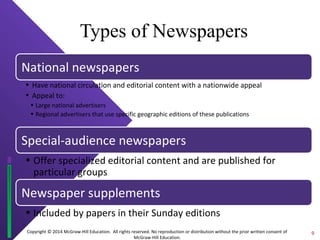
National newspapers 
• Have national circulation and editorial content with a nationwide appeal 
• Appeal to: 
• Large national advertisers 
• Regional advertisers that use specific geographic editions of these publications 
Special-audience newspapers 
• Offer specialized editorial content and are published for 
particular groups 
Newspaper supplements 
• Included by papers in their Sunday editions 
Copyright © 2014 McGraw-Hill Education. All rights reserved. No reproduction or distribution without the prior written consent of 
McGraw-Hill Education. 
9
Types of Newspaper Advertising 
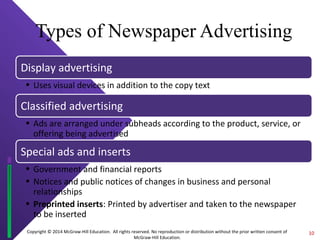
Display advertising 
• Uses visual devices in addition to the copy text 
Classified advertising 
• Ads are arranged under subheads according to the product, service, or 
offering being advertised 
Special ads and inserts 
• Government and financial reports 
• Notices and public notices of changes in business and personal 
relationships 
• Preprinted inserts: Printed by advertiser and taken to the newspaper 
to be inserted 
Copyright © 2014 McGraw-Hill Education. All rights reserved. No reproduction or distribution without the prior written consent of 
McGraw-Hill Education. 
10
Advantages and Disadvantages of 
Newspapers 
Copyright © 2014 McGraw-Hill Education. All rights reserved. No reproduction or distribution without the prior written consent of 
McGraw-Hill Education. 
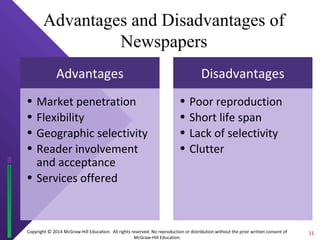
Advantages 
• Market penetration 
• Flexibility 
• Geographic selectivity 
• Reader involvement 
and acceptance 
• Services offered 
Disadvantages 
• Poor reproduction 
• Short life span 
• Lack of selectivity 
• Clutter 
11
Categories of Newspaper Circulation 
Figures 
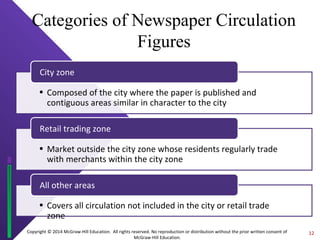
• Composed of the city where the paper is published and 
contiguous areas similar in character to the city 
Retail trading zone 
All other areas 
Copyright © 2014 McGraw-Hill Education. All rights reserved. No reproduction or distribution without the prior written consent of 
McGraw-Hill Education. 
City zone 
• Market outside the city zone whose residents regularly trade 
with merchants within the city zone 
• Covers all circulation not included in the city or retail trade 
zone 
12
Newspaper Rates 
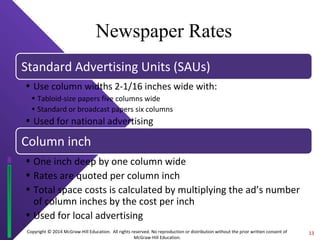
Standard Advertising Units (SAUs) 
• Use column widths 2-1/16 inches wide with: 
• Tabloid-size papers five columns wide 
• Standard or broadcast papers six columns 
• Used for national advertising 
Column inch 
• One inch deep by one column wide 
• Rates are quoted per column inch 
• Total space costs is calculated by multiplying the ad’s number 
of column inches by the cost per inch 
• Used for local advertising 
Copyright © 2014 McGraw-Hill Education. All rights reserved. No reproduction or distribution without the prior written consent of 
McGraw-Hill Education. 
13
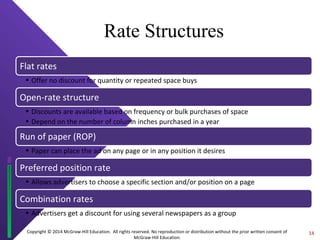
Rate Structures 
Flat rates 
• Offer no discount for quantity or repeated space buys 
Open-rate structure 
• Discounts are available based on frequency or bulk purchases of space 
• Depend on the number of column inches purchased in a year 
Run of paper (ROP) 
• Paper can place the ad on any page or in any position it desires 
Preferred position rate 
• Allows advertisers to choose a specific section and/or position on a page 
Combination rates 
• Advertisers get a discount for using several newspapers as a group 
Copyright © 2014 McGraw-Hill Education. All rights reserved. No reproduction or distribution without the prior written consent of 
McGraw-Hill Education. 
14

Belch 10e ch12_ppt

  • 1.
    Copyright © 2014McGraw-Hill Education. All rights reserved. No reproduction or distribution without the prior written consent of McGraw-Hill Education. Chapter 12 Evaluation of Print Media: Magazines and Newspapers
  • 2.
    Magazines and Newspapers  Present detailed information that can be processed at the reader’s own pace  High-involvement media  Magazines are the most specialized of all advertising media Copyright © 2014 McGraw-Hill Education. All rights reserved. No reproduction or distribution without the prior written consent of McGraw-Hill Education. 2
  • 3.
    Classifications of Magazines Consumer magazines Farm publications Business publications Copyright © 2014 McGraw-Hill Education. All rights reserved. No reproduction or distribution without the prior written consent of McGraw-Hill Education. 3
  • 4.
    Advantages of Magazines Selectivity Reproduction quality Creative flexibility Permanence Prestige Consumer receptivity and engagement Services Copyright © 2014 McGraw-Hill Education. All rights reserved. No reproduction or distribution without the prior written consent of McGraw-Hill Education. 4
  • 5.
    Services Split runs • Two or more versions of an ad are printed in alternate copies of a particular issue of a magazine • Help determine which ad generates the most responses or inquiries Selective binding • Allows creation of hundreds of copies of a magazine in one continuous sequence • Computerized production process • Enables magazines to address specific groups within their circulation base Ink-jet imaging • Projects ink onto paper rather than using mechanical plates • Enables personalization of an advertising message Copyright © 2014 McGraw-Hill Education. All rights reserved. No reproduction or distribution without the prior written consent of McGraw-Hill Education. 5
  • 6.
    Disadvantages of Magazines Copyright © 2014 McGraw-Hill Education. All rights reserved. No reproduction or distribution without the prior written consent of McGraw-Hill Education. Costs Limited reach and frequency Long lead time Clutter and competition 6
  • 7.
    Magazine Circulation Primary circulation  Number of copies distributed to the original subscribers or purchasers  Determines magazine’s rate structure  Guaranteed circulation  Publishers give advertisers a rebate if the number of delivered magazines falls below the guarantee  Figures are set safely below the average actual delivered circulation Copyright © 2014 McGraw-Hill Education. All rights reserved. No reproduction or distribution without the prior written consent of McGraw-Hill Education. 7
  • 8.
    Types of Newspapers Copyright © 2014 McGraw-Hill Education. All rights reserved. No reproduction or distribution without the prior written consent of McGraw-Hill Education. Daily newspapers • Found in cities and larger towns • Provide detailed coverage of events, issues concerning the local area • Classifications - Morning, evening, or Sunday publications Weekly newspapers • Originate in small towns or suburbs • Focus on news, sports, and events relevant to the local area • Appeal primarily to local advertisers 8
  • 9.
    Types of Newspapers National newspapers • Have national circulation and editorial content with a nationwide appeal • Appeal to: • Large national advertisers • Regional advertisers that use specific geographic editions of these publications Special-audience newspapers • Offer specialized editorial content and are published for particular groups Newspaper supplements • Included by papers in their Sunday editions Copyright © 2014 McGraw-Hill Education. All rights reserved. No reproduction or distribution without the prior written consent of McGraw-Hill Education. 9
  • 10.
    Types of NewspaperAdvertising Display advertising • Uses visual devices in addition to the copy text Classified advertising • Ads are arranged under subheads according to the product, service, or offering being advertised Special ads and inserts • Government and financial reports • Notices and public notices of changes in business and personal relationships • Preprinted inserts: Printed by advertiser and taken to the newspaper to be inserted Copyright © 2014 McGraw-Hill Education. All rights reserved. No reproduction or distribution without the prior written consent of McGraw-Hill Education. 10
  • 11.
    Advantages and Disadvantagesof Newspapers Copyright © 2014 McGraw-Hill Education. All rights reserved. No reproduction or distribution without the prior written consent of McGraw-Hill Education. Advantages • Market penetration • Flexibility • Geographic selectivity • Reader involvement and acceptance • Services offered Disadvantages • Poor reproduction • Short life span • Lack of selectivity • Clutter 11
  • 12.
    Categories of NewspaperCirculation Figures • Composed of the city where the paper is published and contiguous areas similar in character to the city Retail trading zone All other areas Copyright © 2014 McGraw-Hill Education. All rights reserved. No reproduction or distribution without the prior written consent of McGraw-Hill Education. City zone • Market outside the city zone whose residents regularly trade with merchants within the city zone • Covers all circulation not included in the city or retail trade zone 12
  • 13.
    Newspaper Rates StandardAdvertising Units (SAUs) • Use column widths 2-1/16 inches wide with: • Tabloid-size papers five columns wide • Standard or broadcast papers six columns • Used for national advertising Column inch • One inch deep by one column wide • Rates are quoted per column inch • Total space costs is calculated by multiplying the ad’s number of column inches by the cost per inch • Used for local advertising Copyright © 2014 McGraw-Hill Education. All rights reserved. No reproduction or distribution without the prior written consent of McGraw-Hill Education. 13
  • 14.
    Rate Structures Flatrates • Offer no discount for quantity or repeated space buys Open-rate structure • Discounts are available based on frequency or bulk purchases of space • Depend on the number of column inches purchased in a year Run of paper (ROP) • Paper can place the ad on any page or in any position it desires Preferred position rate • Allows advertisers to choose a specific section and/or position on a page Combination rates • Advertisers get a discount for using several newspapers as a group Copyright © 2014 McGraw-Hill Education. All rights reserved. No reproduction or distribution without the prior written consent of McGraw-Hill Education. 14