MEDIA OBJECTIVES
AND STRATEGIES
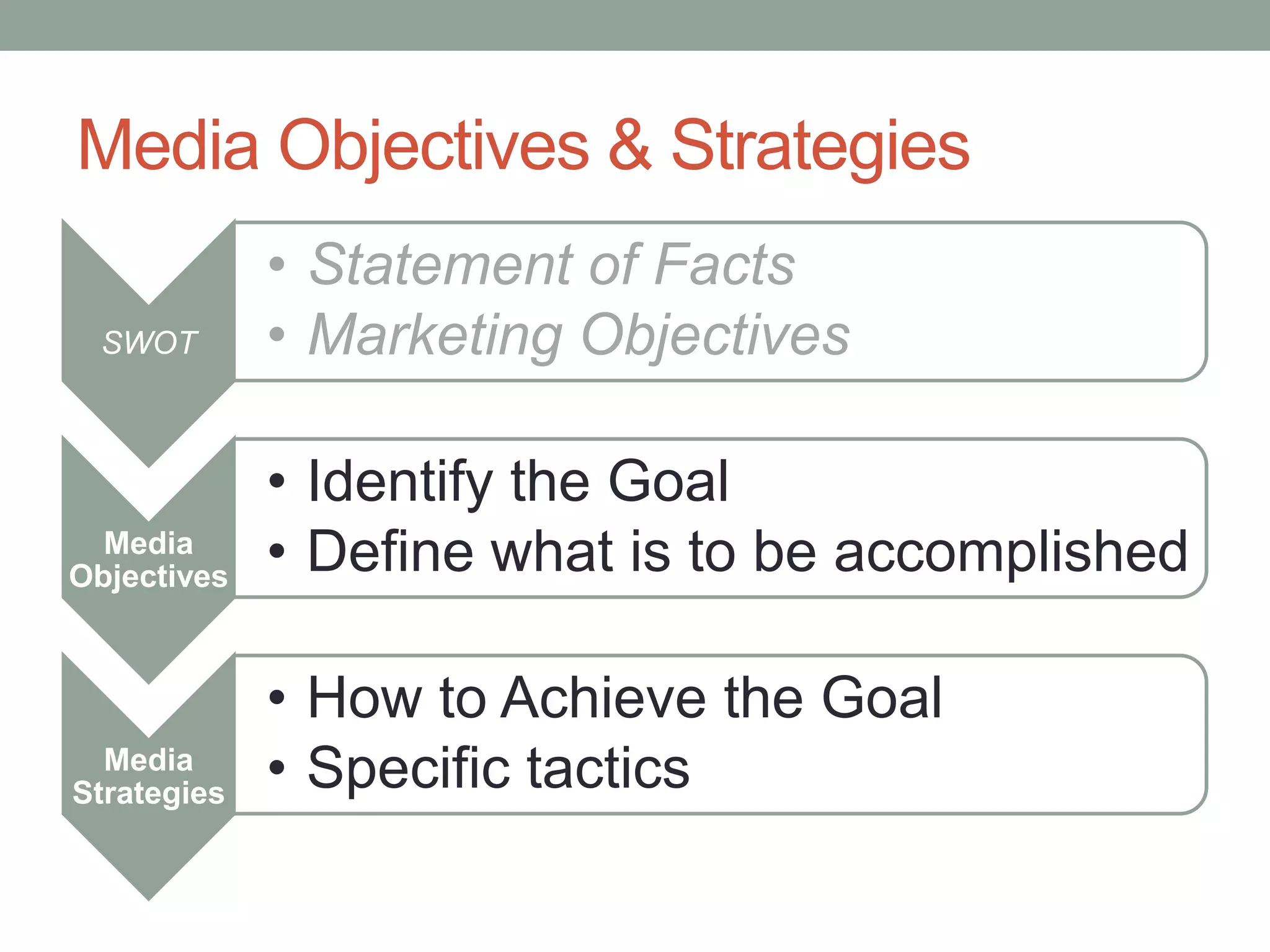
Media Objectives & Strategies
             • Statement of Facts
  SWOT       • Marketing Objectives

             • Identify the Goal
  Media
Objectives
             • Define what is to be accomplished

             • How to Achieve the Goal
  Media
Strategies
             • Specific tactics
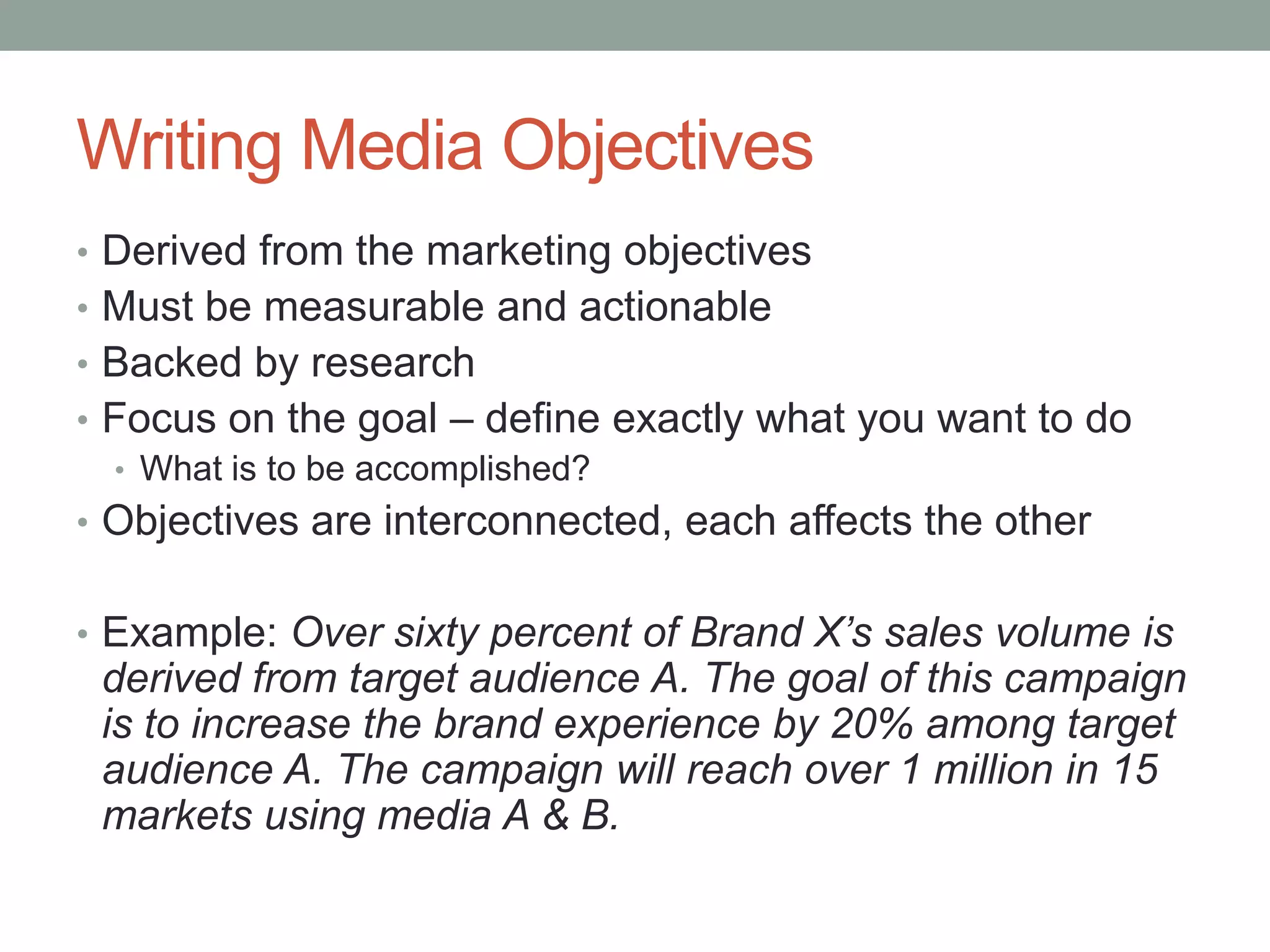
Writing Media Objectives
• Derived from the marketing objectives
• Must be measurable and actionable
• Backed by research
• Focus on the goal – define exactly what you want to do
  • What is to be accomplished?
• Objectives are interconnected, each affects the other


• Example: Over sixty percent of Brand X’s sales volume is
 derived from target audience A. The goal of this campaign
 is to increase the brand experience by 20% among target
 audience A. The campaign will reach over 1 million in 15
 markets using media A & B.
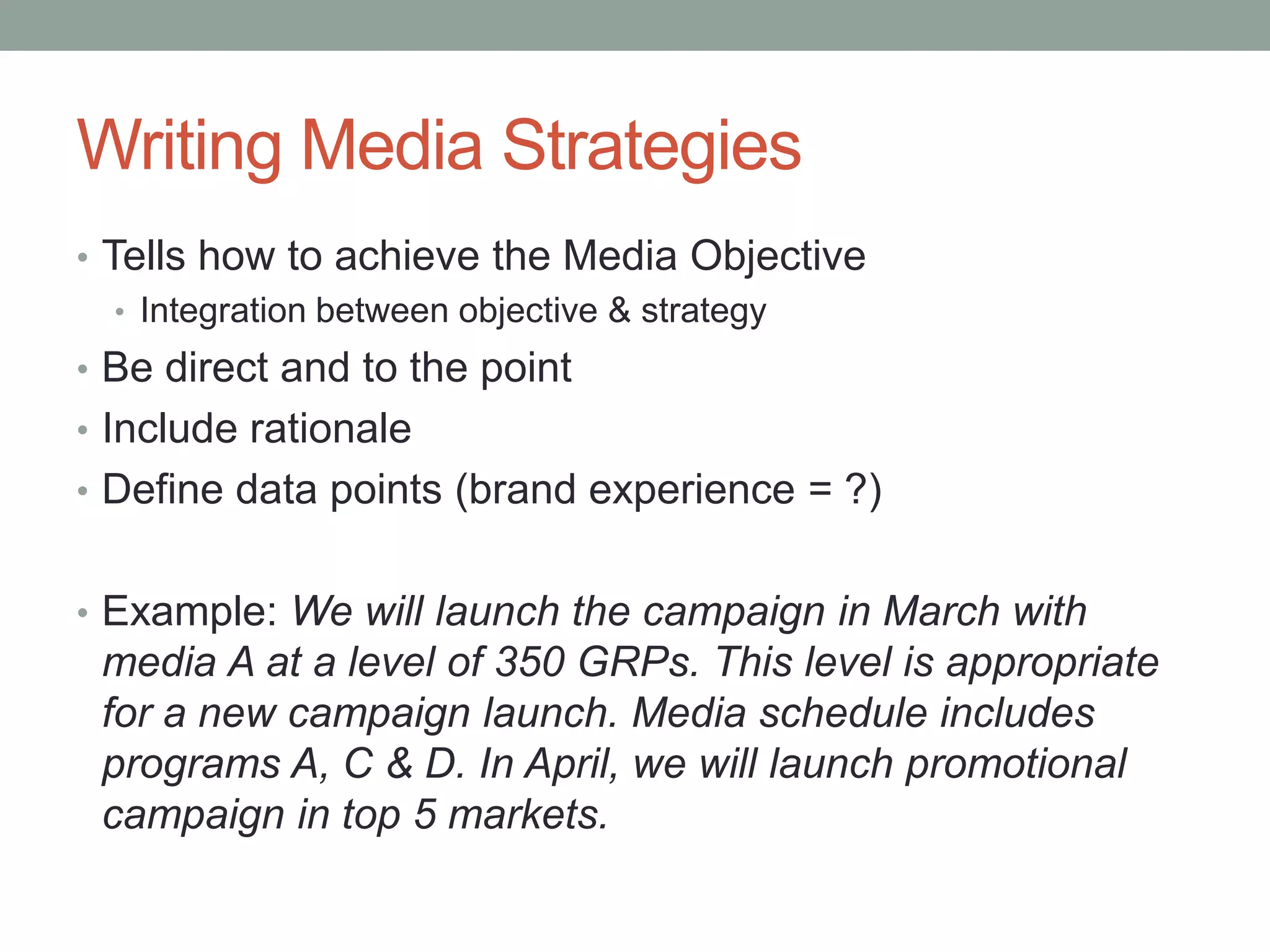
Writing Media Strategies
• Tells how to achieve the Media Objective
   • Integration between objective & strategy
• Be direct and to the point
• Include rationale
• Define data points (brand experience = ?)


• Example: We will launch the campaign in March with
 media A at a level of 350 GRPs. This level is appropriate
 for a new campaign launch. Media schedule includes
 programs A, C & D. In April, we will launch promotional
 campaign in top 5 markets.
6 Media Objectives & Strategies
Each requires an objective and strategy
• Target Audience & Media Mix
• Reach, Frequency & GRPs
• Scheduling & Timing
• Media Budget
• Geography
• Sales Promotion


• Internet Strategy – Covers any content requirements for
 the website.
                    See MFP pages 29-31 for examples of each
General guidelines
• “A brilliant media strategy is totally wasted unless it is
  communicated with brilliance”
• Keep it interesting, be direct
• Organization is key
  • Builds a better case by flowing logically
  • Helps with presentation
• Be specific; use numbers, percentages – not
  generalizations
• Use tables & charts when appropriate, but explain in
  preceding paragraph.

                       See MFP pages 34-35 for list of Dos and Don’ts
DETERMINING REACH
& FREQUENCY GOALS
Determining Reach & Frequency Goals
• How much reach is enough?
• Reach follows a curve that flattens as GRPs increase.
• Highest Reach – 99%
• Moderate Reach – 70% to 75%
• Lowest Reach – 50% to 60%
   • 50% is minimum for brand survival
   • Use flighting schedule to achieve a higher reach over a shorter
     period of time – avoid dilution of the media plan
Determining Reach & Frequency Goals
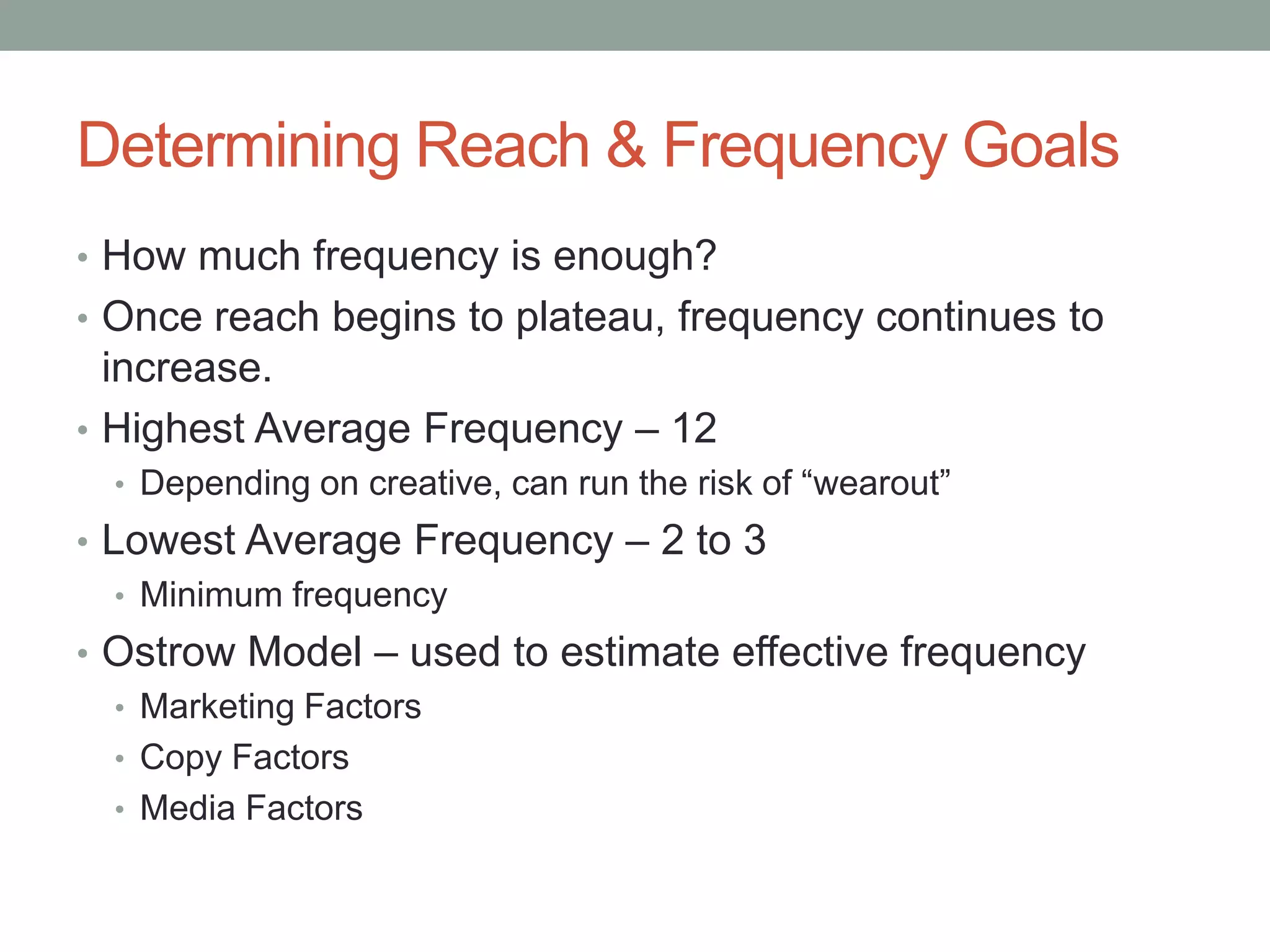
• How much frequency is enough?
• Once reach begins to plateau, frequency continues to
  increase.
• Highest Average Frequency – 12
  • Depending on creative, can run the risk of “wearout”
• Lowest Average Frequency – 2 to 3
   • Minimum frequency
• Ostrow Model – used to estimate effective frequency
  • Marketing Factors
  • Copy Factors
  • Media Factors
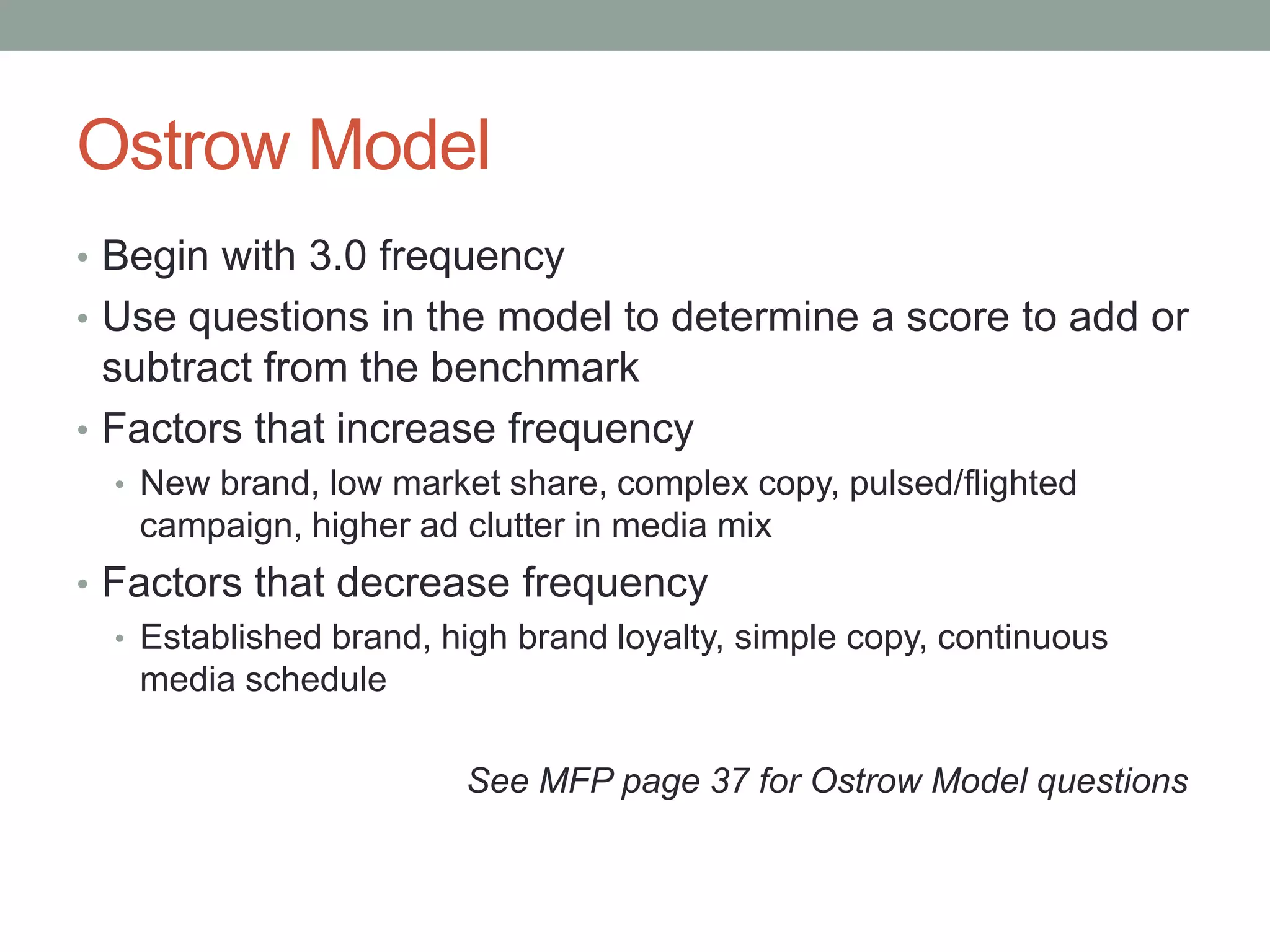
Ostrow Model
• Begin with 3.0 frequency
• Use questions in the model to determine a score to add or
  subtract from the benchmark
• Factors that increase frequency
  • New brand, low market share, complex copy, pulsed/flighted
    campaign, higher ad clutter in media mix
• Factors that decrease frequency
  • Established brand, high brand loyalty, simple copy, continuous
    media schedule

                        See MFP page 37 for Ostrow Model questions
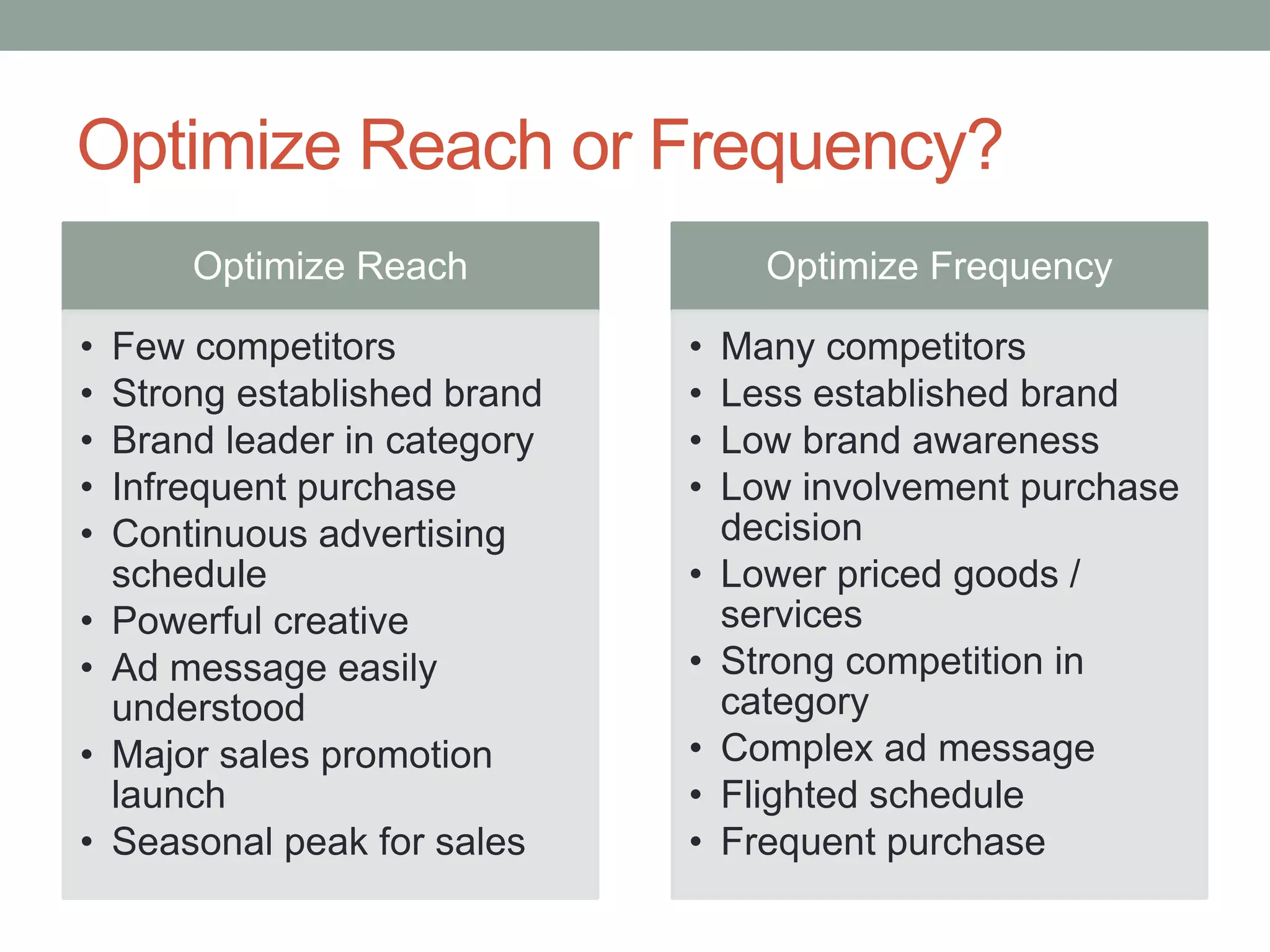
Optimize Reach or Frequency?
        Optimize Reach               Optimize Frequency

•   Few competitors            •   Many competitors
•   Strong established brand   •   Less established brand
•   Brand leader in category   •   Low brand awareness
•   Infrequent purchase        •   Low involvement purchase
•   Continuous advertising         decision
    schedule                   •   Lower priced goods /
•   Powerful creative              services
•   Ad message easily          •   Strong competition in
    understood                     category
•   Major sales promotion      •   Complex ad message
    launch                     •   Flighted schedule
•   Seasonal peak for sales    •   Frequent purchase
CPM & CPP
CPM & CPP
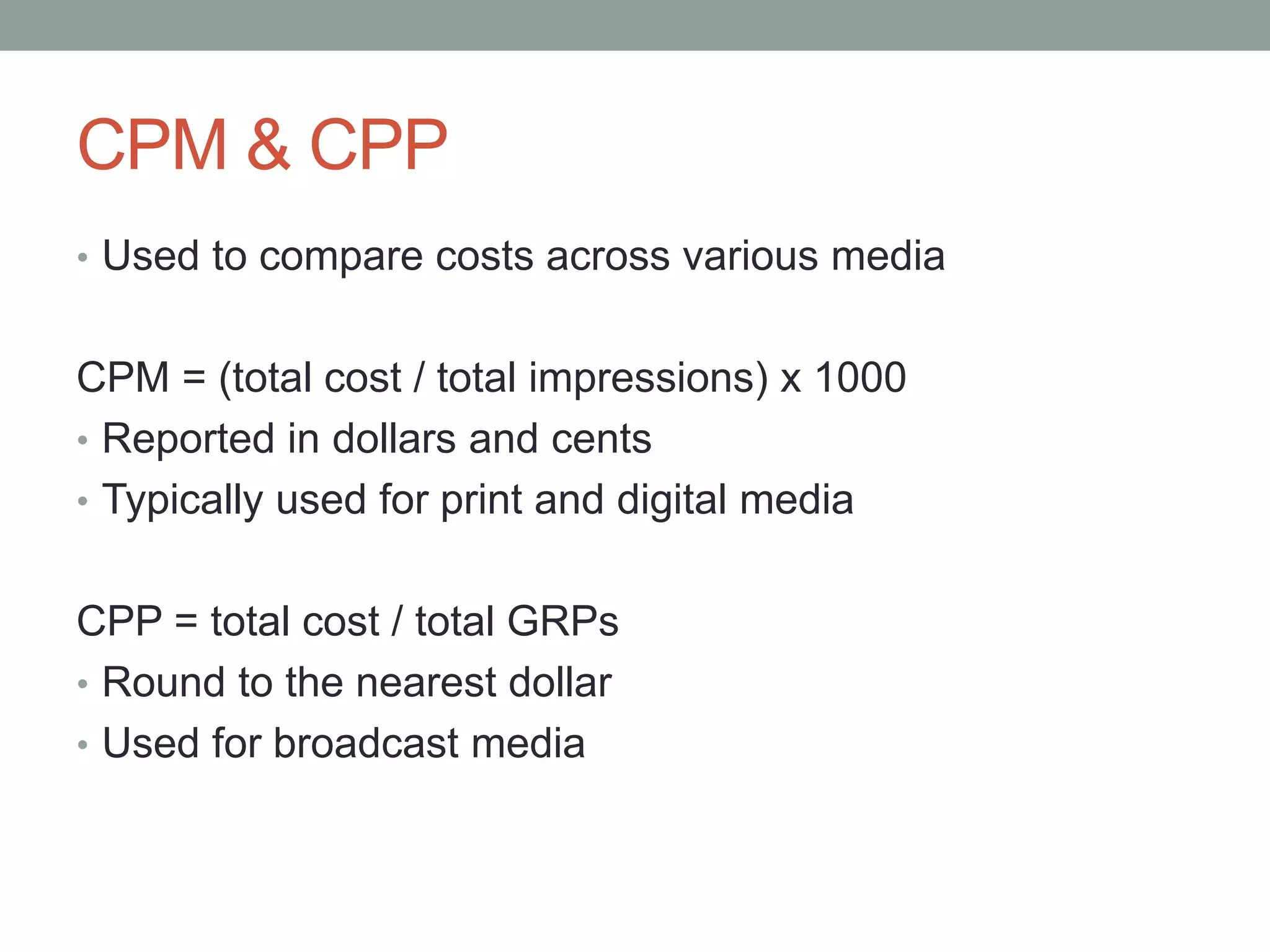
• Used to compare costs across various media


CPM = (total cost / total impressions) x 1000
• Reported in dollars and cents
• Typically used for print and digital media


CPP = total cost / total GRPs
• Round to the nearest dollar
• Used for broadcast media
Using CPM / CPP to estimate budgets
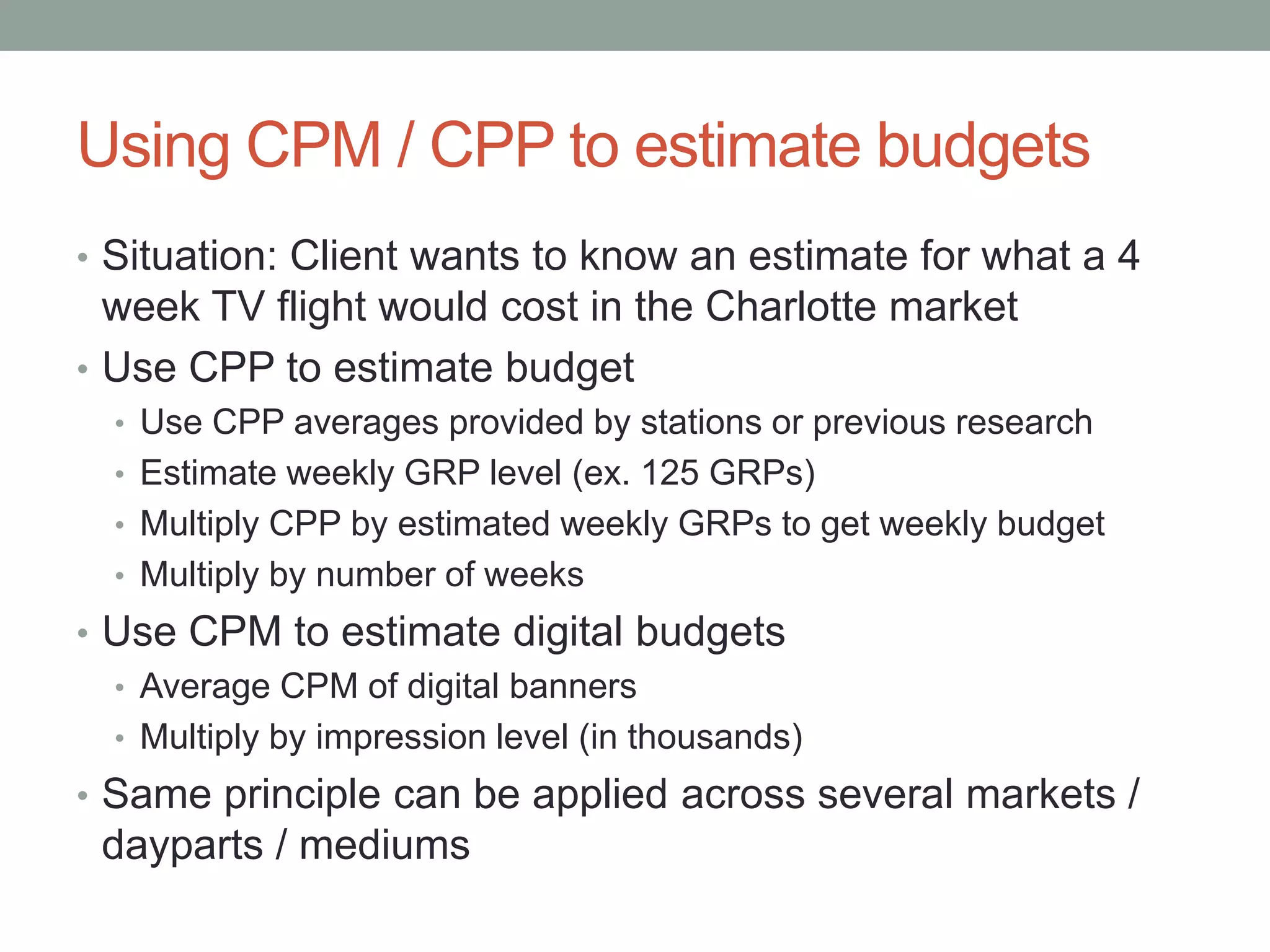
• Situation: Client wants to know an estimate for what a 4
  week TV flight would cost in the Charlotte market
• Use CPP to estimate budget
  • Use CPP averages provided by stations or previous research
  • Estimate weekly GRP level (ex. 125 GRPs)
  • Multiply CPP by estimated weekly GRPs to get weekly budget
  • Multiply by number of weeks
• Use CPM to estimate digital budgets
  • Average CPM of digital banners
  • Multiply by impression level (in thousands)
• Same principle can be applied across several markets /
 dayparts / mediums
MEDIA MIX
Pros & Cons of Media Types
Media Mix
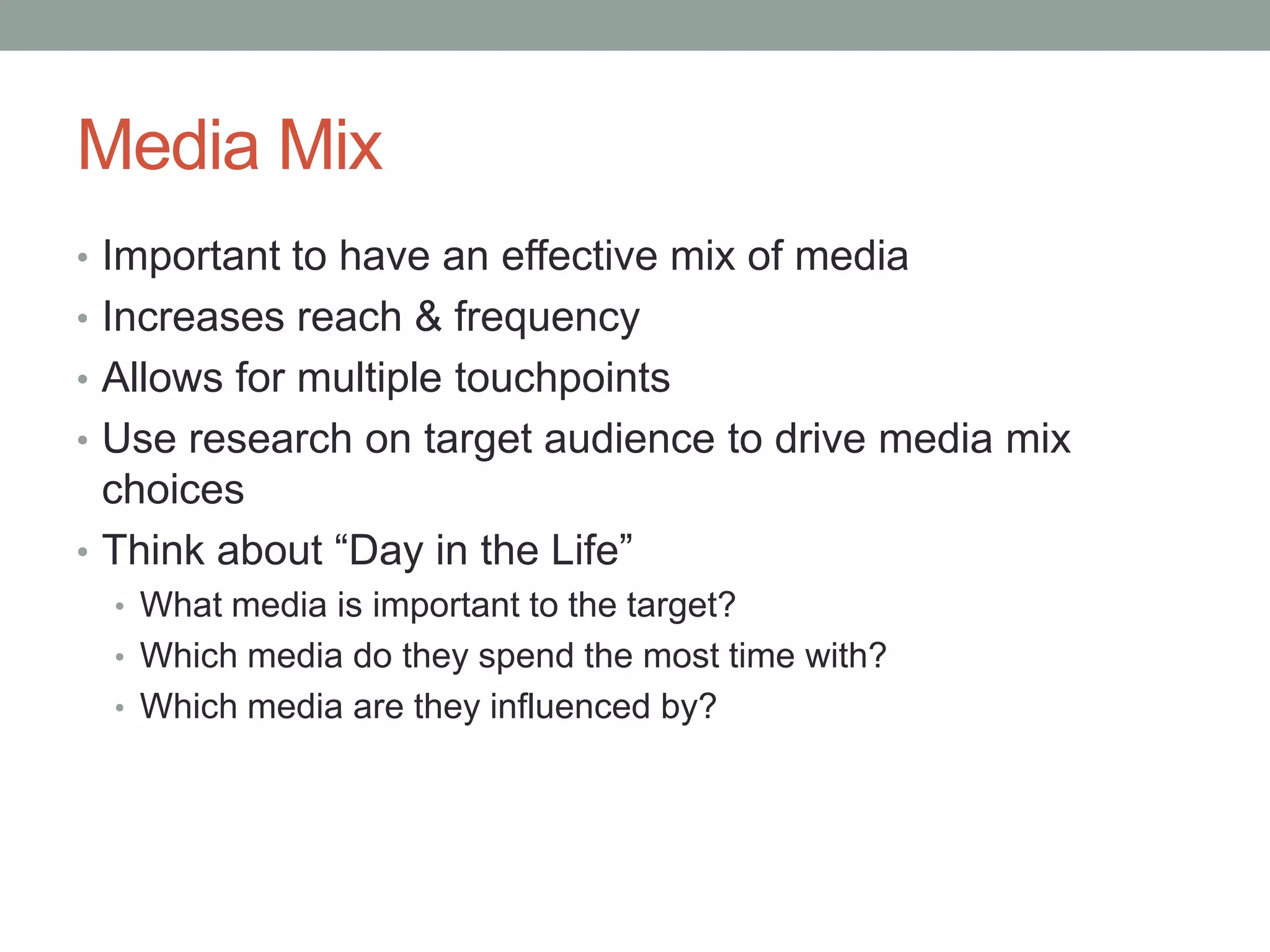
• Important to have an effective mix of media
• Increases reach & frequency
• Allows for multiple touchpoints
• Use research on target audience to drive media mix
  choices
• Think about “Day in the Life”
  • What media is important to the target?
  • Which media do they spend the most time with?
  • Which media are they influenced by?
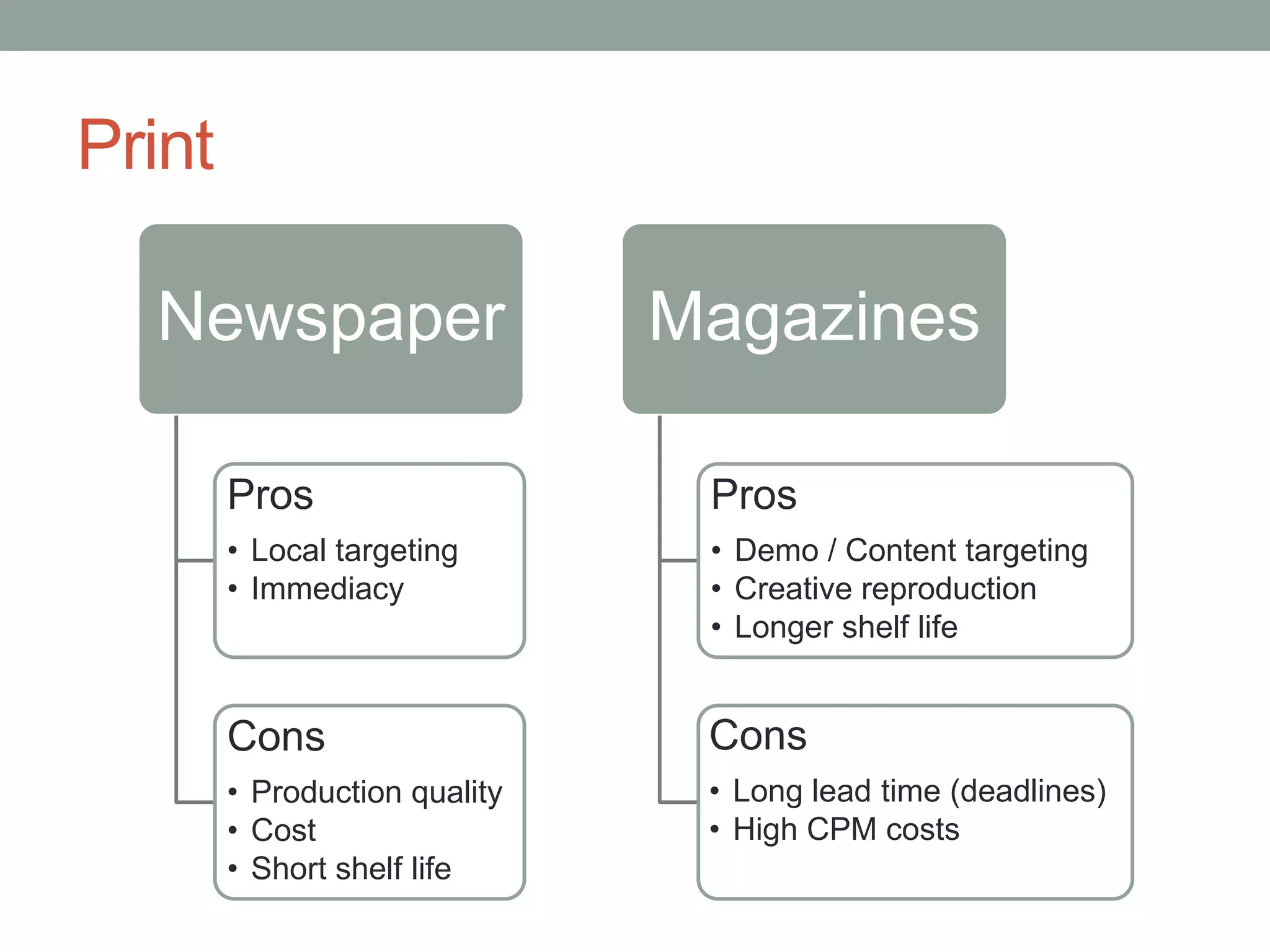
Print

  Newspaper                    Magazines

        Pros                    Pros
        • Local targeting       • Demo / Content targeting
        • Immediacy             • Creative reproduction
                                • Longer shelf life


        Cons                    Cons
        • Production quality    • Long lead time (deadlines)
        • Cost                  • High CPM costs
        • Short shelf life
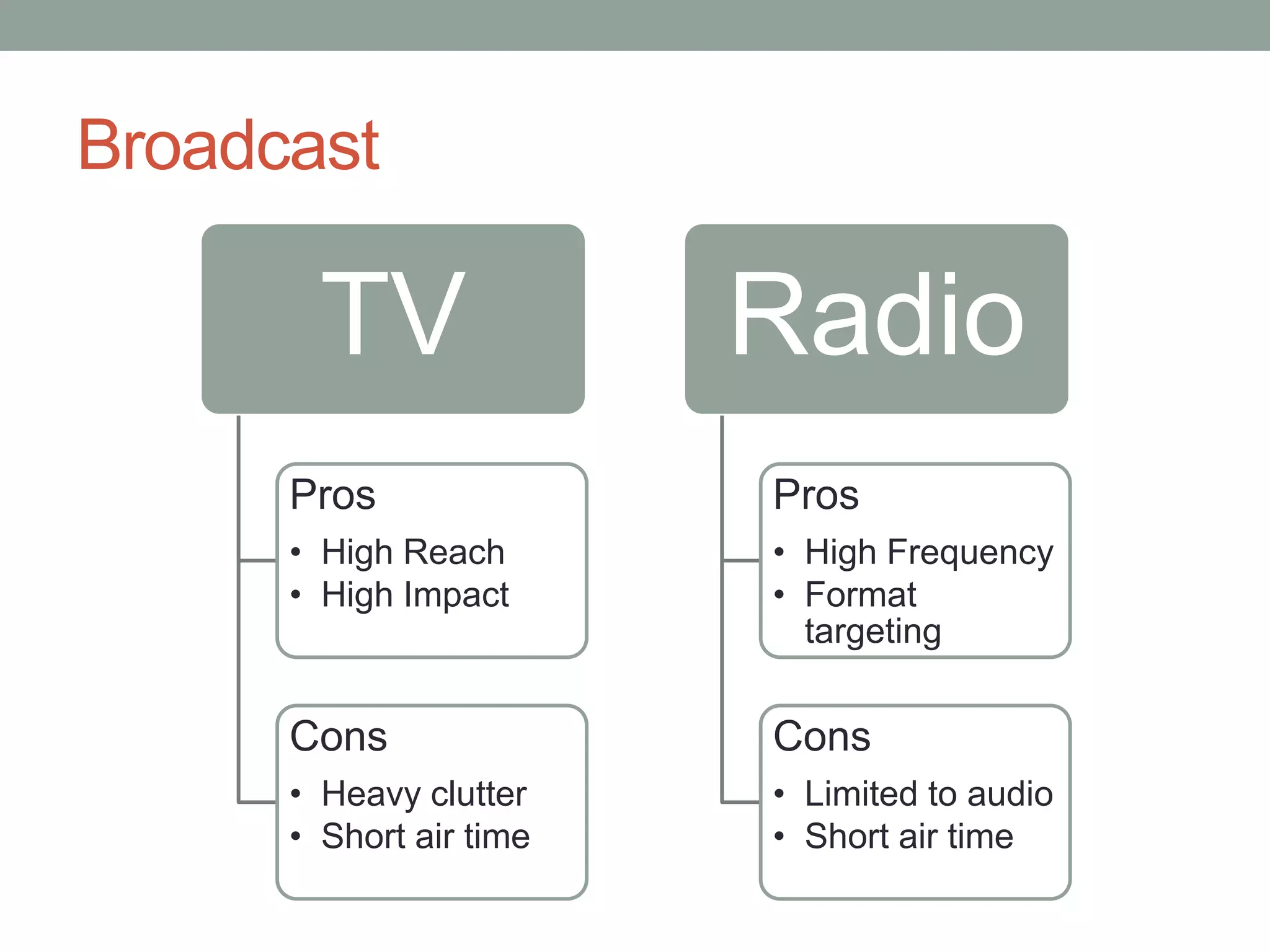
Broadcast

        TV               Radio
      Pros               Pros
      • High Reach       • High Frequency
      • High Impact      • Format
                           targeting


      Cons               Cons
      • Heavy clutter    • Limited to audio
      • Short air time   • Short air time
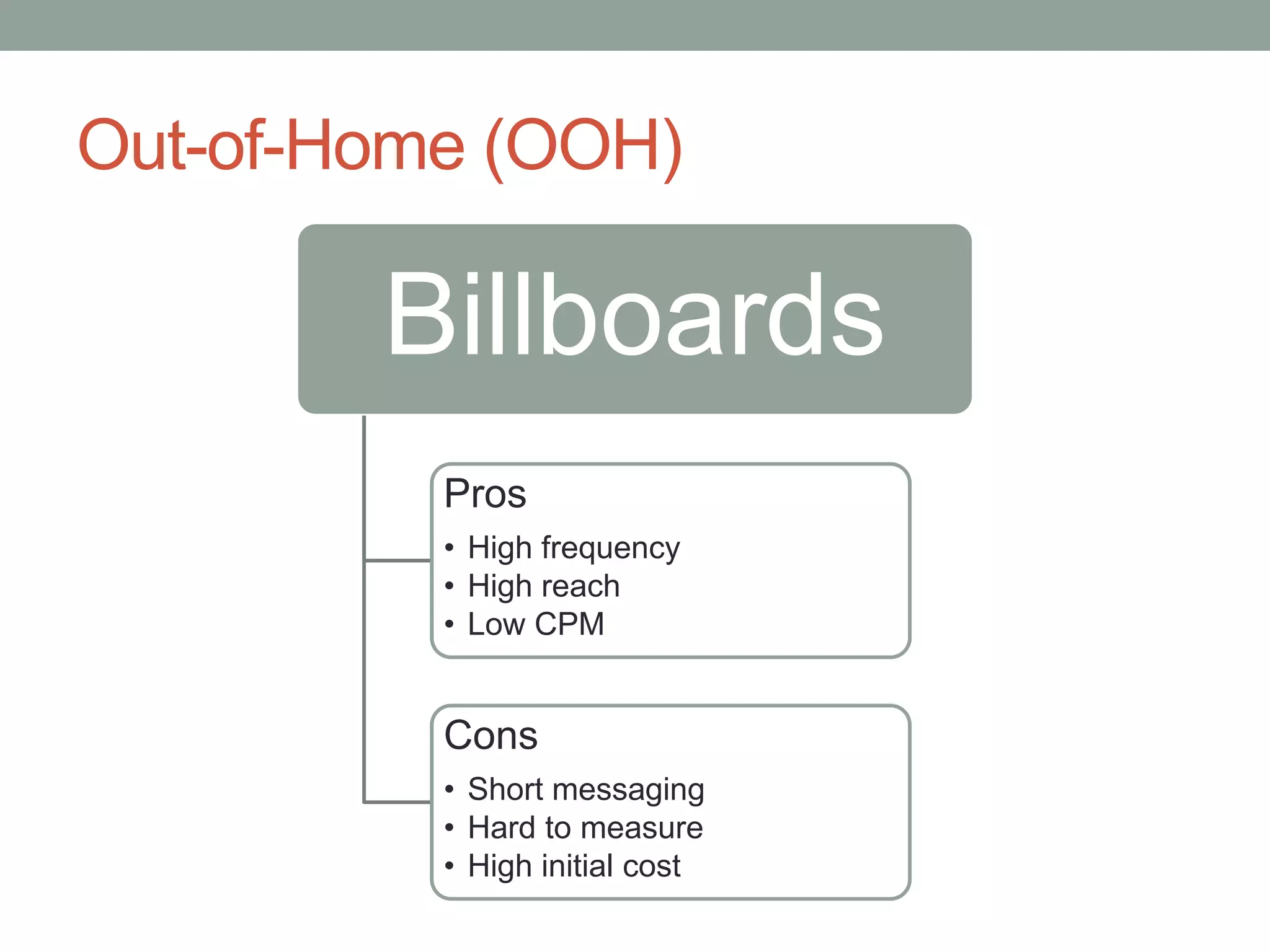
Out-of-Home (OOH)

        Billboards
          Pros
          • High frequency
          • High reach
          • Low CPM


          Cons
          • Short messaging
          • Hard to measure
          • High initial cost
QUESTIONS?

Media objectives and strategies 1.30.13

  • 1.
  • 2.
    Media Objectives &Strategies • Statement of Facts SWOT • Marketing Objectives • Identify the Goal Media Objectives • Define what is to be accomplished • How to Achieve the Goal Media Strategies • Specific tactics
  • 3.
    Writing Media Objectives •Derived from the marketing objectives • Must be measurable and actionable • Backed by research • Focus on the goal – define exactly what you want to do • What is to be accomplished? • Objectives are interconnected, each affects the other • Example: Over sixty percent of Brand X’s sales volume is derived from target audience A. The goal of this campaign is to increase the brand experience by 20% among target audience A. The campaign will reach over 1 million in 15 markets using media A & B.
  • 4.
    Writing Media Strategies •Tells how to achieve the Media Objective • Integration between objective & strategy • Be direct and to the point • Include rationale • Define data points (brand experience = ?) • Example: We will launch the campaign in March with media A at a level of 350 GRPs. This level is appropriate for a new campaign launch. Media schedule includes programs A, C & D. In April, we will launch promotional campaign in top 5 markets.
  • 5.
    6 Media Objectives& Strategies Each requires an objective and strategy • Target Audience & Media Mix • Reach, Frequency & GRPs • Scheduling & Timing • Media Budget • Geography • Sales Promotion • Internet Strategy – Covers any content requirements for the website. See MFP pages 29-31 for examples of each
  • 6.
    General guidelines • “Abrilliant media strategy is totally wasted unless it is communicated with brilliance” • Keep it interesting, be direct • Organization is key • Builds a better case by flowing logically • Helps with presentation • Be specific; use numbers, percentages – not generalizations • Use tables & charts when appropriate, but explain in preceding paragraph. See MFP pages 34-35 for list of Dos and Don’ts
  • 7.
  • 8.
    Determining Reach &Frequency Goals • How much reach is enough? • Reach follows a curve that flattens as GRPs increase. • Highest Reach – 99% • Moderate Reach – 70% to 75% • Lowest Reach – 50% to 60% • 50% is minimum for brand survival • Use flighting schedule to achieve a higher reach over a shorter period of time – avoid dilution of the media plan
  • 9.
    Determining Reach &Frequency Goals • How much frequency is enough? • Once reach begins to plateau, frequency continues to increase. • Highest Average Frequency – 12 • Depending on creative, can run the risk of “wearout” • Lowest Average Frequency – 2 to 3 • Minimum frequency • Ostrow Model – used to estimate effective frequency • Marketing Factors • Copy Factors • Media Factors
  • 10.
    Ostrow Model • Beginwith 3.0 frequency • Use questions in the model to determine a score to add or subtract from the benchmark • Factors that increase frequency • New brand, low market share, complex copy, pulsed/flighted campaign, higher ad clutter in media mix • Factors that decrease frequency • Established brand, high brand loyalty, simple copy, continuous media schedule See MFP page 37 for Ostrow Model questions
  • 11.
    Optimize Reach orFrequency? Optimize Reach Optimize Frequency • Few competitors • Many competitors • Strong established brand • Less established brand • Brand leader in category • Low brand awareness • Infrequent purchase • Low involvement purchase • Continuous advertising decision schedule • Lower priced goods / • Powerful creative services • Ad message easily • Strong competition in understood category • Major sales promotion • Complex ad message launch • Flighted schedule • Seasonal peak for sales • Frequent purchase
  • 12.
  • 13.
    CPM & CPP •Used to compare costs across various media CPM = (total cost / total impressions) x 1000 • Reported in dollars and cents • Typically used for print and digital media CPP = total cost / total GRPs • Round to the nearest dollar • Used for broadcast media
  • 14.
    Using CPM /CPP to estimate budgets • Situation: Client wants to know an estimate for what a 4 week TV flight would cost in the Charlotte market • Use CPP to estimate budget • Use CPP averages provided by stations or previous research • Estimate weekly GRP level (ex. 125 GRPs) • Multiply CPP by estimated weekly GRPs to get weekly budget • Multiply by number of weeks • Use CPM to estimate digital budgets • Average CPM of digital banners • Multiply by impression level (in thousands) • Same principle can be applied across several markets / dayparts / mediums
  • 15.
    MEDIA MIX Pros &Cons of Media Types
  • 16.
    Media Mix • Importantto have an effective mix of media • Increases reach & frequency • Allows for multiple touchpoints • Use research on target audience to drive media mix choices • Think about “Day in the Life” • What media is important to the target? • Which media do they spend the most time with? • Which media are they influenced by?
  • 17.
    Print Newspaper Magazines Pros Pros • Local targeting • Demo / Content targeting • Immediacy • Creative reproduction • Longer shelf life Cons Cons • Production quality • Long lead time (deadlines) • Cost • High CPM costs • Short shelf life
  • 18.
    Broadcast TV Radio Pros Pros • High Reach • High Frequency • High Impact • Format targeting Cons Cons • Heavy clutter • Limited to audio • Short air time • Short air time
  • 19.
    Out-of-Home (OOH) Billboards Pros • High frequency • High reach • Low CPM Cons • Short messaging • Hard to measure • High initial cost
  • 20.