1
Journal Club Presentation-Round 2
As a part of curricular requirement for
M. Pharmacy II year III semester
Presented by
Darshan N U
Register. No. 21MPC101
Department of Pharmaceutical Chemistry
Title, Authors and Affiliations:
2
Introduction
• In general, mesophilic microorganisms cause the majority of harmful diseases in animals
and humans. In the current situation, most pathogens are becoming more resistant to
antimicrobials, which is a big concern all over the world.
• As a result, there is a critical need for novel antimicrobial medicines to combat life-
threatening invasive infections.
• As per the new concepts of drug design, docking studies help to understand in the better
way about the interactions of drugs with receptor.
3
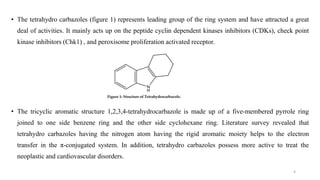
• The tetrahydro carbazoles (figure 1) represents leading group of the ring system and have attracted a great
deal of activities. It mainly acts up on the peptide cyclin dependent kinases inhibitors (CDKs), check point
kinase inhibitors (Chk1) , and peroxisome proliferation activated receptor.
• The tricyclic aromatic structure 1,2,3,4-tetrahydrocarbazole is made up of a five-membered pyrrole ring
joined to one side benzene ring and the other side cyclohexane ring. Literature survey revealed that
tetrahydro carbazoles having the nitrogen atom having the rigid aromatic moiety helps to the electron
transfer in the π-conjugated system. In addition, tetrahydro carbazoles possess more active to treat the
neoplastic and cardiovascular disorders.
4
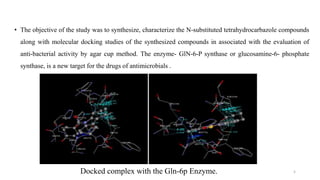
• The objective of the study was to synthesize, characterize the N-substituted tetrahydrocarbazole compounds
along with molecular docking studies of the synthesized compounds in associated with the evaluation of
anti-bacterial activity by agar cup method. The enzyme- GlN-6-P synthase or glucosamine-6- phosphate
synthase, is a new target for the drugs of antimicrobials .
5
Docked complex with the Gln-6p Enzyme.
scheme
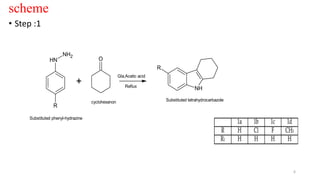
• Step :1
6
N
H
NH2
R
+
O
NH
R
Substituted phenyl-hydrazine
cyclohexanon Substituted tetrahydrocarbazole
Gla.Acetic acid
Reflux
Step :2
NH
R
Substituted tetrahydrocarbazole
S
R
1
O O
Cl
N
R
S
O
O
R
1
N
R
O
R
1
Cl O
R
1
10% NaoH
10% NaoH
7
benzoyl chloride
benzenesulfonyl chloride
3a 3b 3c 3d 3e 3f 3g
R H Cl F CH3 Cl F NO2
R1 Cl Cl Cl Cl NO2 NO2 NO2
2a 2b 2c 2d
H Cl F CH3
CH3 CH3 CH3 CH3
Experimental methods and reagents
• All the chemicals for the synthetic work were used of analytical grade from SD Fine Chem
Limited, Merck, Loba Chemie Private limited and Sigma Aldrich.
• The melting points of the compounds were determined in open capillaries using Thiel's tube.
• Precoated silicagel- G plates are activated at 110°C for 30 minutes were used for thin layer
chromatography and the spots were developed in iodine chamber. The mobile phase for the
analysis of TLC was n-hexane: EtoAc (7:3 v/v).
• The IR spectra of the compounds were recorded using pressed pellet technique using KBr on
FTIR-8400 Spectrophotometer Shimadzu.
8
• 1H –NMR and 13C Spectra (CDCl3, DMSO) were recorded on bruker advance-11,
400 Spectrophotometer on 400 MHz at Loyola index laboratories using TMS as
internal standard
• Elemental analysis was carried out SAIF Punjab University, Chandigarh.
9
General procedure
• Synthesis of tetrahydro carbazole:
Scheme 1: Synthesis of substituted tetrahydro carbazole,
Dissolve 8.8 gm (0.08mol) of cyclohexanone in 50 ml of glacial acetic acid add 8.8
gm (0.08mol) of substituted phenyl hydrazine and boil the solution under reflux for
15 min, cooled the solution, where the product was crystallised out. Filtered it with
vacuum pump, then drained well and recrystallised using Ethanol.
10
Scheme 2: Synthesis of N-substituted Tetrahydro carbazoles
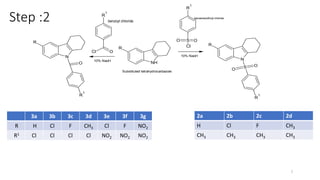
• Suspended ,1 gm (0.07 mol) of substituted tetrahydro carbazole in 20 ml of 10% NaOH
solution into a well corked conical flask and add 2 mL of substituted acid chloride with
constant shaking for 10 minutes until the odour has disappeared and then it was cooled.
Filtered and washed the synthesized N-Substituted derivative using water and recrystallized
with ethanol.
11
Pharmacological evaluation of tetrahydrocarbazole derivatives
• Anti-microbial activity: Determination by Agar cup method
• The antibacterial activity of 1,2,3,4-tetrahydrocarbazole derivatives was studied by
agar cup method. The nutrient broth culture media was chosen as basal medium for
testing the microbe. The nutrient broth medium was plated into Petri dishes, allowed to
solidification and then the microbe was inoculated into broth medium and allowed for
incubation for a period of 24 hours at 25°C. Bacterial culture was spread evenly over
the entire surface to avoid the aggregation and left undisturbed for few minutes to
permeate the culture.
12
• The wells/ holes (4 mm) were drawn using a sterile borer into the solidified
nutrient medium. The compounds of substituted tetrhydrocarbazoles were added
to each well (100μL) at peripheral of the petridish and the reference compounds
(ciprofloxacin for bacterial, flucanazole for fungal) was added at the center and
then the plates are incubated for 24 hrs at 25°C. The plates were collected and
analyze the zone of inhibition with respect to millimeters (mm)
13
• Computational Methods: Molecular docking studies were carried out to explore
binding modes of there derivatives with the target enzyme L-Glutamine: D -fructose-6–
phosphate amido transferase. The molecular docking simulation studies were carried out
by biopredicta tool of V Life MDS software version 4.2. The receptor employed here
was Gln-6-p (PDB code 1XFF) obtained from RCSB protein data bank. The initial
crystal structure consists of bound ligands it was removed and missing loops were added
with help of homology modeling from the same software.
14
Result And Discussion
15
1a. 2,3,4,9-Tetrahydro-1H-carbazole
• Yield 91 %;
• MP 117 – 119 ºC
• Rf 0.39 (n – Hexane: EtoAC ,7:3);
• IR (KBr) cm-1 :3314.12(N-H stretching),2954.8 (C-H Stretching aliphatic),1623 (C=C Stretching), 1513.7 (CN
stretching) ;
• 1H NMR (CDCl3, 400 MHz ):2.08 (m, 2H, ABq, CH2), 2.20 ( m, 2H, ABq, CH2), 2.28(m,4H,CH2),3.90 (s, 1H, NH),
6.73 (m, 4H, Ar);
• 13CNMR: 115.76, 118.50, 129 (Ar), 168.16, 169.10, 170.12 (Tetrahydrocarbazole);
• m/z 171.165;
• (C12H13N);
16
NH
H
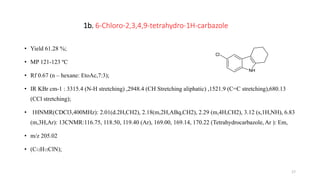
1b. 6-Chloro-2,3,4,9-tetrahydro-1H-carbazole
• Yield 61.28 %;
• MP 121-123 ºC
• Rf 0.67 (n – hexane: EtoAc,7:3);
• IR KBr cm-1 : 3315.4 (N-H stretching) ,2948.4 (CH Stretching aliphatic) ,1521.9 (C=C stretching),680.13
(CCl stretching);
• 1HNMR(CDCl3,400MHz): 2.01(d.2H,CH2), 2.18(m,2H,ABq,CH2), 2.29 (m,4H,CH2), 3.12 (s,1H,NH), 6.83
(m,3H,Ar): 13CNMR:116.75, 118.50, 119.40 (Ar), 169.00, 169.14, 170.22 (Tetrahydrocarbazole, Ar ): Em,
• m/z 205.02
• (C12H12ClN);
17
NH
Cl
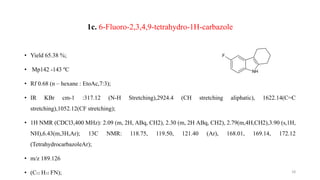
1c. 6-Fluoro-2,3,4,9-tetrahydro-1H-carbazole
• Yield 65.38 %;
• Mp142 -143 ºC
• Rf 0.68 (n – hexane : EtoAc,7:3);
• IR KBr cm-1 :317.12 (N-H Stretching),2924.4 (CH stretching aliphatic), 1622.14(C=C
stretching),1052.12(CF stretching);
• 1H NMR (CDCl3,400 MHz): 2.09 (m, 2H, ABq, CH2), 2.30 (m, 2H ABq, CH2), 2.79(m,4H,CH2),3.90 (s,1H,
NH),6.43(m,3H,Ar); 13C NMR: 118.75, 119.50, 121.40 (Ar), 168.01, 169.14, 172.12
(TetrahydrocarbazoleAr);
• m/z 189.126
• (C12 H12 FN); 18
NH
F
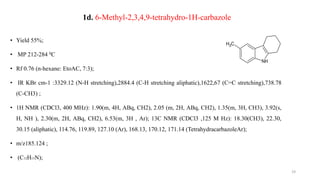
1d. 6-Methyl-2,3,4,9-tetrahydro-1H-carbazole
• Yield 55%;
• MP 212-284 0C
• Rf 0.76 (n-hexane: EtoAC, 7:3);
• IR KBr cm-1 :3329.12 (N-H stretching),2884.4 (C-H stretching aliphatic),1622,67 (C=C stretching),738.78
(C-CH3) ;
• 1H NMR (CDCl3, 400 MHz): 1.90(m, 4H, ABq, CH2), 2.05 (m, 2H, ABq, CH2), 1.35(m, 3H, CH3), 3.92(s,
H, NH ), 2.30(m, 2H, ABq, CH2), 6.53(m, 3H , Ar); 13C NMR (CDCl3 ,125 M Hz): 18.30(CH3), 22.30,
30.15 (aliphatic), 114.76, 119.89, 127.10 (Ar), 168.13, 170.12, 171.14 (TetrahydracarbazoleAr);
• m/z185.124 ;
• (C12H15N);
19
NH
C
H3
2a: 9-[(4-methylphenyl)sulfonyl]-2,3,4,9-tetrahydro-1Hcarbazol
• Yield 61%;
• MP 322- 323 ºc
• Rf 0.86 (n-hexane EtoAC, 7:3) ;
• IR KBrcm-1 :3018.45(C-H aromatic Stretching) ,2856.78 (C-H aliphatic stretching),1601.78 (C=C aromatic
stretching),1346.67(O =S = O Stretching)
• 1 H NMR ( CDCl3 , 400 MHz);2.28 (m, 4H, CH2), 2.08 (m, 2H, ABq, CH2), 1.35 (t, 3H, CH3), 2.20 (m, 2H,
ABq, CH2), 6.83 (m, 4H, Ar), 7.95(m, 4H, Ar); 13CNMR (CDCl3, 125MHz); 17.30, 18.90, (CH3), 21.96,
22.30, 30.15 (aliphatic), 114.76, 117.89, 127.10 (Ar), 167.13, 170.12, 171.14 (Tetrahydracarbazole Ar).
• m/z 328.76 (C19H19NO2S);
20
N
H
S
O
O
CH3
2b: 6-chloro-9-[(4-methylphenyl)sulfonyl]-2,3,4,9-tetrahydro-1H-carbazole
• Yield 61%;
• MP : 338-340 ºC
• Rf 0.91 (n-hexane EtoAC,7:3)
• IR KBr cm-1 : 2950.68 (C-Haromatic stretching), 2876.98 (C-H aliphatic stretching), 1627.34 (C=C aromatic
stretching), 1334.74 (O=S=O Stretching), 735.78(C-Cl stretching) :
• 1H NMR (CDCl3 , 400 M Hz);2.21(m,4H,CH2), 2.08 ( m,2H, ABq ,CH2) 1. 25 (t,3 H, CH3), 2.10
(m,2H,ABq,CH2), 6.23 (m 3H , Ar ), 7.85 (m, 4H,Ar).13C NMR ( CDCl3,125 M Hz)16.90,17.56, 18.30
(CH3), 22.30,30.15( aliphatic), 114.96, 116.89, 128.10 (Ar) 166.13, 169.12, 171.15 ( Tetrahydracarbazole Ar).
• m/z 358.76 (C19H18 ClNO2S);
21
N
Cl
S
O
O
CH3
2d: 6-methyl-9-[(4-methylphenyl)sulfonyl]-2,3,4,9-tetrahydro-1H-carbazole
• Yield 61%;
• MP 346- 348ºC
• Rf 0.91(n-hexane EtoAC 7:3);
• IR KBrcm-1 :3111.18(C-H aromatic Stretching), 2956.13 (C-H aliphatic stretching), 1537.98 (C=C aromatic
stretching),1426.87(O=S=OStretching),924.24(CCH3Stretching);
• 1HNMR (CDCl3, 400MHz); 2.35(m,4H,CH2), 2.38(m,2H,ABq ,CH2)1.72(t,3H,CH3),1. 25 (t,3 H, CH3) ,
2.20 (m, 2H, ABq, CH2), 6.73 (m 3H , Ar ), 7.35 (m, 4H,Ar) 13C NMR (CDCl3 , 125 M Hz)17.34,19.30
(CH3), 22.30, 24.37, 30.15(aliphatic), 114.76, 124.89, 127.10 (Ar), 168.13, 169.12, 171.14 (
Tetrahydracarbazole Ar).
• m/z 339.76 (C20 H21FNO2S);
22
N
C
H3
S
O
O
CH3
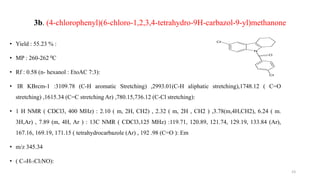
3b. (4-chlorophenyl)(6-chloro-1,2,3,4-tetrahydro-9H-carbazol-9-yl)methanone
• Yield : 55.23 % :
• MP : 260-262 0C
• Rf : 0.58 (n- hexanol : EtoAC 7:3):
• IR KBrcm-1 :3109.78 (C-H aromatic Stretching) ,2993.01(C-H aliphatic stretching),1748.12 ( C=O
stretching) ,1615.34 (C=C stretching Ar) ,780.15,736.12 (C-Cl stretching):
• 1 H NMR ( CDCl3, 400 MHz) : 2.10 ( m, 2H, CH2) , 2.32 ( m, 2H , CH2 ) ,3.78(m,4H,CH2), 6.24 ( m.
3H,Ar) , 7.89 (m, 4H, Ar ) : 13C NMR ( CDCl3,125 MHz) :119.71, 120.89, 121.74, 129.19, 133.84 (Ar),
167.16, 169.19, 171.15 ( tetrahydrocarbazole (Ar) , 192 .98 (C=O ): Em
• m/z 345.34
• ( C19H15Cl2NO):
23
N
Cl
O
Cl
24
Conclusion
Fifteen new tetrahydrocarbazole derivatives were synthesized and were characterized by 1H NMR, 13C NMR, Mass
spectrometry, FT-IR studies and elemental analysis.
In silico studies exposed that all the synthesized compounds have relatively better binding affinity as compared to the
standard drug ( ciprofloxacin, fluconazole). So, it may be considered as a good inhibitor of GlcN-6-P, Among all the
docked compounds 1a, 1b, 1c, 1d, 2a, 2b, 2d, 3b showed good binding affinity and interaction with enzyme with
reference to ciprofloxacin and fluconazole.
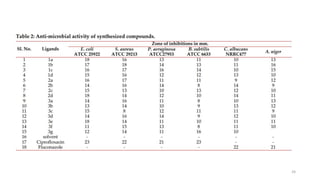
The compounds are subjected to antimicrobial activity, out of fifteen compounds, eight compounds 1a, 1b, 1c, 1d, 2a,
2b, 3d are showed good zone of inhibition for E-coli and S-aureus
25
26
THANK YOU

Journal Club Presentation.

  • 1.
    1 Journal Club Presentation-Round2 As a part of curricular requirement for M. Pharmacy II year III semester Presented by Darshan N U Register. No. 21MPC101 Department of Pharmaceutical Chemistry
  • 2.
    Title, Authors andAffiliations: 2
  • 3.
    Introduction • In general,mesophilic microorganisms cause the majority of harmful diseases in animals and humans. In the current situation, most pathogens are becoming more resistant to antimicrobials, which is a big concern all over the world. • As a result, there is a critical need for novel antimicrobial medicines to combat life- threatening invasive infections. • As per the new concepts of drug design, docking studies help to understand in the better way about the interactions of drugs with receptor. 3
  • 4.
    • The tetrahydrocarbazoles (figure 1) represents leading group of the ring system and have attracted a great deal of activities. It mainly acts up on the peptide cyclin dependent kinases inhibitors (CDKs), check point kinase inhibitors (Chk1) , and peroxisome proliferation activated receptor. • The tricyclic aromatic structure 1,2,3,4-tetrahydrocarbazole is made up of a five-membered pyrrole ring joined to one side benzene ring and the other side cyclohexane ring. Literature survey revealed that tetrahydro carbazoles having the nitrogen atom having the rigid aromatic moiety helps to the electron transfer in the π-conjugated system. In addition, tetrahydro carbazoles possess more active to treat the neoplastic and cardiovascular disorders. 4
  • 5.
    • The objectiveof the study was to synthesize, characterize the N-substituted tetrahydrocarbazole compounds along with molecular docking studies of the synthesized compounds in associated with the evaluation of anti-bacterial activity by agar cup method. The enzyme- GlN-6-P synthase or glucosamine-6- phosphate synthase, is a new target for the drugs of antimicrobials . 5 Docked complex with the Gln-6p Enzyme.
  • 6.
    scheme • Step :1 6 N H NH2 R + O NH R Substitutedphenyl-hydrazine cyclohexanon Substituted tetrahydrocarbazole Gla.Acetic acid Reflux
  • 7.
    Step :2 NH R Substituted tetrahydrocarbazole S R 1 OO Cl N R S O O R 1 N R O R 1 Cl O R 1 10% NaoH 10% NaoH 7 benzoyl chloride benzenesulfonyl chloride 3a 3b 3c 3d 3e 3f 3g R H Cl F CH3 Cl F NO2 R1 Cl Cl Cl Cl NO2 NO2 NO2 2a 2b 2c 2d H Cl F CH3 CH3 CH3 CH3 CH3
  • 8.
    Experimental methods andreagents • All the chemicals for the synthetic work were used of analytical grade from SD Fine Chem Limited, Merck, Loba Chemie Private limited and Sigma Aldrich. • The melting points of the compounds were determined in open capillaries using Thiel's tube. • Precoated silicagel- G plates are activated at 110°C for 30 minutes were used for thin layer chromatography and the spots were developed in iodine chamber. The mobile phase for the analysis of TLC was n-hexane: EtoAc (7:3 v/v). • The IR spectra of the compounds were recorded using pressed pellet technique using KBr on FTIR-8400 Spectrophotometer Shimadzu. 8
  • 9.
    • 1H –NMRand 13C Spectra (CDCl3, DMSO) were recorded on bruker advance-11, 400 Spectrophotometer on 400 MHz at Loyola index laboratories using TMS as internal standard • Elemental analysis was carried out SAIF Punjab University, Chandigarh. 9
  • 10.
    General procedure • Synthesisof tetrahydro carbazole: Scheme 1: Synthesis of substituted tetrahydro carbazole, Dissolve 8.8 gm (0.08mol) of cyclohexanone in 50 ml of glacial acetic acid add 8.8 gm (0.08mol) of substituted phenyl hydrazine and boil the solution under reflux for 15 min, cooled the solution, where the product was crystallised out. Filtered it with vacuum pump, then drained well and recrystallised using Ethanol. 10
  • 11.
    Scheme 2: Synthesisof N-substituted Tetrahydro carbazoles • Suspended ,1 gm (0.07 mol) of substituted tetrahydro carbazole in 20 ml of 10% NaOH solution into a well corked conical flask and add 2 mL of substituted acid chloride with constant shaking for 10 minutes until the odour has disappeared and then it was cooled. Filtered and washed the synthesized N-Substituted derivative using water and recrystallized with ethanol. 11
  • 12.
    Pharmacological evaluation oftetrahydrocarbazole derivatives • Anti-microbial activity: Determination by Agar cup method • The antibacterial activity of 1,2,3,4-tetrahydrocarbazole derivatives was studied by agar cup method. The nutrient broth culture media was chosen as basal medium for testing the microbe. The nutrient broth medium was plated into Petri dishes, allowed to solidification and then the microbe was inoculated into broth medium and allowed for incubation for a period of 24 hours at 25°C. Bacterial culture was spread evenly over the entire surface to avoid the aggregation and left undisturbed for few minutes to permeate the culture. 12
  • 13.
    • The wells/holes (4 mm) were drawn using a sterile borer into the solidified nutrient medium. The compounds of substituted tetrhydrocarbazoles were added to each well (100μL) at peripheral of the petridish and the reference compounds (ciprofloxacin for bacterial, flucanazole for fungal) was added at the center and then the plates are incubated for 24 hrs at 25°C. The plates were collected and analyze the zone of inhibition with respect to millimeters (mm) 13
  • 14.
    • Computational Methods:Molecular docking studies were carried out to explore binding modes of there derivatives with the target enzyme L-Glutamine: D -fructose-6– phosphate amido transferase. The molecular docking simulation studies were carried out by biopredicta tool of V Life MDS software version 4.2. The receptor employed here was Gln-6-p (PDB code 1XFF) obtained from RCSB protein data bank. The initial crystal structure consists of bound ligands it was removed and missing loops were added with help of homology modeling from the same software. 14
  • 15.
  • 16.
    1a. 2,3,4,9-Tetrahydro-1H-carbazole • Yield91 %; • MP 117 – 119 ºC • Rf 0.39 (n – Hexane: EtoAC ,7:3); • IR (KBr) cm-1 :3314.12(N-H stretching),2954.8 (C-H Stretching aliphatic),1623 (C=C Stretching), 1513.7 (CN stretching) ; • 1H NMR (CDCl3, 400 MHz ):2.08 (m, 2H, ABq, CH2), 2.20 ( m, 2H, ABq, CH2), 2.28(m,4H,CH2),3.90 (s, 1H, NH), 6.73 (m, 4H, Ar); • 13CNMR: 115.76, 118.50, 129 (Ar), 168.16, 169.10, 170.12 (Tetrahydrocarbazole); • m/z 171.165; • (C12H13N); 16 NH H
  • 17.
    1b. 6-Chloro-2,3,4,9-tetrahydro-1H-carbazole • Yield61.28 %; • MP 121-123 ºC • Rf 0.67 (n – hexane: EtoAc,7:3); • IR KBr cm-1 : 3315.4 (N-H stretching) ,2948.4 (CH Stretching aliphatic) ,1521.9 (C=C stretching),680.13 (CCl stretching); • 1HNMR(CDCl3,400MHz): 2.01(d.2H,CH2), 2.18(m,2H,ABq,CH2), 2.29 (m,4H,CH2), 3.12 (s,1H,NH), 6.83 (m,3H,Ar): 13CNMR:116.75, 118.50, 119.40 (Ar), 169.00, 169.14, 170.22 (Tetrahydrocarbazole, Ar ): Em, • m/z 205.02 • (C12H12ClN); 17 NH Cl
  • 18.
    1c. 6-Fluoro-2,3,4,9-tetrahydro-1H-carbazole • Yield65.38 %; • Mp142 -143 ºC • Rf 0.68 (n – hexane : EtoAc,7:3); • IR KBr cm-1 :317.12 (N-H Stretching),2924.4 (CH stretching aliphatic), 1622.14(C=C stretching),1052.12(CF stretching); • 1H NMR (CDCl3,400 MHz): 2.09 (m, 2H, ABq, CH2), 2.30 (m, 2H ABq, CH2), 2.79(m,4H,CH2),3.90 (s,1H, NH),6.43(m,3H,Ar); 13C NMR: 118.75, 119.50, 121.40 (Ar), 168.01, 169.14, 172.12 (TetrahydrocarbazoleAr); • m/z 189.126 • (C12 H12 FN); 18 NH F
  • 19.
    1d. 6-Methyl-2,3,4,9-tetrahydro-1H-carbazole • Yield55%; • MP 212-284 0C • Rf 0.76 (n-hexane: EtoAC, 7:3); • IR KBr cm-1 :3329.12 (N-H stretching),2884.4 (C-H stretching aliphatic),1622,67 (C=C stretching),738.78 (C-CH3) ; • 1H NMR (CDCl3, 400 MHz): 1.90(m, 4H, ABq, CH2), 2.05 (m, 2H, ABq, CH2), 1.35(m, 3H, CH3), 3.92(s, H, NH ), 2.30(m, 2H, ABq, CH2), 6.53(m, 3H , Ar); 13C NMR (CDCl3 ,125 M Hz): 18.30(CH3), 22.30, 30.15 (aliphatic), 114.76, 119.89, 127.10 (Ar), 168.13, 170.12, 171.14 (TetrahydracarbazoleAr); • m/z185.124 ; • (C12H15N); 19 NH C H3
  • 20.
    2a: 9-[(4-methylphenyl)sulfonyl]-2,3,4,9-tetrahydro-1Hcarbazol • Yield61%; • MP 322- 323 ºc • Rf 0.86 (n-hexane EtoAC, 7:3) ; • IR KBrcm-1 :3018.45(C-H aromatic Stretching) ,2856.78 (C-H aliphatic stretching),1601.78 (C=C aromatic stretching),1346.67(O =S = O Stretching) • 1 H NMR ( CDCl3 , 400 MHz);2.28 (m, 4H, CH2), 2.08 (m, 2H, ABq, CH2), 1.35 (t, 3H, CH3), 2.20 (m, 2H, ABq, CH2), 6.83 (m, 4H, Ar), 7.95(m, 4H, Ar); 13CNMR (CDCl3, 125MHz); 17.30, 18.90, (CH3), 21.96, 22.30, 30.15 (aliphatic), 114.76, 117.89, 127.10 (Ar), 167.13, 170.12, 171.14 (Tetrahydracarbazole Ar). • m/z 328.76 (C19H19NO2S); 20 N H S O O CH3
  • 21.
    2b: 6-chloro-9-[(4-methylphenyl)sulfonyl]-2,3,4,9-tetrahydro-1H-carbazole • Yield61%; • MP : 338-340 ºC • Rf 0.91 (n-hexane EtoAC,7:3) • IR KBr cm-1 : 2950.68 (C-Haromatic stretching), 2876.98 (C-H aliphatic stretching), 1627.34 (C=C aromatic stretching), 1334.74 (O=S=O Stretching), 735.78(C-Cl stretching) : • 1H NMR (CDCl3 , 400 M Hz);2.21(m,4H,CH2), 2.08 ( m,2H, ABq ,CH2) 1. 25 (t,3 H, CH3), 2.10 (m,2H,ABq,CH2), 6.23 (m 3H , Ar ), 7.85 (m, 4H,Ar).13C NMR ( CDCl3,125 M Hz)16.90,17.56, 18.30 (CH3), 22.30,30.15( aliphatic), 114.96, 116.89, 128.10 (Ar) 166.13, 169.12, 171.15 ( Tetrahydracarbazole Ar). • m/z 358.76 (C19H18 ClNO2S); 21 N Cl S O O CH3
  • 22.
    2d: 6-methyl-9-[(4-methylphenyl)sulfonyl]-2,3,4,9-tetrahydro-1H-carbazole • Yield61%; • MP 346- 348ºC • Rf 0.91(n-hexane EtoAC 7:3); • IR KBrcm-1 :3111.18(C-H aromatic Stretching), 2956.13 (C-H aliphatic stretching), 1537.98 (C=C aromatic stretching),1426.87(O=S=OStretching),924.24(CCH3Stretching); • 1HNMR (CDCl3, 400MHz); 2.35(m,4H,CH2), 2.38(m,2H,ABq ,CH2)1.72(t,3H,CH3),1. 25 (t,3 H, CH3) , 2.20 (m, 2H, ABq, CH2), 6.73 (m 3H , Ar ), 7.35 (m, 4H,Ar) 13C NMR (CDCl3 , 125 M Hz)17.34,19.30 (CH3), 22.30, 24.37, 30.15(aliphatic), 114.76, 124.89, 127.10 (Ar), 168.13, 169.12, 171.14 ( Tetrahydracarbazole Ar). • m/z 339.76 (C20 H21FNO2S); 22 N C H3 S O O CH3
  • 23.
    3b. (4-chlorophenyl)(6-chloro-1,2,3,4-tetrahydro-9H-carbazol-9-yl)methanone • Yield: 55.23 % : • MP : 260-262 0C • Rf : 0.58 (n- hexanol : EtoAC 7:3): • IR KBrcm-1 :3109.78 (C-H aromatic Stretching) ,2993.01(C-H aliphatic stretching),1748.12 ( C=O stretching) ,1615.34 (C=C stretching Ar) ,780.15,736.12 (C-Cl stretching): • 1 H NMR ( CDCl3, 400 MHz) : 2.10 ( m, 2H, CH2) , 2.32 ( m, 2H , CH2 ) ,3.78(m,4H,CH2), 6.24 ( m. 3H,Ar) , 7.89 (m, 4H, Ar ) : 13C NMR ( CDCl3,125 MHz) :119.71, 120.89, 121.74, 129.19, 133.84 (Ar), 167.16, 169.19, 171.15 ( tetrahydrocarbazole (Ar) , 192 .98 (C=O ): Em • m/z 345.34 • ( C19H15Cl2NO): 23 N Cl O Cl
  • 24.
  • 25.
    Conclusion Fifteen new tetrahydrocarbazolederivatives were synthesized and were characterized by 1H NMR, 13C NMR, Mass spectrometry, FT-IR studies and elemental analysis. In silico studies exposed that all the synthesized compounds have relatively better binding affinity as compared to the standard drug ( ciprofloxacin, fluconazole). So, it may be considered as a good inhibitor of GlcN-6-P, Among all the docked compounds 1a, 1b, 1c, 1d, 2a, 2b, 2d, 3b showed good binding affinity and interaction with enzyme with reference to ciprofloxacin and fluconazole. The compounds are subjected to antimicrobial activity, out of fifteen compounds, eight compounds 1a, 1b, 1c, 1d, 2a, 2b, 3d are showed good zone of inhibition for E-coli and S-aureus 25
  • 26.

Editor's Notes

  • #4 Eg for mesophile s.aureus, e coli, streptococcus pneumoniae
  • #25 P. Aeruginosa : pseudomonas, b subtilis: bacillus, C. albucans: candida fungus ( present in mouth, throat, gut, vagina live on skin, inside body),,,