MCKENZIE APPROACH
Dr Nilofar Rasheed(PT)
• McKenzie Approach or Mechanical diagnosis and therapy(MDT) is a
Mechanical-based method of classification and therapy for
Musculoskeletal disorders.
• It was introduced in 1981 by Robin McKenzie (1931–2013), a
physical therapist from New Zealand.
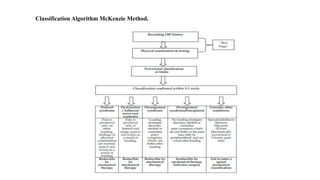
• The assessment and classifying protocol does not aim to identify
specific anatomical structures. Still, it classifies the clinical
presentations as mechanical syndromes (FIGURE 1) based on patients’
symptom responses to standardized mechanical loading strategies
(McKenzie 1981, McKenzie and May 2003).
Basic Principles
• After experimentation in extension and flexion positions, there was a
significant amount of feedback regarding patterns of pain behaviour that led
to the formation of a classification system for many spinal problems(May &
Donelson, 2008).
• When clinicians assessed Chronic Low Back Pain (CLBP) they instructed
their patients to move only once towards flexion and extension leading to
assumption that these movements are painful and harmful. Often the
diagnosis may be inconclusive unless an end-range move multiple times in
order to ease the starting painful symptomDonelson.2008).
• The assessment of this method aims in the identification of their
classification into subgroups, according to their behaviour symptoms when
they are subjected to specific directions and physical examination. The
classification of patients into subgroups then can define treatment
(McKenzie & May, 2003).
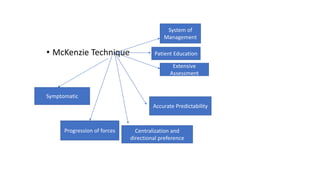
• McKenzie Technique
System of
Management
Patient Education
Extensive
Assessment
Accurate Predictability
Centralization and
directional preference
Progression of forces
Symptomatic
Classification Algorithm McKenzie Method.
Objectives
o The most important objective of the McKenzie method is patient self-
management. Three phases are included (May & Donelson, 2008).
o Patient education and demonstration of the benefits of the appropriate
movements and the aggravating effects of the opposite movement
maintenance education regarding the reduction and abolition of the
symptoms.
o Restoration and symptom-free full function of the lumbar spine.
• It is a philosophy of active patient involvement and education for back,
neck and extremity issues.
• It is grounded in finding a cause and effect relationship between the
positions the patient usually assumes while sitting, standing or moving, and
the location of the pain as a result of those positions or activities.
• The therapeutic approach requires a patient to move through a series of
activities and test movements to gauge the patient’s pain response. The
approach then uses that information to develop an exercise program
designed to centralize or alleviate the pain
• The goal of the McKenzie Method is to centralize the pain or move the pain
from the leg into the low back.
Reliability and Validity?????
A systematic review on the reliability of McKenzie classification system
yielded contradictory results as out of 3 high quality studies, two
demonstrated reliability and one did not (May et al. 2006).
The very first study analyzing the reliability of the McKenzie's
classification system (Kilby et al. 1990) found moderate inter-observer
reliability between two therapists with some training in the use of the
"McKenzie algorithm" in examination of pain behavior and pain
response with repeated movements. Total agreement was 59%, but the
method was unable reliably to detect end-range pain, presence of
kyphotic or flat lumbar spine and relevant lateral shift (sciatic scoliosis).
• The McKenzie method exists of 3 steps:
• 1. Assessment
• 2. Treatment and
• 3. Prevention
According to McKenzie, Pain of spinal origin can be classified into 3 Syndromes.
The Postural Syndrome
• Pain is created from mechanical deformation of normal soft tissue or
vascular insufficiency as a result of prolonged positional or postural
stresses.
Pain is intermittent.
Pain relieved by change of posture/function.
Dysfunction Syndrome
• The dysfunction classification is so named because it implies some
sort of adaptive shortening, scarring, or adherence of connective tissue
causing discomfort.
Derangement Syndrome
• This is the more common and known syndrome
• Symptoms may be local, referred, radicular or a combination, the symptoms could
also move from side to side or proximal to distal.
• Larger derangements cause greater mechanical deformation and more signs and
symptoms, which Can result in postural deformity.
• Symptoms can be constant or intermittent and could vary through the day
• The onset can be sudden, with no known cause, or gradual over time
• Directional preference is a hallmark of derangement syndrome, in which a specific
repeated movement or sustained position causes a relevant improvement in
symptoms.
• Treatments involve specific movements that cause the pain to decrease, centralize
and/or abolish
Directional Preference
• It describes the situation when movements in one direction will
improve pain and the limitation of range, whereas movements in the
opposite direction cause signs and symptoms to worsen.
• 1. Centralization
• 2. Peripheralization
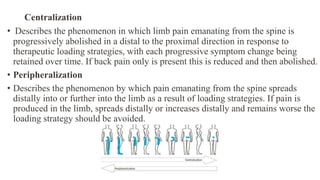
Centralization
• Describes the phenomenon in which limb pain emanating from the spine is
progressively abolished in a distal to the proximal direction in response to
therapeutic loading strategies, with each progressive symptom change being
retained over time. If back pain only is present this is reduced and then abolished.
• Peripheralization
• Describes the phenomenon by which pain emanating from the spine spreads
distally into or further into the limb as a result of loading strategies. If pain is
produced in the limb, spreads distally or increases distally and remains worse the
loading strategy should be avoided.
• Previously, only a few high quality prospective randomized
controlledtrials (RCTs) (Cherkin et al. 1998, Long et al. 1995) and
several lower quality studies (Ponte et al. 1984, Nwuga and Nwuga
1985, Stancovic et al. 1990,Stancovic et al. 1995) existed on the
effectiveness of the"pure" McKenziemethod.
• A subsequent systematic review (Clare et al. 2004b) showed
thatMcKenzie therapy resulted in a greater improvement in LBP and
back-relateddisability in the short term than other standard therapies.
• In the study by Long et al. (2004) all patients who demonstrated
directional preference(P) for centralizing pain were randomized to
receive exercises matched to DP(group 1), exercises opposite to DP
(group 2) or guidelines recommended“ advice to stay active" (group
3). Over 30% of the patients in groups 2 and 3withdrew from the study
because of failure to improve or worsening of symptoms, compared to
none in the group 1. Over 90% of the subjects in group1 rated
themselves better or resolved at 2 weeks, compared to
approximately20% in group 2 and 40% in group 3 (Long et al. 2004)
• In another study (Moffet et al. 2006), 315 patients were randomized to
either the McKenzie therapy or cognitive behavioral approach. The
patients were followed for 12 months with the Tampa Scale of
Kinesiophobia (TSK) as the main outcome. Both groups reported
modest but clinically important functional improvements, but at 6
months the results in the TSK activity-avoidance, patients' satisfaction
and one aspect of health locus of control favoured the McKenzie
method. In an economic analysis of the same trial the McKenzie
therapy was cost-effective with regard to Quality Adjusted Life
Yearsdespite the fact that it was more expensive (Mana et al. 2007)
• Contraindication
• If in the examination no position or movement can be found which
reduces the presenting pain, the patient is unsuited for mechanical
therapy. Saddle anesthesia and bladder weakness.
• Patients who exhibit signs of extreme pain.
• Developmental or acquired anomalies of bone structures which may
lead to weakness or instability of mechanical articulations.
Architectural faults should be excluded from mechanical therapy. E.g.
spondylolisthesis
• If, during the examination, no position or movement can be found to
reduce, centralize or abolish the symptoms, mechanical therapy may
be of no value, at least at that stage. If the symptoms are only
increased or peripheralized, it is likely that a more advanced pathology
exists, such as an extruded disc fragment, fracture or other condition,
and mechanical therapy is contraindicated.
• If the symptoms are not affected at all by mechanical measures (i.e.
movements or positions, rest or activity, loading or unloading of the
spine) or respond atypically to their application the underlying cause
may not be mechanical, and further investigation is indicated.
Common McKenzie exercises
• Exercise Force Progression
1.Static: Mid Range -> Static End Range
2.Dynamic: Mid Range -> End Range-> SSelf OP
3.Clincialian Generated: Patient to End Range -> Overpressure -> Therapist
mobilisation -> Maniupation
• Exercise Prescription
1.10 reps of the motion every 2 hours
2.Take motion to end range
3.Postural awareness
4.Follow-up in next 24-48 hours to assess progress

Mckenzie.pptx

  • 1.
  • 2.
    • McKenzie Approachor Mechanical diagnosis and therapy(MDT) is a Mechanical-based method of classification and therapy for Musculoskeletal disorders. • It was introduced in 1981 by Robin McKenzie (1931–2013), a physical therapist from New Zealand. • The assessment and classifying protocol does not aim to identify specific anatomical structures. Still, it classifies the clinical presentations as mechanical syndromes (FIGURE 1) based on patients’ symptom responses to standardized mechanical loading strategies (McKenzie 1981, McKenzie and May 2003).
  • 3.
    Basic Principles • Afterexperimentation in extension and flexion positions, there was a significant amount of feedback regarding patterns of pain behaviour that led to the formation of a classification system for many spinal problems(May & Donelson, 2008). • When clinicians assessed Chronic Low Back Pain (CLBP) they instructed their patients to move only once towards flexion and extension leading to assumption that these movements are painful and harmful. Often the diagnosis may be inconclusive unless an end-range move multiple times in order to ease the starting painful symptomDonelson.2008). • The assessment of this method aims in the identification of their classification into subgroups, according to their behaviour symptoms when they are subjected to specific directions and physical examination. The classification of patients into subgroups then can define treatment (McKenzie & May, 2003).
  • 4.
    • McKenzie Technique Systemof Management Patient Education Extensive Assessment Accurate Predictability Centralization and directional preference Progression of forces Symptomatic
  • 5.
  • 6.
    Objectives o The mostimportant objective of the McKenzie method is patient self- management. Three phases are included (May & Donelson, 2008). o Patient education and demonstration of the benefits of the appropriate movements and the aggravating effects of the opposite movement maintenance education regarding the reduction and abolition of the symptoms. o Restoration and symptom-free full function of the lumbar spine.
  • 7.
    • It isa philosophy of active patient involvement and education for back, neck and extremity issues. • It is grounded in finding a cause and effect relationship between the positions the patient usually assumes while sitting, standing or moving, and the location of the pain as a result of those positions or activities. • The therapeutic approach requires a patient to move through a series of activities and test movements to gauge the patient’s pain response. The approach then uses that information to develop an exercise program designed to centralize or alleviate the pain • The goal of the McKenzie Method is to centralize the pain or move the pain from the leg into the low back.
  • 8.
    Reliability and Validity????? Asystematic review on the reliability of McKenzie classification system yielded contradictory results as out of 3 high quality studies, two demonstrated reliability and one did not (May et al. 2006). The very first study analyzing the reliability of the McKenzie's classification system (Kilby et al. 1990) found moderate inter-observer reliability between two therapists with some training in the use of the "McKenzie algorithm" in examination of pain behavior and pain response with repeated movements. Total agreement was 59%, but the method was unable reliably to detect end-range pain, presence of kyphotic or flat lumbar spine and relevant lateral shift (sciatic scoliosis).
  • 9.
    • The McKenziemethod exists of 3 steps: • 1. Assessment • 2. Treatment and • 3. Prevention
  • 10.
    According to McKenzie,Pain of spinal origin can be classified into 3 Syndromes. The Postural Syndrome • Pain is created from mechanical deformation of normal soft tissue or vascular insufficiency as a result of prolonged positional or postural stresses. Pain is intermittent. Pain relieved by change of posture/function. Dysfunction Syndrome • The dysfunction classification is so named because it implies some sort of adaptive shortening, scarring, or adherence of connective tissue causing discomfort.
  • 11.
    Derangement Syndrome • Thisis the more common and known syndrome • Symptoms may be local, referred, radicular or a combination, the symptoms could also move from side to side or proximal to distal. • Larger derangements cause greater mechanical deformation and more signs and symptoms, which Can result in postural deformity. • Symptoms can be constant or intermittent and could vary through the day • The onset can be sudden, with no known cause, or gradual over time • Directional preference is a hallmark of derangement syndrome, in which a specific repeated movement or sustained position causes a relevant improvement in symptoms. • Treatments involve specific movements that cause the pain to decrease, centralize and/or abolish
  • 12.
    Directional Preference • Itdescribes the situation when movements in one direction will improve pain and the limitation of range, whereas movements in the opposite direction cause signs and symptoms to worsen. • 1. Centralization • 2. Peripheralization
  • 13.
    Centralization • Describes thephenomenon in which limb pain emanating from the spine is progressively abolished in a distal to the proximal direction in response to therapeutic loading strategies, with each progressive symptom change being retained over time. If back pain only is present this is reduced and then abolished. • Peripheralization • Describes the phenomenon by which pain emanating from the spine spreads distally into or further into the limb as a result of loading strategies. If pain is produced in the limb, spreads distally or increases distally and remains worse the loading strategy should be avoided.
  • 14.
    • Previously, onlya few high quality prospective randomized controlledtrials (RCTs) (Cherkin et al. 1998, Long et al. 1995) and several lower quality studies (Ponte et al. 1984, Nwuga and Nwuga 1985, Stancovic et al. 1990,Stancovic et al. 1995) existed on the effectiveness of the"pure" McKenziemethod. • A subsequent systematic review (Clare et al. 2004b) showed thatMcKenzie therapy resulted in a greater improvement in LBP and back-relateddisability in the short term than other standard therapies.
  • 15.
    • In thestudy by Long et al. (2004) all patients who demonstrated directional preference(P) for centralizing pain were randomized to receive exercises matched to DP(group 1), exercises opposite to DP (group 2) or guidelines recommended“ advice to stay active" (group 3). Over 30% of the patients in groups 2 and 3withdrew from the study because of failure to improve or worsening of symptoms, compared to none in the group 1. Over 90% of the subjects in group1 rated themselves better or resolved at 2 weeks, compared to approximately20% in group 2 and 40% in group 3 (Long et al. 2004)
  • 16.
    • In anotherstudy (Moffet et al. 2006), 315 patients were randomized to either the McKenzie therapy or cognitive behavioral approach. The patients were followed for 12 months with the Tampa Scale of Kinesiophobia (TSK) as the main outcome. Both groups reported modest but clinically important functional improvements, but at 6 months the results in the TSK activity-avoidance, patients' satisfaction and one aspect of health locus of control favoured the McKenzie method. In an economic analysis of the same trial the McKenzie therapy was cost-effective with regard to Quality Adjusted Life Yearsdespite the fact that it was more expensive (Mana et al. 2007)
  • 17.
    • Contraindication • Ifin the examination no position or movement can be found which reduces the presenting pain, the patient is unsuited for mechanical therapy. Saddle anesthesia and bladder weakness. • Patients who exhibit signs of extreme pain. • Developmental or acquired anomalies of bone structures which may lead to weakness or instability of mechanical articulations. Architectural faults should be excluded from mechanical therapy. E.g. spondylolisthesis
  • 18.
    • If, duringthe examination, no position or movement can be found to reduce, centralize or abolish the symptoms, mechanical therapy may be of no value, at least at that stage. If the symptoms are only increased or peripheralized, it is likely that a more advanced pathology exists, such as an extruded disc fragment, fracture or other condition, and mechanical therapy is contraindicated. • If the symptoms are not affected at all by mechanical measures (i.e. movements or positions, rest or activity, loading or unloading of the spine) or respond atypically to their application the underlying cause may not be mechanical, and further investigation is indicated.
  • 19.
  • 20.
    • Exercise ForceProgression 1.Static: Mid Range -> Static End Range 2.Dynamic: Mid Range -> End Range-> SSelf OP 3.Clincialian Generated: Patient to End Range -> Overpressure -> Therapist mobilisation -> Maniupation • Exercise Prescription 1.10 reps of the motion every 2 hours 2.Take motion to end range 3.Postural awareness 4.Follow-up in next 24-48 hours to assess progress