What is Earth Leakage?
The electrical current that flows from the live conductor to the earth through an
unintended path is called earth leakage. It may flow between their poor insulation
or through a person’s body & cause electrical shock. The consequence of
electrical shock may prove fatal if the leakage current exceeds the only 30mA.
Therefore, protection devices are used to disconnect the power source when
such current leakage is detected
Causes of Earth Leakage?
Earth leakage can occur due to various reasons. It can occur due to damaged
insulation of the live conductor or broken conductors. It can also occur when the
live conductor comes in contact with the body of the equipment (if the equipment
is not properly grounded). Upon touching the conductor or the equipment,
the current can pass to the earth through the person’s body
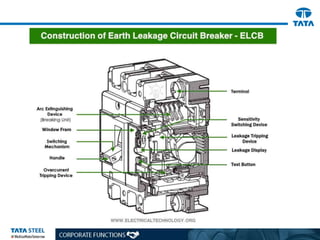
What is Earth Leakage Circuit Breaker?
ELCB or Earth Leakage Circuit Breaker is a type of circuit breaker that is used for
protection against leakage current. it breaks the circuit & disconnects
the power supply to the load when it senses the leakage current. The earth
leakage can cause electrical shocks that can be fatal.
ELCB is mainly used for protection against electrical shock. They do not offer
protection against overloading or short circuit. Therefore, they must be used in
series with an MCB (miniature circuit breaker).
Function of ELCB
ELCB is a safety device whose main function is to prevent electrical shock. It
monitors the leakage current that flows out of the circuit through any unintended
path. It cannot protect against overloading or short circuit current.
Operation of ELCB
Under normal conditions, the current from the source flows into the load through
the live wire & flows out of the load through the neutral wire. In fact, both currents
are equal in amount. If the current leaks through any unintended path, an
imbalance between the live & neutral wire occurs. The ELCB can sense the
imbalance using a current transformer & break the contacts using an
electromagnetic relay.
Types of ELCB
There are two types of ELCB classified based on its operation principle;
•Voltage ELCB
•Current ELCB
Both types of ELCBs detect the leakage current but their sensitivity & the level of
protection they offer are different. Voltage ELCB was invented before the current
ELCB. voltage based ELCB is inferior to current ELCB. Therefore, to avoid
confusion, the voltage ELCB is renamed ELCB while the current ELCB is
renamed RCCB or RCD.
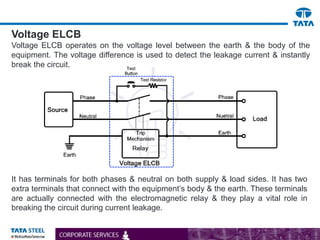
Voltage ELCB
Voltage ELCB operates on the voltage level between the earth & the body of the
equipment. The voltage difference is used to detect the leakage current & instantly
break the circuit.
It has terminals for both phases & neutral on both supply & load sides. It has two
extra terminals that connect with the equipment’s body & the earth. These terminals
are actually connected with the electromagnetic relay & they play a vital role in
breaking the circuit during current leakage.
Working Principle
One of the terminals of the relay coil is directly connected to the earth while the
other terminal is connected to the body of the equipment. The coil can sense the
voltage difference between the earth & the body of the equipment.
If the live wire breaks or its insulation fails & comes in contact with the body of the
equipment, a voltage difference appears across the terminals of the coil. As a
result, the current starts to flow through the coil & it is energized. The relay starts to
generate electromagnetic force. When the current exceeds a certain limit, the relay
produces sufficient force to pull the latch. By doing so, the latch break opens the
contacts & disconnects the power supply to the equipment & prevents electrical
shock.
Therefore, the earth connection is necessary as the relay only operates when the
leakage current flows through it. if the current leaks through any other parts of the
circuit & flows through any other unintended path, it will not break the circuit as the
current must flow through the relay in order to break the circuit.
Advantages
•It helps in protection against electrical shocks.
•They are less sensitive & do not trip unnecessarily.
•They are less expensive.
Disadvantages
•It cannot sense the current leakage from phase to any other earthed body.
•It cannot prevent electrical shock in case of touching the phase conductor directly.
•It only trips when the leakage current flows through the earth conductor
•It requires an extra connection with the body of the equipment & earth.
•It is less sensitive & cannot detect low leakage current.
•Electrical equipment that normally leaks voltage might trip ELCB unnecessarily.
It has far more disadvantages than advantages & they are obsolete. Therefore, if
you have installed any old voltage ELCBs in your home, replace them with current
ELCB or RCCB. They are more efficient, reliable & best at providing protection
against any kind of leakage current.
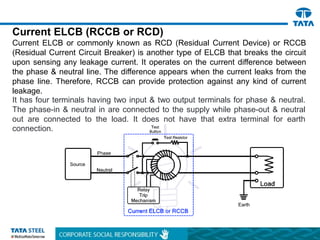
Current ELCB (RCCB or RCD)
Current ELCB or commonly known as RCD (Residual Current Device) or RCCB
(Residual Current Circuit Breaker) is another type of ELCB that breaks the circuit
upon sensing any leakage current. It operates on the current difference between
the phase & neutral line. The difference appears when the current leaks from the
phase line. Therefore, RCCB can provide protection against any kind of current
leakage.
It has four terminals having two input & two output terminals for phase & neutral.
The phase-in & neutral in are connected to the supply while phase-out & neutral
out are connected to the load. It does not have that extra terminal for earth
connection.
Working Principle
The RCCB working is based on the current imbalance between the phase & neutral
line. It continuously monitors the phase & neutral current. Under normal conditions,
both phase & neutral current are equal because it is the same current flowing back
from the load. If, the current leaks through any unintended path, the neutral current
reduces & causes imbalance. When the imbalance exceeds a certain limit, the
RCCB breaks the contacts & disconnects the power supply.
RCCB works on the principle of Kirchhoff’s current law, according to which the
amount of current entering the load through the hot wire must be equal to the
amount of current leaving the load through the neutral wire. The difference between
the two currents known as residual current should be zero. If there is a difference
then the current is leaking somewhere that causes the imbalance.
RCCB includes a zero-sequence current transformer that has three coils i.e. phase
coil, neutral coil & search coil. It is used for detecting the imbalance or difference
between two currents. The phase coil & neutral coil is wounded around the toroidal
core in such a way to cancel out each other’s flux.
if the currents are equal as should be under normal conditions, the resultant flux will
cancel out each other & there will be no induced current in the search coil. suppose,
there is a leakage current, the current difference will produce flux that will induce a
voltage in the search coil. as the search coil is connected to the relay trip
mechanism, it will break the contacts & disconnect the power supply to the load.
Advantages
•RCCB breaks the circuit when the current leaks from any part of the circuit.
•It is very reliable in providing protection against electrical shock.
•It is far more sensitive than voltage ELCB.
•It continuously monitors the residual current & instantaneously breaks when it
exceeds its rated limit.
•It does not require an earth connection.
Disadvantages
•It does not provide protection against short circuit current.
•It does not have overload protection.
•It is expensive than ELCB.
•It cannot provide protection against electrical shock due to touching both phases
& neutral wire because the current still remains equal.
•Due to high sensitivity, it may trip unnecessarily when used with old appliances
having small current leakage.
•It operates only on normal supply waveforms & cannot operate reliably on non-
standard waveforms.
Applications of ELCB
ELCB is used for protection against current leakage. The current leakage causes
electrical shock and faults in the system. It breaks the circuit instantly to prevents
damage to the connected circuits. They are essential in wet locations having
increased risks of electrical shocks.
ELCB.pptx

ELCB.pptx

  • 1.
    What is EarthLeakage? The electrical current that flows from the live conductor to the earth through an unintended path is called earth leakage. It may flow between their poor insulation or through a person’s body & cause electrical shock. The consequence of electrical shock may prove fatal if the leakage current exceeds the only 30mA. Therefore, protection devices are used to disconnect the power source when such current leakage is detected Causes of Earth Leakage? Earth leakage can occur due to various reasons. It can occur due to damaged insulation of the live conductor or broken conductors. It can also occur when the live conductor comes in contact with the body of the equipment (if the equipment is not properly grounded). Upon touching the conductor or the equipment, the current can pass to the earth through the person’s body
  • 2.
    What is EarthLeakage Circuit Breaker? ELCB or Earth Leakage Circuit Breaker is a type of circuit breaker that is used for protection against leakage current. it breaks the circuit & disconnects the power supply to the load when it senses the leakage current. The earth leakage can cause electrical shocks that can be fatal. ELCB is mainly used for protection against electrical shock. They do not offer protection against overloading or short circuit. Therefore, they must be used in series with an MCB (miniature circuit breaker). Function of ELCB ELCB is a safety device whose main function is to prevent electrical shock. It monitors the leakage current that flows out of the circuit through any unintended path. It cannot protect against overloading or short circuit current. Operation of ELCB Under normal conditions, the current from the source flows into the load through the live wire & flows out of the load through the neutral wire. In fact, both currents are equal in amount. If the current leaks through any unintended path, an imbalance between the live & neutral wire occurs. The ELCB can sense the imbalance using a current transformer & break the contacts using an electromagnetic relay.
  • 4.
    Types of ELCB Thereare two types of ELCB classified based on its operation principle; •Voltage ELCB •Current ELCB Both types of ELCBs detect the leakage current but their sensitivity & the level of protection they offer are different. Voltage ELCB was invented before the current ELCB. voltage based ELCB is inferior to current ELCB. Therefore, to avoid confusion, the voltage ELCB is renamed ELCB while the current ELCB is renamed RCCB or RCD.
  • 5.
    Voltage ELCB Voltage ELCBoperates on the voltage level between the earth & the body of the equipment. The voltage difference is used to detect the leakage current & instantly break the circuit. It has terminals for both phases & neutral on both supply & load sides. It has two extra terminals that connect with the equipment’s body & the earth. These terminals are actually connected with the electromagnetic relay & they play a vital role in breaking the circuit during current leakage.
  • 6.
    Working Principle One ofthe terminals of the relay coil is directly connected to the earth while the other terminal is connected to the body of the equipment. The coil can sense the voltage difference between the earth & the body of the equipment. If the live wire breaks or its insulation fails & comes in contact with the body of the equipment, a voltage difference appears across the terminals of the coil. As a result, the current starts to flow through the coil & it is energized. The relay starts to generate electromagnetic force. When the current exceeds a certain limit, the relay produces sufficient force to pull the latch. By doing so, the latch break opens the contacts & disconnects the power supply to the equipment & prevents electrical shock. Therefore, the earth connection is necessary as the relay only operates when the leakage current flows through it. if the current leaks through any other parts of the circuit & flows through any other unintended path, it will not break the circuit as the current must flow through the relay in order to break the circuit.
  • 7.
    Advantages •It helps inprotection against electrical shocks. •They are less sensitive & do not trip unnecessarily. •They are less expensive. Disadvantages •It cannot sense the current leakage from phase to any other earthed body. •It cannot prevent electrical shock in case of touching the phase conductor directly. •It only trips when the leakage current flows through the earth conductor •It requires an extra connection with the body of the equipment & earth. •It is less sensitive & cannot detect low leakage current. •Electrical equipment that normally leaks voltage might trip ELCB unnecessarily. It has far more disadvantages than advantages & they are obsolete. Therefore, if you have installed any old voltage ELCBs in your home, replace them with current ELCB or RCCB. They are more efficient, reliable & best at providing protection against any kind of leakage current.
  • 8.
    Current ELCB (RCCBor RCD) Current ELCB or commonly known as RCD (Residual Current Device) or RCCB (Residual Current Circuit Breaker) is another type of ELCB that breaks the circuit upon sensing any leakage current. It operates on the current difference between the phase & neutral line. The difference appears when the current leaks from the phase line. Therefore, RCCB can provide protection against any kind of current leakage. It has four terminals having two input & two output terminals for phase & neutral. The phase-in & neutral in are connected to the supply while phase-out & neutral out are connected to the load. It does not have that extra terminal for earth connection.
  • 9.
    Working Principle The RCCBworking is based on the current imbalance between the phase & neutral line. It continuously monitors the phase & neutral current. Under normal conditions, both phase & neutral current are equal because it is the same current flowing back from the load. If, the current leaks through any unintended path, the neutral current reduces & causes imbalance. When the imbalance exceeds a certain limit, the RCCB breaks the contacts & disconnects the power supply. RCCB works on the principle of Kirchhoff’s current law, according to which the amount of current entering the load through the hot wire must be equal to the amount of current leaving the load through the neutral wire. The difference between the two currents known as residual current should be zero. If there is a difference then the current is leaking somewhere that causes the imbalance.
  • 10.
    RCCB includes azero-sequence current transformer that has three coils i.e. phase coil, neutral coil & search coil. It is used for detecting the imbalance or difference between two currents. The phase coil & neutral coil is wounded around the toroidal core in such a way to cancel out each other’s flux. if the currents are equal as should be under normal conditions, the resultant flux will cancel out each other & there will be no induced current in the search coil. suppose, there is a leakage current, the current difference will produce flux that will induce a voltage in the search coil. as the search coil is connected to the relay trip mechanism, it will break the contacts & disconnect the power supply to the load.
  • 11.
    Advantages •RCCB breaks thecircuit when the current leaks from any part of the circuit. •It is very reliable in providing protection against electrical shock. •It is far more sensitive than voltage ELCB. •It continuously monitors the residual current & instantaneously breaks when it exceeds its rated limit. •It does not require an earth connection. Disadvantages •It does not provide protection against short circuit current. •It does not have overload protection. •It is expensive than ELCB. •It cannot provide protection against electrical shock due to touching both phases & neutral wire because the current still remains equal. •Due to high sensitivity, it may trip unnecessarily when used with old appliances having small current leakage. •It operates only on normal supply waveforms & cannot operate reliably on non- standard waveforms.
  • 12.
    Applications of ELCB ELCBis used for protection against current leakage. The current leakage causes electrical shock and faults in the system. It breaks the circuit instantly to prevents damage to the connected circuits. They are essential in wet locations having increased risks of electrical shocks.