MANAGEMENT CONSULTING AN OVERVIEW Matthias Kipping Schulich School of Business Toronto, Canada
Overview Definitions Assets of Consulting Firms Evolution of the Industry How Consultants Market Themselves Responsibilities and Risks McKinsey at Enron
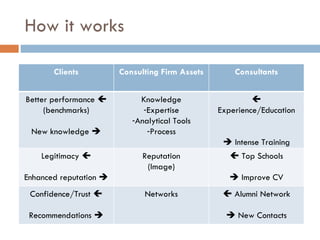
How it works Clients Consulting Firm Assets Consultants Better performance   (benchmarks) New knowledge   Knowledge Expertise Analytical Tools Process    Experience/Education    Intense Training Legitimacy   Enhanced reputation   Reputation (Image)    Top Schools    Improve CV Confidence/Trust   Recommendations   Networks    Alumni Network    New Contacts
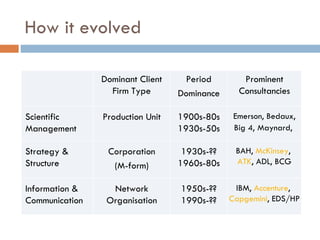
How it evolved Dominant Client Firm Type Period Dominance Prominent Consultancies Scientific Management Production Unit 1900s-80s 1930s-50s Emerson, Bedaux,  Big 4,   Maynard ,  Strategy & Structure Co rporation (M-form) 1930s-?? 1960s-80s BAH,  McKinsey ,  ATK ,  ADL,  BCG Information & Communication Network Organisation 1950s-?? 1990s-?? IBM,  Accenture ,  Capgemini , EDS/HP
Why marketing? To establish and maintain reputation QUESTIONS: How do consultants get their foot in the door for the first time? How do they retain their clients subsequently?
Unique product Attempts to create proprietary approaches Bedaux / MTM systems (shop floor efficiency) Multidivisional form (corporate organization) Business Process Re-engineering (value chain) Data bases (e.g. benchmarking; remuneration) Efforts to make them widely known Publications (e.g. In Search of Excellence) Teaching at Business Schools  Presentations to managers (at conferences)
Difficult to sustain Success eliminates the market for product McKinsey decentralised many European companies Competitors imitate: Commodification Consultancies “invent” own version of BPR New “fads” appear with increasing speed From JIT to TQM to BPR to CRM Consultants: Creators and Victims of “Management Fashions”
Sales efforts and incentives Contact potential clients directly, repeatedly Through mail shots, phone calls, etc. Separate sales efforts from consulting Different people sell and carry out projects Provide consultants with sales incentives Relate part of the pay to successful selling Make promotion dependent on new sales
Works only in the short-term Very fast initial expansion Example George S. May BUT: Many clients complain very soon About unrealistic promises of sales staff Consulting firm looses market share Some even collapse completely Often creates bad reputation For consulting firm and industry as a whole
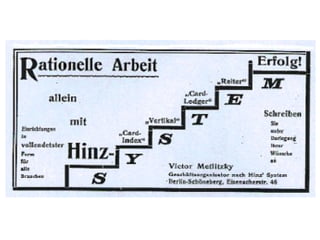
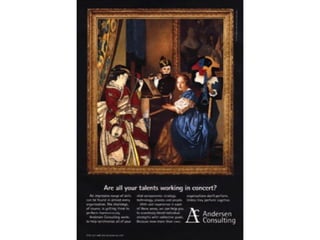
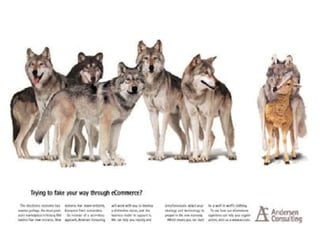
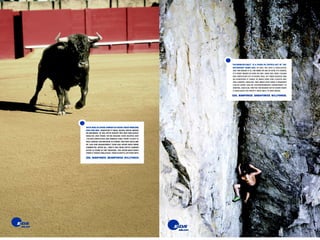
Advertising for image building Used since beginning of century Usually quite boring style Not allowed by professional rules But often hidden as job advert Has become more widespread Pioneering role of Andersen Consulting Taken on by other large consultancies
 
 
Use of television and stars Early examples:  Reach for the moon , shark Change of  name  on 1 January 2001 Recent campaigns Ideas Be a Tiger:  Remake ,  Revision ,  Invention


Relationship marketing Building trust-based personal relations between consulting partner and client CEO Often based on similar background Culture, education (“old schools ties”), etc. BUT: There are also some problems Spin-offs: Partners leave with clients International expansion: need for “bridges”
Why long-term relationship?  Provides the consultancy with a stable income stream and… reduces the costly efforts to identify and sign up new clients Clients have a better idea about the quality of the consulting service and… only need to disclose confidential information to one consulting firm
How McKinsey does it Famous “up or out” policy Only 1 out of 10 recruits makes partner Former consultants in top positions CEOs of potential client companies (e.g. IBM) McKinsey maintains this network Through newsletter, social events, etc.
 

Management Consulting Overview

  • 1.
    MANAGEMENT CONSULTING ANOVERVIEW Matthias Kipping Schulich School of Business Toronto, Canada
  • 2.
    Overview Definitions Assetsof Consulting Firms Evolution of the Industry How Consultants Market Themselves Responsibilities and Risks McKinsey at Enron
  • 3.
    How it worksClients Consulting Firm Assets Consultants Better performance  (benchmarks) New knowledge  Knowledge Expertise Analytical Tools Process  Experience/Education  Intense Training Legitimacy  Enhanced reputation  Reputation (Image)  Top Schools  Improve CV Confidence/Trust  Recommendations  Networks  Alumni Network  New Contacts
  • 4.
    How it evolvedDominant Client Firm Type Period Dominance Prominent Consultancies Scientific Management Production Unit 1900s-80s 1930s-50s Emerson, Bedaux, Big 4, Maynard , Strategy & Structure Co rporation (M-form) 1930s-?? 1960s-80s BAH, McKinsey , ATK , ADL, BCG Information & Communication Network Organisation 1950s-?? 1990s-?? IBM, Accenture , Capgemini , EDS/HP
  • 5.
    Why marketing? Toestablish and maintain reputation QUESTIONS: How do consultants get their foot in the door for the first time? How do they retain their clients subsequently?
  • 6.
    Unique product Attemptsto create proprietary approaches Bedaux / MTM systems (shop floor efficiency) Multidivisional form (corporate organization) Business Process Re-engineering (value chain) Data bases (e.g. benchmarking; remuneration) Efforts to make them widely known Publications (e.g. In Search of Excellence) Teaching at Business Schools Presentations to managers (at conferences)
  • 7.
    Difficult to sustainSuccess eliminates the market for product McKinsey decentralised many European companies Competitors imitate: Commodification Consultancies “invent” own version of BPR New “fads” appear with increasing speed From JIT to TQM to BPR to CRM Consultants: Creators and Victims of “Management Fashions”
  • 8.
    Sales efforts andincentives Contact potential clients directly, repeatedly Through mail shots, phone calls, etc. Separate sales efforts from consulting Different people sell and carry out projects Provide consultants with sales incentives Relate part of the pay to successful selling Make promotion dependent on new sales
  • 9.
    Works only inthe short-term Very fast initial expansion Example George S. May BUT: Many clients complain very soon About unrealistic promises of sales staff Consulting firm looses market share Some even collapse completely Often creates bad reputation For consulting firm and industry as a whole
  • 10.
    Advertising for imagebuilding Used since beginning of century Usually quite boring style Not allowed by professional rules But often hidden as job advert Has become more widespread Pioneering role of Andersen Consulting Taken on by other large consultancies
  • 11.
  • 12.
  • 13.
    Use of televisionand stars Early examples: Reach for the moon , shark Change of name on 1 January 2001 Recent campaigns Ideas Be a Tiger: Remake , Revision , Invention
  • 14.
  • 15.
  • 18.
  • 19.
  • 20.
  • 21.
    Relationship marketing Buildingtrust-based personal relations between consulting partner and client CEO Often based on similar background Culture, education (“old schools ties”), etc. BUT: There are also some problems Spin-offs: Partners leave with clients International expansion: need for “bridges”
  • 22.
    Why long-term relationship? Provides the consultancy with a stable income stream and… reduces the costly efforts to identify and sign up new clients Clients have a better idea about the quality of the consulting service and… only need to disclose confidential information to one consulting firm
  • 23.
    How McKinsey doesit Famous “up or out” policy Only 1 out of 10 recruits makes partner Former consultants in top positions CEOs of potential client companies (e.g. IBM) McKinsey maintains this network Through newsletter, social events, etc.
  • 24.