McKinsey & Company
INTRODUCTION
 The McKinsey Way is a book authored by Ethan M. Raisel which was published in
the year 1999 (Rasiel).
 The book has offered timeless insights about the consulting firm that is relevant
even after 24 years.
 In this presentation, we will look into the McKinsey Way and how they have
managed to be the best in the field of management.
WHO IS MCKISNEY
 McKinsey & Co. is a global management consulting firm that offers services to
organizations and government.
 It was founded in 1926 by James O. McKinsey who was a professor of the
university of Chicago.
 It is the largest of the Big Three management consultancies
 Its core work includes finance and operations
HOW HAS THE COMPANY EVOLVED?
 The firm started as a partnership but they restructured as a private entity.
 A unique strategy is that they follow the structure of the partnership and the
employees are considered as partners.
 The various scandals in McKinsey has been an eye opener for the orgnaisation
and they aim to adopt sustainable approaches keeping in mind the employee
welfare
DOMAIN OF MCKINSEY
 The firm focuses on marketing through magazines, books and scholarly articles.
 They try to create informal contacts with organizations who could be potential
clients.
 They handle projects who has a full team of consultants appointed
 They spend a major portion of their time in preparing presentations, charts and
exhibits
SWOT ANALYSIS
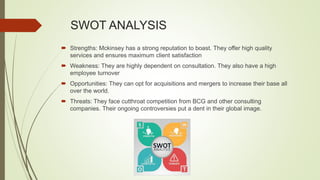
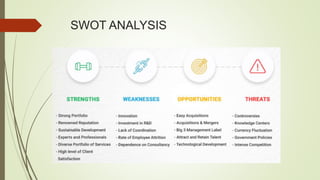
 Strengths: Mckinsey has a strong reputation to boast. They offer high quality
services and ensures maximum client satisfaction
 Weakness: They are highly dependent on consultation. They also have a high
employee turnover
 Opportunities: They can opt for acquisitions and mergers to increase their base all
over the world.
 Threats: They face cutthroat competition from BCG and other consulting
companies. Their ongoing controversies put a dent in their global image.
SWOT ANALYSIS
WHY IS MCKINSEY ONE OF THE MOST
POWERFUL?
 In 1970, McKinsey helped create the barcode (Rasiel).
 They are always at the forefront when it comes to solve the most pressing global
issues.
 They have a unparalleled alumni network
 The McKinsey clients are all conglomerates that are satisfied with the services
offered.
 The various scandals like Enron Collapse and linkage of McKinsey with an alleged
insider trader Rajat Gupta has not been able to create a dent in its image
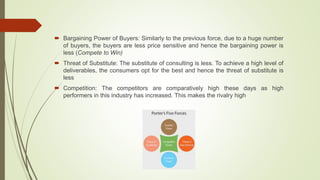
PORTERS FIVE FORCES
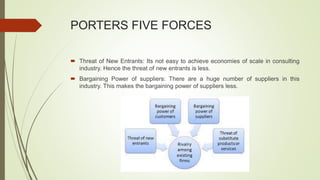
 Threat of New Entrants: Its not easy to achieve economies of scale in consulting
industry. Hence the threat of new entrants is less.
 Bargaining Power of suppliers: There are a huge number of suppliers in this
industry. This makes the bargaining power of suppliers less.
 Bargaining Power of Buyers: Similarly to the previous force, due to a huge number
of buyers, the buyers are less price sensitive and hence the bargaining power is
less (Compete to Win)
 Threat of Substitute: The substitute of consulting is less. To achieve a high level of
deliverables, the consumers opt for the best and hence the threat of substitute is
less
 Competition: The competitors are comparatively high these days as high
performers in this industry has increased. This makes the rivalry high
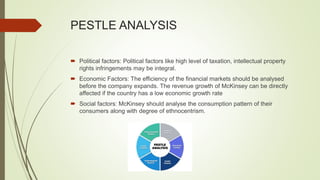
PESTLE ANALYSIS
 Political factors: Political factors like high level of taxation, intellectual property
rights infringements may be integral.
 Economic Factors: The efficiency of the financial markets should be analysed
before the company expands. The revenue growth of McKinsey can be directly
affected if the country has a low economic growth rate
 Social factors: McKinsey should analyse the consumption pattern of their
consumers along with degree of ethnocentrism.
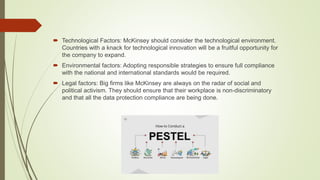
 Technological Factors: McKinsey should consider the technological environment.
Countries with a knack for technological innovation will be a fruitful opportunity for
the company to expand.
 Environmental factors: Adopting responsible strategies to ensure full compliance
with the national and international standards would be required.
 Legal factors: Big firms like McKinsey are always on the radar of social and
political activism. They should ensure that their workplace is non-discriminatory
and that all the data protection compliance are being done.
DIGITAL TRANSFORMATION
 McKinsey has developed a digital transformation framework known as 4Ds
 The first stage involves the companies to discover optimum strategy
 The second stage is all about designing the customer experience (Compete to
Win)
 The third stage involves the network partners and delivering the experience
 The fourth stage calculates risk and eliminates them.
COMPETITORS
 The top Competitors of McKinsey are as follows:
 Deloitte
 Accenture
 PwC
 Ernst and young
 Boston Consulting Group
 KPMG
 Bain & Company
 Oliver Wyman
 Goldman Sachs
COMPARISON
 When it comes to product quality, consumers tend to gravitate towards Bain & Co
more than McKinsey.
 The pricing point of McKinsey is quite high and competitors like Oliver Wyman,
BCG offers similar services at lesser price.
 The consumer service of other competitors like BCG, Oliver Wyman, Bain & Co is
better than McKinsey.
COMPETITIVE ANALYSIS
 The management consultancies experience intense rivalry.
 McKinsey faced stiff competition from Boston Consulting Group and to counter the
same, they followed the 2X2 matrix developed by BCG
 They developed a 3X3 matrix to analyse the strategy of the business.
 They combine the attractiveness of the industry with the competitiveness .
MCKINSEY 7S MODEL
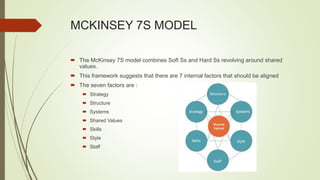
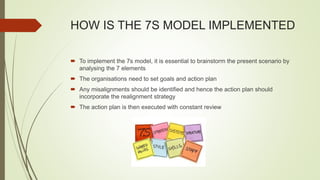
 The McKinsey 7S model combines Soft Ss and Hard Ss revolving around shared
values.
 This framework suggests that there are 7 internal factors that should be aligned
 The seven factors are :
 Strategy
 Structure
 Systems
 Shared Values
 Skills
 Style
 Staff
HOW IS THE 7S MODEL IMPLEMENTED
 To implement the 7s model, it is essential to brainstorm the present scenario by
analysing the 7 elements
 The organisations need to set goals and action plan
 Any misalignments should be identified and hence the action plan should
incorporate the realignment strategy
 The action plan is then executed with constant review
CLIENTS
 The clients of McKinsey are often Fortune 1000 Companies.
 At present, the clients of McKinsey include Coca Cola, Microsoft, US Department
of Energy, Bill and Melinda Gates Foundation to name a few.
 Coca Cola underwent a massive change by adopting McKinsey strategy under
their guidance (Belluz and Buissonniere).
 They established a digital academy so as to provide an upgradation of skills to
their managers.
 Since 2020, Microsoft has collaborated with McKinsey to de-risk the clients
 Microsoft has utilised the digital transformation of McKinsey to redesign their entire
business process (Belluz and Buissonniere).
 The technology transformation has been at the forefront especially during Covid-19
pandemic
 The Bill & Melinda Gates foundation aimed to eradicate poverty worldwide.
 McKinsey has conducted investigations for the foundation to analyse the situation
worldwide (Channon et al).
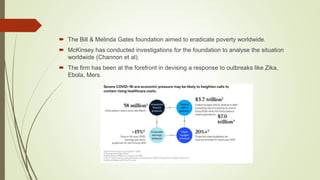
 The firm has been at the forefront in devising a response to outbreaks like Zika,
Ebola, Mers.
 McKinsey has worked with public sectors like WHO, Vaccine Alliance to expand
the access of healthcare worldwide.
 The other clients of McKinsey includes:
 Blue Cross Shield of Michigan
 Loblaws
 Best Buy
 National Resources Defense
USE CASE-1
 Beautify is a global company that sells its products only in high end shops like
Harrods and through online retailer Sephora.
 The company hire beauty consultants who connect with consumers in order to
provide world class services.
 They were faced with a problem of managing the consultants as they had not paid
much attention on the training.
 Beautify engaged McKinsey to help evaluate whether any training would be helpful
or not
 Their real problem lied in the amalgamation of those consultants for their in-store
experience and also virtually
 McKinsey helped Beautify to strategize some factors that would help them
overcome this problem
 As per McKinsey, the retailer response should be recorded to assess the majority
of the consumers who would prefer buying from the website and not from the
store.
 An analysis of competitors in terms of adoption of virtual assisstants were also
done.
 The current skill set of their beauty consultants were assessed. Consultants who
already had a social media presence were asked to retain
 The action was effective as Beautify retained most of the consultants having
experience in social media thereby reducing training costs.
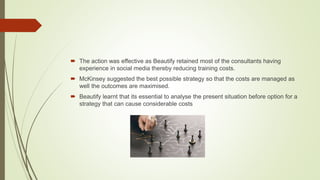
 McKinsey suggested the best possible strategy so that the costs are managed as
well the outcomes are maximised.
 Beautify learnt that its essential to analyse the present situation before option for a
strategy that can cause considerable costs
USE CASE-2
 The Bill & Melinda Gates foundation works for rural regions to counter the poverty
 They had approached McKinsey to design them a financial service plan for the
residents at Mexico
 The problem here was that they didn’t know how to get it done.
 McKinsey researched and discovered that Diconsa is a government operated
chain that distributes neccesities to its people.
 These stores have a central and regional supply chain management that has a
seamless distribution system
 McKinsey conducted research on the viability of the Diconsa chain for providing
financial services by analysing the risks and other factors
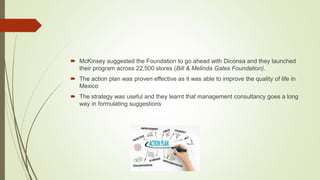
 McKinsey suggested the Foundation to go ahead with Diconsa and they launched
their program across 22,500 stores (Bill & Melinda Gates Foundation).
 The action plan was proven effective as it was able to improve the quality of life in
Mexico
 The strategy was useful and they learnt that management consultancy goes a long
way in formulating suggestions
CONCLUSION
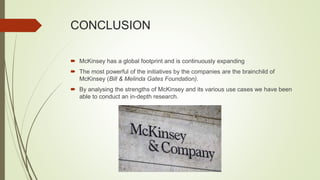
 McKinsey has a global footprint and is continuously expanding
 The most powerful of the initiatives by the companies are the brainchild of
McKinsey (Bill & Melinda Gates Foundation).
 By analysing the strengths of McKinsey and its various use cases we have been
able to conduct an in-depth research.
REFERENCES
 Belluz, Julia, and Marine Buissonniere. “How Mckinsey Infiltrated the World of Global
Public Health.” Vox, Vox, 13 Dec. 2019, https://www.vox.com/science-and-
health/2019/12/13/21004456/bill-gates-mckinsey-global-public-health-bcg.
 Channon, Derek F., and Adrián A. Caldart. "McKinsey 7S model." Wiley encyclopedia of
management (2015): 1-1.
 “Diconsa to Offer Financial Services in Rural Mexico.” Bill & Melinda Gates Foundation,
https://www.gatesfoundation.org/ideas/media-center/press-releases/2009/09/diconsa-
to-offer-financial-services-in-rural-mexico.
 “McKinsey Matrix: Compete to Win.” Compete to Win | World Class Know How, 11 June
2020, http://www.competetowin.co.uk/know-how/strategic-planning/mckinsey-matrix/.
 Rasiel, Ethan M. The McKinsey Way. New York: McGraw-Hill, 1999.

OR135264 (2).pptx

  • 1.
  • 2.
    INTRODUCTION  The McKinseyWay is a book authored by Ethan M. Raisel which was published in the year 1999 (Rasiel).  The book has offered timeless insights about the consulting firm that is relevant even after 24 years.  In this presentation, we will look into the McKinsey Way and how they have managed to be the best in the field of management.
  • 3.
    WHO IS MCKISNEY McKinsey & Co. is a global management consulting firm that offers services to organizations and government.  It was founded in 1926 by James O. McKinsey who was a professor of the university of Chicago.  It is the largest of the Big Three management consultancies  Its core work includes finance and operations
  • 4.
    HOW HAS THECOMPANY EVOLVED?  The firm started as a partnership but they restructured as a private entity.  A unique strategy is that they follow the structure of the partnership and the employees are considered as partners.  The various scandals in McKinsey has been an eye opener for the orgnaisation and they aim to adopt sustainable approaches keeping in mind the employee welfare
  • 5.
    DOMAIN OF MCKINSEY The firm focuses on marketing through magazines, books and scholarly articles.  They try to create informal contacts with organizations who could be potential clients.  They handle projects who has a full team of consultants appointed  They spend a major portion of their time in preparing presentations, charts and exhibits
  • 6.
    SWOT ANALYSIS  Strengths:Mckinsey has a strong reputation to boast. They offer high quality services and ensures maximum client satisfaction  Weakness: They are highly dependent on consultation. They also have a high employee turnover  Opportunities: They can opt for acquisitions and mergers to increase their base all over the world.  Threats: They face cutthroat competition from BCG and other consulting companies. Their ongoing controversies put a dent in their global image.
  • 7.
  • 8.
    WHY IS MCKINSEYONE OF THE MOST POWERFUL?  In 1970, McKinsey helped create the barcode (Rasiel).  They are always at the forefront when it comes to solve the most pressing global issues.  They have a unparalleled alumni network  The McKinsey clients are all conglomerates that are satisfied with the services offered.  The various scandals like Enron Collapse and linkage of McKinsey with an alleged insider trader Rajat Gupta has not been able to create a dent in its image
  • 9.
    PORTERS FIVE FORCES Threat of New Entrants: Its not easy to achieve economies of scale in consulting industry. Hence the threat of new entrants is less.  Bargaining Power of suppliers: There are a huge number of suppliers in this industry. This makes the bargaining power of suppliers less.
  • 10.
     Bargaining Powerof Buyers: Similarly to the previous force, due to a huge number of buyers, the buyers are less price sensitive and hence the bargaining power is less (Compete to Win)  Threat of Substitute: The substitute of consulting is less. To achieve a high level of deliverables, the consumers opt for the best and hence the threat of substitute is less  Competition: The competitors are comparatively high these days as high performers in this industry has increased. This makes the rivalry high
  • 11.
    PESTLE ANALYSIS  Politicalfactors: Political factors like high level of taxation, intellectual property rights infringements may be integral.  Economic Factors: The efficiency of the financial markets should be analysed before the company expands. The revenue growth of McKinsey can be directly affected if the country has a low economic growth rate  Social factors: McKinsey should analyse the consumption pattern of their consumers along with degree of ethnocentrism.
  • 12.
     Technological Factors:McKinsey should consider the technological environment. Countries with a knack for technological innovation will be a fruitful opportunity for the company to expand.  Environmental factors: Adopting responsible strategies to ensure full compliance with the national and international standards would be required.  Legal factors: Big firms like McKinsey are always on the radar of social and political activism. They should ensure that their workplace is non-discriminatory and that all the data protection compliance are being done.
  • 13.
    DIGITAL TRANSFORMATION  McKinseyhas developed a digital transformation framework known as 4Ds  The first stage involves the companies to discover optimum strategy  The second stage is all about designing the customer experience (Compete to Win)  The third stage involves the network partners and delivering the experience  The fourth stage calculates risk and eliminates them.
  • 14.
    COMPETITORS  The topCompetitors of McKinsey are as follows:  Deloitte  Accenture  PwC  Ernst and young  Boston Consulting Group  KPMG  Bain & Company  Oliver Wyman  Goldman Sachs
  • 15.
    COMPARISON  When itcomes to product quality, consumers tend to gravitate towards Bain & Co more than McKinsey.  The pricing point of McKinsey is quite high and competitors like Oliver Wyman, BCG offers similar services at lesser price.  The consumer service of other competitors like BCG, Oliver Wyman, Bain & Co is better than McKinsey.
  • 16.
    COMPETITIVE ANALYSIS  Themanagement consultancies experience intense rivalry.  McKinsey faced stiff competition from Boston Consulting Group and to counter the same, they followed the 2X2 matrix developed by BCG  They developed a 3X3 matrix to analyse the strategy of the business.  They combine the attractiveness of the industry with the competitiveness .
  • 17.
    MCKINSEY 7S MODEL The McKinsey 7S model combines Soft Ss and Hard Ss revolving around shared values.  This framework suggests that there are 7 internal factors that should be aligned  The seven factors are :  Strategy  Structure  Systems  Shared Values  Skills  Style  Staff
  • 18.
    HOW IS THE7S MODEL IMPLEMENTED  To implement the 7s model, it is essential to brainstorm the present scenario by analysing the 7 elements  The organisations need to set goals and action plan  Any misalignments should be identified and hence the action plan should incorporate the realignment strategy  The action plan is then executed with constant review
  • 19.
    CLIENTS  The clientsof McKinsey are often Fortune 1000 Companies.  At present, the clients of McKinsey include Coca Cola, Microsoft, US Department of Energy, Bill and Melinda Gates Foundation to name a few.  Coca Cola underwent a massive change by adopting McKinsey strategy under their guidance (Belluz and Buissonniere).  They established a digital academy so as to provide an upgradation of skills to their managers.
  • 20.
     Since 2020,Microsoft has collaborated with McKinsey to de-risk the clients  Microsoft has utilised the digital transformation of McKinsey to redesign their entire business process (Belluz and Buissonniere).  The technology transformation has been at the forefront especially during Covid-19 pandemic
  • 21.
     The Bill& Melinda Gates foundation aimed to eradicate poverty worldwide.  McKinsey has conducted investigations for the foundation to analyse the situation worldwide (Channon et al).  The firm has been at the forefront in devising a response to outbreaks like Zika, Ebola, Mers.
  • 22.
     McKinsey hasworked with public sectors like WHO, Vaccine Alliance to expand the access of healthcare worldwide.  The other clients of McKinsey includes:  Blue Cross Shield of Michigan  Loblaws  Best Buy  National Resources Defense
  • 23.
    USE CASE-1  Beautifyis a global company that sells its products only in high end shops like Harrods and through online retailer Sephora.  The company hire beauty consultants who connect with consumers in order to provide world class services.  They were faced with a problem of managing the consultants as they had not paid much attention on the training.
  • 24.
     Beautify engagedMcKinsey to help evaluate whether any training would be helpful or not  Their real problem lied in the amalgamation of those consultants for their in-store experience and also virtually  McKinsey helped Beautify to strategize some factors that would help them overcome this problem
  • 25.
     As perMcKinsey, the retailer response should be recorded to assess the majority of the consumers who would prefer buying from the website and not from the store.  An analysis of competitors in terms of adoption of virtual assisstants were also done.  The current skill set of their beauty consultants were assessed. Consultants who already had a social media presence were asked to retain
  • 26.
     The actionwas effective as Beautify retained most of the consultants having experience in social media thereby reducing training costs.  McKinsey suggested the best possible strategy so that the costs are managed as well the outcomes are maximised.  Beautify learnt that its essential to analyse the present situation before option for a strategy that can cause considerable costs
  • 27.
    USE CASE-2  TheBill & Melinda Gates foundation works for rural regions to counter the poverty  They had approached McKinsey to design them a financial service plan for the residents at Mexico  The problem here was that they didn’t know how to get it done.
  • 28.
     McKinsey researchedand discovered that Diconsa is a government operated chain that distributes neccesities to its people.  These stores have a central and regional supply chain management that has a seamless distribution system  McKinsey conducted research on the viability of the Diconsa chain for providing financial services by analysing the risks and other factors
  • 29.
     McKinsey suggestedthe Foundation to go ahead with Diconsa and they launched their program across 22,500 stores (Bill & Melinda Gates Foundation).  The action plan was proven effective as it was able to improve the quality of life in Mexico  The strategy was useful and they learnt that management consultancy goes a long way in formulating suggestions
  • 30.
    CONCLUSION  McKinsey hasa global footprint and is continuously expanding  The most powerful of the initiatives by the companies are the brainchild of McKinsey (Bill & Melinda Gates Foundation).  By analysing the strengths of McKinsey and its various use cases we have been able to conduct an in-depth research.
  • 31.
    REFERENCES  Belluz, Julia,and Marine Buissonniere. “How Mckinsey Infiltrated the World of Global Public Health.” Vox, Vox, 13 Dec. 2019, https://www.vox.com/science-and- health/2019/12/13/21004456/bill-gates-mckinsey-global-public-health-bcg.  Channon, Derek F., and Adrián A. Caldart. "McKinsey 7S model." Wiley encyclopedia of management (2015): 1-1.  “Diconsa to Offer Financial Services in Rural Mexico.” Bill & Melinda Gates Foundation, https://www.gatesfoundation.org/ideas/media-center/press-releases/2009/09/diconsa- to-offer-financial-services-in-rural-mexico.  “McKinsey Matrix: Compete to Win.” Compete to Win | World Class Know How, 11 June 2020, http://www.competetowin.co.uk/know-how/strategic-planning/mckinsey-matrix/.  Rasiel, Ethan M. The McKinsey Way. New York: McGraw-Hill, 1999.