CONSULTING CLUB
             EDUCATION


   WHAT IS
CONSULTING?

       Denis Amaral
       14 November 2011
Denis Mantelatto Amaral
• Industrial Engineer (production and mechanics)
   @ Escola de Engenharia Mauá (Commercial Director @ Mauá Jr.)
• Post-graduated in Information Technology (ERP)
   @ FIAP
• Exponential Technologies Executive Program
   @ Singularity University (NASA)
• Attending the Master of International Business
   @ HULT


• 5 Years Experience in Management Consulting
   @ THOMPSON MANAGEMENT HORIZONS
Today’s Overview
 1

 2

 3

 4

 5

 6

 7
CONSULTING:
IN CONTEXT
Discussion:

What is
consulting?

  “Everything should be made
       as simple as possible,
         but not simpler.”

              - Albert Einstein
What is Consulting
consulting |kənˈsəltiNG|
noun
   the business of giving expert advice to other
   professionals, typically in business matters.


 Interactive process
 Executed by people external to the problem
 Supply client with changing options
 Attend with efficacy
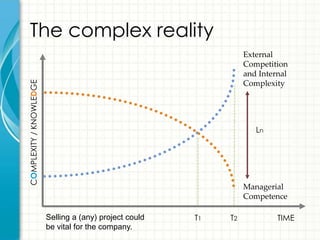
The complex reality
                                                                   External
                                                                   Competition
                                                                   and Internal
COMPLEXITY / KNOWLEDGE


                                                                   Complexity


                                                                      Ln


                                                                   Conhecimento e
                                                                   Competência
                                                                   Managerial
                                                                   Gerencial
                                                                   Competence

                         Selling a (any) project could   T1   T2            TIME
                         be vital for the company.
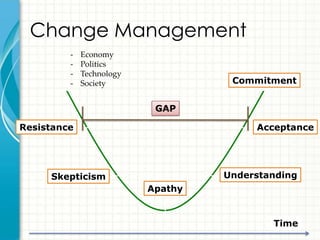
Change Management
         -   Economy
         -   Politics
         -   Technology
         -   Society                Commitment


                           GAP

Resistance                              Acceptance


     Skepticism                    Understanding
                          Apathy


                                           Time
Why people hire consultancies


• Knowledge increasing necessity

• Lack of time / work force

• Organization policies
Knowledge increasing necessity

The client does   not:

•   Know what it needs
•   Have the knowledge needed
•   Have the competencies
•   Administrate its knowledge
Lack of time / work force
COMPLEXITY


• Market perception
• Quick changes
• Future projection

KNOWLEDGE


• Enterprise evolution
• Structure and organization
• Processes
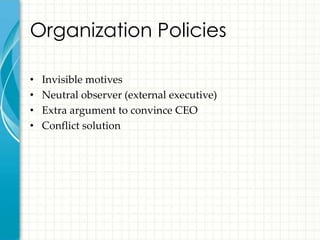
Organization Policies

•   Invisible motives
•   Neutral observer (external executive)
•   Extra argument to convince CEO
•   Conflict solution
BECOMING A
CONSULTANT
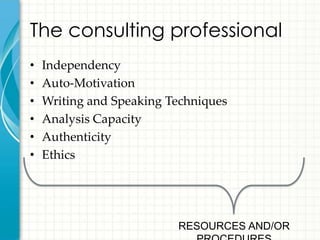
The consulting professional
•   Independency
•   Auto-Motivation
•   Writing and Speaking Techniques
•   Analysis Capacity
•   Authenticity
•   Ethics


                          RESOURCES AND/OR
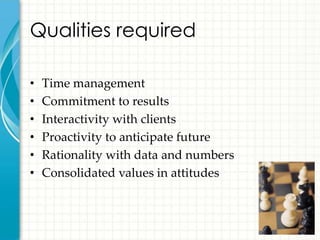
Qualities required

•   Time management
•   Commitment to results
•   Interactivity with clients
•   Proactivity to anticipate future
•   Rationality with data and numbers
•   Consolidated values in attitudes
Perceived Qualities
•   Consulting techniques
•   Specialist on the topic
•   Human relationship within the industry
•   Brand and experience
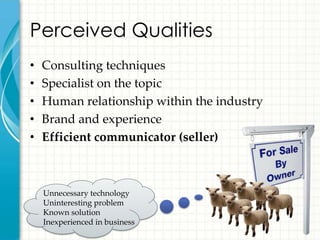
•   Efficient communicator (seller)


    Unnecessary technology
    Uninteresting problem
    Known solution
    Inexperienced in business
How to become a consultant
• For those who have vast experience in a specific
  industry: you have the differential – open your
  business;
• For those with less experience but with fitting
  profile and education: apply for graduate
  schemes;
• For those who did not know what consultancy
  was before today: participate actively of the
  Hult Consulting Club!

  The clients notice special competencies and values of
 consultants as a unique opportunity to their businesses.
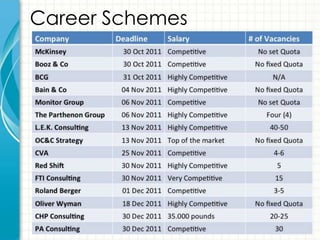
Career Schemes
Consulting Techniques
• Survey
VALUE ADDED:
CONTRACTS
AND SERVICES
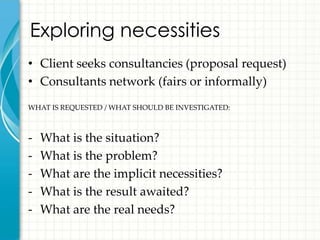
Exploring necessities
• Client seeks consultancies (proposal request)
• Consultants network (fairs or informally)
WHAT IS REQUESTED / WHAT SHOULD BE INVESTIGATED:


-   What is the situation?
-   What is the problem?
-   What are the implicit necessities?
-   What is the result awaited?
-   What are the real needs?
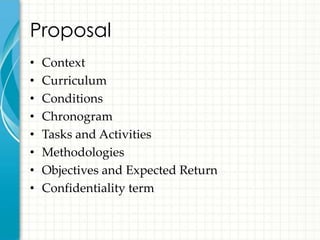
Proposal
•   Context
•   Curriculum
•   Conditions
•   Chronogram
•   Tasks and Activities
•   Methodologies
•   Objectives and Expected Return
•   Confidentiality term
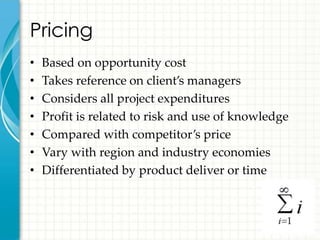
Pricing
•   Based on opportunity cost
•   Takes reference on client’s managers
•   Considers all project expenditures
•   Profit is related to risk and use of knowledge
•   Compared with competitor’s price
•   Vary with region and industry economies
•   Differentiated by product deliver or time
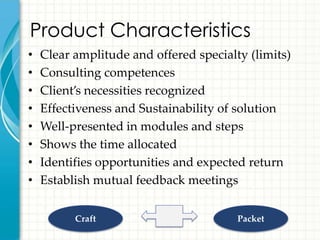
Product Characteristics
•   Clear amplitude and offered specialty (limits)
•   Consulting competences
•   Client’s necessities recognized
•   Effectiveness and Sustainability of solution
•   Well-presented in modules and steps
•   Shows the time allocated
•   Identifies opportunities and expected return
•   Establish mutual feedback meetings


          Craft                         Packet
Craft
•   More Flexible
•   Follows client’s culture and architecture
•   Closer to client’s business reality
•   Longer contracts
•   More complex negotiations
•   Longer projects
•   Lower resistance in change management
•   Better relative quality
•   Partnership is established
•   Vast experience and knowledge
Packet
•   Work follows a classical pattern
•   Use of famous methodologies
•   More generic in terms of client’s reality
•   Easy contract
•   Price seeking
•   Short projects
•   Lower cost
•   Focused on change management
•   Client becomes dependent of consultancy
TYPES OF
CONSULTING
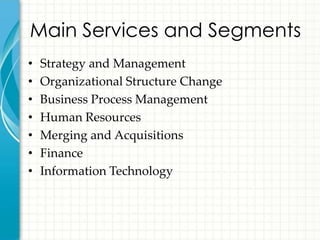
Main Services and Segments
•   Strategy and Management
•   Organizational Structure Change
•   Business Process Management
•   Human Resources
•   Merging and Acquisitions
•   Finance
•   Information Technology
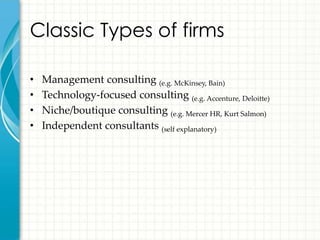
Classic Types of firms

•   Management consulting (e.g. McKinsey, Bain)
•   Technology-focused consulting (e.g. Accenture, Deloitte)
•   Niche/boutique consulting (e.g. Mercer HR, Kurt Salmon)
•   Independent consultants (self explanatory)
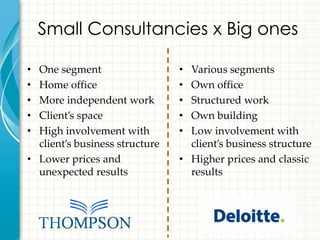
Small Consultancies x Big ones

• One segment                   • Various segments
• Home office                   • Own office
• More independent work         • Structured work
• Client’s space                • Own building
• High involvement with         • Low involvement with
  client’s business structure     client’s business structure
• Lower prices and              • Higher prices and classic
  unexpected results              results
DAILY BASIS
AND ETHICS
Office daily basis
•   Speaking with a pen
•   Periodical meetings
•   Interviews in loco (travel)
•   Change management resistance
•   Client’s culture and internal procedures
Consultant Daily Basis
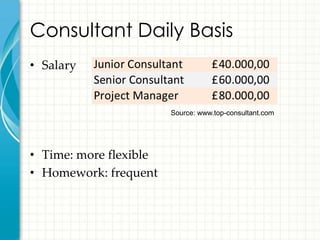
• Salary


                        Source: www.top-consultant.com


• Time: more flexible
• Homework: frequent
Ethics
• Accepting only those client engagements they
  are qualified to perform
• Agreeing with the client in advance on the basis
  for professional charges
• Developing realistic and practical solutions to
  client problems
• Rendering impartial, independent advice
• Safeguarding confidential information


                 Source: Institute of Management Consultants USA
PERSONAL
EXPERIENCE
Personal Experience
@ Maua Jr.
Areas:
    Engineering Project Sales
@ Thompson Management Horizons
Areas:
    Business Process Redesign (FCT)
    Project Management (ESPM)


(2010-2011) The fifth biggest private bank of the world:
Standardized the processes of reception, screening and distribution for the
106 buildings of the corporation, and trained the personnel in executing the
tasks in concordance to the internal Service Level Agreements generated by
the project. The greatest challenge was to change the management of a frozen
culture, adapting the modern routines to avoid risks using Key Performance
Indicators.
Personal Experience
(2009-2010) The biggest on-shore petroleum extractor of Latin America:
Drew the business’ accounting, finance and stockings processes in all of its
branches all over the country, adapting it to the Enterprise Resource Planning
(ERP) system platform. The stock analysis generated reduction of R$30
million in three years. Also coordinated the accounting reconciliation of the
main office, after an acquisition of a minor enterprise by the client.

(2009) The Brazilian gas syndicate:
Revised the exchanging model of P13-Gas Cylinders (empty canisters for full
ones) of all Brazilian brands, generating a 10% saving to the process.

(2009) A innovated enterprise focused on generating creative strategic
solutions (partner of Thompson):
Cooperated in creating the strategy agenda of investments of the biggest tug
company in Brazil. The challenge consisted of investigating the growth of
Brazilian ports in the next five years.
Personal Experience
(2008) An automobile reseller, with more than thirty branches in Brazil:
Cooperated in the implementation of its Shared Services Center, achieving
back-office savings of R$1.5 million per year.

(2006) The biggest gas cylinders supplier of Brazil:
Designed the operational procedures and established a Shared Services
Center based on the “Sarbanes-Oxley” law, thereby generating a R$12 million
savings in the purchasing area on its first year. The greatest challenge was to
reduce the number of employees –approx. 50 people were let go – and
establish institutional politics for the organization. The change management
for the new SSC structure reduced many costs (e.g.: travelling costs by 80%).
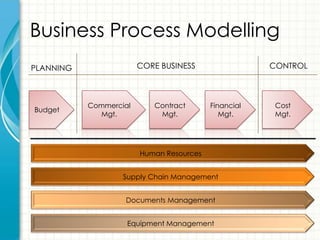
Business Process Modelling
PLANNING                CORE BUSINESS                 CONTROL


           Commercial      Contract       Financial    Cost
Budget
             Mgt.           Mgt.             Mgt.      Mgt.


                        Human Resources


                   Supply Chain Management


                   Documents Management


                    Equipment Management
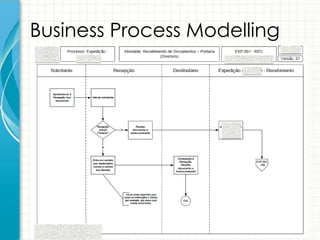
Business Process Modelling
Conclusion
• Where to start
• Who to follow
• Where to aim
Conclusion:   the mission
• Every company has a
  mission.
• Every person can
  have his/her mission
  too.
• For example, a doctor
  should fight for the
  end of diseases
  throughout the
  world.
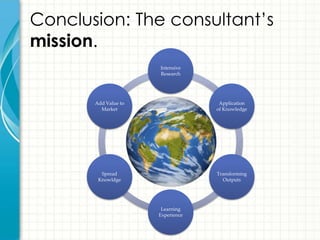
Conclusion: The consultant’s
mission.
                      Intensive
                      Research


       Add Value to                 Application
         Market                    of Knowledge


         Spread                    Transforming
        Knowldge                     Outputs


                       Learning
                      Experience
QUESTIONS?
CONSULTING CLUB
          EDUCATION


THANK YOU

What Is Consulting

  • 1.
    CONSULTING CLUB EDUCATION WHAT IS CONSULTING? Denis Amaral 14 November 2011
  • 2.
    Denis Mantelatto Amaral •Industrial Engineer (production and mechanics) @ Escola de Engenharia Mauá (Commercial Director @ Mauá Jr.) • Post-graduated in Information Technology (ERP) @ FIAP • Exponential Technologies Executive Program @ Singularity University (NASA) • Attending the Master of International Business @ HULT • 5 Years Experience in Management Consulting @ THOMPSON MANAGEMENT HORIZONS
  • 3.
  • 4.
  • 5.
    Discussion: What is consulting? “Everything should be made as simple as possible, but not simpler.” - Albert Einstein
  • 6.
    What is Consulting consulting|kənˈsəltiNG| noun the business of giving expert advice to other professionals, typically in business matters.  Interactive process  Executed by people external to the problem  Supply client with changing options  Attend with efficacy
  • 7.
    The complex reality External Competition and Internal COMPLEXITY / KNOWLEDGE Complexity Ln Conhecimento e Competência Managerial Gerencial Competence Selling a (any) project could T1 T2 TIME be vital for the company.
  • 8.
    Change Management - Economy - Politics - Technology - Society Commitment GAP Resistance Acceptance Skepticism Understanding Apathy Time
  • 9.
    Why people hireconsultancies • Knowledge increasing necessity • Lack of time / work force • Organization policies
  • 10.
    Knowledge increasing necessity Theclient does not: • Know what it needs • Have the knowledge needed • Have the competencies • Administrate its knowledge
  • 11.
    Lack of time/ work force COMPLEXITY • Market perception • Quick changes • Future projection KNOWLEDGE • Enterprise evolution • Structure and organization • Processes
  • 12.
    Organization Policies • Invisible motives • Neutral observer (external executive) • Extra argument to convince CEO • Conflict solution
  • 13.
  • 14.
    The consulting professional • Independency • Auto-Motivation • Writing and Speaking Techniques • Analysis Capacity • Authenticity • Ethics RESOURCES AND/OR
  • 15.
    Qualities required • Time management • Commitment to results • Interactivity with clients • Proactivity to anticipate future • Rationality with data and numbers • Consolidated values in attitudes
  • 16.
    Perceived Qualities • Consulting techniques • Specialist on the topic • Human relationship within the industry • Brand and experience • Efficient communicator (seller) Unnecessary technology Uninteresting problem Known solution Inexperienced in business
  • 17.
    How to becomea consultant • For those who have vast experience in a specific industry: you have the differential – open your business; • For those with less experience but with fitting profile and education: apply for graduate schemes; • For those who did not know what consultancy was before today: participate actively of the Hult Consulting Club! The clients notice special competencies and values of consultants as a unique opportunity to their businesses.
  • 18.
  • 19.
  • 20.
  • 21.
    Exploring necessities • Clientseeks consultancies (proposal request) • Consultants network (fairs or informally) WHAT IS REQUESTED / WHAT SHOULD BE INVESTIGATED: - What is the situation? - What is the problem? - What are the implicit necessities? - What is the result awaited? - What are the real needs?
  • 22.
    Proposal • Context • Curriculum • Conditions • Chronogram • Tasks and Activities • Methodologies • Objectives and Expected Return • Confidentiality term
  • 23.
    Pricing • Based on opportunity cost • Takes reference on client’s managers • Considers all project expenditures • Profit is related to risk and use of knowledge • Compared with competitor’s price • Vary with region and industry economies • Differentiated by product deliver or time
  • 24.
    Product Characteristics • Clear amplitude and offered specialty (limits) • Consulting competences • Client’s necessities recognized • Effectiveness and Sustainability of solution • Well-presented in modules and steps • Shows the time allocated • Identifies opportunities and expected return • Establish mutual feedback meetings Craft Packet
  • 25.
    Craft • More Flexible • Follows client’s culture and architecture • Closer to client’s business reality • Longer contracts • More complex negotiations • Longer projects • Lower resistance in change management • Better relative quality • Partnership is established • Vast experience and knowledge
  • 26.
    Packet • Work follows a classical pattern • Use of famous methodologies • More generic in terms of client’s reality • Easy contract • Price seeking • Short projects • Lower cost • Focused on change management • Client becomes dependent of consultancy
  • 27.
  • 28.
    Main Services andSegments • Strategy and Management • Organizational Structure Change • Business Process Management • Human Resources • Merging and Acquisitions • Finance • Information Technology
  • 29.
    Classic Types offirms • Management consulting (e.g. McKinsey, Bain) • Technology-focused consulting (e.g. Accenture, Deloitte) • Niche/boutique consulting (e.g. Mercer HR, Kurt Salmon) • Independent consultants (self explanatory)
  • 30.
    Small Consultancies xBig ones • One segment • Various segments • Home office • Own office • More independent work • Structured work • Client’s space • Own building • High involvement with • Low involvement with client’s business structure client’s business structure • Lower prices and • Higher prices and classic unexpected results results
  • 31.
  • 32.
    Office daily basis • Speaking with a pen • Periodical meetings • Interviews in loco (travel) • Change management resistance • Client’s culture and internal procedures
  • 33.
    Consultant Daily Basis •Salary Source: www.top-consultant.com • Time: more flexible • Homework: frequent
  • 34.
    Ethics • Accepting onlythose client engagements they are qualified to perform • Agreeing with the client in advance on the basis for professional charges • Developing realistic and practical solutions to client problems • Rendering impartial, independent advice • Safeguarding confidential information Source: Institute of Management Consultants USA
  • 35.
  • 36.
    Personal Experience @ MauaJr. Areas: Engineering Project Sales @ Thompson Management Horizons Areas: Business Process Redesign (FCT) Project Management (ESPM) (2010-2011) The fifth biggest private bank of the world: Standardized the processes of reception, screening and distribution for the 106 buildings of the corporation, and trained the personnel in executing the tasks in concordance to the internal Service Level Agreements generated by the project. The greatest challenge was to change the management of a frozen culture, adapting the modern routines to avoid risks using Key Performance Indicators.
  • 37.
    Personal Experience (2009-2010) Thebiggest on-shore petroleum extractor of Latin America: Drew the business’ accounting, finance and stockings processes in all of its branches all over the country, adapting it to the Enterprise Resource Planning (ERP) system platform. The stock analysis generated reduction of R$30 million in three years. Also coordinated the accounting reconciliation of the main office, after an acquisition of a minor enterprise by the client. (2009) The Brazilian gas syndicate: Revised the exchanging model of P13-Gas Cylinders (empty canisters for full ones) of all Brazilian brands, generating a 10% saving to the process. (2009) A innovated enterprise focused on generating creative strategic solutions (partner of Thompson): Cooperated in creating the strategy agenda of investments of the biggest tug company in Brazil. The challenge consisted of investigating the growth of Brazilian ports in the next five years.
  • 38.
    Personal Experience (2008) Anautomobile reseller, with more than thirty branches in Brazil: Cooperated in the implementation of its Shared Services Center, achieving back-office savings of R$1.5 million per year. (2006) The biggest gas cylinders supplier of Brazil: Designed the operational procedures and established a Shared Services Center based on the “Sarbanes-Oxley” law, thereby generating a R$12 million savings in the purchasing area on its first year. The greatest challenge was to reduce the number of employees –approx. 50 people were let go – and establish institutional politics for the organization. The change management for the new SSC structure reduced many costs (e.g.: travelling costs by 80%).
  • 39.
    Business Process Modelling PLANNING CORE BUSINESS CONTROL Commercial Contract Financial Cost Budget Mgt. Mgt. Mgt. Mgt. Human Resources Supply Chain Management Documents Management Equipment Management
  • 40.
  • 41.
    Conclusion • Where tostart • Who to follow • Where to aim
  • 42.
    Conclusion: the mission • Every company has a mission. • Every person can have his/her mission too. • For example, a doctor should fight for the end of diseases throughout the world.
  • 43.
    Conclusion: The consultant’s mission. Intensive Research Add Value to Application Market of Knowledge Spread Transforming Knowldge Outputs Learning Experience
  • 44.
  • 45.
    CONSULTING CLUB EDUCATION THANK YOU