Consultancy Services
Service Delivery Aspect
Presentation by
Renjin Babu, Roll No. 1001, PGDM, CCSMS
Types of Consulting firms
 Financial
 Information technology
 Management
 Human Resources
 Legal
 Hotel and Hospitality industry
 Others – Advertising/Marketing/Public relations,
Environmental, Energy, Politics and the Public Sector,
Real Estate, etc.
Who is a Consultant?
A consultant is "someone who has influence over an individual, group, or
organization, but who has no direct authority to implement changes. A
consultant is usually an expert or a professional in a specific field and has a
wide knowledge of the subject matter.
Role of a consultant
Internal consultant - someone who operates within an organization but is
available to be consulted on areas of specialism by other departments or
individuals (acting as clients);
External consultant - someone who is employed externally (either by a firm
or some other agency) whose expertise is provided on a temporary basis,
usually for a fee. As such this type of consultant generally engages with
multiple and changing clients.
The overall impact of a consultant is that clients have access to deeper levels
of expertise than would be feasible for them to retain in-house, and may
purchase only as much service from the outside consultant as desired.
Place of work
Though most of the back-office research and analysis
occurs at the consultants’ offices, consultants typically
work at the site of the client for at least some of the time.
The governing factor tends to be the amount of interaction
required with other employees of the client.
Characteristics of consultants
 Consultants have all the materials, methodology, and tools needed to carry out the
activity at their disposal.
 They combine human and material resources with the application of a businessman’s
way of looking at the client’s problem.
 They are flexible in their ability to assimilate changes in the planning of projects.
 They have sufficient assets to cover delays in payments which may possibly occur.
 They are independent, maintain a high level of confidentiality, and are always at the
client’s service.
 Furthermore, consultants are of above-average intelligence and are quick to learn,
observe, reason, synthesise, and imagine.
 They understand other people and work well with them.
 They are good at communicating, persuading and motivating.
 They can control themselves. They have personal energy and self-initiative, ethics and
integrity.
 They are mentally and physically fit for the strain they are put under in their daily work”
The 7Cs of Consulting: Details
Source: “The 7Cs of Consulting”; Mick Cope
Client: Understanding the client’s real and perceived view of what is required
from the assignment
Clarify: Understanding the nature of the problem being addressed and the
scope of the change being attempted.
Create: Here the consultant needs to develop the plan of action needed.
Change: The consultant must attempt to understand the drivers of the
change.
Confirm: Once the actions taken, the consultant should follow-up and confirm
the change has taken place and looks like the success envisaged.
Continue: The consultant ensures that the changes made continue.
Close: They should ensure that the client is fully aware of the final outcomes,
added value, the new learning and what may be required in the future.
Commonly found Consultants
Engineering consultants
Provide engineering-related services such as
design, supervision, execution, repair, operation,
maintenance, technology, creation of drawings
and specifications, and make recommendations to
public, companies, firms and industries.
Strategy consultants
Working on the development of and improvements
to organisational strategy alongside senior
management in many industries.
Human-resources (HR) consultants
Who provide expertise around employment
practice and people management
Internet consultants
Who are specialists in business use of the internet
and keep themselves up-to-date with new and
changed capabilities offered by the web. Ideally
internet consultants also have practical experience
and expertise in management skills such as
strategic planning, change, projects, processes,
training, team-working and customer satisfaction.
Process consultants
Who are specialists in the design or improvement
of operational processes and can be specific to
the industry or sector.
Public-relations (PR) consultants
Dealing specifically with public relations matters
external to the client organization and often
engaged on a semi-permanent basis by larger
organizations to provide input and guidance.
Performance consultants
Who focus on the execution of an initiative or
overall performance of their client.
Immigration consultants
Who helps through legal procedure of immigration
from one country to other country.
Information Technology (IT) consultants
In many disciplines such as computer hardware,
software engineering, or networks.
Marketing Consultants
Who are generally called upon to advise around
areas of product development and related
marketing matters.
Qualifications
 There is no single qualification to be a consultant
 Internationally the accreditation of Management Consultants is
overseen by higher education training and accreditation
organizations.
 International Council of Management Consulting Institutes
(ICMCI): Certified Management Consultant (CMC)
 Chartered Institute of Management Consultants (CIMC):
Chartered Management Consultant
 International Federation of Consulting Engineers (FIDIC) is a
Federation whose members are national associations of
Consulting Engineers.
Examples of consultancies
 McKinsey & Company
 Bain & Company
 The Boston Consulting Group
 Deloitte Consulting LLP
 PriceWaterhouseCoopers
 KPMG
 Accenture
 Capgemini
 Tata Consultancy Services
 Arthur D’ Little
Significance of consultancy service
A client’s need for external assistance relating to business matters arises in
several cases. The experience showed that a client organization frequently
resorts to consultancy services when it reaches a critical threshold in its
development, which is either generated by a favorable evolution or by an
unfavorable evolution of the organization.
The continuous sales decrease, the loss of market share, the difficult
macroeconomic context, all of these may bring the organization at a critical
level that cannot be surpassed without the help of experienced professionals.
Similarly, the uncontrolled development of an organization may lead to a dramatic
deterioration of financial indicators, sometimes up to reaching the insolvency and
this is another case in which the organization calls for external help.
Criteria for selection of a business
consultancy
 Integrity and professional ethics
of the consulting company
 Professional competence
 Problem solving approach
 Capacity to deliver on time
 Ability to deploy resources
 Consultant’s image and reputation
Service delivery model
 At the core of the consulting firm are the processes of the Value Creation
Process.
 Service Delivery is important for three reasons: revenue, recurring business
with the customer and knowledge building.
 Service Delivery should be managed to be profitable, contribute to knowledge
building and should be performed with the highest quality and service quality.
There is no uniform consulting process, because consulting is a project-
based business, every client and project includes new challenges and unique
questions.
 The Service Delivery process involves steps to solve the problem and
steps to increase acceptation and adoption of the solution.
Service delivery model
 Practice Development is about creating awareness for the quality and
capabilities of the practice and professionals and needs to be done to
generate business.
 Existing clients are the easiest to target and should at least get 70% of non-
billable hours.
 The best way to build a relation with the client is to exceed his expectations.
Relationship is about getting a deep understanding of wants and needs of the
client.
 To improve the relationship active participation of the client is needed in
Service Delivery.
Service delivery model
 There is no uniform consulting process, because consulting is a project-
based business, every client and project includes new challenges and unique
questions.
 Service Delivery should be monitored for added value to the client, both
during and after delivery, as in the way the service is delivered. Under-
delegation must be prevented to raise profitability, knowledge building and
staff motivation.
 Service Delivery can add to staff morale and motivation through challenging,
creative and meaningful projects
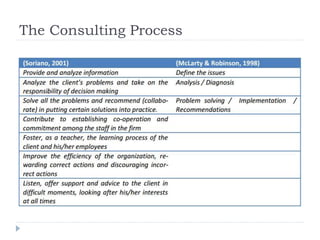
 Consultancy stems from a feeling of anxiety, a need or problem, which the
delivered service needs to address. To solve this problem or fill in the need,
the consultant must take a number of steps.
The Consulting Process
Service Quality
 Service quality determines if a firm gets the opportunity to continue the
relationship and delivering services. Different aspects of service quality are:
 First the quality of the delivered solution itself: does it solve the problem?
 Next, the quality in use: this is more a long-term value. Did the service impact
the client as organization? Is the client more mature, wiser?
 Third, Service quality is determined in the way the service was delivered:
Continuous communication on progress, on considerations, on expected
outcomes, involving the client in the process of finding and solving the solution
Case of McKinsey & Company
McKinsey & Co
 McKinsey & Company was founded in 1926 in Chicago under the name
James O. McKinsey & Company by James McKinsey
 The firm called itself a team of "management engineers" and started out
giving consulting on using accounting principles to make management
decisions
 McKinsey consultants are either industry experts, functional experts, or a
generalist that covers a geographic region.
 The firm has 23 Industry Practices focused on individual industries, 9
Functional Practices that work in areas like finance, marketing or risk, and
5 Capabilities and Solutions areas related to technology consulting
 McKinsey has a de-centralized structure, whereby different offices operate
similarly, but independently.
McKinsey & Co culture
 McKinsey claims its consultants are not motivated by money
 McKinsey does not advertise itself. Members are not supposed to “sell”
their services, a tradition based in the early 1900s
 A 1993 profile story in Fortune Magazine said McKinsey & Company was
“the most well-known, most secretive, most high-priced, most prestigious,
most consistently successful, most envied, most trusted, most disliked
management consulting firm on earth.”
 McKinsey's culture has often been compared to religion, because of the
influence, loyalty and zeal of its members
 Many chief executive officers of large companies have worked at the firm.
There were over 100 McKinsey offices in 60 countries as of September
2013
Consultancy services
 McKinsey provides management consulting services, such as providing advice on
an acquisition, developing a plan to restructure a sales force, creating a new
business strategy or providing advice on downsizing.
 Its consultants design and implement studies to evaluate management decisions
using data and interviews to test hypotheses.
 Conclusions of the study are presented to senior management, typically in a
PowerPoint presentation and a booklet
 McKinsey is considered one of the most prestigious and most expensive
management consulting firms, charged approximately 25% more than competing
firms
 A typical McKinsey engagement can last between two and twelve months and
involves three to six McKinsey consultants. An engagement is usually managed by
a generalist that covers the region the client's headquarters are located in and
specialists that have either an industry or functional expertise. Unlike some
competing consulting firms, McKinsey does not hold a policy against a consultant
working for two competing companies. This has sometimes lead to accusations of
sharing confidential information or re-packaging a competitor's practices as best
practices
THANK YOU

Consultancyservices 141107200647-conversion-gate01

  • 1.
    Consultancy Services Service DeliveryAspect Presentation by Renjin Babu, Roll No. 1001, PGDM, CCSMS
  • 2.
    Types of Consultingfirms  Financial  Information technology  Management  Human Resources  Legal  Hotel and Hospitality industry  Others – Advertising/Marketing/Public relations, Environmental, Energy, Politics and the Public Sector, Real Estate, etc.
  • 3.
    Who is aConsultant? A consultant is "someone who has influence over an individual, group, or organization, but who has no direct authority to implement changes. A consultant is usually an expert or a professional in a specific field and has a wide knowledge of the subject matter. Role of a consultant Internal consultant - someone who operates within an organization but is available to be consulted on areas of specialism by other departments or individuals (acting as clients); External consultant - someone who is employed externally (either by a firm or some other agency) whose expertise is provided on a temporary basis, usually for a fee. As such this type of consultant generally engages with multiple and changing clients. The overall impact of a consultant is that clients have access to deeper levels of expertise than would be feasible for them to retain in-house, and may purchase only as much service from the outside consultant as desired.
  • 4.
    Place of work Thoughmost of the back-office research and analysis occurs at the consultants’ offices, consultants typically work at the site of the client for at least some of the time. The governing factor tends to be the amount of interaction required with other employees of the client.
  • 5.
    Characteristics of consultants Consultants have all the materials, methodology, and tools needed to carry out the activity at their disposal.  They combine human and material resources with the application of a businessman’s way of looking at the client’s problem.  They are flexible in their ability to assimilate changes in the planning of projects.  They have sufficient assets to cover delays in payments which may possibly occur.  They are independent, maintain a high level of confidentiality, and are always at the client’s service.  Furthermore, consultants are of above-average intelligence and are quick to learn, observe, reason, synthesise, and imagine.  They understand other people and work well with them.  They are good at communicating, persuading and motivating.  They can control themselves. They have personal energy and self-initiative, ethics and integrity.  They are mentally and physically fit for the strain they are put under in their daily work”
  • 6.
    The 7Cs ofConsulting: Details Source: “The 7Cs of Consulting”; Mick Cope Client: Understanding the client’s real and perceived view of what is required from the assignment Clarify: Understanding the nature of the problem being addressed and the scope of the change being attempted. Create: Here the consultant needs to develop the plan of action needed. Change: The consultant must attempt to understand the drivers of the change. Confirm: Once the actions taken, the consultant should follow-up and confirm the change has taken place and looks like the success envisaged. Continue: The consultant ensures that the changes made continue. Close: They should ensure that the client is fully aware of the final outcomes, added value, the new learning and what may be required in the future.
  • 7.
  • 8.
    Engineering consultants Provide engineering-relatedservices such as design, supervision, execution, repair, operation, maintenance, technology, creation of drawings and specifications, and make recommendations to public, companies, firms and industries.
  • 9.
    Strategy consultants Working onthe development of and improvements to organisational strategy alongside senior management in many industries.

  • 10.
    Human-resources (HR) consultants Whoprovide expertise around employment practice and people management
  • 11.
    Internet consultants Who arespecialists in business use of the internet and keep themselves up-to-date with new and changed capabilities offered by the web. Ideally internet consultants also have practical experience and expertise in management skills such as strategic planning, change, projects, processes, training, team-working and customer satisfaction.
  • 12.
    Process consultants Who arespecialists in the design or improvement of operational processes and can be specific to the industry or sector.
  • 13.
    Public-relations (PR) consultants Dealingspecifically with public relations matters external to the client organization and often engaged on a semi-permanent basis by larger organizations to provide input and guidance.
  • 14.
    Performance consultants Who focuson the execution of an initiative or overall performance of their client.
  • 15.
    Immigration consultants Who helpsthrough legal procedure of immigration from one country to other country.
  • 16.
    Information Technology (IT)consultants In many disciplines such as computer hardware, software engineering, or networks.
  • 17.
    Marketing Consultants Who aregenerally called upon to advise around areas of product development and related marketing matters.
  • 18.
    Qualifications  There isno single qualification to be a consultant  Internationally the accreditation of Management Consultants is overseen by higher education training and accreditation organizations.  International Council of Management Consulting Institutes (ICMCI): Certified Management Consultant (CMC)  Chartered Institute of Management Consultants (CIMC): Chartered Management Consultant  International Federation of Consulting Engineers (FIDIC) is a Federation whose members are national associations of Consulting Engineers.
  • 19.
    Examples of consultancies McKinsey & Company  Bain & Company  The Boston Consulting Group  Deloitte Consulting LLP  PriceWaterhouseCoopers  KPMG  Accenture  Capgemini  Tata Consultancy Services  Arthur D’ Little
  • 20.
    Significance of consultancyservice A client’s need for external assistance relating to business matters arises in several cases. The experience showed that a client organization frequently resorts to consultancy services when it reaches a critical threshold in its development, which is either generated by a favorable evolution or by an unfavorable evolution of the organization. The continuous sales decrease, the loss of market share, the difficult macroeconomic context, all of these may bring the organization at a critical level that cannot be surpassed without the help of experienced professionals. Similarly, the uncontrolled development of an organization may lead to a dramatic deterioration of financial indicators, sometimes up to reaching the insolvency and this is another case in which the organization calls for external help.
  • 21.
    Criteria for selectionof a business consultancy  Integrity and professional ethics of the consulting company  Professional competence  Problem solving approach  Capacity to deliver on time  Ability to deploy resources  Consultant’s image and reputation
  • 22.
    Service delivery model At the core of the consulting firm are the processes of the Value Creation Process.  Service Delivery is important for three reasons: revenue, recurring business with the customer and knowledge building.  Service Delivery should be managed to be profitable, contribute to knowledge building and should be performed with the highest quality and service quality. There is no uniform consulting process, because consulting is a project- based business, every client and project includes new challenges and unique questions.  The Service Delivery process involves steps to solve the problem and steps to increase acceptation and adoption of the solution.
  • 23.
    Service delivery model Practice Development is about creating awareness for the quality and capabilities of the practice and professionals and needs to be done to generate business.  Existing clients are the easiest to target and should at least get 70% of non- billable hours.  The best way to build a relation with the client is to exceed his expectations. Relationship is about getting a deep understanding of wants and needs of the client.  To improve the relationship active participation of the client is needed in Service Delivery.
  • 24.
    Service delivery model There is no uniform consulting process, because consulting is a project- based business, every client and project includes new challenges and unique questions.  Service Delivery should be monitored for added value to the client, both during and after delivery, as in the way the service is delivered. Under- delegation must be prevented to raise profitability, knowledge building and staff motivation.  Service Delivery can add to staff morale and motivation through challenging, creative and meaningful projects  Consultancy stems from a feeling of anxiety, a need or problem, which the delivered service needs to address. To solve this problem or fill in the need, the consultant must take a number of steps.
  • 25.
  • 26.
    Service Quality  Servicequality determines if a firm gets the opportunity to continue the relationship and delivering services. Different aspects of service quality are:  First the quality of the delivered solution itself: does it solve the problem?  Next, the quality in use: this is more a long-term value. Did the service impact the client as organization? Is the client more mature, wiser?  Third, Service quality is determined in the way the service was delivered: Continuous communication on progress, on considerations, on expected outcomes, involving the client in the process of finding and solving the solution
  • 27.
  • 28.
    McKinsey & Co McKinsey & Company was founded in 1926 in Chicago under the name James O. McKinsey & Company by James McKinsey  The firm called itself a team of "management engineers" and started out giving consulting on using accounting principles to make management decisions  McKinsey consultants are either industry experts, functional experts, or a generalist that covers a geographic region.  The firm has 23 Industry Practices focused on individual industries, 9 Functional Practices that work in areas like finance, marketing or risk, and 5 Capabilities and Solutions areas related to technology consulting  McKinsey has a de-centralized structure, whereby different offices operate similarly, but independently.
  • 29.
    McKinsey & Coculture  McKinsey claims its consultants are not motivated by money  McKinsey does not advertise itself. Members are not supposed to “sell” their services, a tradition based in the early 1900s  A 1993 profile story in Fortune Magazine said McKinsey & Company was “the most well-known, most secretive, most high-priced, most prestigious, most consistently successful, most envied, most trusted, most disliked management consulting firm on earth.”  McKinsey's culture has often been compared to religion, because of the influence, loyalty and zeal of its members  Many chief executive officers of large companies have worked at the firm. There were over 100 McKinsey offices in 60 countries as of September 2013
  • 30.
    Consultancy services  McKinseyprovides management consulting services, such as providing advice on an acquisition, developing a plan to restructure a sales force, creating a new business strategy or providing advice on downsizing.  Its consultants design and implement studies to evaluate management decisions using data and interviews to test hypotheses.  Conclusions of the study are presented to senior management, typically in a PowerPoint presentation and a booklet  McKinsey is considered one of the most prestigious and most expensive management consulting firms, charged approximately 25% more than competing firms  A typical McKinsey engagement can last between two and twelve months and involves three to six McKinsey consultants. An engagement is usually managed by a generalist that covers the region the client's headquarters are located in and specialists that have either an industry or functional expertise. Unlike some competing consulting firms, McKinsey does not hold a policy against a consultant working for two competing companies. This has sometimes lead to accusations of sharing confidential information or re-packaging a competitor's practices as best practices
  • 31.