The Evolution of Business
Consulting
Contributed by Troy Gautier on August 11, 2015 in Management & Leadership , Strategy, Marketing, & Sales
Professional services firms are undergoing a
profound transformation. The markets are
changing and the old ways of doing business
are becoming obsolete. Customers paying for
professional services are becoming more
sophisticated and more discerning. Why are we still doing business as usual when the world
around us is in such extreme flux?
The professional services industry is attractive because it requires high skill and little capital
to grow firms for lawyers, accountants and consultants. Consultants today in North America
and Europe are delivering services in a more independent manner, and buyers are more
adept at navigating the complex integrities of client-supplier relationships.
The old pyramid model of Partner – Principal – Managing Consultant – Senior – Junior is
crumbling at its base. The need to have a large contingent of junior consultants (analysts) on
staff, and the economic model (blended rate with lots of cheap labor at the base) is being
replaced with new more flexible hybrid models, leveraging higher skills and higher rates,
with shorter projects.
If we look at management consulting as a profession, we observe a huge increase in the
market supply of consultants as the “Baby Boomers” (born between 1946-64) flood the
marketplace as independents, and in small boutique firms, creating new demand for their
services and expertise.
Management consulting is now a mature industry in the developed economies. Arthur D.
Lille founded his partnership in 1886 specialized in technical research. Frederick W. Taylor
created his consulting practice in 1893. His business card read “Consulting Engineer –
Systematizing Shop Management and Manufacturing Costs a Specialty.” Many other well-
known brands, named after their founders, followed in the early 20 th century and been very
successful businesses for several generations.
As the Industrial Revolution changed the nature of production and distribution of goods
and services, demand for advice on finance, strategy and operational organization grew
steadily. In the first half of the 20 th century, firms like McKinsey, Boston Consulting Group,
AT Kearney, and Booz Allen Hamilton grew in influence. Harvard Business School (Monitor
Group) and other fine academic institutions provided world class research into
organizational design and industry best practices.
The Big Eight (then Six, then Five, now Four – Deloitte, KPMG, PWC and Ernst & Young)
offered management consulting advice in addition to their traditional auditing and
accounting services. The global Anglo-American professional services firms remain the
benchmark standard in the industry but sometimes can be considered as brand-selling, with
less of a clear differentiation.
So, how has the landscape changed and what are the issues facing management consulting
firms going forward?
The edges around the old distinctions between consulting, staffing and outsourcing are
fading. The mix of management and IT consulting has brought together strategy, people,
process, and technology. The distinction between doing a project and providing resources to
do a project is not always evident in buying patterns.
How to adapt and what does this mean for business consulting firms over the next twenty
years? What is the added value of their services and how do they grow?
A famous quote from Darwin comes to mind: “It is not the strongest of the species that
survives, nor the most intelligent that survives. It is the one that is most adaptable to
change.”
One of the major evolutionary trends is the progressive development of new collaborative
frameworks, allowing a mix of large and small organizations to come together across
specializations to create value for their clients.
These partnering models have become ubiquitous. Some of them are long-standing one-to-
one alliances, for example between technology vendors and business consultants. And some
of them are new structures of multi-party collaboration to gain global coverage and
capabilities in research, sales and delivery of products and services.
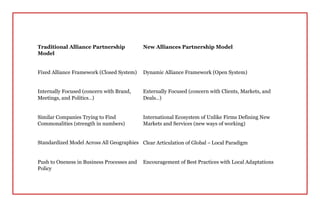
Ecosystem development is the latest evolution in modeling alliance management:
Traditional Alliance Partnership
Model
New Alliances Partnership Model
Fixed Alliance Framework (Closed System) Dynamic Alliance Framework (Open System)
Internally Focused (concern with Brand,
Meetings, and Politics…)
Externally Focused (concern with Clients, Markets, and
Deals…)
Similar Companies Trying to Find
Commonalities (strength in numbers)
International Ecosystem of Unlike Firms Defining New
Markets and Services (new ways of working)
Standardized Model Across All Geographies Clear Articulation of Global – Local Paradigm
Push to Oneness in Business Processes and
Policy
Encouragement of Best Practices with Local Adaptations
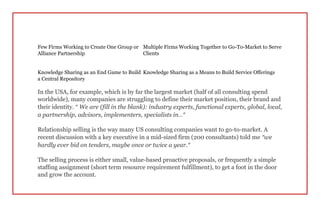
Few Firms Working to Create One Group or
Alliance Partnership
Multiple Firms Working Together to Go-To-Market to Serve
Clients
Knowledge Sharing as an End Game to Build
a Central Repository
Knowledge Sharing as a Means to Build Service Offerings
In the USA, for example, which is by far the largest market (half of all consulting spend
worldwide), many companies are struggling to define their market position, their brand and
their identity. “ We are (fill in the blank): industry experts, functional experts, global, local,
a partnership, advisors, implementers, specialists in…”
Relationship selling is the way many US consulting companies want to go-to-market. A
recent discussion with a key executive in a mid-sized firm (200 consultants) told me “we
hardly ever bid on tenders, maybe once or twice a year.”
The selling process is either small, value-based proactive proposals, or frequently a simple
staffing assignment (short term resource requirement fulfillment), to get a foot in the door
and grow the account.
The buying process is a client with an immediate need, an ability to engage funds for a small
project (under the procurement radar) and confidence that the consultant has the skills and
the firm has the credentials to deliver.
It all comes down to time, skills, money, urgency of need and of course timing.
Consultants are typically hired to do a job because the buyer lacks the time or skills to do it
in-house. In-house hiring is often more difficult and time-consuming than hiring of contract
labor. Variable rather than fixed costs are sometimes easier to budget.
So, does the value reside in the firm (internal knowledge and best practices) or the
consultant (experience and expertise) or the process (timing and availability)?
What surprises one most when we compare US vs European based business consulting
models is the hybrid staffing/consulting models which have over-taken the North American
market.
Here are some data points to do a quick self-assessment of the hybrid model:
Time and materials vs project based fees
Hourly rates vs daily, weekly or monthly rates vs fixed price bids
Use of blended teams (FTEs are a mix of permanent staff and contract labor) vs permanent
employees (staff the bench, first)
Do anything generalist vs highly specialized team of experts
Weak alumni club vs strong alumni club
Hire to project vs hire to grow capabilities
Resume-based selling vs project deliverable model
In the emerging markets (Latin America, Middle East, Africa and Asia Pacific), the story is
very different. The management consulting maturity level is less than one generation old.
Highly educated and quality labor has been used massively for the information technology
and now business process outsourcing markets.
On-shore/off-shore models involving in-sourcing/out-sourcing resources are now filtering
down from the multinational companies who have been leveraging the opportunity for years
to lower costs, to the mid-tier markets.
The so-called “SWITCH companies” of the last generation (Satyam, Wipro, Infosys, TCS,
Cognizant and HCL) all have significant traction in worldwide IT markets (Engineering,
R&D, Custom IT, ERP / CRM), and are moving into Business Process Outsourcing.
Digital Transformation is a game-changer. Consulting companies doing Change
Management outside of technology are experiencing rough sledding, and the terrain is
getting rougher by the day. Strategy consulting firms are finding it more difficult to provide
value in pure studies, and are now in the strategy execution business.
The most exciting and potentially high reward model is ecosystem development whereby the
individual company has a mix of in-house core staff, with contractor expertise and outside
partners who provide capabilities across four dimensions:
Geographies – regional delivery teams
Accounts – knowledge of and relationships within target clients
Industry Expertise – deep understanding of sector issues
Product/Service Offerings – bundled solutions creating stronger value
The evolution of the consulting industry, largely speaking has evolved over the past 60 years
from studies to implementation to managed services:
Research – academic studies of management as a discipline
Strategy – assistance to position product/service to markets
Advisory – organizational design & optimization
Process Re-Engineering – large-scale cost reduction
IT Design, Delivery & Support – outsourcing, SaaS
Ecosystems – bundled product and service offerings
The professional services sector is still largely lagging behind many of the other industries in
working their alliance relationships. But some of the more evolved management teams are
now embracing partnership models, to the benefit of their clients, their teams and their
organizations.
About Troy Gautier
As a founder and managing director of Alliances Progress and former partner with Big Four consulting
firms, Troy Gautier is an expert in designing and implementing strategic alliances, commercial
partnerships, and business networks. With experiences on P&L responsibilities, start-up launch, and
operational due diligence, board and executive leadership across multiple industries and functions, he is
currently president of Southeast Chapter of the Association of Strategic Alliance Professionals. You can
connect with him on LinkedIn here or troygautier@alliancesprogress.com.
Flevy (www.flevy.com) is the
marketplace for premium documents.
These documents can range from
Business Frameworks to Financial
Models to PowerPoint Templates.
Flevy was founded under the principle
that companies waste a lot of time and
money recreating the same foundational
businessdocuments. Our vision is for
Flevy to become a comprehensive
knowledge base of business
documents. All rganizations, from
startups to large enterprises, can use
Flevy— whether it's to jumpstart
projects, to find reference or comparison
materials, or just to learn.
Contact Us
Please contact us with any questions you
may haveabout our company.
• General Inquiries
support@flevy.com
• Media/PR
press@flevy.com
• Billing
billing@flevy.com

The Evolution of Business Consulting

  • 1.
    The Evolution ofBusiness Consulting Contributed by Troy Gautier on August 11, 2015 in Management & Leadership , Strategy, Marketing, & Sales Professional services firms are undergoing a profound transformation. The markets are changing and the old ways of doing business are becoming obsolete. Customers paying for professional services are becoming more sophisticated and more discerning. Why are we still doing business as usual when the world around us is in such extreme flux? The professional services industry is attractive because it requires high skill and little capital to grow firms for lawyers, accountants and consultants. Consultants today in North America and Europe are delivering services in a more independent manner, and buyers are more adept at navigating the complex integrities of client-supplier relationships.
  • 2.
    The old pyramidmodel of Partner – Principal – Managing Consultant – Senior – Junior is crumbling at its base. The need to have a large contingent of junior consultants (analysts) on staff, and the economic model (blended rate with lots of cheap labor at the base) is being replaced with new more flexible hybrid models, leveraging higher skills and higher rates, with shorter projects. If we look at management consulting as a profession, we observe a huge increase in the market supply of consultants as the “Baby Boomers” (born between 1946-64) flood the marketplace as independents, and in small boutique firms, creating new demand for their services and expertise. Management consulting is now a mature industry in the developed economies. Arthur D. Lille founded his partnership in 1886 specialized in technical research. Frederick W. Taylor created his consulting practice in 1893. His business card read “Consulting Engineer – Systematizing Shop Management and Manufacturing Costs a Specialty.” Many other well- known brands, named after their founders, followed in the early 20 th century and been very successful businesses for several generations. As the Industrial Revolution changed the nature of production and distribution of goods and services, demand for advice on finance, strategy and operational organization grew
  • 3.
    steadily. In thefirst half of the 20 th century, firms like McKinsey, Boston Consulting Group, AT Kearney, and Booz Allen Hamilton grew in influence. Harvard Business School (Monitor Group) and other fine academic institutions provided world class research into organizational design and industry best practices. The Big Eight (then Six, then Five, now Four – Deloitte, KPMG, PWC and Ernst & Young) offered management consulting advice in addition to their traditional auditing and accounting services. The global Anglo-American professional services firms remain the benchmark standard in the industry but sometimes can be considered as brand-selling, with less of a clear differentiation. So, how has the landscape changed and what are the issues facing management consulting firms going forward? The edges around the old distinctions between consulting, staffing and outsourcing are fading. The mix of management and IT consulting has brought together strategy, people, process, and technology. The distinction between doing a project and providing resources to do a project is not always evident in buying patterns.
  • 4.
    How to adaptand what does this mean for business consulting firms over the next twenty years? What is the added value of their services and how do they grow? A famous quote from Darwin comes to mind: “It is not the strongest of the species that survives, nor the most intelligent that survives. It is the one that is most adaptable to change.” One of the major evolutionary trends is the progressive development of new collaborative frameworks, allowing a mix of large and small organizations to come together across specializations to create value for their clients. These partnering models have become ubiquitous. Some of them are long-standing one-to- one alliances, for example between technology vendors and business consultants. And some of them are new structures of multi-party collaboration to gain global coverage and capabilities in research, sales and delivery of products and services. Ecosystem development is the latest evolution in modeling alliance management:
  • 5.
    Traditional Alliance Partnership Model NewAlliances Partnership Model Fixed Alliance Framework (Closed System) Dynamic Alliance Framework (Open System) Internally Focused (concern with Brand, Meetings, and Politics…) Externally Focused (concern with Clients, Markets, and Deals…) Similar Companies Trying to Find Commonalities (strength in numbers) International Ecosystem of Unlike Firms Defining New Markets and Services (new ways of working) Standardized Model Across All Geographies Clear Articulation of Global – Local Paradigm Push to Oneness in Business Processes and Policy Encouragement of Best Practices with Local Adaptations
  • 6.
    Few Firms Workingto Create One Group or Alliance Partnership Multiple Firms Working Together to Go-To-Market to Serve Clients Knowledge Sharing as an End Game to Build a Central Repository Knowledge Sharing as a Means to Build Service Offerings In the USA, for example, which is by far the largest market (half of all consulting spend worldwide), many companies are struggling to define their market position, their brand and their identity. “ We are (fill in the blank): industry experts, functional experts, global, local, a partnership, advisors, implementers, specialists in…” Relationship selling is the way many US consulting companies want to go-to-market. A recent discussion with a key executive in a mid-sized firm (200 consultants) told me “we hardly ever bid on tenders, maybe once or twice a year.” The selling process is either small, value-based proactive proposals, or frequently a simple staffing assignment (short term resource requirement fulfillment), to get a foot in the door and grow the account.
  • 7.
    The buying processis a client with an immediate need, an ability to engage funds for a small project (under the procurement radar) and confidence that the consultant has the skills and the firm has the credentials to deliver. It all comes down to time, skills, money, urgency of need and of course timing. Consultants are typically hired to do a job because the buyer lacks the time or skills to do it in-house. In-house hiring is often more difficult and time-consuming than hiring of contract labor. Variable rather than fixed costs are sometimes easier to budget. So, does the value reside in the firm (internal knowledge and best practices) or the consultant (experience and expertise) or the process (timing and availability)? What surprises one most when we compare US vs European based business consulting models is the hybrid staffing/consulting models which have over-taken the North American market. Here are some data points to do a quick self-assessment of the hybrid model: Time and materials vs project based fees
  • 8.
    Hourly rates vsdaily, weekly or monthly rates vs fixed price bids Use of blended teams (FTEs are a mix of permanent staff and contract labor) vs permanent employees (staff the bench, first) Do anything generalist vs highly specialized team of experts Weak alumni club vs strong alumni club Hire to project vs hire to grow capabilities Resume-based selling vs project deliverable model In the emerging markets (Latin America, Middle East, Africa and Asia Pacific), the story is very different. The management consulting maturity level is less than one generation old. Highly educated and quality labor has been used massively for the information technology and now business process outsourcing markets. On-shore/off-shore models involving in-sourcing/out-sourcing resources are now filtering down from the multinational companies who have been leveraging the opportunity for years to lower costs, to the mid-tier markets. The so-called “SWITCH companies” of the last generation (Satyam, Wipro, Infosys, TCS, Cognizant and HCL) all have significant traction in worldwide IT markets (Engineering, R&D, Custom IT, ERP / CRM), and are moving into Business Process Outsourcing.
  • 9.
    Digital Transformation isa game-changer. Consulting companies doing Change Management outside of technology are experiencing rough sledding, and the terrain is getting rougher by the day. Strategy consulting firms are finding it more difficult to provide value in pure studies, and are now in the strategy execution business. The most exciting and potentially high reward model is ecosystem development whereby the individual company has a mix of in-house core staff, with contractor expertise and outside partners who provide capabilities across four dimensions: Geographies – regional delivery teams Accounts – knowledge of and relationships within target clients Industry Expertise – deep understanding of sector issues Product/Service Offerings – bundled solutions creating stronger value The evolution of the consulting industry, largely speaking has evolved over the past 60 years from studies to implementation to managed services: Research – academic studies of management as a discipline Strategy – assistance to position product/service to markets Advisory – organizational design & optimization Process Re-Engineering – large-scale cost reduction
  • 10.
    IT Design, Delivery& Support – outsourcing, SaaS Ecosystems – bundled product and service offerings The professional services sector is still largely lagging behind many of the other industries in working their alliance relationships. But some of the more evolved management teams are now embracing partnership models, to the benefit of their clients, their teams and their organizations. About Troy Gautier As a founder and managing director of Alliances Progress and former partner with Big Four consulting firms, Troy Gautier is an expert in designing and implementing strategic alliances, commercial partnerships, and business networks. With experiences on P&L responsibilities, start-up launch, and operational due diligence, board and executive leadership across multiple industries and functions, he is currently president of Southeast Chapter of the Association of Strategic Alliance Professionals. You can connect with him on LinkedIn here or troygautier@alliancesprogress.com.
  • 11.
    Flevy (www.flevy.com) isthe marketplace for premium documents. These documents can range from Business Frameworks to Financial Models to PowerPoint Templates. Flevy was founded under the principle that companies waste a lot of time and money recreating the same foundational businessdocuments. Our vision is for Flevy to become a comprehensive knowledge base of business documents. All rganizations, from startups to large enterprises, can use Flevy— whether it's to jumpstart projects, to find reference or comparison materials, or just to learn. Contact Us Please contact us with any questions you may haveabout our company. • General Inquiries support@flevy.com • Media/PR press@flevy.com • Billing billing@flevy.com