INTRODUCTION TO MBTI & SII
SYM 120 001, 9/15/2016
Personality vs. Interests
Personality:
How do I do what I do?
How do others experience me?
Who will I get along with?
Interests:
What will I do?
What do I enjoy?
Where might I fit in?
The MBTI & SII do not measure skill, aptitude or intelligence and are NOT used
to tell you what you should be, but to be used as a spring board for ideas
Myer’s Briggs Type Indicator (MBTI)
Questionnaire designed to measure psychological
preferences in:
Where we focus your attention and energy
How we acquire or gather information
How we make decisions or judgments
How we relate to the outer world
…….based on personality.
These preferences are represented in 2
dichotomies and designated on 4 continuums.
Application to Career
 Knowledge of personality preferences helps to identify
jobs where people will feel most comfortable and effective,
have a natural inclination towards and find motivation in
work.
 MBTI results…
 Summary designed to help you explore career options
 Focus on the exploration process instead of the selection process
 Consider the strengths and challenges associated with
each type
 Consider the relationship between your personality
preferences and possible careers
What is the MBTI based on?
Jung's typological model of
personality development
Individuals are born with innate
(genetic) preferred ways of thinking
and acting.
Although behavior is influenced by
our environment and situational, we
have an initial preference on how to
approach the world.
Who Created the Instrument?
Isabel Briggs Myers (daughter)
& Katharine Briggs (mother)
 First published in 1943 and revised several
times since (Form M in 1998, Form Q in 2001)
 Made the insights of Jung’s personality type theory accessible to
individuals and groups
 Identify basic preferences of each of the four dichotomies
 E/I (Where we focus your attention and energy)
 N/S (How we acquire or gather information)
 T/F (How we make decisions or judgments)
 J/P (How we relate to the outer world)
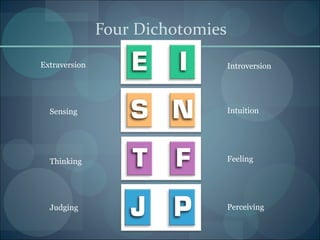
Four Dichotomies
Extraversion Introversion
Sensing Intuition
Thinking Feeling
Judging Perceiving
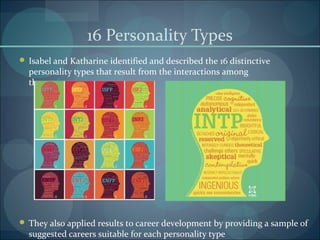
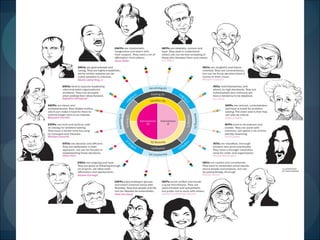
16 Personality Types
 Isabel and Katharine identified and described the 16 distinctive
personality types that result from the interactions among
the preferences
 They also applied results to career development by providing a sample of
suggested careers suitable for each personality type
What are Preferences?
Everyone has a natural preference for one of the
two dichotomies on each of the four MBTI
continuums.
When we use our preferred methods we are at our
best and feel most competent.
We all use both dichotomies, just not with equal
comfort.
We prefer to start with one
It might be difficult but not impossible
“HANDEDNESS” ACTIVITY
To better illustrate what Jung meant by
having an initial preference in how we
approach and relate to the world.
• We use both dichotomies, just not with equal comfort.
For example, you might have a preference for P, but if you had to,
you could use J. It would just be less “comfortable” at first but would
get easier and you would improve overtime.
Important Distinctions
No type is better than another; just different.
 Each dichotomy is an accepted and sound way of operating.
Scores indicate clarity of choice, not strength/skill level.
 Slight -> Moderate -> Clear -> Very Clear
Psychological type can explain some human behavior, not all.
 Type should never be used as an excuse for behavior
Only you can self-validate your type, nobody else can validate
your type, even the MBTI.
Developing non-preferred characteristics may be a valuable
lifetime goal and is also encouraged by Jung.
 You have the ability and opportunity to change.
 What might be the benefits of this?
Questions?
Strong Interest Inventory (SII)
 First developed by E.K. Strong in 1920s (last update was in
2012)
 Decided/concluded that similar interests bring people
together in work settings
Adapted to John Holland’s theory in 1970s
 People tend to surround themselves with others
who share their interests, competencies, and outlook
on world. Thus, where people congregate reflects the
type they are.
 Holland’s career theory is used worldwide to
describe people and categorize work environments.
 If you have a career that interests you (that you love)
overall you will have greater life satisfaction.
Where SII Results Come From
Compared against 67,000 people who took the assessment.
All people are at least 21 years old, been in occupation for 3
years, do typical/expected work tasks and are satisfied with
their work
Measures similarities to others and how well you would fit
into different work environments
Compares your interests to the interests of others and
categorizes that into different General Occupational
Themes
 i.e. banana example
Random sample with race and ethnicity
Profile is gender specific
General Occupational Themes (GOTs)
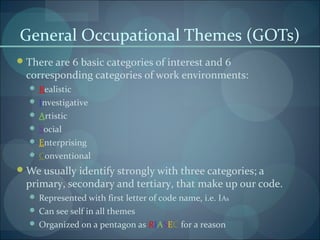
There are 6 basic categories of interest and 6
corresponding categories of work environments:
 Realistic
 Investigative
 Artistic
 Social
 Enterprising
 Conventional
We usually identify strongly with three categories; a
primary, secondary and tertiary, that make up our code.
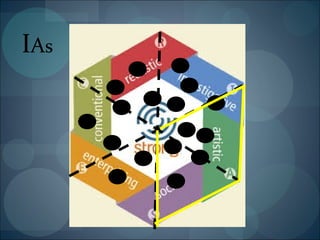
 Represented with first letter of code name, i.e. IAs
 Can see self in all themes
 Organized on a pentagon as RIASEC for a reason
IAs
Realistic: The Doers, Fun
Facts
What kind of car do they drive?
Trucks, SUV, Jeep
What would be their ideal vacation?
Camping, attending sports event, fishing, golfing,
outward bound, hiking, adventure trip
What motivates them?
Hands-on, tangible results
What would they buy?
Boats, campers, sports equipment, power tools, ESPN
magazine, adventure books
Investigative: The Thinkers, Fun
Facts
What would they drive?
Bicycle, Volvo, “hybrid,” Honda
What would be their ideal vacation?
Space camp, fossil dig, science museum, African
safari, visit ruins, historical places (Europe)
What motivates them?
Curiosity, learning, knowledge
What would they buy?
Telescopes, computers, books, puzzles, electronic
equipment, science fiction or mystery novels
Artistic: The Creators, Fun
Facts
What kind of car do they drive?
Bug, PT Cruiser, Mini Copper, Convertible
What would be their ideal vacation?
NYC to see shows, Venice to see art, dance/acting
workshop
What motivates them?
Self-expression
What would they buy?
Art objects, music CDs, colorful things, decorations,
theater tickets
Social: The Helpers, Fun Facts
What car would they drive?
Mini-van, SUV, Suburban
Where would be their ideal vacation?
Cruise with friends/family, beach house vacation,
Disney World, family reunion
What motivates them?
Helping others
What would they buy?
Charity event tickets, food to entertain others, People
magazine, self-help books
Enterprising: The Leaders, Fun Facts
What kind of car do they drive?
Lexus, BMW, Cadillac, Lincoln, high-end SUV
What is their ideal vacation?
Luxury cruise, spa retreat, week of golf, Hamptons or Cape
Cod, skiing
What motivates them?
Persuading others
What do they buy?
Nice cars, good clothes, country club memberships, the latest
equipment, bestsellers, Wall Street Journal
Conventional: The Organizers, Fun
Facts
What kind of car do they drive?
Buick, Honda, Saturn, fuel efficient cars
What is their ideal vacation?
Historical cities, knitting workshop, pre-programmed
tour, same cabin each year
What motivates them?
Organizing and bring things together
What do they buy?
Hobby collections, how-to books, file cabinets and
shelves
Questions?
“How/When” to take the MBTI & SII
Any computer with internet
Choose a comfortable/favorite spot
On a day you feel happy and good about yourself
Take off all your different “hats”
Consider each item not so deeply
Complete MBTI by midnight 9/21
Complete SII by midnight 9/28
Depending on how fast you read, give yourself an
hour to complete each assessment

MBTI & SII Intro

  • 1.
    INTRODUCTION TO MBTI& SII SYM 120 001, 9/15/2016
  • 2.
    Personality vs. Interests Personality: Howdo I do what I do? How do others experience me? Who will I get along with? Interests: What will I do? What do I enjoy? Where might I fit in? The MBTI & SII do not measure skill, aptitude or intelligence and are NOT used to tell you what you should be, but to be used as a spring board for ideas
  • 4.
    Myer’s Briggs TypeIndicator (MBTI) Questionnaire designed to measure psychological preferences in: Where we focus your attention and energy How we acquire or gather information How we make decisions or judgments How we relate to the outer world …….based on personality. These preferences are represented in 2 dichotomies and designated on 4 continuums.
  • 5.
    Application to Career Knowledge of personality preferences helps to identify jobs where people will feel most comfortable and effective, have a natural inclination towards and find motivation in work.  MBTI results…  Summary designed to help you explore career options  Focus on the exploration process instead of the selection process  Consider the strengths and challenges associated with each type  Consider the relationship between your personality preferences and possible careers
  • 6.
    What is theMBTI based on? Jung's typological model of personality development Individuals are born with innate (genetic) preferred ways of thinking and acting. Although behavior is influenced by our environment and situational, we have an initial preference on how to approach the world.
  • 7.
    Who Created theInstrument? Isabel Briggs Myers (daughter) & Katharine Briggs (mother)  First published in 1943 and revised several times since (Form M in 1998, Form Q in 2001)  Made the insights of Jung’s personality type theory accessible to individuals and groups  Identify basic preferences of each of the four dichotomies  E/I (Where we focus your attention and energy)  N/S (How we acquire or gather information)  T/F (How we make decisions or judgments)  J/P (How we relate to the outer world)
  • 8.
    Four Dichotomies Extraversion Introversion SensingIntuition Thinking Feeling Judging Perceiving
  • 9.
    16 Personality Types Isabel and Katharine identified and described the 16 distinctive personality types that result from the interactions among the preferences  They also applied results to career development by providing a sample of suggested careers suitable for each personality type
  • 11.
    What are Preferences? Everyonehas a natural preference for one of the two dichotomies on each of the four MBTI continuums. When we use our preferred methods we are at our best and feel most competent. We all use both dichotomies, just not with equal comfort. We prefer to start with one It might be difficult but not impossible
  • 12.
    “HANDEDNESS” ACTIVITY To betterillustrate what Jung meant by having an initial preference in how we approach and relate to the world. • We use both dichotomies, just not with equal comfort. For example, you might have a preference for P, but if you had to, you could use J. It would just be less “comfortable” at first but would get easier and you would improve overtime.
  • 13.
    Important Distinctions No typeis better than another; just different.  Each dichotomy is an accepted and sound way of operating. Scores indicate clarity of choice, not strength/skill level.  Slight -> Moderate -> Clear -> Very Clear Psychological type can explain some human behavior, not all.  Type should never be used as an excuse for behavior Only you can self-validate your type, nobody else can validate your type, even the MBTI. Developing non-preferred characteristics may be a valuable lifetime goal and is also encouraged by Jung.  You have the ability and opportunity to change.  What might be the benefits of this?
  • 14.
  • 16.
    Strong Interest Inventory(SII)  First developed by E.K. Strong in 1920s (last update was in 2012)  Decided/concluded that similar interests bring people together in work settings Adapted to John Holland’s theory in 1970s  People tend to surround themselves with others who share their interests, competencies, and outlook on world. Thus, where people congregate reflects the type they are.  Holland’s career theory is used worldwide to describe people and categorize work environments.  If you have a career that interests you (that you love) overall you will have greater life satisfaction.
  • 17.
    Where SII ResultsCome From Compared against 67,000 people who took the assessment. All people are at least 21 years old, been in occupation for 3 years, do typical/expected work tasks and are satisfied with their work Measures similarities to others and how well you would fit into different work environments Compares your interests to the interests of others and categorizes that into different General Occupational Themes  i.e. banana example Random sample with race and ethnicity Profile is gender specific
  • 18.
    General Occupational Themes(GOTs) There are 6 basic categories of interest and 6 corresponding categories of work environments:  Realistic  Investigative  Artistic  Social  Enterprising  Conventional We usually identify strongly with three categories; a primary, secondary and tertiary, that make up our code.  Represented with first letter of code name, i.e. IAs  Can see self in all themes  Organized on a pentagon as RIASEC for a reason
  • 19.
  • 20.
    Realistic: The Doers,Fun Facts What kind of car do they drive? Trucks, SUV, Jeep What would be their ideal vacation? Camping, attending sports event, fishing, golfing, outward bound, hiking, adventure trip What motivates them? Hands-on, tangible results What would they buy? Boats, campers, sports equipment, power tools, ESPN magazine, adventure books
  • 21.
    Investigative: The Thinkers,Fun Facts What would they drive? Bicycle, Volvo, “hybrid,” Honda What would be their ideal vacation? Space camp, fossil dig, science museum, African safari, visit ruins, historical places (Europe) What motivates them? Curiosity, learning, knowledge What would they buy? Telescopes, computers, books, puzzles, electronic equipment, science fiction or mystery novels
  • 22.
    Artistic: The Creators,Fun Facts What kind of car do they drive? Bug, PT Cruiser, Mini Copper, Convertible What would be their ideal vacation? NYC to see shows, Venice to see art, dance/acting workshop What motivates them? Self-expression What would they buy? Art objects, music CDs, colorful things, decorations, theater tickets
  • 23.
    Social: The Helpers,Fun Facts What car would they drive? Mini-van, SUV, Suburban Where would be their ideal vacation? Cruise with friends/family, beach house vacation, Disney World, family reunion What motivates them? Helping others What would they buy? Charity event tickets, food to entertain others, People magazine, self-help books
  • 24.
    Enterprising: The Leaders,Fun Facts What kind of car do they drive? Lexus, BMW, Cadillac, Lincoln, high-end SUV What is their ideal vacation? Luxury cruise, spa retreat, week of golf, Hamptons or Cape Cod, skiing What motivates them? Persuading others What do they buy? Nice cars, good clothes, country club memberships, the latest equipment, bestsellers, Wall Street Journal
  • 25.
    Conventional: The Organizers,Fun Facts What kind of car do they drive? Buick, Honda, Saturn, fuel efficient cars What is their ideal vacation? Historical cities, knitting workshop, pre-programmed tour, same cabin each year What motivates them? Organizing and bring things together What do they buy? Hobby collections, how-to books, file cabinets and shelves
  • 26.
  • 27.
    “How/When” to takethe MBTI & SII Any computer with internet Choose a comfortable/favorite spot On a day you feel happy and good about yourself Take off all your different “hats” Consider each item not so deeply Complete MBTI by midnight 9/21 Complete SII by midnight 9/28 Depending on how fast you read, give yourself an hour to complete each assessment

Editor's Notes

  • #14 No one type is better than another, just different Everyone uses all type preferences at times One preference is favored on each scale Scores indicate clarity/consistency of choice, not strength or skill in using the preference Psychological type can explain some human behavior—not all Type should never be used as an excuse for behavior