
June 2015
The Myers-Briggs Type Indicator ®
(MBTI®
)
A tool for self-reflection
by Mark Laothavornwong
Potentia Thailand and Vietnam
14th Floor One Pacific Place Unit 1401
140 Sukhumvit Road, Klongtoey
Bangkok 10110
+66 (0) 2 653-5055
www.potentia.co.th
Introducing Potentia
• Official partner for CPP USA, who is the expert of development
assessment instruments especially MBTI®
• Official Distributor of the Myers-Briggs Type Indicator (MBTI®) in
Thailand and Vietnam
• Focus on assessing and developing talent and potential using a first
class range of instruments, training, and individual coaching.
Focused attention on all
three ensures potential
transforms to results.
capability. energy. mindset.
What We Do
Potentia is located in Singapore, Thailand, and Vietnam and assesses and
develops talent and potential using a first class range of instruments, training,
and individual coaching.
•Our solutions are tailored to various business issues and cover:
• Talent Effectiveness
• Team Effectiveness
• Virtual Teams
• Leadership Effectiveness
• Work Effectiveness
• Emotional Intelligence
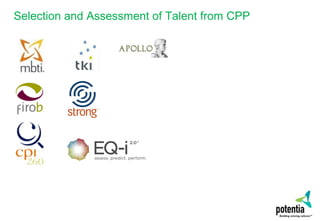
Selection and Assessment of Talent from CPP
Some of Our Partners
© 2010, CPP, Inc. All rights reserved
What is The Myers-Briggs Type Indicator®
(MBTI®
) ?
• Tool developed from Carl Jung’s Personality Type Theory;
• Some behaviors are not random, they are innate or inborn
• Our type preferences come naturally
• Preferences make us feel energetic/competent
• Tool for self-reflection or to know/ discover you at your best
• Tool for self-understanding and how to interact with others through
personality differences
• Tool to explore one’s own strengths and weaknesses
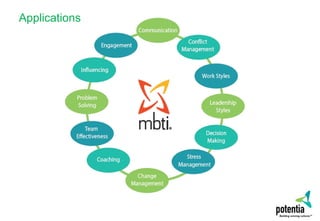
Applications
Benefits
• Identifies individual preference
• Engages participants in the use of type concepts
• Summarizes underlying type patterns common to most people
• Leverages learning methods
• Offers supporting materials
• Available as an online assessment, interactive feedback session, and
interpretive report
• Enhances emotional intelligence
The MBTI®
instrument indicates preferences on four pairs of opposites, called
dichotomies:
The MBTI® Dichotomies
Extraversion E or I Introversion
Sensing S or N Intuition
Thinking T or F Feeling
Judging J or P Perceiving
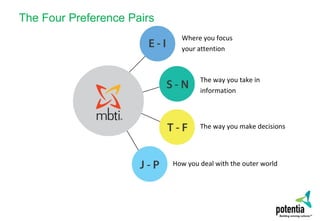
The Four Preference Pairs
Where you focus
your attention
The way you take in
information
The way you make decisions
How you deal with the outer world
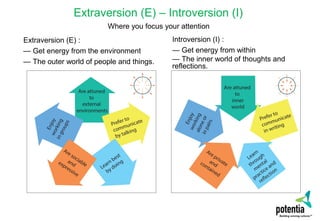
Extraversion (E) – Introversion (I)
Extraversion (E) :
— Get energy from the environment
— The outer world of people and things.
Introversion (I) :
— Get energy from within
— The inner world of thoughts and
reflections.
Where you focus your attention
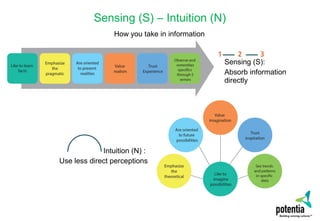
Sensing (S) – Intuition (N)
How you take in information
Sensing (S):
Absorb information
directly
Intuition (N) :
Use less direct perceptions
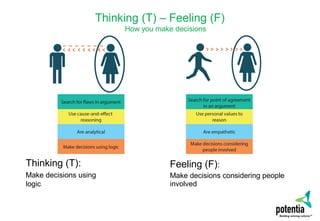
Thinking (T) – Feeling (F)
How you make decisions
Thinking (T):
Make decisions using
logic
Feeling (F):
Make decisions considering people
involved
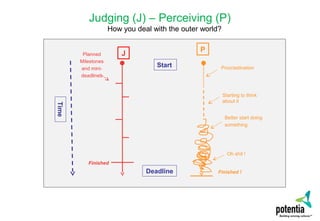
P
Starting to think
about it
JTime
Deadline
Start
Finished
Planned
Milestones
and mini-
deadlines
Finished !
Procrastination
Better start doing
something
Oh shit !
Judging (J) – Perceiving (P)
How you deal with the outer world?
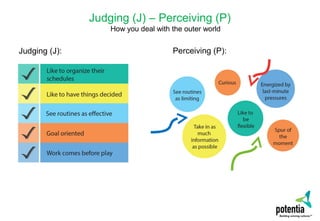
Judging (J) – Perceiving (P)
How you deal with the outer world
Judging (J): Perceiving (P):
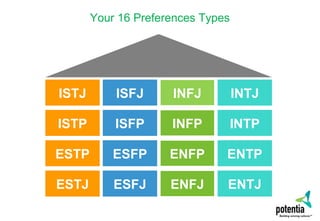
Your 16 Preferences Types
ISTJ ISFJ INFJ INTJ
ISTP ISFP INFP INTP
ESTP ESFP ENFP ENTP
ESTJ ESFJ ENFJ ENTJ
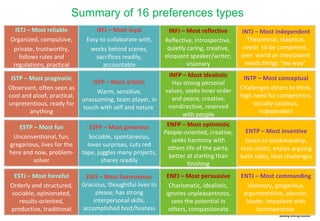
Summary of 16 preferences types
ISTJ – Most reliable
Organized, compulsive,
private, trustworthy,
follows rules and
regulations, practical
ISFJ – Most loyal
Easy to collaborate with,
works behind scenes,
sacrifices readily,
accountable
INFJ – Most reflective
Reflective, introspective,
quietly caring, creative,
eloquent speaker/writer,
visionary
INTJ – Most independent
Theoretical, skeptical,
needs to be competent ,
sees world as chessboard,
needs things “my way”
ISTP – Most pragmatic
Observant, often seen as
cool and aloof, practical,
unpretentious, ready for
anything
ISFP – Most artistic
Warm, sensitive,
unassuming, team player, in
touch with self and nature
INFP – Most idealistic
Has strong personal
values, seeks inner order
and peace, creative,
nondirective, reserved
with people
INTP – Most conceptual
Challenges others to think,
high need for competency,
socially cautious,
independent
ESTP – Most fun
Unconventional, fun,
gregarious, lives for the
here and now, problem-
solver
ESFP – Most generous
Sociable, spontaneous,
loves surprises, cuts red
tape, juggles many projects,
shares readily
ENFP – Most optimistic
People-oriented, creative,
seeks harmony with
others life of the party,
better at starting than
finishing
ENTP – Most inventive
Given to brinkmanship,
tests limits, enjoys arguing
both sides, likes challenges
ESTJ – Most forceful
Orderly and structured,
sociable, opinionated,
results-oriented,
productive, traditional
ESFJ – Most harmonious
Gracious, thoughtful lives to
please, has strong
interpersonal skills,
accomplished host/hostess
ENFJ – Most persuasive
Charismatic, idealistic,
ignores unpleasantness,
sees the potential in
others, compassionate
ENTJ – Most commanding
Visionary, gregarious,
argumentative, planner,
leader, impatient with
incompetence
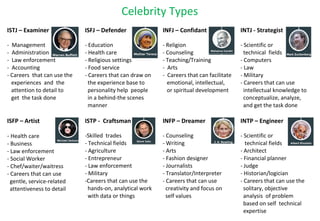
Celebrity Types
ISTJ – Examiner
- Management
- Administration
- Law enforcement
- Accounting
- Careers that can use the
experiences and the
attention to detail to
get the task done
ISFJ – Defender
- Education
- Health care
- Religious settings
- Food service
- Careers that can draw on
the experience base to
personality help people
in a behind-the scenes
manner
INFJ – Confidant
- Religion
- Counseling
- Teaching/Training
- Arts
- Careers that can facilitate
emotional, intellectual,
or spiritual development
INTJ - Strategist
- Scientific or
technical fields
- Computers
- Law
- Military
- Careers that can use
intellectual knowledge to
conceptualize, analyze,
and get the task done
ISFP – Artist
- Health care
- Business
- Law enforcement
- Social Worker
- Chef/waiter/waitress
- Careers that can use
gentle, service-related
attentiveness to detail
ISTP - Craftsman
-Skilled trades
- Technical fields
- Agriculture
- Entrepreneur
- Law enforcement
- Military
-Careers that can use the
hands-on, analytical work
with data or things
INFP – Dreamer
- Counseling
- Writing
- Arts
- Fashion designer
- Journalists
- Translator/Interpreter
- Careers that can use
creativity and focus on
self values
INTP – Engineer
- Scientific or
technical fields
- Architect
- Financial planner
- Judge
- Historian/logician
- Careers that can use the
solitary, objective
analysis of problem
based on self technical
expertise
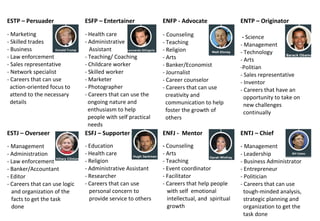
ESTP – Persuader
- Marketing
- Skilled trades
- Business
- Law enforcement
- Sales representative
- Network specialist
- Careers that can use
action-oriented focus to
attend to the necessary
details
ESFP – Entertainer
- Health care
- Administrative
Assistant
- Teaching/ Coaching
- Childcare worker
- Skilled worker
- Marketer
- Photographer
- Careers that can use the
ongoing nature and
enthusiasm to help
people with self practical
needs
ENFP - Advocate
- Counseling
- Teaching
- Religion
- Arts
- Banker/Economist
- Journalist
- Career counselor
- Careers that can use
creativity and
communication to help
foster the growth of
others
ENTP – Originator
- Science
- Management
- Technology
- Arts
-Politian
- Sales representative
- Inventor
- Careers that have an
opportunity to take on
new challenges
continually
ESTJ – Overseer
- Management
- Administration
- Law enforcement
- Banker/Accountant
- Editor
- Careers that can use logic
and organization of the
facts to get the task
done
ESFJ – Supporter
- Education
- Health care
- Religion
- Administrative Assistant
- Researcher
- Careers that can use
personal concern to
provide service to others
ENFJ - Mentor
- Counseling
- Arts
- Teaching
- Event coordinator
- Facilitator
- Careers that help people
with self emotional
intellectual, and spiritual
growth
ENTJ – Chief
- Management
- Leadership
- Business Administrator
- Entrepreneur
- Politician
- Careers that can use
tough-minded analysis,
strategic planning and
organization to get the
task done
Now, what type are you?

MBTI Presentation - May 2015 (Corporate)

  • 1.
    June 2015 The Myers-BriggsType Indicator ® (MBTI® ) A tool for self-reflection by Mark Laothavornwong Potentia Thailand and Vietnam 14th Floor One Pacific Place Unit 1401 140 Sukhumvit Road, Klongtoey Bangkok 10110 +66 (0) 2 653-5055 www.potentia.co.th
  • 2.
    Introducing Potentia • Officialpartner for CPP USA, who is the expert of development assessment instruments especially MBTI® • Official Distributor of the Myers-Briggs Type Indicator (MBTI®) in Thailand and Vietnam • Focus on assessing and developing talent and potential using a first class range of instruments, training, and individual coaching. Focused attention on all three ensures potential transforms to results. capability. energy. mindset.
  • 3.
    What We Do Potentiais located in Singapore, Thailand, and Vietnam and assesses and develops talent and potential using a first class range of instruments, training, and individual coaching. •Our solutions are tailored to various business issues and cover: • Talent Effectiveness • Team Effectiveness • Virtual Teams • Leadership Effectiveness • Work Effectiveness • Emotional Intelligence
  • 4.
    Selection and Assessmentof Talent from CPP
  • 5.
    Some of OurPartners © 2010, CPP, Inc. All rights reserved
  • 6.
    What is TheMyers-Briggs Type Indicator® (MBTI® ) ? • Tool developed from Carl Jung’s Personality Type Theory; • Some behaviors are not random, they are innate or inborn • Our type preferences come naturally • Preferences make us feel energetic/competent • Tool for self-reflection or to know/ discover you at your best • Tool for self-understanding and how to interact with others through personality differences • Tool to explore one’s own strengths and weaknesses
  • 7.
  • 8.
    Benefits • Identifies individualpreference • Engages participants in the use of type concepts • Summarizes underlying type patterns common to most people • Leverages learning methods • Offers supporting materials • Available as an online assessment, interactive feedback session, and interpretive report • Enhances emotional intelligence
  • 9.
    The MBTI® instrument indicatespreferences on four pairs of opposites, called dichotomies: The MBTI® Dichotomies Extraversion E or I Introversion Sensing S or N Intuition Thinking T or F Feeling Judging J or P Perceiving
  • 10.
    The Four PreferencePairs Where you focus your attention The way you take in information The way you make decisions How you deal with the outer world
  • 11.
    Extraversion (E) –Introversion (I) Extraversion (E) : — Get energy from the environment — The outer world of people and things. Introversion (I) : — Get energy from within — The inner world of thoughts and reflections. Where you focus your attention
  • 12.
    Sensing (S) –Intuition (N) How you take in information Sensing (S): Absorb information directly Intuition (N) : Use less direct perceptions
  • 13.
    Thinking (T) –Feeling (F) How you make decisions Thinking (T): Make decisions using logic Feeling (F): Make decisions considering people involved
  • 14.
    P Starting to think aboutit JTime Deadline Start Finished Planned Milestones and mini- deadlines Finished ! Procrastination Better start doing something Oh shit ! Judging (J) – Perceiving (P) How you deal with the outer world?
  • 15.
    Judging (J) –Perceiving (P) How you deal with the outer world Judging (J): Perceiving (P):
  • 16.
    Your 16 PreferencesTypes ISTJ ISFJ INFJ INTJ ISTP ISFP INFP INTP ESTP ESFP ENFP ENTP ESTJ ESFJ ENFJ ENTJ
  • 17.
    Summary of 16preferences types ISTJ – Most reliable Organized, compulsive, private, trustworthy, follows rules and regulations, practical ISFJ – Most loyal Easy to collaborate with, works behind scenes, sacrifices readily, accountable INFJ – Most reflective Reflective, introspective, quietly caring, creative, eloquent speaker/writer, visionary INTJ – Most independent Theoretical, skeptical, needs to be competent , sees world as chessboard, needs things “my way” ISTP – Most pragmatic Observant, often seen as cool and aloof, practical, unpretentious, ready for anything ISFP – Most artistic Warm, sensitive, unassuming, team player, in touch with self and nature INFP – Most idealistic Has strong personal values, seeks inner order and peace, creative, nondirective, reserved with people INTP – Most conceptual Challenges others to think, high need for competency, socially cautious, independent ESTP – Most fun Unconventional, fun, gregarious, lives for the here and now, problem- solver ESFP – Most generous Sociable, spontaneous, loves surprises, cuts red tape, juggles many projects, shares readily ENFP – Most optimistic People-oriented, creative, seeks harmony with others life of the party, better at starting than finishing ENTP – Most inventive Given to brinkmanship, tests limits, enjoys arguing both sides, likes challenges ESTJ – Most forceful Orderly and structured, sociable, opinionated, results-oriented, productive, traditional ESFJ – Most harmonious Gracious, thoughtful lives to please, has strong interpersonal skills, accomplished host/hostess ENFJ – Most persuasive Charismatic, idealistic, ignores unpleasantness, sees the potential in others, compassionate ENTJ – Most commanding Visionary, gregarious, argumentative, planner, leader, impatient with incompetence
  • 18.
    Celebrity Types ISTJ –Examiner - Management - Administration - Law enforcement - Accounting - Careers that can use the experiences and the attention to detail to get the task done ISFJ – Defender - Education - Health care - Religious settings - Food service - Careers that can draw on the experience base to personality help people in a behind-the scenes manner INFJ – Confidant - Religion - Counseling - Teaching/Training - Arts - Careers that can facilitate emotional, intellectual, or spiritual development INTJ - Strategist - Scientific or technical fields - Computers - Law - Military - Careers that can use intellectual knowledge to conceptualize, analyze, and get the task done ISFP – Artist - Health care - Business - Law enforcement - Social Worker - Chef/waiter/waitress - Careers that can use gentle, service-related attentiveness to detail ISTP - Craftsman -Skilled trades - Technical fields - Agriculture - Entrepreneur - Law enforcement - Military -Careers that can use the hands-on, analytical work with data or things INFP – Dreamer - Counseling - Writing - Arts - Fashion designer - Journalists - Translator/Interpreter - Careers that can use creativity and focus on self values INTP – Engineer - Scientific or technical fields - Architect - Financial planner - Judge - Historian/logician - Careers that can use the solitary, objective analysis of problem based on self technical expertise
  • 19.
    ESTP – Persuader -Marketing - Skilled trades - Business - Law enforcement - Sales representative - Network specialist - Careers that can use action-oriented focus to attend to the necessary details ESFP – Entertainer - Health care - Administrative Assistant - Teaching/ Coaching - Childcare worker - Skilled worker - Marketer - Photographer - Careers that can use the ongoing nature and enthusiasm to help people with self practical needs ENFP - Advocate - Counseling - Teaching - Religion - Arts - Banker/Economist - Journalist - Career counselor - Careers that can use creativity and communication to help foster the growth of others ENTP – Originator - Science - Management - Technology - Arts -Politian - Sales representative - Inventor - Careers that have an opportunity to take on new challenges continually ESTJ – Overseer - Management - Administration - Law enforcement - Banker/Accountant - Editor - Careers that can use logic and organization of the facts to get the task done ESFJ – Supporter - Education - Health care - Religion - Administrative Assistant - Researcher - Careers that can use personal concern to provide service to others ENFJ - Mentor - Counseling - Arts - Teaching - Event coordinator - Facilitator - Careers that help people with self emotional intellectual, and spiritual growth ENTJ – Chief - Management - Leadership - Business Administrator - Entrepreneur - Politician - Careers that can use tough-minded analysis, strategic planning and organization to get the task done
  • 20.

Editor's Notes

  • #7 The questions you just answered are similar to those in the Meyers-Briggs Type Indicator, or MBTI. In each question, you choose between two word pairs or short phrases. Sometimes the words seem like they are opposites, while others might make it hard for you to choose. Each answer helps determine what your personality “type” might be. The Meyers-Briggs Type Indicator is a tool for self-reflection that can help you think about what is important to you, what your strengths and weaknesses are, and what your preferred work tasks and work environment might be.
  • #9 The MBTI assessment demonstrates the highest levels of consistency and reliability of any personality assessment product. Many years of rigorous testing and use of the most up-to-date psychometric tools, such as item response theory (IRT) for both scoring and item selection, ensures that all MBTI forms are of the highest quality and value. The MBTI® Manual contains more than 400 pages of technical and statistical data on the construction and reliability of the MBTI assessments. CPP’s Research Division often jokes that we measure the amount of our supporting data not by the page but by the pound.
  • #11 The MBTI results are categorized along four dichotomies. Extraversion-Introversion, Sensing-Intuition, Thinking-Feeling, and Judging-Percieving. Extraversion-Introversion has to do with where you prefer to focus your attention and where you get your energy from. Sensing-Intuition has to do with the way you prefer to take in information. Thinking-Feeling has to do with the way you prefer to make decisions. Judging-Perceiving has to do with the way you prefer to deal with the outside world.
  • #12 Where do you focus your energy? Where do you get your energy from? Extraversion (E)’s: Get energy and essential stimulation from the environment—the outer world of people and things. They: Are attuned to their external environments Prefer to communicate by talking Learn best by doing Are sociable and expressive Enjoy working in groups
  • #13 How do you prefer to take in information? Sensing (S’s): Like to learn facts Emphasize the pragmatic Are oriented to present realities Value realism Trust experience Observe and remember specifics through 5 senses
  • #14 Thinking (T’s): Make decisions using logic Are analytical Use cause-and-effect reasoning Search for flaws in argument
  • #16 Judging (J’s): People who prefer to use their Judging process in the outer world like to live in a planned, orderly way, seeking to regulate and manage their lives. They want to make decisions, come to closure, and move on. Their lives tend to be structured and organized, and they like to have things settled. Sticking to a plan and schedule is very important to them, and they are energized by getting things done.
  • #17 You use each room, but there is one favorite, comfortable room where you always feel at your best. Your personality type is like that favorite room. Let’s say that your type is ISTJ. When at work, you might have to go to the ENTJ room. You adapt to the room's surroundings, but as soon as you get the opportunity, you head back to your ISTJ room again. In your lifetime, you will occasionally visit each of the other 15 rooms in your “house”. You may grow more and more comfortable in certain other rooms. But you won’t spend as much time in any room as you do your ISTJ room, or “favorite” room.
  • #18 You use each room, but there is one favorite, comfortable room where you always feel at your best. Your personality type is like that favorite room. Let’s say that your type is ISTJ. When at work, you might have to go to the ENTJ room. You adapt to the room's surroundings, but as soon as you get the opportunity, you head back to your ISTJ room again. In your lifetime, you will occasionally visit each of the other 15 rooms in your “house”. You may grow more and more comfortable in certain other rooms. But you won’t spend as much time in any room as you do your ISTJ room, or “favorite” room.
  • #19 You use each room, but there is one favorite, comfortable room where you always feel at your best. Your personality type is like that favorite room. Let’s say that your type is ISTJ. When at work, you might have to go to the ENTJ room. You adapt to the room's surroundings, but as soon as you get the opportunity, you head back to your ISTJ room again. In your lifetime, you will occasionally visit each of the other 15 rooms in your “house”. You may grow more and more comfortable in certain other rooms. But you won’t spend as much time in any room as you do your ISTJ room, or “favorite” room.
  • #20 You use each room, but there is one favorite, comfortable room where you always feel at your best. Your personality type is like that favorite room. Let’s say that your type is ISTJ. When at work, you might have to go to the ENTJ room. You adapt to the room's surroundings, but as soon as you get the opportunity, you head back to your ISTJ room again. In your lifetime, you will occasionally visit each of the other 15 rooms in your “house”. You may grow more and more comfortable in certain other rooms. But you won’t spend as much time in any room as you do your ISTJ room, or “favorite” room.