What is operations research?
 Operations Research is an Art and Science.
 The British/Europeans refer: "Operational Research".
 The Americans refer: "Operations Research".
 Modern synonyms: Management Science (MS) | Decision Science
(DS)| Industrial engineering" (IE)
 It is often considered to be a sub-field of mathematics.
 The Americans are using terms OR and MS together: "ORMS".
 ORMS: Operations Research Management Science
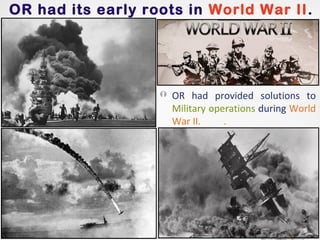
OR had its early roots in World War II.
 OR had provided solutions to
Military operations during World
War II. .
Operations Research?
 Operational Research is the discipline of applying advanced
analytical methods to help make better decisions.
 OR is professional discipline.
 It deals with scientific methods.
 OR is an interdisciplinary discipline.
 It represents the study of optimal resource allocation.
 It deals with advanced analytical methods for making decisions.
 Business applications concerned with O.R. analysis.
Optimization= To Obtain the Best
 Optimization is a word that
comes to mind first in
Operations Research.
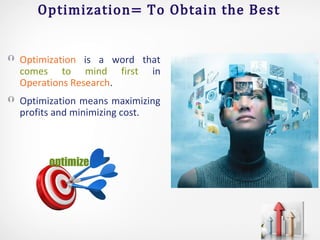
 Optimization means maximizing
profits and minimizing cost.
Operations Research
FMD-0465-2DA-6N
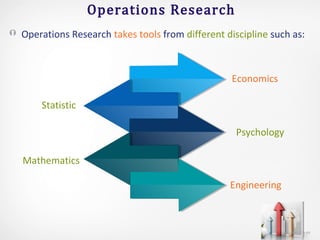
 Operations Research takes tools from different discipline such as:
Economics
Engineering
Statistic
Mathematics
Psychology
Definition
 Operations Research Society, America: “Operations research is
concerned with scientifically deciding how to best design and
operate man machine systems usually requiring the allocation of
scare resources”.
 PM Morse and GE Kimball: “O.R. is a scientific method of providing
executive departments with a quantitative basis for decisions
regarding the operations under their control”.
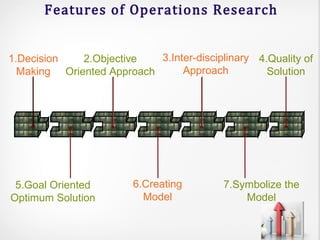
Features of Operations Research
1.Decision
Making
5.Goal Oriented
Optimum Solution
2.Objective
Oriented Approach
6.Creating
Model
3.Inter-disciplinary
Approach
7.Symbolize the
Model
4.Quality of
Solution
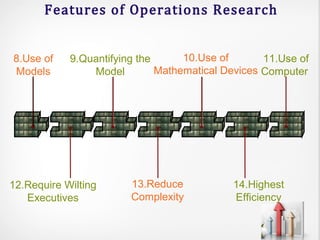
Features of Operations Research
8.Use of
Models
12.Require Wilting
Executives
9.Quantifying the
Model
13.Reduce
Complexity
10.Use of
Mathematical Devices
14.Highest
Efficiency
11.Use of
Computer
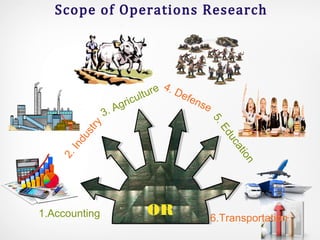
Scope of Operations Research
1.Accounting
3. Agriculture
2.Industry
4. Defense
5.Education
6.Transportation
OR
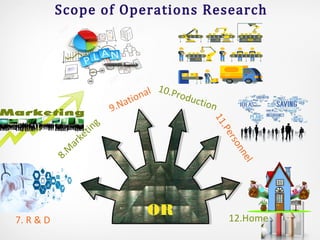
Scope of Operations Research
7. R & D
9.National
8.M
arketing
10.Production
11.Personnel
12.Home
OR
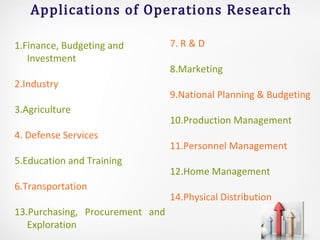
Applications of Operations Research
1.Finance, Budgeting and
Investment
2.Industry
3.Agriculture
4. Defense Services
5.Education and Training
6.Transportation
13.Purchasing, Procurement and
Exploration
7. R & D
8.Marketing
9.National Planning & Budgeting
10.Production Management
11.Personnel Management
12.Home Management
14.Physical Distribution
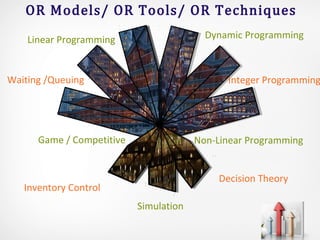
OR Models/ OR Tools/ OR Techniques
Inventory Control
Decision Theory
Waiting /Queuing Integer Programming
Linear Programming Dynamic Programming
Game / Competitive
Simulation
Non-Linear Programming
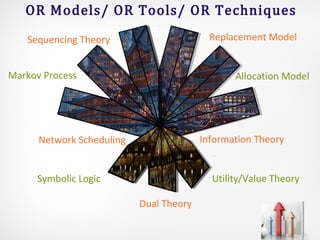
OR Models/ OR Tools/ OR Techniques
Symbolic Logic Utility/Value Theory
Markov Process Allocation Model
Sequencing Theory Replacement Model
Network Scheduling
Dual Theory
Information Theory
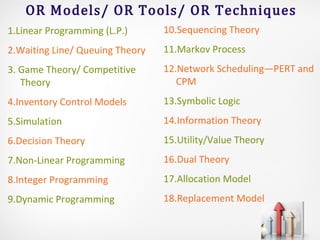
1.Linear Programming (L.P.)
2.Waiting Line/ Queuing Theory
3. Game Theory/ Competitive
Theory
4.Inventory Control Models
5.Simulation
6.Decision Theory
7.Non-Linear Programming
8.Integer Programming
9.Dynamic Programming
OR Models/ OR Tools/ OR Techniques
10.Sequencing Theory
11.Markov Process
12.Network Scheduling—PERT and
CPM
13.Symbolic Logic
14.Information Theory
15.Utility/Value Theory
16.Dual Theory
17.Allocation Model
18.Replacement Model
 IFORS: International Federation of Operational Research Society
 IFORS is an umbrella organization for Operational Research
societies world-wide .
 It is a 50-year old organization which is currently composed of 50
national societies.
 It represents 50 national societies including those in US, UK ,
France , Germany, Canada , Australia , New Zealand, Philippines ,
India , Japan and South-Africa.
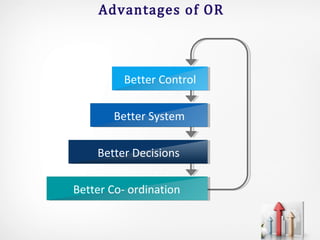
Advantages of OR
Better Control
Better System
Better Decisions
Better Co- ordination
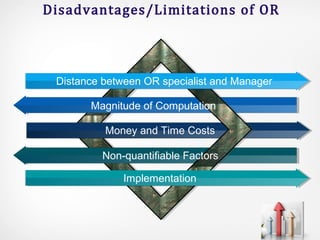
Disadvantages/Limitations of OR
Magnitude of Computation
Non-quantifiable Factors
Money and Time Costs
Distance between OR specialist and Manager
Implementation
MBA | QA II | Overview | Operations Research Part 1

MBA | QA II | Overview | Operations Research Part 1

  • 2.
    What is operationsresearch?  Operations Research is an Art and Science.  The British/Europeans refer: "Operational Research".  The Americans refer: "Operations Research".  Modern synonyms: Management Science (MS) | Decision Science (DS)| Industrial engineering" (IE)  It is often considered to be a sub-field of mathematics.  The Americans are using terms OR and MS together: "ORMS".  ORMS: Operations Research Management Science
  • 3.
    OR had itsearly roots in World War II.  OR had provided solutions to Military operations during World War II. .
  • 4.
    Operations Research?  OperationalResearch is the discipline of applying advanced analytical methods to help make better decisions.  OR is professional discipline.  It deals with scientific methods.  OR is an interdisciplinary discipline.  It represents the study of optimal resource allocation.  It deals with advanced analytical methods for making decisions.  Business applications concerned with O.R. analysis.
  • 5.
    Optimization= To Obtainthe Best  Optimization is a word that comes to mind first in Operations Research.  Optimization means maximizing profits and minimizing cost.
  • 6.
    Operations Research FMD-0465-2DA-6N  OperationsResearch takes tools from different discipline such as: Economics Engineering Statistic Mathematics Psychology
  • 7.
    Definition  Operations ResearchSociety, America: “Operations research is concerned with scientifically deciding how to best design and operate man machine systems usually requiring the allocation of scare resources”.  PM Morse and GE Kimball: “O.R. is a scientific method of providing executive departments with a quantitative basis for decisions regarding the operations under their control”.
  • 8.
    Features of OperationsResearch 1.Decision Making 5.Goal Oriented Optimum Solution 2.Objective Oriented Approach 6.Creating Model 3.Inter-disciplinary Approach 7.Symbolize the Model 4.Quality of Solution
  • 9.
    Features of OperationsResearch 8.Use of Models 12.Require Wilting Executives 9.Quantifying the Model 13.Reduce Complexity 10.Use of Mathematical Devices 14.Highest Efficiency 11.Use of Computer
  • 10.
    Scope of OperationsResearch 1.Accounting 3. Agriculture 2.Industry 4. Defense 5.Education 6.Transportation OR
  • 11.
    Scope of OperationsResearch 7. R & D 9.National 8.M arketing 10.Production 11.Personnel 12.Home OR
  • 12.
    Applications of OperationsResearch 1.Finance, Budgeting and Investment 2.Industry 3.Agriculture 4. Defense Services 5.Education and Training 6.Transportation 13.Purchasing, Procurement and Exploration 7. R & D 8.Marketing 9.National Planning & Budgeting 10.Production Management 11.Personnel Management 12.Home Management 14.Physical Distribution
  • 13.
    OR Models/ ORTools/ OR Techniques Inventory Control Decision Theory Waiting /Queuing Integer Programming Linear Programming Dynamic Programming Game / Competitive Simulation Non-Linear Programming
  • 14.
    OR Models/ ORTools/ OR Techniques Symbolic Logic Utility/Value Theory Markov Process Allocation Model Sequencing Theory Replacement Model Network Scheduling Dual Theory Information Theory
  • 15.
    1.Linear Programming (L.P.) 2.WaitingLine/ Queuing Theory 3. Game Theory/ Competitive Theory 4.Inventory Control Models 5.Simulation 6.Decision Theory 7.Non-Linear Programming 8.Integer Programming 9.Dynamic Programming OR Models/ OR Tools/ OR Techniques 10.Sequencing Theory 11.Markov Process 12.Network Scheduling—PERT and CPM 13.Symbolic Logic 14.Information Theory 15.Utility/Value Theory 16.Dual Theory 17.Allocation Model 18.Replacement Model
  • 16.
     IFORS: InternationalFederation of Operational Research Society  IFORS is an umbrella organization for Operational Research societies world-wide .  It is a 50-year old organization which is currently composed of 50 national societies.  It represents 50 national societies including those in US, UK , France , Germany, Canada , Australia , New Zealand, Philippines , India , Japan and South-Africa.
  • 17.
    Advantages of OR BetterControl Better System Better Decisions Better Co- ordination
  • 18.
    Disadvantages/Limitations of OR Magnitudeof Computation Non-quantifiable Factors Money and Time Costs Distance between OR specialist and Manager Implementation