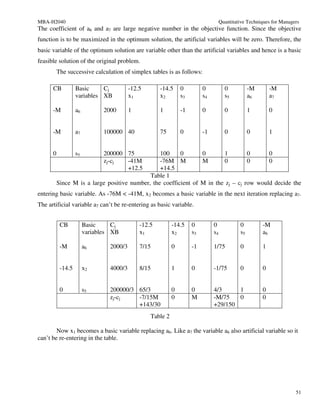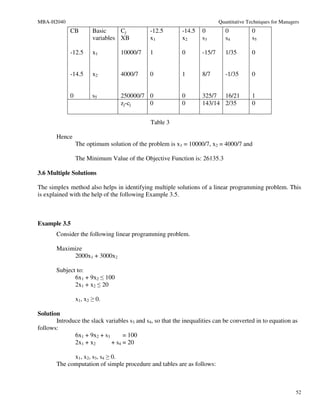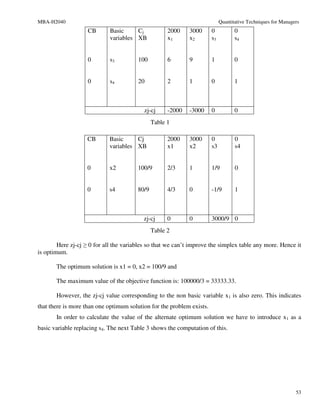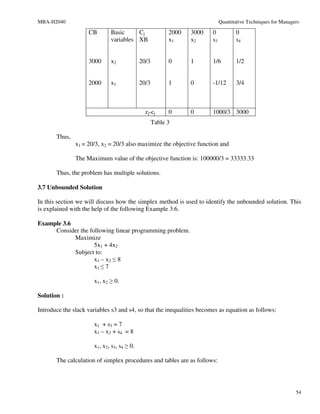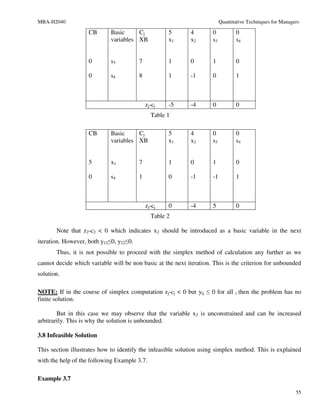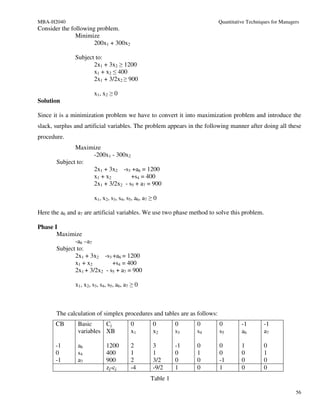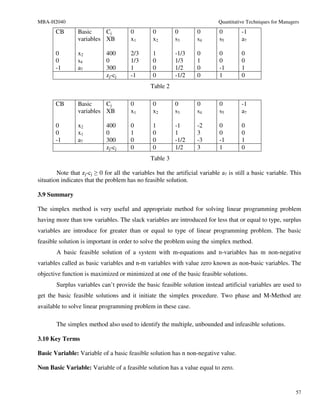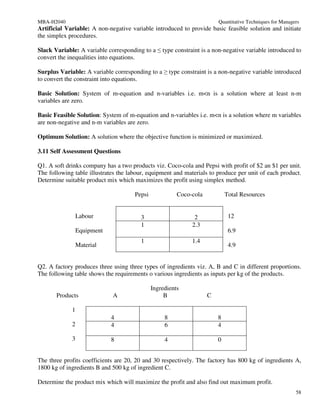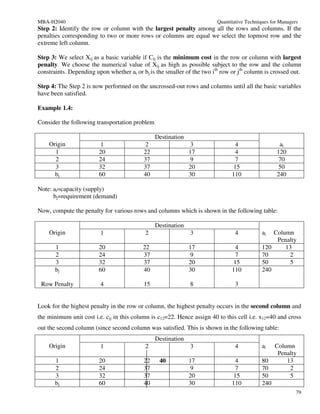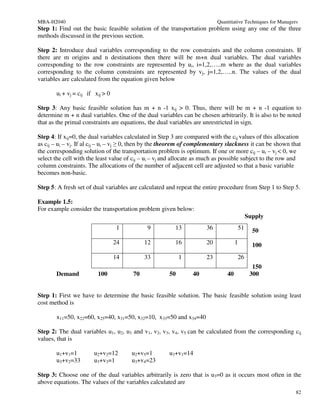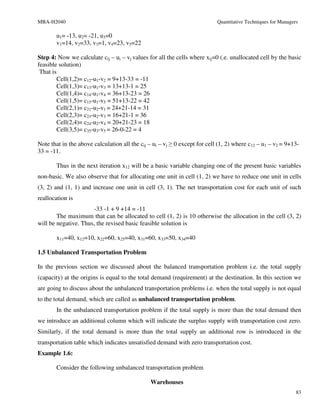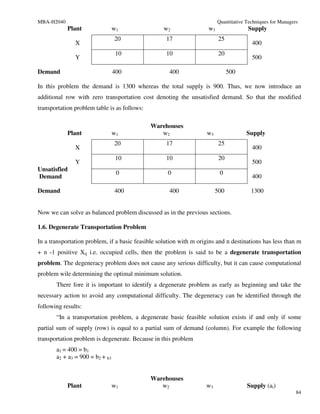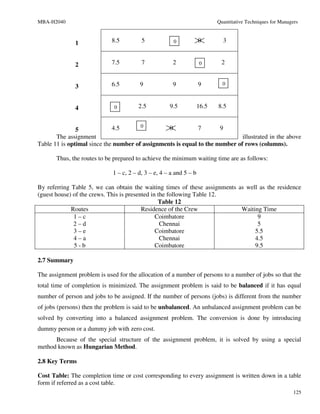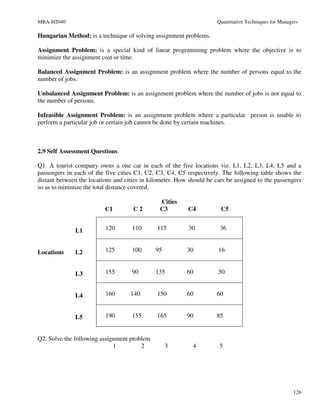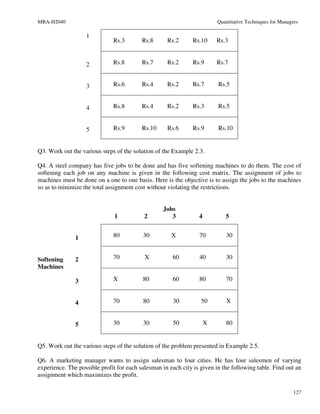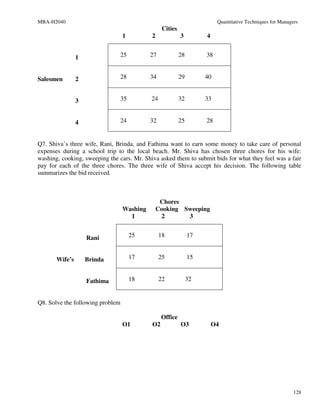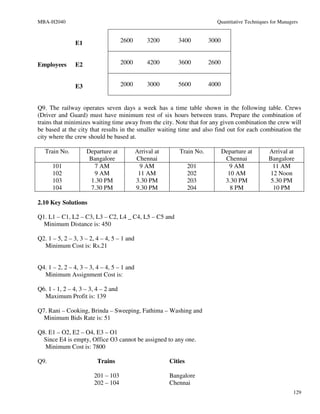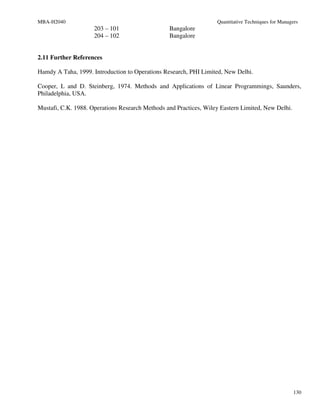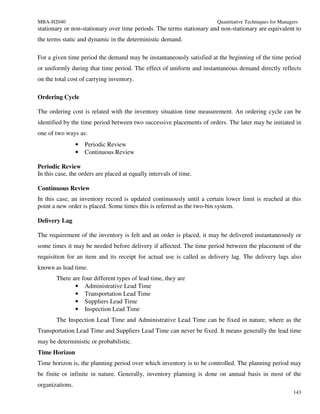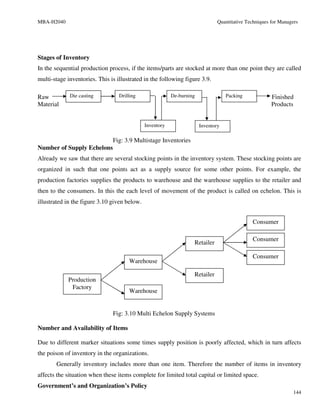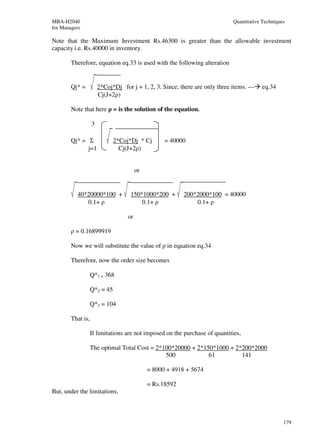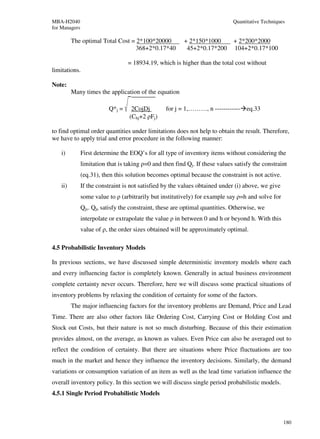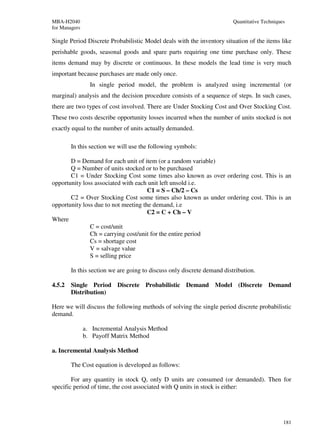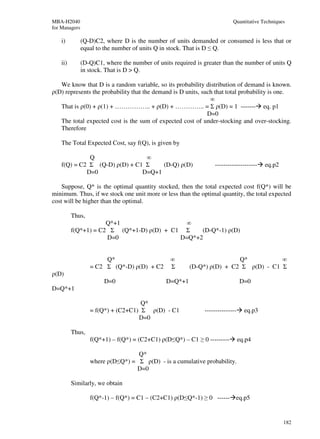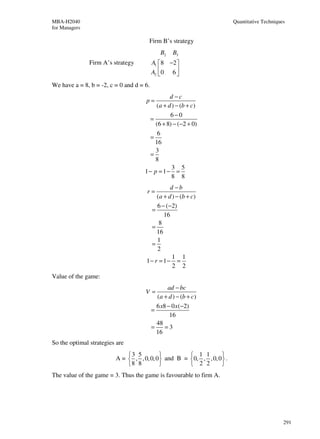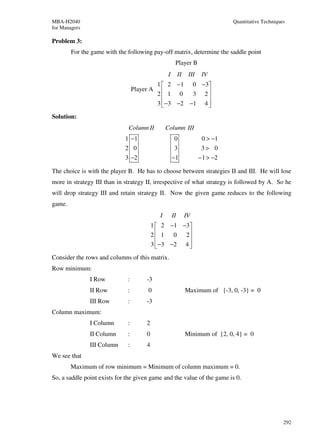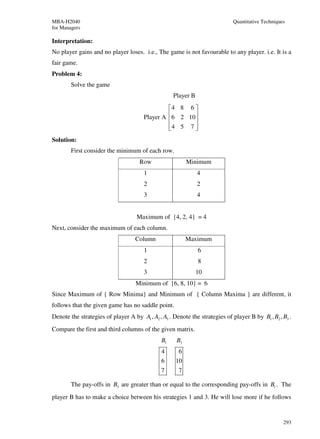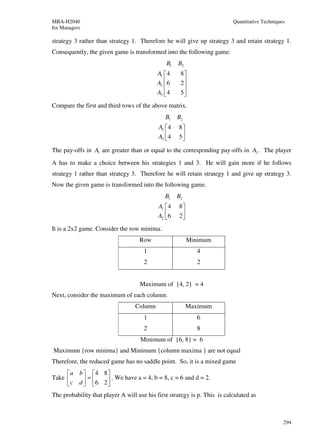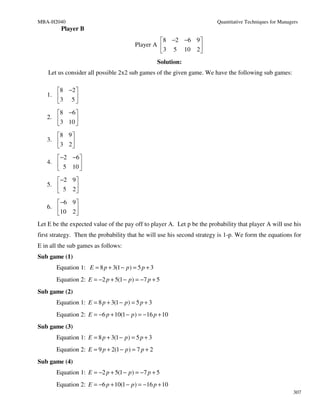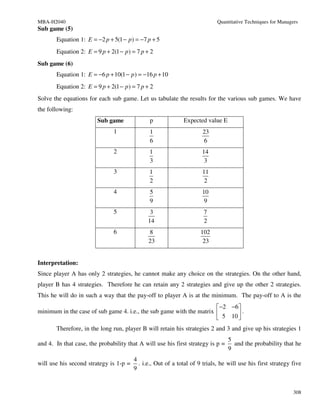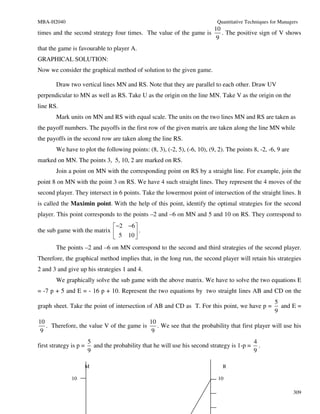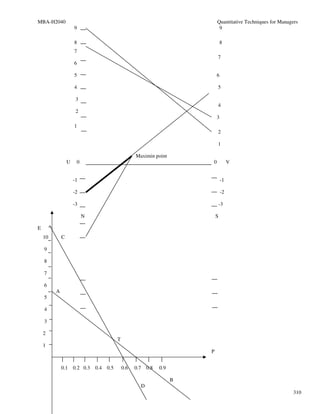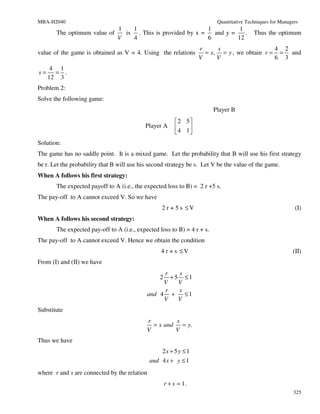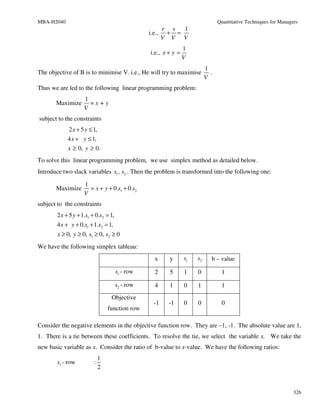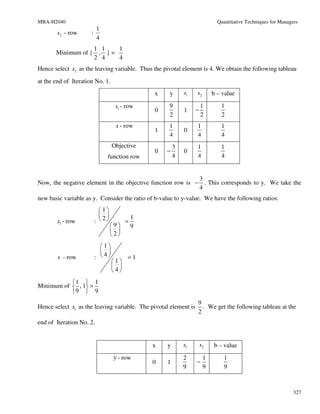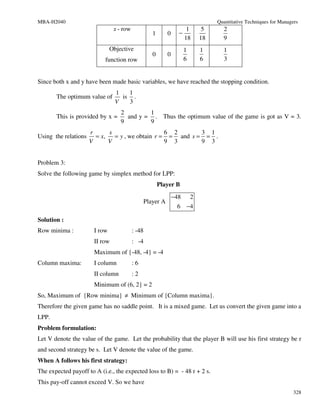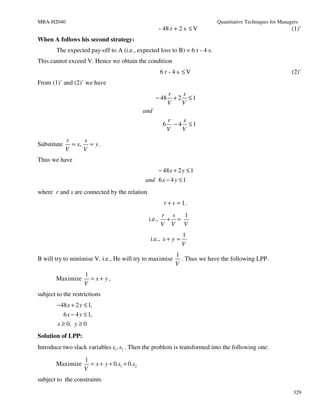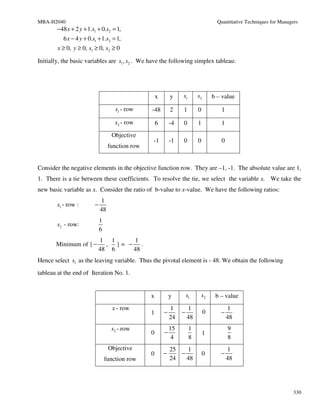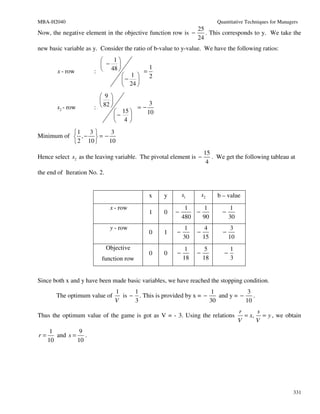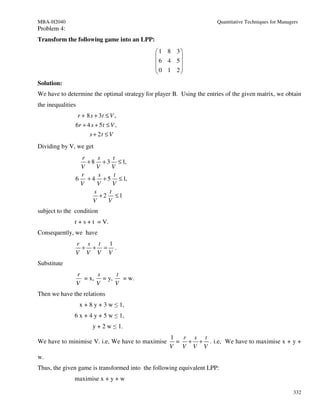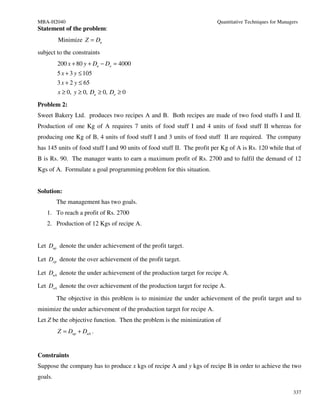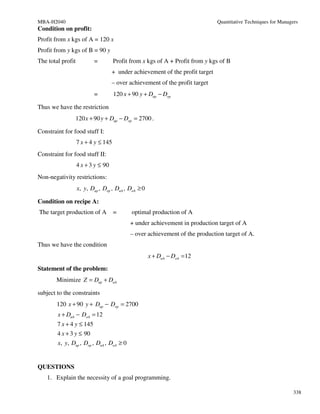
MBA-H2040                                                            Quantitative Techniques for Managers

UNIT I


           1 INTRODUCTION TO OPERATIONS RESEARCH
LESSON


           LESSON STRUCTURE

         1.1    Introduction
         1.2    History of Operations Research
         1.3    Stages of Development of Operations
                Research
         1.4    Relationship Between Manager and
                OR Specialist
         1.5    OR Tools and Techniques
         1.6    Applications of Operations Research
         1.7    Limitations of Operations Research
         1.8    Summary                               Objectives
         1.9    Key Terms                             After Studying this lesson, you should be able
         1.10   Self Assessment Questions             to:
         1.11   Further References                           Understand the meaning, purpose, and
                                                             tools of Operations Research
                                                             Describe the history of Operations
                                                             Research
                                                             Describe the Stages of O.R
                                                             Explain the Applications of Operations
                                                             Research
                                                             Describe the Limitations of Operation
                                                             Research
                                                             Understand the OR specialist and
                                                             Manager relationship
MBA-H2040                                                                 Quantitative Techniques for Managers
1.1 Introduction

The British/Europeans refer to "operational research", the Americans to "operations research" - but both
are often shortened to just "OR" - which is the term we will use.

       Another term which is used for this field is "management science" ("MS"). The Americans
sometimes combine the terms OR and MS together and say "OR/MS" or "ORMS". Yet other terms
sometimes used are "industrial engineering" ("IE") and "decision science" ("DS"). In recent years there
has been a move towards a standardization upon a single term for the field, namely the term "OR".

       Operation Research is a relatively new discipline. The contents and the boundaries of the OR are
not yet fixed. Therefore, to give a formal definition of the term Operations Research is a difficult task.
The OR starts when mathematical and quantitative techniques are used to substantiate the decision being
taken. The main activity of a manager is the decision making. In our daily life we make the decisions
even without noticing them. The decisions are taken simply by common sense, judgment and expertise
without using any mathematical or any other model in simple situations. But the decision we are
concerned here with are complex and heavily responsible. Examples are public transportation network
planning in a city having its own layout of factories, residential blocks or finding the appropriate product
mix when there exists a large number of products with different profit contributions and production
requirement etc.
       Operations Research tools are not from any one discipline. Operations Research takes tools from
different discipline such as mathematics, statistics, economics, psychology, engineering etc. and
combines these tools to make a new set of knowledge for decision making. Today, O.R. became a
professional discipline which deals with the application of scientific methods for making decision, and
especially to the allocation of scarce resources. The main purpose of O.R. is to provide a rational basis
for decisions making in the absence of complete information, because the systems composed of human,
machine, and procedures may do not have complete information.
       Operations Research can also be treated as science in the sense it describing, understanding and
predicting the systems behaviour, especially man-machine system. Thus O.R. specialists are involved in
three classical aspect of science, they are as follows:
       i) Determining the systems behaviour
       ii) Analyzing the systems behaviour by developing appropriate models
       iii) Predict the future behaviour using these models

       The emphasis on analysis of operations as a whole distinguishes the O.R. from other research
and engineering. O.R. is an interdisciplinary discipline which provided solutions to problems of military
operations during World War II, and also successful in other operations. Today business applications are
MBA-H2040                                                               Quantitative Techniques for Managers
primarily concerned with O.R. analysis for the possible alternative actions. The business and industry
befitted from O.R. in the areas of inventory, reorder policies, optimum location and size of warehouses,
advertising policies, etc.
    As stated earlier defining O.R. is a difficult task. The definitions stressed by various experts and
Societies on the subject together enable us to know what O.R. is, and what it does. They are as follows:
    1. According to the Operational Research Society of Great Britain (OPERATIONAL RESEARCH
       QUARTERLY, l3(3):282, l962), Operational Research is the attack of modern science on
       complex problems arising in the direction and management of large systems of men, machines,
       materials and money in industry, business, government and defense. Its distinctive approach is to
       develop a scientific model of the system, incorporating measurements of factors such as change
       and risk, with which to predict and compare the outcomes of alternative decisions, strategies or
       controls. The purpose is to help management determine its policy and actions scientifically.

    2. Randy Robinson stresses that Operations Research is the application of scientific methods to
       improve the effectiveness of operations, decisions and management. By means such as analyzing
       data, creating mathematical models and proposing innovative approaches, Operations Research
       professionals develop scientifically based information that gives insight and guides decision-
       making. They also develop related software, systems, services and products.

    3. Morse and Kimball have stressed O.R. is a quantitative approach and described it as “ a scientific
       method of providing executive departments with a quantitative basis for decisions regarding the
       operations under their control”.

    4. Saaty considers O.R. as tool of improving quality of answers. He says, “O.R. is the art of giving
       bad answers to problems which otherwise have worse answers”.

    5. Miller and Starr state, “O.R. is applied decision theory, which uses any scientific, mathematical
       or logical means to attempt to cope with the problems that confront the executive, when he tries
       to achieve a thorough-going rationality in dealing with his decision problem”.

    6. Pocock stresses that O.R. is an applied Science. He states “O.R. is scientific methodology
       (analytical, mathematical, and quantitative) which by assessing the overall implication of various
       alternative courses of action in a management system provides an improved basis for
       management decisions”.

1.2 History of Operations Research
Operation Research is a relatively new discipline. Whereas 70 years ago it would have been possible to
study mathematics, physics or engineering (for example) at university it would not have been possible to
study Operation Research, indeed the term O.R. did not exist then. It was really only in the late 1930's
that operational research began in a systematic fashion, and it started in the UK. As such it would be
interesting to give a short history of O.R.

1936
MBA-H2040                                                                Quantitative Techniques for Managers
Early in 1936 the British Air Ministry established Bawdsey Research Station, on the east coast, near
Felixstowe, Suffolk, as the centre where all pre-war radar experiments for both the Air Force and the
Army would be carried out. Experimental radar equipment was brought up to a high state of reliability
and ranges of over 100 miles on aircraft were obtained.

       It was also in 1936 that Royal Air Force (RAF) Fighter Command, charged specifically with the
air defense of Britain, was first created. It lacked however any effective fighter aircraft - no Hurricanes
or Spitfires had come into service - and no radar data was yet fed into its very elementary warning and
control system.

       It had become clear that radar would create a whole new series of problems in fighter direction
and control so in late 1936 some experiments started at Biggin Hill in Kent into the effective use of such
data. This early work, attempting to integrate radar data with ground based observer data for fighter
interception, was the start of OR.

1937
The first of three major pre-war air-defence exercises was carried out in the summer of 1937. The
experimental radar station at Bawdsey Research Station was brought into operation and the information
derived from it was fed into the general air-defense warning and control system. From the early warning
point of view this exercise was encouraging, but the tracking information obtained from radar, after
filtering and transmission through the control and display network, was not very satisfactory.

1938
In July 1938 a second major air-defense exercise was carried out. Four additional radar stations had been
installed along the coast and it was hoped that Britain now had an aircraft location and control system
greatly improved both in coverage and effectiveness. Not so! The exercise revealed, rather, that a new
and serious problem had arisen. This was the need to coordinate and correlate the additional, and often
conflicting, information received from the additional radar stations. With the outbreak of war apparently
imminent, it was obvious that something new - drastic if necessary - had to be attempted. Some new
approach was needed.

Accordingly, on the termination of the exercise, the Superintendent of Bawdsey Research Station, A.P.
Rowe, announced that although the exercise had again demonstrated the technical feasibility of the radar
system for detecting aircraft, its operational achievements still fell far short of requirements. He
therefore proposed that a crash program of research into the operational - as opposed to the technical -
aspects of the system should begin immediately. The term "operational research" [RESEARCH into
MBA-H2040                                                                 Quantitative Techniques for Managers
(military) OPERATIONS] was coined as a suitable description of this new branch of applied science.
The first team was selected from amongst the scientists of the radar research group the same day.

1939
In the summer of 1939 Britain held what was to be its last pre-war air defence exercise. It involved some
33,000 men, 1,300 aircraft, 110 antiaircraft guns, 700 searchlights, and 100 barrage balloons. This
exercise showed a great improvement in the operation of the air defence warning and control system.
The contribution made by the OR team was so apparent that the Air Officer Commander-in-Chief RAF
Fighter Command (Air Chief Marshal Sir Hugh Dowding) requested that, on the outbreak of war, they
should be attached to his headquarters at Stanmore in north London.

        Initially, they were designated the "Stanmore Research Section". In 1941 they were redesignated
the "Operational Research Section" when the term was formalised and officially accepted, and similar
sections set up at other RAF commands.

1940
On May 15th 1940, with German forces advancing rapidly in France, Stanmore Research Section was
asked to analyses a French request for ten additional fighter squadrons (12 aircraft a squadron - so 120
aircraft in all) when losses were running at some three squadrons every two days (i.e. 36 aircraft every 2
days). They prepared graphs for Winston Churchill (the British Prime Minister of the time), based upon
a study of current daily losses and replacement rates, indicating how rapidly such a move would deplete
fighter strength. No aircraft were sent and most of those currently in France were recalled.

        This is held by some to be the most strategic contribution to the course of the war made by OR
(as the aircraft and pilots saved were consequently available for the successful air defense of Britain, the
Battle of Britain).

1941 onward
In 1941, an Operational Research Section (ORS) was established in Coastal Command which was to
carry out some of the most well-known OR work in World War II.

        The responsibility of Coastal Command was, to a large extent, the flying of long-range sorties by
single aircraft with the object of sighting and attacking surfaced U-boats (German submarines). The
technology of the time meant that (unlike modern day submarines) surfacing was necessary to recharge
batteries, vent the boat of fumes and recharge air tanks. Moreover U-boats were much faster on the
surface than underwater as well as being less easily detected by sonar.
MBA-H2040                                                                 Quantitative Techniques for Managers
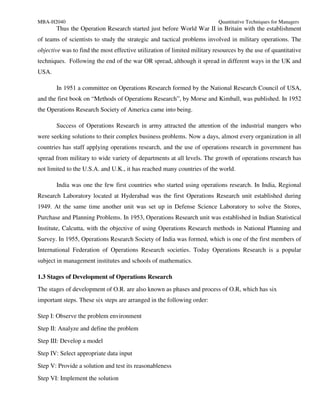
       Thus the Operation Research started just before World War II in Britain with the establishment
of teams of scientists to study the strategic and tactical problems involved in military operations. The
objective was to find the most effective utilization of limited military resources by the use of quantitative
techniques. Following the end of the war OR spread, although it spread in different ways in the UK and
USA.

       In 1951 a committee on Operations Research formed by the National Research Council of USA,
and the first book on “Methods of Operations Research”, by Morse and Kimball, was published. In 1952
the Operations Research Society of America came into being.

       Success of Operations Research in army attracted the attention of the industrial mangers who
were seeking solutions to their complex business problems. Now a days, almost every organization in all
countries has staff applying operations research, and the use of operations research in government has
spread from military to wide variety of departments at all levels. The growth of operations research has
not limited to the U.S.A. and U.K., it has reached many countries of the world.

       India was one the few first countries who started using operations research. In India, Regional
Research Laboratory located at Hyderabad was the first Operations Research unit established during
1949. At the same time another unit was set up in Defense Science Laboratory to solve the Stores,
Purchase and Planning Problems. In 1953, Operations Research unit was established in Indian Statistical
Institute, Calcutta, with the objective of using Operations Research methods in National Planning and
Survey. In 1955, Operations Research Society of India was formed, which is one of the first members of
International Federation of Operations Research societies. Today Operations Research is a popular
subject in management institutes and schools of mathematics.

1.3 Stages of Development of Operations Research
The stages of development of O.R. are also known as phases and process of O.R, which has six
important steps. These six steps are arranged in the following order:

Step I: Observe the problem environment
Step II: Analyze and define the problem
Step III: Develop a model
Step IV: Select appropriate data input
Step V: Provide a solution and test its reasonableness
Step VI: Implement the solution
MBA-H2040                                                                 Quantitative Techniques for Managers


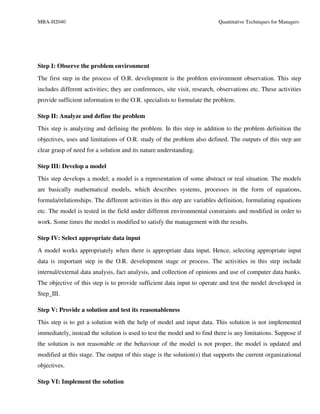
Step I: Observe the problem environment
The first step in the process of O.R. development is the problem environment observation. This step
includes different activities; they are conferences, site visit, research, observations etc. These activities
provide sufficient information to the O.R. specialists to formulate the problem.

Step II: Analyze and define the problem
This step is analyzing and defining the problem. In this step in addition to the problem definition the
objectives, uses and limitations of O.R. study of the problem also defined. The outputs of this step are
clear grasp of need for a solution and its nature understanding.

Step III: Develop a model
This step develops a model; a model is a representation of some abstract or real situation. The models
are basically mathematical models, which describes systems, processes in the form of equations,
formula/relationships. The different activities in this step are variables definition, formulating equations
etc. The model is tested in the field under different environmental constraints and modified in order to
work. Some times the model is modified to satisfy the management with the results.

Step IV: Select appropriate data input
A model works appropriately when there is appropriate data input. Hence, selecting appropriate input
data is important step in the O.R. development stage or process. The activities in this step include
internal/external data analysis, fact analysis, and collection of opinions and use of computer data banks.
The objective of this step is to provide sufficient data input to operate and test the model developed in
Step_III.

Step V: Provide a solution and test its reasonableness
This step is to get a solution with the help of model and input data. This solution is not implemented
immediately, instead the solution is used to test the model and to find there is any limitations. Suppose if
the solution is not reasonable or the behaviour of the model is not proper, the model is updated and
modified at this stage. The output of this stage is the solution(s) that supports the current organizational
objectives.

Step VI: Implement the solution
MBA-H2040                                                               Quantitative Techniques for Managers
At this step the solution obtained from the previous step is implemented. The implementation of the
solution involves mo many behavioural issues. Therefore, before implementation the implementation
authority has to resolve the issues. A properly implemented solution results in quality of work and gains
the support from the management.

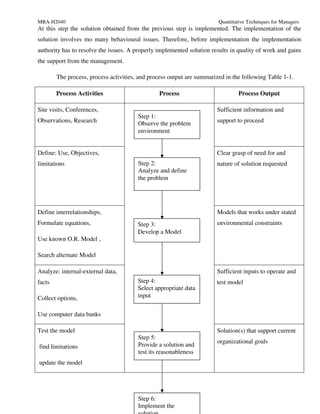
        The process, process activities, and process output are summarized in the following Table 1-1.

        Process Activities                      Process                         Process Output

Site visits, Conferences,                                              Sufficient information and
                                        Step 1:
Observations, Research                  Observe the problem            support to proceed
                                        environment


Define: Use, Objectives,                                               Clear grasp of need for and
limitations                             Step 2:                        nature of solution requested
                                        Analyze and define
                                        the problem


Define interrelationships,                                             Models that works under stated
Formulate equations,                    Step 3:                        environmental constraints
                                        Develop a Model
Use known O.R. Model ,

Search alternate Model

Analyze: internal-external data,                                       Sufficient inputs to operate and
facts                                   Step 4:                        test model
                                        Select appropriate data
Collect options,                        input

Use computer data banks

Test the model                                                         Solution(s) that support current
                                        Step 5:
                                                                       organizational goals
find limitations                        Provide a solution and
                                        test its reasonableness
update the model


                                        Step 6:
                                        Implement the
MBA-H2040                                                             Quantitative Techniques for Managers
Resolve behavioural issues                                            Improved working and
                                                                      Management support for longer
Sell the idea
                                                                      run operation of model
Give explanations

Management involvement

       Table 1-1: Process, Process activities, Process output of O.R. development stages

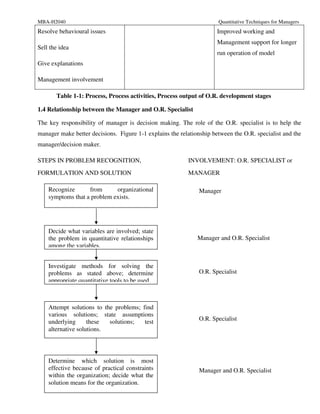
1.4 Relationship between the Manager and O.R. Specialist

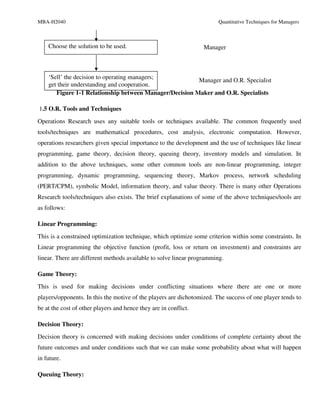
The key responsibility of manager is decision making. The role of the O.R. specialist is to help the
manager make better decisions. Figure 1-1 explains the relationship between the O.R. specialist and the
manager/decision maker.

STEPS IN PROBLEM RECOGNITION,                             INVOLVEMENT: O.R. SPECIALIST or
FORMULATION AND SOLUTION                                  MANAGER

    Recognize      from      organizational                    Manager
    symptoms that a problem exists.


    Decide what variables are involved; state
    the problem in quantitative relationships                 Manager and O.R. Specialist
    among the variables.


    Investigate methods for solving the
    problems as stated above; determine                        O.R. Specialist
    appropriate quantitative tools to be used.


    Attempt solutions to the problems; find
    various solutions; state assumptions
    underlying      these  solutions;   test                   O.R. Specialist
    alternative solutions.


    Determine which solution is most
    effective because of practical constraints                 Manager and O.R. Specialist
    within the organization; decide what the
    solution means for the organization.
MBA-H2040                                                               Quantitative Techniques for Managers


    Choose the solution to be used.                               Manager


    ‘Sell’ the decision to operating managers;
                                                         Manager and O.R. Specialist
    get their understanding and cooperation.
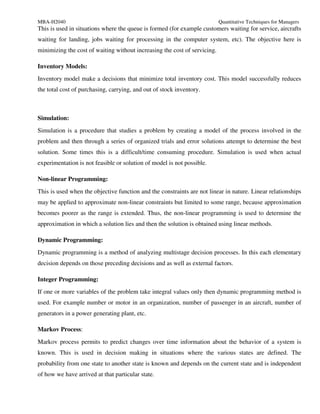
       Figure 1-1 Relationship between Manager/Decision Maker and O.R. Specialists

1.5 O.R. Tools and Techniques

Operations Research uses any suitable tools or techniques available. The common frequently used
tools/techniques are mathematical procedures, cost analysis, electronic computation. However,
operations researchers given special importance to the development and the use of techniques like linear
programming, game theory, decision theory, queuing theory, inventory models and simulation. In
addition to the above techniques, some other common tools are non-linear programming, integer
programming, dynamic programming, sequencing theory, Markov process, network scheduling
(PERT/CPM), symbolic Model, information theory, and value theory. There is many other Operations
Research tools/techniques also exists. The brief explanations of some of the above techniques/tools are
as follows:

Linear Programming:
This is a constrained optimization technique, which optimize some criterion within some constraints. In
Linear programming the objective function (profit, loss or return on investment) and constraints are
linear. There are different methods available to solve linear programming.

Game Theory:
This is used for making decisions under conflicting situations where there are one or more
players/opponents. In this the motive of the players are dichotomized. The success of one player tends to
be at the cost of other players and hence they are in conflict.

Decision Theory:
Decision theory is concerned with making decisions under conditions of complete certainty about the
future outcomes and under conditions such that we can make some probability about what will happen
in future.

Queuing Theory:
MBA-H2040                                                                  Quantitative Techniques for Managers
This is used in situations where the queue is formed (for example customers waiting for service, aircrafts
waiting for landing, jobs waiting for processing in the computer system, etc). The objective here is
minimizing the cost of waiting without increasing the cost of servicing.

Inventory Models:
Inventory model make a decisions that minimize total inventory cost. This model successfully reduces
the total cost of purchasing, carrying, and out of stock inventory.


Simulation:
Simulation is a procedure that studies a problem by creating a model of the process involved in the
problem and then through a series of organized trials and error solutions attempt to determine the best
solution. Some times this is a difficult/time consuming procedure. Simulation is used when actual
experimentation is not feasible or solution of model is not possible.

Non-linear Programming:
This is used when the objective function and the constraints are not linear in nature. Linear relationships
may be applied to approximate non-linear constraints but limited to some range, because approximation
becomes poorer as the range is extended. Thus, the non-linear programming is used to determine the
approximation in which a solution lies and then the solution is obtained using linear methods.

Dynamic Programming:
Dynamic programming is a method of analyzing multistage decision processes. In this each elementary
decision depends on those preceding decisions and as well as external factors.

Integer Programming:
If one or more variables of the problem take integral values only then dynamic programming method is
used. For example number or motor in an organization, number of passenger in an aircraft, number of
generators in a power generating plant, etc.

Markov Process:
Markov process permits to predict changes over time information about the behavior of a system is
known. This is used in decision making in situations where the various states are defined. The
probability from one state to another state is known and depends on the current state and is independent
of how we have arrived at that particular state.
MBA-H2040                                                               Quantitative Techniques for Managers
Network Scheduling:
This technique is used extensively to plan, schedule, and monitor large projects (for example computer
system installation, R & D design, construction, maintenance, etc.). The aim of this technique is
minimize trouble spots (such as delays, interruption, production bottlenecks, etc.) by identifying the
critical factors. The different activities and their relationships of the entire project are represented
diagrammatically with the help of networks and arrows, which is used for identifying critical activities
and path. There are two main types of technique in network scheduling, they are:

 Program Evaluation and Review Technique (PERT) – is used when activities time is not known
accurately/ only probabilistic estimate of time is available.
Critical Path Method (CPM) – is used when activities time is know accurately.

Information Theory:
This analytical process is transferred from the electrical communication field to O.R. field. The
objective of this theory is to evaluate the effectiveness of flow of information with a given system. This
is used mainly in communication networks but also has indirect influence in simulating the examination
of business organizational structure with a view of enhancing flow of information.

1.6 Applications of Operations Research
Today, almost all fields of business and government utilizing the benefits of Operations Research. There
are voluminous of applications of Operations Research. Although it is not feasible to cover all
applications of O.R. in brief. The following are the abbreviated set of typical operations research
applications to show how widely these techniques are used today:

       Accounting:
               Assigning audit teams effectively
               Credit policy analysis
               Cash flow planning
               Developing standard costs
               Establishing costs for byproducts
               Planning of delinquent account strategy
       Construction:
               Project scheduling, monitoring and control
               Determination of proper work force
               Deployment of work force
               Allocation of resources to projects
       Facilities Planning:
               Factory location and size decision
               Estimation of number of facilities required
               Hospital planning
MBA-H2040                                                              Quantitative Techniques for Managers
               International logistic system design
               Transportation loading and unloading
               Warehouse location decision
         Finance:
               Building cash management models
               Allocating capital among various alternatives
               Building financial planning models
               Investment analysis
               Portfolio analysis
               Dividend policy making
         Manufacturing:
               Inventory control
               Marketing balance projection
               Production scheduling
               Production smoothing
         Marketing:
               Advertising budget allocation
               Product introduction timing
               Selection of Product mix
               Deciding most effective packaging alternative
         Organizational Behavior / Human Resources:
               Personnel planning
               Recruitment of employees
               Skill balancing
               Training program scheduling
               Designing organizational structure more effectively
         Purchasing:
               Optimal buying
               Optimal reordering
               Materials transfer
         Research and Development:
               R & D Projects control
               R & D Budget allocation
               Planning of Product introduction
1.7 Limitations of Operations Research

Operations Research has number of applications; similarly it also has certain limitations. These
limitations are mostly related to the model building and money and time factors problems involved in its
application. Some of them are as given below:

   i)       Distance between O.R. specialist and Manager
            Operations Researchers job needs a mathematician or statistician, who might not be aware of
            the business problems. Similarly, a manager is unable to understand the complex nature of
            Operations Research. Thus there is a big gap between the two personnel.
   ii)      Magnitude of Calculations
MBA-H2040                                                                   Quantitative Techniques for Managers
              The aim of the O.R. is to find out optimal solution taking into consideration all the factors. In
              this modern world these factors are enormous and expressing them in quantitative model and
              establishing relationships among these require voluminous calculations, which can be
              handled only by machines.
    iii)      Money and Time Costs
              The basic data are subjected to frequent changes, incorporating these changes into the
              operations research models is very expensive. However, a fairly good solution at present may
              be more desirable than a perfect operations research solution available in future or after some
              time.
    iv)       Non-quantifiable Factors
              When all the factors related to a problem can be quantifiable only then operations research
              provides solution otherwise not. The non-quantifiable factors are not incorporated in O.R.
              models. Importantly O.R. models do not take into account emotional factors or qualitative
              factors.
    v)        Implementation
              Once the decision has been taken it should be implemented. The implementation of decisions
              is a delicate task. This task must take into account the complexities of human relations and
              behavior and in some times only the psychological factors.

1.8 Summary
Operations Research is relatively a new discipline, which originated in World War II, and became very
popular throughout the world. India is one of the few first countries in the world who started using
operations research. Operations Research is used successfully not only in military/army operations but
also in business, government and industry. Now a day’s operations research is almost used in all the
fields.

           Proposing a definition to the operations research is a difficult one, because its boundary and
content are not fixed. The tools for operations search is provided from the subject’s viz. economics,
engineering, mathematics, statistics, psychology, etc., which helps to choose possible alternative courses
of action. The operations research tool/techniques include linear programming, non-linear programming,
dynamic programming, integer programming, Markov process, queuing theory, etc.

           Operations Research has a number of applications. Similarly it has a number of limitations,
which is basically related to the time, money, and the problem involves in the model building. Day-by-
day operations research gaining acceptance because it improve decision making effectiveness of the
managers. Almost all the areas of business use the operations research for decision making.

1.9 Key Terms
MBA-H2040                                                                Quantitative Techniques for Managers
OR: Operations Research.
MS: Management Science.
Symbolic Model: An abstract model, generally using mathematical symbols.
Criterion: is measurement, which is used to evaluation of the results.
Integer Programming: is a technique, which ensures only integral values of variables in the problem.
Dynamic Programming: is a technique, which is used to analyze multistage decision process.
Linear Programming: is a technique, which optimizes linear objective function under limited
                        constraints.
Inventory Model: these are the models used to minimize total inventory costs.
Optimization: Means maximization or minimization.


1.10 Self Assessment Questions
Q1. Define Operations Research.
Q2. Describe the relationship between the manager and O.R. specialist.
Q3. Explain the various steps in the O.R. development process.
Q4. Discuss the applications of O.R.
Q5. Discuss the limitation of O.R.
Q6. Describe different techniques of O.R.
Q7. Discuss few areas of O.R. applications in your organization or organization you are familiar with.

1.11 Further References

Hamdy A Taha, 1999. Introduction to Operations Research, PHI Limited, New Delhi.

Sharma, J.K., 1989. Mathematical Models in Operations Research, Tata McGraw Hill Publishing
Company Ltd., New Delhi.
Beer, Stafford, 1966. Decision and Control, John Wiley & Sons, Inc., New York.
Levin, Rubin, Stinson, Gardner, 1992. Quantitative Approaches to Management, Tata McGraw Hill
Publishing Company Ltd. New Delhi.
Wagner, Harvery M., 1975. Principles of Operations Research, PHI, Egnlewood Cliffs, N.J.
MBA-H2040                                            Quantitative Techniques for Managers


UNIT I
LESSON


            2 LINEAR PROGRAMMING –GRAPHICAL METHOD


LESSON STRUCTURE

         2.1 Introduction to Linear Programming
         2.2 Linear Programming Problem
             Formulation
         2.3 Formulation with Different Types of
             Constraints
         2.4 Graphical Analysis of Linear
              Programming
         2.5 Graphical Linear Programming Solution
         2.6 Multiple Optimal Solutions
         2.7 Unbounded Solution
         2.8 Infeasible Solution
         2.9 Summary
         2.10 Key Terms
         2.11 Self Assessment Questions
         2.12 Key Solutions
         2.13 Further References
MBA-H2040                                        Quantitative Techniques for Managers


Objectives
After studying this lesson, you should be able
to:

      Formulate Linear Programming Problem
      Identify the characteristics of linear
      programming problem
      Make a graphical analysis of the linear
      programming problem
      Solve the problem graphically
      Identify the various types of solutions
MBA-H2040                                                              Quantitative Techniques for Managers

2.1 Introduction to Linear Programming

Linear Programming is a special and versatile technique which can be applied to a variety of
management problems viz. Advertising, Distribution, Investment, Production, Refinery Operations, and
Transportation analysis. The linear programming is useful not only in industry and business but also in
non-profit sectors such as Education, Government, Hospital, and Libraries. The linear programming
method is applicable in problems characterized by the presence of decision variables. The objective
function and the constraints can be expressed as linear functions of the decision variables. The
decision variables represent quantities that are, in some sense, controllable inputs to the system being
modeled. An objective function represents some principal objective criterion or goal that measures the
effectiveness of the system such as maximizing profits or productivity, or minimizing cost or
consumption. There is always some practical limitation on the availability of resources viz. man,
material, machine, or time for the system. These constraints are expressed as linear equations involving
the decision variables. Solving a linear programming problem means determining actual values of the
decision variables that optimize the objective function subject to the limitation imposed by the
constraints.
       The main important feature of linear programming model is the presence of linearity in the
problem. The use of linear programming model arises in a wide variety of applications. Some model
may not be strictly linear, but can be made linear by applying appropriate mathematical transformations.
Still some applications are not at all linear, but can be effectively approximated by linear models. The
ease with which linear programming models can usually be solved makes an attractive means of dealing
with otherwise intractable nonlinear models.

2.2 Linear Programming Problem Formulation

The linear programming problem formulation is illustrated through a product mix problem. The product
mix problem occurs in an industry where it is possible to manufacture a variety of products. A product
has a certain margin of profit per unit, and uses a common pool of limited resources. In this case the
linear programming technique identifies the products combination which will maximize the profit
subject to the availability of limited resource constraints.

Example 2.1:

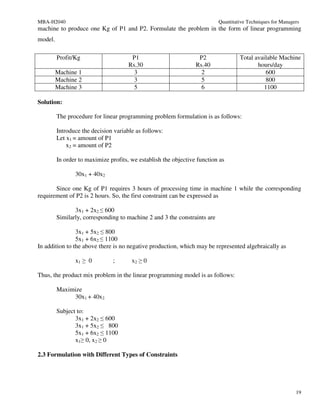
Suppose an industry is manufacturing tow types of products P1 and P2. The profits per Kg of the two
products are Rs.30 and Rs.40 respectively. These two products require processing in three types of
machines. The following table shows the available machine hours per day and the time required on each
                                                                                                         18
MBA-H2040                                                                  Quantitative Techniques for Managers
machine to produce one Kg of P1 and P2. Formulate the problem in the form of linear programming
model.

         Profit/Kg                     P1                         P2                Total available Machine
                                      Rs.30                      Rs.40                     hours/day
         Machine 1                      3                          2                          600
         Machine 2                      3                          5                          800
         Machine 3                      5                          6                         1100

Solution:

         The procedure for linear programming problem formulation is as follows:

         Introduce the decision variable as follows:
         Let x1 = amount of P1
             x2 = amount of P2

         In order to maximize profits, we establish the objective function as

                30x1 + 40x2

       Since one Kg of P1 requires 3 hours of processing time in machine 1 while the corresponding
requirement of P2 is 2 hours. So, the first constraint can be expressed as

                3x1 + 2x2 ≤ 600
         Similarly, corresponding to machine 2 and 3 the constraints are

                3x1 + 5x2 ≤ 800
                5x1 + 6x2 ≤ 1100
In addition to the above there is no negative production, which may be represented algebraically as

                x1 ≥ 0         ;       x2 ≥ 0

Thus, the product mix problem in the linear programming model is as follows:

         Maximize
              30x1 + 40x2

         Subject to:
                3x1 + 2x2 ≤ 600
                3x1 + 5x2 ≤ 800
                5x1 + 6x2 ≤ 1100
                x1≥ 0, x2 ≥ 0

2.3 Formulation with Different Types of Constraints


                                                                                                             19
MBA-H2040                                                              Quantitative Techniques for Managers
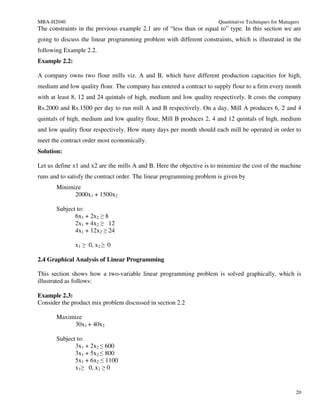
The constraints in the previous example 2.1 are of “less than or equal to” type. In this section we are
going to discuss the linear programming problem with different constraints, which is illustrated in the
following Example 2.2.
Example 2.2:

A company owns two flour mills viz. A and B, which have different production capacities for high,
medium and low quality flour. The company has entered a contract to supply flour to a firm every month
with at least 8, 12 and 24 quintals of high, medium and low quality respectively. It costs the company
Rs.2000 and Rs.1500 per day to run mill A and B respectively. On a day, Mill A produces 6, 2 and 4
quintals of high, medium and low quality flour, Mill B produces 2, 4 and 12 quintals of high, medium
and low quality flour respectively. How many days per month should each mill be operated in order to
meet the contract order most economically.
Solution:

Let us define x1 and x2 are the mills A and B. Here the objective is to minimize the cost of the machine
runs and to satisfy the contract order. The linear programming problem is given by
       Minimize
             2000x1 + 1500x2

       Subject to:
              6x1 + 2x2 ≥ 8
              2x1 + 4x2 ≥ 12
              4x1 + 12x2 ≥ 24

               x1 ≥ 0, x2 ≥ 0

2.4 Graphical Analysis of Linear Programming

This section shows how a two-variable linear programming problem is solved graphically, which is
illustrated as follows:

Example 2.3:
Consider the product mix problem discussed in section 2.2

       Maximize
            30x1 + 40x2

       Subject to:
              3x1 + 2x2 ≤ 600
              3x1 + 5x2 ≤ 800
              5x1 + 6x2 ≤ 1100
              x1≥ 0, x2 ≥ 0


                                                                                                         20
MBA-H2040                                                                  Quantitative Techniques for Managers
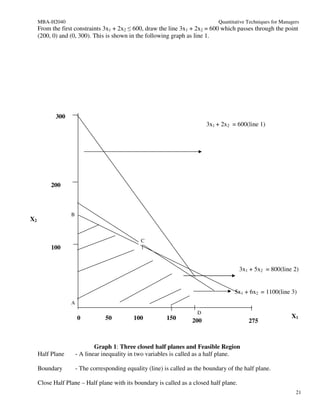
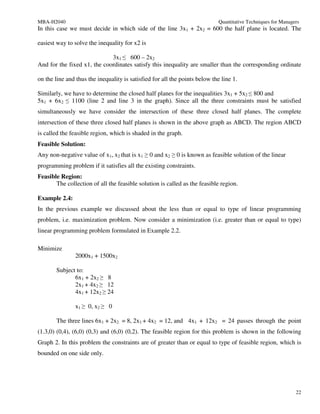
     From the first constraints 3x1 + 2x2 ≤ 600, draw the line 3x1 + 2x2 = 600 which passes through the point
     (200, 0) and (0, 300). This is shown in the following graph as line 1.


            300
                                                                           3x1 + 2x2 = 600(line 1)


          200


                  B
X2


                                                C
          100


                                                                                         3x1 + 5x2 = 800(line 2)


                                                                                       5x1 + 6x2 = 1100(line 3)
                  A
                                                                       D
                      0           50         100           150                                                  X1
                                                                     200                     275


                              Graph 1: Three closed half planes and Feasible Region
     Half Plane       - A linear inequality in two variables is called as a half plane.

     Boundary         - The corresponding equality (line) is called as the boundary of the half plane.

     Close Half Plane – Half plane with its boundary is called as a closed half plane.
                                                                                                                  21
MBA-H2040                                                                    Quantitative Techniques for Managers
In this case we must decide in which side of the line 3x1 + 2x2 = 600 the half plane is located. The

easiest way to solve the inequality for x2 is

                             3x1 ≤ 600 – 2x2
And for the fixed x1, the coordinates satisfy this inequality are smaller than the corresponding ordinate

on the line and thus the inequality is satisfied for all the points below the line 1.

Similarly, we have to determine the closed half planes for the inequalities 3x1 + 5x2 ≤ 800 and
5x1 + 6x2 ≤ 1100 (line 2 and line 3 in the graph). Since all the three constraints must be satisfied
simultaneously we have consider the intersection of these three closed half planes. The complete
intersection of these three closed half planes is shown in the above graph as ABCD. The region ABCD
is called the feasible region, which is shaded in the graph.
Feasible Solution:
Any non-negative value of x1, x2 that is x1 ≥ 0 and x2 ≥ 0 is known as feasible solution of the linear
programming problem if it satisfies all the existing constraints.
Feasible Region:
       The collection of all the feasible solution is called as the feasible region.

Example 2.4:
In the previous example we discussed about the less than or equal to type of linear programming
problem, i.e. maximization problem. Now consider a minimization (i.e. greater than or equal to type)
linear programming problem formulated in Example 2.2.

Minimize
                2000x1 + 1500x2

        Subject to:
               6x1 + 2x2 ≥ 8
               2x1 + 4x2 ≥ 12
               4x1 + 12x2 ≥ 24

                x1 ≥ 0, x2 ≥ 0

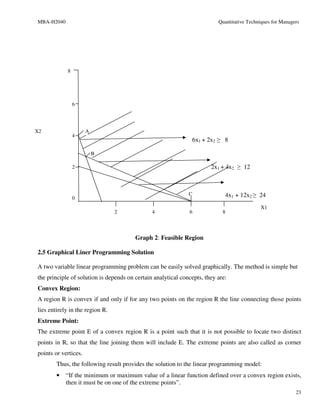
        The three lines 6x1 + 2x2 = 8, 2x1 + 4x2 = 12, and 4x1 + 12x2 = 24 passes through the point
(1.3,0) (0,4), (6,0) (0,3) and (6,0) (0,2). The feasible region for this problem is shown in the following
Graph 2. In this problem the constraints are of greater than or equal to type of feasible region, which is
bounded on one side only.


                                                                                                               22
MBA-H2040                                                                 Quantitative Techniques for Managers


            8


                6


X2                    A
                4
                                                               6x1 + 2x2 ≥ 8

                          B

                2                                                      2x1 + 4x2 ≥ 12


                0
                                                              C              4x1 + 12x2 ≥ 24
                                                                                            X1
                                 2             4              6             8


                                        Graph 2: Feasible Region

2.5 Graphical Liner Programming Solution

A two variable linear programming problem can be easily solved graphically. The method is simple but
the principle of solution is depends on certain analytical concepts, they are:
Convex Region:
A region R is convex if and only if for any two points on the region R the line connecting those points
lies entirely in the region R.
Extreme Point:
The extreme point E of a convex region R is a point such that it is not possible to locate two distinct
points in R, so that the line joining them will include E. The extreme points are also called as corner
points or vertices.
        Thus, the following result provides the solution to the linear programming model:
        •   “If the minimum or maximum value of a linear function defined over a convex region exists,
            then it must be on one of the extreme points”.
                                                                                                            23
MBA-H2040                                                            Quantitative Techniques for Managers

            In this section we are going to describe linear programming graphical solution for both the
     maximization and minimization problems, discussed in Example 2.3 and Example 2.4.


     Example 2. 5:

            Consider the maximization problem described in Example 2.3.

            Maximize
                   30x1 + 40x2
            Subject to:
                   3x1 + 2x2 ≤ 600
                   3x1 + 5x2 ≤ 800
                   5x1 + 6x2 ≤ 1100
                                                               M = 30x1 +40x2
                   x1 ≥ 0, x2 ≥ 0

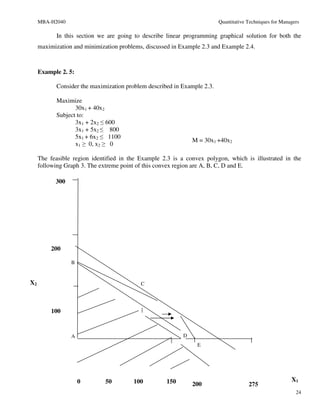
     The feasible region identified in the Example 2.3 is a convex polygon, which is illustrated in the
     following Graph 3. The extreme point of this convex region are A, B, C, D and E.

           300


          200

                 B


X2                                         C


          100


                 A                                         D
                                                                E


                     0        50        100          150                                                  X1
                                                               200                     275
                                                                                                            24
MBA-H2040                                                                   Quantitative Techniques for Managers


                       Graph 3: Graphical Linear Programming Solution

       In this problem the objective function is 30x1 + 40x2. Let be M is a parameter, the graph 30x1 +
40x2 = M is a group of parallel lines with slope – 30/40. Some of these lines intersects the feasible region
and contains many feasible solutions, whereas the other lines miss and contain no feasible solution. In
order to maximize the objective function, we find the line of this family that intersects the feasible
region and is farthest out from the origin. Note that the farthest is the line from the origin the greater will
be the value of M.
       Observe that the line 30x1 + 40x2 = M passes through the point D, which is the intersection of the
lines 3x1 + 5x2 = 800 and 5x1 + 6x2 = 1100 and has the coordinates x1 = 170 and x2 = 40. Since D is the
only feasible solution on this line the solution is unique.
       The value of M is 6700, which is the objective function maximum value. The optimum value
variables are x1 = 170 and X2 = 40.
       The following Table 1 shows the calculation of maximum value of the objective function.

      Extreme Point                               Coordinates                           Objective Function
                                        X1                         X2                      30x1 + 40x2
            A                          X1 = 0                     X2 = 0                         0
            B                          X1 = 0                    X2 = 160                      6400
            C                         X1 = 110                   X2 = 70                       6100
            D                         X1 = 170                   X2 = 40                       6700
            E                         X1 = 200                    X2 = 0                       6000

                Table 1: Shows the objective function Maximum value calculation

Example 2.6:
     Consider the minimization problem described in Example 2.4.

       Minimize
             2000x1 + 1500x2

       Subject to:
              6x1 + 2x2 ≥ 8
              2x1 + 4x2 ≥ 12
              4x1 + 12x2 ≥ 24
              x1≥ 0, x2 ≥ 0

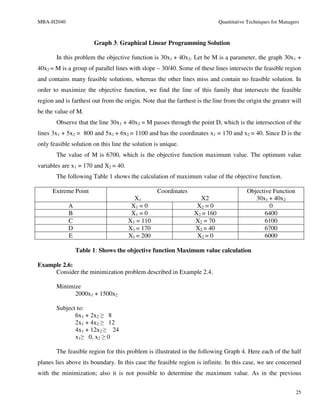
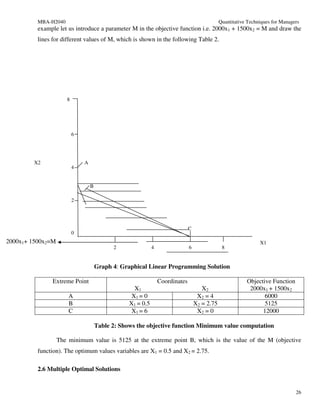
       The feasible region for this problem is illustrated in the following Graph 4. Here each of the half
planes lies above its boundary. In this case the feasible region is infinite. In this case, we are concerned
with the minimization; also it is not possible to determine the maximum value. As in the previous


                                                                                                              25
MBA-H2040                                                                            Quantitative Techniques for Managers
          example let us introduce a parameter M in the objective function i.e. 2000x1 + 1500x2 = M and draw the
          lines for different values of M, which is shown in the following Table 2.


                      8


                          6


         X2                   A
                          4


                                  B

                          2


                                                                               C
                          0
2000x1+ 1500x2=M                                                                                                 X1
                                            2                4                 6                8


                                      Graph 4: Graphical Linear Programming Solution

                Extreme Point                                    Coordinates                               Objective Function
                                                    X1                                X2                    2000x1 + 1500x2
                       A                           X1 = 0                           X2 = 4                        6000
                       B                          X1 = 0.5                         X2 = 2.75                      5125
                       C                           X1 = 6                           X2 = 0                       12000

                                      Table 2: Shows the objective function Minimum value computation

                   The minimum value is 5125 at the extreme point B, which is the value of the M (objective
          function). The optimum values variables are X1 = 0.5 and X2 = 2.75.

          2.6 Multiple Optimal Solutions


                                                                                                                                 26
MBA-H2040                                                                 Quantitative Techniques for Managers
When the objective function passed through only the extreme point located at the intersection of two
half planes, then the linear programming problem possess unique solutions. The previous examples i.e.
Example 2.5 and Example 2.6 are of this types (which possessed unique solutions).
       When the objective function coincides with one of the half planes generated by the constraints in
the problem, will possess multiple optimal solutions. In this section we are going to discuss about the
multiple optimal solutions of linear programming problem with the help of the following Example 2.7.


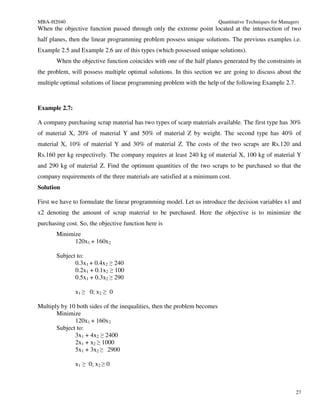
Example 2.7:

A company purchasing scrap material has two types of scarp materials available. The first type has 30%
of material X, 20% of material Y and 50% of material Z by weight. The second type has 40% of
material X, 10% of material Y and 30% of material Z. The costs of the two scraps are Rs.120 and
Rs.160 per kg respectively. The company requires at least 240 kg of material X, 100 kg of material Y
and 290 kg of material Z. Find the optimum quantities of the two scraps to be purchased so that the
company requirements of the three materials are satisfied at a minimum cost.
Solution

First we have to formulate the linear programming model. Let us introduce the decision variables x1 and
x2 denoting the amount of scrap material to be purchased. Here the objective is to minimize the
purchasing cost. So, the objective function here is
       Minimize
             120x1 + 160x2

       Subject to:
              0.3x1 + 0.4x2 ≥ 240
              0.2x1 + 0.1x2 ≥ 100
              0.5x1 + 0.3x2 ≥ 290

               x1 ≥ 0; x2 ≥ 0

Multiply by 10 both sides of the inequalities, then the problem becomes
       Minimize
              120x1 + 160x2
       Subject to:
              3x1 + 4x2 ≥ 2400
              2x1 + x2 ≥ 1000
              5x1 + 3x2 ≥ 2900

               x1 ≥ 0; x2 ≥ 0


                                                                                                            27
MBA-H2040                                                                  Quantitative Techniques for Managers
     Let us introduce parameter M in the objective function i.e. 120x1 + 160x2 = M. Then we have to

     determine the different values for M, which is shown in the following Table 3.

           Extreme Point                             Coordinates                            Objective Function
                                            X1                          X2                    120x1 + 160x2
                    A                     X1 = 0                    X2 = 1000                    160000
                    B                    X1 = 150                   X2 = 740                     136400
                    C                    X1 = 400                   X2 = 300                      96000
                    D                    X1=800                       X2=0                        96000


                        Table 3: Shows the calculation of Minimum objective function value

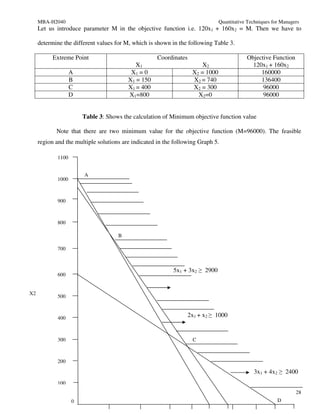
            Note that there are two minimum value for the objective function (M=96000). The feasible
     region and the multiple solutions are indicated in the following Graph 5.

             1100


                        A
             1000


             900


             800

                                     B

             700


                                                           5x1 + 3x2 ≥ 2900
             600


X2
             500


             400
                                                                   2x1 + x2 ≥ 1000


             300                                                    C


             200

                                                                                               3x1 + 4x2 ≥ 2400
             100
                                                                                                                  28
                    0                                                                                     D
MBA-H2040                                                                Quantitative Techniques for Managers


                                                                                                                X1
                      Graph 5: Feasible Region, Multiple Optimal Solutions

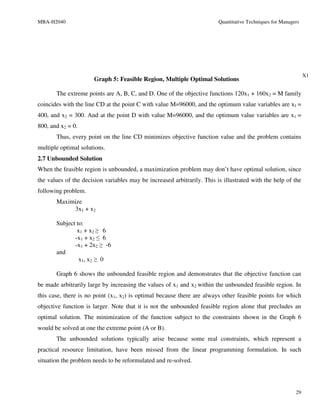
       The extreme points are A, B, C, and D. One of the objective functions 120x1 + 160x2 = M family
coincides with the line CD at the point C with value M=96000, and the optimum value variables are x1 =
400, and x2 = 300. And at the point D with value M=96000, and the optimum value variables are x1 =
800, and x2 = 0.
       Thus, every point on the line CD minimizes objective function value and the problem contains
multiple optimal solutions.
2.7 Unbounded Solution
When the feasible region is unbounded, a maximization problem may don’t have optimal solution, since
the values of the decision variables may be increased arbitrarily. This is illustrated with the help of the
following problem.
       Maximize
            3x1 + x2

       Subject to:
               x1 + x2 ≥ 6
              -x1 + x2 ≤ 6
              -x1 + 2x2 ≥ -6
       and
                x1, x2 ≥ 0

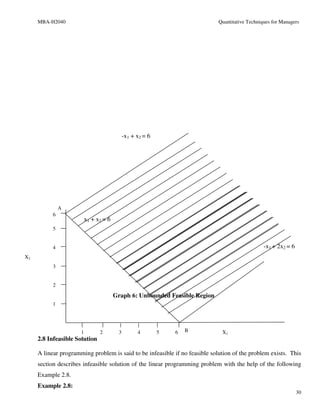
       Graph 6 shows the unbounded feasible region and demonstrates that the objective function can
be made arbitrarily large by increasing the values of x1 and x2 within the unbounded feasible region. In
this case, there is no point (x1, x2) is optimal because there are always other feasible points for which
objective function is larger. Note that it is not the unbounded feasible region alone that precludes an
optimal solution. The minimization of the function subject to the constraints shown in the Graph 6
would be solved at one the extreme point (A or B).
       The unbounded solutions typically arise because some real constraints, which represent a
practical resource limitation, have been missed from the linear programming formulation. In such
situation the problem needs to be reformulated and re-solved.


                                                                                                           29
MBA-H2040                                                               Quantitative Techniques for Managers


                                             -x1 + x2 = 6


               A
           6
                          x1 + x2 = 6
           5


           4                                                                                     -x1 + 2x2 = 6
X2
           3


           2

                                        Graph 6: Unbounded Feasible Region
           1


                      1         2        3         4        5   6   B         X1
     2.8 Infeasible Solution

     A linear programming problem is said to be infeasible if no feasible solution of the problem exists. This
     section describes infeasible solution of the linear programming problem with the help of the following
     Example 2.8.
     Example 2.8:
                                                                                                                 30
MBA-H2040                                                                Quantitative Techniques for Managers

Minimize
      200x1 + 300x2

Subject to:
       0.4x1 + 0.6x2 ≥ 240
       0.2x1 + 0.2x2 ≤ 80
       0.4x1 + 0.3x2 ≥ 180
       x1, x2 ≥ 0

On multiplying both sides of the inequalities by 10, we get

       4x1 + 6x2 ≥ 2400
       2x1 + 2x2 ≤ 800
       4x1 + 3x2 ≥ 1800
          700


                A
          600
                             4x1 + 3x2 = 1800

          500


                    B
          400
  X2


          300


          200                                               F
                                                                                   2x1 + 2x2 = 800

          100
                                                                                  4x1 + 6x2 = 2400

                0
                                                                        D
                                                                 C                            E
                              100         200         300        400        500         600       X1


                               Graph 7: Infeasible Solution

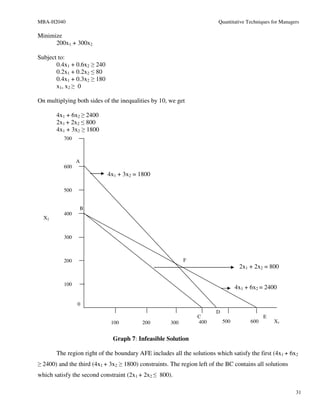
       The region right of the boundary AFE includes all the solutions which satisfy the first (4x1 + 6x2
≥ 2400) and the third (4x1 + 3x2 ≥ 1800) constraints. The region left of the BC contains all solutions
which satisfy the second constraint (2x1 + 2x2 ≤ 800).

                                                                                                           31
MBA-H2040                                                                  Quantitative Techniques for Managers
       Hence, there is no solution satisfying all the three constraints (first, second, and third). Thus, the
linear problem is infeasible. This is illustrated in the above Graph 7.
2.9 Summary

In Operations Research linear programming is a versatile technique with wide applications in various
management problems. Linear Programming problem has a number of characteristics. That is first we
have to identify the decision variable. The problem must have a well defined objective function, which
are expressed in terms of the decision variables.
       The objective function may have to be maximized when it indicates the profit or production or
contribution. If the objective function represents cost, in this case the objective function has to be
minimized.
       The management problem is expressed in terms of the decision variables with the objective
function and constraints. A linear programming problem is solved graphically if it contains only two
variables.

2.10 Key Terms

Objective Function: is a linear function of the decision variables representing the objective of the
                    manager/decision maker.

Constraints: are the linear equations or inequalities arising out of practical limitations.

Decision Variables: are some physical quantities whose values indicate the solution.

Feasible Solution: is a solution which satisfies all the constraints (including the non-negative) presents
       in the problem.

Feasible Region: is the collection of feasible solutions.

Multiple Solutions: are solutions each of which maximize or minimize the objective function.

Unbounded Solution: is a solution whose objective function is infinite.

Infeasible Solution: means no feasible solution.

2.11 Self Assessment Questions

Q1. A juice company has its products viz. canned apple and bottled juice with profit margin Rs.4 and
Rs.2 respectively pre unit. The following table shows the labour, equipment, and ingredients to produce
each product per unit.

                           Canned Apple                Bottled Juice                Total
Labour                     2.0                         3.0                          12.0
Equipment                  3.2                         1.0                          8.0
                                                                                                             32
MBA-H2040                                                                Quantitative Techniques for Managers
Ingredients                 2.4                       2.0                         9.0

Formulate the linear programming problem (model) specifying the product mix which will maximize the
profit without exceeding the levels of resources.


Q2. An organization is interested in the analysis of two products which can be produces from the idle
time of labour, machine and investment. It was notified on investigation that the labour requirement of
the first and the second products was 4 and 5 units respectively and the total available man hours was
48. Only first product required machine hour utilization of one hour per unit and at present only 10 spare
machine hours are available. Second product needs one unit of byproduct per unit and the daily
availability of the byproduct is 12 units. According to the marketing department the sales potential of
first product cannot exceed 7 units. In a competitive market, first product can be sold at a profit of Rs.6
and the second product at a profit of Rs.10 per unit.

        Formulate the problem as a linear programming model. Also determine graphically the feasible
region. Identify the redundant constraints if any.

Q3. Find graphically the feasible region of the linear programming problem given in Q1.

Q4. A bed mart company is in the business of manufacturing beds and pillows. The company has 40
hours for assembly and 32 hours for finishing work per day. Manufacturing of a bed requires 4 hours for
assembly and 2 hours in finishing. Similarly a pillow requires 2 hours for assembly and 4 hours for
finishing. Profitability analysis indicates that every bed would contribute Rs.80, while a pillow
contribution is Rs.55 respectively. Find out the daily production of the company to maximize the
contribution (profit).

Q5. Maximize
               1170x1 + 1110x2
     Subject to:
               9x1 + 5x2 ≥ 500
               7x1 + 9x2 ≥ 300
               5x1 + 3x2 ≤ 1500
               7x1 + 9x2 ≤ 1900
               2x1 + 4x2 ≤ 1000
               x1, x2 ≥ 0
Find graphically the feasible region and the optimal solution.

Q6. Solve the following LP problem graphically
       Minimize
               2x1 +1.7x2
       Subject to:
               0.15x1 + 0.10x2 ≥ 1.0
               0.75x1 + 1.70x2 ≥ 7.5
               1.30x1 + 1.10x2 ≥ 10.0

               x1, x2 ≥ 0

Q7. Solve the following LP problem graphically

                                                                                                           33
MBA-H2040                                           Quantitative Techniques for Managers
       Maximize
              2x1 + 3x2
       Subject to:
              x1 – x2 ≤ 1
              x1 + x2 ≥ 3
              x1, x2 ≥ 0

Q8. Graphically solve the following problem of LP
       Maximize
              3x1 + 2x2
       Subject to:
              2x1 – 3x2 ≥ 0
              3x1 + 4x2 ≤ -12
              x1, x2 ≥ 0


Q9. Solve the following problem graphically

       Maximize
              4x1 + 4x2
       Subject to:
              -2x1 + x2 ≤ 1
               x1      ≤ 2
               x1 + x2 ≤ 3
               x1, x2 ≥ 0

2.12 Key Solutions

Q1.
              Canned Apple x1
              Bottled Juice x2

              Maximize
                   4x1 + 2x2

              Subject to:
                     2x1 + 3x2 ≤ 12
                     3.2x1 + x2 ≤ 8
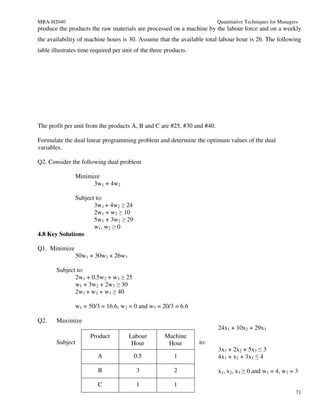
                     2.4x1 + 2x2 ≤ 9
                     x1, x2 ≥ 0

Q2.
              First Product x1
              Second Product x2

              Maximize
                     6x1 + 10x2
              Subject to:
                     4x1 + 5x2 ≤ 48
                       x1      ≤ 10
                                                                                      34
MBA-H2040                                                             Quantitative Techniques for Managers
                             x2 ≤ 12
                       x1        ≤ 7

                     x1, x2 ≥ 0
              The constraints x1 ≤ 10 is redundant.
Q4.
       Beds = 8
       Pillows = 4
       Maximum Profits is: Rs.860

Q5.
       Optimum variables values are: x1=271.4, x2=0
       The maximum value is: 317573

Q6.
       Optimum variables values are: x1=6.32, x2=1.63
       The minimum values is: 15.4

Q7.
       The solution is unbounded

Q8.
       The problem has no feasible solution

Q9.
       The problem has multiple solutions with the following optimum variable values:
       x1=2, x2 =1 or x1=2/3, x2=7/3

       The Maximum objective function value is: 12

2.13 Further References

Mittal, K.V. 1976. Optimization Methods in Operations Research and Systems Analysis, Wiley Eastern
Ltd, New Delhi.

Taha, H.A1999. Operations Research An Introduction, PHI Ltd., New Delhi.

Richard I.Levin, David S. Rubin, Joel P. Stinson, Everette S.Gardner, Jr.1992. Quantitative Approaches
to Management, McGraw Hill, NJ.


                                                                                                        35
MBA-H2040                                        Quantitative Techniques for Managers


UNIT I
LESSON


         3 LINEAR PROGRAMMING – SIMPLEX METHOD


LESSON STRUCTURE

3.1  Introduction
3.2  Basics of Simplex Method
3.3  Simplex Method Computation
3.4  Simplex Method with More Than Two
    Variables
3.5 Two Phase and M Method
3.5.1 Two Phase Method
3.5.2 M Method
3.6 Multiple Solutions
3.7 Unbounded Solution
3.8 Infeasible Solution
3.9 Summary
3.10 Key Terms
3.11 Self Assessment Questions
3.12 Key Solutions
3.13 3.13 Further References


                                                                                   36
MBA-H2040                                        Quantitative Techniques for Managers


Objectives
After Studying this lesson, you should be able
to:
    Understand the basics of simplex method
    Explain the simplex calculations
    Describe various solutions of Simplex
    Method
    Understand two phase and M method


                                                                                   37
MBA-H2040                                                                Quantitative Techniques for Managers
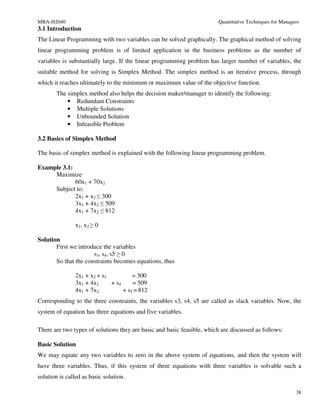
3.1 Introduction
The Linear Programming with two variables can be solved graphically. The graphical method of solving
linear programming problem is of limited application in the business problems as the number of
variables is substantially large. If the linear programming problem has larger number of variables, the
suitable method for solving is Simplex Method. The simplex method is an iterative process, through
which it reaches ultimately to the minimum or maximum value of the objective function.
       The simplex method also helps the decision maker/manager to identify the following:
           • Redundant Constraints
           • Multiple Solutions
           • Unbounded Solution
           • Infeasible Problem

3.2 Basics of Simplex Method

The basic of simplex method is explained with the following linear programming problem.

Example 3.1:
     Maximize
             60x1 + 70x2
     Subject to:
             2x1 + x2 ≤ 300
             3x1 + 4x2 ≤ 509
             4x1 + 7x2 ≤ 812

               x1, x2 ≥ 0

Solution
       First we introduce the variables
                      s3, s4, s5 ≥ 0
       So that the constraints becomes equations, thus

               2x1 + x2 + s3          = 300
               3x1 + 4x2     + s4     = 509
               4x1 + 7x2          + s5 = 812
Corresponding to the three constraints, the variables s3, s4, s5 are called as slack variables. Now, the
system of equation has three equations and five variables.

There are two types of solutions they are basic and basic feasible, which are discussed as follows:

Basic Solution
We may equate any two variables to zero in the above system of equations, and then the system will
have three variables. Thus, if this system of three equations with three variables is solvable such a
solution is called as basic solution.

                                                                                                           38
MBA-H2040                                                                 Quantitative Techniques for Managers

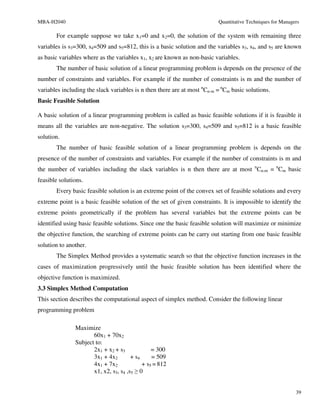
       For example suppose we take x1=0 and x2=0, the solution of the system with remaining three
variables is s3=300, s4=509 and s5=812, this is a basic solution and the variables s3, s4, and s5 are known
as basic variables where as the variables x1, x2 are known as non-basic variables.
       The number of basic solution of a linear programming problem is depends on the presence of the
number of constraints and variables. For example if the number of constraints is m and the number of
variables including the slack variables is n then there are at most nCn-m = nCm basic solutions.
Basic Feasible Solution

A basic solution of a linear programming problem is called as basic feasible solutions if it is feasible it
means all the variables are non-negative. The solution s3=300, s4=509 and s5=812 is a basic feasible
solution.
       The number of basic feasible solution of a linear programming problem is depends on the
presence of the number of constraints and variables. For example if the number of constraints is m and
the number of variables including the slack variables is n then there are at most nCn-m = nCm basic
feasible solutions.
       Every basic feasible solution is an extreme point of the convex set of feasible solutions and every
extreme point is a basic feasible solution of the set of given constraints. It is impossible to identify the
extreme points geometrically if the problem has several variables but the extreme points can be
identified using basic feasible solutions. Since one the basic feasible solution will maximize or minimize
the objective function, the searching of extreme points can be carry out starting from one basic feasible
solution to another.
       The Simplex Method provides a systematic search so that the objective function increases in the
cases of maximization progressively until the basic feasible solution has been identified where the
objective function is maximized.
3.3 Simplex Method Computation
This section describes the computational aspect of simplex method. Consider the following linear
programming problem

               Maximize
                      60x1 + 70x2
               Subject to:
                      2x1 + x2 + s3             = 300
                      3x1 + 4x2        + s4     = 509
                      4x1 + 7x2             + s5 = 812
                      x1, x2, s3, s4 ,s5 ≥ 0


                                                                                                            39
MBA-H2040                                                                       Quantitative Techniques for Managers
              The profit Z=60x1 + 70x2 i.e. Maximize 60x1 + 70x2
       The standard form can be summarized in a compact table form as

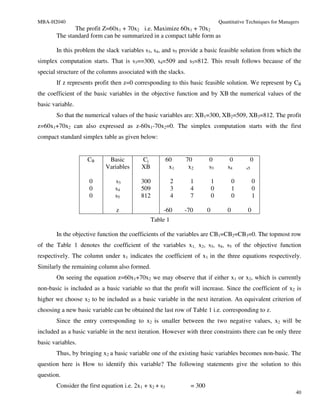
       In this problem the slack variables s3, s4, and s5 provide a basic feasible solution from which the
simplex computation starts. That is s3==300, s4=509 and s5=812. This result follows because of the
special structure of the columns associated with the slacks.
       If z represents profit then z=0 corresponding to this basic feasible solution. We represent by CB
the coefficient of the basic variables in the objective function and by XB the numerical values of the
basic variable.
       So that the numerical values of the basic variables are: XB1=300, XB2=509, XB3=812. The profit
z=60x1+70x2 can also expressed as z-60x1-70x2=0. The simplex computation starts with the first
compact standard simplex table as given below:


                    CB      Basic          Cj           60     70       0            0        0
                           Variables       XB            x1     x2      s3          s4      s5


                     0         s3         300             2     1           1           0        0
                     0         s4         509             3     4           0           1        0
                     0         s5         812             4     7           0           0        1

                                z                   -60       -70       0           0        0
                                                Table 1

       In the objective function the coefficients of the variables are CB1=CB2=CB3=0. The topmost row
of the Table 1 denotes the coefficient of the variables x1, x2, s3, s4, s5 of the objective function
respectively. The column under x1 indicates the coefficient of x1 in the three equations respectively.
Similarly the remaining column also formed.
       On seeing the equation z=60x1+70x2 we may observe that if either x1 or x2, which is currently
non-basic is included as a basic variable so that the profit will increase. Since the coefficient of x2 is
higher we choose x2 to be included as a basic variable in the next iteration. An equivalent criterion of
choosing a new basic variable can be obtained the last row of Table 1 i.e. corresponding to z.
       Since the entry corresponding to x2 is smaller between the two negative values, x2 will be
included as a basic variable in the next iteration. However with three constraints there can be only three
basic variables.
       Thus, by bringing x2 a basic variable one of the existing basic variables becomes non-basic. The
question here is How to identify this variable? The following statements give the solution to this
question.
       Consider the first equation i.e. 2x1 + x2 + s3           = 300
                                                                                                                  40
MBA-H2040                                                                    Quantitative Techniques for Managers

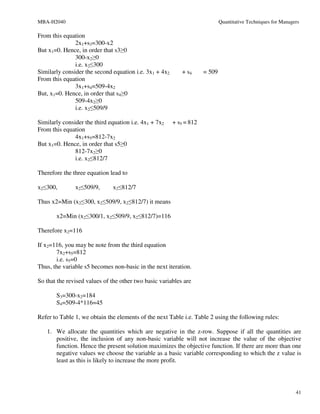
From this equation
               2x1+s3=300-x2
But x1=0. Hence, in order that s3≥0
               300-x2≥0
               i.e. x2≤300
Similarly consider the second equation i.e. 3x1 + 4x2      + s4      = 509
From this equation
               3x1+s4=509-4x2
But, x1=0. Hence, in order that s4≥0
               509-4x2≥0
               i.e. x2≤509/9

Similarly consider the third equation i.e. 4x1 + 7x2    + s5 = 812
From this equation
               4x1+s5=812-7x2
But x1=0. Hence, in order that s5≥0
               812-7x2≥0
               i.e. x2≤812/7

Therefore the three equation lead to

x2≤300,        x2≤509/9,       x2≤812/7

Thus x2=Min (x2≤300, x2≤509/9, x2≤812/7) it means

       x2=Min (x2≤300/1, x2≤509/9, x2≤812/7)=116

Therefore x2=116

If x2=116, you may be note from the third equation
       7x2+s5=812
       i.e. s5=0
Thus, the variable s5 becomes non-basic in the next iteration.

So that the revised values of the other two basic variables are

       S3=300-x2=184
       S4=509-4*116=45

Refer to Table 1, we obtain the elements of the next Table i.e. Table 2 using the following rules:

   1. We allocate the quantities which are negative in the z-row. Suppose if all the quantities are
      positive, the inclusion of any non-basic variable will not increase the value of the objective
      function. Hence the present solution maximizes the objective function. If there are more than one
      negative values we choose the variable as a basic variable corresponding to which the z value is
      least as this is likely to increase the more profit.


                                                                                                               41
MBA-H2040                                                                 Quantitative Techniques for Managers
   2. Let xj be the incoming basic variable and the corresponding elements of the jth row column be
      denoted by Y1j, Y2j and Y3j respectively. If the present values of the basic variables are XB1,
      XB2 and XB3 respectively, then we can compute.

       Min [XB1/Y1j, XB2/Y2j, XB3/Y3j] for Y1j, Y2j, Y3j>0.
       Note that if any Yij≤0, this need not be included in the comparison. If the minimum occurs
       corresponding to XBr/Yrj then the rth basic variable will become non-basic in the next iteration.

   3. Using the following rules the Table 2 is computed from the Table 1.

            i.     The revised basic variables are s3, s4 and x2. Accordingly, we make CB1=0, CB2=0
                   and CB3=70.

            ii.    As x2 is the incoming basic variable we make the coefficient of x2 one by dividing
                   each element of row-3 by 7. Thus the numerical value of the element corresponding
                   to x1 is 4/7, corresponding to s5 is 1/7 in Table 2.

            iii.   The incoming basic variable should appear only in the third row. So we multiply the
                   third-row of Table 2 by 1 and subtract it from the first-row of Table 1 element by
                   element. Thus the element corresponding to x2 in the first-row of Table 2 is 0.

                   Therefore the element corresponding to x1 is
                      2-1*4/7=10/7 and the element corresponding to s5 is
                      0-1*1/7=-1/7

      In this way we obtain the elements of the first and the second row in Table 2. In Table 2 the
numerical values can also be calculated in a similar way.


                    CB      Basic         Cj        60      70       0        0         0
                           Variables      XB         x1      x2      s3      s4       s5

                     0         s3         184      10/7      0       1         0      -1/7
                     0         s4          45       5/7      0       0         1      -4/7
                    70         x2         116       4/7      1       0         0       1/7

                              zj-cj                -140/7    0        0        0      70/7
                                               Table 2

       Let CB1, CB2, Cb3 be the coefficients of the basic variables in the objective function. For
example in Table 2 CB1=0, CB2=0 and CB3=70. Suppose corresponding to a variable J, the quantity zj is
defined as zj=CB1, Y1+CB2, Y2j+CB3Y3j. Then the z-row can also be represented as Zj-Cj.
For example:
       z1 - c1 = 10/7*0+5/7*0+70*4/7-60 = -140/7

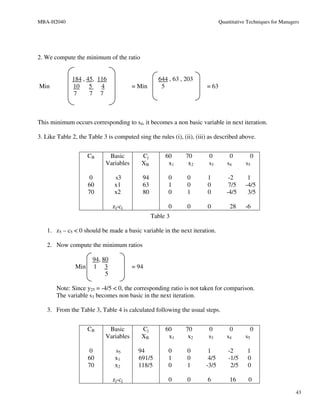
       z5 – c5 = -1/7*0-4/7*0+1/7*70-0 = 70/7

1. Now we apply rule (1) to Table 2. Here the only negative zj-cj is z1-c1 = -140/7
      Hence x1 should become a basic variable at the next iteration.
                                                                                                            42
MBA-H2040                                                                     Quantitative Techniques for Managers


2. We compute the minimum of the ratio


              184 , 45, 116                        644 , 63 , 203
Min           10 5       4              = Min       5                  = 63
               7     7 7


This minimum occurs corresponding to s4, it becomes a non basic variable in next iteration.

3. Like Table 2, the Table 3 is computed sing the rules (i), (ii), (iii) as described above.


                     CB      Basic         Cj         60      70        0         0         0
                            Variables      XB          x1      x2       s3       s4       s5

                      0         s3          94         0       0       1          -2       1
                     60         x1          63         1       0       0          7/5     -4/5
                     70         x2          80         0       1       0         -4/5      3/5

                                zj-cj                  0       0       0          28      -6
                                                 Table 3

   1. z5 – c5 < 0 should be made a basic variable in the next iteration.

   2. Now compute the minimum ratios

                       94, 80
               Min     1 3              = 94
                            5

       Note: Since y25 = -4/5 < 0, the corresponding ratio is not taken for comparison.
       The variable s3 becomes non basic in the next iteration.

   3. From the Table 3, Table 4 is calculated following the usual steps.


                     CB      Basic         Cj         60      70        0         0            0
                            Variables      XB          x1      x2       s3       s4       s5

                      0          s5       94           0       0        1         -2      1
                     60          x1       691/5        1       0        4/5       -1/5    0
                     70          x2       118/5        0       1       -3/5        2/5    0

                                zj-cj                  0       0       6          16       0
                                                                                                                43
MBA-H2040                                                                     Quantitative Techniques for Managers

      Note that zj – cj ≥ 0 for all j, so that the objective function can’t be improved any further.

      Thus, the objective function is maximized for x1 = 691/5 and x2=118/5 and

      The maximum value of the objective function is 9944.

3.4      Simplex Method with More Than Two Variables

In previous section we discussed the simplex method of linear programming problem with two decision
variables. The simplex method computational procedure can be readily extended to linear programming
problems with more than two variables. This is illustrated in this section with the help of the product
mix problem given in the following Example 3.2.

Example 3.2
An organization has three machine shops viz. A, B and C and it produces three product viz. X, Y and Z
using these three machine shops. Each product involves the operation of the machine shops. The time
available at the machine shops A, B and C are 100, 72 and 80 hours respectively. The profit per unit of
product X, Y and Z is $22, $6                                          and $2 respectively. The
following table shows the time        10           7           2       required for each operation for
unit amount of each product.                                           Determine an appropriate
product mix so as to maximize          2           3           4       the profit.
                                       1           2           1                      Machine
Shops
                                                                       A            B            C
                      Products                                          Profit/unit

                                 X $22

                                 Y     $6

                                 Z     $2

                 Available Hours            100          72             80

Solution

First we have to develop linear programming formulation. The linear programming formulation of the
product mix problem is:

                         Maximize
                              22x1 + 6x2 + 2x3

                         Subject to:
                                10x1 + 2x2 + x3 ≤ 100
                                7x1 + 3x2 + 2x3 ≤ 72
                                2x1 + 4x2 + x3 ≤ 80

                                 x1, x2, x3 ≥ 0

                                                                                                                44
MBA-H2040                                                                    Quantitative Techniques for Managers
We introduce slack variables s4, s5 and s6 to make the inequalities equation.
       Thus, the problem can be stated as
                      Maximize
                             22x1 + 6x2 + 2x3

                        Subject to:
                                10x1 + 2x2 + x3 + s4              = 100
                                7x1 + 3x2 + 2x3          + s5     = 72
                                2x1 + 4x2 + x3               + s6 = 80
                                x1, x2, x3, s4, s5, s6 ≥ 0
        From the above equation the simplex Table 1 can be obtained in a straight forward manner. Here
the basic variables are s4, s5 and s6. Therefore CB1 = CB2 = CB3 = 0.

          CB          Basic    Cj             22      6        2    0        0         0
                      Variable XB             x1      x2       x3   s4       s5        s6

          0           s4             100      10      2        1    1        0         0
          0           s5             72       7       3        2    0        1         0
          0           s6             80       2       4        1    0        0         1

                      zj-cj                   -22     -6       -2   0        0         0
                                                     Table 1

   1. z1-c1 = -22 is the smallest negative value. Hence x1 should be taken as a basic variable in the next
      iteration.
   2. Calculate the minimum of the ratios


                   Min        100 , 72 , 80   = 10
                               10 7 2

   The variable s4 corresponding to which minimum occurs is made a non basic variable.
   3. From the Table 1, the Table 2 is calculated using the following rules:

            i.        The revised basic variables are x1, s5, s6. Accordingly we make CB1=22, CB2=0 and
                      CB3=0.
            ii.       Since x1 is the incoming variable we make x1 coefficient one by dividing each
                      element of row 1 by 10. Thus the numerical value of the element corresponding to x2
                      is 2/10, corresponding to x3 is 1/10, corresponding to s4 is 1/10, corresponding to s5 is
                      0/10 and corresponding to s6 is 0/10 in Table 2.
            iii.      The incoming basic variable should only appear in the first row. So we multiply first
                      row of Table 2 by 7 and subtract if from the second row of Table 1 element by
                      element.
                      Thus,
                      The element corresponding to x1 in the second row of Table 2 is zero

                      The element corresponding to x2 is 3 – 7 * 2 = 16
                                                                 10 10

                   By using this way we get the elements of the second and the third row in Table 2.
                                                                                                               45
MBA-H2040                                                                    Quantitative Techniques for Managers

               Similarly, the calculation of numerical values of basic variables in Table 2 is done.

          CB       Basic    Cj         22       6        2       0           0         0
                   Variable XB         x1       x2       x3      s4          s5        s6

          22       x1         10       1        2/10     1/10    1/10        0         0
          0        s5         2        0        16/10    13/10   -7/10       1         0
          0        s6         60       0        18/5     4/5     -1/5        0         1

                   zj-cj               0       -8/5      1/5     12/5        0         0
                                              Table 2

   1. z2-c2 = -8/5. So x2 becomes a basic variable in the next iteration.
   2. Calculate the minimum of the ratios


                        10, 7 , 60
               Min       2 16 18            = Min 50, 70, 300         = 70
                         10 10 5                     16 18              16


       Hence the variable s5 will be a non basic variable in the next iteration.

   3. From Table 2, the Table 3 is calculated using the rules (i), (ii) and (iii) mentioned above.

          CB       Basic    Cj         22       6        2       0           0         0
                   Variable XB         x1       x2       x3      s4          s5        s6

          22       x1         73/8     1        0        -1/16   3/16        -1/8      0
          6        x2         30/8     0        1        13/16   -7/16       5/8       0
          0        s6         177/4    0        0        -17/8   11/8        -9/4      1

                   zj-cj               0       0         24/16   24/16       1         0
                                              Table 3

   Note that all zj – cj ≥0, so that the solution is x1 = 73/8, x2 = 30/8 and s6 = 177/4 maximizes the
   objective function.

   The Maximum Profit is: 22*73/8 + 6*30/8 = 1606/8 + 180/8

                                                = 1786/8 = $223.25

3.5 Tow Phase and M-Method

In the last two section we discussed the simplex method was applied to linear programming problems
with less than or equal to (≤) type constraints. Thus, there we could introduce slack variables which
provide an initial basic feasible solution of the problem.

                                                                                                               46
MBA-H2040                                                                      Quantitative Techniques for Managers
       Generally, the linear programming problem can also be characterized by the presence of both
‘less than or equal to’ type or ‘greater than or equal to (≥)’ type constraints. In such case it is not always
possible to obtain an initial basic feasible solution using slack variables.
       The greater than or equal to type of linear programming problem can be solved by using the
following methods:

                        1. Two Phase Method
                        2. M Method
In this section we will discuss these two methods.

3.5.1 Two Phase Method

We discuss the Two Phase Method with the help of the following Example 3.3.

Example 3.3
               Minimize
                     12.5x1 + 14.5x2

               Subject to:
                      x1 + x2 ≥ 2000
                      0.4x1 + 0.75x2 ≥ 1000
                      0.075x1 + 0.1x2 ≤ 200

                       x1, x2 ≥ 0
Solution
Here the objective function is to be minimized; the values of x1 and x2 which minimized this objective
function are also the values which maximize the revised objective function i.e.

               Maximize
                    -12.5x1 – 14.5x2

      We can multiply the second and the third constraints by 100 and 1000 respectively for the
convenience of calculation.

       Thus, the revised linear programming problem is:
              Maximize
                      -12.5x1 – 14.5x2
              Subject to:
                      x1 + x2 ≥ 2000
                      40x1 + 75x2 ≥ 100000
                      75x1 + 100x2 ≤ 200000
                      x1, x2 ≥ 0

       Now we convert the two inequalities by introducing surplus variables s3 and s4 respectively.
The third constraint is changed into an equation by introducing a slack variable s5.

       Thus, the linear programming problem becomes as
                                                                                                                 47
MBA-H2040                                                                Quantitative Techniques for Managers
        Maximize
             -12.5x1 – 14.5x2 = -25/2x1 – 29/2x2

        Subject to:
               x1 + x2 -s3                   = 2000
               40x1 + 75x2        -s4       = 100000
               75x1 + 100x2             +s5 = 200000

              x1, x2,s3,s4,s5 ≥ 0
        Even though the surplus variables can convert greater than or equal to type constraints into
equations they are unable to provide initial basic variables to start the simplex method calculation. So
we may have to introduce two more additional variables a6 and a7 called as artificial variable to
facilitate the calculation of an initial basic feasible solution.

        In this method the calculation is carried out in tow phases hence tow phase method.

Phase I
       In this phase we will consider the following linear programming problem

                Maximize
                     -a6 –a7

                Subject to:
                       x1 + x2 -s3        +a6        = 2000
                       40x1 + 75x2        -s4          + a7 = 100000
                       75x1 + 100x2             +s5 = 200000

                        x1, x2.s3,s4,s5,a6,a7 ≥ 0

        The initial basic feasible solution of the problem is
                        a6 = 2000, a7=100000 and s5 = 200000.

        As the minimum value of the objective function of the Phase I is zero at the end of the Phase I
calculation both a6 and a7 become zero.
       CB        Basic     Cj           0           0      0        0    0         -1        -1
                 variables XB           x1          x2     s3       s4   s5        a6        a7

       -1        a6          2000       1           1      -1       0    0         1         0
       -1        a7          100000     40          75     0        -1   0         0         1
       0         s5          200000     75          100    0        0    1         0         0
                             zj-cj      -41         -76    1        1    0         0         0
                                             Table 1
       Here x2 becomes a basic variable and a7 becomes non basic variable in the next iteration. It is no
longer considered for re-entry in the table.


                                                                                                           48
MBA-H2040                                                                         Quantitative Techniques for Managers
            CB        Basic     Cj            0         0         0          0           0         -1
                      variables XB            x1        x2        s3         s4          s5        a6

            -1        a6         2000/3       7/15      0         -1         1/75        0         1


            0         x2         4000/3       8/15      1         0          -1/75       0         0

            0         s5         200000/3 65/3          0         0          4/3         1         0
                                 zj-cj    -1/15         0         1          -1/75       0         0
       Table 2

       Then x1 becomes a basic variable and a6 becomes a non basic variable in the next iteration.

                 CB        Basic     Cj            0         0         0            0         0
                           variables XB            x1        x2        s3           s4        s5

                 0         x1        10000/7       1         0         -15/7        1/35      0


                 0         x2        4000/7        0         1         8/7          -1/35     0


                 0         s5        250000/7 0              0         325/7        16/21     1
                                     zj-cj    0              0         0            0         0
                                            Table 3
      The calculation of Phase I end at this stage. Note that, both the artificial variable have been
removed and also found a basic feasible solution of the problem.


       The basic feasible solution is:
                                         x1 = 10000/7, x2 = 4000/2, s5 = 250000/7.

Phase II
The initial basic feasible solution obtained at the end of the Phase I calculation is used as the initial basic
feasible solution of the problem. In this Phase II calculation the original objective function is introduced
and the usual simplex procedure is applied to solve the linear programming problem.


                                                                                                                    49
MBA-H2040                                                                  Quantitative Techniques for Managers
               CB        Basic     Cj              -25/2   -29/2   0         0         0
                         variables XB              x1      x2      s3        s4        s5

               -25/2     x1           10000/7      1       0       -15/7     1/35      0


               -29/2     x2           4000/7       0       1       8/7       -1/35     0


               0         s5           250000/7 0           0       325/7 5/7           1
                                      zj-cj    0           0       143/14 2/35         0
                                                 Table 1

       In this Table 1 all zj-cj ≥ 0 the current solution maximizes the revised objective function.

       Thus, the solution of the problem is:

                       x1 = 10000/7 = 1428 and x2 = 4000/7 = 571.4 and

       The Minimum Value of the objective function is: 26135.3

3.5.2 M Method
In this method also we need artificial variables for determining the initial basic feasible solution. The M
method is explained in the next Example 3.4 with the help of the previous Example 3.3.

Example 3.4
               Maximize
                     -12.5x1 – 14.5x2

               Subject to:
                      x1 + x2 –s3         = 2000
                      40x1 + 75x2 -s4     = 100000
                      75x1 + 100x2    +s5 = 200000

                       x1, x2, s3, s4, s5 ≥ 0.

Introduce the artificial variables a6 and a7 in order to provide basic feasible solution in the second and
third constraints. The objective function is revised using a large positive number say M.
       Thus, instead of the original problem, consider the following problem i.e.

       Maximize
                       -12.5x1 – 14.5x2 – M (a6 + a7)
       Subject to:
                       x1 + x2 –s3 + a6                = 2000
                       40x1 + 75x2 -s4 +a7 = 100000
                       75x1 + 100x2            +s5 = 200000
                       x1, x2, s3, s4, s5, a6, a7 ≥ 0.
                                                                                                             50
MBA-H2040                                                                           Quantitative Techniques for Managers
The coefficient of a6 and a7 are large negative number in the objective function. Since the objective
function is to be maximized in the optimum solution, the artificial variables will be zero. Therefore, the
basic variable of the optimum solution are variable other than the artificial variables and hence is a basic
feasible solution of the original problem.
          The successive calculation of simplex tables is as follows:

      CB           Basic     Cj           -12.5       -14.5     0         0           0           -M       -M
                   variables XB           x1          x2        s3        s4          s5          a6       a7

      -M           a6          2000       1           1         -1        0           0           1        0


      -M           a7          100000 40              75        0         -1          0           0        1


      0            s5          200000 75         100     0       0        1        0      0
                               zj-cj  -41M       -76M M          M        0        0      0
                                      +12.5      +14.5
                                             Table 1
          Since M is a large positive number, the coefficient of M in the zj – cj row would decide the
entering basic variable. As -76M < -41M, x2 becomes a basic variable in the next iteration replacing a7.
The artificial variable a7 can’t be re-entering as basic variable.


           CB           Basic     Cj          -12.5         -14.5    0         0             0         -M
                        variables XB          x1            x2       s3        s4            s5        a6

           -M           a6       2000/3       7/15          0        -1        1/75          0         1


           -14.5        x2       4000/3       8/15          1        0         -1/75         0         0


           0            s5       200000/3 65/3              0        0         4/3     1               0
                                 zj-cj    -7/15M            0        M         -M/75   0               0
                                          +143/30                              +29/150
                                                  Table 2

        Now x1 becomes a basic variable replacing a6. Like a7 the variable a6 also artificial variable so it
can’t be re-entering in the table.


                                                                                                                      51
MBA-H2040                                                                  Quantitative Techniques for Managers
             CB         Basic     Cj          -12.5        -14.5   0          0          0
                        variables XB          x1           x2      s3         s4         s5

             -12.5      x1        10000/7     1            0       -15/7      1/35       0


             -14.5      x2        4000/7      0            1       8/7        -1/35      0


             0          s5        250000/7 0               0       325/7 16/21           1
                                  zj-cj    0               0       143/14 2/35           0


                                              Table 3

       Hence
                 The optimum solution of the problem is x1 = 10000/7, x2 = 4000/7 and

                 The Minimum Value of the Objective Function is: 26135.3

3.6 Multiple Solutions

The simplex method also helps in identifying multiple solutions of a linear programming problem. This
is explained with the help of the following Example 3.5.


Example 3.5
       Consider the following linear programming problem.

       Maximize
            2000x1 + 3000x2

       Subject to:
              6x1 + 9x2 ≤ 100
              2x1 + x2 ≤ 20

                 x1, x2 ≥ 0.

Solution
       Introduce the slack variables s3 and s4, so that the inequalities can be converted in to equation as
follows:
              6x1 + 9x2 + s3      = 100
              2x1 + x2       + s4 = 20

             x1, x2, s3, s4 ≥ 0.
       The computation of simple procedure and tables are as follows:


                                                                                                             52
MBA-H2040                                                                   Quantitative Techniques for Managers
                    CB       Basic     Cj            2000    3000      0           0
                             variables XB            x1      x2        s3          s4


                    0        s3         100          6       9         1           0


                    0        s4         20           2       1         0           1


                                          zj-cj      -2000   -3000     0           0
                                               Table 1

                    CB      Basic     Cj             2000    3000      0           0
                            variables XB             x1      x2        s3          s4


                    0       x2          100/9        2/3     1         1/9         0


                    0       s4          80/9         4/3     0         -1/9        1


                                          zj-cj      0       0         3000/9 0
                                               Table 2

        Here zj-cj ≥ 0 for all the variables so that we can’t improve the simplex table any more. Hence it
is optimum.

       The optimum solution is x1 = 0, x2 = 100/9 and

       The maximum value of the objective function is: 100000/3 = 33333.33.

       However, the zj-cj value corresponding to the non basic variable x1 is also zero. This indicates
that there is more than one optimum solution for the problem exists.
       In order to calculate the value of the alternate optimum solution we have to introduce x1 as a
basic variable replacing s4. The next Table 3 shows the computation of this.


                                                                                                              53
MBA-H2040                                                                   Quantitative Techniques for Managers

                    CB       Basic     Cj                2000   3000   0           0
                             variables XB                x1     x2     s3          s4


                    3000     x2             20/3         0      1      1/6         1/2


                    2000     x1             20/3         1      0      -1/12       3/4


                                              zj-cj      0      0      1000/3 3000
                                                   Table 3

       Thus,
               x1 = 20/3, x2 = 20/3 also maximize the objective function and

               The Maximum value of the objective function is: 100000/3 = 33333.33

       Thus, the problem has multiple solutions.

3.7 Unbounded Solution

In this section we will discuss how the simplex method is used to identify the unbounded solution. This
is explained with the help of the following Example 3.6.

Example 3.6
     Consider the following linear programming problem.
            Maximize
                    5x1 + 4x2
            Subject to:
                    x1 – x2 ≤ 8
                    x1 ≤ 7

                      x1, x2 ≥ 0.

Solution :

Introduce the slack variables s3 and s4, so that the inequalities becomes as equation as follows:

                      x1 + s3 = 7
                      x1 – x2 + s4 = 8

                      x1, x2, s3, s4 ≥ 0.

       The calculation of simplex procedures and tables are as follows:


                                                                                                              54
MBA-H2040                                                                 Quantitative Techniques for Managers

                    CB       Basic     Cj            5       4       0           0
                             variables XB            x1      x2      s3          s4


                    0        s3          7           1       0       1           0

                    0        s4          8           1       -1      0           1


                                             zj-cj   -5      -4      0           0
                                               Table 1

                    CB       Basic     Cj            5       4       0           0
                             variables XB            x1      x2      s3          s4


                    5        x1          7           1       0       1           0

                    0        s4          1           0       -1      -1          1


                                             zj-cj   0       -4      5           0
                                               Table 2

       Note that z2-c2 < 0 which indicates x2 should be introduced as a basic variable in the next
iteration. However, both y12≤0, y22≤0.
       Thus, it is not possible to proceed with the simplex method of calculation any further as we
cannot decide which variable will be non basic at the next iteration. This is the criterion for unbounded
solution.

NOTE: If in the course of simplex computation zj-cj < 0 but yij ≤ 0 for all i then the problem has no
finite solution.

        But in this case we may observe that the variable x2 is unconstrained and can be increased
arbitrarily. This is why the solution is unbounded.

3.8 Infeasible Solution

This section illustrates how to identify the infeasible solution using simplex method. This is explained
with the help of the following Example 3.7.

Example 3.7

                                                                                                            55
MBA-H2040                                                                 Quantitative Techniques for Managers
Consider the following problem.
               Minimize
                      200x1 + 300x2

               Subject to:
                      2x1 + 3x2 ≥ 1200
                      x1 + x2 ≤ 400
                      2x1 + 3/2x2 ≥ 900

                        x1, x2 ≥ 0
Solution

Since it is a minimization problem we have to convert it into maximization problem and introduce the
slack, surplus and artificial variables. The problem appears in the following manner after doing all these
procedure.
              Maximize
                   -200x1 - 300x2
       Subject to:
                   2x1 + 3x2 -s3 +a6 = 1200
                   x1 + x2        +s4 = 400
                   2x1 + 3/2x2 - s5 + a7 = 900

                        x1, x2, s3, s4, s5, a6, a7 ≥ 0

Here the a6 and a7 are artificial variables. We use two phase method to solve this problem.

Phase I
       Maximize
              -a6 –a7
       Subject to:
              2x1 + 3x2 -s3 +a6 = 1200
              x1 + x2        +s4 = 400
              2x1 + 3/2x2 - s5 + a7 = 900

               x1, x2, s3, s4, s5, a6, a7 ≥ 0


       The calculation of simplex procedures and tables are as follows:
       CB       Basic     Cj             0          0        0    0       0         -1        -1
                variables XB             x1         x2       s3   s4      s5        a6        a7

       -1       a6           1200        2          3        -1   0       0         1         0
       0        s4           400         1          1        0    1       0         0         1
       -1       a7           900         2          3/2      0    0       -1        0         0
                             zj-cj       -4         -9/2     1    0       1         0         0
                                                   Table 1

                                                                                                            56
MBA-H2040                                                                   Quantitative Techniques for Managers
       CB        Basic     Cj          0        0         0        0         0        -1
                 variables XB          x1       x2        s3       s4        s5       a7

       0         x2          400       2/3      1         -1/3     0         0        0
       0         s4          0         1/3      0         1/3      1         0        0
       -1        a7          300       1        0         1/2      0         -1       1
                             zj-cj     -1       0         -1/2     0         1        0
                                                Table 2

       CB        Basic     Cj          0        0         0        0         0        -1
                 variables XB          x1       x2        s3       s4        s5       a7

       0         x2          400       0        1         -1       -2        0        0
       0         x1          0         1        0         1        3         0        0
       -1        a7          300       0        0         -1/2     -3        -1       1
                             zj-cj     0        0         1/2      3         1        0
                                                Table 3

        Note that zj-cj ≥ 0 for all the variables but the artificial variable a7 is still a basic variable. This
situation indicates that the problem has no feasible solution.

3.9 Summary

The simplex method is very useful and appropriate method for solving linear programming problem
having more than tow variables. The slack variables are introduced for less that or equal to type, surplus
variables are introduce for greater than or equal to type of linear programming problem. The basic
feasible solution is important in order to solve the problem using the simplex method.
        A basic feasible solution of a system with m-equations and n-variables has m non-negative
variables called as basic variables and n-m variables with value zero known as non-basic variables. The
objective function is maximized or minimized at one of the basic feasible solutions.
        Surplus variables can’t provide the basic feasible solution instead artificial variables are used to
get the basic feasible solutions and it initiate the simplex procedure. Two phase and M-Method are
available to solve linear programming problem in these case.

        The simplex method also used to identify the multiple, unbounded and infeasible solutions.

3.10 Key Terms

Basic Variable: Variable of a basic feasible solution has n non-negative value.

Non Basic Variable: Variable of a feasible solution has a value equal to zero.


                                                                                                              57
MBA-H2040                                                               Quantitative Techniques for Managers
Artificial Variable: A non-negative variable introduced to provide basic feasible solution and initiate
the simplex procedures.

Slack Variable: A variable corresponding to a ≤ type constraint is a non-negative variable introduced to
convert the inequalities into equations.

Surplus Variable: A variable corresponding to a ≥ type constraint is a non-negative variable introduced
to convert the constraint into equations.

Basic Solution: System of m-equation and n-variables i.e. m<n is a solution where at least n-m
variables are zero.

Basic Feasible Solution: System of m-equation and n-variables i.e. m<n is a solution where m variables
are non-negative and n-m variables are zero.

Optimum Solution: A solution where the objective function is minimized or maximized.

3.11 Self Assessment Questions

Q1. A soft drinks company has a two products viz. Coco-cola and Pepsi with profit of $2 an $1 per unit.
The following table illustrates the labour, equipment and materials to produce per unit of each product.
Determine suitable product mix which maximizes the profit using simplex method.

                                      Pepsi             Coco-cola           Total Resources


              Labour                    3                     2              12
                                        1                    2.3
              Equipment                                                      6.9
                                        1                    1.4
              Material                                                       4.9


Q2. A factory produces three using three types of ingredients viz. A, B and C in different proportions.
The following table shows the requirements o various ingredients as inputs per kg of the products.

                                              Ingredients
       Products              A                     B                C

             1
                            4                      8                    8
             2              4                      6                    4

             3              8                      4                    0


The three profits coefficients are 20, 20 and 30 respectively. The factory has 800 kg of ingredients A,
1800 kg of ingredients B and 500 kg of ingredient C.

Determine the product mix which will maximize the profit and also find out maximum profit.
                                                                                                          58
MBA-H2040                                                          Quantitative Techniques for Managers

Q3. Solve the following linear programming problem using two phase and M method.

       Maximize
              12x1 + 15x2 + 9x3
       Subject to:
              8x1 + 16x2 + 12x3 ≤ 250
              4x1 + 8x2 + 10x3 ≥ 80
              7x1 + 9x2 + 8x3 =105
              x1, x2, x3 ≥ 0

Q4. Solve the following linear programming problem using simplex method.

       Maximize
              3x1 + 2x2
       Subject to:
              x1 –x2 ≤ 1
              x1 + x2 ≥ 3
              x1, x2 ≥ 0

Q5. Solve the following linear programming problem using simplex method.
       Maximize
               x1 + x2
       Subject to:
               -2x1 + x2 ≤ 1
               x1         ≤2
               x1 + x2 ≤ 3
               x1, x2, x3 ≥ 0

Q6. Maximize
               P = 3x1 + 4x2 + x3
    Subject to:
               x1 + 2x2 + x3 ≤ 6
               2x1        +2x3 ≤ 4
               3x1 + x2 + x3 ≤ 9
               x1, x2, x3 ≥ 0
3.12 Key Solutions

Q1. Coco-Cola = 20/9, Pepsi = 161/90
    Maximum Profit = $6.23

Q2. x1 = 0, x2 = 125, x3 = 75/2
    Maximum Profit = 5375

Q3. x1 = 6, x2 = 7, x3 = 0
    Maximum Profit = 177

Q4. Unbounded Solution

Q5. x1 = 2, x2 = 1   or x1 = 2/3, x2 = 7/3
                                                                                                     59
MBA-H2040                                                            Quantitative Techniques for Managers
    Maximum Profit = 3.

Q6. x1 = 2, x2 = 2, x3 = 0
    Maximum P = 14


3.13. Further References

Hamdy A Taha, 1999. Introduction to Operations Research, PHI Limited, New Delhi.

Mustafi, C.K. 1988. Operations Research Methods and Practices, Wiley Eastern Limited, New Delhi.

Levin, R and Kirkpatrick, C.A. 1978. Quantitative Approached to Management, Tata McGraw Hill,
Kogakusha Ltd., International Student Edition.

Peterson R and Silver, E. A. 1979. Decision Systems for Inventory Management and Production
Planning.

Handley, G and T.N. Whitin. 1983. Analysis of Inventory Systems, PHI.

Starr, M.K. and D.W. Miller. 1977. Inventory Control Theory and Practice, PHI.


UNIT I


                                                                                                       60
MBA-H2040                                                          Quantitative Techniques for Managers


LESSON

               4 DUAL LINEAR PROGRAMMING PROBLEMS


LESSON STRUCTURE

         4.1    Introduction
         4.2    Dual Problem Formulation
         4.3    Dual Problem Properties
         4.4    Simple Way of Solving Dual Problem
         4.5    Summary
         4.6    Key Terms
         4.7    Self Assessment Questions
         4.8    Key Solutions
         4.9    Further References                   Objectives
                                                     After Studying this lesson, you should be able
                                                     to:
                                                            Understand the Dual Linear programming
                                                            Problem
                                                            Formulate a Dual Problem
                                                            Solve the Dual Linear Programming
                                                            Problem
                                                            Understand the Properties of a Dual
                                                            Problem


                                                                                                     61
MBA-H2040                                                              Quantitative Techniques for Managers
4.1 Introduction

For every linear programming problem there is a corresponding linear programming problem called the
dual. If the original problem is a maximization problem then the dual problem is minimization problem
and if the original problem is a minimization problem then the dual problem is maximization problem.
In either case the final table of the dual problem will contain both the solution to the dual problem and
the solution to the original problem.
       The solution of the dual problem is readily obtained from the original problem solution if the
simplex method is used.
       The formulation of the dual problem also sometimes referred as the concept of duality is helpful
for the understanding of the linear programming. The variable of the dual problem is known as the dual
variables or shadow price of the various resources. The dual problem is easier to solve than the original
problem. The dual problem solution leads to the solution of the original problem and thus efficient
computational techniques can be developed through the concept of duality. Finally, in the competitive
strategy problem solution of both the original and dual problem is necessary to understand the complete
problem.
4.2 Dual Problem Formulation

If the original problem is in the standard form then the dual problem can be formulated using the
following rules:
       The number of constraints in the original problem is equal to the number of dual variables. The
       number of constraints in the dual problem is equal to the number of variables in the original
       problem.
       The original problem profit coefficients appear on the right hand side of the dual problem
       constraints.
       If the original problem is a maximization problem then the dual problem is a minimization
       problem. Similarly, if the original problem is a minimization problem then the dual problem is a
       maximization problem.
       The original problem has less than or equal to (≤) type of constraints while the dual problem has
       greater than or equal to (≥) type constraints.
       The coefficients of the constraints of the original problem which appear from left to right are
       placed from top to bottom in the constraints of the dual problem and vice versa.

   The Dual Linear Programming Problem is explained with the help of the following Example 4.1.

Example 4.1

Consider the following product mix problem:


                                                                                                          62
MBA-H2040                                                                                 Quantitative Techniques for Managers
Three machine shops A, B, C produces three types of products X, Y, Z respectively. Each product
involves operation of each of the machine shops. The time required for each operation on various
products is given as follows:

                                                   Machine Shops
                   Products             A               B                            C             Profit per unit

                          X                                                                        $12
                                        10                    7                      2
                          Y                                                                        $3
                                        2                     3                      4
                          Z                                                                        $1
                                        1                     2                      1
       Available Hours                  100                   77                     80

       The available hours at the machine shops A, B, C are 100, 77, and 80 only. The profit per unit of
products X, Y, and Z is $12, $3, and $1 respectively.

Solution:

       The formulation of Linear Programming (original problem) is as follows:
Maximize
              12x1 + 3x2 + x3
Subject to:
              10x1 + 2x2 + x3 ≤ 100
              7x1 + 3x2 + 2x3 ≤ 77
              2x1 + 4x2 + x3 ≤ 80

                 x1, x2, x3 ≥ 0

We introduce the slack variables s4, s5 and s6 then the equalities becomes as:

                 Maximize
                      12x1 + 3x2 + x3

                 Subject to:
                        10x1 + 2x2 + x3                + s4             = 100
                        7x1 + 3x2 + 2x3                    + s5         = 77
                        2x1 + 4x2 + x3                  +s6             = 80

                          x1, x2, x3, s4, s5, s6 ≥ 0

Form the above equations, the first simplex table is obtained is as follows:

            CB       Basic    Cj              12        3          1            0          0        0
                     Variable XB              x1        x2         x3           s4         s5       s6

            0        s4           100         10        2          1            1          0        0

                                                                                                                             63
MBA-H2040                                                                    Quantitative Techniques for Managers
          0           s5            77      7       3        2       0        1        0
          0           s6            80      2       4        1       0        0        1

                      zj-cj              -12      -3      -1      0       0        0
                                        Table 1
Note that the basic variables are s4, s5 and s6. Therefore CB1 = 0, CB2 = 0, CB3 = 0.

   1. The smallest negative element in the above table of z1 – c1 is -12. Hence, x1 becomes a basic
      variable in the next iteration.

   2. Determine the minimum ratios

                   Min        100, 72, 80   = 10
                              10 7 2

       Here the minimum value is s4, which is made as a non-basic variable.

   3. The next Table 2 is calculated using the following rules:

            (i)       The revised basic variables are x1, s5, s6. Accordingly we make CB1=22, CB2=0 and
                      CB3=0.

            (ii)      Since x1 is the incoming variable we make x1 coefficient one by dividing each
                      element of row 1 by 10. Thus the numerical value of the element corresponding to x2
                      is 2/10, corresponding to x3 is 1/10, corresponding to s4 is 1/10, corresponding to s5 is
                      0/10 and corresponding to s6 is 0/10 in Table 2.

            (iii)     The incoming basic variable should only appear in the first row. So we multiply first
                      row of Table 2 by 7 and subtract if from the second row of Table 1 element by
                      element.
                      Thus,
                      The element corresponding to x1 in the second row of Table 2 is zero

                      The element corresponding to x2 is 3 – 7 * 2 = 16
                                                                 10 10

                   By using this way we get the elements of the second and the third row in Table 2.

                   Similarly, the calculation of numerical values of basic variables in Table 2 is done.

          CB          Basic    Cj           22      6        2       0        0        0
                      Variable XB           x1      x2       x3      s4       s5       s6

          12          x1            10      1       2/10     1/10    1/10     0        0
          0           s5            7       0       16/10    13/10   -7/10    1        0
          0           s6            60      0       18/5     4/5     -1/5     0        1

                      zj-cj                 0       -3/5     1/5     6/5      0        0

                                                   Table 2
                                                                                                                64
MBA-H2040                                                                      Quantitative Techniques for Managers

   4. z2-c2 = -3/5. So x2 becomes a basic variable in the next iteration.


   5. Determine the minimum of the ratios


                        10, 7 , 60
               Min       2 16 18             = Min 50, 70, 300          = 70
                         10 10 5                      16 18               16


       So that the variable s5 will be a non basic variable in the next iteration.

   6. From Table 2, the Table 3 is calculated using the rules (i), (ii) and (iii) mentioned above.

          CB       Basic    Cj          12       3       1         0            0        0
                   Variable XB          x1       x2      x3        s4           s5       s6

          12       x1          73/8     1        0       -1/16     3/16         -1/8     0
          3        s5          35/8     0        1       13/16     -7/16        5/8      0
          0        s6          177/4    0        0       -17/8     11/8         -9/4     1

                   zj-cj                0      0         11/16     15/16        3/8      0
                                       Table 3

Since all the zi – cj ≥ 0, the optimum solution is as:

                        x1 = 73/8 and x2 = 35/8 and

The Maximum Profit is: $981/8 = $122.625

Suppose an investor is deciding to purchase the resources A, B, C. What offers is he going to produce?

Let, assume that W1, W2 and W3 are the offers made per hour of machine time A, B and C respectively.
Then these prices W1, W2 and W3 must satisfy the conditions given below:

   1. W1, W2, W3 ≥ 0

   2. Assume that the investor is behaving in a rational manner; he would try to bargain as much as
      possible so that the total annual payable to the produces would be as little as possible. This leads
      to the following condition:

       Minimize
             100W1 + 77W2 + 80W3


                                                                                                                  65
MBA-H2040                                                                  Quantitative Techniques for Managers
   3. The total amount offer by the investor to the three resources viz. A, B and C required to produce
      one unit of each product must be at least as high as the profit gained by the producer per unit.

          Since, these resources enable the producer to earn the specified profit corresponding to the
          product he would not like to sell it for anything less assuming he is behaving rationally. This
          leads to the following conditions:
                          10w1 + 7w2 + 2w3 ≥ 12
                          2w1 + 3w2 + 4w3 ≥ 3
                          w1 + 2w2 + w3 ≥ 1

          Thus, in this case we have a linear problem to ascertain the values of the variable w1, w2, w3. The
          variables w1, w2 and w3 are called as dual variables.

Note:
          The original (primal) problem illustrated in this example

          a. considers the objective function maximization
          b. contains ≤ type constraints
          c. has non-negative constraints

          This original problem is called as primal problem in the standard form.

4.3 Dual Problem Properties

          The following are the different properties of dual programming problem:

   i.        If the original problem is in the standard form, then the dual problem solution is obtained
             from the zj – cj values of slack variables.

             For example: In the Example 4.1, the variables s4, s4 and s6 are the slack variables. Hence
             the dual problem solution is w1 = z4 – c4 = 15/16, w2 = z5 – c5 = 3/8 and w3 = z6 – c6 = 0.

   ii.       The original problem objective function maximum value is the minimum value of the dual
             problem objective function.

             For example:
                        From the above Example 4.1 we know that the original problem maximum values
             is 981/8 = 122.625. So that the minimum value of the dual problem objective function is

                                100*15/16 + 77*3/8 + 80*0 = 981/8
             Here the result has an important practical implication. If both producer and investor analyzed
             the problem then neither of the two can outmaneuver the other.


   iii.      Shadow Price: A resource shadow price is its unit cost, which is equal to the increase in
             profit to be realized by one additional unit of the resource.

             For example:
                       Let the minimum objective function value is expressed as:

                                                                                                              66
MBA-H2040                                                                  Quantitative Techniques for Managers
                         100*15/16 + 77*3/8 + 80*0
            If the first resource is increased by one unit the maximum profit also increases by 15/16,
            which is the first dual variable of the optimum solution. Therefore, the dual variables are also
            referred as the resource shadow price or imputed price. Note that in the previous example the
            shadow price of the third resource is zero because there is already an unutilized amount, so
            that profit is not increased by more of it until the current supply is totally exhausted.

   iv.      In the originals problem, if the number of constraints and variables is m and n then the
            constraint and variables in the dual problem is n and m respectively. Suppose the slack
            variables in the original problem is represented by y1, y1, ….., yn and the surplus variables are
            represented by z1, z2, …, zn in the dual problem.

   v.       Suppose, the original problem is not in a standard form, then the dual problem structure is
            unchanged. However, if a constraint is greater than or equal to type, the corresponding dual
            variable is negative or zero. Similarly, if a constraint in the original problem is equal to type,
            then the corresponding dual variables is unrestricted in sign.

Example 4.2

         Consider the following linear programming problem

         Maximize
              22x1 + 25x2 +19x3

         Subject to:
                18x1 + 26x2 + 22x3 ≤ 350
                14x1 + 18x2 + 20x3 ≥180
                17x1 + 19x2 + 18x3 = 205
                x1, x2, x3 ≥ 0

Note that this is a primal or original problem.

The corresponding dual problem for this problem is as follows:

         Minimize
               250w1 + 80w2 +105w3

         Subject to:
                18w1 + 4w2 + 7w3 ≥ 22
                26w1 + 18w2 + 19w3 ≥ 25
                22w1 + 20w2 + 18w3 ≥ 19

               w1 ≥ 0, w2 ≤, and w3 is unrestricted in sign (+ or -).

Now, we can solve this using simplex method as usual.

4.4 Simple Way of Solving Dual Problem

Solving of dual problem is simple; this is illustrated with the help of the following Example 4.3.

                                                                                                              67
MBA-H2040                                                                     Quantitative Techniques for Managers
Example 4.3:

               Minimize
                     P = x1 + 2x2


               Subject to:
                      x1 + x2 ≥ 8
                      2x1 + y ≥ 12
                      x1 ≥ 1
Solution:

Step 1: Set up the P-matrix and its transpose

               1     1 8
               2     1 12
       P=      1     0 1
               1      2 0


                   1 2 1 1
       PT =        1 1 0 2
                   8                                                                         12 1    0
                       w1  w2            w3        s1        s2       g        z

                         1        2        1            1         0       0        1
Step 2: Form the         1        1        0            0         1       0        2         constraints and the
objective function                                                                           for the dual
                         -8      -12      -1            0         0       1        0
               w1                                                                            + 2w2 + w3 ≤ 1
               w1 + w2 ≤ 2
               z = 8w1 = 12w2 + 2
Step 3: Construct the initial simplex tableau for the dual


Since there are no negative entries in the last column above the third row, we have a standard
simplex problem. The most negative number in the bottom row to the left of the last column is
-12. This establishes the pivot column. The smallest nonnegative ratio is 1/2. The pivot element
is 2 in the w2-column.

                                                                                                                 68
MBA-H2040                                                                   Quantitative Techniques for Managers
Step 4: Pivoting


Pivoting about the 2 we get:


                        w1     w2      w3       s1         s2       g        z

                         1/2    1        1/2         1/2        0       0            1/2
                         1      1        0           0          1       0        2
                        -8     -12      -1           0          0       1        0


                        w1     w2      w3       s1         s2       g            z

                         1/2    1       1/2      1/2            0       0            1/2
                         1/2    0      -1/2      -1/2           1       0            3/2
                        -2       0       5           6          0       1             6

       The most negative entry in the bottom row to the left of the last column is -2. The smallest non-
negative ratio is the 1/2 in the first row. This is the next pivot element.


                        w1     w2      w3       s1         s2       g            z

                         1/2    1       1/2      1/2            0       0            1/2
                         1/2    0      -1/2      -1/2           1       0            3/2
Pivoting about the      -2       0       5           6          0       1             6    1/2:


                                                                                                               69
MBA-H2040                                                                  Quantitative Techniques for Managers


                          w1     w2     w3       s1       s2       g          z

                           1      2       1        1           0       0          1
                          1/2     0      -1/2     -1/2         1       0          3/2
          Since there                                                                     are    no    negative
                          -2      0       5           6        0       1          6
entries      in   the                                                                     bottom row and to
the left of the last                                                                      column,            the
                          w1     w2     w3       s1       s2       g          z
process             is                                                                    complete.         The
solutions are at the       1      2       1        1           0       0          1       feet of the slack
variable columns.          0     -1      -1       -1       1       0              1
                           0        4     7           8        0       1          8
Therefore,
          The optimum solution provided by x1 = 8 and x2 = 0
          The Minimum Value is: 8

4.5 Summary
For every linear programming problem there is a dual problem. The variables of the dual problem are
called as dual variables. The variables have economic value, which can be used for planning its
resources. The dual problem solution is achieved by the simplex method calculation of the original
(primal) problem. The dual problem solution has certain properties, which may be very useful for
calculation purposes.

4.6 Key Terms
Original Problem: This is the original linear programming problem, also called as primal problem.
Dual Problem: A dual problem is a linear programming problem is another linear programming
problem formulated from the parameters of the primal problem.
Dual Variables: Dual programming problem variables.
Optimum Solution: The solution where the objective function is minimized or maximized.
Shadow Price: Price of a resource is the change in the optimum value of the objective function per unit
increase of the resource.

4.7 Self Assessment Questions
Q1. An organization manufactures three products viz. A, B and c. The required raw material per piece of
product A, B and C is 2kg, 1kg, and 2kg. Assume that the total weekly availability is 50 kg. In order to
                                                                                                              70
MBA-H2040                                                                Quantitative Techniques for Managers
produce the products the raw materials are processed on a machine by the labour force and on a weekly
the availability of machine hours is 30. Assume that the available total labour hour is 26. The following
table illustrates time required per unit of the three products.


The profit per unit from the products A, B and C are #25, #30 and #40.

Formulate the dual linear programming problem and determine the optimum values of the dual
variables.

Q2. Consider the following dual problem

                 Minimize
                       3w1 + 4w2

              Subject to:
                     3w1 + 4w2 ≥ 24
                     2w1 + w2 ≥ 10
                     5w1 + 3w2 ≥ 29
                     w1, w2 ≥ 0
4.8 Key Solutions

Q1. Minimize
                 50w1 + 30w2 + 26w3

       Subject to:
              2w1 + 0.5w2 + w3 ≥ 25
              w1 + 3w2 + 2w3 ≥ 30
              2w1 + w2 + w3 ≥ 40

                 w1 = 50/3 = 16.6, w2 = 0 and w3 = 20/3 = 6.6

Q2.    Maximize
                                                                         24x1 + 10x2 + 29x3
                      Product         Labour         Machine
       Subject                         Hour           Hour        to:
                                                                         3x1 + 2x2 + 5x3 ≤ 3
                         A              0.5              1               4x1 + x2 + 3x3 ≤ 4

                         B               3               2               x1, x2, x3 ≥ 0 and w1 = 4, w2 = 3

                         C               1               1
                                                                                                            71
MBA-H2040                                                          Quantitative Techniques for Managers
       Objective Function Maximum Value is: 24

4.9 Further References

Mustafi, C.K. 1988. Operations Research Methods and Practices, Wiley Eastern Limited, New Delhi.

Hamdy A Taha, 1999. Introduction to Operations Research, PHI Limited, New Delhi.

Peterson R and Silver, E. A. 1979. Decision Systems for Inventory Management and Production
Planning.

Levin, R and Kirkpatrick, C.A. 1978. Quantitative Approached to Management, Tata McGraw Hill,
Kogakusha Ltd., International Student Edition.


                                                                                                      72
MBA-H2040                                                             Quantitative Techniques for Managers

UNIT II
LESSON


           1 TRANSPORTATION PROBLEM


LESSON STRUCTURE

         1.5 Introduction
         1.6 Transportation Algorithm
         1.7 Basic Feasible Solution of a
            Transportation Problem
         1.8 Modified Distribution Method
         1.9 Unbalanced Transportation Problem
         1.10          Degenerate     Transportation
             Problem
         1.11          Transshipment Problem
         1.12          Transportation      Problem
             Maximization
         1.13          Summary
         1.14       Key Terms
         1.15       Self Assessment Questions
         1.16       Key Solutions
         1.17       Further References                 Objectives
                                                       After Studying this lesson, you should be able
                                                       to:

                                                             Formulation of a Transportation Problem
                                                             Determine basic feasible solution using
                                                             various methods
                                                             Understand the MODI, Stepping Stone
                                                             Methods for cost minimization
                                                             Make unbalanced Transportation Problem
                                                             into balanced one using appropriate
                                                             method
                                                             Solve Degenerate Problem
                                                             Formulate and Solve Transshipment
                                                             Problem
                                                             Describe suitable method for maximizing
                                                             the objective function instead of
                                                             minimizing


                                                                                                         73
MBA-H2040                                                                    Quantitative Techniques for Managers
1.1 Introduction

A special class of linear programming problem is Transportation Problem, where the objective is to
minimize the cost of distributing a product from a number of sources (e.g. factories) to a number of
destinations (e.g. warehouses) while satisfying both the supply limits and the demand requirement.
Because of the special structure of the Transportation Problem the Simplex Method of solving is
unsuitable for the Transportation Problem. The model assumes that the distributing cost on a given rout
is directly proportional to the number of units distributed on that route. Generally, the transportation
model can be extended to areas other than the direct transportation of a commodity, including among
others, inventory control, employment scheduling, and personnel assignment.

The transportation problem special feature is illustrated here with the help of following Example 1.1.

Example 1.1:

Suppose a manufacturing company owns three factories (sources) and distribute his products to five
different retail agencies (destinations). The following table shows the capacities of the three factories,
the quantity of products required by the various retail agencies and the cost of shipping one unit of the
product from each of the three factories to each of the five retail agencies.

                                               Retail Agency
  Factories          1               2                3                 4               5             Capacity
      1              1                9              13                 36              51              50
      2              24              12              16                 20              1               100
      3              14              33               1                 23              26              150

Requirement         100              60              50                 50              40               300


Usually the above table is referred as Transportation Table, which provides the basic information
regarding the transportation problem. The quantities inside the table are known as transportation cost per
unit of product. The capacity of the factories 1, 2, 3 is 50, 100 and 150 respectively. The requirement of
the retail agency 1, 2, 3, 4, 5 is 100,60,50,50, and 40 respectively.

       In this case, the transportation cost of one unit
                from factory 1 to retail agency 1 is 1,
                from factory 1 to retail agency 2 is 9,
                from factory 1 to retail agency 3 is 13, and so on.

       A transportation problem can be formulated as linear programming problem using variables with
two subscripts.
       Let
                                                                                                                74
MBA-H2040                                                                Quantitative Techniques for Managers
               x11=Amount to be transported from factory 1 to retail agency 1
               x12= Amount to be transported from factory 1 to retail agency 2
               ……..
               ……..
               ……..
               ……..
               x35= Amount to be transported from factory 3 to retail agency 5.


Let the transportation cost per unit be represented by C11, C12, …..C35 that is C11=1, C12=9, and so on.
        Let the capacities of the three factories be represented by a1=50, a2=100, a3=150.
        Let the requirement of the retail agencies are b1=100, b2=60, b3=50, b4=50, and b5=40.

       Thus, the problem can be formulated as

       Minimize
             C11x11+C12x12+……………+C35x35

       Subject to:
              x11 + x12 + x13 + x14 + x15 = a1
              x21 + x22 + x23 + x24 + x25 = a2
              x31 + x32 + x33 + x34 + x35 = a3

               x11 + x21 + x31 = b1
               x12 + x22 + x32 = b2
               x13 + x23 + x33 = b3
               x14 + x24 + x34 = b4
               x15 + x25 + x35 = b5

               x11, x12, ……, x35 ≥ 0.

       Thus, the problem has 8 constraints and 15 variables. So, it is not possible to solve such a
problem using simplex method. This is the reason for the need of special computational procedure to
solve transportation problem. There are varieties of procedures, which are described in the next section.
1.2 Transportation Algorithm

The steps of the transportation algorithm are exact parallels of the simplex algorithm, they are:
Step 1: Determine a starting basic feasible solution, using any one of the following three methods
       1. North West Corner Method
       2. Least Cost Method
       3. Vogel Approximation Method

Step 2: Determine the optimal solution using the following method
       1. MODI (Modified Distribution Method) or UV Method.

1.3 Basic Feasible Solution of a Transportation Problem


                                                                                                            75
MBA-H2040                                                                 Quantitative Techniques for Managers
The computation of an initial feasible solution is illustrated in this section with the help of the
example1.1 discussed in the previous section. The problem in the example 1.1 has 8 constraints and 15
variables we can eliminate one of the constraints since a1 + a2 + a3 = b1 + b2 + b3 + b4 +b5. Thus now the
problem contains 7 constraints and 15 variables. Note that any initial (basic) feasible solution has at
most 7 non-zero Xij. Generally, any basic feasible solution with m sources (such as factories) and n
destination (such as retail agency) has at most m + n -1 non-zero Xij.
        The special structure of the transportation problem allows securing a non artificial basic feasible
solution using one the following three methods.

       4. North West Corner Method
       5. Least Cost Method
       6. Vogel Approximation Method

       The difference among these three methods is the quality of the initial basic feasible solution they
produce, in the sense that a better that a better initial solution yields a smaller objective value. Generally
the Vogel Approximation Method produces the best initial basic feasible solution, and the North West
Corner Method produces the worst, but the North West Corner Method involves least computations.

North West Corner Method:

The method starts at the North West (upper left) corner cell of the tableau (variable x11).

Step -1: Allocate as much as possible to the selected cell, and adjust the associated amounts of capacity
(supply) and requirement (demand) by subtracting the allocated amount.

Step -2: Cross out the row (column) with zero supply or demand to indicate that no further assignments
can be made in that row (column). If both the row and column becomes zero simultaneously, cross out
one of them only, and leave a zero supply or demand in the uncrossed out row (column).

Step -3: If exactly one row (column) is left uncrossed out, then stop. Otherwise, move to the cell to the
right if a column has just been crossed or the one below if a row has been crossed out. Go to step -1.

Example 1.2:

Consider the problem discussed in Example 1.1 to illustrate the North West Corner Method of
determining basic feasible solution.
                                        Retail Agency
  Factories          1               2         3            4           5         Capacity
      1              1                9       13            36          51          50
      2             24               12       16            20          1           100
      3             14               33        1            23          26          150

Requirement         100              60              50              50              40               300


                                                                                                             76
MBA-H2040                                                                Quantitative Techniques for Managers


The allocation is shown in the following tableau:
                                                                                       Capacity
                               1            9          13           36            51     50
                      50
                              24            12         16           20             1     100 50
                      50           50
                              14            33          1           23            26
                                   10            50         50           40              150 140 90 40

       Requirement          100         60           50        50        40
                             50         10
        The arrows show the order in which the allocated (bolded) amounts are generated. The starting
basic solution is given as
                             x11 = 50,
                             x21 = 50, x22 = 50
                             x32 = 10, x33 = 50, x34 = 50, x35 = 40

       The corresponding transportation cost is

               50 * 1 + 50 * 24 + 50 * 12 + 10 * 33 + 50 * 1 + 50 * 23 + 40 * 26 = 4420

       It is clear that as soon as a value of Xij is determined, a row (column) is eliminated from further
consideration. The last value of Xij eliminates both a row and column. Hence a feasible solution
computed by North West Corner Method can have at most m + n – 1 positive Xij if the transportation
problem has m sources and n destinations.

Least Cost Method

The least cost method is also known as matrix minimum method in the sense we look for the row and
the column corresponding to which Cij is minimum. This method finds a better initial basic feasible
solution by concentrating on the cheapest routes. Instead of starting the allocation with the northwest
cell as in the North West Corner Method, we start by allocating as much as possible to the cell with the
smallest unit cost. If there are two or more minimum costs then we should select the row and the column
corresponding to the lower numbered row. If they appear in the same row we should select the lower
numbered column. We then cross out the satisfied row or column, and adjust the amounts of capacity
and requirement accordingly. If both a row and a column is satisfied simultaneously, only one is crossed
out. Next, we look for the uncrossed-out cell with the smallest unit cost and repeat the process until we
are left at the end with exactly one uncrossed-out row or column.

                                                                                                            77
MBA-H2040                                                                    Quantitative Techniques for Managers

Example 1.3:
The least cost method of determining initial basic feasible solution is illustrated with the help of problem
presented in the section 1.1.

                                                                                             Capacity
                                 1              9         13            36              51     50
                       50
                                24          12            16            20             1       100 60
                                      60                                     40
                                14          33                1         23              26
                       50                           50            50                           150 100 50

       Requirement              100        60            50        50             40
                                 50


The Least Cost method is applied in the following manner:

       We observe that C11=1 is the minimum unit cost in the table. Hence X11=50 and the first row is
crossed out since the row has no more capacity. Then the minimum unit cost in the uncrossed-out row
and column is C25=1, hence X25=40 and the fifth column is crossed out. Next C33=1is the minimum unit
cost, hence X33=50 and the third column is crossed out. Next C22=12 is the minimum unit cost, hence
X22=60 and the second column is crossed out. Next we look for the uncrossed-out row and column now
C31=14 is the minimum unit cost, hence X31=50 and crossed out the first column since it was satisfied.
Finally C34=23 is the minimum unit cost, hence X34=50 and the fourth column is crossed out.

       So that the basic feasible solution developed by the Least Cost Method has transportation cost is

       1 * 50 + 12 * 60 + 1 * 40 + 14 * 50 + 1 * 50 + 23 * 50 = 2710

        Note that the minimum transportation cost obtained by the least cost method is much lower than
the corresponding cost of the solution developed by using the north-west corner method.

Vogel Approximation Method (VAM):

VAM is an improved version of the least cost method that generally produces better solutions. The steps
involved in this method are:

Step 1: For each row (column) with strictly positive capacity (requirement), determine a penalty by
subtracting the smallest unit cost element in the row (column) from the next smallest unit cost element
in the same row (column).


                                                                                                                78
MBA-H2040                                                                Quantitative Techniques for Managers
Step 2: Identify the row or column with the largest penalty among all the rows and columns. If the
penalties corresponding to two or more rows or columns are equal we select the topmost row and the
extreme left column.

Step 3: We select Xij as a basic variable if Cij is the minimum cost in the row or column with largest
penalty. We choose the numerical value of Xij as high as possible subject to the row and the column
constraints. Depending upon whether ai or bj is the smaller of the two ith row or jth column is crossed out.

Step 4: The Step 2 is now performed on the uncrossed-out rows and columns until all the basic variables
have been satisfied.

Example 1.4:

Consider the following transportation problem

                                                Destination
    Origin                1                 2                  3                 4                  ai
      1                  20                22                 17                 4                 120
      2                  24                37                  9                 7                  70
      3                  32                37                 20                15                  50
      bj                 60                40                 30               110                 240

Note: ai=capacity (supply)
      bj=requirement (demand)

Now, compute the penalty for various rows and columns which is shown in the following table:

                                                Destination
    Origin               1                  2                 3                 4           ai  Column
                                                                                                 Penalty
       1                 20                22                 17                 4          120     13
       2                 24                37                  9                 7          70        2
       3                 32                37                 20                15          50        5
       bj                60                40                 30               110          240

 Row Penalty             4                 15                 8                 3


Look for the highest penalty in the row or column, the highest penalty occurs in the second column and
the minimum unit cost i.e. cij in this column is c12=22. Hence assign 40 to this cell i.e. x12=40 and cross
out the second column (since second column was satisfied. This is shown in the following table:
                                                Destination
    Origin               1                  2                 3                 4           ai    Column
                                                                                                   Penalty
       1                 20                22    40           17                 4          80        13
       2                 24                37                  9                 7          70         2
       3                 32                37                 20                15          50         5
       bj                60                40                 30               110          240
                                                                                                            79
MBA-H2040                                                              Quantitative Techniques for Managers

 Row Penalty            4                15                 8                 3

The next highest penalty in the uncrossed-out rows and columns is 13 which occur in the first row and
the minimum unit cost in this row is c14=4, hence x14=80 and cross out the first row. The modified table
is as follows:


                                              Destination
    Origin              1                 2                 3                 4           ai    Column
                                                                                                 Penalty
       1                20               22                 17                        4 0            13
                                                40                                   80
      2                 24               37                  9                 7        70             2
      3                 32               37                 20                15        50             5
      bj                60               40                 30               110        240

 Row Penalty            4                15                 8                 3


The next highest penalty in the uncrossed-out rows and columns is 8 which occurs in the third column
and the minimum cost in this column is c23=9, hence x23=30 and cross out the third column with
adjusted capacity, requirement and penalty values. The modified table is as follows:

                                              Destination
    Origin              1                 2                 3                 4           ai    Column
                                                                                                 Penalty
       1                20               22                 17                        4 0            13
                                                40                                   80
       2                24               37                 9                 7         40             17
                                                                  30
      3                 32               37                 20                15          50           17
      bj                60               40                 30               110          240

 Row Penalty            8                15                 8                 8

The next highest penalty in the uncrossed-out rows and columns is 17 which occurs in the second row
and the smallest cost in this row is c24=15, hence x24=30 and cross out the fourth column with the
adjusted capacity, requirement and penalty values. The modified table is as follows:

                                              Destination
    Origin              1                 2                 3                 4           ai    Column
                                                                                                 Penalty
       1                20               22                 17                        4 0            13
                                                40                                   80
       2                24               37                 9                 7         10             17
                                                                  30                 30
      3                 32               37                 20                15        50             17
      bj                60               40                 30               110        240
                                                                                                           80
MBA-H2040                                                                Quantitative Techniques for Managers

 Row Penalty               8               15                 8                 8


The next highest penalty in the uncrossed-out rows and columns is 17 which occurs in the second row
and the smallest cost in this row is c21=24, hence xi21=10 and cross out the second row with the adjusted
capacity, requirement and penalty values. The modified table is as follows:


                                                Destination
    Origin                 1               2                  3                 4           ai    Column
                                                                                                   Penalty
       1                   20              22                 17                        4 0            13
                                                 40                                    80
       2                   24              37                 9                 7         0             17
                                10                                  30                 30
       3                   32              37                 20                15        50             17
       bj                  60              40                 30               110        240

 Row Penalty               8               15                 8                 8

The next highest penalty in the uncrossed-out rows and columns is 17 which occurs in the third row and
the smallest cost in this row is c31=32, hence xi31=50 and cross out the third row or first column. The
modified table is as follows:

                                                Destination
    Origin                 1               2                  3                 4           ai    Column
                                                                                                   Penalty
       1                   20              22                 17                        4 0            13
                                                 40                                    80
       2                   24              37                 9                 7         0             17
                                10                                  30                 30
       3                   32              37                 20                15        0             17
                                50
       bj                  60              40                 30               110          240

 Row Penalty               8               15                 8                 8

The transportation cost corresponding to this choice of basic variables is

22 * 40 + 4 * 80 + 9 * 30 + 7 * 30 + 24 * 10 + 32 * 50 = 3520

1.4 Modified Distribution Method

The Modified Distribution Method, also known as MODI method or u-v method, which provides a
minimum cost solution (optimal solution) to the transportation problem. The following are the steps
involved in this method.


                                                                                                             81
MBA-H2040                                                                  Quantitative Techniques for Managers
Step 1: Find out the basic feasible solution of the transportation problem using any one of the three
methods discussed in the previous section.

Step 2: Introduce dual variables corresponding to the row constraints and the column constraints. If
there are m origins and n destinations then there will be m+n dual variables. The dual variables
corresponding to the row constraints are represented by ui, i=1,2,…..m where as the dual variables
corresponding to the column constraints are represented by vj, j=1,2,…..n. The values of the dual
variables are calculated from the equation given below

       ui + vj = cij if xij > 0

Step 3: Any basic feasible solution has m + n -1 xij > 0. Thus, there will be m + n -1 equation to
determine m + n dual variables. One of the dual variables can be chosen arbitrarily. It is also to be noted
that as the primal constraints are equations, the dual variables are unrestricted in sign.

Step 4: If xij=0, the dual variables calculated in Step 3 are compared with the cij values of this allocation
as cij – ui – vj. If al cij – ui – vj ≥ 0, then by the theorem of complementary slackness it can be shown that
the corresponding solution of the transportation problem is optimum. If one or more cij – ui – vj < 0, we
select the cell with the least value of cij – ui – vj and allocate as much as possible subject to the row and
column constraints. The allocations of the number of adjacent cell are adjusted so that a basic variable
becomes non-basic.

Step 5: A fresh set of dual variables are calculated and repeat the entire procedure from Step 1 to Step 5.

Example 1.5:
For example consider the transportation problem given below:
                                                                                             Supply
                                  1          9           13           36             51        50
                                  24        12           16           20            1          100
                                  14        33              1         23                26
                                                                                               150
       Demand            100           70              50       40             40             300


Step 1: First we have to determine the basic feasible solution. The basic feasible solution using least
cost method is

       x11=50, x22=60, x25=40, x31=50, x32=10, x33=50 and x34=40

Step 2: The dual variables u1, u2, u3 and v1, v2, v3, v4, v5 can be calculated from the corresponding cij
values, that is

       u1+v1=1         u2+v2=12        u2+v5=1         u3+v1=14
       u3+v2=33        u3+v3=1         u3+v4=23

Step 3: Choose one of the dual variables arbitrarily is zero that is u3=0 as it occurs most often in the
above equations. The values of the variables calculated are
                                                                                                              82
MBA-H2040                                                                   Quantitative Techniques for Managers

       u1= -13, u2= -21, u3=0
       v1=14, v2=33, v3=1, v4=23, v5=22

Step 4: Now we calculate cij – ui – vj values for all the cells where xij=0 (.e. unallocated cell by the basic
feasible solution)
 That is
         Cell(1,2)= c12-u1-v2 = 9+13-33 = -11
         Cell(1,3)= c13-u1-v3 = 13+13-1 = 25
         Cell(1,4)= c14-u1-v4 = 36+13-23 = 26
         Cell(1,5)= c15-u1-v5 = 51+13-22 = 42
         Cell(2,1)= c21-u2-v1 = 24+21-14 = 31
         Cell(2,3)= c23-u2-v3 = 16+21-1 = 36
         Cell(2,4)= c24-u2-v4 = 20+21-23 = 18
         Cell(3,5)= c35-u3-v5 = 26-0-22 = 4

Note that in the above calculation all the cij – ui – vj ≥ 0 except for cell (1, 2) where c12 – u1 – v2 = 9+13-
33 = -11.

       Thus in the next iteration x12 will be a basic variable changing one of the present basic variables
non-basic. We also observe that for allocating one unit in cell (1, 2) we have to reduce one unit in cells
(3, 2) and (1, 1) and increase one unit in cell (3, 1). The net transportation cost for each unit of such
reallocation is
                      -33 -1 + 9 +14 = -11
        The maximum that can be allocated to cell (1, 2) is 10 otherwise the allocation in the cell (3, 2)
will be negative. Thus, the revised basic feasible solution is

       x11=40, x12=10, x22=60, x25=40, x31=60, x33=50, x34=40

1.5 Unbalanced Transportation Problem

In the previous section we discussed about the balanced transportation problem i.e. the total supply
(capacity) at the origins is equal to the total demand (requirement) at the destination. In this section we
are going to discuss about the unbalanced transportation problems i.e. when the total supply is not equal
to the total demand, which are called as unbalanced transportation problem.
       In the unbalanced transportation problem if the total supply is more than the total demand then
we introduce an additional column which will indicate the surplus supply with transportation cost zero.
Similarly, if the total demand is more than the total supply an additional row is introduced in the
transportation table which indicates unsatisfied demand with zero transportation cost.
Example 1.6:

       Consider the following unbalanced transportation problem

                                               Warehouses
                                                                                                               83
MBA-H2040                                                                 Quantitative Techniques for Managers
            Plant                w1                w2                w3                Supply
                                 20                 17                    25
               X                                                                         400
                                  10                10                    20
               Y                                                                         500

Demand                           400                 400                       500

In this problem the demand is 1300 whereas the total supply is 900. Thus, we now introduce an
additional row with zero transportation cost denoting the unsatisfied demand. So that the modified
transportation problem table is as follows:

                                              Warehouses
            Plant                w1              w2                 w3                 Supply
                                 20                 17                    25
               X                                                                         400
                                  10                10                    20
               Y                                                                         500
Unsatisfied
                                  0                 0                      0
Demand                                                                                   400

Demand                           400                 400                 500             1300


Now we can solve as balanced problem discussed as in the previous sections.

1.6. Degenerate Transportation Problem

In a transportation problem, if a basic feasible solution with m origins and n destinations has less than m
+ n -1 positive Xij i.e. occupied cells, then the problem is said to be a degenerate transportation
problem. The degeneracy problem does not cause any serious difficulty, but it can cause computational
problem wile determining the optimal minimum solution.
       There fore it is important to identify a degenerate problem as early as beginning and take the
necessary action to avoid any computational difficulty. The degeneracy can be identified through the
following results:
       “In a transportation problem, a degenerate basic feasible solution exists if and only if some
partial sum of supply (row) is equal to a partial sum of demand (column). For example the following
transportation problem is degenerate. Because in this problem
       a1 = 400 = b1
       a2 + a3 = 900 = b2 + b3


                                              Warehouses
            Plant                w1              w2                 w3                 Supply (ai)
                                                                                                             84
MBA-H2040                                                                    Quantitative Techniques for Managers
                                20                    17                     25
                X                                                                           400
                                10                    10                     20
               Y                                                                            500
        Unsatisfied
                                 0                     0                      0
        demand                                                                              400

Demand (bj)                     400                     400                500              1300

        There is a technique called perturbation, which helps to solve the degenerate problems.

Perturbation Technique:

        The degeneracy of the transportation problem can be avoided if we ensure that no partial sum of
ai (supply) and bj (demand) is equal. We set up a new problem where

        ai = ai +d              i = 1, 2, ……, m
        bj = bj                 j = 1, 2, ……, n -1
        bn = bn + md            d>0

        This modified problem is constructed in such a way that no partial sum of ai is equal to the bj.
Once the problem is solved, we substitute d = 0 leading to optimum solution of the original problem.
Example: 1.7
     Consider the above problem

                                                Warehouses
            Plant              w1                  w2                   w3                 Supply (ai)
                                20                    17                     25
                X                                                                           400 + d
                                10                    10                     20
               Y                                                                            500 + d
        Unsatisfied
                                 0                     0                      0
        demand                                                                              400 + d

Demand (bj)                     400                     400                500 + 3d         1300 + 3d

Now this modified problem can be solved by using any of the three methods viz. North-west Corner,
Least Cost, or VAM.

1.7 Transshipment Problem

There could be a situation where it might be more economical to transport consignments in several sages
that is initially within certain origins and destinations and finally to the ultimate receipt points, instead of
transporting the consignments from an origin to a destination as in the transportation problem.


                                                                                                                85
MBA-H2040                                                              Quantitative Techniques for Managers
       The movement of consignment involves tow different modes of transport viz. road and railways
or between stations connected by metre gauge and broad gauge lines. Similarly it is not uncommon to
maintain dumps for central storage of certain bulk material. These require transshipment.
       Thus for the purpose of transshipment the distinction between an origin and destination is
dropped so that from a transportation problem with m origins and n destinations we obtain a
transshipment problem with m + n origins and m + n destinations.
      The formulation and solution of a transshipment problem is illustrated with the following
Example 1.8.


Example 1.8:

Consider the following transportation problem where the origins are plants and destinations are depots.
                                               Table 1
                                               Depot
      Plant                  X                    Y               Z               Supply

               A                                                                    150
                              $1                 $3                  $15
               B                                                                    300
                              $3                 $5                  $25
       Demand                 150              150                 150              450

       When each plant is also considered as a destination and each depot is also considered as an
origin, there are altogether five origins and five destinations. So that some additional cost data are
necessary, they are as follows:
                                                Table 2
                              Unit transportation cost From Plant To Plant
                                                   To
                                      Plant A              Plant B
                    From

                   Plant A               0                   55

                   Plant B               2                   0

                                                Table 3
                             Unit transportation cost From Depot To Depot
                                                   To
                             Depot X           Depot Y           Depot Z


                                                                                                          86
MBA-H2040                                                                 Quantitative Techniques for Managers
          From

       Depot X                 0                    25                    2

       Depot Y                 2                    0                     3

       Depot Z                 55                   3                     0
      Table 4
                              Unit transportation cost From Depot to Plant

                                                    To
                                     Plant A                Plant B
                    From

                   Depot X                 3                  15

                   Depot Y               25                   3

                   Depot Z               45                  55
       Now, from the Table                                               1, Table 2, Table 3, Table 4
we obtain the transportation formulation of the transshipment problem, which is shown in the Table 5.

                                               Table 5
                                         Transshipment Table
                                                                                            Supply
                      A              B               X                Y                 Z

            A             0         55              1              3               15          150+450=600

            B             2          0              3              5               25          300+450=750

            X             3         15              0              25               2          450

            Y         25             3              2              0                3          450

            Z         45            55              55             3                0          450

       Demand         450            450        150+450=      150+450=         150+450=
                                                    600           600               600

       A buffer stock of 450 which is the total supply and total demand in the original transportation
problem is added to each row and column of the transshipment problem. The resulting transportation
problem has m + n = 5 origins and m + n = 5 destinations.
       By solving the transportation problem presented in the Table 5, we obtain

                x11=150       x13=300          x14=150      x21=3001          x22=450          x33=300
                x35=150       x44=450          x55=450

       The transshipment problem explanation is as follows:
                                                                                                             87
MBA-H2040                                                                  Quantitative Techniques for Managers

   1. Transport x21=300 from plant B to plant A. This increase the availability at plant A to 450 units
      including the 150 originally available from A.
   2. From plant A transport x13=300 to depot X and x14=150 to depot Y.
   3. From depot X transport x35=150 to depot Z.

   Thus, the total cost of transshipment is:

   2*300 + 3 * 150 + 1*300 + 2*150 = $1650

   Note: The consignments are transported from pants A, B to depots X, Y, Z only according to the
   transportation Table 1, the minimum transportation cost schedule is x13=150 x21=150 x22=150 with a
   minimum cost of 3450.

       Thus, transshipment reduces the cost of consignment movement.


1.8 Transportation Problem Maximization
There are certain types of transportation problem where the objective function is to be maximized
instead of minimized. These kinds of problems can be solved by converting the maximization problem
into minimization problem. The conversion of maximization into minimization is done by subtracting
the unit costs from the highest unit cost of the table.
       The maximization of transportation problem is illustrated with the following Example 1.9.

Example 1.9:

A company has three factories located in three cities viz. X, Y, Z. These factories supplies consignments
to four dealers viz. A, B, C and D. The dealers are spread all over the country. The production capacity
of these factories is 1000, 700 and 900 units per month respectively. The net return per unit product is
given in the following table.
                                                    Dealers
               Factory           A             B                   C   D               capacity

                       X          6             6              6        4           1000

                       Y          4             2              4        5           700

                       Z          5             6              7        8           900

               Requirement        900          800            500      400         2600

       Determine a suitable allocation to maximize the total return.


                                                                                                              88
MBA-H2040                                                                 Quantitative Techniques for Managers
       This is a maximization problem. Hence first we have to convert this in to minimization problem.
The conversion of maximization into minimization is done by subtracting the unit cost of the table from
the highest unit cost.
       Look the table, here 8 is the highest unit cost. So, subtract all the unit cost from the 8, and then
we get the revised minimization transportation table, which is given below.

                                                  Dealers
               Factory          A            B                  C     D               capacity

                         X       2            2             2           4          1000 = a1

                         Y       4            6             4           3          700 =a2

                         Z       3            2             1           0          900 =a3

               Requirement       900=b1      800=b2         500=b3     400=b4 2600

Now we can solve the problem as a minimization problem.

       The problem here is degenerate, since the partial sum of a1=b2+b3 or a3=b3. So consider the
corresponding perturbed problem, which is shown below.

                                                  Dealers
               Factory          A            B                  C     D               capacity

                         X       2            2             2           4          1000+d

                         Y       4            6             4           3          700+d

                         Z       3            2             1           0          900+d

               Requirement       900         800         500          400+3d      2600+3d


       First we have to find out the basic feasible solution. The basic feasible solution by lest cost
method is x11=100+d, x22=700-d, x23=2d, x33=500-2d and x34=400+3d.
       Once if the basic feasible solution is found, next we have to determine the optimum solution
using MODI (Modified Distribution Method) method. By using this method we obtain
               u1+v1=2                 u1+v2=2       u2+v2=6
               u2+v3=4                 u3+v3=1       u3+v4=0

Taking u1=0 arbitrarily we obtain
              u1=0, u2=4, u3=1 and
              v1=2, v2=3, v3=0

On verifying the condition of optimality, we know that

                                                                                                             89
MBA-H2040                                                               Quantitative Techniques for Managers
         C12-u1-v2 < 0         and    C32-u3-v2 <0

So, we allocate x12=700-d and make readjustment in some of the other basic variables.

The revised values are:

x11=200+d, x12=800, x21=700-d, x23=2d, x33=500-3d, and x34=400+3d

       u1+v1=2         u1+v2=2         u2+v1=4
       u2+v3=4        u3+v3=1         u3+v4=0
Taking u1=0 arbitrarily we obtain
              u1=0, u2=2, u3=-1
              v1=2, v2=2, v3=2, v4=1
Now, the optimality condition is satisfied.

Finally, taking d=0 the optimum solution of the transportation problem is
        X11=200, x12=800, x21=700, x33=500 and x34=400

Thus, the maximum return is:
       6*200 + 6*800 + 4*700 + 7*500 + 8*400 = 15500

1.9    Summary

Transportation Problem is a special kind of linear programming problem. Because of the transportation
problem special structure the simplex method is not suitable. But which may be utilized to make
efficient computational techniques for its solution.
         Generally transportation problem has a number of origins and destination. A certain amount of
consignment is available in each origin. Similarly, each destination has a certain demand/requirements.
The transportation problem represents amount of consignment to be transported from different origins to
destinations so that the transportation cost is minimized with out violating the supply and demand
constraints.
         There are two phases in the transportation problem. First is the determination of basic feasible
solution and second is the determination of optimum solution.
      There are three methods available to determine the basic feasible solution, they are
          1. North West Corner Method
          2. Least Cost Method or Matrix Minimum Method
          3. Vogel’s Approximation Method (VAM)
      In order to determine optimum solution we can use either one of the following method

         1. Modified Distribution (MODI) Method
                              Or
         2. Stepping Stone Method

         Transportation problem can be generalized into a Transshipment Problem where transportation
of consignment is possible from origin to origin or destination as well as destination to origin or
                                                                                                           90
MBA-H2040                                                            Quantitative Techniques for Managers
destination. The transshipment problem may be result in an economy way of shipping in some
situations.
1.10    Key Terms

Origin:        is the location from which the shipments are dispatched.
Destination: is the location to which the shipments are transported.
Unit Transportation Cost: is the transportation cost per unit from an origin to destination.
Perturbation Technique: is a method of modifying a degenerate transportation problem in order to
solve the degeneracy.

1.11    Self Assessment Questions

Q1. Four companies viz. W, X, Y and Z supply the requirements of three warehouses viz. A, B and C
respectively. The companies’ availability, warehouses requirements and the unit cost of transportation
are given in the following table. Find an initial basic feasible solution using

    a. North West Corner Method
    b. Least Cost Method
    c. Vogel Approximation Method (VAM)


                                            Warehouses
              Company                A          B            C          Supply

                     W               10           8           9        15

                     X               5            2           3        20

                     Y               6            7           4        30

                     Z               7            6           9        35

              Requirement           25            26          49       100


Q2. Find the optimum Solution of the following Problem using MODI method.

                                           Destination
                     Source           1          2            3         Capacity
                        A 42
                                     8            9           10
                           B                                           30
                                     9           11           11
                          C                                            28
                                     10          12           9

                     Demand          35           40          25       100


                                                                                                        91
MBA-H2040                                                                    Quantitative Techniques for Managers
Q3. The ABT transport company ships truckloads of food grains from three sources viz. X, Y, Z to four
mills viz. A, B, C, D respectively. The supply and the demand together with the unit transportation cost
per truckload on the different routes are described in the following transportation table. Assume that the
unit transportation costs are in hundreds of dollars. Determine the optimum minimum shipment cost of
transportation using MODI method.


                                                     Mill
                Source                A         B               C        D                    Supply

                         X            10        2           20           11              15

                         Y            12        7           9            20              25

                         Z            4         14          16           18              10

                Demand                5         15          15           15


Q4. An organization has three plants at X, Y, Z which supply to warehouses located at A, B, C, D, and E
respectively. The capacity of the plants is 800, 500 and 900 per month and the requirement of the
warehouses is 400, 400, 500, 400 and 800 units respectively. The following table shows the unit
transportation cost.

                             A             B           C            D               E
            X
                             $5            $8        $6             $6              $3
                Y
                             $4            $7        $7             $6              $6
                Z
                             $8            $4        $6             $6              $3

Determine an optimum distribution for the organization in order to minimize the total cost of
transportation.

Q5. Solve the following transshipment problem
Consider a transportation problem has tow sources and three depots. The availability, requirements and
unit cost are as follows:
                                               Depot
                        Source       D1         D2           D3       Availability
                          S1                                           30
                                      9          8            1

                                 S2        1          7             8          30

                    Requirement            20        20             20         60

In addition to the above, suppose that the unit cost of transportation from source to source and from
depot to depot are as:
                                                Source
                                                                                                                92
MBA-H2040                                                                       Quantitative Techniques for Managers
                                                 S1               S2
                                    S1
                       Source                    0                1

                                     S2          2                0


                                                         Depot
                                          D1              D2            D3
                          D1
                                           0              2              1
               Depot
                              D2           2              0              9

                              D3           1              9              0


Find out minimum transshipment cost of the problem and also compare this cost with the corresponding
minimum transportation cost.


Q6. Saravana Store, T.Nagar, Chennai interested to purchase the following type and quantities of dresses

             Dress            V             W                 X             Y              Z
             Type
            Quantity          150          100             75            250           200

Four different dress makers are submitted the tenders, who undertake to supply not more than the
quantities indicated below:

                    Dress           A                B            C             D
                    Maker
                    Dress           300          250              150           200
                   Quantity

Saravana Store estimates that its profit per dress will vary according to the dress maker as indicates in
the following table:

                         V                W                X            Y             Z

               A         2.75             3.5            4.25           2.25          1.5

               B          3               3.25            4.5           1.75           1

               C         2.5              3.5            4.75            2            1.25

               D         3.25             2.75             4            2.5           1.75


Determine how should the orders to be places for the dresses so as to maximize the profit.
                                                                                                                   93
MBA-H2040                                                              Quantitative Techniques for Managers

1.12   Key Solutions

   Q1. a. x11 = 15, x21 = 10, x22 = 10, x32 = 16, x33 = 14, x43 = 35
          Minimum Cost is: 753

       b. x13 = 15, x22 = 20, x33 = 30, x41 = 25, x42 = 6, x43 = 4
          Minimum Cost is: 542

       c. x13=15, x22=20, x33=30, x41=25, x42=6, x43=4
           Minimum Cost is: 542

   Q2. x11=2, x12=40, x21=30, x31=3, x33=25
        Minimum Transportation Optimal cost is: 901.

   Q3. x12=5, x14=10, x22=10, x23=15, x31=5, x34=5
       Minimum Optimal Cost is: $435

   Q4. x15=800, x21=400, x24=100, x32=400, x33=200, x34=300, x43=300 (supply shortage)
       Minimum Cost of Transportation is: $9200

   Q5. Transportation Problem
       S1-D2=10, S1-D3=20, S2-D1=20, S2-D2=10 and
       Minimum Transportation Cost is: 100

      Transshipment Problem
       x11=60, x12=10, x15=20, x22=50, x23=40, x33=40, x34=20, x44=60, x55=60 and
      Minimum Transshipment Cost is: 100
   Q6. 150 dresses of V and 50 dresses of Z by Dress Maker A
       250 dresses of Y by Dress Maker B
       150 dress of Z by Dress Maker C
       100 dress of W and 75 dresses of X by Dress Maker D

       Maximum Profit is: 1687.50

1.13 Further References

Hamdy A Taha. 1999. Introduction to Operations Research, PHI Limited, New Delhi.

Mustafi, C.K. 1988. Operations Research Methods and Practice, Wiley Eastern Ltd., New Delhi.

Mittal, K.V. 1976. Optimization Methods in Operations Research and Systems Analysis, Wiley Eastern
Ltd., New Delhi.


                                                                                                          94
MBA-H2040                                        Quantitative Techniques for Managers


UNIT II
LESSON


               2 ASSIGNMENT PROBLEM


LESSON STRUCTURE

         2.1  Introduction
         2.2  Assignment Problem Structure and
              Solution
         2.3 Unbalanced Assignment Problem
         2.4 Infeasible Assignment Problem
         2.5 Maximization in an Assignment
              Problem
         2.6 Crew Assignment Problem
         2.7 Summary
         2.8 Key Solutions
         2.9 Self Assessment Questions
         2.10 Key Answers
         2.11 Further References


                                                                                    95
MBA-H2040                                         Quantitative Techniques for Managers


Objectives
After Studying this lesson, you should be able
to:
       Assignment Problem Formulation
       How to solve the Assignment Problem
       How to solve the unbalanced problem
       using appropriate method
       Make appropriate modification when
       some problems are infeasible
       Modify the problem when the objective is
       to maximize the objective function
       Formulate and solve the crew assignment
       problems


                                                                                     96
MBA-H2040                                                                       Quantitative Techniques for Managers


2.1 Introduction

The Assignment Problem can define as follows:

Given n facilities, n jobs and the effectiveness of each facility to each job, here the problem is to assign
each facility to one and only one job so that the measure of effectiveness if optimized. Here the
optimization means Maximized or Minimized. There are many management problems has a assignment
problem structure. For example, the head of the department may have 6 people available for assignment
and 6 jobs to fill. Here the head may like to know which job should be assigned to which person so that
all tasks can be accomplished in the shortest time possible. Another example a container company may
have an empty container in each of the location 1, 2,3,4,5 and requires an empty container in each of the
locations 6, 7, 8,9,10. It would like to ascertain the assignments of containers to various locations so as
to minimize the total distance. The third example here is, a marketing set up by making an estimate of
sales performance for different salesmen as well as for different cities one could assign a particular
salesman to a particular city with a view to maximize the overall sales.
       Note that with n facilities and n jobs there are n! possible assignments. The simplest way of
finding an optimum assignment is to write all the n! possible arrangements, evaluate their total cost and
select the assignment with minimum cost. Bust this method leads to a calculation problem of formidable
size even when the value of n is moderate. For n=10 the possible number of arrangements is 3268800.

2.2 Assignment Problem Structure and Solution

The structure of the Assignment problem is similar to a transportation problem, is as follows:
                                                 Jobs
                             1      2               …               n
                        1   c11 c12              …              c1n           1

                         2    c21     c21          …              c2n                   1

                              .             .          .                .               .
               Workers
                              .             .          .                .

                              .             .          .                .

                         n    cn1     cn2          …               cnn                  1

                                  1     1            …                      1

                                                                                                                   97
MBA-H2040                                                                   Quantitative Techniques for Managers
The element cij represents the measure of effectiveness when ith person is assigned jth job. Assume that
the overall measure of effectiveness is to be minimized. The element xij represents the number of ith
individuals assigned to the jth job. Since ith person can be assigned only one job and jth job can be
assigned to only one person we have the following

          xi1 + xi2 + ……………. + xin = 1, where i = 1, 2, . . . . . . . , n

          x1j + x2j + ……………. + xnj = 1, where j = 1, 2, . . . . . . . , n

and the objective function is formulated as

          Minimize c11x11 + c12x12 + ……….. + cnnxnn

                 xij ≥ 0

          The assignment problem is actually a special case of the transportation problem where m = n and
ai = bj = 1. However, it may be easily noted that any basic feasible solution of an assignment problem
contains (2n – 1) variables of which (n – 1) variables are zero. Because of this high degree of degeneracy
the usual computation techniques of a transportation problem become very inefficient. So, hat a separate
computation technique is necessary for the assignment problem.
          The solution of the assignment problem is based on the following results:

          “If a constant is added to every element of a row/column of the cost matrix of an assignment
problem the resulting assignment problem has the same optimum solution as the original assignment
problem and vice versa”. – This result may be used in two different methods to solve the assignment
problem. If in an assignment problem some cost elements cij are negative, we may have to convert them
into an equivalent assignment problem where all the cost elements are non-negative by adding a suitable
large constant to the cost elements of the relevant row or column, and then we look for a feasible
solution which has zero assignment cost after adding suitable constants to the cost elements of the
various rows and columns. Since it has been assumed that all the cost elements are non-negative, this
assignment must be optimum. On the basis of this principle a computational technique known as
Hungarian Method is developed. The Hungarian Method is discussed as follows.

Hungarian Method:

The Hungarian Method is discussed in the form of a series of computational steps as follows, when the
objective function is that of minimization type.

Step 1:

                                                                                                               98
MBA-H2040                                                               Quantitative Techniques for Managers
From the given problem, find out the cost table. Note that if the number of origins is not equal to the
number of destinations then a dummy origin or destination must be added.


Step 2:
In each row of the table find out the smallest cost element, subtract this smallest cost element from each
element in that row. So, that there will be at least one zero in each row of the new table. This new table
is known as First Reduced Cost Table.

Step 3:
In each column of the table find out the smallest cost element, subtract this smallest cost element from
each element in that column. As a result of this, each row and column has at least one zero element. This
new table is known as Second Reduced Cost Table.

Step 4:
Now determine an assignment as follows:

       1. For each row or column with a single zero element cell that has not be assigned or
          eliminated, box that zero element as an assigned cell.
       2. For every zero that becomes assigned, cross out all other zeros in the same row and for
          column.
       3. If for a row and for a column there are two or more zero and one can’t be chosen by
          inspection, choose the assigned zero cell arbitrarily.
       4. The above procedures may be repeated until every zero element cell is either assigned
          (boxed) or crossed out.

Step 5:
An optimum assignment is found, if the number of assigned cells is equal to the number of rows (and
columns). In case we had chosen a zero cell arbitrarily, there may be an alternate optimum. If no
optimum solution is found i.e. some rows or columns without an assignment then go to Step 6.

Step 6:
Draw a set of lines equal to the number of assignments which has been made in Step 4, covering all the
zeros in the following manner

       1. Mark check (√) to those rows where no assignment has been made.

        2. Examine the checked (√) rows. If any zero element cell occurs in those rows, check (√) the
respective columns that contains those zeros.

       3. Examine the checked (√) columns. If any assigned zero element occurs in those columns,
check (√) the respective rows that contain those assigned zeros.

       4. The process may be repeated until now more rows or column can be checked.

       5. Draw lines through all unchecked rows and through all checked columns.

Step 7:
Examine those elements that are not covered by a line. Choose the smallest of these elements and
subtract this smallest from all the elements that do not have a line through them.
                                                                                                           99
MBA-H2040                                                              Quantitative Techniques for Managers

        Add this smallest element to every element that lies at the intersection of two lines. Then the
resulting matrix is a new revised cost table.


Example 2.1:

Problem
A work shop contains four persons available for work on the four jobs. Only one person can work on
any one job. The following table shows the cost of assigning each person to each job. The objective is to
assign person to jobs such that the total assignment cost is a minimum.

                                                  Jobs
                            1           2                3            4

                           20               25               22           28
               A
                           15               18               23           17
Persons        B
                           19               17               21           24
               C
                           25               23               24           24
               D

Solution

       As per the Hungarian Method

Step 1: The cost Table

                                                  Jobs
                            1                2                3            4

               A            20               25              22           28

Persons        B           15               18               23            17

               C           19               17               21            24

               D           25               23               24            24


                                                                                                         100
MBA-H2040                                                               Quantitative Techniques for Managers


Step 2: Find the First Reduced Cost Table

                                                   Jobs
                            1                2                3           4

               A           0                5                2            8

                           0                3                8            2
Persons        B
                           2                0                4            7
               C
                           2                0                1            1
               D


Step 3: Find the Second Reduced Cost Table

                                                   Jobs
                            1                2                3           4

               A           0                5                1            7

                           0                3                7            1
Persons        B
                           2                0                3            6
               C
                           2                0                0            0
               D

Step 4: Determine an Assignment

By examine row A of the table in Step 3, we find that it has only one zero (cell A1) box this zero and
cross out all other zeros in the boxed column. In this way we can eliminate cell B1.

Now examine row C, we find that it has one zero (cell C2) box this zero and cross out (eliminate) the
zeros in the boxed column. This is how cell D2 gets eliminated.

There is one zero in the column 3. Therefore, cell D3 gets boxed and this enables us to eliminate cell
D4.

Therefore, we can box (assign) or cross out (eliminate) all zeros.

The resultant table is shown below:


                                                                                                          101
MBA-H2040                                                               Quantitative Techniques for Managers


                                                    Jobs
                            1               2                3            4


               A             0              5               1             7


Persons        B           0                 3              7             1


               C           2                    0
                                                             3            6


               D           2                 0               0            0


Step 5:

The solution obtained in Step 4 is not optimal. Because we were able to make three assignments when
four were required.

Step 6:

Cover all the zeros of the table shown in the Step 4 with three lines (since already we made three
assignments).

Check row B since it has no assignment. Note that row B has a zero in column 1, therefore check
column1. Then we check row A since it has a zero in column 1. Note that no other rows and columns are
checked. Now we may draw three lines through unchecked rows (row C and D) and the checked column
(column 1). This is shown in the table given below:

                                                    Jobs
                            1               2                3            4


               A             0              5               1             7


Persons        B           0                 3              7             1


               C           2                    0            3            6


               D           2                 0               0            0
                                                                                                          102
MBA-H2040                                                                  Quantitative Techniques for Managers


Step 7:
Develop the new revised table.

Examine those elements that are not covered by a line in the table given in Step 6. Take the smallest
element in this case the smallest element is 1. Subtract this smallest element from the uncovered cells
and add 1 to elements (C1 and D1) that lie at the intersection of two lines. Finally, we get the new
revised cost table, which is shown below:

                                                     Jobs
                               1               2                3            4


                 A             0               4                0            6


Persons          B            0                2                6            0


                 C            3                0                 3            6


                 D             3               0                 0               0
Step 8:

          Now, go to Step 4 and repeat the procedure until we arrive at an optimal solution (assignment).

Step 9:
          Determine an assignment

Examine each of the four rows in the table given in Step 7, we may find that it is only row C which has
only one zero box this cell C2 and cross out D2.

Note that all the remaining rows and columns have two zeros. Choose a zero arbitrarily, say A1 and box
this cell so that the cells A3 and B1 get eliminated.

Now row B (cell B4) and column 3 (cell D4) has one zero box these cells so that cell D4 is eliminated.

          Thus, all the zeros are either boxed or eliminated. This is shown in the following table


                                                                                                             103
MBA-H2040                                                              Quantitative Techniques for Managers
                                                     Jobs
                            1                2              3            4


               A             0               4              0            6


Persons        B            0                2              6            0


               C            3                    0              3        6


               D            3                0              0            0

        Since the number of assignments equal to the number of rows (columns), the assignment shown
in the above tale is optimal.

       The total cost of assignment is: 78 that is A1 + B4 + C2 + D3

                                       20 + 17 + 17 + 24 = 78

2.3 Unbalanced Assignment Problem

In the previous section we assumed that the number of persons to be assigned and the number of jobs
were same. Such kind of assignment problem is called as balanced assignment problem. Suppose if
the number of person is different from the number of jobs then the assignment problem is called as
unbalanced.
If the number of jobs is less than the number of persons, some of them can’t be assigned any job. So that
we have to introduce on or more dummy jobs of zero duration to make the unbalanced assignment
problem into balanced assignment problem. This balanced assignment problem can be solved by using
the Hungarian Method as discussed in the previous section. The persons to whom the dummy jobs are
assigned are left out of assignment.
Similarly, if the number of persons is less than number of jobs then we have introduce one or more
dummy persons with zero duration to modify the unbalanced into balanced and then the problem is
solved using the Hungarian Method. Here the jobs assigned to the dummy persons are left out.


                                                                                                         104
MBA-H2040                                                            Quantitative Techniques for Managers
Example 2.2:

Solve the following unbalanced assignment problem of minimizing the total time for performing all the
jobs.
                                                Jobs
                           1         2         3         4         5


               A           5          2         4         2          5


               B           2          4         7         6          6


Workers        C           6          7         5         8          7


               D           5          2         3         3          4


               E           8          3         7         8          6


               F           3          6         3         5          7


Solution

In this problem the number of jobs is less than the number of workers so we have to introduce a dummy
job with zero duration.


                                                                                                       105
MBA-H2040                                                            Quantitative Techniques for Managers
The revised assignment problem is as follows:

                                                    Jobs
                         1          2           3          4     5          6


              A          5          2           4          2     5          0


              B          2          4           7          6     6          0


Workers       C          6          7           5          8     7          0


              D          5          2           3          3     4          0


              E          8          3           7          8     6          0


              F          3          6           3          5     7          0


Now the problem becomes balanced one since the number of workers is equal to the number jobs. So
that the problem can be solved using Hungarian Method.

Step 1: The cost Table

                                                    Jobs
                         1          2           3          4     5          6


              A          5          2           4          2     5          0


Workers       B          2          4           7          6     6          0


              C          6          7           5          8     7          0


              D          5          2           3          3     4          0


              E          8          3           7          8     6          0


              F          3          6           3          5     7          0
                                                                                                       106
MBA-H2040                                                       Quantitative Techniques for Managers

Step 2: Find the First Reduced Cost Table

                                                 Jobs
                         1          2        3          4   5          6


              A          5          2        4          2   5          0


              B          2          4        7          6   6          0


Workers       C          6          7        5          8   7          0


              D          5          2        3          3   4          0


              E          8          3        7          8   6          0


              F          3          6        3          5   7          0


Step 3: Find the Second Reduced Cost Table


                                                 Jobs
                         1          2        3          4   5          6


              A          3          0        1          0   1          0


              B          0          2        4          4   2          0


Workers       C          4          5        2          6   3          0


              D          3          0        0          1   0          0


              E          6          1        4          6   2          0


              F          1          4        0          3   3          0
                                                                                                  107
MBA-H2040                                                                   Quantitative Techniques for Managers


Step 4: Determine an Assignment


          By using the Hungarian Method the assignment is made as follows:


                                                       Jobs
                           1          2         3             4     5              6


                 A         3          0         1             0     1              0


                 B          0        2         4          4         2              0


Workers          C         4          5         2         6         3              0


                 D         3          0         0         1          0             0


                 E         6          1         4         6         2              0


                 F         1          4            0          3         3           0


Step 5:

       The solution obtained in Step 4 is not optimal. Because we were able to make five assignments
when six were required.


Step 6:

       Cover all the zeros of the table shown in the Step 4 with five lines (since already we made five
assignments).

      Check row E since it has no assignment. Note that row B has a zero in column 6, therefore check
column6. Then we check row C since it has a zero in column 6. Note that no other rows and columns are
checked. Now we may draw five lines through unchecked rows (row A, B, D and F) and the checked
column (column 6). This is shown in the table given below:


                                                                                                              108
MBA-H2040                                                                Quantitative Techniques for Managers
                                                    Jobs
                            1          2     3             4      5             6


                 A          3          0     1             0     1              0


                 B          0         2     4              4      2             0


Workers          C          4          5     2             6      3             0


                 D          3          0     0             1      0             0


                 E          6          1     4             6      2             0


                 F          1          4        0          3         3           0


Step 7:
          Develop the new revised table.

        Examine those elements that are not covered by a line in the table given in Step 6. Take the
smallest element in this case the smallest element is 1. Subtract this smallest element from the
uncovered cells and add 1 to elements (A6, B6, D6 and F6) that lie at the intersection of two lines.
Finally, we get the new revised cost table, which is shown below:

                                                 Jobs
                            1          2     3             4      5             6


                                                                                                           109
MBA-H2040                                                                       Quantitative Techniques for Managers


                 A          3           0         1                 0   1              1


                 B          0           2         4                 4    2             1


Workers          C          3           4         1                 5    2             0


                 D          3           0         0                 1    0             1


                 E          5           0         3              5       1             0


                 F          1           4         0              3       3             1
Step 8:

          Now, go to Step 4 and repeat the procedure until we arrive at an optimal solution (assignment).


Step 9:
          Determine an assignment


                                                         Jobs
                            1          2          3                 4   5              6


                            3           0         1                 0   1             1
                 A


                 B           0        2          4              4       2             1


Workers          C          3           4         1                 5    2                0


                            3           0         0                 1       0         1
                 D


                 E          5             0      3              5       1             0


                 F          1           4            0          3       3             1


                                                                                                                  110
MBA-H2040                                                             Quantitative Techniques for Managers
Since the number of assignments equal to the number of rows (columns), the assignment shown in the
above tale is optimal.

        Thus, the worker A is assigned to Job4, worker B is assigned to job 1, worker C is assigned to
job 6, worker D is assigned to job 5, worker E is assigned to job 2, and worker F is assigned to job 3.
Since the Job 6 is dummy so that worker C can’t be assigned.

       The total minimum time is: 14 that is A4 + B1 + D5 + E2 + F3

                                    2 + 2 + 4 + 3 + 3 = 14


Example 2.3:

      A marketing company wants to assign three employees viz. A, B, and C to four offices located at
W, X, Y and Z respectively. The assignment cost for this purpose is given in following table.


                                                  Offices
                           W                X               Y         Z


               A           160              220             240     200

Employees      B
                           100              320             260     160

               C           100              200             460     250


Solution

      Since the problem has fewer employees than offices so that we have introduce a dummy
employee with zero cost of assignment.


       The revised problem is as follows:


                                                  Offices
                           W                X               Y         Z


                                                                                                        111
MBA-H2040                                                             Quantitative Techniques for Managers


               A            160           220            240         200

Employees      B
                            100           320            260         160

               C            100           200            460         250


               D             0                0           0            0


        Now the problem becomes balanced. This can be solved by using Hungarian Method as in the
case of Example 2.2. Thus as per the Hungarian Method the assignment made as follows:

       Employee A is assigned to Office X, Employee B is assigned to Office Z, Employee C is
assigned to Office W and Employee D is assigned to Office Y. Note that D is empty so that no one is
assigned to Office Y.


       The minimum cost of assignment is: 220 + 160 + 100 = 480


2.4 Infeasible Assignment Problem

       Sometimes it is possible a particular person is incapable of performing certain job or a specific
job can’t be performed on a particular machine. In this case the solution of the problem takes into
account of these restrictions so that the infeasible assignment can be avoided.

       The infeasible assignment can be avoided by assigning a very high cost to the cells where
assignments are restricted or prohibited. This is explained in the following Example 2.4.

Example 2.4:

       A computer centre has five jobs to be done and has five computer machines to perform them.
The cost of processing of each job on any machine is shown in the table below.


                                                  Jobs
                              1           2          3         4           5


                                                                                                        112
MBA-H2040                                                               Quantitative Techniques for Managers


              1               70          30         X          60         30


Computer      2               X          70          50         30         30
Machines

              3               60          X          50         70         60


              4               60          70         20          40         X


              5               30          30         40             X      70


        Because of specific job requirement and machine configurations certain jobs can’t be done on
certain machines. These have been shown by X in the cost table. The assignment of jobs to the machines
must be done on a one to one basis. The objective here is to assign the jobs to the available machines so
as to minimize the total cost without violating the restrictions as mentioned above.


Solution

Step 1: The cost Table

        Because certain jobs cannot be done on certain machines we assign a high cost say for example
500 to these cells i.e. cells with X and modify the cost table. The revised assignment problem is as
follows:

                                                  Jobs
                              1           2          3          4            5


              1               70          30        500        60          30


Computer      2             500           70         50        30          30
Machines

              3               60         500         50        70          60


              4               60          70         20        40         500


              5               30          30         40        500         70
                                                                                                          113
MBA-H2040                                                           Quantitative Techniques for Managers


       Now we can solve this problem using Hungarian Method as discussed in the previous sections.


Step 2: Find the First Reduced Cost Table


                                                Jobs
                             1              2      3         4            5


              1              40         0        470         30        0


Computer      2             470         40       20         0         0
Machines

              3             10          450      0         20         10


              4             40          50       0         20        480


              5             0           0        10        470       40


Step 3: Find the Second Reduced Cost Table

                                                Jobs
                             1              2      3         4            5


                                                                                                      114
MBA-H2040                                                             Quantitative Techniques for Managers


              1              40          0         470        30         0


Computer      2             470          40        20         0         0
Machines

              3             10          450        0         20         10


              4             40          50         0        20         480


              5             0           0         10        470        40


Step 4: Determine an Assignment

                                                 Jobs
                              1          2          3          4            5


              1              40             0     470         30        0


                            470          40        20          0        0
Computer      2
Machines

              3             10          450         0        20         10


              4             40          50         0        20         480


              5              0          0         10        470        40


Step 5:

       The solution obtained in Step 4 is not optimal. Because we were able to make four assignments
when five were required.


Step 6:
       Cover all the zeros of the table shown in the Step 4 with four lines (since already we made four
assignments).

                                                                                                        115
MBA-H2040                                                                Quantitative Techniques for Managers
      Check row 4 since it has no assignment. Note that row 4 has a zero in column 3, therefore check
column3. Then we check row 3 since it has a zero in column 3. Note that no other rows and columns are
checked. Now we may draw four lines through unchecked rows (row 1, 2, 3 and 5) and the checked
column (column 3). This is shown in the table given below:
                                                 Jobs
                              1           2          3        4          5


                 1              40             0     470         30         0


                                470         40        20          0         0
Computer         2
Machines

                 3              10         450         0         20         10


                 4              40         50         0         20         480


                                 0         0         10         470        40
                 5


Step 7:
          Develop the new revised table.

        Examine those elements that are not covered by a line in the table given in Step 6. Take the
smallest element in this case the smallest element is 10. Subtract this smallest element from the
uncovered cells and add 1 to elements (A6, B6, D6 and F6) that lie at the intersection of two lines.
Finally, we get the new revised cost table, which is shown below:
                                                   Jobs
                               1            2          3        4       5


                 1              40           0       471         30             0


Computer         2              470         40        21          0             0
Machines

                 3              0          440         0         10          0


                 4              30         40         0          10         470


                 5              0          0         11         470         40
Step 8:

          Now, go to Step 4 and repeat the procedure until we arrive at an optimal solution (assignment).
                                                                                                           116
MBA-H2040                                                            Quantitative Techniques for Managers

Step 9:
          Determine an assignment

                                                  Jobs
                               1          2          3        4          5


                1             40          0        471       30          0


Computer        2             470        40        21                    0
Machines
                               0        440         0       10           0
                3


                4             30         40         0       10          470


                5             0          0         11       470         40


        Since the number of assignments equal to the number of rows (columns), the assignment shown
in the above tale is optimal.

       Thus, the Machine1 is assigned to Job5, Machine 2 is assigned to job4, Machine3 is assigned to
job1, Machine4 is assigned to job3 and Machine5 is assigned to job2.

          The minimum assignment cost is: 170


2.5 Maximization in an Assignment Problem

       There are situations where certain facilities have to be assigned to a number of jobs so as to
maximize the overall performance of the assignment. In such cases the problem can be converted into a
minimization problem and can be solved by using Hungarian Method. Here the conversion of
maximization problem into a minimization can be done by subtracting all the elements of the cost table
from the highest value of that table.

Example 2.5:

        Consider the problem of five different machines can do any of the required five jobs with
different profits resulting from each assignment as illustrated below:


                                                Machines
                               1          2         3         4          5

                                                                                                       117
MBA-H2040                                                             Quantitative Techniques for Managers


              1               40          47          50        38        50


              2               50          34          37        31        46
   Jobs

              3               50          42          43        40        45


              4               35          48          50        46        46


              5               38          72          51        51        49


Find out the maximum profit through optimal assignment.

Solution

       This is a maximization problem, so that first we have to find out the highest value in the table
and subtract all the values from the highest value. In this case the highest value is 72.

       The new revised table is given below:

                                                Machines
                              1            2        3           4         5


              1               32          35          22        34        22


              2               22          38          35        41        26
   Jobs

              3               22          30          29        32        27


              4               37          24          22        26        26


              5               34          0           21        21        23


       This can be solved by using the Hungarian Method.

       By solving this, we obtain the solution is as follows:
                                                                                                        118
MBA-H2040                                                               Quantitative Techniques for Managers

                              Jobs                   Machines

                               1                           3

                               2                           5

                               3                           1

                               4                           4

                               5                           2


       The maximum profit through this assignment is: 264

2.6 Crew Assignment Problem

      The crew assignment problem is explained with the help of the following problem
Problem:

        A trip from Chennai to Coimbatore takes six hours by bus. A typical time table of the bus service
in both the direction is given in the Table 1. The cost of providing this service by the company based on
the time spent by the bus crew i.e. driver and conductor away from their places in addition to service
times. The company has five crews. The condition here is that every crew should be provided with more
than 4 hours of rest before the return trip again and should not wait for more than 24 hours for the return
trip. Also the company has guest house facilities for the crew of Chennai as well as at Coimbatore.

       Find which line of service is connected with which other line so as to reduce the waiting time to
the minimum.

                                                 Table 1

Departure from    Route Number         Arrival at          Arrival at    Route Number       Departure from
   Chennai                            Coimbatore           Chennai                           Coimbatore
    06.00                1              12.00               11.30               a               05.30
    07.30                2              13.30               15.00               b               09.00
    11.30                3              17.30               21.00               c               15.00
    19.00                4              01.00               00.30               d               18.30
    00.30                5              06.30               06.00               e               00.00

Solution
For each line the service time is constant so that it does not include directly in the computation. Suppose
if the entire crew resides at Chennai then the waiting times in hours at Coimbatore for different route
connections are given below in Table 2.
       If route 1 is combined with route a, the crew after arriving at Coimbatore at 12 Noon start at 5.30
next morning. Thus the waiting time is 17.5 hours. Some of the assignments are infeasible. Route c
                                                                                                          119
MBA-H2040                                                              Quantitative Techniques for Managers
leaves Coimbatore at 15.00 hours. Thus the crew of route 1 reaching Coimbatore at 12 Noon are unable
to take the minimum stipulated rest of four hours if they are asked to leave by route c. Hence 1-c is an
infeasible assignment. Thus it cost is M (a large positive number).


                                                 Table 2

               Route           a           b          c          d           e


               1              17.5        21          M         6.5       12


               2              16          19.5        M         5        10.5


               3              12          15.5        21.5      M        6.5


               4              4.5         8          4          17.5    23


               5              23          M          8.5       12       17.5


       Similarly, if the crews are assumed to reside at Coimbatore then the waiting times of the crew in
hours at Chennai for different route combinations are given below in Table 3.

                                                 Table 3

               Route           a           b          c          d           e


               1              18.5        15          9        5.5      M


               2              20          16.5        10.5      7       M


               3              M           20.5       14.5      11        5.5


               4              7.5         M           22        18.5    13


               5              13          9.5         M        M        18.5

                                                                                                         120
MBA-H2040                                                            Quantitative Techniques for Managers
       Suppose, if the crew can be instructed to reside either at Chennai or at Coimbatore, minimum
waiting time from the above operation can be computed for different route combination by choosing the
minimum of the two waiting times (shown in the Table 2 and Table 3). This is given in the following
Table 4.
                                               Table 4

              Route            a         b          c         d            e


              1                17.5*     15         9        5.5      12*


              2                16*      16.5        10.5     5*       10.5*


              3                12*      15.5*       14.5     11       5.5


              4                4.5*      8*         14*      17.5*    13


              5                13       9.5         8.5*     12*      17.5*


Note: The asterisk marked waiting times denotes that the crew are based at Chennai; otherwise they are
based at Coimbatore.

Now we can solve the assignment problem (presented in Table 4) using Hungarian Method.

Step 1: Cost Table (Table 5)

                                                Table 5

              Route            a         b          c         d            e


              1                17.5*     15         9        5.5      12*


              2                16*      16.5        10.5     5*       10.5*


              3                12*      15.5*       14.5     11       5.5


              4                4.5*      8*         14*      17.5*    13


              5                13       9.5         8.5*     12*      17.5*

                                                                                                       121
MBA-H2040                                                           Quantitative Techniques for Managers
Step 2: Find the First Reduced cost table (Table 6)

                                                Table 6

               Route          a             b             c    d       e


               1             12          9.5          3.5     0       6.5


               2             11          11.5         5.5     0       5.5


               3             6.5        10            9       5.5     0


               4             0          3.5           9.5     13      8.5


               5             4.5         1            0       3.5     9


Step 3: Find the Second Reduced cost table (Table 7)


                                                Table 7

               Route          a             b             c    d       e


               1             12          8.5          3.5     0       6.5


               2             11          10.5         5.5     0       5.5


               3             6.5        9             9       5.5    0


               4             0          2.5           9.5     13     8.5


               5             4.5         0            0       3.5    9


                                                                                                      122
MBA-H2040                                                              Quantitative Techniques for Managers
Step 4: Determine an Assignment (Table 8)

                                                Table 8

              Route           a             b          c       d            e


                             12          8.5        3.5            0    6.5
              1


              2              11          10.5       5.5        0        5.5


              3              6.5        9          9          5.5           0


                              0         2.5        9.5        13        8.5
              4


              5              4.5         0         0          3.5       9


Step 5: The solution obtained in Step 4 is not optimal since the number of assignments are less than the
number of rows (columns).

Step 6: Check (√) row 2 since it has no assignment and note that row 2 has a zero in column d, therefore
check (√) column d also. Then check row 1 since it has zero in column d. Draw the lines through the
unchecked rows and checked column using 4 lines (only 4 assignments are made). This is shown in
Table 9.
                                               Table 9

              Route           a             b          c       d            e


                             12          8.5        3.5         0       6.5
              1


              2              11          10.5       5.5        0        5.5


              3              6.5        9          9          5.5           0


                              0         2.5        9.5        13        8.5
              4


              5              4.5         0         0          3.5       9


                                                                                                         123
MBA-H2040                                                               Quantitative Techniques for Managers

Step 7: Develop a new revised table (Table 10)

        Take the smallest element from the elements not covered by the lines in this case 3.5 is the
smallest element. Subtract all the uncovered elements from 3.5 and add 3.5 to the elements lie at the
intersection of two lines (cells 3d, 4d and 5d). The new revised table is presented in Table 10.


                                                 Table 10

               Route           a             b        c          d           e


               1              8.5         5           0          0           3


               2              7.5         7           2         0            2


               3              6.5        9            9          9       0


               4              0          2.5          9.5        16.5    8.5


               5              4.5         0          0           7       9


Step 8: Go to Step 4 and repeat the procedure until an optimal solution if arrived.

Step 9: Determine an Assignment (Table 11)

                                                 Table 11

               Route           a             b        c          d           e


                                                                                                          124
MBA-H2040                                                                  Quantitative Techniques for Managers


              1              8.5         5             0            0        3


              2              7.5         7            2             0       2


                             6.5        9             9             9        0
              3


              4               0         2.5          9.5            16.5   8.5


                             4.5       0         0           7       9
               5
       The assignment                                                        illustrated in the above
Table 11 is optimal since the number of assignments is equal to the number of rows (columns).

       Thus, the routes to be prepared to achieve the minimum waiting time are as follows:

                             1 – c, 2 – d, 3 – e, 4 – a and 5 – b

By referring Table 5, we can obtain the waiting times of these assignments as well as the residence
(guest house) of the crews. This is presented in the following Table 12.
                                                 Table 12
             Routes                       Residence of the Crew             Waiting Time
              1–c                               Coimbatore                        9
              2–d                                 Chennai                         5
              3–e                               Coimbatore                       5.5
              4–a                                 Chennai                        4.5
              5-b                               Coimbatore                       9.5

2.7 Summary

The assignment problem is used for the allocation of a number of persons to a number of jobs so that the
total time of completion is minimized. The assignment problem is said to be balanced if it has equal
number of person and jobs to be assigned. If the number of persons (jobs) is different from the number
of jobs (persons) then the problem is said to be unbalanced. An unbalanced assignment problem can be
solved by converting into a balanced assignment problem. The conversion is done by introducing
dummy person or a dummy job with zero cost.
      Because of the special structure of the assignment problem, it is solved by using a special
method known as Hungarian Method.

2.8 Key Terms

Cost Table: The completion time or cost corresponding to every assignment is written down in a table
form if referred as a cost table.
                                                                                                             125
MBA-H2040                                                             Quantitative Techniques for Managers

Hungarian Method: is a technique of solving assignment problems.

Assignment Problem: is a special kind of linear programming problem where the objective is to
minimize the assignment cost or time.

Balanced Assignment Problem: is an assignment problem where the number of persons equal to the
number of jobs.

Unbalanced Assignment Problem: is an assignment problem where the number of jobs is not equal to
the number of persons.

Infeasible Assignment Problem: is an assignment problem where a particular person is unable to
perform a particular job or certain job cannot be done by certain machines.


2.9 Self Assessment Questions

Q1. A tourist company owns a one car in each of the five locations viz. L1, L2, L3, L4, L5 and a
passengers in each of the five cities C1, C2, C3, C4, C5 respectively. The following table shows the
distant between the locations and cities in kilometer. How should be cars be assigned to the passengers
so as to minimize the total distance covered.

                                               Cities
                          C1         C2        C3         C4           C5


              L1          120       110       115         30           36


Locations     L2          125       100       95          30          16


              L3          155       90        135         60          50


              L4          160       140       150         60          60


              L5          190       155       165         90          85


Q2. Solve the following assignment problem
                             1         2           3        4          5


                                                                                                        126
MBA-H2040                                                                Quantitative Techniques for Managers

                   1
                              Rs.3        Rs.8      Rs.2      Rs.10      Rs.3


                   2          Rs.8        Rs.7      Rs.2      Rs.9       Rs.7


                   3          Rs.6        Rs.4      Rs.2      Rs.7       Rs.5


                   4          Rs.8        Rs.4      Rs.2      Rs.3       Rs.5


                   5          Rs.9        Rs.10     Rs.6      Rs.9       Rs.10


Q3. Work out the various steps of the solution of the Example 2.3.

Q4. A steel company has five jobs to be done and has five softening machines to do them. The cost of
softening each job on any machine is given in the following cost matrix. The assignment of jobs to
machines must be done on a one to one basis. Here is the objective is to assign the jobs to the machines
so as to minimize the total assignment cost without violating the restrictions.


                                                  Jobs
                               1           2         3           4          5


               1              80          30          X          70         30


Softening      2              70           X          60         40         30
Machines

               3              X           80          60         80         70


               4              70          80          30          50         X


               5              30          30          50             X      80


Q5. Work out the various steps of the solution of the problem presented in Example 2.5.

Q6. A marketing manager wants to assign salesman to four cities. He has four salesmen of varying
experience. The possible profit for each salesman in each city is given in the following table. Find out an
assignment which maximizes the profit.

                                                                                                           127
MBA-H2040                                                                 Quantitative Techniques for Managers
                                                  Cities
                                  1         2              3         4


                1               25          27             28        38


Salesmen        2               28          34             29        40


                3               35          24             32        33


                4               24          32             25        28


Q7. Shiva’s three wife, Rani, Brinda, and Fathima want to earn some money to take care of personal
expenses during a school trip to the local beach. Mr. Shiva has chosen three chores for his wife:
washing, cooking, sweeping the cars. Mr. Shiva asked them to submit bids for what they feel was a fair
pay for each of the three chores. The three wife of Shiva accept his decision. The following table
summarizes the bid received.


                                                 Chores
                                  Washing       Cooking Sweeping
                                    1            2       3


                    Rani              25         18             17


       Wife’s       Brinda            17         25             15


                    Fathima           18         22             32


Q8. Solve the following problem

                                                 Office
                                  O1        O2             O3            O4


                                                                                                            128
MBA-H2040                                                                  Quantitative Techniques for Managers


                E1                   2600        3200       3400         3000


Employees       E2                   2000        4200       3600         2600


                E3                   2000        3000       5600         4000


Q9. The railway operates seven days a week has a time table shown in the following table. Crews
(Driver and Guard) must have minimum rest of six hours between trans. Prepare the combination of
trains that minimizes waiting time away from the city. Note that for any given combination the crew will
be based at the city that results in the smaller waiting time and also find out for each combination the
city where the crew should be based at.

   Train No.         Departure at           Arrival at       Train No.          Departure at     Arrival at
                      Bangalore             Chennai                              Chennai         Bangalore
      101               7 AM                  9 AM                201              9 AM            11 AM
      102               9 AM                 11 AM                202             10 AM          12 Noon
      103              1.30 PM              3.30 PM               203            3.30 PM          5.30 PM
      104              7.30 PM              9.30 PM               204              8 PM            10 PM

2.10 Key Solutions

Q1. L1 – C1, L2 – C3, L3 – C2, L4 _ C4, L5 – C5 and
  Minimum Distance is: 450

Q2. 1 – 5, 2 – 3, 3 – 2, 4 – 4, 5 – 1 and
  Minimum Cost is: Rs.21


Q4. 1 – 2, 2 – 4, 3 – 3, 4 – 4, 5 – 1 and
  Minimum Assignment Cost is:

Q6. 1 - 1, 2 – 4, 3 – 3, 4 – 2 and
  Maximum Profit is: 139

Q7. Rani – Cooking, Brinda – Sweeping, Fathima – Washing and
  Minimum Bids Rate is: 51

Q8. E1 – O2, E2 – O4, E3 – O1
  Since E4 is empty, Office O3 cannot be assigned to any one.
  Minimum Cost is: 7800

Q9.                      Trains                          Cities

                       201 – 103                         Bangalore
                       202 – 104                         Chennai
                                                                                                             129
MBA-H2040                                                          Quantitative Techniques for Managers
                     203 – 101                   Bangalore
                     204 – 102                   Bangalore


2.11 Further References

Hamdy A Taha, 1999. Introduction to Operations Research, PHI Limited, New Delhi.

Cooper, L and D. Steinberg, 1974. Methods and Applications of Linear Programmings, Saunders,
Philadelphia, USA.

Mustafi, C.K. 1988. Operations Research Methods and Practices, Wiley Eastern Limited, New Delhi.


                                                                                                     130
MBA-H2040                                                           Quantitative Techniques for Managers

UNIT II
LESSON


           3 INTRODUCTION TO INVENTORY MANAGEMENT


LESSON STRUCTURE

         3.1 Introduction
         3.2 Objectives of Inventory
         3.3 Inventory is an Essential Requirement
         3.4 Basic Functions of Inventory
         3.5 Types of Inventory
         3.6 Factors Affecting Inventory
         3.7 Summary
         3.8 Key Terms                               Objectives
         3.9 Self Assessment Questions               After Studying this lesson, you should be able
         3.10 Further References                     to:

                                                         Understand what is inventory
                                                         Describe various inventory concepts
                                                         Describe the objectives of inventory
                                                         Explain the functions of inventory
                                                         Describe requirements of inventory
                                                         Explain different types of inventory
                                                         Describe different factors affecting
                                                         inventory


                                                                                                      131
MBA-H2040                                                                Quantitative Techniques for Managers
3.1 Introduction

Simply inventory is a stock of physical assets. The physical assets have some economic value, which
can be either in the form of material, men or money. Inventory is also called as an idle resource as long
as it is not utilized. Inventory may be regarded as those goods which are procured, stored and used for
day to day functioning of the organization.
        Inventory can be in the form of physical resource such as raw materials, semi-finished goods
used in the process of production, finished goods which are ready for delivery to the consumers, human
resources, or financial resources such as working capital etc.
        Inventories means measures of power and wealth of a nation or of an individual during centuries
ago. That is a business man or a nation’s wealth and power were assessed in terms of grammes of gold,
heads of cattle, quintals of rice etc.
        In recent past, inventories mean measure of business failure. Therefore, businessmen have
started to put more emphasis on the liquidity of assets as inventories, until fast turnover has become a
goal to be pursues for its own sake.
        Today inventories are viewed as a large potential risk rather than as a measure of wealth due to
the fast developments and changes in product life. The concept of inventories at present has necessitated
the use of scientific techniques in the inventory management called as inventory control.
        Thus, inventory control is the technique of maintaining stock items at desired levels. In other
words, inventory control is the means by which material of the correct quality and quantity is made
available as and when it is needed with due regard to economy in the holding cost, ordering costs, setup
costs, production costs, purchase costs and working capital.
        Inventory Management answers two questions viz. How much to order? and when to order?
Management scientist insisting that the inventory is an very essential requirement. Why? This is
illustrated in the next section with the help of materials conversion process diagram.
3.2 Objectives of Inventory

Inventory has the following main objectives:

                To supply the raw material, sub-assemblies, semi-finished goods, finished goods, etc. to
                its users as per their requirements at right time and at right price.
                To maintain the minimum level of waste, surplus, inactive, scrap and obsolete items.
                To minimize the inventory costs such as holding cost, replacement cost, breakdown cost
                and shortage cost.
                To maximize the efficiency in production and distribution.
                To maintain the overall inventory investment at the lowest level.
                To treat inventory as investment which is risky? For some items, investment may lead to
                higher profits and for others less profit.

                                                                                                           132
MBA-H2040                                                                 Quantitative Techniques for Managers
3.3 Inventory is an Essential Requirement

Inventory is a part and parcel of every facet of business life. Without inventory no business activity can
be performed, whether it being a manufacturing organization or service organization such as libraries,
banks, hospitals etc. Irrespective of the specific organization, inventories are reflected by way of a
conversion process of inputs to outputs. The conversion process is illustrated in the figure 3.1 as given
below.
         From the figure 3.1 we can see that there may be stock pints at three stages viz. Input,
Conversion Process and Output. The socks at input are called raw materials whereas the stocks at the
output are called products. The stocks at the conversion process may be called finished or semi-finished
goods or sometimes may be raw material depending on the requirement of the product at conversion
process, where the input and output are based on the market situations of uncertainty, it becomes
physically impossible and economically impractical for each stock item to arrive exactly where it is
required and when it is required.
                                                       Random Fluctuations


                                                         Conversion
           Inputs            Inventory                   process Inventory
                                                         Sock-points

                                                                             Comparing Actual Material
                                                                             Stock levels to planned levels
Material Sock-Points

    •    Land
                                                                                                Outputs
    •    Labour
    •    Capital
    •    Management


                                               Feed Back                                Product Inventory
                                                                                        Stock-points
                                           Corrective action: More or less Stocks

                                    Fig: 3.1 Materials Conversion Process


Even it is physically possible to deliver the stock when it is required, it costs more expensive. This is the
basic reason for carrying the inventory. Thus, inventories play an essential and pervasive role in any
organization because they make it possible:
                                                                                                            133
MBA-H2040                                                               Quantitative Techniques for Managers

               To meet unexpected demand
               To achieve return on investment
               To order largest quantities of goods, components or materials from the suppliers at
               advantageous prices
               To provide reasonable customer service through supplying most of the requirements from
               stock without delay
               To avoid economically impractical and physically impossible delivering/getting right
               amount of stock at right time of required
               To maintain more work force levels
               To facilitate economic production runs
               To advantage of shipping economies
               To smooth seasonal or critical demand
               To facilitate the intermittent production of several products on the same facility
               To make effective utilization of space and capital
               To meet variations in customer demand
               To take the advantage of price discount
               To hedge against price increases
               To discount quantity

3.4 Basic Functions of Inventory

       The important basic function of inventory is
               •   Increase the profitability- through manufacturing and marketing support. But zero
                   inventory manufacturing- distribution system is not practically possible, so it is
                   important to remember that each rupee invested in inventory should achieve a specific
                   goal. The other inventory basic functions are

               •   Geographical Specialization
               •   Decoupling
               •   Balancing supply and demand and
               •   Safety stock

Inventory Investment Alternative

Investment is most important and major part of asset, which should be required to produce a minimum
investment return. The MEC (Marginal Efficiency of Capital) concept holds that an organization should
invest in those alternatives that produce a higher investment return than capital to borrow. The following
figure 3.2 shows that investment alternative A on the MEC curve is acceptable.


                                                                                                          134
MBA-H2040                                                                                    Quantitative Techniques for Managers

                                    100


       Return On Investment ( %)
                                                   Accepted Inventory Investment


                                                              A                                     Cost of Capital


                                                                                     Reject Inventory Investment

                                             0        20            40              60                     80             100
                                                   Total Investment Alternatives (in %)
                                                       Fig 3.2 Typical MEC curve

       The curve shows that about 20% of the inventory investment alternatives will produce a return
on investment above the capital cost.

Geographical Specialization

Another basic inventory function is to allow the geographical specialization individual operating units.
There is a considerable distance between the economical manufacturing location and demand areas due
to factors of production such as raw material, labour, water, power. So that the goods from various
manufacturing locations are collected at a simple warehouse or plant to assemble in final product or to
offer consumers a single mixed product shipment. This also provides economic specialization between
manufacturing and distribution units/locations of an organization.
Decoupling
The provision of maximum efficiency of operations within a single facility is also one of the important
basic functions of the inventory. This is achieved by decoupling, which is done by breaking operations
apart so that one operation(s) supply is independent of another(s) supply.
        The decoupling function serves in two ways of purposes, they are
1. Inventories are needed to reduce the dependencies among successive stages of operations so that
shortage of materials, breakdowns or other production fluctuations at one stage do not cause later stage
to shut down. This is illustrated in the following figure 3.3 in an engineering unit.

Raw                                Die casting   Drilling               De-burning               Packing             Finished
Material                                                                                                             Products


                                                            Inventory                Inventory

                                                                                                                                135
MBA-H2040                                                               Quantitative Techniques for Managers
                           Fig: 3.3 Decoupling of operation using inventory
        The figure shows that the de-burning, packing could continue to operate from inventories should
die-casting and drilling be shut down or they can be decoupled from the production processes that
precede them.

       2. One organizational unit schedules its operations independently of another organizational unit.
For example: Consider an automobile organization, here assembly process can be schedule separately
from engine built up operation, and each can be decoupled from final automobile assembly operations
through in process inventories.

Supply and Demand Balancing

The function of Balancing concerns elapsed time between manufacturing and using the product.
Balancing inventories exist to reconcile supply with demand. The most noticeable example of balancing
is seasonal production and year round usage like sugar, rice, woolen textiles, etc. Thus the investment of
balancing inventories links the economies of manufacturing with variations of usage.
Safety Stock
The safety stock also called as buffer stock. The function of safety stock concerns short range variations
in either replacement or demand. Determination of the safety stock size requires a great deal of
inventory planning. Safety stock provides protection against two types of uncertainty, they are

               1. Sales in excess of forecast during the replenishment period
               2. Delays in replenishment
       Thus, the inventories committed to safety stocks denote the greatest potential for improved
performances. There are different techniques are available to develop safety stocks.
3.5 Types of Inventory

Inventory may be classified into manufacturing, service and control aspects, which is illustrated in the
figure 3.4 as given below:


                                                                                                          136
MBA-H2040                                                             Quantitative Techniques for Managers

                                                           Raw Materials/Production Inventory


                                                           Work-in-Process Inventory

                                          Manufacturing    M.R.O Inventory
                                          Aspect

                                                           Finished Goods Inventory


                                                           Miscellaneous Inventory


                                                            Lot Size Stocks
Fig: 3.4 Types of Inventory


                                                            Anticipation Stocks
                              Inventory   Service Aspect


                                                            Fluctuation Stocks


                                                            Risk Stocks


                                                           A-Items Inventory


                                                           B-Items Inventory
                                          Control Aspect


                                                           C-Items Inventory
                                                                                                        137
MBA-H2040                                                               Quantitative Techniques for Managers

       Each inventory type is discussed in detail are as follows:

Raw Material/Manufacturing Inventory

There are five types of Manufacturing Inventory, they are

Production Inventory

Items going to final product such a raw materials, sub-assemblies purchased from outside are called
production inventory.

Work-in-Process Inventory

The items in the form of semi-finished or products at different stage of production process are known as
work-in-process inventory.

M.R.O. Inventory

Maintenance, Repair and Operating supplies such as spare parts and consumable stores, which do not go
into final product but are consumed during the production process.

Finished Goods Inventory

Finished Goods Inventory includes the products ready for dispatch to the consumers or
distributors/retailers.

Miscellaneous Inventory

Items excluding those mentioned above, such as waste, scrap, obsolete, and un-saleable items arising
from the main production process, stationery used in the office and other items required by office,
factory and other departments, etc. are called miscellaneous inventory.

Service Inventory

The service inventory can be classified into four types, they are:

Lot Size Stocks
Lot size means purchasing in lots. The reasons for this is to
        Obtain quantity discounts
        Minimize receiving and handling costs
        Reduce purchase and transport costs

   For example: It would be uneconomical for a textile factory to buy cotton everyday rather than in
   bulk during the cotton season.

Anticipation Stocks

Anticipation stocks are kept to meet predictable changes in demand or in availability of raw materials.

                                                                                                          138
MBA-H2040                                                                           Quantitative Techniques for Managers
For example: The purchase of potatoes in the potato season for sale of roots preservation products
throughout the year.
Fluctuation Stocks

Fluctuation stocks are carried to ensure ready supplies to consumers in the face of irregular fluctuations
in their demands

Risk Stocks

Risk stocks are the items required to ensure that there is no risk of complete production breakdown. Risk
stocks are critical and important for production.

Control Inventory

A good way of examining an inventory control is: to make ABC classification, which is also known as
ABC analysis. ABC analysis means the “control” will be “Always Better” if we start with the ABC
classification of inventory.
                      The ABC concepts classifies inventories into three groups in terms of percentage of total value
and percentage of number of inventory items, this is illustrated in the figure 3.5 and 3.6 as given below.


                                                                               Values
Percentage of Value


                                                                A                                                  A
                                                                     10%                               70%


                      A items                                        20%                               20%
                                                                B                                                  B

                                   B items
                                                                     70%                                  10%
                                                 C items                                                           C
C

                                Percentage of Numbers                                     Numbers


Fig: 3.5 ABC Classification (Frequency Form)                         Fig: 3.6 ABC Classification (Tabular Form)

       The three groups of inventory items are called A-items group, B-items group, C-items group,
which are explained as follows:

A-items Group: This constitutes 10% of the total number of inventory items and 70% of total money
value for all the items.


                                                                                                                       139
MBA-H2040                                                               Quantitative Techniques for Managers
B-items Group: This constitutes 20% of the total number of inventory items and 20 % of total money
value for all the items.

C-items Group: This constitutes 70% of the total number of inventory items and 10 % of total money
value for all the items. This is just opposite of A-items group.

       The ABC classification provides us clear indication for setting properties of control to the items,
and A-class item receive the importance first in every respect such as tight control, more security, and
high operating doctrine of the inventory control.
       The coupling of ABC classification with VED classification enhances the inventory control
efficiency. VED classification means Vital, Essential and Desirable Classification. From the above
description, it may be noted that ABC classification is based on the logic of proportionate value while
VED classification based on experience, judgment, etc. The ABC /VED classification is presented in the
following figure 3.7.

                                    V               E             D              Total
                    A                3               5             2               10
                    B                5               7             8               20
                    C               10              40            20               70
                   Total            18              52            30              100

                               Fig: 3.7 ABC/VED Classifications
               •   This is an example of a particular case
               •   The values are expressed in percentage

       Note that the total number of categories becomes nine.

3.6 Factors Affecting Inventory

The main problem of inventory control is to answer tow questions viz.
               1. How much to order? and
               2. When to order?
       These questions are answered by developing a inventory model, which is based on the
consideration of the main aspects of inventory viz. demand and cost. There are many factors related with
these tow main factors (Demand and Cost). In this section we will discuss these different factors.
       The different factors are:

               •   Economic Parameters
               •   Demand
               •   Ordering Cycle
               •   Delivery Lag
               •   Time Horizon
                                                                                                          140
MBA-H2040                                                               Quantitative Techniques for Managers
            • Stages of Inventory
            • Number of Supply Echelons
            • Number and Availability of Items
            • Government’s and Organization’s Policy
Economic Parameters

There are different types of economic parameters, they are:
               • Purchase Price
               • Procurement Costs
               • Selling Price
               • Holding Costs
               • Shortage costs
               • Information Processing System Operating Costs
Purchase Cost
The cost of the item is the direct manufacturing cost if it is produced in in-house or the cost paid to the
supplier for the item received. This cost usually equal to the purchase price. When the marketing price
goes on fluctuating, inventory planning is based on the average price mostly it is called as a fixed price.
When price discounts can be secured or when large production runs may result in a decrease in the
production cost, the price factor is of special interest.
Procurement Costs
The costs of placing a purchase order is known as ordering costs and the costs of initial preparation of a
production system (if in-house manufacturing) is called as set up cost. These costs are called as
procurement cost, but these costs vary directly with each purchase order placed or with set up made and
are normally assumed independent of the quantity ordered or produced.
        Procurement costs include costs of transportation of items ordered, expediting and follow up,
goods receiving and inspection, administration (includes telephone bills, computer cost, postage, salaries
of the persons working for tendering, purchasing, paper work, etc.), payment processing etc. This cost is
expressed as the cost per order/setup.
Holding Costs
The holding costs also called as carrying costs. The cost associated with holding/carrying of stocks is
called holding cost or carrying cost or possession cost. Holding costs includes handling/carrying cost,
maintenance cost, insurance, safety measures, warehouse rent, depreciation, theft, obsolescence, salaries,
interest on the locked money, etc. Thus, by considering all these elements the storage cost is expressed
either as per unit of item held per unit of time or as a percentage of average money value of investment
held. Therefore the size of all these holding costs usually increases or decreases in proportion to the
amount of inventory that is carried.
Shortage Costs

                                                                                                          141
MBA-H2040                                                                   Quantitative Techniques for Managers
These costs are penalty costs as a result of running out of stock at the time of item is required. There are
different forms of shortage cost, which is illustrated in the following figure 3.8. One form of the
shortage costs is called as back order on the selling side or backlogging cost on the production side when
the unsatisfied demand can be satisfied at later stage that is consumers has to wait till they gests the
supply.
          The second form of shortage costs is called as lost sales costs on the selling side or no
backlogging costs on the production side, when the unsatisfied demand is lost or the consumers goes
some where else instead of waiting for the supply.
                                               Shortage Costs


                Selling Side                                                   Production Side


Back order Costs       Lost Sales Costs                        Backlogging              No Backlogging
                                                                     Costs                    Costs

                                     Fig: 3.8 Nature of Shortage Costs

          These includes the costs of production stoppage, overtime payments, idle machine, loss of
goodwill, loss of sales opportunity, special order at higher price, loss of profits etc.
Information System Operation Costs
Today there are more inventory records should be maintain in the organization, so that some person
must update the records either by hand or by using computer. If the inventory levels are not recorded
daily, this operating cost is incurred in obtaining accurate physical inventory record counts. The
operating costs are fixed.
Demand
A commodity demand pattern may be deterministic or probabilistic.

Deterministic Demand
In this case, the demand is assumed that the quantities of commodity needed over subsequent periods of
time are known with certainty. This is expressed over equal time periods in terms of known constant
demands or in terms of variable demands. The two cases are called as static and dynamic demands.
Probabilistic Demand
This occurs when requirements over a certain time period are not known with certainty but their pattern
can be denoted by a known probability distribution. In this case, the probability distribution is said to be
                                                                                                              142
MBA-H2040                                                              Quantitative Techniques for Managers
stationary or non-stationary over time periods. The terms stationary and non-stationary are equivalent to
the terms static and dynamic in the deterministic demand.

For a given time period the demand may be instantaneously satisfied at the beginning of the time period
or uniformly during that time period. The effect of uniform and instantaneous demand directly reflects
on the total cost of carrying inventory.

Ordering Cycle

The ordering cost is related with the inventory situation time measurement. An ordering cycle can be
identified by the time period between two successive placements of orders. The later may be initiated in
one of two ways as:
                 •   Periodic Review
                 •   Continuous Review

Periodic Review
In this case, the orders are placed at equally intervals of time.

Continuous Review
In this case, an inventory record is updated continuously until a certain lower limit is reached at this
point a new order is placed. Some times this is referred as the two-bin system.

Delivery Lag

The requirement of the inventory is felt and an order is placed, it may be delivered instantaneously or
some times it may be needed before delivery if affected. The time period between the placement of the
requisition for an item and its receipt for actual use is called as delivery lag. The delivery lags also
known as lead time.
       There are four different types of lead time, they are
              • Administrative Lead Time
              • Transportation Lead Time
              • Suppliers Lead Time
              • Inspection Lead Time
       The Inspection Lead Time and Administrative Lead Time can be fixed in nature, where as the
Transportation Lead Time and Suppliers Lead Time can never be fixed. It means generally the lead time
may be deterministic or probabilistic.
Time Horizon
Time horizon is, the planning period over which inventory is to be controlled. The planning period may
be finite or infinite in nature. Generally, inventory planning is done on annual basis in most of the
organizations.
                                                                                                         143
MBA-H2040                                                                      Quantitative Techniques for Managers


Stages of Inventory
In the sequential production process, if the items/parts are stocked at more than one point they are called
multi-stage inventories. This is illustrated in the following figure 3.9.

Raw          Die casting          Drilling                De-burning               Packing             Finished
Material                                                                                               Products


                                              Inventory                Inventory

                               Fig: 3.9 Multistage Inventories
Number of Supply Echelons
Already we saw that there are several stocking points in the inventory system. These stocking points are
organized in such that one points act as a supply source for some other points. For example, the
production factories supplies the products to warehouse and the warehouse supplies to the retailer and
then to the consumers. In this the each level of movement of the product is called on echelon. This is
illustrated in the figure 3.10 given below.


                                                                                              Consumer

                                                                                              Consumer
                                                                   Retailer

                                                                                              Consumer
                                      Warehouse

                                                                   Retailer
            Production
             Factory
                                      Warehouse


                               Fig: 3.10 Multi Echelon Supply Systems

Number and Availability of Items

Due to different marker situations some times supply position is poorly affected, which in turn affects
the poison of inventory in the organizations.
       Generally inventory includes more than one item. Therefore the number of items in inventory
affects the situation when these items complete for limited total capital or limited space.
Government’s and Organization’s Policy
                                                                                                                 144
MBA-H2040                                                                   Quantitative Techniques for Managers

There are different governments and as well as organization policies such as import and export,
availability of capital, land, labour, pollutions systems, etc. The government has laid down some policy
norms for items to be imported as well as for other items like highly inflammable, explosive and other
important materials. Similarly, an organization also has certain policies based on the availability of
capital, labour, etc. All these policies affect organization inventories level.
       We have discussed different factors that affect the inventory in an organization (above). These
factors are responsible for the development of proper inventory system is called as characteristics of
inventory.

3.7 Summary
This lesson illustrated the introduction of inventory and inventory management/control. This lesson also
illustrated the objectives of inventory, inventory functions, inventory types and the various factors
affecting the inventory.
3.8 Key Terms

Carrying Cost: Cost of maintaining one unit of an item in the stock per unit of time (normally one
year). The carrying cost also called as Holding Cost.

Decoupling: Use of inventories to break apart operations so that one operations supply is independent of
another.

Backlog: Accumulation of unsatisfied demands

Delivery Lag: Time between the placing of an order for the item and receipt of the items for use.

ABC Classification: Classifications of inventories in terms of annual usage value in different categories
of high value (A), medium value (B) and low value (C).
VED Classification: Vital Essential Desirable Classification. This is based on experience/judgment.
VED classification when coupled with ABC classification enhances the inventory control efficiency.

3.9 Self Assessment Questions

Q1. What is inventory and their Objectives?
Q2. Discuss different types of inventory.
Q3. What are the major functions of inventory in an organization?
Q4. Explain different factors affect the inventory?
Q5. Some business peoples think that inventory as necessary evil while others think inventory as an
asset. What is your view?

3.10 Further References

Hamdy A Taha, 1999. Introduction to Operations Research, PHI Limited, New Delhi.
                                                                                                              145
MBA-H2040                                                        Quantitative Techniques for Managers
Mustafi, C.K. 1988. Operations Research Methods and Practices, Wiley Eastern Limited, New Delhi.
Levin, R and Kirkpatrick, C.A. 1978. Quantitative Approached to Management, Tata McGraw Hill,
Kogakusha Ltd., International Student Editon.
Levin and Rubin. Quantitative Techniques for Managers, PHI, New Delhi.

UNIT II
LESSON


          4 INVENTORY MODELS


LESSON STRUCTURE

4.1 Introduction
4.2 Deterministic Inventory Model
4.3 Deterministic Single Item Inventory Model
    4.3.1 Economic Order Quantity Model I
    4.3.2 Economic Order Quantity Model II
    4.3.3 Economic Production Quantity Model
    4.3.4 Price Discounts Model
    4.3.5 Dynamic Demand Models
4.4 Deterministic Multi Items Inventory Model
    4.4.1 Unknown Cost Structure Model
    4.4.2 Known Cost Structure Model               Objectives
4.5 Probabilistic Inventory Models                 After Studying this lesson, you should be able
    4.5.1 Single Period Probabilistic Model        to:
    4.5.2 Single Period Discrete Probabilistic            Understand Simple Deterministic
          Demand Model                                    Inventory Models
4.6 Summary                                               Understand Simple Probabilistic
4.7 Key Terms                                             Inventory Models
4.8 Self Assessment Questions                             Develop Simple Deterministic Inventory
4.9 Further References                                    Models
                                                          Illustrate the use of Simple Inventory
                                                          Models in Practical Situations
                                                          Briefly explain Single Item Inventory
                                                          Models
                                                          Briefly explain Multi Item Inventory
                                                          Models
                                                          Describe static and dynamic Inventory
                                                          Models
                                                          Develop Single Period Probabilistic
                                                          Models


                                                                                                   146
MBA-H2040                                                                 Quantitative Techniques
for Managers

4.1 Introduction

        The methodology for inventory situation modeling is based on four concepts, they are:

    1. Examine the inventory situation, list characteristics and assumption related to the
       inventory situation.
    2. Develop the total annual relevant cost equation in narrative form as:


      Total annual                           Procurement          Carrying cost          Stock out costs
      relevant cost    = Item cost      +    cost            +    (cycle stocks     +    (cost/sales back
                                                                  + safety               order)
                                                                  stocks)

    3. Convert the total annual relevant cost equation from narrative form into the shorthand
       logic of mathematics.
    4. Optimize the cost equation by finding the optimum for how much to order (also called
       order quantity), when to re-order (also called re-order point) and the total annual
       relevant cost.

    In general, the situation of inventory can be classified into tow types viz. deterministic and
stochastic.

    Deterministic- in this variables are known with certainty
    Stochastic – in this variables are probabilistic

    This lesson briefly outlines Deterministic Inventory Models and Probabilistic (Discrete
    Demand Distribution Model) Inventory Models.

    In this section we will discuss deterministic inventory models and later we will discuss
    probabilistic inventory models (section 4.5).

4.2 Deterministic Inventory Models

There are different deterministic inventory models, they are:

        a. Deterministic single item Inventory Models
              i.     EOQ – Economic Order Quantity Model – I
              ii.    EOQ – Economic Order Quantity Model – II (instantaneous supply
                     when shortages are allowed)
              iii.   EPQ – Economic Production Model (Gradual supply case and shortage
                     not allowed)
              iv.    Price Discounts Model (instantaneous supply with no shortages)
              v.     Dynamic Demand Models

        b. Deterministic multi-item Inventory Models
              i.     Unknown cost structure Model
              ii.    Known cost structure Model


                                                                                                147
MBA-H2040                                                                Quantitative Techniques
for Managers


4.3 Deterministic Single Item inventory Models

Inventory models with all the known parameters with certainty are known as deterministic
inventory model. In this section we will discuss the deterministic inventory models for sing
item.
4.3.1 Economic Order Quantity (EOQ) Model I
The EOQ concept applies to the items which are replenished periodically into inventory in
lots covering several periods’ needs, subject to the following conditions:

    •    Consumption of item or sales or usage is uniform and continuous
    •    The item is replenished in lots or batches, either by manufacturing or by purchasing

Description

    The EOQ model is described under the following situations:

    a.   Demand is deterministic and it is denoted by D units per year.
    b.   Price per Unit or cost of purchase is C.
    c.   Planning period is one year.
    d.   Ordering Cost or Procurement Cost or Replenishment Cost is Co. Suppose if the items
         are manufactured it is known as set up cost.
    e.   Holding Cost (or carrying cost) is Ch per unit of item per one year time period. The
         Ch is expressed either in terms of cost per unit per period or in terms of percentage
         charge of the purchase price.
    f.   Shortage Cost (mostly it is back order cost) is Cs per unit per year.
    g.   Order Size is Q.
    h.   Cycle period of replenishment is t.
    i.   Delivery lad/Lead Time is L (expressed in units of time)

    In this section we will discuss about instantaneous supply when shortages are not allowed.
That is whatever is demanded, is supplied immediately after the lead time. If we assume these
constraints, a graph of inventory against time will be look like a regular saw-tooth pattern as
given below (Fig: 4.1).


                                                                                                148
MBA-H2040                                                                  Quantitative Techniques
for Managers


                                            Inventory


Inventory


                                                                           Reorder Point


                      Q
                Q/2


                                      L                          L     Time
                  Reorder Level
                                  t           t              t

                          Fig: 4.1. Saw-Tooth Inventory Model

        -      In this model we assumed that the shortages are not allowed, it means that shortage
               cost is prohibitive or Cs is too much large or infinite.
        -      Everything is so known and regular, there is no need of safety stock.
        -      Inventory will run out altogether just as the next lot is received.

The different levels of inventories for this model are fixed as follows:
        -      Minimum level = Safety Stock (Buffer Stock)
        -      Maximum level = Minimum level + EOQ
        -      Reorder level = Minimum level + Lead Time Consumption

        -- In this case safety stock is not needed, so that safety stock is zero i.e. Minimum
        level = 0.
        -- Maximum Inventory is the ORDER SIZE (lot size).
        -- Maximum Inventory is the ORDER SIZE (lot size).
           Therefore, the average inventory per cycle = ½(Maximum level + Minimum level).
               Here cycle is the intermittent pattern, in which inventory vary from maximum
               to minimum and then back to maximum.

       -- Maximum inventory is Q
          Therefore, the average inventory per cycle = ½(Q+O) =Q/2, and the average
inventory is time
           independent.


                                                                                                 149
MBA-H2040                                                                          Quantitative Techniques
for Managers


In this case, the Total Annual Relevant Cost is as follows:


        Total annual                  Annual Purchase
                               =                                     +   Annual Ordering
        relevant cost                 Cost (PC) +
                                                                         Cost (OC)
        (TC)                          Annual Carrying
                                      Cost (CC)


                  Quantity              Ordering           Number of                 Carrying Cost
        Average
= (Price/Unit) Purchased        +      Cost/Order         Orders placed / + per unit
number of
                  Per Year                                    year
        units carried


                                                                                      --------------     eq.1
Note that,
 Number of Orders/Year = Annual Demand/Order Size

                           = D/Q
Thus, the eq.1 is written as:

               TC = CD + Co D/Q + Ch Q/2           -------------------    eq.2


The EOQ or Order Size is that quantity, which minimizes the Total Cost. Total Cost is the
sum of Fixed Cost and Variable Cost. The Fixed Cost (CD) is independent of Order Size
while the variable Cost is dependent on the Order Size (Q). Since, the fixed cost does not play
any in minimization or maximization process, only variable cost will be minimized here.

        For the total cost to be minimum, the first order derivative of TC is zero, that is,

        dTC/dQ = -CoD/Q2 +Ch/2 = 0 -----       eq.3      or          CoD/Q = ChQ/2 ---------           eq.4

                               or

        Annual Ordering Cost = Annual Carrying Cost -----------             eq.5

The eq.5 may also be obtained from the following fig: 4.2


                                                                                                              150
MBA-H2040                                                                        Quantitative Techniques
for Managers


TOTAL COST
                                  Total Cost Curve


                                                                                     Annual Carrying
                                                                                     Cost Curve


    TC
                                                                                Annual Ordering Cost
Curve


                                                                            Annual Purchase Cost
Curve


                          Q*                                          ORDER SIZE = Q


                                 Fig: 4.2. Inventory Control Cost Trade-offs

          Now, if we examine the eq.2 that is the total cost equation, we obtain the relationship
between the fixed cost and variable cost. This relationship is shown in the above fig.4.2. Note
that the total cost curve has the lowest value just above the intersection of the ordering cost
curve and carrying cost curve, and also at the intersection annual cost is equal to the annual
carrying cost.

From the eq.4, now we will get

EOQ = Q* =         2CoD     -----------     eq.6
                    Ch
The cycle period          t = Optimal Order Quantity           or t* = Q*   =      2Co      ----------
eq.7
                               Annual Demand                          D            ChD

N = Total number of orders per year , which is the reciprocal of cycle period (1/t*)

That is
                 N=D =         Ch D       ------------------   eq.8


                                                                                                         151
MBA-H2040                                                                      Quantitative Techniques
for Managers

                          Q     2Co

The annual cost = TC = CD +           2CoChD -----------     eq.9

Lead Time Consumption = (Lead time in years) * (Demand Rate per year)

        Minimum Level = O
        Maximum Level = Q*
        Reorder Level = LD

        Let us see few example of this case.

Example 4.1

A manufacturer uses Rs.20, 000 worth of an item during the year. Manufacturer estimated the
ordering cost as Rs.50 per order and holding costs as 12.5% of average inventory value. Find
the optimal order size, number of orders per year, time period per order and total cost.

Solution

Given that:
                   D = Rs.20, 000
                   Co = Rs.50
                   Ch = 12.5% of average inventory value / unit

Total Cost = TC = 25D + (0.125) Q             , where Q is order size in Rs.
                   Q            D

By applying the equations (eq.6) to (eq.9), we will get Q*, t*, N
Ñ

        Q* =       2CoD
                     Ch

               =     2 * 50 * 20000              = Rs.4000
                          0.125

        t* =       2Co
                   Ch D

               =         2 * 50                 = 1 years = 73 days
                    (0.125) * (20000)             5

        N=1 =5
          t*

Note: TC means in this case variable cost only


                                                                                                     152
MBA-H2040                                                                 Quantitative Techniques
for Managers

        TC* =     2 * 50 * 0.125 * 20000        = Rs.500

Therefore
                  Order Size = Q = Rs.4000
                  Number of order / year = N = 5
                  Time period / order = t* = 73 days
                  Total Cost = TC* = Rs.500
Example 4.2
A manufacturer uses an item at a uniform rate of 25,000 units per year. Assume that no
shortage is allowed and delivery is at an infinite rate. The ordering, receiving and hauling cost
is Rs.23 per order, while inspection cost is Rs.22 per order. Interest costs is Rs.0.056 and
deterioration and obsolescence cost is Rs.0.004 respectively per year for each item actually
held in inventory plus Rs.0.02 per year per unit based on the maximum number of units in
inventory.

        Determine the EOQ. If lead time is 40 days, find reorder level.

Solution

Given that

       Demand = D = 25000 units/year
       Ordering Cost = Co = 23 + 22 = Rs.45 per order
       Storage cost Ch = 0.056 + 0.004 = Rs0.060 (based on actual inventory (=average
inventory)
       Storage cost Ch = Rs.0.02 per unit/year    (based on maximum inventory)

        Total Variable Cost = TC = 25 * 25000 + 0.060 * Q + 0.02 * Q
                                        Q           2

                        = 625000 + 0.1*Q
                             Q       2
        Thus,
                 Q* =    2CoD          = Q* =     2*25*25000 =3535.5 units (3535 units
approximately)
                          Ch                           0.1

                Reorder level = L*D = 40*25000 = 2739.7 units
                                        365

                                That is = 2740 units

Therefore
                                EOQ = Q* = 3535 units

                                Reorder level = 2740 units


                                                                                                153
MBA-H2040                                                                Quantitative Techniques
for Managers

        Look in to the fig.4.2; in this the total cost curve is almost flat near the minimum cost
point. This indicates that small variations in optimal order size will not change the total cost
appreciably. For this purpose we will examine the model of sensitivity in the next section.
Model Sensitivity

In order to examine sensitivity of the model, we compare the sensitivity of the total costs (TC)
for any operating system with the total variable costs for an optimal inventory system (TC*)
by using the ratio TC/TC*. To do this, we have to calculate TC/TC* as a function of Q/Q*.


                                                                                               154
MBA-H2040                                                                  Quantitative Techniques
for Managers

Therefore
                           CoD + ChQ                  CoD + ChQ*
               TC =         Q     2                    Q*     2             ----------    eq.10


Now by substituting Q* =       2CoD/Ch into equation eq.10 and solving algebraically we get
the relationship as

               TC = 1 Q* + Q            ---------------------- eq.11
               TC* 2 Q     Q*          , which is shown in the following figure fig.4.3


    TC/TC*


      2.0


      1.5


      1.0


      0.5


                  0.5         1.0     1.5    2.0       2.5      3.0 Q/Q*
                        Fig: 4.3 Inventory Sensitivity (in case of simple lot size)

       According to this if Q is off from optimal either direction by a factor of 2; costs are
increased by only 25%. This has an important practical implication.

       The model sensitivity is explained with the help of the following example, so that we
will understand more.

Example 4.3
Consider the Example 4.1. The sensitivity of total cost if order size is Rs.4000, then we will
get that

        TC/TC* = 1 4000 + 4000          =1
                 2 4000 4000


                                                                                                  155
MBA-H2040                                                                       Quantitative Techniques
for Managers

This indicates that even though order quantity deviates from optimal by Rs.4000 or 100%, the
costs are only 25% higher than the optimal. This excess cost of the non-optimal order quantity
can be found as:
   Excess Cost (Marginal Cost) = 0.25(TC*) = 0.25(500) = Rs.125.

4.3.2 The EOQ Model II

Here we are going to discuss, Instantaneous Supply When shortages are allowed. In this case,
stock outs are permitted which means that shortage cost is finite or it is not more. The entire
Model I assumptions (a to i) are also good applicable here. The Inventory situation with
shortages is represented diagrammatically in the following figure fig.4.4.
        Look the figure there are two triangles viz. ABC and CEF.
The triangle ABC denotes inventory, whereas
The triangle CEF denotes the shortage
I = inventory level
S = shortage level
Q = order size = I + S
Cycle period = t = t1 + t2
        Where t1 is the proportion of cycle period for inventory holding
                t2 is the time of stock out

                                  Inventory          Reorder Point

                              A


                       I


                   Q                        t2                 t2

                             B t1       C            F   t1           S

                       S                                                      Shortage

                             D                   E

                                    t                    t

                      Fig: 4.4 Inventory Situation with Shortages
       Total Variable Cost = Annual Ordering Cost + Annual Holding Cost + Annual
Shortage Cost

                           = CoD + I2Ch + (Q-I)2Cs                  ----------------   eq.12


                                                                                                      156
MBA-H2040                                                                  Quantitative Techniques
for Managers

                                 Q     2Q        2Q
        From this we will get


                        EOQ = Q* =          ( 2CoD ) ( Co+Ch) --------     eq.13
                                                Ch         Cs


        Inventory Level = I* =       ( 2CoD ) ( Cs ) --------      eq.14
                                         Ch       Co+Ch

        Shortage Level = Q* - I*     ------------------   eq.15

        Cycle Period = t* = Q*       -----------------    eq.16
                            D

        Number of Orders/Year = 1
                                t*

        Therefore
               Total Variable Cost = TC* =            2CoChCsD
                                                       (Ch + Cs)    --------------   eq.18

        Thus, if we compare the total variable cost of Model I and Model II we will see that


                   2CoChD       >      2CoChCsD     ---- This implies that the annual
                                             (Ch + Cs)
Cost when shortage is allowed is less than the annual inventory management cost when
shortages are not allowed. That is shortage should be allowed whenever the shortage cost is
not very large for reducing the total cost.

Example 4.4

      Consider the following problem.
Problem
The demand for an inventory item each costing Re5, is 20000 units per year. The ordering
cost is Rs.10. The inventory carrying cost is 30% based on the average inventory per year.
Stock out cost is Rs.5 per unit of shortage incurred. Find out various parameters.

Solution

        Given that
               Demand = D = 20000
               Ordering Cost = Co = Rs.10
               Carrying Cost = Ch = 30% of Re 5 = 30 * 5 = 1.5
                                                  100


                                                                                                 157
MBA-H2040                                                               Quantitative Techniques
for Managers

               Stock out Cost = Cs = Rs.5

Now we have to determine the various parameter of EOQ Model II such as EOQ, Inventory
Level, Shortage Level, Cycle Period, number of orders/year and Total Cost.


        EOQ = Q* =       (2CoD ) ( Co+Ch)
                            Ch         Cs


                    =      2*10*20000       0.30 + 10    = 1657 units
                               0.30              5


        Inventory Level = I* =     ( 2CoD ) (Cs     )
                                             Ch         Co+Ch


        Inventory Level = I* =     2*10*20000           5         = 804 units
                                      0.30              10+0.30

        Shortage Level = Q* - I* = 1657 – 804 = 853 units

        Cycle Period = t* = Q* = 1657 = 30.24 days = 30 days
                            D   20000

        Number of Orders/Year = 1 = 1    = D = 20000 = 12 Orders/year
                                t*  Q*/D   Q*   1657

        Total Cost =      2CoChCsD
                           (Ch + Cs)


               =       2*10*0.30*5*20000        = RS.336.4
                            0.30+5


4.3.3 Economic Production Quantity (EPQ) Model

Here we will discuss about Graduate Supply case when Shortages are not allowed. EOQ
model is more common in retail situation, while economic production quantity EPQ is
basically associated with manufacturing environment. EPQ shows that over a period of time
inventory gradually built and the consumption go side by side where production rate is higher
than that of consumption rate.


                                                                                              158
MBA-H2040                                                               Quantitative Techniques
for Managers

        Assumption (a) to (i) of EOQ Model I also hold good for this model. In this model the
Order Size (Q) is taken as Production Size, the annual production rate is taken as P such that P
> D, otherwise, if P ≤ D, the item will be used as fast as it is produced. This situation is
illustrated in the following figure fig: 4.5.


                                                                                              159
MBA-H2040                                                                              Quantitative Techniques
for Managers


                                                       Maximum Inventory Level


                                          B

                                                         Rate of
                                                        Decrease of
                                                       Inventory=D

                  Rate of increase of
                  Inventory = P-D


                                 t1               t2                t1            t2

                         A                    D           C                                       Time

                                      t                                  t


                               Fig: 4.5 Gradual Replacement Inventory Situation

        In the above figure,  t = Cycle Time
                               t1 = Production Time
                               t2 = Depletion Time and
        t = t1 + t2 of maximum inventory level BD.
        Production Time = t1 = Q
                                  P
        Cycle Time = t = Q
                           D
        Maximum Inventory Level = BD = (P – D) * t1
                                           = (P – D) * Q
                                                       P
        Minimum Inventory Level = 0

        Average Inventory Carried = (P – D) Q + O
                                            P                         (P – D) Q
                                                                =
                                                  2                          2P


                                                                                                             160
MBA-H2040                                                                   Quantitative Techniques
for Managers

        Total Variable Cost/Year = Annual Setup Cost + Annual Carrying Cost

                                       CoD           (P – D) Q
                                   =          + Ch                      -----    eq.19
                                        Q              P       2
        Thus,

                EPQ = Q* =     2CoD                   ------------------------   eq.20
                               Ch(P-D)
                                  P


                Total Variable Cost = TC* =       2CoCh(P-D) D      ---------    eq.21
                                                              P

       The economic production quantity model (gradual supply case and shortage not
allowed) is explained with the help of following Example 4.5.

Example 4.5

Problem
An inventory item unit is used at the rate of 200/day, and can be manufactured at a rate of
700/day. It costs Rs.3000 to set up the manufacturing process and Rs.0.2 per unit per day held
in inventory based on the actual inventory any time. Assume that shortage is not allowed.
        Find out the minimum cost and the optimum number of units per manufacturing run.

Solution
       Given that
       Demand, D = 200 units
       Production, P = 700 units
       Set up Cost, Co = Rs.3000
       Holding Cost, Ch = Rs.0.2


Ñ Minimum Cost =       TC* =    2CoCh(P-D) D

                                              P


                       =   2*3000*0.2(700-200) (200)           = Rs.414
                                    700


        EPQ = Q* =     2CoD              =        2CoD * P


                                                                                                  161
MBA-H2040                                                                 Quantitative Techniques
for Managers

                         Ch(P-D)                  Ch(P-D)
                           P


               =    2*3000*200*700            = 2898.2 = 2898 units
                      0.2(700-200)


                                Minimum Cost = Rs.414
        Therefore
                                Number of units per Manufacturing Run = 2898 units


4.3.4 Price Discounts Model

In this section we will discuss, instantaneous supply with no shortages. We know very well
that whenever we make bulk purchasing of items there may be some discount in price is
usually offered by the suppliers. As far as discount concern, there are two types:
    1. Incremental Discount – discount allowed only for items which are in excess of the
       specified amount. In this case, all the prices offered in different slabs are applicable in
       finding the total cost.
    2. All units Discount – discount allowed fro all the items purchased. In this, only one
       price at any one slab is applicable for finding the total cost.

    Here we are going to discuss only all units’ discount type.
    Advantages of Bulk Purchase

        Buying in bulk may results in the following advantages:

    •   less unit price
    •   less ordering cost
    •   cheaper transportation
    •   fewer stock outs
    •   sellers preferential treatment

    Disadvantages of Bulk Purchase

       Bulk purchase also has the following disadvantages in addition to the above
    advantages:
    • high carrying cost
    • lower stock turnover
    • huge capital required
    • less flexibility
    • older stocks
    • heavy deterioration
    • heavy depreciation


                                                                                                162
MBA-H2040                                                                    Quantitative Techniques
for Managers


In case of purchased items, if the discounts are allowed, the price C may vary according to the
following
    pattern:

        C = P0 if purchase quantity Q = Q0 < q1

          = P1 if purchase quantity q1 ≤ Q1 < q2

           ……………………………………….

           ………………………………………..

          = Pn if purchase quantity qn < Qn

        where Pj-1 is > Pj, for j = 1, 2, …….., n.            --------     eq.22
        Pj = Price per unit for the jth lot size

Suppose, shortages are not permitted, the total cost per year is obtained by the following set of
relations:

    TC(Qj) = DPj + CoD + 1 ChQj         , where qj≤Qj<qj+1               -----------   eq.23

and Ch=ipj, i being percentage change for j=0 to n. Since price (or unit cost) varies with
purchase size (Q), the fixed cost term CD in equation eq.23 can’t be omitted for minimizing
the total cost (TC).

    Equation eq.23 for quantity discounts are represented in the figure fig: 4.6.


Total
Cost
(TC)


                                                                                                   163
MBA-H2040                                                                   Quantitative Techniques
for Managers


        O                      q1                 q2             q3         q4 Quantity (Q)

                                       Fig: 4.6 Quantity Discount

        The heavy curve on the various price discounts shows feasible portion of the total cost
which is a step function. Therefore, for determining the overall optimum, the following steps
of procedure is adopted:

Step 1: Find EOQ for the lowest price


        That is compute Q*n =             2CoD
                                           iPn

        If Q*n ≥ qn, the optimum order quantity is Q*n.

        If Q*n < qn, then go to Step 2.


Step 2: Compute Q*n           -1   =   2CoD    for the next lowest price.
                                       iPn-1


       If Q*n -1 ≥ qn-1, then compare the total cost TCn-1 for purchasing Q*n      -1   with the total
cost TCn for purchasing quantity qn and select least cost purchase quantity.
       If Q*n -1 < qn-1 then go to Step 3.

Step 3: Compute Q*n           -2   =   2CoD    for the next lowest price.
                                       iPn-2

        If Q*n        -2    ≥ qn-2, then compare the total cost TCn-2, TCn-1 and TCn for purchase
quantities Q*n   -2 ,      qn-1 and qn respectively and select the optimum purchase quantity.

        If Q*n   -1   < qn-2 then go to Step 4.

Step 4: Continue the procedure until Q*n -j ≥ qn-j. Then compare the total costs TCn-j with TCn-
                                              *
j+1, …. , TCn-1, TCn for purchase quantities Q n -j , qn-j+1, …. , qn-1, qn respectively, and select
the optimum purchase quantity.

        The price discount model is explained with the help of the following examples.

Example 4.6
      Consider the following problem, which explains the price discount model.
Problem

Suppose, annual demand for an item is 1500 units, ordering cost is Rs.250, inventory carrying
charge is 12% of the purchase price per year and the purchase prices are:


                                                                                                  164
MBA-H2040                                                           Quantitative Techniques
for Managers


                P1 = Rs.5    for purchasing Q1 < 250
                P2 = Rs.4.25 for purchasing 250 ≤ Q2 < 500
                P3 = Rs.3.75 for purchasing 500 ≤ Q3

        Find out the optimum purchase quantity.

Solution
       Given that
       Demand, D = 1500 units
       Ordering Cost, Co = Rs.250
       Carrying Cost, Ch = 12% = i
       This problem belongs to the Step 1. So that as per Step 1


        Q*3 =    2CoD      =   2*250*1500 = 1290 units
                  iPn           (0.12)(3.75)

Note that 1290 > 500, Optimum Purchase Quantity = 1290 units.

Example 4.7

Problem
Consider the problem in Example 4.6 with ordering cost of Rs.10 only. Find out the optimum
purchase quantity.

Solution

Given that
       Demand, D = 1500 units
       Ordering Cost, Co = Rs.10
       Carrying Cost, Ch = 12% = i

In this case,


        Q*3 =    2CoD      =    2*10*1500     = 258 units
                  iPn          (0.12)(3.75)


        Since 258 < 500 = q3, so that we may have to compute


        Q*2 =       2CoD       =       2*10*1500      = 242 units
                    iPn                (0.12)(4.25)


        Since 242 < 250 = q2, next we may have to compute


                                                                                          165
MBA-H2040                                                              Quantitative Techniques
for Managers


        Q*1 =       2CoD       =     2*10*1500       = 224 units
                    iPn              (0.12)(5)

       Since 224 > 0, now we have to compare the total cost for purchasing Q*1 = 224, q2 =
250 and q3 = 500 units respectively.

From equation eq.23

TC (Qj) = DPj + CoD + 1 ChQj         , where qj≤Qj<qj+1

We will get

TC1 (for purchasing 224) = 5*1500 + 10*1500 + 1 (0.12) (5)224 = 7634.2
                                      224     2

TC2 (for Q2=250) = 4.25*1500 + 10*1500 + 1 (0.12) (4.25)250 = 6498.75
                                  250    2

TC3 (for Q3=500) = 3.75*1500 + 10*1500 + 1 (0.12) (3.75)500 = 5767.5
                                  500    2

        The EPQ for his problem is Q*3 = 500 units

4.3.5 Dynamic Demand Models

In this model, assume that demand is known with certainty, and although may vary from one
period to the next period. There are five types of dynamic demand inventory models, they are:

        i)      Production Inventory Model (Incremental Cost Method)
        ii)     Dynamic Inventory Model (Prescribed Rule Method)
        iii)    Dynamic Inventory Model (Fixed EOQ Method)

The above five dynamic demand models of inventory are discussed in details in the following
subsequent sections.

i) Production Inventory Model

This is also called as Incremental Cost Method. This situation is explained with the help of
the following example 4.8.

Example 4.8
     Consider the following problem.

Problem
A production factory has a fixed weekly cyclic demand as follows:


                                                                                             166
MBA-H2040                                                                     Quantitative Techniques
for Managers

  Days          Mon          Tue          Wed          Thu          Fri            Sat          Sun
 Demand          9           17            2            0           19              9            14
 in units

Here the policy is to maintain constant daily production seven days a week. Shortage cost is
Rs.4 per unit per day and storage cost depends upon the size of Q, the quantity carried, as
follows:

Cost per unit for one               =1                       =4                          =10
      day(Rs.)
         Q                       1≤Q≤3                    4≤Q≤20                         20≤Q

And the chargers are based on the situation at the end of the day.

Determine the optimal starting stock level.

Solution

        Let the production rate be the average of the total sales which is

               = 9 + 17 + 2 + 0 + 19 + 9 + 14 = 10 units/days
               Day          On hand       Demand        Inventory         Shortage       Carrying
                           stock start                                    cost (Rs.)     cost (Rs.)
                             of day
               Mon              8            9               -1               4              0
7
               Tue          -1+10=9          17              -8              32              0
               Wed         -8+10+=2          2                0               0              0
Next
               Thu          0+10=10          0               10               0             44
we will
               Fri         10+10=20          19               1               0              1
find the
               Sat          1+10=11          9                2               0              2
total
               Sun          2+10=12          14              -2               8              0
weekly
               Mon          -2+10=8      Total Cost                     44             + 43 = 87
cost for
different starting stocks, which is illustrated in the following tables.


       Table 4.1 shows for starting stock 8, Table 4.2 shows for starting stock 9 and Table
4.3 shows for starting stock 10.


                                                                                                      167
MBA-H2040      Day        On hand       Demand         Inventory       QuantitativeCarrying
                                                                   Shortage        Techniques
for Managers
                         stock start                               cost (Rs.)     cost (Rs.)
                           of day
               Mon            9            9               0             0            0
               Tue        0+10=10          17             -7            28            0
 Table         Wed       -7+10+=3          2               1             0            1
  4.1          Thu        1+10=11          0              11             0           44
  Cost         Fri       11+10=21          19              2             0            2
Analysi        Sat        2+10=12          9               3             0            3
s with         Sun        3+10=13          14             -1             4            0
 Initial       Mon        -1+10=9      Total Cost                  32           + 50 = 82
                                           Stock 8


               Day        On hand       Demand         Inventory   Shortage      Carrying
                         stock start                               cost (Rs.)    cost (Rs.)
                           of day
               Mon           10            9               1             0            1
               Tue        1+10=11          17             -6            24            0
               Wed       -6+10+=4          2               2             0            2
               Thu        2+10=12          0              12             0           48
               Fri       12+10=22          19              3             0            3
               Sat        3+10=13          9               4             0           16
               Sun        4+10=14          14              0             0            0
               Mon        0+10=10      Total Cost                  24           + 70 = 94


                        Table 4.2 Cost Analysis with Initial Stock 9


                             Table 4.3 Cost Analysis with Initial Stock 10

        Therefore

               The optimal solution for starting stock of 9 units is on MONDAY.

               Minimum Total Cost for this is Rs.82.


                                                                                              168
MBA-H2040                                                            Quantitative Techniques
for Managers

       Procedure for solving such incremental problem is cost analysis, which is self
explanatory.

ii) Dynamic Inventory Model (Prescribed Rule Method)

Some times, the organization dealing with inventory may prescribe some rule of procurement
of items of inventory. For example

        -      Procuring every month
        -      Procuring every three months

      The prescribed rule method is explained with the help of the following Example 4.9.
Example 4.9
Consider the following problem.


                                                                                           169
MBA-H2040                                                                   Quantitative Techniques
for Managers

Problem

An organization estimates the demand of an item as follows:

Month  Jan        Feb    Mar       Apr    May Jun    Jul   Aug   Sep   Oct      Nov     Dec    Total
Demand 140        98     62        134    20  72     22    164   139   170      248     51     1320

The organization has decided that their ordering cost is Rs.54 and carrying charge per unit per
month is 2% at the end of each month. The cost of item per unit is Rs.20. Assume that the
supply is instantaneous, there in no stock outs and no lead time. Only full month requirement
is ordered.
Solution

The following table is used for determining the total cost for the policy of quarterly ordering.

Month           Jan     Feb    Mar Apr         May   Jun   Jul   Aug Sep        Oct     Nov Dec           Total
Starting        0       160    62  0           92    72    0     303 139        0       299 51            --
Inventory
                300     --     --        226   --    --    325   --    --       469     --     --         1320
Replenishment
                140     98     62        134   20    72    22    164   139      170     248    51         1320
Requirements
                160     62     0         92    72    0     303   139   0        299     51     0          1178
Ending
Inventory


                Table 4.4 Total Cost Analysis for Quarterly Policy

Therefore
                Total Carrying Cost = 1178*(0.02)*(20) = Rs.471.2
                Total Replenishment Cost = 4*54 = Rs.216
                Total Annual Cost = 216 + 471.2 = Rs.687.2

iii) Dynamic Inventory Model (Fixed EOQ Method)

The Fixed EOQ Method is explained with the help of the following Example 4.10.

Example 4.10
     Consider the problem of Example 4.9.

Problem
      An organization estimates the demand of an item as follows:

Month  Jan        Feb    Mar       Apr    May Jun    Jul   Aug   Sep   Oct      Nov     Dec    Total
Demand 140        98     62        134    20  72     22    164   139   170      248     51     1320


                                                                                                    170
MBA-H2040                                                                   Quantitative Techniques
for Managers

The organization has decided that their ordering cost is Rs.54 and carrying charge per unit per
month is 2% at the end of each month. The cost of item per unit is Rs.20. Assume that the
supply is instantaneous, there in no stock outs and no lead time. Only full month requirement
is ordered.

Solution

        Average Monthly Demand = ΣDemand = 1320 = 110 units/month
                                 ΣMonth     12


                        EOQ =     2*54*110 = 172 (approximately)
                                   (0.02)*(20)
In this case the organization has to ordered full month requirement, therefore 172 lies between
140 and 248 units, but 172 is more closer to 140 than 248, so that the organization order one
month requirement at the beginning of the January.
       Similarly, at the beginning of the February, the organization order two month
requirement.

        The detailed result is illustrated in the following Table 4.5

 Month           Jan   Feb    Mar Apr       May    Jun    Jul    Aug Sep        Oct     Nov Dec           Total
 Starting        0     0      62  0         92     72     0      164 0          0       0   0             --
 Inventory
                 140   160    --     226    --     --     186    --     139     170     248    51         1320
 Replenishment

 Requirements    140   98     62     134    20     72     22     164    139     170     248    51         1320

 Ending          0     62     0      92     72     0      164    0      0       0       0      0          390
 Inventory


                 Table 4.5 EOQ Total Cost Analysis

        Therefore

                 Total Ordering Cost = 8*54 = Rs.432
                 Total Carrying Cost = 390*0.4 = Rs.156

        Thus, the Total Cost is reduced if EOQ policy is used instead of three month
(quarterly) rule.

4.4 Deterministic Multi Item Inventory Models

When there is more than one item in the inventory is called as multi item inventory. Since this
contains more items, the inventory control requires special type of care. This type of

                                                                                                    171
MBA-H2040                                                                Quantitative Techniques
for Managers

inventory problems may different types of constraints like capital, cost structure, storage
space, purchasing load etc. As the number of constraints increase the problem becomes more
complex. In this section we will discuss some examples of this type of inventory.
        There are two types of multi item inventory model which is based on the structure of
the cost, they are:
        1. Model with Unknown Cost Structure
        2. Model with Known Cost Structure

4.4.1 Unknown Cost Structure Model

In India most of the organizations do not maintain the proper inventory records which may
provide sufficient cost information to generate the two basic parameters viz. procurement cost
and carrying cost of inventory control. Some organizations in some situations have not
developed cost structure related to inventory control, but still they wish to minimize total cost
of inventory. There may be critical situations, in which an organization may need to take
immediate actions to improve the situation without considering the structure of cost.
        The use of inventory models without cost information is impossible, but we will show
here that it is possible to get many of benefits of inventory techniques even when carrying
cost and ordering cost are not known. In such a problem, there are two different approaches,
they are:

        1. Minimize the Total Carrying Cost while keeping the number of orders/year fixed
                                           or
        2. Minimize the Total Number of orders/year while keeping the same level of
           inventory.


Minimize the Total Carrying Cost while keeping the number of orders/year fixed Model

        As per the EOQ model

        Q* = √ 2CoD           or       Q* = √ 2CoD * √D
                 Ch                             Ch

Suppose α = √ 2Co = Constant, because ordering cost and carrying cost are deterministic
values.
               Ch

Therefore      Q* = α * √D      ------------   eq.24


       The equation eq.24 tells that EOQ is proportional to the square root of demand for any
inventory item of control.


                                                                                               172
MBA-H2040                                                                   Quantitative Techniques
for Managers

        For this equation, we get
                α = Q* = Q*√D = √D = Square root of Demand                  -----------   eq.25
                  √D        D     (D/Q*) Number of orders/year

        Since α is constant for any single item of inventory, we take α as the constant for all
the inventory items. Thus, we take
        α = Σ√D               or α = Sum of square roots of Demand of each inventory item -
   eq.26
            Σ(D/Q*)                  Sum of the number of orders/year for each item


      This model is explained with the help of the following Example 4.11.
Example 4.11
Consider the following problem.
Problem
An organization has the following procurement pattern of six items irrespective of their
demand level. Reduce the inventory levels while keeping total number of orders/year fixed.

               Item No.       Number of     Demand         Order Size       Average
                              Orders/Year   (Rs.)          (Rs.)            Inventory
               1              5             2000,000       500000           250000
               2              5             700,000        260000           130000
               3              5             100,000        23500            11750
               4              5             9,000          10000            5000
               5              5             5,000          700              350
               6              5             2,700          500              250
Solution

        First we find the value of α = Σ√D             ----------   eq.27
                                       Σ(D/Q*)

        Therefore         Σ√D = 1414 + 836 + 316 + 95 + 70 + 52 = Rs.2783

                          Σ(D/Q*) = 5 + 5 + 5 + 5 + 5 + 5 = 30

        Thus, α = Σ√D         = 2783 = 92.7
                  Σ(D/Q*)        30
        Now we will analyze the ordering quantity, which is illustrated in the following Table
4.6.

                            Demand       √D     α       EOQ=            Number of Average
               Item No.     (D) (Rs.)                   α√D             orders/year Inventory =
                                                                        =D/EOQ      EOQ/Σ
                                                                                    Number of
                                                                                    orders/year
               1            2000,000     1414   92.7    131077.8        15.258      4369
               2            700,000      836    92.7    77497.2         9.0         2583
               3            100,000      316    92.7    29293.2         3.41        976
               4            9,000        95     92.7    8806.5          1.0         293


                                                                                                  173
MBA-H2040                                                                         Quantitative Techniques
for Managers

               5               5,000        70      92.7    6489               0.77           216
               6               2,700        52      92.7    4820.4             0.56           160
                                                                               Σ 29.998       Σ 8597

                                   Table 4.6 Analysis of Ordering Quantity

        Thus, according to the policy of the organization ordering for six items a year each
item, Total Average Inventory becomes Rs.397350.
        But, as per the new schedule as obtained in the above Table , the Average Inventory is
Rs.8597 which is much less and at the same time total Number of Orders remains same.
        Therefore, substantial savings can still be achieved when cost information is known.

Minimize the Total Number of orders/year (or purchasing workload) while keeping the
same level of inventory Model

        We will know that

        Q* = α √D         or       α = Q*
                                       √D

        Now onwards, we will take           α = ΣQ*     -------     eq.28 for all inventory items.
                                                Σ√D

        This model is explained with the help of the previous Example 4.11.

        Here we will discuss about how to minimize the number of orders or purchasing
workload.
Problem
An organization has the following procurement pattern of six items irrespective of their
demand level. Reduce the inventory levels while keeping total number of orders/year fixed.

               Item No.         Number of        Demand           Order Size      Average
                                Orders/Year      (Rs.)            (Rs.)           Inventory
               1                5                2000,000         500000          250000
               2                5                700,000          260000          130000
               3                5                100,000          23500           11750
               4                5                9,000            10000           5000
               5                5                5,000            700             350
               6                5                2,700            500             250

Solution

         Here K= Sum of the order size
                  Sum of square root of Demand


                                                                                                        174
MBA-H2040                                                    Quantitative Techniques
for Managers


               K= 50000+260000+23500+10000+700+500   = 794700 = 285.555
                  1414+836+316+95+70+52                  2783


                                                                                   175
MBA-H2040                                                                  Quantitative Techniques
for Managers


               Item      Demand       √D      α          EOQ= α√D        Number of      Average
               No.       (D) (Rs.)                                       orders/year    Inventory =
                                                                         =D/EOQ         EOQ/2
               1         2000,000     1414    285.555    403774.77       4.95           201887.385
               2         700,000      836     285.555    238723.98       2.93           119361.99
               3         100,000      316     285.555    90235.38        1.10           45117.69
               4         9,000        95      285.555    27127.725       0.33           13563.8625
               5         5,000        70      285.555    19988.85        0.25           9994.425
               6         2,700        52      285.555    14848.86        0.18           7424.43

                                                                         Σ 9.74         Σ 397349.8
               ΣEOQ=794700

                         Table 4.7 Analysis for Reducing Number of Orders

Thus, from the Table 4.7, it is obvious that the total purchasing workload has reduced by
35%. Therefore, there is a definite saving of cost by applying these methods for multiple
items even when cost information is not known.

4.4.2 Known Cost Structure Model

We may classify the models with known cost structures into two main types, they are:

    •   Model without Limitations
    •   Model with Limitations

Here we will discuss these models, if we know the complete cost structure. In this model let
us consider the following symbolic notation:
                   Dj    -      Demand
                   Coj   -      Ordering Cost
                   Chj   -      Holding Cost or Carrying Cost for jth item respectively.

Model without Limitations

In any situation the items may be purchased according to their individual economic order
quantities, if there are no restrictions for the items being storing.
        In this case,

        Total Variable Cost per annum for n-items can be represented as


                               n
                         TC = Σ  CojDj + ChjQj          and ------------------- eq.29
                              J=1 Qj       2


                                                                                                 176
MBA-H2040                                                                    Quantitative Techniques
for Managers

        The optimum Order Size for each item is


        Qj* =    2CojDj        for j = 1,………, n ----------------     eq.30
                   Chj

Model with Limitations

We know that the different constraints on inventories are available capital, order size per year,
storage space, etc. In this case we will consider a single constraint for the discussion of this
model. Note that the constraints capital and storage space are interchangeable.

Let
                Qj is the order quantity for item j
                Fj is the storage space (or floor space) for one unit of item j
                         (or) Fj – the capital requirement for one unit of item j, since the storage
space and
                                   the capital are interchangeable.
                F is the total available storage space (floor space) or available capital

Then the constraints are as follows:
       n
       Σ F1Q1 + F2Q2 + ………… FnQn ≤ F ------------- eq.31
       j=1

Here the objective is to minimize the total inventory cost expressed by the equation eq.29. So
that in order to solve this problem first we have to convert the constraint problem into
unconstrained minimization problem and then the optimum result is obtained.

The problem is to minimize the function known as Lagrange Function:


                               n                      n
        L(ρ, Q1, Q2, …, Qn) = Σ   CojDj + ChjQj + ρ( Σ FjQj - F)              --------- eq.32
                              j=1  Qj       2        j=1


        Then, the values of optimal sizes are


                Qj* =    2CojDj        for j = 1,………, n ------------ eq.33
                        (Chj+2 ρFj)


                                                                                                   177
MBA-H2040                                                               Quantitative Techniques
for Managers


        The known cost structures model is explained with the following Example 4.12.


Example 4.12
        Consider the following problem.

Problem
A retail shop purchases three items of inventory viz. A, B and C respectively. The shop works
on the limitations that the shop is not able to invest more than Rs.40000 at any time. The other
shop relevant information is given in the following table:

               Item                               A           B           C
               Demand rage (units/year) – Dj      20000       1000        2000
               Purchase Cost/unit – Cj            40          200         100
               Ordering Cost/Order – Coj          100         150         200
               Holding or Carrying Cost - J       40%         40%         40%


Solution

        In the absence of constraints, the Optimal Order Sizes are:


        Q1 =      2*100*20000 = 500
                   (.40) (40)


        Q2 =      2*150*1000 = 61
                   (.40)(200)


        Q3 =      2*200*2000 = 141
                   (.40) (100)

        Now we know the optimal sizes, so that with these optimal sizes we may determine
the maximum investment, that is

Maximum Investment = 500 * 40 + 61 * 200 + 141 * 100

                        = 20000 + 12200 + 14100

                        = Rs. 46300


                                                                                              178
MBA-H2040                                                                     Quantitative Techniques
for Managers

Note that the Maximum Investment Rs.46300 is greater than the allowable investment
capacity i.e. Rs.40000 in inventory.

        Therefore, equation eq.33 is used with the following alteration


        Qj* =          2*Coj*Dj for j = 1, 2, 3. Since, there are only three items. ---   eq.34
                       Cj(J+2ρ)

        Note that here ρ = is the solution of the equation.

                   3

        Qj* = Σ               2*Coj*Dj * Cj        = 40000
              j=1               Cj(J+2ρ)


                                        or


          40*20000*100 +            150*1000*200 +        200*2000*100 = 40000
             0.1+ ρ                     0.1+ ρ                0.1+ ρ

                                   or

        ρ = 0.16899919

        Now we will substitute the value of ρ in equation eq.34

        Therefore, now the order size becomes

                   Q*1 = 368

                   Q*2 = 45

                   Q*3 = 104

        That is,

                   If limitations are not imposed on the purchase of quantities,

                   The optimal Total Cost = 2*100*20000 + 2*150*1000 + 2*200*2000
                                               500            61         141

                                             = 8000 + 4918 + 5674

                                             = Rs.18592
But, under the limitations,


                                                                                                    179
MBA-H2040                                                                     Quantitative Techniques
for Managers

          The optimal Total Cost = 2*100*20000            + 2*150*1000        + 2*200*2000
                                   368+2*0.17*40           45+2*0.17*200      104+2*0.17*100

                                  = 18934.19, which is higher than the total cost without
limitations.

Note:
          Many times the application of the equation

                          Q*j =     2CojDj        for j = 1,………, n ------------ eq.33
                                   (Chj+2 ρFj)

to find optimal order quantities under limitations does not help to obtain the result. Therefore,
we have to apply trial and error procedure in the following manner:

    i)         First determine the EOQ’s for all type of inventory items without considering the
               limitation that is taking ρ=0 and then find Qj. If these values satisfy the constraint
               (eq.31), then this solution becomes optimal because the constraint is not active.
    ii)        If the constraint is not satisfied by the values obtained under (i) above, we give
               some value to ρ (arbitrarily but institutively) for example say ρ=h and solve for
               Qjs. Qjs satisfy the constraint, these are optimal quantities. Otherwise, we
               interpolate or extrapolate the value ρ in between 0 and h or beyond h. With this
               value of ρ, the order sizes obtained will be approximately optimal.

4.5 Probabilistic Inventory Models

In previous sections, we have discussed simple deterministic inventory models where each
and every influencing factor is completely known. Generally in actual business environment
complete certainty never occurs. Therefore, here we will discuss some practical situations of
inventory problems by relaxing the condition of certainty for some of the factors.
          The major influencing factors for the inventory problems are Demand, Price and Lead
Time. There are also other factors like Ordering Cost, Carrying Cost or Holding Cost and
Stock out Costs, but their nature is not so much disturbing. Because of this their estimation
provides almost, on the average, as known as values. Even Price can also be averaged out to
reflect the condition of certainty. But there are situations where Price fluctuations are too
much in the market and hence they influence the inventory decisions. Similarly, the demand
variations or consumption variation of an item as well as the lead time variation influence the
overall inventory policy. In this section we will discuss single period probabilistic models.
4.5.1 Single Period Probabilistic Models


                                                                                                    180
MBA-H2040                                                                Quantitative Techniques
for Managers

Single Period Discrete Probabilistic Model deals with the inventory situation of the items like
perishable goods, seasonal goods and spare parts requiring one time purchase only. These
items demand may by discrete or continuous. In these models the lead time is very much
important because purchases are made only once.
                 In single period model, the problem is analyzed using incremental (or
marginal) analysis and the decision procedure consists of a sequence of steps. In such cases,
there are two types of cost involved. There are Under Stocking Cost and Over Stocking Cost.
These two costs describe opportunity losses incurred when the number of units stocked is not
exactly equal to the number of units actually demanded.

        In this section we will use the following symbols:

       D = Demand for each unit of item (or a random variable)
       Q = Number of units stocked or to be purchased
       C1 = Under Stocking Cost some times also known as over ordering cost. This is an
opportunity loss associated with each unit left unsold i.e.
                                      C1 = S – Ch/2 – Cs
       C2 = Over Stocking Cost some times also known as under ordering cost. This is an
opportunity loss due to not meeting the demand, i.e
                                      C2 = C + Ch – V
Where
               C = cost/unit
               Ch = carrying cost/unit for the entire period
               Cs = shortage cost
               V = salvage value
               S = selling price

        In this section we are going to discuss only discrete demand distribution.

4.5.2   Single Period Discrete Probabilistic Demand Model (Discrete Demand
        Distribution)

Here we will discuss the following methods of solving the single period discrete probabilistic
demand.

               a. Incremental Analysis Method
               b. Payoff Matrix Method

a. Incremental Analysis Method

        The Cost equation is developed as follows:

        For any quantity in stock Q, only D units are consumed (or demanded). Then for
specific period of time, the cost associated with Q units in stock is either:


                                                                                               181
MBA-H2040                                                                  Quantitative Techniques
for Managers

    i)         (Q-D)C2, where D is the number of units demanded or consumed is less that or
               equal to the number of units Q in stock. That is D ≤ Q.

    ii)        (D-Q)C1, where the number of units required is greater than the number of units Q
               in stock. That is D > Q.

   We know that D is a random variable, so its probability distribution of demand is known.
ρ(D) represents the probability that the demand is D units, such that total probability is one.
                                                               ∞
   That is ρ(0) + ρ(1) + …………….. + ρ(D) + ………….. = Σ ρ(D) = 1 ------- eq. p1
                                                              D=0
   The total expected cost is the sum of expected cost of under-stocking and over-stocking.
   Therefore

    The Total Expected Cost, say f(Q), is given by

              Q                 ∞
    f(Q) = C2 Σ (Q-D) ρ(D) + C1 Σ    (D-Q) ρ(D)                   --------------------    eq.p2
             D=0               D=Q+1

    Suppose, Q* is the optimal quantity stocked, then the total expected cost f(Q*) will be
minimum. Thus, if we stock one unit more or less than the optimal quantity, the total expected
cost will be higher than the optimal.

          Thus,
                      Q*+1                  ∞
          f(Q*+1) = C2 Σ (Q*+1-D) ρ(D) + C1 Σ    (D-Q*-1) ρ(D)
                      D=0                  D=Q*+2


                       Q*                        ∞                      Q*           ∞
                  = C2 Σ (Q*-D) ρ(D) + C2        Σ      (D-Q*) ρ(D) + C2 Σ ρ(D) - C1 Σ
ρ(D)
                        D=0                    D=Q*+1                           D=0
D=Q*+1

                                    Q*
                  = f(Q*) + (C2+C1) Σ ρ(D) - C1               ---------------     eq.p3
                                   D=0

          Thus,
                  f(Q*+1) – f(Q*) = (C2+C1) ρ(D≤Q*) – C1 ≥ 0 ---------          eq.p4

                                  Q*
                  where ρ(D≤Q*) = Σ ρ(D) - is a cumulative probability.
                                 D=0

          Similarly, we obtain

                  f(Q*-1) – f(Q*) = C1 – (C2+C1) ρ(D≤Q*-1) ≥ 0 ------ eq.p5


                                                                                                  182
MBA-H2040                                                                   Quantitative Techniques
for Managers


          We will obtain the following from the above equations eq.p4 and eq.p5

                 ρ(D≤Q*-1) ≤ C1 ≤ ρ(D≤Q*) ---------------------            eq.p6
                            C2+C1

          Therefore, the optimal stock level Q* satisfies the relationship (eq.p6).

          Note that for practical application of (eq.p6), the three step procedure is as follows:
Step 1:
From the data, prepare a table showing the probability ρ(D), and cumulative probability
ρ(D≤Q) for each reasonable value of D.
Step 2:
          Calculate the ratio    C1 which is called as service level.
                                C2+C1
Step 3:
          Determine the value of Q which satisfies the inequality eq.p6.

This situation is explained with the following Example 4.13.

Example 4.13

An organization stocks seasonal products at the start of the season and cannot reorder. The
inventory item costs him Rs.35 each and he sells at Rs.50 each. For any item that cannot be
met on demand, the organization has estimated a goodwill cost of Rs.25. Any unsold item will
have a salvage value of Rs.20. Holding cost during the period is estimated to be 10% of the
price. The probability distribution of demand is as follows:

                            Units Stocked           2       3        4        5        6
                            Probability of        0.35    0.25     0.20     0.15      0.05
                           Demand ρ(D=Q)


          Determine the Optimum Number of Items to be stocked.

Solution

          Now we have to follow the above sequence of steps.

Step 1:
    We will prepare the Table 4.8 containing the data regarding demand distribution as
follows:


                                                                                                    183
MBA-H2040                                                                 Quantitative Techniques
for Managers


                      Units Stocked          Probability of          Cumulative
                                           Demand ρ(D=Q) Probability ρ(D≤Q)
                             2                    0.35                  0.35
                             3                    0.25                  0.60
                             4                    0.20                  0.80
                             5                    0.15                  0.95
                             6                    0.05                  1.00
                            Table 4.8 Probability Distribution of Demand

Step 2:
          Calculate the ratio      C1 which is called as service level.
                                  C2+C1

          We see that
                            S=50, C=35, Ch=0.1*35= 3.5, V=20, Cs=25

          Therefore
                            C2 = C+Ch-V = 35+3.5-20 = 18.5

                            C1 = S-C-Ch + Cs = 50-35-3.5 + 25 = 38.25
                                      2                2

          Thus,        C1     =     38.25 = 0.6740
                    C2+C1         18.5+38.25
Step 3:
Look into the Table 4.8, the ratio 0.6740 lies between cumulative probabilities of 0.60 and
0.80 which in turn reflect the values of Q as 3 and 4 (units stocked).

          That is           ρ(D≤3) = 0.60<0.6740<0.80 = ρ(D≤4)

          Therefore, the optimal number of units to stock is 4 units.

Cost of Under Stocking Estimation

Suppose, in the previous Example 4.13, the under stocking cost is not known, but the decision
maker policy is to maintain a stock level of say 5 units. We can determine for what values of
C1(under estimating cost) does Q*=5?

          In this case, we have the following inequality:

          ρ(D≤4) ≤       C1 ≤ ρ(D≤5)
                      C2+C1

          That is           ρ(D≤4) ≤       C1 ≤ ρ(D≤5) or
                                       18.5+C1

                                    Or


                                                                                                184
MBA-H2040                                                                Quantitative Techniques
for Managers


                 0.80 ≤       C1 ≤ 0.95
                          18.5+C1

          So that the Minimum Value of C1 is determine by letting

                              C1 = 0.80      or   C1 = (0.80)(18.5)    = Rs.74
                          18.5+C1                        (1-0.80)

          Similarly, the Maximum Value of C1 is determine by letting

                              C1 = 0.95      or   C1 = (0.95)(18.5)    = Rs.351.5
                          18.5+C1                        (1-0.95)

          Therefore              74≤C1≤351.5


Perishable Products Inventory

Many of the organization manage merchandise which contains negligible utility if it is not
sold almost immediately. The examples of such kind of products are newspaper, fresh
produce, printed programmes for special events and other perishable products. Generally such
inventory items have high mark-up. The major difference between the wholesale cost and the
retail price is due to the risk vendor faces in stocking the inventory. Vendor faces
obsolescence costs on the one hand and opportunity costs on the other.
          All this kind of problems can be very easily solved with the help of the above
discussed model. This is explained in the following Example 4.14.

Example 4.14

A boy selling newspaper, he buys papers for Rs.0.45 each and sells them for Rs.0.70 each.
The condition here is the boy cannot return unsold newspapers. The following table shows the
daily demand distribution. If each days demand is independent of the pervious days demand,
how many news papers should he order each day?

Number of       240       250    260      270     280    290     300       310      320      330
Customers
Probability     0.01      0.03   0.06     0.10    0.20   0.25    0.15     0.10      0.05    0.05

Solution

Step 1:


                                                                                               185
MBA-H2040                                                                 Quantitative Techniques
for Managers

Prepare a following Table 4.9 showing the probability ρ(D), and cumulative probability
ρ(D≤Q) for each reasonable value of D.
Number of        240     250      260     270     280      290     300     310       320      330
Customers
Probability      0.01    0.03    0.06     0.10    0.20    0.25     0.15    0.10     0.05      0.05
Cumulative       0.01    0.04    0.10     0.20    0.40    0.65     0.80    0.90     0.95      1.00
Probability
                         Table 4.9 Probability Discrete Distribution of Demand
Step 2:

       C1 = 0.25                = 0.25 = 0.357
      C2+C1 0.45+0.25             0.70

Step 3:
          Thus, the Value of Q such that
                 ρ(D≤Q*-1) ≤ 0.357 ≤ ρ(D≤Q*) this gives
                 Q* = 280

Therefore        The newspaper boy should buy 280 papers each day.

b. Payoff Matrix Method

The Payoff Matrix Method of single period Discrete Probabilistic Demand Model is explained
with the help of the following Example 4.15.

Example 4.15

Consider the example 4.13 i.e.

          An organization stocks seasonal products at the start of the season and cannot reorder.
The inventory item costs him Rs.35 each and he sells at Rs.50 each. For any item that cannot
be met on demand, the organization has estimated a goodwill cost of Rs.25. Any unsold item
will have a salvage value of Rs.20. Holding cost during the period is estimated to be 10% of
the price. The probability distribution of demand is as follows:

                           Units Stocked           2       3      4        5       6
                           Probability of        0.35    0.25    0.20     0.15    0.05
                          Demand ρ(D=Q)


          Determine the Optimum Number of Items to be stocked.

          In this case the organization has five reasonable courses of action. The organization
can stock the items from 2 to 6 units. There is no possible reason to stock more than 6 items


                                                                                                186
MBA-H2040                                                                 Quantitative Techniques
for Managers

since the organization can never sell more than 6 items and there is no possible reason for
ordering less than 2 items. Since there are five courses of action for stocking and five levels of
demand, it follows that there are 25 combinations of one course of action and one level of
demand. For these 25 combinations, we can determine the organization payoffs in the form of
payoff matrix.
          As per the information of cost given in the problem, the payoffs are obtained for the
following two situations:
    •     When demand is not more than the stock level
    •     When demand is more than the stock quantity.

That is
                Payoffs For                   Q≥D                        Q<D
                 Item Cost                    -35Q                       -35Q
               Sale of items                   50D                        50Q
               Goodwill Cost                    -                      -25(D-Q)
               Salvage Cost                  20(Q-D)                        -
               Holding Cost             -3.5(Q-D)-3.5D/2                -3.5Q/2
                Total payoff            -18.50Q+31.75D               38.25Q-25D
          The payoff matrix will be 5X5. Each element of the matrix can be computed by above
total payoffs for demand less than, equal to, or greater than the order size (Q). When demand
is less than or equal to the order size, we have the following contributions to the payoff.
          Here the organization buys the items for Rs.Rs.35Q and the organization sells D of
them for Rs.50D, the organization earns salvage of Rs.20 (Q-D) for unsold items, and the
organization incurs holding cost of Rs.(.10)(35)(Q-D) on unsold items an average holding
cost of (.10)(35)D/2 on the sold items during the period. Thus the total payoff becomes -
128.5Q+31.75D for demand less or equal to order size.
       If demand is more than the order size, the contributory payoff will consist of the
following:

          -    Purchase Cost Rs.35Q
          -    Selling Profit of Rs.50Q
          -    Goodwill Cost Rs.25(D-Q) and
          -    Holding Cost of Rs. (0.10)(35)Q/2

          Thus, the total payoff for demand more than order size is 38.25Q-25D.

          The payoff matrix is as follows (Table 4.10):

                                         Units Demanded D
                                     2           3              4                  5
6
Units stocked or           2       26.50        1.50          -23.50            -48.5               -


                                                                                                187
MBA-H2040                                                                  Quantitative Techniques
for Managers

73.5
Order Size (Q)            3         8.0        39.75            14.75            -10.25              -
35.25
                         4        -10.5        21.25            53.0              28.0
3.0
                         5        -29.0         2.75            34.5              66.25
41.25
                         6        -47.5       -15.75            16.0              47.75
79.5


Probability of Demand               0.35         0.25           0.20               0.15
0.05

                                Table 4.10 Payoff Matrix

       Now we will determine the expected payoff for each order size or courses of action.
The procedure for computing the expected values is simple, as follows:

        Procedure: For any given course of action multiply each possible payoff for that
course of action by the corresponding probability of the given level of demand and add all of
these products up.

        Thus, for first course of action of order size 2 units, the expected value of payoff is:

                 (26.5)(0.35) + (1.5)(0.25) + (-23.5)(0.2) + (-48.5)(0.15) + (-73.5)(0.05) = Rs.-6

       For order size 3 units
              (8.0)(0.35) + (39.75)(0.25) + (14.75)(0.2) + (-10.25)(0.15) + (-35.25)(0.05) =
Rs.12.3875

        For order size 4 units
               (-10.5)(0.35) + (21.25)(0.25) + (53)(0.2) + (28)(0.15) + (3)(0.05) = Rs.20.2625

       For order size 5 units
              (-29)(0.35) + (2.75)(0.25) + (34.5)(0.2) + (66.25)(0.15) + (41.25)(0.05) =
Rs.9.4375

        For order size 6 units
               (-47.5)(0.35) + (-15.75)(0.25) + (16)(0.2) + (47.75)().15) + (79.5)(0.05) = Rs.-
6.225

Therefore, we compute all the expected values:

                Order Size Q          2            3          4          5                    6
               Expected value        Rs.-6     Rs.12.3875 Rs.20.2625 Rs.9.4375               Rs.-
                                                                                            6.225


                                                                                                   188
MBA-H2040                                                               Quantitative Techniques
for Managers

       Here the objective is to select course of action which provides the highest payoff.
Thus, the organization should order for 4 units for the highest expected payoff value of
Rs.20.2625.

Note: If we compare the two methods i.e. incremental analysis and payoff matrix, if we see
the solution that incremental analysis provides only the optimum level of purchase quantity
and does not indicate about the level of expected profit. But, the payoff matrix method
provides both the answers i.e. optimum purchase quantity as well as the optimum expected
profit.
          The interesting is here, we may also convert the payoff matrix to opportunity cost
matrix, where the opportunity cost is, in short, a cost sustained because the decision taken is
not the best in terms of the level of demand which actually occurs.
          The computation of opportunity cost matrix from the payoff matrix is very easy. Take
any column of the payoff matrix corresponding to a specific level of demand and select the
largest payoff if the payoffs are profits, the smallest payoff if the payoffs are costs. Then
subtract each payoff in the same column from the largest payoff to get the corresponding
opportunity costs in the case of profits. If it is cost, subtract the smallest payoff from each
payoff in the same column to get the opportunity costs.
          In this Example 4.15, we may obtain the opportunity cost matrix as follows (Table
4.11):

                                       Units Demanded D
                     2           3             4                 5                6
   Order size
     2               0         38.25          76.5            114.75            153.0
     3             18.5          0            38.25            76.5             114.75
     4             37.0         18.5          0                38.25             76.5
     5             55.5         37.0          18.5              0                38.0
     6             74.0         55.5          37.0             18.5               0


Probability of
Demand             0.35        0.25          0.20              0.15            0.05

                                Table 4.11 Opportunity Cost Matrix

          Now, we have to determine the expected opportunity costs for each alternative courses
of action. The objective is to select the course of action which provides minimum expected
opportunity costs.
Therefore,
       The expected opportunity cost for the first alternative course of action of order size 2
is:


                                                                                              189
MBA-H2040                                                                  Quantitative Techniques
for Managers

                  (0)(.35) + (38.25)(.25) + (76.5)(.2) + (114.75)(0.15) + (153)(.05) = Rs.49.725

         For order size 3 units
                (18.5)(.35) + (0)(.25) + (38.25)(.2) + (76.5)(.15) + (114.75)(.05) = Rs.31.3375

         For order size 4 units
                (37)(.35) + (18.5)(.25) + (0)(.2) + (38.25)(.15) + (76.5)(.05) = Rs.27.1375

         For order size 5 units
                (55.5)(.35) + (37)(.25) + (18.5)(.2) + (0)(.15) + (38)(.05) = Rs.34.275

         For order size 6 units
                (74)(.35) + (55.5)(.25) + (37)(.2) + (18.5)(.15) + (0)(.05) = Rs.49.95

         That is, the following are the obtained expected opportunity costs;

               Order Size Q            2             3             4            5             6
               Expected Cost       Rs.          Rs.31.3375 Rs.27.1375 Rs.34.275            Rs.49.95
                                   49.725


       Thus, the decision is to select the minimum expected cost is that, the organization
should store 4 units for the lowest cost of Rs.27.1375

Relationship between the Payoff Matrix and Opportunity Cost Matrix

        Here, we may find a relationship between the payoff matrix and the opportunity cost
matrix, as follows:

         Let
                  EOC = K – EP
         Where,
                  EOC = Expected Opportunity Cost
                  EP = Expected Payoff or profit
                  K = Constant or
                  K = (26.5)(.35) + (39.75)(.25) + (53)(.2) + (66.25)(.15) + (79.5)(.05)
                    = 43.735

                  That is K = sum of the expected value of the largest elements in each column
of the
                              payoff matrix.

                       = the expected value of the payoffs for all the best courses of action.
                     Or
The expected opportunity cost for a given courses of action= K(43.735)-Expected pay of for
each
                                                                         courses of action -
  (eq1)


                                                                                                  190
MBA-H2040                                                                Quantitative Techniques
for Managers

         Thus, it is obvious from the above equation eq1 that the maximum value of EP will
simultaneously produce, the minimum of EOC. The two analyses namely, the payoff matrix
method and the opportunity cost matrix method produce the same result.
         Suppose, if the original matrix is in terms of costs it can by similar reasoning, be
shown that the above relationship (eq1) will be of the following form:
                                                 EOC = EP – K
         In this case EP is in terms of costs.

4.6 Summary

In this lesson various deterministic inventory models have been developed for various
operating conditions. Here we discussed single item inventory and as well as multi item
inventory models. In this lesson we also discussed probabilistic discrete demand models for
single period inventory items.

4.7 Key Terms

         Inventory – stores of goods or stocks.
         Ordering Cost - Cost involved in placing an order.
         Procurement Cost – Same as ordering cost.
         Replenishment Cost – Same as ordering cost.
         Set up Cost – Cost associated with the setting of machine for production.
         Shortage Cost – Costs associated with the demand when stocks have been depleted, it
is
                         generally called as back order costs.
         Safety Stock – Extra Stocks.
         Perishable Product – The inventories that deteriorate with time.
         Deterministic Model – An inventory model where all the factors are completely
known.
        Discrete Probability Distribution – A probability distribution in which the variable
is allowed
                                              to take only limited number of values.
        Expected Opportunity Cost – Expected value of the variable indicating opportunity
costs.
        Expected payoff – Expected value of the variable indicating payoffs.
        Expected Value – The average value or mean.
        Minimum Value – This is also known as safety stock or the buffer stock.
        Maximum Value – Level of inventory beyond which inventory is not allowed.
        Payoff – The benefit which accrues form a given combination of decision alternative
courses of
                 action and state of nature.
        Reorder Level – The stock level which is sufficient for the lead time consumption,
and an order
                         is initiated when inventory dips to this level.
        Under Stocking Cost – Cost relating to the out of stock situation under the
probabilistic


                                                                                               191
MBA-H2040                                                              Quantitative Techniques
for Managers

                              situation.
        Over Stocking Cost – This is the cost of keeping more units than demanded.
        Opportunity Cost Matrix – Matrix of opportunity Costs.


4.8 Self Assessment Questions

Q1. A Production unit uses Rs.10,000 worth of an item during the year. The production units
estimated the ordering cost as Rs.25 per order and holding cost as 12.5 percent of the average
inventory value. Determine the optimal order size, number of orders per year, time period per
order and total cost.

Answer
     Order Size = Q* = Rs.2000
     No. of orders per year = N = 5
     Time period per order = t* = 73 days
     Total Cost = TC* = Rs.250

Q2. The usage of an inventory item each costing Re 1, is 10000 units/year and the ordering
cost is Rs.10, carrying charge is 20% based on the average inventory per year, stock out cost
is Rs.5 per unit of shortage incurred. Determine EOQ, inventory level, shortage level, cycle
period, number of order per year and the total cost.

Answer
     EOQ = Q* = 1020 units
     Inventory Level = I* = 980 units
     Shortage Level = 40 units
     Cycle Period = t* = 37 days
     No. of orders/year = 10
     Total Cost = Rs.400

Q3. The demand for a unit of item is at the rate of 200 per day and can be produced at a rate
of 800 per day. It costs Rs.5000 to set up the production process and Rs.0.2 per unit per day
held in inventory based on the actual inventory any time. Assume that the shortage is not
allowed. Find out the minimum cost and the optimum number of units per production run.

Answer
     Hint: D=200 P=800 Co=Rs.5000 Ch=Rs.0.2

        Q* = 3651 units
        TC* = Rs.547.7

Q4. The demand for an item is 2400 units per year. The ordering cost is Rs.100, inventory
holding cost is 24 percent of the purchase price per year. Determine the optimum purchase
quantity if the purchase prices are as follows:


                                                                                             192
MBA-H2040                                                                     Quantitative Techniques
for Managers

                 P1 = Rs.10 for purchasing Q1 < 500
                 P2 = Rs.9.25 for purchasing 500 ≤ Q2 < 750
                 P3 = Rs.8.75 for purchasing 750 ≤ Q3

Answer
                 Economic Purchase Quantity = EPQ = Q* = 750 units


Q5. A company follows the following procurement pattern of five items irrespective of their
level of demand. Reduce the inventory levels while keeping the same total number of orders
per annum.

       Item                Demand/Year       Number of       Order size ($)      Average
                           ($)               orders/year                         Inventory
       1                   1000,000          5               250,000             125,000
       2                   640,000           5               160,000             80,000
       3                   90,000            5               22,500              11,250
       4                   2,500             5               625                 350
       5                   1,600             5               400                 200

Answer

According to the company policy, ordering five times a year each item, total average
inventory becomes $.216800.
        But after the analysis of ordering quantity the average inventory becomes $.7698.32,
which is much less, at the same time the number of orders almost remain same. Thus,
substantial savings can still be achieved when cost information is not known.

Q6. Suppose the carrying cost is 30% per unit/year, unit price is Rs.4, and the ordering cost is
Rs.30 per order for an item used in an organization in the following pattern:

Month          Jan   Feb    Mar   Apr        May   Jun     Jul   Aug     Sep      Oct     Nov     Dec
Demand         200   220    150   170        210   200     180   220     170      200     160     140

Determine the ordering schedule and the total inventory cost using the following method.

    1. Prescribed Rule Method
    2. Fixed EOQ Method

Q7. The following numbers indicate the annual values in dollars of some thirty inventory
items of materials selected at random. Carry out an ABC analysis and list out the values of
three items viz. A-items, B-items and C-items.

                     1        2         3          9        75       3
                     4        6         13         2        3       12


                                                                                                    193
MBA-H2040                                     Quantitative Techniques
for Managers

               100    2   7    40   15   55
                1    12   25   15   8    10
                1    20   30    1   4     5


                                                                    194
MBA-H2040                                                                 Quantitative Techniques
for Managers

Q8. An organization stoking two products. The organization has limited storage space and
can’t store more than 40 units. The following are the demand distribution for the products:

                 Product1                                        Product2
   Demand               Probability of Demand             Demand   Probability of Demand
   10                     0.10                              10            0.05
   20                     0.20                              20            0.20
   30                     0.35                              30            0.30
   40                     0.25                              40            0.13
   50                     0.10                              50            0.10

If the inventory holding cost is Rs.10 (product 1) and Rs15 (product 2) per unit of the ending
inventories, the shortage costs are Rs.20 and Rs.50 per unit at the ending shortage for the first
and second products respectively. Determine the economic order quantities for both the
products.

4.9 Further References

Hamdy A Taha, 1999. Introduction to Operations Research, PHI Limited, New Delhi.

Mustafi, C.K. 1988. Operations Research Methods and Practices, Wiley Eastern Limited,
New Delhi.

Levin, R and Kirkpatrick, C.A. 1978. Quantitative Approached to Management, Tata
McGraw Hill, Kogakusha Ltd., International Student Edition.

Peterson R and Silver, E. A. 1979. Decision Systems for Inventory Management and
Production Planning.

Handley, G and T.N. Whitin. 1983. Analysis of Inventory Systems, PHI.

Starr, M.K. and D.W. Miller. 1977. Inventory Control Theory and Practice, PHI.


                                                                                                195
MBA-H2040                                                                              Quantitative Techniques
for Managers


                                                    UNIT III


                                         NETWORK PROBLEMS
Introduction
A network consists of several destinations or jobs which are linked with one another. A
manager will have occasions to deal with some network or other. Certain problems pertaining
to networks are taken up for consideration in this unit.

                                                   LESSON 1


                                     SHORTEST PATH PROBLEM

LESSON OUTLINE
    •    The description of a shortest path problem.
    •    The determination of the shortest path.

LEARNING OBJECTIVES
After reading this lesson you should be able to
    - understand a shortest path problem
    - understand the algorithm for a shortest path problem
    - work out numerical problems

THE PROBLEM
Imagine a salesman or a milk vendor or a post man who has to cover certain previously earmarked places to
perform his daily routines. It is assumed that all the places to be visited by him are connected well for a suitable
mode of transport. He has to cover all the locations. While doing so, if he visits the same place again and again
on the same day, it will be a loss of several resources such as time, money, etc. Therefore he shall place a
constraint upon himself not to visit the same place again and again on the same day. He shall be in a position to
determine a route which would enable him to cover all the locations, fulfilling the constraint.
         The shortest route method aims to find how a person can travel from one location to another, keeping
the total distance traveled to the minimum. In other words, it seeks to identify the shortest route to a series of
destinations.


EXAMPLE
Let us consider a real life situation involving a shortest route problem.
         A leather manufacturing company has to transport the finished goods from the factory
to the store house.          The path from the factory to the store house is through certain


                                                                                                                196
MBA-H2040                                                                                 Quantitative Techniques
for Managers

intermediate stations as indicated in the following diagram. The company executive wants to
identify the path with the shortest distance so as to minimize the transportation cost. The
problem is to achieve this objective.


                                                          95                              Store house

                                               2                                 4
          Factory 40                                                            40
                                               35              65              70                          6
                                                                                                 40
                   1
                                     100
                                                                                      5
                                                                    20
                                                      3
                                 Linkages from Factory to Store house


          The shortest route technique can be used to minimize the total distance from a node designated as the
starting node or origin to another node designated as the final node.
          In the example under consideration, the origin is the factory and the final node is the store house.
STEPS IN THE SHORTEST ROUTE TECHNIQUE
The procedure consists of starting with a set containing a node and enlarging the set by choosing a node in each
subsequent step.
Step 1:
First, locate the origin. Then, find the node nearest to the origin. Mark the distance between the origin and the
nearest node in a box by the side of that node.
          In some cases, it may be necessary to check several paths to find the nearest node.
Step 2:
Repeat the above process until the nodes in the entire network have been accounted for. The last distance placed
in a box by the side of the ending node will be the distance of the shortest route. We note that the distances
indicated in the boxes by each node constitute the shortest route to that node. These distances are used as
intermediate results in determining the next nearest node.
SOLUTION FOR THE EXAMPLE PROBLEM
Looking at the diagram, we see that node 1 is the origin and the nodes 2 and 3 are neighbours
to the origin. Among the two nodes, we see that node 2 is at a distance of 40 units from node
1 whereas node 3 is at a distance of 100 units from node 1. The minimum of {40, 100} is 40.
Thus, the node nearest to the origin is node 2, with a distance of 40 units. So, out of the two
nodes 2 and 3, we select node 2. We form a set of nodes {1, 2} and construct a path
connecting the node 2 with node 1 by a thick line and mark the distance of 40 in a box by the
side of node 2. This first iteration is shown in the following diagram.


                                             40


                                                                                                                 197
MBA-H2040                                                                                  Quantitative Techniques
for Managers

                                                         95                           Store house

                                             2                                    4
                              40                                                            40
                                                                                                           6
    Factory                                             35                  65        70
                   1                                                                              40
                                                                                       5
                                    100
                                                    3
                                                                       20
                                            ITERATION No. 1

           Now we search for the next node nearest to the set of nodes {1, 2}. For this purpose, consider those
nodes which are neighbours of either node 1 or node 2. The nodes 3, 4 and 5 fulfill this condition. We calculate
the following distances.
The distance between nodes 1 and 3 = 100.
The distance between nodes 2 and 3 = 35.
The distance between nodes 2 and 4 = 95.
The distance between nodes 2 and 5 = 65.
Minimum of {100, 35, 95, 65} = 35.
Therefore, node 3 is the nearest one to the set {1, 2}. In view of this observation, the set of nodes is enlarged
from {1, 2} to {1, 2, 3}. For the set {1, 2, 3}, there are two possible paths, viz. Path 1 → 2 → 3 and Path 1 →
3 → 2. The Path 1 → 2 → 3 has a distance of 40 + 35 = 75 units while the Path 1 → 3 → 2 has a distance of
100 + 35 = 135 units.
Minimum of {75, 135} = 75. Hence we select the path 1 → 2 → 3 and display this path by thick edges. The
distance 75 is marked in a box by the side of node 3. We obtain the following diagram at the end of Iteration
No. 2.


                                            40
                                                                  95                       Store house

                                             2                                    4
         Factory                      40                                                            40
                                                                                                           6
                                             35              65                  70
                   1                                                                              40
                                                                                       5
                                    100
                                                    3
                                                                       20
                                                   75


                                            ITERATION No. 2
REPEATING THE PROCESS
We repeat the process. The next node nearest to the set {1, 2, 3} is either node 4 or node 5.
           Node 4 is at a distance of 95 units from node 2 while node 2 is at a distance of 40 units
from node 1. Thus, node 4 is at a distance of 95 + 40 = 135 units from the origin.


                                                                                                                 198
MBA-H2040                                                                              Quantitative Techniques
for Managers

        As regards node 5, there are two paths viz. 2 → 5 and 3 → 5, providing a link to the origin. We already
know the shortest routes from nodes 2 and 3 to the origin. The minimum distances have been indicated in boxes
near these nodes. The path 3 → 5 involves the shortest distance. Thus, the distance between nodes 1 and 5 is 95
units (20 units between nodes 5 and 3 + 75 units between node 3 and the origin). Therefore, we select node 5
and enlarge the set from {1, 2, 3} to {1, 2, 3, 5}. The distance 95 is marked in a box by the side of node 5. The
following diagram is obtained at the end of Iteration No. 3.
                                          40
                                                         95                            Store house

                                               2                              4
                                     40                                                         40
                                                                                                       6
                                               35             65         70
                  1                                                                           40
                                                                                   5
        Factory       100
                                                     3
                                                                   20              95
                                                    75


                                            ITERATION No. 3
        Now 2 nodes remain, viz., nodes 4 and 6. Among them, node 4 is at a distance of 135 units from the
origin (95 units from node 4 to node 2 + 40 units from node 2 to the origin). Node 6 is at a distance of 135
units from the origin (40 + 95 units). Therefore, nodes 4 and 6 are at equal distances from the origin. If we
choose node 4, then travelling from node 4 to node 6 will involve an additional distance of 40 units. However,
node 6 is the ending node. Therefore, we select node 6 instead of node 4. Thus the set is enlarged from {1, 2, 3,
5} to {1, 2, 3, 5, 6}. The distance 135 is marked in a box by the side of node 6. Since we have got a path
beginning from the start node and terminating with the stop node, we see that the solution to the given problem
has been obtained. We have the following diagram at the end of Iteration No. 4.

                                          40
                                                         95                            Store house

                                               2                              4
                             40                                                         40
                                                                                                       6
                                               35             65              70
                  1                                                                           40       135
                                                                                   5
        Factory             100
                                                     3
                                                                   20              95
                                                    75
                                            ITERATION No. 4
MINIMUM DISTANCE
Referring to the above diagram, we see that the shortest route is provided by the path 1 → 2
→ 3 → 5 → 6 with a minimum distance of 135 units.


                                                                                                             199
MBA-H2040                                                                       Quantitative Techniques
for Managers

QUESTIONS
      1.      Explain the shortest path problem.

      2. Explain the algorithm for a shortest path problem
      3. Find the shortest path of the following network:

                                           30
                                      3                               5
                                                                      40
              40
  1                              30             50           30

                   45                                                            6
                                                                           25

                                          35
                                 2                                4

      4. Determine the shortest path of the following network:

                            2
                                          16                          5

                   7
                                                         9            7
          1                                          4
                            15                                                  6
                        8             4
                                                             25
                                      3


                                                             LESSON 2
                                      MINIMUM SPANNING TREE PROBLEM
LESSON OUTLINE
      •       The description of a minimum spanning tree problem.
      •       The identification of the minimum spanning tree.

LEARNING OBJECTIVES

After reading this lesson you should be able to
      -       understand a minimum spanning tree problem
      -       understand the algorithm for minimum spanning tree problem
      -       locate the minimum spanning tree


                                                                                                      200
MBA-H2040                                                                       Quantitative Techniques
for Managers

     -   carry out numerical problems

Tree: A minimally connected network is called a tree. If there are n nodes in a network, it
will be a tree if the number of edges = n-1.


Minimum spanning tree algorithm
Problem : Given a connected network with weights assigned to the edges, it is required to
find out a tree whose nodes are the same as those of the network.
         The weight assigned to an edge may be regarded as the distance between the two
nodes with which the edge is incident.
Algorithm:
The problem can be solved with the help of the following algorithm.
         The procedure consists of selection of a node at each step.
Step 1: First select any node in the network. This can be done arbitrarily. We will start with
this node.
Step 2: Connect the selected node to the nearest node.
Step 3: Consider the nodes that are now connected. Consider the remaining nodes. If there is
no node remaining, then stop. On the other hand, if some nodes remain, among them find out
which one is nearest to the nodes that are already connected. Select this node and go to Step
2.
         Thus the method involves the repeated application of Steps 2 and 3. Since the number
of nodes in the given network is finite, the process will end after a finite number of steps. The
algorithm will terminate with step 3.
How to break ties:
While applying the above algorithm, if some nodes remain in step 3 and if there is a tie in the
nearest node, then the tie can be broken arbitrarily.
         As a consequence of tie, we may end up with more than one optimal solution.
Problem 1:
Determine the minimum spanning tree for the following network.
                                                   60        5
                                  2
                                                                       70
                        60                60            80
                                                                 100    7

                    1                          3
                                 40                          120            50

                                                                            8

                                                                                                      201

                                                                 6
MBA-H2040                                                                               Quantitative Techniques
for Managers

                           80              50               60
                                                                               30
                                                  90
Solution:
Step 1: First select node 1. (This is done arbitrarily)
Step 2: We have to connect node 1 to the nearest node. Nodes 2, 3 and 4 are adjacent to node
1. They are at distances of 60, 40 and 80 units from node 1. Minimum of {60, 40, 80} = 40.
Hence the shortest distance is 40. This corresponds to node 3. So we connect node 1 to node
3 by a thick line. This is Iteration No. 1.

                                                      60        5
                                 2
                                                                          70
                      60                     60            80
                                                                    100    7

                  1                               3
                                40                               120                50

                                                                                    8
                           80              50               60
                                                                               30

                                       4
                                                  90                6


                                            Iteration No. 1
Step 3: Now the connected nodes are 1 and 3. The remaining nodes are 2, 4, 5, 6, 7 and 8.
Among them, nodes 2 and 4 are connected to node 1. They are at distances of 60 and 80 from
node 1. Minimum of {60, 80} = 60. So the shortest distance is 60. Next, among the nodes 2,
4, 5, 6, 7 and 8, find out which nodes are connected to node 3. We find that all of them are
connected to node 3. They are at distances of 60, 50, 80, 60, 100 and 120 from node 3.
Minimum of {60, 50, 80, 60, 100, 120} = 50. Hence the shortest distance is 50.
        Among these nodes, it is seen that node 4 is nearest to node 3.
        Now we go to Step 2. We connect node 3 to node 4 by a thick line. This is Iteration
No.2.


                                                      60        5
                                 2
                                                                          70
                      60                     60            80
                                                                    100    7

                  1                               3


                                                                                                              202
MBA-H2040                                                                                 Quantitative Techniques
for Managers

                                 40                               120             50

                                                                                      8
                            80               50               60
                                                                                 30

                                         4          90                6


                                              Iteration No. 2
        Next go to step 3.
        Now the connected nodes are 1, 3 and 4. The remaining nodes are 2, 5, 6, 7 and 8.
Node 2 is at a distance of 60 from node 1. Nodes 5, 6, 7 and 8 are not adjacent to node 1. All
of the nodes 2, 5, 6, 7 and 8 are adjacent to node 3. Among them, nodes 2 and 6 are nearer to
node 3, with equal distance of 60.
        Node 6 is adjacent to node 4, at a distance of 90. Now there is a tie between nodes 2
and 6. The tie can be broken arbitrarily. So we select node 2. Connect node 3 to Node 2 by
a thick line. This is Iteration No. 3.


                                                        60        5
                                  2
                                                                            70
                       60                      60            80
                                                                      100    7

                   1                                3
                                 40                               120                 50

                                                                                      8
                         80                  50              60
                                                                                 30

                                         4          90                6


                                              Iteration No. 3


        We continue the above process.
        Now nodes 1, 2, 3 and 4 are connected. The remaining nodes are 5, 6, 7 and 8. None
of them is adjacent to node 1. Node 5 is adjacent to node 2 at a distance of 60. Node 6 is at a
distance of 60 from node 3. Node 6 is at a distance of 90 from node 4. There is a tie between


                                                                                                                203
MBA-H2040                                                                               Quantitative Techniques
for Managers

nodes 5 and 6. We select node 5. Connect node 2 to node 5 by a thick line. This is Iteration
No. 4.


                                                        60        5
                                  2
                                                                          70
                      60                       60            80
                                                                   100     7

                  1                                 3
                                 40                               120               50

                                                                                    8
                           80             50                  60
                                                                               30

                                      4
                                                    90                6


                                           Iteration No. 4


Now nodes 1, 2, 3, 4 and 5 are connected. The remaining nodes are 6, 7 and 8. Among them,
node 6 is at the shortest distance of 60 from node 3. So, connect node 3 to node 6 by a thick
line. This is Iteration No. 5.


                                                        60        5
                                  2
                                                                          70
                      60                    60               80
                                                                   100     7

                  1                                 3
                                 40                                120              50

                                                                                    8
                         80               50                 60
                                                                               30

                                      4             90                6


                                           Iteration No. 5
Now nodes 1, 2, 3, 4, 5 and 6 are connected. The remaining nodes are 7 and 8. Among them,
node 8 is at the shortest distance of 30 from node 6. Consequently we connect node 6 to node
8 by a thick line. This is Iteration No. 6.


                                                                                                              204
MBA-H2040                                                                                Quantitative Techniques
for Managers

                                                         60        5
                                2
                                                                           70
                     60                         60            80
                                                                    100     7

                 1                                   3
                               40                                  120           50

                                                                                     8
                          80               50                  60
                                                                                30

                                       4
                                                     90                6


                                            Iteration No. 6
Now nodes 1, 2, 3, 4, 5, 6 and 8 are connected. The remaining node is 7. It is at the shortest
distance of 50 from node 8. So, connect node 8 to node 7 by a thick line. This is Iteration
No.7.


                                                         60        5
                                2
                                                                           70
                     60                      60               80
                                                                    100     7

                 1                                   3
                               40                                  120               50

                                                                                     8
                       80                  50                 60
                                                                                30

                                       4             90                6


                                            Iteration No. 7
Now all the nodes 1, 2, 3, 4, 5, 6, 7 and 8 are connected by seven thick lines. Since no node
is remaining, we have reached the stopping condition. Thus we obtain the following minimum
spanning tree for the given network.


                                                         60        5
                                2

                                             60
                                                                            7

                 1                                   3

                                                                                                               205
                                                                                     8
MBA-H2040                                                                                         Quantitative Techniques
for Managers

                                     40                                                          50


                                                   50                    60
                                                                                            30


                                          Minimum Spanning Tree


QUESTIONS
    1. Explain the minimum spanning tree algorithm.
    2. From the following network, find the minimum spanning tree.


                                                                75                                6
                                      2

                           80                          55                 90
                                                                                                           100
                       1                                    3
                                     70                                           40


                                25                 60                                                 5


                                               4                              30


3. Find the minimum spanning tree of the following network:


                                     12
                                                                              5
                   2                                                                             15
        5                                  8
               2                               10                                      13                   8
   1                                 3                               6


                                                   9                     4                            10
        5                                                                         7


                                                                 4
                            4


                                                                                                                        206
MBA-H2040      Quantitative Techniques
for Managers


                                     207
MBA-H2040                                                                Quantitative Techniques
for Managers

                                                  LESSON 3
                                              PROJECT NETWORK


LESSON OUTLINE
    •       The key concepts
    •       Construction of project network diagram

LEARNING OBJECTIVES

After reading this lesson you should be able to
    - understand the definitions of important terms
    - understand the development of project network diagram
    - work out numerical problems


KEY CONCEPTS
Certain key concepts pertaining to a project network are described below:
    1. Activity
An activity means a work. A project consists of several activities. An activity takes time. It
is represented by an arrow in a diagram of the network. For example, an activity in house
construction can be flooring. This is represented as follows:

                                                          flooring
Construction of a house involves various activities. Flooring is an activity in this project. We
can say that a project is completed only when all the activities in the project are completed.
    2. Event
It is the beginning or the end of an activity. Events are represented by circles in a project
network diagram. The events in a network are called the nodes.           Example:
                   Start                              Stop


                                   Punching
Starting a punching machine is an activity. Stopping the punching machine is another activity.
    3. Predecessor Event
The event just before another event is called the predecessor event.
    4. Successor Event
The event just following another event is called the successor event.
            Example: Consider the following.

                                                      3


                                                                                                 208
        1                      2                      4                   6
MBA-H2040                                                                Quantitative Techniques
for Managers


    In this diagram, event 1 is predecessor for the event 2.
    Event 2 is successor to event 1.
    Event 2 is predecessor for the events 3, 4 and 5.
    Event 4 is predecessor for the event 6.
    Event 6 is successor to events 3, 4 and 5.
    5. Network
A network is a series of related activities and events which result in an end product or service.
The activities shall follow a prescribed sequence. For example, while constructing a house,
laying the foundation should take place before the construction of walls. Fitting water tapes
will be done towards the completion of the construction. Such a sequence cannot be altered.
    6. Dummy Activity
A dummy activity is an activity which does not consume any time. Sometimes, it may be
necessary to introduce a dummy activity in order to provide connectivity to a network or for
the preservation of the logical sequence of the nodes and edges.


    7. Construction of a Project Network
A project network consists of a finite number of events and activities, by adhering to a certain
specified sequence. There shall be a start event and an end event (or stop event). All the
other events shall be between the start and the end events. The activities shall be marked by
directed arrows. An activity takes the project from one event to another event.
        An event takes place at a point of time whereas an activity takes place from one point
of time to another point of time.


CONSTRUCTION OF PROJECT NETWORK DIAGRAMS
Problem 1:
Construct the network diagram for a project with the following activities:
                          Activity            Name of   Immediate


                                                                                               209
MBA-H2040                                                                  Quantitative Techniques
for Managers

                             Event→Event       Activity      Predecessor
                                                             Activity

                               1→2                   A             -
                               1→3                   B             -
                               1→4                   C             -
                               2→5                   D             A
                               3→6                   E             B
                               4→6                   F             C
                               5→6                   G             D


Solution:
The start event is node 1.
The activities A, B, C start from node 1 and none of them has a predecessor activity. A joins
nodes1 and 2; B joins nodes 1 and 3; C joins nodes 1 and 4. So we get the following:


                                   A             2


                    1                            3
                                           B
                              C
                                                 4

This is a part of the network diagram that is being constructed.
Next, activity D has A as the predecessor activity. D joins nodes 2 and 5. So we get


                   1           A                2            D             5
Next, activity E has B as the predecessor activity. E joins nodes 3 and 6. So we get


                   1               B             3             E           6


Next, activity G has D as the predecessor activity. G joins nodes 5 and 6. Thus we obtain
                                   D                           G
                   2                            5                          6


  Since activities E, F, G terminate in node 6, we get

                        5
                                       G

                        3                                6
                                       E

                        4

                                                                                                 210
MBA-H2040                                                                    Quantitative Techniques
for Managers

                                        F


6 is the end event.
Combining all the pieces together, the following network diagram is obtained for the given
project:
                                         D
                             2                        5

               A                                                         G
Start event                                                                         End event
           1
                   B         3
                                                     E                          6


                   C                                       F
                                 4


We validate the diagram by checking with the given data.


Problem 2:
Develop a network diagram for the project specified below:
                                     Activity     Immediate
                                                  Predecessor Activity

                                       A                    -
                                        B                  A
                                      C, D                 B
                                        E                  C
                                        F                  D
                                       G                  E, F


Solution:
Activity A has no predecessor activity. i.e., It is the first activity. Let us suppose that activity
A takes the project from event 1 to event 2. Then we have the following representation for A:


                                                                                                   211
MBA-H2040                                                                Quantitative Techniques
for Managers

                          A
          1                                   2


For activity B, the predecessor activity is A. Let us suppose that B joins nodes 2 and 3. Thus
we get


          1
                              A               2
                                                      B            3


Activities C and D have B as the predecessor activity. Therefore we obtain the following:
                                                  C
                          B                                   4


          2                                   3
                                                      D


                                                          5
Activity E has D as the predecessor activity. So we get


                                  C               E
      3                                   4                   6


Activity F has D as the predecessor activity. So we get


                          D                       F
      3                                   5                   6l
                                                              ”

Activity G has E and F as predecessor activities. This is possible only if nodes 6 and 6l are
one and the same. So, rename node 6l as node 6. Then we get


                      D                           F
      3                                   5                   6!


and
                  4
                                      E

                                              6                    7
                                                      G

              5
                                                                                                212
MBA-H2040                                                                          Quantitative Techniques
    for Managers

                                 F


    G is the last activity.
    Putting all the pieces together, we obtain the following diagram the project network:


    Start event                                  C       4                E                    End event

1             A      2           B       3                                                G
                                                                                 6                     7

                                                 D                    F
                                                         5


    The diagram is validated by referring to the given data.

    Note: An important point may be observed for the above diagram. Consider the following
    parts in the diagram


                             C                       E
          3                          4                           6


    and


                     D                               F
          3                          5                           6l
                                                                 ”


    We took nodes 6 and 6l as one and the same. Instead, we can retain them as different nodes.
    Then, in order to provide connectivity to the network, we join nodes 6l and 6 by a dummy
    activity. Then we arrive at the following diagram for the project network:


                                                             4
    Start event                                  C                        E                6

    1                    2                   3                                                     G
              A                  B                                            dummy
                                                                              activity                     7

                                                     D       5            F       6l            End event
                                                                                  !


                                                                                                               213
MBA-H2040                                                             Quantitative Techniques
for Managers


QUESTIONS:

    1. Explain the terms: event, predecessor event, successor event, activity, dummy
        activity, network.
    2. Construct the network diagram for the following project:
                                 Activity         Immediate
                                              Predecessor Activity
                                   A                   -
                                    B                  -
                                   C                  A
                                   D                   B
                                    E                 A
                                    F                C, D
                                   G                  E
                                   H                  E
                                    I                F, G
                                    J                H, I


                                                                                            214
MBA-H2040                                                                   Quantitative Techniques
for Managers

                                                   LESSON 4

                                     CRITICAL PATH METHOD (CPM)
LESSON OUTLINE
    •   The concepts of critical path and critical activities
    •   Location of the critical path
    •   Evaluation of the project completion time


LEARNING OBJECTIVES

After reading this lesson you should be able to
    - understand the definitions of critical path and critical activities
    - identify critical path and critical activities
    - determine the project completion time


INTRODUCTION
The critical path method (CPM) aims at the determination of the time to complete a project
and the important activities on which a manager shall focus attention.


ASSUMPTION FOR CPM
In CPM, it is assumed that precise time estimate is available for each activity.


PROJECT COMPLETION TIME
From the start event to the end event, the time required to complete all the activities of the
project in the specified sequence is known as the project completion time.


PATH IN A PROJECT
A continuous sequence, consisting of nodes and activities alternatively, beginning with the
start event and stopping at the end event of a network is called a path in the network.


CRITICAL PATH AND CRTICAL ACTIVITIES
Consider all the paths in a project, beginning with the start event and stopping at the end
event. For each path, calculate the time of execution, by adding the time for the individual
activities in that path.


        The path with the largest time is called the critical path and the activities along this
path are called the critical activities or bottleneck activities. The activities are called critical


                                                                                                  215
MBA-H2040                                                                      Quantitative Techniques
for Managers

because they cannot be delayed. However, a non-critical activity may be delayed to a certain
extent. Any delay in a critical activity will delay the completion of the whole project.
However, a certain permissible delay in a non –critical activity will not delay the completion
of the whole project. It shall be noted that delay in a non-critical activity beyond a limit
would certainly delay the completion the whole project. Sometimes, there may be several
critical paths for a project. A project manager shall pay special attention to critical activities.

Problem 1:
The following details are available regarding a project:
                       Activity       Predecessor       Duration (Weeks)
                                      Activity

                       A              -                     3
                       B              A                     5
                       C              A                     7
                       D              B                 10
                       E              C                     5
                       F              D,E                   4


Determine the critical path, the critical activities and the project completion time.
Solution:
First let us construct the network diagram for the given project. We mark the time estimates
along the arrows representing the activities. We obtain the following diagram:


Start event                 B             3             D            End event
                                  5            10
 1       A         2
         3                                                      5   F      6
                                  C                                 4
                              7                     E
                                          4             5


Consider the paths, beginning with the start node and stopping with the end node. There are
two such paths for the given project. They are as follows:
Path I


                                                                                                     216
MBA-H2040                                                                                           Quantitative Techniques
    for Managers

                          A                            B               D                            F
          1                           2                        3                        5                            6
                          3                                5           10                            4

    with a time of 3 + 5 + 10 + 4 = 22 weeks.

    Path II

                          A                            C               E                            F
          1                           2                        4                        5                            6
                          3                                7           5                            4

    with a time of 3 + 7 + 5 + 4 = 19 weeks.

    Compare the times for the two paths. Maximum of {22,19} = 22. We see that path I has the
    maximum time of 22 weeks. Therefore, path I is the critical path. The critical activities are A,
    B, D and F. The project completion time is 22 weeks.
           We notice that C and E are non- critical activities.
           Time for path I - Time for path II = 22- 19 = 3 weeks.
              Therefore, together the non- critical activities can be delayed upto a maximum of 3
    weeks, without delaying the completion of the whole project.
    Problem 2:
    Find out the completion time and the critical activities for the following project:

                                          D                            5
                 2                    20
    A        8                                                                      G   8
                     B                                 E           H           11               K        6
1                                                              6                        8                            10
                                  3

                     10                           16               I            14                           L   5


          C          7                                                     J                9

                                              F                7               10
                              4
                                          25
    Solution:
    In all, we identify 4 paths, beginning with the start node of 1 and terminating at the end node
    of 10. They are as follows:
    Path I

                          A                            D               G                            K
          1                           2                        5                        8                            10


                                                                                                                              217
MBA-H2040                                                                     Quantitative Techniques
for Managers


               8                 20                  8                    6

Time for the path = 8 + 20 + 8 + 6 = 42 units of time.

Path II

               B                   E                 H                   K
      1                   3                  6                   8                     10
               10                  16                11                   6

Time for the path = 10 + 16 + 11 + 6 = 43 units of time.

Path III

               B                  E                   I                  L
      1                   3                  6                   9                     10
               10                16                 14                   5

Time for the path = 10 + 16 + 14 + 5 = 45 units of time.

Path IV

               C                  F                   J                  L
      1                   4                  7                   9                     10
               7                 25                  10                   5

Time for the path = 7 + 25 + 10 + 5 = 47 units of time.

Compare the times for the four paths. Maximum of {42, 43, 45, 47} = 47. We see that the
following path has the maximum time and so it is the critical path:
               C                  F                   J                  L
      1                   4                  7                   9                     10
               7                 25                  10                   5

The critical activities are C, F, J and L. The non-critical activities are A, B, D, E, G, H, I and
K. The project completion time is 47 units of time.
Problem 3:
Draw the network diagram and determine the critical path for the following project:
                     Activity     Time estimate (Weeks)
                       1- 2                 5
                      1- 3                  6


                                                                                                    218
MBA-H2040                                                                              Quantitative Techniques
    for Managers

                               1- 4                    3
                               2 -5                    5
                               3 -6                    7
                               3 -7                10
                               4 -7                    4
                               5 -8                    2
                               6 -8                    5
                               7 -9                    6
                               8 -9                    4
    Solution: We have the following network diagram for the project:

                                 D                                 5
                 2               5
                                                                       2       H
       A
             5
1                  B              3       E                6       I               8           K
                   6                      7                        5                       4
                                                                                                         9


             3     C                      F       10                           J

                                                                           6
                                                           7
                           4          G
                                          4

    Solution:
    We assert that there are 4 paths, beginning with the start node of 1 and terminating at the end
    node of 9. They are as follows:


    Path I

                       A                  D                    H                           K
           1                      2                    5                   8                        9
                       5                      5                2                       4

    Time for the path = 5 + 5 + 2 + 4 = 16 weeks.

    Path II

                       B                  E                    I                       K
           1                      3                    6                   8                        9


                                                                                                                 219
MBA-H2040                                                                    Quantitative Techniques
for Managers

               6                  7               5                      4

Time for the path = 6 + 7 + 5 + 4 = 22 weeks.

Path III

               B                   F                  J
      1                   3                  7                   9
               6                  10                  6

Time for the path = 6 + 10 + 6 = 16 weeks.

Path IV

               C                   G                  J
      1                   4                  7                   9
               3                  4                       6

Time for the path = 3 + 4 + 6 = 13 weeks.

Compare the times for the four paths. Maximum of {16, 22, 16, 13} = 22. We see that the
following path has the maximum time and so it is the critical path:

               B                   E                  I                 K
      1                  3                   6                  8                     9
               6                    7             5                       4
The critical activities are B, E, I and K. The non-critical activities are A, C, D, F, G, H and J.
The project completion time is 22 weeks.


                                                                                                   220
MBA-H2040                                                               Quantitative Techniques
for Managers

QUESTIONS:

1. Explain the terms: critical path, critical activities.
2. The following are the time estimates and the precedence relationships of the activities
  in a project network:

Activity         IMMEDIATE                  time estimate
                 Predecessor                (weeks)
                 Activity
     A                      -                         4
     B                      -                         7
     C                      -                         3
     D                      A                         6
     E                      B                         4
     F                      B                         7
     G                      C                         6
     H                      E                        10
      I                     D                         3
      J                   F, G                        4
     K                    H, I                        2


Draw the project network diagram. Determine the critical path and the project completion
time.


                                                                                              221
MBA-H2040                                                                                Quantitative Techniques
for Managers

                                                   LESSON 5

                                                      PERT


LESSON OUTLINE
    •    The concept of PERT
    •    Estimates of the time of an activity
    •    Determination of critical path
    •    Probability estimates


LEARNING OBJECTIVES

After reading this lesson you should be able to
    -   understand the importance of PERT
    -   locate the critical path
    -   determine the project completion time
    -   find out the probability of completion of a project before a stipulated time


INTRODUCTION
Programme Evaluation and Review Technique (PERT) is a tool that would help a project
manager in project planning and control. It would enable him in continuously monitoring a
project and taking corrective measures wherever necessary.                             This technique involves
statistical methods.


ASSUMPTIONS FOR PERT
Note that in CPM, the assumption is that precise time estimate is available for each activity in
a project. However, one finds most of the times that this is not practically possible.
         In PERT, we assume that it is not possible to have precise time estimate for each
activity and instead, probabilistic estimates of time alone are possible. A multiple time
estimate approach is followed here. In probabilistic time estimate, the following 3 types of
estimate are possible:
    1. Pessimistic time estimate ( t p )

    2. Optimistic time estimate ( to )

    3. Most likely time estimate ( tm )
The optimistic estimate of time is based on the assumption that an activity will not involve
any difficulty during execution and it can be completed within a short period. On the other
hand, a pessimistic estimate is made on the assumption that there would be unexpected


                                                                                                               222
MBA-H2040                                                                   Quantitative Techniques
for Managers

problems during the execution of an activity and hence it would consume more time. The
most likely time estimate is made in between the optimistic and the pessimistic estimates of
time. Thus the three estimates of time have the relationship
         to ≤ t m ≤ t p .

        Practically speaking, neither the pessimistic nor the optimistic estimate may hold in
reality and it is the most likely time estimate that is expected to prevail in almost all cases.
Therefore, it is preferable to give more weight to the most likely time estimate.
        We give a weight of 4 to most likely time estimate and a weight of 1 each to the
pessimistic and optimistic time estimates. We arrive at a time estimate ( te ) as the weighted
average of these estimates as follows:
                                                          to + 4 tm + t p
                                                   te =
                                                                6
Since we have taken 6 units ( 1 for t p , 4 for tm and 1 for to ), we divide the sum by 6. With

this time estimate, we can determine the project completion time as applicable for CPM.
        Since PERT involves the average of three estimates of time for each activity, this
method is very practical and the results from PERT will be have a reasonable amount of
reliability.
MEASURE OF CERTAINTY
The 3 estimates of time are such that
                                                       to ≤ t m ≤ t p .

Therefore the range for the time estimate is t p − to .

        The time taken by an activity in a project network follows a distribution with a
standard deviation of one sixth of the range, approximately.
                                            t p − to
i.e., The standard deviation = σ =
                                               6
                                        2
                          t p − to 
and the variance = σ 2 =           
                          6 
        The certainty of the time estimate of an activity can be analysed with the help of the
variance. The greater the variance, the more uncertainty in the time estimate of an activity.
Problem 1:
Two experts A and B examined an activity and arrived at the following time estimates.
                            Expert              Time Estimate


                                                                                                  223
MBA-H2040                                                                                     Quantitative Techniques
for Managers

                                                to                  tm               tp

                         A                     4                   6                  8
                         B                     4                   7             10


Determine which expert is more certain about his estimates of time:
Solution:
                                                                    2
                                             t −t 
         Variance ( σ ) in time estimates =  p o 
                         2

                                             6 
                                                            2
                                        8−4   4
In the case of expert A, the variance =     =
                                         6  9
                                                        2
                                     10 − 4 
As regards expert B, the variance =          =1
                                     6 
So, the variance is less in the case of A. Hence, it is concluded that the expert A is more
certain about his estimates of time.
Determination of Project Completion Time in PERT
Problem 2:

Find out the time required to complete the following project and the critical activities:

Activity       Predecessor         Optimistic time               Most likely time          Pessimistic time
                 Activity         estimate (to days)            estimate (tm days)         estimate (tp days)
    A               -                      2                             4                          6
    B              A                       3                             6                          9
    C              A                       8                            10                        12
    D               B                      9                            12                        15
    E               C                      8                             9                        10
    F             D, E                   16                             21                        26
    G             D, E                   19                             22                        25
    H               F                      2                             5                          8
    I              G                       1                             3                          5
Solution:

From the three time estimates   t p , tm and to , calculate te for each activity. We obtain the following table:

Activity         Optimistic      4 x Most likely          Pessimistic          to+ 4tm+ tp         Time estimate
               time estimate      time estimate         time estimate                                  to + 4 t m + t p
                    (to)                                      (tp)                              te =
                                                                                                                6
    A                2                  16                         6                  24                    4
    B                3                  24                         9                  36                    6
    C                8                  40                        12                  60                   10
    D                9                  48                        15                  72                   12
    E                8                  36                        10                  54                    9
    F               16                  84                        26                 126                   21


                                                                                                                          224
MBA-H2040                                                                                                     Quantitative Techniques
for Managers

            G                       19                    88                     25                   132                22
            H                        2                    20                      8                    30                 5
            I                        1                    12                      5                    18                 3

Using the single time estimates of the activities, we get the following network diagram for the project.


                                B                     3 D           F                             H6
                                            6          12                        21       5
            A
    1       4               2
                                C           10             E          5G                          I                          8
                                                                9   22                                    3

                                                      4         7
Consider the paths, beginning with the start node and stopping with the end node. There are
four such paths for the given project. They are as follows:
Path I

            A                     D         B                       F                 H
1                                 3 2                                       5                     6                 8
     4                6           12                                21                    5
Time for the path: 4+6+12+21+5 = 48 days.


Path II
                A                            B              D       G                 I
1                                   2                     3                  5                        7              8
                4                            6            12            6             3               6

Time for the path: 4+6+12+ 6+3 = 31 days.

Path III
                    A                            C          E               F             H
    1                                                      4                                              6              8
                    4                   2        10         9               215           5
                                                           3                                              7
Time for the path: 4+10+9+ 21+5 = 49 days.

Path IV
                        A                        C         E                G             I
        1                                2                 4                     5                        7              8
                    4                            10         9               6                 3           6

Time for the path: 4+10+9+ 6+3 = 32 days.

Compare the times for the four paths.
Maximum of {48, 31, 49, 32} = 49.
We see that Path III has the maximum time.
Therefore the critical path is Path III. i.e., 1 → 2 → 4 → 5 → 6 → 8.
The critical activities are A, C, E, F and H.
The non-critical activities are B, D, G and I.
Project time (Also called project length) = 49 days.

Problem 3:

Find out the time, variance and standard deviation of the project with the following time estimates in weeks:


                                                                                                                                    225
MBA-H2040                                                                                               Quantitative Techniques
for Managers


                     Activity                Optimistic time       Most likely time          Pessimistic time
                                              estimate (to)         estimate (tm)              estimate (tp)
                         1-2                       3                       6                         9
                         1-6                       2                       5                         8
                         2-3                       6                      12                        18
                         2-4                       4                       5                         6
                         3-5                       8                      11                        14
                         4-5                       3                       7                        11
                         6-7                       3                       9                        15
                         5-8                       2                       4                         6
                         7-8                       8                      16                        18

Solution:

From the three time estimates            t p , tm and to , calculate te for each activity. We obtain the following table:


      Activity       Optimistic                  4 x Most likely   Pessimistic        to+ 4tm+ tp         Time estimate
                     time estimate              time estimate      time estimate                                 to + 4 t m + t p
                     (to)                                          (tp)                                   te =
                                                                                                                        6
         1-2                     3                     24                 9                36                     6
         1-6                     2                     20                 8                30                     5
         2-3                     6                     48                18                72                    12
         2-4                     4                     20                 6                30                     5
         3-5                     8                     44                14                66                    11
         4-5                     3                     28                11                42                     7
         6-7                     3                     36                15                54                     9
         5-8                     2                     16                 6                24                     4
         7-8                     8                     64                18               90                     15

With the single time estimates of the activities, we get the following network diagram for the project.


                             C                     3        F
                                 12                11

                     2
                         D       5                     G                 5I
        A 6                                                 7
                                                                         4
                                                    4
  1     5        B                                                  H
                                                                                                    8
                                         E                               15
                                         9
                         6
Consider the paths, beginning with the start node and stopping with the end node. There are three such paths for
                                                    7
the given project. They are as follows:


Path I

            A                        C                 F             I
  1                          2                         3                 5                  8


                                                                                                                                    226
MBA-H2040                                                                                   Quantitative Techniques
for Managers

         6               12          11                     4
Time for the path: 6+12+11+4 = 33 weeks.


Path II
        A                   D        G                  I
  1                  2               4                          5                8
         6              5            7
                                     3                  4
Time for the path: 6+5+7+ 4= 22 weeks.


Path III
       B                E              H
  1                    6 9              7                       8
        5                               15
                                        3
Time for the path: 5+9+15 = 29 weeks.

Compare the times for the three paths.
Maximum of {33, 22, 29} = 33.
It is noticed that Path I has the maximum time.
Therefore the critical path is Path I. i.e., 1 → 2 → 3 → 5 → 8
The critical activities are A, C, F and I.
The non-critical activities are B, D, G and H.
Project time = 33 weeks.

Calculation of Standard Deviation and Variance for the Critical Activities:
 Critical     Optimistic  Most likely Pessimistic      Range        Standard                           Variance
 Activity   time          time         time            (tp - to)   deviation =                                    2
                                                                                                    t −t 
            estimate      estimate     estimate                         t −t                    σ = p o 
                                                                                                   2
                 (to)         (tm)          (tp)                  σ= p o                            6 
                                                                                     6
 A: 1→2            3               6               9                 6            1                       1
 C: 2→3            6              12              18                12            2                       4
 F: 3→5            8              11              14                 6            1                       1
 I: 5→8            2               4               6                 4           2/3                     4/9

Variance of project time (Also called Variance of project length) =
Sum of the variances for the critical activities = 1+4+1+ 4/9 = 58/9 Weeks.
Standard deviation of project time = √ Variance = √ 58/9 = 2.54 weeks.

Problem 4
A project consists of seven activities with the following time estimates. Find the probability that the project will
be completed in 30 weeks or less.

Activity       Predecessor        Optimistic time            Most likely time            Pessimistic time
                 Activity        estimate (to days)         estimate (tm days)           estimate (tp days)
    A               -                    2                           5                            8
    B              A                     2                           3                            4
    C              A                     6                           8                          10
    D              A                     2                           4                            6
    E               B                    2                           6                          10
    F               C                    6                           7                            8
    G            D, E, F                 6                           8                        10
Solution:


                                                                                                                      227
MBA-H2040                                                                                               Quantitative Techniques
for Managers

From the three time estimates               t p , tm and to , calculate te for each activity. The results are furnished in the
following table:

        Activity    Optimistic                 4 x Most            Pessimistic time       to+ 4tm+ tp     Time estimate
                    time estimate             likely time          estimate (tp)                                 to + 4 t m + t p
                    (to)                      estimate                                                    te =
                                                                                                                         6
           A                2                        20                       8                30                5
           B                2                        12                       4               18                 3
           C                6                        32                     10                 48                8
           D                2                        16                       6               24                 4
           E                2                        24                     10                36                 6
           F                6                        28                       8               42                 7
           G                6                        32                    10                 48                 8

With the single time estimates of the activities, the following network diagram is constructed for the project.


                                                              3


                                        B        3        6       E

                                        C                     4F
                                             8                7
                A                                    D                                G
                5                                    4                                8
1                                   2                                                 5                              6

Consider the paths, beginning with the start node and stopping with the end node. There are three such paths for
the given project. They are as follows:


Path I
           A                    B                    E                 G
    1                   2                            3                      5                   6
                5           3                        46                8                        8

Time for the path: 5+3+6+8 = 22 weeks.

Path II
           A                C       F                                 G
 1                  2               4                                      5                   6
       5                8           47                                8                        8
Time for the path: 5+8+7+ 8 = 28 weeks.


Path III
           A                D                        G
    1                   2                            5                      6
            5               4                        4
                                                     8

Time for the path: 5+4+8 = 17 weeks.

Compare the times for the three paths.
Maximum of {22, 28, 17} = 28.
It is noticed that Path II has the maximum time.


                                                                                                                                    228
MBA-H2040                                                                                       Quantitative Techniques
for Managers

Therefore the critical path is Path II. i.e., 1 → 2 → 4 → 5 → 6.
The critical activities are A, C, F and G.
The non-critical activities are B, D and E.
Project time = 28 weeks.

Calculation of Standard Deviation and Variance for the Critical Activities:

 Critical       Optimistic     Most likely      Pessimistic      Range          Standard                 Variance
 Activity          time           time        time estimate     (tp -to)       deviation =                          2
                                                                                                       t −t 
                 estimate       estimate            (tp)                             t p − to      σ = p o 
                                                                                                     2
                    (to)           (tm)                                       σ=                       6 
                                                                                          6

 A: 1→2               2              5               8             6                  1                     1
 C: 2→4               6              8              10                                2                     4
                                                                                      3                     9
                                                                   4
 F: 4→5               6              7               8                               1                      1
                                                                                     3                      9
                                                                   2
 G: 5→6               6              8              10                                2                     4
                                                                   4                  3                     9

Standard deviation of the critical path = √2 = 1.414

The standard normal variate is given by the formula

         Given value of t − Expected value of t in the critical path
 Z=
                          SD for the critical path

                     30 − 28
So we get    Z=              = 1.414
                      1.414
We refer to the Normal Probability Distribution Table.
Corresponding to Z = 1.414, we obtain the value of 0.4207
We get 0.5 + 0.4207 = 0. 9207
Therefore the required probability is 0.92
i.e., There is 92% chance that the project will be completed before 30 weeks. In other words, the chance that it
will be delayed beyond 30 weeks is 8%


QUESTIONS:
    1.    Explain how time of an activity is estimated in PERT.
    2.    Explain the measure of certainty in PERT.
    3.    The estimates of time in weeks of the activities of a project are as follows:

          Activity           Predecessor        Optimistic                 Most likely               Pessimistic
                             Activity           estimate of time           estimate of time          estimate of time
               A                 -                        2                      4                         6
               B                 A                        8                     11                        20
               C                 A                       10                     15                        20
               D                 B                       12                     18                        24


                                                                                                                        229
MBA-H2040                                                                               Quantitative Techniques
for Managers

             E                 C                         8                13                     24
             F                 C                         4                 7                     16
             G                D,F                      14                 18                     28
             H                  E                      10                 12                     14
               I              G,H                        7                10                     19

Determine the critical activities and the project completion time.

4. Draw the network diagram for the following project. Determine the time, variance and standard deviation of
the project.:

        Activity          Predecessor          Optimistic            Most likely             Pessimistic
                          Activity             estimate of time      estimate of time        estimate of time
             A                 -                       12                 14                     22
             B                 -                       16                 17                     24
             C                 A                       14                 15                     16
             D                 A                       13                 18                     23
             E                 B                       16                 18                     20
             F                 D,E                     13                 14                     21
             G                C,F                        6                 8                     10


                                                                                                                230
MBA-H2040                                                                                 Quantitative Techniques
for Managers

5. Consider the following project with the estimates of time in weeks:

        Activity          Predecessor         Optimistic               Most likely             Pessimistic
                          Activity            estimate of time         estimate of time        estimate of time
             A                -                         2                       4                       6
             B                -                         3                       5                       7
             C                A                         5                       6                      13
             D                A                         4                       8                      12
             E                B,C                       5                       6                      13
             F                D,E                       6                       8                      14

Find the probability that the project will be completed in 27 weeks.


                                                                                                                  231
MBA-H2040                                                                    Quantitative Techniques
for Managers


                              NORMAL DISTRIBUTION TABLE

Area Under Standard Normal Distribution

          0.00     0.01     0.02      0.03     0.04     0.05     0.06     0.07     0.08     0.09
 0.0     0.0000   0.0040   0.0080    0.0120   0.0160   0.0199   0.0239   0.0279   0.0319   0.0359
 0.1     0.0398   0.0438   0.0478    0.0517   0.0557   0.0596   0.0636   0.0675   0.0714   0.0753
 0.2     0.0793   0.0832   0.0871    0.0910   0.0948   0.0987   0.1026   0.1064   0.1103   0.1141
 0.3     0.1179   0.1217   0.1255    0.1293   0.1331   0.1368   0.1406   0.1443   0.1480   0.1517
 0.4     0.1554   0.1591   0.1628    0.1664   0.1700   0.1736   0.1772   0.1808   0.1844   0.1879
 0.5     0.1915   0.1950   0.1985    0.2019   0.2054   0.2088   0.2123   0.2157   0.2190   0.2224
 0.6     0.2257   0.2291   0.2324    0.2357   0.2389   0.2422   0.2454   0.2486   0.2517   0.2549
 0.7     0.2580   0.2611   0.2642    0.2673   0.2704   0.2734   0.2764   0.2794   0.2823   0.2852
 0.8     0.2881   0.2910   0.2939    0.2967   0.2995   0.3023   0.3051   0.3078   0.3106   0.3133
 0.9     0.3159   0.3186   0.3212    0.3238   0.3264   0.3289   0.3315   0.3340   0.3365   0.3389
 1.0     0.3413   0.3438   0.3461    0.3485   0.3508   0.3531   0.3554   0.3577   0.3599   0.3621
 1.1     0.3643   0.3665   0.3686    0.3708   0.3729   0.3749   0.3770   0.3790   0.3810   0.3830
 1.2     0.3849   0.3869   0.3888    0.3907   0.3925   0.3944   0.3962   0.3980   0.3997   0.4015
 1.3     0.4032   0.4049   0.4066    0.4082   0.4099   0.4115   0.4131   0.4147   0.4162   0.4177
 1.4     0.4192   0.4207   0.4222    0.4236   0.4251   0.4265   0.4279   0.4292   0.4306   0.4319
 1.5     0.4332   0.4345   0.4357    0.4370   0.4382   0.4394   0.4406   0.4418   0.4429   0.4441
 1.6     0.4452   0.4463   0.4474    0.4484   0.4495   0.4505   0.4515   0.4525   0.4535   0.4545
 1.7     0.4554   0.4564   0.4573    0.4582   0.4591   0.4599   0.4608   0.4616   0.4625   0.4633
 1.8     0.4641   0.4649   0.4656    0.4664   0.4671   0.4678   0.4686   0.4693   0.4699   0.4706
 1.9     0.4713   0.4719   0.4726    0.4732   0.4738   0.4744   0.4750   0.4756   0.4761   0.4767
 2.0     0.4772   0.4778   0.4783    0.4788   0.4793   0.4798   0.4803   0.4808   0.4812   0.4817
 2.1     0.4821   0.4826   0.4830    0.4834   0.4838   0.4842   0.4846   0.4850   0.4854   0.4857
 2.2     0.4861   0.4864   0.4868    0.4871   0.4875   0.4878   0.4881   0.4884   0.4887   0.4890
 2.3     0.4893   0.4896   0.4898    0.4901   0.4904   0.4906   0.4909   0.4911   0.4913   0.4916
 2.4     0.4918   0.4920   0.4922    0.4925   0.4927   0.4929   0.4931   0.4932   0.4934   0.4936
 2.5     0.4938   0.4940   0.4941    0.4943   0.4945   0.4946   0.4948   0.4949   0.4951   0.4952
 2.6     0.4953   0.4955   0.4956    0.4957   0.4959   0.4960   0.4961   0.4962   0.4963   0.4964
 2.7     0.4965   0.4966   0.4967    0.4968   0.4969   0.4970   0.4971   0.4972   0.4973   0.4974
 2.8     0.4974   0.4975   0.4976    0.4977   0.4977   0.4978   0.4979   0.4979   0.4980   0.4981
 2.9     0.4981   0.4982   0.4982    0.4983   0.4984   0.4984   0.4985   0.4985   0.4986   0.4986
 3.0     0.4987   0.4987   0.4987    0.4988   0.4988   0.4989   0.4989   0.4989   0.4990   0.4990


                                              LESSON 6


                                    EARLIEST AND LATEST TIMES


                                                                                                    232
MBA-H2040                                                                                  Quantitative Techniques
for Managers


LESSON OUTLINE
    •     The concepts of earliest and latest times
    •     The concept of slack
    •     Numerical problems


LEARNING OBJECTIVES

After reading this lesson you should be able to
     - understand the concepts of earliest and latest times
     - understand the concept of slack
    - calculate the earliest and latest times
     - find out the slacks
     - identify the critical activities
     - carry out numerical problems

INTRODUCTION

A project manager has the responsibility to see that a project is completed by the stipulated date, without delay.
Attention is focused on this aspect in what follows.

Key concepts

Certain key concepts are introduced below.

EARLIEST TIMES OF AN ACTIVITY

We can consider (i) Earliest Start Time of an activity and (ii) Earliest Finish Time of an activity.
          Earliest Start Time of an activity is the earliest possible time of starting that activity on
the condition that all the other activities preceding to it were began at the earliest possible
times.

          Earliest Finish Time of an activity is the earliest possible time of completing that activity. It is given by
the formula.
          The Earliest Finish Time of an activity = The Earliest Start Time of the activity + The estimated
duration to carry out that activity.
LATEST TIMES OF AN ACTIVITY

We can consider (i) Latest Finish Time of an activity and (ii) Latest Start Time of an activity.
          Latest Finish Time of an activity is the latest possible time of completing that activity
on the condition that all the other activities succeeding it are carried out as per the plan of the
management and without delaying the project beyond the stipulated time.

          Latest Start Time of an activity is the latest possible time of beginning that activity. It is given by the
formula
    Latest Start Time of an activity = The Latest Finish Time of the activity - The estimated
    duration to carry out that activity.


                                                                                                                    233
MBA-H2040                                                                               Quantitative Techniques
for Managers


TOTAL FLOAT OF AN ACTIVITY

Float seeks to measure how much delay is acceptable. It sets up a control limit for delay.
         The total float of an activity is the time by which that activity can be delayed without delaying the
whole project. It is given by the formula
         Total Float of an Activity = Latest Finish Time of the activity - Earliest Finish Time of that activity.
It is also given by the formula
    Total Float of an Activity = Latest Start Time of the activity - Earliest Start Time of that
    activity.
    Since a delay in a critical activity will delay the execution of the whole project, the total
float of a critical activity must be zero.

EXPECTED TIMES OF AN EVENT

An event occurs at a point of time. We can consider (i) Earliest Expected Time of Occurrence of an event and
(ii) Latest Allowable Time of Occurrence an event.
    The Earliest Expected Time of Occurrence of an event is the earliest possible time of
expecting that event to happen on the condition that all the preceding activities have been
completed.

    The Latest Allowable Time of Occurrence of an event is the latest possible time of
expecting that event to happen without delaying the project beyond the stipulated time.

PROCUDURE TO FIND THE EARLIEST EXPECTED TIME OF AN EVENT


    Step 1. Take the Earliest Expected Time of Occurrence of the Start Event as zero.


    Step 2. For an event other than the Start Event, find out all paths in the network which
    connect the Start node with the node representing the event under consideration.
    Step 3. In the “Forward Pass” (i.e., movement in the network from left to right), find out
    the sum of the time durations of the activities in each path identified in Step 2.
    Step 4. The path with the longest time in Step 3 gives the Earliest Expected Time of
    Occurrence of the event

Working Rule for finding the earliest expected time of an event:


For an event under consideration, locate all the predecessor events and identify their earliest
expected times. With the earliest expected time of each event, add the time duration of the
activity connecting that event to the event under consideration. The maximum among all these
values gives the Earliest Expected Time of Occurrence of the event.


                                                                                                                    234
MBA-H2040                                                                              Quantitative Techniques
for Managers

PROCUDURE TO FIND THE LATEST ALLOWABLE TIME OF AN EVENT

We consider the “Backward Pass” (i.e., movement in the network from right to left).
    The latest allowable time of occurrence of the End Node must be the time of completion
of the project. Therefore it shall be equal to the time of the critical path of the project.


    Step 1. Identify the latest allowable time of occurrence of the End Node.


    Step 2. For an event other than the End Event, find out all paths in the network which
    connect the End node with the node representing the event under consideration.


    Step 3. In the “Backward Pass” (i.e., movement in the network from right to left),
    subtract the time durations of the activities along each such path.


    Step 4. The Latest Allowable Time of Occurrence of the event is determined by the path
    with the longest time in Step 3. In other words, the smallest value of time obtained in
    Step 3 gives the Latest Allowable Time of Occurrence of the event.

Working Rule for finding the latest allowable time of an event:


For an event under consideration, locate all the successor events and identify their latest
allowable times. From the latest allowable time of each successor event, subtract the time
duration of the activity that begins with the event under consideration. The minimum among
all these values gives the Latest Allowable Time of Occurrence of the event.

SLACK OF AN EVENT

The allowable time gap for the occurrence of an event is known as the slack of that event. It is given by the
formula
Slack of an event = Latest Allowable Time of Occurrence of the event - Earliest Expected
Time of Occurrence of that event.
SLACK OF AN ACTIVITY

The slack of an activity is the float of the activity.
Problem 1:
The following details are available regarding a project:
                        Activity        Predecessor       Duration (Weeks)
                                        Activity

                        A               -                       12


                                                                                                                235
MBA-H2040                                                                                           Quantitative Techniques
for Managers

                           B                            A                     7
                           C                            A                     11
                           D                            A                     8
                           E                            A                     6
                           F                            B                     10
                           G                            C                     9
                           H                            D, F                  14
                           I                            E, G                  13
                           J                            H, I                  16
Determine the earliest and latest times, the total float for each activity, the critical activities and the project
completion time.

Solution:
With the given data, we construct the following network diagram for the project.


                                            3 F
                                            10
                       B 7                                         H
                                            D                    14
                                                                  5
        A                               8                                                   J

1       12         2                    E                                               16      7                    8
                                    6                            I

                       C           11                            13
                                                G
                                                                  6
                                                    9


                           4
Consider the paths, beginning with the start node and stopping with the end node. There are
four such paths for the given project. They are as follows:


Path I

             A             B                                 F            H        J

    1                  2                                3               5               7                    1
             12                7                        10            14           16

Time of the path = 12 + 7 + 10 + 14 + 16 = 59 weeks.

Path II

             A             D                                 H        J

    1                  2                                 5                7             8

                                                                                                                          236
MBA-H2040                                                                             Quantitative Techniques
for Managers


         12                  8             14               16

Time of the path = 12 + 8 + 14 + 16 = 50 weeks.


Path III

          A              E                    I         J

  1                  2                    6                   7               8
         12                  6            13                16

Time of the path = 12 + 6 + 13 + 16 = 47 weeks.

Path IV

          A                  C             G                I           J
  1                  2                    4                     6             7                8
         12                  11            9            13             16

Time of the path = 12 + 11 + 9 + 13 + 16 = 61 weeks.
Compare the times for the four paths. Maximum of {51, 50, 47, 61} = 61. We see that the maximum time of a
path is 61 weeks.

Forward pass:

Calculation of Earliest Expected Time of Occurrence of Events

                         Node     Earliest Time of Occurrence of Node
                         1        0
                         2        Time for Node 1 + Time for Activity A = 0 + 12 = 12
                         3        Time for Node 2 + Time for Activity B = 12 + 7 = 19
                         4        Time for Node 2 + Time for Activity C = 12 + 11 = 23
                         5        Max {Time for Node 2 + Time for Activity D,
                                        Time for Node 3 + Time for Activity F}
                                  = Max {12 + 8, 19 + 10} = Max {20, 29} = 29
                         6        Max {Time for Node 2 + Time for Activity E,
                                        Time for Node 4 + Time for Activity G}
                                  = Max {12 + 6, 23 + 9} = Max {18, 32} = 32
                         7        Max {Time for Node 5 + Time for Activity H,
                                        Time for Node 6 + Time for Activity I}
                                  = Max {29 + 14, 32 + 13} = Max {43, 45} = 45
                         8        Time for Node 7 + Time for Activity J = 45 + 16 = 61

Using the above values, we obtain the Earliest Start Times of the activities as follows:


                         Activity        Earliest Start Time
                                         (Weeks)


                                                                                                            237
MBA-H2040                                                                            Quantitative Techniques
for Managers

                       A                        0
                       B                      12
                       C                      12
                       D                      12
                       E                      12
                       F                      19
                       G                      23
                       H                      29
                       I                      32
                       J                      45

Backward pass:

Calculation of Latest Allowable Time of Occurrence of Events

                       Node    Latest Allowable Time of Occurrence of Node
                       8       Maximum time of a path in the network = 61
                       7       Time for Node 8 - Time for Activity J = 61 -16 = 45
                       6       Time for Node 7 - Time for Activity I = 45 -13 = 32
                       5       Time for Node 7 - Time for Activity H = 45 -14 = 31
                       4       Time for Node 6 - Time for Activity G = 32 - 9 = 23
                       3       Time for Node 5 - Time for Activity F = 31- 10 = 21
                       2       Min {Time for Node 3 - Time for Activity B,
                                     Time for Node 4 - Time for Activity C,
                                     Time for Node 5 - Time for Activity D,
                                     Time for Node 6 - Time for Activity E}
                               = Min {21 - 7, 23 - 11, 31 - 8, 32 - 6}
                               = Min {14, 12, 23, 26} = 12
                       1       Time for Node 2 - Time for Activity A = 12- 12 = 0

Using the above values, we obtain the Latest Finish Times of the activities as follows:


                       Activity        Latest Finish Time
                                       (Weeks)
                       J                       61
                       I                       45
                       H                       45
                       G                       32
                       F                       31


                                                                                                           238
MBA-H2040                                                                                      Quantitative Techniques
for Managers

                           E                             32
                           D                             31
                           C                             23
                           B                             21
                           A                             12

Calculation of Total Float for each activity:

Activity     Duration          Earliest Start       Earliest      Latest       Latest         Total Float = Latest
             (Weeks)           Time                 Finish Time   Start Time   Finish         Finish Time - Earliest
                                                                               Time           Finish Time
A                   12          0                   12             0           12             0

B                      7       12                   19            14           21              2

C                   11         12                   23            12           23              0

D                      8       12                   20            23           31             11

E                      6       12                   18            26           32             14

F                   10         19                   29            21           31              2

G                      9       23                   32            23           32              0

H                   14         29                   43            31           45              2

I                   13         32                   45            32           45              0

J                 16           45                   61            45           61              0

The activities with total float = 0 are A, C, G, I and J. They are the critical activities.
Project completion time = 61 weeks.


Problem 2:

The following are the details of the activities in a project:
                           Activity             Predecessor       Duration (Weeks)
                                                Activity

                           A                    -                      15
                           B                    A                      17
                           C                    A                      21
                           D                    B                      19
                           E                    B                      22


                                                                                                                       239
MBA-H2040                                                                                           Quantitative Techniques
for Managers

                        F                C, D                            18
                        G                E, F                            15

Calculate the earliest and latest times, the total float for each activity and the project completion time.


Solution:
    The following network diagram is obtained for the given project.

                                                      3E
                                                    22
                             B
        A                     17           D 19                                        G

1      15           2                                                                  15       5                   6

                            C       21                     F        18


                                                     4
Consider the paths, beginning with the start node and stopping with the end node. There are
three such paths for the given project. They are as follows:


Path I
             A                  B               E              G

       1                 2                   3                       5                      6
            15               17              22                15
Time of the path = 15 + 17 + 22 + 15 = 69 weeks.

Path II
               A                B             D                F                   G

       1                 2                   3                       4                      5                   6
               15                   17                19                      18                     15

Time of the path = 15 + 17 + 19 + 18 + 15 = 84 weeks.

Path III

             A                  C             F                G
       1                 2                   4                       5                      6
            15               21              18                15

Time of the path = 15 + 21 + 18 + 15 = 69 weeks.
Compare the times for the three paths. Maximum of {69, 84, 69} = 84. We see that the maximum time of a path
is 84 weeks.


                                                                                                                          240
MBA-H2040                                                                            Quantitative Techniques
for Managers

Forward pass:

Calculation of Earliest Time of Occurrence of Events

                       Node       Earliest Time of Occurrence of Node
                       1          0
                       2          Time for Node 1 + Time for Activity A = 0 + 15 = 15
                       3          Time for Node 2 + Time for Activity B = 15 + 17 = 32
                       4          Max {Time for Node 2 + Time for Activity C,
                                        Time for Node 3 + Time for Activity D}
                                  = Max {15 + 21, 32 + 19} = Max {36, 51} = 51
                       5          Max {Time for Node 3 + Time for Activity E,
                                        Time for Node 4 + Time for Activity F}
                                  = Max {32 + 22, 51 + 18} = Max {54, 69} = 69
                       6          Time for Node 5 + Time for Activity G = 69 + 15 = 84


Calculation of Earliest Time for Activities


                       Activity         Earliest Start Time
                                        (Weeks)
                       A                         0
                       B                       15
                       C                       15
                       D                       32
                       E                       32
                       F                       51
                       G                       69

Backward pass:
Calculation of the Latest Allowable Time of Occurrence of Events

                       Node       Latest Allowable Time of Occurrence of Node
                       6          Maximum time of a path in the network = 84
                       5          Time for Node 6 - Time for Activity G = 84 -15 = 69
                       4          Time for Node 5 - Time for Activity F = 69 - 18 = 51
                       3          Min {Time for Node 4 - Time for Activity D,
                                        Time for Node 5 - Time for Activity E}
                                  = Min {51 - 19, 69 - 22} = Min {32, 47} = 32
                       2          Min {Time for Node 3 - Time for Activity B,
                                        Time for Node 4 - Time for Activity C}
                                  = Min {32 - 17, 51 - 21} = Min {15, 30} = 15
                       1          Time for Node 2 - Time for Activity A = 15 - 15 = 0

Calculation of the Latest Finish Times of the activities
                        Activity       Latest Finish Time (Weeks)
                       G                       84


                                                                                                           241
MBA-H2040                                                                                     Quantitative Techniques
for Managers

                         F                          69
                         E                          69
                         D                          51
                         C                          51
                         B                          32
                         A                          15


Calculation of Total Float for each activity:

Activity     Duration        Earliest Start   Earliest           Latest       Latest       Total Float = Latest
             (Weeks)         Time             Finish Time        Start Time   Finish       Finish Time - Earliest
                                                                              Time         Finish Time
A                   15        0               15                  0           15            0

B                   17       15               32                 15           32              0

C                   21       15               36                 30           51           15

D                   19       32               51                 32           51              0

E                   22       32               54                 47           69           15

F                   18       51               69                 51           69              0

G                   15       69               84                 69           84              0


The activities with total float = 0 are A, B, D, F and G. They are the critical activities.
Project completion time = 84 weeks.


Problem 3:
Consider a project with the following details:

                                   Name of         Predecessor         Duration
                                   Activity        Activity            (Weeks)
                                      A                  -              8
                                      B                 A              13
                                      C                 A               9
                                      D                 A              12
                                      E                 B              14
                                      F                 B               8
                                      G                 D               7
                                      H              C, F, G           12
                                      I              C, F, G            9
                                      J               E, H             10
                                      K               I, J              7

Determine the earliest and latest times, the total float for each activity, the critical activities, the slacks of the
events and the project completion time.


                                                                                                                         242
MBA-H2040                                                                                                Quantitative Techniques
    for Managers

    Solution:

    The following network diagram is got for the given project:

                                                            E
                                                 3                                               6
                                                            14
                              B        13                             H           12
                                                            8                           J   10
                                                      F
          A                                 C                                     I                      K
                                            9                                     9                      7
1         8           2                                               5                                      7                    8
                          D       12                G       7


                                                4
    Path I

                  A                    B                E                     J                  K

      1                       2                        3                          6                  7                8
              8                       13              14                  10                     7

    Time of the path = 8 + 13 + 14 + 10 + 7 = 52 weeks.


    Path II


              A                   B               F              H                     J             K
      1                   2                     3                     5                      6                   7            8
              8                   13            8                12                    10            7

    Time of the path = 8 + 13 + 8 + 12 + 10 + 7 = 58 weeks.

    Path III


                  A                    B                F                 I                  K
      1                       2                       3                           5                  7                8
              8                        13             8                   9                  7

    Time of the path = 8 + 13 + 8 + 9 + 7 = 45 weeks.
    Path IV


                  A                    C                H                 J                  K

      1                       2                       5                  6                           7                8
              8                        9              12              10 5                   7

    Time of the path = 8 + 9 + 12 + 10 + 7 = 46 weeks.


                                                                                                                                      243
MBA-H2040                                                                                  Quantitative Techniques
for Managers


Path V

                  A                 C            I                K
      1                        2                 5                    7                8
                  8                 9            9
                                                 5                7                    6

Time of the path = 8 + 9 + 9 + 7 = 33 weeks.

Path VI

          A                   D         G            H                     J           K
  1                   2                 4                 5                    6            7               8
          8                   12        7            12                   10       7
Time of the path = 8 + 12 + 7 + 12 + 10 + 7 = 56 weeks.


Path VII

              A                    D        G                 I                K
  1                       2                 4                     5                7                8
          8                        12        7            9                    7

Time of the path = 8 + 12 + 7 + 9 + 7 = 43 weeks.

Compare the times for the three paths. Maximum of {52, 58, 45, 46, 33, 56, 43} = 58.
We see that the maximum time of a path is 58 weeks.


                                                                                                                 244
MBA-H2040                                                                            Quantitative Techniques
for Managers

Forward pass:

Calculation of Earliest Time of Occurrence of Events

                      Node    Earliest Time of Occurrence of Node
                      1       0
                      2       Time for Node 1 + Time for Activity A = 0 + 8 = 8
                      3       Time for Node 2 + Time for Activity B = 8 + 13 = 21
                      4       Time for Node 2 + Time for Activity D = 8+ 12 = 20
                      5       Max {Time for Node 2 + Time for Activity C,
                                    Time for Node 3 + Time for Activity F,
                                    Time for Node 4 + Time for Activity G}
                              = Max { 8 + 9, 21 + 8 , 20 + 7 } = Max {17, 29, 27} = 29
                      6       Max {Time for Node 3 + Time for Activity E,
                                    Time for Node 5 + Time for Activity H}
                              = Max {21 + 14 , 29 + 12} = Max {35, 41} = 41
                      7       Max {Time for Node 5 + Time for Activity I,
                                    Time for Node 6 + Time for Activity J}
                              = Max {29 + 9, 41 + 10} = Max {38, 51} = 51
                      8       Time for Node 7 + Time for Activity J = 51+ 7 = 58

Earliest Start Times of the activities

                       Activity       Earliest Start Time
                                      (Weeks)
                       A                       0
                       B                       8
                       C                       8
                       D                       8
                       E                     21
                       F                     21
                       G                     20
                       H                     29
                       I                     29
                       J                     41
                       K                     51


Backward pass:

Calculation of Latest Allowable Time of Occurrence of Events

                       Node    Latest Allowable Time of Occurrence of Node
                       8       Maximum time of a path in the network = 58
                       7       Time for Node 8 - Time for Activity K = 58 -7 = 51
                       6       Time for Node 7 - Time for Activity J = 51 -10 = 41


                                                                                                           245
MBA-H2040                                                                                  Quantitative Techniques
for Managers

                        5           Min {Time for Node 6 - Time for Activity H,
                                         Time for Node 7 - Time for Activity I}
                                    = Min {41 - 12, 51 - 9} = Min {29, 42} = 29
                        4           Time for Node 5 - Time for Activity G = 29 - 7 = 22
                        3           Min {Time for Node 5 - Time for Activity F,
                                         Time for Node 6 - Time for Activity E}
                                    = Min {29 - 8, 41 - 14} = Min {21, 27} = 21
                        2           Min {Time for Node 3 - Time for Activity B,
                                         Time for Node 4 - Time for Activity D,
                                         Time for Node 5 - Time for Activity C}
                                    = Min {21 - 13, 22 - 12, 29 - 9}
                                    = Min {8, 10, 20} = 8
                        1           Time for Node 2 - Time for Activity A = 8 - 8 = 0

Latest Finish Times of the activities

                        Activity             Latest Finish Time
                                             (Weeks)
                        K                           58
                        J                           51
                        I                           51
                        H                           41
                        G                           29
                        F                           29
                        E                           41
                        D                           22
                        C                           29
                        B                           21
                        A                            8


Calculation of Total Float for each activity:

Activity     Duration       Earliest Start     Earliest      Latest       Latest          Total Float = Latest
             (Weeks)        Time               Finish Time   Start Time   Finish          Finish Time - Earliest
                                                                          Time            Finish Time
A                   8           0               8             0            8               0

B                  13       8                  21             8           21               0

C                   9       8                  17            20           29              12

D                  12       8                  20            10           22               2

E                  14       21                 35            27           41               6

F                   8       21                 29            21           29               0


                                                                                                                   246
MBA-H2040                                                                                  Quantitative Techniques
for Managers

G                    7     20               27               22            29              2

H                   12     29               41               29            41              0

I                    9     29               38               42            51             13

J                   10     41               51               41            51              0

K                   7      51               58               51            58              0


The activities with total float = 0 are A, B, F, H, J and K. They are the critical activities.
Project completion time = 58 weeks.

Calculation of slacks of the events

Slack of an event = Latest Allowable Time of Occurrence of the event - Earliest Expected
Time of Occurrence of that event.

           Event         Earliest Expected Time              Latest Allowable Time               Slack of the
           (Node)        of Occurrence of Event              of Occurrence of Event              Event
           1              0                                   0                                  0
           2              8                                   8                                  0
           3             21                                  21                                  0
           4             20                                  22                                  2
           5             29                                  29                                  0
           6             41                                  41                                  0
           7             51                                  51                                  0
           8             58                                  58                                  0


Interpretation:

On the basis of the slacks of the events, it is concluded that the occurrence of event 4 may be delayed upto a
maximum period of 2 weeks while no other event cannot be delayed.
QUESTIONS
       1. Explain the terms: The earliest and latest times of the activities of a project.
       2. Explain the procedure to find the earliest expected time of an event.
       3. Explain the procedure to find the latest allowable time of an event.
       4. What is meant by the slack of an activity? How will you determine it?
       5. Consider the project with the following details:


             activity                Duration (weeks)
              1→2                    1
             2→3                     3


                                                                                                                 247
MBA-H2040                                                                   Quantitative Techniques
for Managers

           2→4                7
           3→4                5
           3→5                8
           4→5                4
           5→6                1


       Determine the earliest and the latest times of the activities. Calculate the total float for
                              each activity and the slacks of the events.


                                                                                                  248
MBA-H2040                                                                              Quantitative Techniques
for Managers

                                                      LESSON 7

                                      CRASHING OF A PROJECT
LESSON OUTLINE
    •    The idea of crashing of a project
    •    The criterion of selection of an activity for crashing
    •    Numerical problems


LEARNING OBJECTIVES

After reading this lesson you should be able to
    - understand the concept of crashing of a project
    - choose an activity for crashing
   - work out numerical problems
THE MEANING OF CRASHING:
The process of shortening the time to complete a project is called crashing and is usually achieved by putting
into service additional labour or machines to one activity or more activities. Crashing involves more costs. A
project manager would like to speed up a project by spending as minimum extra cost as possible. Project
crashing seeks to minimize the extra cost for completion of a project before the stipulated time.
STEPS IN PROJECT CRASHING:
Assumption: It is assumed that there is a linear relationship between time and cost.
         Let us consider project crashing by the critical path method. The following four-step
procedure is adopted.
Step 1: Find the critical path with the normal times and normal costs for the activities and
identify the critical activities.
Step 2: Find out the crash cost per unit time for each activity in the network. This is
calculated by means of the following formula.
                        Crash cos t                        Crash cos t − Normal cos t
                                                       =
                                      Time period          Normal time − Crash time


                                                                                                             249
MBA-H2040                                                                       Quantitative Techniques
for Managers


Activity Cost


                       Crash time & Cost
Crash Cost


Normal Cost                                Normal time & Cost


                                                                Activity Time
                Crash Time           Normal Time


Step 3: Select an activity for crashing. The criteria for the selection is as follows:
Select the activity on the critical path with the smallest crash cost per unit time. Crash this
activity to the maximum units of time as may be permissible by the given data.
          Crashing an activity requires extra amount to be spent. However, even if the company
is prepared to spend extra money, the activity time cannot be reduced beyond a certain limit in
view of several other factors.
          In step 1, we have to note that reducing the time of on activity along the critical path
alone will reduce the completion time of a project. Because of this reason, we select an
activity along the critical path for crashing.
          In step 3, we have to consider the following question:
          If we want to reduce the project completion time by one unit, which critical activity
will involve the least additional cost?
          On the basis of the least additional cost, a critical activity is chosen for crashing. If
there is a tie between two critical activities, the tie can be resolved arbitrarily.


Step 4: After crashing an activity, find out which is the critical path with the changed
conditions. Sometimes, a reduction in the time of an activity in the critical path may cause a
non-critical path to become critical. If the critical path with which we started is still the
longest path, then go to Step 3. Otherwise, determine the new critical path and then go to
Step 3.


Problem 1: A project has activities with the following normal and crash times and cost:


                                                                                                      250
MBA-H2040                                                                                   Quantitative Techniques
for Managers

Activity           Predecessor            Normal Time   Crash Time       Normal Cost       Crash Cost
                   Activity               (Weeks)       (Weeks)          (Rs.)             (Rs.)
A                  -                      4             3                 8,000             9,000

B                  A                      5             3                16,000            20,000

C                  A                      4             3                12,000            13,000

D                  B                      6             5                34,000            35,000

E                  C                      6             4                42,000            44,000

F                  D                      5             4                16,000            16,500

G                  E                      7             4                66,000            72,000

H                  G                      4             3                2,000              5,000


Determine a crashing scheme for the above project so that the total project time is reduced by 3 weeks.

Solution:

We have the following network diagram for the given project with normal costs:


                                                    E                   G
                              C                    3
                                                   6                    7 5                 H       7
          A                           4            4                      4            4            3

1          4              2           5
                           B                                                                                          8
                                                            D                          F                              5
                                                                                        5
                                                            6
                                                   4                                                6
                                                                                                    4
Beginning from the Start Node and terminating with the End Node, there are two paths for the network as
detailed below:


Path I:

           A                      B               D             F
 1                        2                      5               7                8
           4                      5               6             5

The time for the path = 4 + 5 + 6 + 5 = 20 weeks.

Path II:

               A                  C               E             G             H
    1                      2 4                    3                 5             7                     8
               4                                  6             7             4

The time for the path = 4 + 4 + 6 + 7 + 4 = 25 weeks.

Maximum of {20, 25} = 25.


                                                                                                                  251
MBA-H2040                                                                                    Quantitative Techniques
for Managers

Therefore Path II is the critical path and the critical activities are A, C, E, G and H. The non-critical activities are
B, D and F.

          Given that the normal time of activity A is 4 weeks while its crash time is 3 weeks. Hence the time of
this activity can be reduced by one week if the management is prepared to spend an additional amount. However,
the time cannot be reduced by more than one week even if the management may be prepared to spend more
money. The normal cost of this activity is Rs. 8,000 whereas the crash cost is Rs. 9,000. From this, we see that
crashing of activity A by one week will cost the management an extra amount of Rs. 1,000. In a similar fashion,
we can work out the crash cost per unit time for the other activities also. The results are provided in the
following table.

Activity       Normal        Crash      Normal          Crash Cost       Crash cost    Normal          Crash Cost
               Time          Time       Cost                             -             Time -          per unit
                                                                          Normal       Crash           time
                                                                         Cost          Time
A              4             3          8,000            9,000           1,000         1               1,000

B              5             3          16,000          20,000           4,000         2               2,000

C              4             3          12,000          13,000           1,000         1               1,000

D              6             5          34,000          35,000           1,000         1               1,000

E              6             4          42,000          44,000           2,000         2               1,000

F              5             4          16,000          16,500             500         1                500

G              7             4          66,000          72,000           6,000         1               6,000

H              4             3          2,000            5,000           3,000         1               3,000


           A non-critical activity can be delayed without delaying the execution of the whole project. But, if a
critical activity is delayed, it will delay the whole project. Because of this reason, we have to select a critical
activity for crashing. Here we have to choose one of the activities A, C, E, G and H The crash cost per unit time
works out as follows:

Rs. 1,000 for A; Rs. 1,000 for C; Rs. 1,000 for E; Rs. 6,000 for G; Rs. 3,000 for H.

The maximum among them is Rs. 1,000. So we have to choose an activity with                    Rs.1,000 as the crash cost
per unit time. However, there is a tie among A, C and E. The tie can be resolved arbitrarily. Let us select A for
crashing. We reduce the time of A by one week by spending an extra amount of Rs. 1,000.
           After this step, we have the following network with the revised times for the activities:

                                             E                        G
                         C                  3
                                            6                         7 5                    H     7
        A                    4              4                           4              4           3

1          3            2    5
                         B                                                                                             8
                                                         D                              F                              5
                                                                                         5
                                                         6
                                            4                                                     6
                                                                                                  4
The revised time for Path I = 3 + 5 + 6 + 5 = 19 weeks.
The time for Path II = 3 + 4 + 6 + 7 + 4 = 24 weeks.
Maximum of {19, 24} = 24.


                                                                                                                    252
MBA-H2040                                                                             Quantitative Techniques
for Managers

Therefore Path II is the critical path and the critical activities are A, C, E, G and H. However, the time for A
cannot be reduced further. Therefore, we have to consider C, E, G and H for crashing. Among them, C and E
have the least crash cost per unit time. The tie between C and E can be resolved arbitrarily. Suppose we reduce
the time of C by one week with an extra cost of Rs. 1,000.
        After this step, we have the following network with the revised times for the activities:


                                                                                                            253
MBA-H2040                                                                                  Quantitative Techniques
for Managers


                                               E                     G
                            C                 3
                                              6                      7 5                   H       7
        A                        3            4                        4              4            3

1          3              2      5
                           B                                                                                         8
                                                            D                         F                              5
                                                                                       5
                                                            6
                                              4                                                    6
                                                                                                   4
The time for Path I = 3 + 5 + 6 + 5 = 19 weeks.
The time for Path II = 3 + 3 + 6 + 7 + 4 = 23 weeks.
Maximum of {19, 23} = 23.
Therefore Path II is the critical path and the critical activities are A, C, E, G and H. Now the time for A or C
cannot be reduced further. Therefore, we have to consider E, G and H for crashing. Among them, E has the least
crash cost per unit time. Hence we reduce the time of E by one week with an extra cost of Rs. 1,000.
By the given condition, we have to reduce the project time by 3 weeks. Since this has been accomplished, we
stop with this step.

Result: We have arrived at the following crashing scheme for the given project:
Reduce the time of A, C and E by one week each.
Project time after crashing is 22 weeks.
Extra amount required = 1,000 + 1,000 + 1,000 = Rs. 3,000.
Problem 2:
The management of a company is interested in crashing of the following project by spending an additional
amount not exceeding Rs. 2,000. Suggest how this can be accomplished.


Activity           Predecessor       Normal Time       Crash Time     Normal Cost         Crash Cost
                   Activity          (Weeks)           (Weeks)        (Rs.)               (Rs.)

A                  -                 7                 6              15,000              18,000

B                  A                 12                 9             11,000              14,000

C                  A                 22                21             18,500              19,000

D                  B                 11                10              8,000               9,000

E                  C, D               6                 5              4,000              4,500


Solution:

We have the following network diagram for the given project with normal costs:


                                                       3
                                     B                 D        11
                                      12
               A                                   C                              E
    1                      2                                                                4                 5
               7                                  22                              6


                                                                                                                  254
MBA-H2040                                                                                  Quantitative Techniques
for Managers


There are two paths for this project as detailed below:

Path I:

                   A                 B             D                E

           1       7            2 12              113               6 4                     5

The time for the path = 7 + 12 + 11 + 6 = 36 weeks.

Path II:

                   A                 C                 E
               1                 2                     4                  5
                    7                22                6

The time for the path = 7 + 22 + 6 = 35 weeks.

Maximum of {36, 35} = 36.

Therefore Path I is the critical path and the critical activities are A, B, D and E. The non-critical activity is C.
        The crash cost per unit time for the activities in the project are provided in the following table.


                                                                                                                       255
MBA-H2040                                                                                     Quantitative Techniques
for Managers


Activity        Normal       Crash      Normal            Crash Cost     Crash cost       Normal       Crash Cost
                Time         Time       Cost                             -                Time -       per unit
                                                                          Normal          Crash        time
                                                                         Cost             Time
A                7            6         15,000            18,000         3,000            1            3,000

B               12            9         11,000            14,000         3,000            3            1,000

C               22           21         18,500            19,000          500             1              500

D               11           10          8,000             9,000         1,000            1            1,000

E                6            5          4,000            4,500            500            1              500


           We have to choose one of the activities A, B, D and E for crashing. The crash cost per unit time is as
follows:

Rs. 3,000 for A; Rs. 1,000 for B; Rs. 1,000 for D; Rs. 500 for E.

The least among them is Rs. 500. So we have to choose the activity E for crashing. We reduce the time of E by
one week by spending an extra amount of Rs. 500.

           After this step, we have the following network with the revised times for the activities:


                                  B                  3
                                                     D             11
                                   12
            A                                    C                                    E
    1                    2                                                                     4                    5
             7                                22                                      5


The revised time for Path I = 7 + 12 + 11 + 5 = 35 weeks.

The time for Path II = 7 + 22 + 5 = 34 weeks.

Maximum of {35, 34} = 35.

Therefore Path I is the critical path and the critical activities are A, B, D and E. The non-critical activity is C.
The time of E cannot be reduced further. So we cannot select it for crashing. Next B and have the smallest crash
cost per unit time. Let us select B for crashing. Let us reduce the time of E by one week at an extra cost of Rs.
1,000.
           After this step, we have the following network with the revised times for the activities:


                                                      3
                                  B                  D             11
                                   11
            A                                    C                                    E
    1                    2                                                                     4                    5
             7                                22                                      5

The revised time for Path I = 7 + 11 + 11 + 5 = 34 weeks.


                                                                                                                        256
MBA-H2040                                                                               Quantitative Techniques
for Managers

The time for Path II = 7 + 22 + 5 = 34 weeks.

Maximum of {34, 34} = 34.

Since both paths have equal times, both are critical paths. So, we can choose an activity for crashing from either
of them depending on the least crash cost per unit time. In path I, the activities are A, B, D and E. In path II, the
activities are A, C and E.
The crash cost per unit time is the least for activity C. So we select C for crashing. Reduce the time of C by one
week at an extra cost of Rs. 500.
By the given condition, the extra amount cannot exceed Rs. 2,000. Since this state has been met, we stop with
this step.

Result: The following crashing scheme is suggested for the given project:
Reduce the time of E, B and C by one week each.
Project time after crashing is 33 weeks.
Extra amount required = 500 + 1,000 + 500 = Rs. 2,000.


                                                                                                                 257
MBA-H2040                                                                             Quantitative Techniques
for Managers

Problem 3:
The manager of a company wants to apply crashing for the following project by spending an additional amount
not exceeding Rs. 2,000. Offer your suggestion to the manager.


Activity       Predecessor       Normal Time       Crash Time          Normal Cost   Crash Cost
               Activity          (Weeks)           (Weeks)             (Rs.)         (Rs.)
A              -                 20                19                   8,000        10,000

B              -                 15                14                  16,000        19,000

C              A                 22                20                  13,000        14,000

D              A                 17                15                   7,500         9,000

E              B                 19                18                   4,000         5,000

F              C                 28                27                   3,000        4,000

G              D, E              25                24                  12,000        13,000


Solution:
We have the following network diagram for the given project with normal costs:

                                          C
                             3                                5
          A                               22                      28
          20                                                  F
    1                                      17
                                      D
               15                                                                      7
           B                     E                       G        25

                                19
                         2                                4
There are three paths for this project as detailed below:

Path I:
                        A                     C    F
                    1                     2              4                 6
                        20                 22       28

The time for the path = 20 + 22 + 28= 70 weeks.


                                                                                                            258
MBA-H2040                                                                                     Quantitative Techniques
for Managers

Path II:

                         A                  D               G
                     1                      2                    5                   6
                         20                  17             25

The time for the path = 20 + 17 + 25= 62 weeks.

Path III:

                         B                   E              G
                 1                          3                 5                     6
                         15                  19             25

The time for the path = 15+19 +25 = 69 weeks.
Maximum of {70, 62, 69} = 70.
Therefore Path I is the critical path and the critical activities are A, C and F. The non-critical activities are B, D,
E and G.
The crash cost per unit time for the activities in the project are provided in the following table
Activity    Normal          Crash       Normal           Crash Cost       Crash cost Normal           Crash Cost
            Time            Time        Cost                              -            Time -         per unit
                                                                           Normal      Crash          time
                                                                          Cost         Time
A           20              19           8,000           10,000           2,000        1              2,000

B               15                14            16,000          19,000            3,000   1            3,000

C               22                20            13,000          14,000            1,000   2              500

D               17                15                7,500        9,000            1,500   2              750

E               19                18                4,000        5,000            1,000   1            1,000

F               28                27                3,000        4,000            1,000   1            1,000

G               25                24            12,000          13,000            1,000   1            1,000


           We have to choose one of the activities A, C and F for crashing. The crash cost per unit time is as
follows:

Rs. 2,000 for A; Rs. 500 for C; Rs. 1,000 for F.

The least among them is Rs. 500. So we have to choose the activity C for crashing. We reduce the time of C by
one week by spending an extra amount of Rs. 500.

           After this step, we have the following network with the revised times for the activities:


                                               C
                                   3                                     5
        A                                      21                            28
        20                                                               F
    1                                           17
                                           D
                15                                                                             7
            B                          E                             G       25

                                       19
                              2                                      4


                                                                                                                    259
MBA-H2040                                                                                 Quantitative Techniques
for Managers

The revised time for Path I = 20 + 21 + 28= 69 weeks.

The time for Path II = 20 + 17 + 25= 62 weeks.

The time for Path III = 15+19 +25 = 69 weeks.
Maximum of {69, 62, 69} = 69.

Since paths I and III have equal times, both are critical paths. So, we can choose an activity for crashing from
either of them depending on the least crash cost per unit time.
In path I, the activities are A, C and F. In path III, the activities are B, E and G.
The crash cost per unit time is the least for activity C. So we select C for crashing. Reduce the time of C by one
week at an extra cost of Rs. 500.
            After this step, we have the following network with the revised times for the activities:
                                           C
                               3                                5
            A                              20                       28
            20                                                  F
   1                                        17
                                       D
                 15                                                                         7
             B                     E                        G       25

                              19
                        2                             4
The revised time for Path I = 20 + 20 + 28= 68 weeks.
The time for Path II = 20 + 17 + 25= 62 weeks.

The time for Path III = 15+19 +25 = 69 weeks.
Maximum of {68, 62, 69} = 69.

Therefore path III is the critical activities. Hence we have to select an activity from Path III for crashing. We see
that the crash cost per unit time is as follows:

Rs. 3,000 for B; Rs. 1,000 for E; Rs. 1,000 for G.

The least among them is Rs. 1,000. So we can select either E or G for crashing. Let us select E for crashing. We
reduce the time of E by one week by spending an extra amount of Rs. 1,000.
By the given condition, the extra amount cannot exceed Rs. 2,000. Since this condition has been reached, we
stop with this step.

Result: The following crashing scheme is suggested for the given project:
Reduce the time of C by 2 weeks and that of E by one week.
Project time after crashing is 67 weeks.
Extra amount required = 2 x 500 + 1,000 = Rs. 2,000.

QUESTIONS

       1.   Explain the concept of crashing of a project.
       2.   Explain the criterion for selection of an activity for crashing.


                                                                                                                 260
MBA-H2040      Quantitative Techniques
for Managers


                                     261
MBA-H2040                                                                  Quantitative Techniques
for Managers

                                             UNIT IV
                       GAME THEORY & GOAL PROGRAMMING


                LESSON          1     BASIC CONCEPTS IN GAME THEORY


LESSON OUTLINE
    •   Introduction to the theory of games
    •   The definition of a game
    •   Competitive game
    •   Managerial applications of the theory of games
    •   Key concepts in the theory of games
    •   Types of games


LEARNING OBJECTIVES

After reading this lesson you should be able to
    - understand the concept of a game
    - grasp the assumptions in the theory of games
    - appreciate the managerial applications of the theory of games
    - understand the key concepts in the theory of games
    - distinguish between different types of games

Introduction to game theory

Game theory seeks to analyse competing situations which arise out of conflicts of interest.
Abraham Maslow’s hierarchical model of human needs lays emphasis on fulfilling the basic
needs such as food, water, clothes, shelter, air, safety and security. There is conflict of interest
between animals and plants in the consumption of natural resources. Animals compete among
themselves for securing food. Man competes with animals to earn his food. A man also
competes with another man. In the past, nations waged wars to expand the territory of their
rule. In the present day world, business organizations compete with each other in getting the
market share. The conflicts of interests of human beings are not confined to the basic needs
alone. Again considering Abraham Maslow’s model of human needs, one can realize that
conflicts also arise due to the higher levels of human needs such as love, affection, affiliation,
recognition, status, dominance, power, esteem, ego, self-respect, etc.            Sometimes one
witnesses clashes of ideas of intellectuals also. Every intelligent and rational participant in a
conflict wants to be a winner but not all participants can be the winners at a time. The
situations of conflict gave birth to Darwin’s theory of the ‘survival of the fittest’. Nowadays


                                                                                                 262
MBA-H2040                                                                 Quantitative Techniques
for Managers

the concepts of conciliation, co-existence, co-operation, coalition and consensus are gaining
ground. Game theory is another tool to examine situations of conflict so as to identify the
courses of action to be followed and to take appropriate decisions in the long run. Thus this
theory assumes importance from managerial perspectives. The pioneering work on the theory
of games was done by von Neumann and Morgenstern through their publication entitled ‘The
Theory of Games and Economic Behaviour’ and subsequently the subject was developed by
several experts. This theory can offer valuable guidelines to a manager in ‘strategic
management’ which can be used in the decision making process for merger, take-over, joint
venture, etc. The results obtained by the application of this theory can serve as an early
warning to the top level management in meeting the threats from the competing business
organizations and for the conversion of the internal weaknesses and external threats into
opportunities and strengths, thereby achieving the goal of maximization of profits. While this
theory does not describe any procedure to play a game, it will enable a participant to select the
appropriate strategies to be followed in the pursuit of his goals. The situation of failure in a
game would activate a participant in the analysis of the relevance of the existing strategies and
lead him to identify better, novel strategies for the future occasions.
Definitions of game theory

There are several definitions of game theory. A few standard definitions are presented below.
       In the perception of Robert Mockler, “Game theory is a mathematical technique
helpful in making decisions in situations of conflicts, where the success of one part depends at
the expense of others, and where the individual decision maker is not in complete control of
the factors influencing the outcome”.
       The definition given by William G. Nelson runs as follows: “Game theory, more
properly the theory of games of strategy, is a mathematical method of analyzing a conflict.
The alternative is not between this decision or that decision, but between this strategy or that
strategy to be used against the conflicting interest”.
       In the opinion of Matrin Shubik, “Game theory is a method of the study of decision
making in situation of conflict. It deals with human processes in which the individual
decision-unit is not in complete control of other decision-units entering into the environment”.
       According to von Neumann and Morgenstern, “The ‘Game’ is simply the totality of
the rules which describe it. Every particular instance at which the game is played – in a
particular way – from beginning to end is a ‘play’. The game consists of a sequence of
moves, and the play of a sequence of choices”.


                                                                                                263
MBA-H2040                                                                Quantitative Techniques
for Managers

       J.C.C McKinsey points out a valid distinction between two words, namely ‘game’ and
‘play’. According to him, “game refers to a particular realization of the rules”.
       In the words of O.T. Bartos, “The theory of games can be used for ‘prescribing’ how
an intelligent person should go about resolving social conflicts, ranging all the way from open
warfare between nations to disagreements between husband and wife”.
       Martin K Starr gave the following definition: “Management models in the competitive
sphere are usually termed game models. By studying game theory, we can obtain substantial
information into management’s role under competitive conditions, even though much of the
game theory is neither directly operational nor implementable”.
       According to Edwin Mansfield, “A game is a competitive situation where two or more
persons pursue their own interests and no person can dictate the outcome. Each player, an
entity with the same interests, make his own decisions. A player can be an individual or a
group”.
Assumptions for a Competitive Game
        Game theory helps in finding out the best course of action for a firm in view of the
anticipated countermoves from the competing organizations. A competitive situation is a
competitive game if the following properties hold:
      1. The number of competitors is finite, say N.
      2. A finite set of possible courses of action is available to each of the N competitors.
      3. A play of the game results when each competitor selects a course of action from the
          set of courses available to him. In game theory we make an important assumption
          that al the players select their courses of action simultaneously. As a result, no
          competitor will be in a position to know the choices of his competitors.
      4. The outcome of a play consists of the particular courses of action chosen by the
          individual players. Each outcome leads to a set of payments, one to each player,
          which may be either positive, or negative, or zero.
                     Managerial Applications of the Theory of Games

        The techniques of game theory can be effectively applied to various managerial
problems as detailed below:
    1) Analysis of the market strategies of a business organization in the long run.
    2) Evaluation of the responses of the consumers to a new product.
    3) Resolving the conflict between two groups in a business organization.
    4) Decision making on the techniques to increase market share.


                                                                                                 264
MBA-H2040                                                                  Quantitative Techniques
for Managers

    5) Material procurement process.
    6) Decision making for transportation problem.
    7) Evaluation of the distribution system.
    8) Evaluation of the location of the facilities.
    9) Examination of new business ventures and
    10) Competitive economic environment.
                            Key concepts in the Theory of Games

        Several of the key concepts used in the theory of games are described below:
Players:
The competitors or decision makers in a game are called the players of the game.
Strategies:
The alternative courses of action available to a player are referred to as his strategies.
Pay off:
The outcome of playing a game is called the pay off to the concerned player.
Optimal Strategy:
A strategy by which a player can achieve the best pay off is called the optimal strategy for
him.
Zero-sum game:
A game in which the total payoffs to all the players at the end of the game is zero is referred
to as a zero-sum game.
Non-zero sum game:
Games with “less than complete conflict of interest” are called non-zero sum games. The
problems faced by a large number of business organizations come under this category. In
such games, the gain of one player in terms of his success need not be completely at the
expense of the other player.
Payoff matrix:
The tabular display of the payoffs to players under various alternatives is called the payoff
matrix of the game.
Pure strategy:
If the game is such that each player can identify one and only one strategy as the optimal
strategy in each play of the game, then that strategy is referred to as the best strategy for that
player and the game is referred to as a game of pure strategy or a pure game.


                                                                                                 265
MBA-H2040                                                                  Quantitative Techniques
for Managers

Mixed strategy:
If there is no one specific strategy as the ‘best strategy’ for any player in a game, then the
game is referred to as a game of mixed strategy or a mixed game. In such a game, each player
has to choose different alternative courses of action from time to time.
N-person game:
A game in which N-players take part is called an N-person game.
Maximin-Minimax Principle :
The maximum of the minimum gains is called the maximin value of the game and the
corresponding strategy is called the maximin strategy.            Similarly the minimum of the
maximum losses is called the minimax value of the game and the corresponding strategy is
called the minimax strategy. If both the values are equal, then that would guarantee the best
of the worst results.
Negotiable or cooperative game:
If the game is such that the players are taken to cooperate on any or every action which may
increase the payoff of either player, then we call it a negotiable or cooperative game.
Non-negotiable or non-cooperative game:
If the players are not permitted for coalition then we refer to the game as a non-negotiable or
non-cooperative game.
Saddle point:
A saddle point of a game is that place in the payoff matrix where the maximum of the row
minima is equal to the minimum of the column maxima. The payoff at the saddle point is
called the value of the game and the corresponding strategies are called the pure strategies.
Dominance:
One of the strategies of either player may be inferior to at least one of the remaining ones.
The superior strategies are said to dominate the inferior ones.
Types of Games:
There are several classifications of a game. The classification may be based on various
factors such as the number of participants, the gain or loss to each participant, the number of
strategies available to each participant, etc. Some of the important types of games are
enumerated below.
Two person games and n-person games:
In two person games, there are exactly two players and each competitor will have a finite
number of strategies. If the number of players in a game exceeds two, then we refer to the
game as n-person game.


                                                                                                 266
MBA-H2040                                                               Quantitative Techniques
for Managers

Zero sum game and non-zero sum game:
If the sum of the payments to all the players in a game is zero for every possible outcome of
the game, then we refer to the game as a zero sum game. If the sum of the payoffs from any
play of the game is either positive or negative but not zero, then the game is called a non-zero
sum game
Games of perfect information and games of imperfect information:
A game of perfect information is the one in which each player can find out the strategy that
would be followed by his opponent. On the other hand, a game of imperfect information is the
one in which no player can know in advance what strategy would be adopted by the
competitor and a player has to proceed in his game with his guess works only.
Games with finite number of moves / players and games with unlimited number of
moves:
A game with a finite number of moves is the one in which the number of moves for each
player is limited before the start of the play. On the other hand, if the game can be continued
over an extended period of time and the number of moves for any player has no restriction,
then we call it a game with unlimited number of moves.
Constant-sum games:
If the sum of the game is not zero but the sum of the payoffs to both players in each case is
constant, then we call it a constant sum game. It is possible to reduce such a game to a zero-
sum game.
2x2 two person game and 2xn and mx2 games:
When the number of players in a game is two and each player has exactly two strategies, the
game is referred to as 2x2 two person game.
       A game in which the first player has precisely two strategies and the second player has
three or more strategies is called an 2xn game.
    A game in which the first player has three or more strategies and the second player has
    exactly two strategies is called an mx2 game.
3x3 and large games:
When the number of players in a game is two and each player has exactly three strategies, we
call it a 3x3 two person game.
       Two-person zero sum games are said to be larger if each of the two players has 3 or
more choices.


                                                                                              267
MBA-H2040                                                              Quantitative Techniques
for Managers

       The examination of 3x3 and larger games is involves difficulties. For such games, the
technique of linear programming can be used as a method of solution to identify the optimum
strategies for the two players.
Non-constant games :
Consider a game with two players. If the sum of the payoffs to the two players is not constant
in all the plays of the game, then we call it a non-constant game.
        Such games are divided into negotiable or cooperative games and non-negotiable or
non-cooperative games.
QUESTIONS
    1. Explain the concept of a game.
    2. Define a game.
    3. State the assumptions for a competitive game.
    4. State the managerial applications of the theory of games.
    5. Explain the following terms: strategy, pay-off matrix, saddle point, pure strategy and
       mixed strategy.
    6. Explain the following terms: two person game, two person zero sum game, value of a
        game, 2xn game and mx2 game.


                                                                                             268
MBA-H2040                                                                Quantitative Techniques
for Managers

                                          LESSON 2
                             TWO-PERSON ZERO SUM GAMES

LESSON OUTLINE
     •    The concept of a two-person zero sum game
     •    The assumptions for a two-person zero sum game
     •    Minimax and Maximin principles

LEARNING OBJECTIVES

After reading this lesson you should be able to
     - understand the concept of a two-person zero sum game
     - have an idea of the assumptions for a two-person zero sum game
     - understand Minimax and Maximin principles
     - solve a two-person zero sum game
     - interpret the results from the payoff matrix of a two-person zero sum game

Definition of two-person zero sum game

A game with only two players, say player A and player B, is called a two-person zero sum
game if the gain of the player A is equal to the loss of the player B, so that the total sum is
zero.
Payoff matrix:
When players select their particular strategies, the payoffs (gains or losses) can be represented
in the form of a payoff matrix.
          Since the game is zero sum, the gain of one player is equal to the loss of other and
vice-versa. Suppose A has m strategies and B has n strategies. Consider the following payoff
matrix.
                                             Player B’s strategies
                                             B1   B2 L Bn
                                      A1  a11    a12    L a1n 
                                                        L a2 n 
                Player A’s strategies A1  a21    a22           
                                       M  M       M     L M 
                                                               
                                      Am  am1
                                                 am 2   L amn 
Player A wishes to gain as large a payoff aij as possible while player B will do his best to

reach as small a value aij as possible where the gain to player B and loss to player A be (-

aij ).


                                                                                               269
MBA-H2040                                                                                 Quantitative Techniques
for Managers

Assumptions for two-person zero sum game:
For building any model, certain reasonable assumptions are quite necessary.                                  Some
assumptions for building a model of two-person zero sum game are listed below.
     a) Each player has available to him a finite number of possible courses of action.
            Sometimes the set of courses of action may be the same for each player. Or, certain
            courses of action may be available to both players while each player may have certain
            specific courses of action which are not available to the other player.
     b) Player A attempts to maximize gains to himself. Player B tries to minimize losses to
            himself.
     c) The decisions of both players are made individually prior to the play with no
            communication between them.
     d) The decisions are made and announced simultaneously so that neither player has an
            advantage resulting from direct knowledge of the other player’s decision.
     e) Both players know the possible payoffs of themselves and their opponents.
Minimax and Maximin Principles
The selection of an optimal strategy by each player without the knowledge of the competitor’s
strategy is the basic problem of playing games.
            The objective of game theory is to know how these players must select their respective
strategies, so that they may optimize their payoffs. Such a criterion of decision making is
referred to as minimax-maximin principle. This principle in games of pure strategies leads to
the best possible selection of a strategy for both players.
            For example, if player A chooses his ith strategy, then he gains at least the payoff min
aij , which is minimum of the ith row elements in the payoff matrix. Since his objective is to

maximize his payoff, he can choose strategy i so as to make his payoff as large as possible.
i.e., a payoff which is not less than max min aij .
                                              1≤i ≤ m     1≤ j ≤ n


Similarly player B can choose jth column elements so as to make his loss not greater than
 min max aij .
 1≤ j ≤ n 1≤ i ≤ m


            If the maximin value for a player is equal to the minimax value for another player, i.e.
                                    max min aij = V = min max aij
                                    1≤i ≤ m    1≤ j ≤ n              1≤ j ≤ n   1≤i ≤ m


then the game is said to have a saddle point (equilibrium point) and the corresponding
strategies are called optimal strategies. If there are two or more saddle points, they must be
equal.


                                                                                                                270
MBA-H2040                                                                 Quantitative Techniques
for Managers

        The amount of payoff, i.e., V at an equilibrium point is known as the value of the
game.
        The optimal strategies can be identified by the players in the long run.
Fair game:
        The game is said to be fair if the value of the game V = 0.
Problem 1:
Solve the game with the following pay-off matrix.
                                              Player B
                                              Strategies
                                    I    II    III    IV   V
                                1 −2     5     −3      6    7
        Player A Strategies     2 4      6      8 −1        6
                                3 8      2      3      5    4
                                4 15 14        18 12       20

Solution:
First consider the minimum of each row.
                                  Row                Minimum Value
                                   1                       -3
                                   2                       -1
                                   3                       2
                                   4                       12
                                Maximum of {-3, -1, 2, 12} = 12
Next consider the maximum of each column.
                                Column               Maximum Value
                                   1                       15
                                   2                       14
                                   3                       18
                                   4                       12
                                   5                       20
                              Minimum of {15, 14, 18, 12, 20}= 12
We see that the maximum of row minima = the minimum of the column maxima. So the
game has a saddle point. The common value is 12. Therefore the value V of the game = 12.
Interpretation:
In the long run, the following best strategies will be identified by the two players:


                                                                                                271
MBA-H2040                                                          Quantitative Techniques
for Managers

The best strategy for player A is strategy 4.
The best strategy for player B is strategy IV.
The game is favourable to player A.
Problem 2:
Solve the game with the following pay-off matrix
                                             Player Y
                                             Strategies
                                   I    II   III   IV     V
                                1 9 12          7 14 26
       Player X Strategies      2 25 35 20 28 30
                                3 7     6 −8        3     2
                                4 8 11 13 −2              1

Solution:
First consider the minimum of each row.
                                  Row              Minimum Value
                                   1                          7
                                   2                      20
                                   3                      -8
                                   4                      -2


                               Maximum of {7, 20, –8, -2} = 20
Next consider the maximum of each column.
                                Column             Maximum Value
                                   1                      25
                                   2                      35
                                   3                      20
                                   4                      28
                                   5                      30


                             Minimum of {25, 35, 20, 28, 30}= 20
        It is observed that the maximum of row minima and the minimum of the column
maxima are equal. Hence the given the game has a saddle point. The common value is 20.
This indicates that the value V of the game is 20.
Interpretation.


                                                                                         272
MBA-H2040                                                           Quantitative Techniques
for Managers

The best strategy for player X is strategy 2.
The best strategy for player Y is strategy III.
The game is favourable to player A.
Problem 3:
Solve the following game:
                                             Player B
                                             Strategies
                                        I   II    III   IV
                                    1 1 −6         8    4
       Player A Strategies          2 3 −7         2 −8
                                    3 5 −5 −1           0
                                    4 3 −4         5    7

Solution
First consider the minimum of each row.
                                  Row              Minimum Value
                                    1                        -6
                                    2                        -8
                                    3                        -5
                                    4                        -4


                                Maximum of {-6, -8, -5, -4} = -4
Next consider the maximum of each column.
                                Column             Maximum Value
                                    1                         5
                                    2                        -4
                                    3                         8
                                    4                         7


                                  Minimum of {5, -4, 8, 7}= - 4
Since the max {row minima} = min {column maxima}, the game under consideration has a
saddle point. The common value is –4. Hence the value of the game is –4.
Interpretation.
The best strategy for player A is strategy 4.
The best strategy for player B is strategy II.


                                                                                          273
MBA-H2040                                                               Quantitative Techniques
for Managers

       Since the value of the game is negative, it is concluded that the game is favourable to
player B.
QUESTIONS
    1. What is meant by a two-person zero sum game? Explain.
    2. State the assumptions for a two-person zero sum game.
    3. Explain Minimax and Maximin principles.
    4. How will you interpret the results from the payoff matrix of a two-person zero sum
        game? Explain.
    5. What is a fair game? Explain.
    6. Solve the game with the following pay-off matrix.
                                               Player B
                                               Strategies
                                    I      II     III   IV          V
                               1   7       5       2      3         9
        Player A Strategies    2 10        8       7      4         5
                               3   9      12       0      2         1
                               4 11       −2      −1        3       4

        Answer: Best strategy for A: 2
                Best strategy for B: IV
                V=4
                The game is favourable to player A
    7. Solve the game with the following pay-off matrix.
                                               Player B
                                               Strategies
                                   I      II     III    IV      V
                               1 −2       −3      8     7       0
        Player A Strategies    2 1        − 7 −5 −2             3
                               3 4        −2      3     5       −1
                               4 6        −4      5     4       7

        Answer: Best strategy for A: 3
                Best strategy for B: II
                V = -2
                The game is favourable to player B
     8. Solve the game with the following pay-off matrix.


                                                                                              274
MBA-H2040                                                                 Quantitative Techniques
for Managers

                                                     Player B
                                                    6 4
                              Player A
                                                    7 5

         Answer: Best strategy for A: 2
                 Best strategy for B: II
                 V=5
                 The game is favourable to player A
    9. Solve the following game and interpret the result.
                                                Player B
                                                Strategies
                                    I      II      III   IV
                                1 −3 −7             1        3
        Player A Strategies     2 −1       2      −3         1
                                3 0        4        2        6
                                4 −2 −1           −5         1

        Answer: Best strategy for A: 3
                 Best strategy for B: I
                 V=0
                 The value V = 0 indicates that the game is a fair one.
    10. Solve the following game:
                                                Player B
                                                Strategies
                                    I      II      III
                                1 1        8        2
        Player A Strategies     2 3        5        6
                                3 2        2        1


        Answer: Best strategy for A: 2
                Best strategy for B: I
                V=3
                The game is favourable to player A
    11. Solve the game


                                                                                                275
MBA-H2040                                                                            Quantitative Techniques
for Managers

                                                Player B
                                            I        II       III           IV
                                      1 4       −1            2              0
                           Player A
                                      2 −3 −5 −9                        − 2
                                      3 2       −8            0         − 11

        Answer : V = -1


    12. Solve the game
                                                Player Y
                                        I       II        III       IV           V
                                      1 4        0            1         7 −1
                                      2 0 −3 −5 −7                               5
                          Player X
                                      3 3        2            3         4        3
                                      4 −6       4        −1            0        5
                                      5 0        0            6         0        0

        Answer : V = 2


    13. Solve the game
                                                Player B
                                        I       II        III       IV           V
                                      1 9 3               4         4       2
                                      2 8 6               8         5 12
                          Player A
                                      3 10 7 19 18 14
                                      4 8 6               8 11              6
                                      5 3 5 16 10                           8

        Answer : V = 7


                                                                                                           276
MBA-H2040                                                             Quantitative Techniques
for Managers

    14. Solve the game
                                                   Player Y
                                        17 10 12        5     4   8
                                          2   5     6   7     6   9
                                          7   6     9   2     3   1
                            Player X
                                        10 11 14        8 13      8
                                        20 18 17 10 15 17
                                        12 11 15        9     5 11

        Answer : V = 10


   15. Solve the game
                                                   Player B
                                        12 14       8   7     4   9
                                          2 13      6   7     9   8
                                        13     6    8   6     3   1
                            Player A
                                        14     9 10     8     9   6
                                         20 18 17 11 14 16
                                            8 12 16     9     6 13

        Answer : V = 11


    16. Examine whether the following game is fair.
                                                   Player Y
                                              6 −4 −3 −2
                                 Player X     3 5 0           8
                                              7 −2 −6         5

        Answer : V = 0. Therefore, it is a fair game.


                                                                                            277
MBA-H2040                                                           Quantitative Techniques
for Managers

                                           LESSON 3
                           GAMES WITH NO SADDLE POINT
LESSON OUTLINE
    •   The concept of a 2x2 game with no saddle point
    •   The method of solution

LEARNING OBJECTIVES

After reading this lesson you should be able to
    -   understand the concept of a 2x2 game with no saddle point
    -   know the method of solution of a 2x2 game without saddle point
    -   solve a game with a given payoff matrix
    -   interpret the results obtained from the payoff matrix

2 x 2 zero-sum game
When each one of the first player A and the second player B has exactly two strategies,
we have a 2 x 2 game.
Motivating point
First let us consider an illustrative example.
Problem 1:
Examine whether the following 2 x 2 game has a saddle point
                                             Player B
                                                 3 5
                             Player A
                                                 4 2

Solution:
First consider the minimum of each row.
                                Row              Minimum Value
                                  1                     3
                                  2                     2
                                  Maximum of {3, 2} = 3
Next consider the maximum of each column.
                              Column             Maximum Value
                                  1                     4
                                  2                     5
                                      Minimum of {4, 5}= 4


                                                                                          278
MBA-H2040                                                                       Quantitative Techniques
for Managers

          We see that max {row minima} and min {column maxima} are not equal. Hence the
game has no saddle point.
Method of solution of a 2x2 zero-sum game without saddle point
Suppose that a 2x2 game has no saddle point. Suppose the game has the following pay-off
matrix.
                                                 Player B
                                                 Strategy
                                                   a    b
                        Player A Strategy
                                                   c    d

Since this game has no saddle point, the following condition shall hold:
                    Max {Min {a, b}, Min {c, d }} ≠ Min {Max {a, c}, Max {b, d }}
In this case, the game is called a mixed game. No strategy of Player A can be called the
best strategy for him. Therefore A has to use both of his strategies. Similarly no strategy
of Player B can be called the best strategy for him and he has to use both of his
strategies.
          Let p be the probability that Player A will use his first strategy. Then the
probability that Player A will use his second strategy is 1-p.
If Player B follows his first strategy
Expected value of the pay-off to Player A
   Expected value of the pay-off to Player A      Expected value of the pay-off to Player A
={                                           }+ {                                           }
        arising from his first strategy              arising from his second strategy

= ap + c(1 − p)                                                                  (1)

In the above equation, note that the expected value is got as the product of the corresponding
values of the pay-off and the probability.
If Player B follows his second strategy
            Expected value of the 
                                   = bp + d (1 − p)                                              (2)
             pay-off to Player A 
If the expected values in equations (1) and (2) are different, Player B will prefer the minimum
of the two expected values that he has to give to player A. Thus B will have a pure strategy.
This contradicts our assumption that the game is a mixed one. Therefore the expected values
of the pay-offs to Player A in equations (1) and (2) should be equal. Thus we have the
condition


                                                                                                      279
MBA-H2040                                                                      Quantitative Techniques
for Managers

                       ap + c(1 − p)               =       bp + d (1 − p)
                       ap − bp                     =       (1 − p)[d − c]
                       p ( a − b)                  =       (d − c ) − p (d − c )
                       p ( a − b) + p ( d − c )    =       d −c
                       p (a − b + d − c)           =       d −c
                                                                  d −c
                        p                          =
                                                           (a + d ) − (b + c)
                                                           a + d −b−c−d +c
                       1− p                        =
                                                              (a + d ) − (b + c)
                                                                  a−b
                                                   =
                                                           (a + d ) − (b + c)
    The number of times A        The number of times A          d −c               a−b
   {                         }:{                         }=                 :
     will use first strategy     will use second strategy (a + d ) − (b + c) (a + d ) − (b + c)
The expected pay-off to Player A
                              = ap + c(1 − p )
                              = c + p (a − c )
                                      (d − c)(a − c)
                              =c+
                                     (a + d ) − (b + c)
                                  c {(a + d ) − (b + c)} + (d − c)(a − c)
                              =
                                            (a + d ) − (b + c)
                                ac + cd − bc − c 2 + ad − cd − ac + c 2 )
                              =
                                            (a + d ) − (b + c)
                                    ad − bc
                              =
                                (a + d ) − (b + c)
Therefore, the value V of the game is
    ad − bc
(a + d ) − (b + c)
To find the number of times that B will use his first strategy and second strategy:
Let the probability that B will use his first strategy be r. Then the probability that B will use
his second strategy is 1-r.
When A use his first strategy
The expected value of loss to Player B with his first strategy = ar
The expected value of loss to Player B with his second strategy = b(1-r)
Therefore the expected value of loss to B = ar + b(1-r)                                    (3)
When A use his second strategy
The expected value of loss to Player B with his first strategy = cr


                                                                                                     280
MBA-H2040                                                                 Quantitative Techniques
for Managers

        The expected value of loss to Player B with his second strategy = d(1-r)
        Therefore the expected value of loss to B = cr + d(1-r)                               (4)


If the two expected values are different then it results in a pure game, which is a contradiction.
Therefore the expected values of loss to Player B in equations (3) and (4) should be equal.
Hence we have the condition
                                   ar + b(1 − r ) = cr + d (1 − r )
                                   ar + b − br = cr + d − dr
                                   ar − br − cr + dr = d − b
                                   r (a − b − c + d ) = d − b
                                            d −b
                                   r=
                                        a −b−c+ d
                                              d −b
                                     =
                                       (a + d ) − (b + c)
Problem 2:
Solve the following game
                                                     Y
                                                   2 5
                                           X       4 1
                                                      
Solution:
First consider the row minima.


                                  Row             Minimum Value
                                   1                       2
                                   2                       1


                                    Maximum of {2, 1} = 2
Next consider the maximum of each column.
                                 Column           Maximum Value
                                   1                       4
                                   2                       5


                                       Minimum of {4, 5}= 4
We see that


                                                                                                281
MBA-H2040                                                                 Quantitative Techniques
for Managers

        Max {row minima} ≠ min {column maxima}
So the game has no saddle point. Therefore it is a mixed game.
We have a = 2, b = 5, c = 4 and d = 1.
Let p be the probability that player X will use his first strategy. We have
                                                  d −c
                                      p=
                                           (a + d ) − (b + c)
                                                 1− 4
                                         =
                                           (2 + 1) − (5 + 4)
                                            −3
                                         =
                                           3−9
                                           −3
                                         =
                                           −6
                                           1
                                         =
                                           2
                                                                         1  1
The probability that player X will use his second strategy is 1-p = 1-     = .
                                                                         2  2
                             ad − bc         2 − 20 −18
Value of the game V =                      =       =    = 3.
                         (a + d ) − (b + c) 3 − 9    −6
Let r be the probability that Player Y will use his first strategy. Then the probability that Y
will use his second strategy is (1-r). We have
                                                d −b
                                      r=
                                          (a + d ) − (b + c)
                                                1− 5
                                        =
                                          (2 + 1) − (5 + 4)
                                           −4
                                        =
                                          3−9
                                          −4
                                        =
                                          −6
                                          2
                                        =
                                          3
                                                 2 1
                                      1− r = 1− =
                                                 3 3
Interpretation.
               1 1
p : (1-p) =     :
               2 2
Therefore, out of 2 trials, player X will use his first strategy once and his second strategy
once.


                                                                                                282
MBA-H2040                                                              Quantitative Techniques
for Managers

              2 1
r : (1-r) =    :
              3 3
Therefore, out of 3 trials, player Y will use his first strategy twice and his second strategy
once.
QUESTIONS
    1. What is a 2x2 game with no saddle point? Explain.
    2. Explain the method of solution of a 2x2 game without saddle point.
    3. Solve the following game
                                                   Y
                                                12 4 
                                           X     3 7
                                                     
                        1    1
         Answer: p =      ,r= ,V=6
                        3    4
    4. Solve the following game
                                                   Y
                                                5 −4 
                                       X        −9 3 
                                                     
                        4      1
          Answer: p =     , r = , V = -1
                        7      3
     5. Solve the following game
                                                   Y
                                                10    4
                                       X        6
                                                      8
                                                        
                        1    1
          Answer: p =     ,r= ,V=7
                        4    2
     6. Solve the following game
                                                   Y
                                                20 8 
                                      X         − 2 10 
                                                       
                        1      1
          Answer: p =     ,r=    ,V=9
                        2     12
     7. Solve the following game
                                                   Y


                                                                                             283
MBA-H2040                                                    Quantitative Techniques
for Managers

                                              10     2
                                   X          1
                                                     5
                                                       
                        1    1
         Answer: p =      ,r= ,V=4
                        3    4
     8. Solve the following game
                                                  Y
                                              12     6
                                   X          6
                                                     9
                                                       
                        1    1
         Answer: p =      ,r= ,V=8
                        3    3
     9. Solve the following game
                                                  Y
                                              10      8
                                   X     
                                               8     10 
                                                         
                        1    1
         Answer: p =      ,r= ,V=9
                        2    2
    10. Solve the following game
                                                  Y
                                              16     4
                                   X          4
                                                     8
                                                       
                        1    1
          Answer: p =     ,r= ,V=7
                        4    4
          11. Solve the following game
                                                  Y
                                             − 11     5
                                   X     
                                                7    −9 
                                                         
                        1      7
          Answer: p =     ,r=    ,V=-2
                        2     16
    12. Solve the following game              Y
                                          −9          3
                                   X      5
                                                     −7 
                                                         
                        1      5
          Answer: p =     ,r=    ,V=-2
                        2     12


                                                                                   284
MBA-H2040                                                                  Quantitative Techniques
for Managers

                                                 LESSON 4
                               THE PRINCIPLE OF DOMINANCE


LESSON OUTLINE
      •   The principle of dominance
      •   Dividing a game into sub games


LEARNING OBJECTIVES

After reading this lesson you should be able to
      -   understand the principle of dominance
      -   solve a game using the principle of dominance
      -   solve a game by dividing a game into sub games

The principle of dominance

In the previous lesson, we have discussed the method of solution of a game without a saddle
point. While solving a game without a saddle point, one comes across the phenomenon of the
dominance of a row over another row or a column over another column in the pay-off matrix
of the game. Such a situation is discussed in the sequel.
          In a given pay-off matrix A, we say that the ith row dominates the kth row if
                                          aij ≥ akj for all j = 1,2,…,n

and
                                          aij > akj for at least one j.

          In such a situation player A will never use the strategy corresponding to kth row,
because he will gain less for choosing such a strategy.
          Similarly, we say the pth column in the matrix dominates the qth column if
          aip ≤ aiq for all i = 1,2,…,m

and
          aip < aiq for at least one i.

In this case, the player B will loose more by choosing the strategy for the qth column than by
choosing the strategy for the pth column. So he will never use the strategy corresponding to
the qth column. When dominance of a row ( or a column) in the pay-off matrix occurs, we can
delete a row (or a column) from that matrix and arrive at a reduced matrix. This principle of
dominance can be used in the determination of the solution for a given game.


                                                                                                 285
MBA-H2040                                                              Quantitative Techniques
for Managers

Let us consider an illustrative example involving the phenomenon of dominance in a game.
Problem 1:
Solve the game with the following pay-off matrix:
                                                    Player B
                                               I    II   III     IV
                                             1 4   2        3   6
                              Player A
                                             2 3
                                                   4        7   5
                                                                  
                                             3 6
                                                   3        5   4
                                                                  
Solution:
First consider the minimum of each row.
                                 Row           Minimum Value
                                  1                      2
                                  2                      3
                                  3                      3


                                  Maximum of {2, 3, 3} = 3
Next consider the maximum of each column.
                               Column          Maximum Value
                                  1                      6
                                  2                      4
                                  3                      7
                                  4                      6


                                 Minimum of {6, 4, 7, 6}= 4
The following condition holds:
                        Max {row minima} ≠ min {column maxima}
Therefore we see that there is no saddle point for the game under consideration.
Compare columns II and III.


                                  Column II          Column III
                                         2                   3
                                         4                   7
                                         3                   5


                                                                                             286
MBA-H2040                                                               Quantitative Techniques
for Managers


We see that each element in column III is greater than the corresponding element in column
II. The choice is for player B. Since column II dominates column III, player B will discard
his strategy 3.
Now we have the reduced game
                                            I   II    IV
                                         1 4   2         6
                                         2 3
                                               4         5
                                                           
                                         3 6
                                               3         4
                                                           
For this matrix again, there is no saddle point. Column II dominates column IV. The choice
is for player B. So player B will give up his strategy 4
The game reduces to the following:
                                                I    II
                                            1 4 2
                                            2 3 4 
                                                  
                                            3 6 3 
                                                  
This matrix has no saddle point.
        The third row dominates the first row. The choice is for player A. He will give up his
strategy 1 and retain strategy 3. The game reduces to the following:
                                             3 4
                                             6 3 
                                                 
                                                                           a b 
Again, there is no saddle point. We have a 2x2 matrix. Take this matrix as     
                                                                           c d 
Then we have a = 3, b = 4, c = 6 and d = 3. Use the formulae for p, 1-p, r, 1-r and V.
                                                d −c
                                      p=
                                          (a + d ) − (b + c)
                                                3−6
                                        =
                                          (3 + 3) − (6 + 4)
                                            −3
                                        =
                                          6 − 10
                                          −3
                                        =
                                          −4
                                          3
                                        =
                                          4
                                                 3 1
                                      1− p = 1− =
                                                 4 4


                                                                                              287
MBA-H2040                                                                  Quantitative Techniques
for Managers

                                                 d −b
                                       r=
                                           (a + d ) − (b + c)
                                                 3− 4
                                         =
                                           (3 + 3) − (6 + 4)
                                             −1
                                         =
                                           6 − 10
                                           −1
                                         =
                                           −4
                                           1
                                         =
                                           4
                                                  1 3
                                       1− r = 1− =
                                                  4 4
The value of the game
                                                ad − bc
                                      V=
                                           (a + d ) − (b + c)
                                           3 x3 − 4 x 6
                                         =
                                               −4
                                           −15
                                         =
                                            −4
                                           15
                                         =
                                            4
          3 1                1 3       
Thus, X =  , , 0, 0  and Y =  , , 0, 0  are the optimal strategies.
          4 4                4 4       
Method of convex linear combination
A strategy, say s, can also be dominated if it is inferior to a convex linear combination of
several other pure strategies. In this case if the domination is strict, then the strategy s can be
deleted. If strategy s dominates the convex linear combination of some other pure strategies,
then one of the pure strategies involved in the combination may be deleted. The domination
will be decided as per the above rules. Let us consider an example to illustrate this case.
Problem 2:
Solve the game with the following pay-off matrix for firm A:
                                                        Firm B
                                              B1   B2     B3     B4   B5
                                         A1  4   8 −2 5              6
                                         A2  4   0 6 8               5
                             Firm A                                   
                                         A3  −2 −6 −4 4              2
                                                                      
                                         A4  4 −3 5 6                3
                                         A5  4 −1 5 7
                                                                     3
                                                                       


                                                                                                 288
MBA-H2040                                                              Quantitative Techniques
for Managers

Solution:
First consider the minimum of each row.
                                Row             Minimum Value
                                  1                    -2
                                  2                    0
                                  3                    -6
                                  4                    -3
                                  5                    -1


                              Maximum of {-2, 0, -6, -3, -1} = 0
Next consider the maximum of each column.
                               Column           Maximum Value
                                  1                    4
                                  2                    8
                                  3                    6
                                  4                    8
                                  5                    6


                               Minimum of { 4, 8, 6, 8, 6}= 4
Hence,
         Maximum of {row minima} ≠ minimum of {column maxima}.
So we see that there is no saddle point. Compare the second row with the fifth row. Each
element in the second row exceeds the corresponding element in the fifth row. Therefore, A2

dominates A5 . The choice is for firm A. It will retain strategy A2 and give up strategy A5 .
Therefore the game reduces to the following.
                                      B1   B2    B3   B4    B5
                                  A1  4 8 −2 5             6
                                  A2  4 0    6 8           5
                                                            
                                  A3  −2 −6 −4 4           2
                                                            
                                  A4  4 −3 5 6             3

Compare the second and fourth rows. We see that A2 dominates A4 . So, firm A will retain

the strategy A2 and give up the strategy A4 . Thus the game reduces to the following:


                                                                                             289
MBA-H2040                                                                    Quantitative Techniques
for Managers

                                       B1     B2        B3        B4    B5
                                   A1  4 8 −2 5 6 
                                   A2  4 0 6 8 5 
                                                    
                                   A3  −2 −6 −4 4 2 
                                                    
Compare the first and fifth columns. It is observed that B1 dominates B5. The choice is for
firm B. It will retain the strategy B1 and give up the strategy B5 . Thus the game reduces to the
following
                                         B1    B2        B3        B4
                                      A1  4 8 −2 5 
                                      A2  4 0
                                                 6 8
                                      A3  −2 −6 −4 4 
                                                     
Compare the first and fourth columns. We notice that B1 dominates B4. So firm B will discard
the strategy B4 and retain the strategy B1 . Thus the game reduces to the following:

                                              B1        B2        B3
                                       A1  4 8 −2 
                                       A2  4 0 6 
                                                    
                                       A3  −2 −6 −4 
                                                    
For this reduced game, we check that there is no saddle point.
       Now none of the pure strategies of firms A and B is inferior to any of their other
strategies. But, we observe that convex linear combination of the strategies B2 and B3

dominates B1 , i.e. the averages of payoffs due to strategies B2 and B3 ,

                                 8 − 2 0 + 6 −6 − 4 
                                      ,     ,        = {3,3, −5}
                                 2       2     2 
dominate B1 . Thus B1 may be omitted from consideration. So we have the reduced matrix

                                                   B2        B3
                                            A1  8 −2 
                                            A2  0 6 
                                                      
                                            A3  −6 −4 
                                                      
Here, the average of the pay-offs due to strategies A1 and A2 of firm A, i.e.

 8 + 0 −2 + 6 
      ,        = {4, 2} dominates the pay-off due to A3 . So we get a new reduced 2x2 pay-
 2       2 
off matrix.


                                                                                                   290
MBA-H2040                                                               Quantitative Techniques
for Managers

                                      Firm B’s strategy
                                              B2   B3
               Firm A’s strategy          A1 8 −2 
                                          A2  0 6 
                                                  
We have a = 8, b = -2, c = 0 and d = 6.
                                               d −c
                                     p=
                                         (a + d ) − (b + c)
                                               6−0
                                       =
                                         (6 + 8) − (−2 + 0)
                                          6
                                       =
                                         16
                                         3
                                       =
                                         8
                                                3 5
                                     1− p = 1− =
                                                8 8
                                               d −b
                                      r=
                                         (a + d ) − (b + c)
                                         6 − (−2)
                                       =
                                            16
                                          8
                                       =
                                         16
                                         1
                                       =
                                         2
                                                1 1
                                     1− r = 1− =
                                                2 2
Value of the game:
                                                 ad − bc
                                     V=
                                            (a + d ) − (b + c)
                                            6 x8 − 0 x (−2)
                                          =
                                                  16
                                            48
                                          =     =3
                                            16
So the optimal strategies are
                             3 5                    1 1        
                         A =  , , 0, 0, 0  and B = 0, , , 0, 0  .
                             8 8                    2 2        
The value of the game = 3. Thus the game is favourable to firm A.


                                                                                              291
MBA-H2040                                                                          Quantitative Techniques
for Managers

Problem 3:
        For the game with the following pay-off matrix, determine the saddle point
                                                        Player B
                                                   I        II    III    IV
                                             1  2 −1 0 −3
                                  Player A
                                             2 1 0
                                                       3 2
                                             3  −3 −2 −1 4 
                                                           
Solution:
                              Column II           Column III
                             1 −1                       0                0 > −1
                             2 0                        3                3> 0
                             3 −2                      −1               − 1 > −2

The choice is with the player B. He has to choose between strategies II and III. He will lose
more in strategy III than in strategy II, irrespective of what strategy is followed by A. So he
will drop strategy III and retain strategy II. Now the given game reduces to the following
game.
                                              I        II        IV
                                           1  2 −1 −3 
                                           2 1 0
                                                    2
                                           3  −3 −2 4 
                                                      
Consider the rows and columns of this matrix.
Row minimum:
               I Row          :        -3
               II Row         :         0                        Maximum of {-3, 0, -3} = 0
               III Row        :        -3
Column maximum:
               I Column       :        2
               II Column      :        0                         Minimum of {2, 0, 4} = 0
               III Column     :        4
We see that
        Maximum of row minimum = Minimum of column maximum = 0.
So, a saddle point exists for the given game and the value of the game is 0.


                                                                                                         292
MBA-H2040                                                                    Quantitative Techniques
for Managers

Interpretation:
No player gains and no player loses. i.e., The game is not favourable to any player. i.e. It is a
fair game.
Problem 4:
        Solve the game
                                                    Player B
                                                4 8 6 
                                       Player A  6 2 10 
                                                        
                                                4 5 7 
                                                        
Solution:
        First consider the minimum of each row.
                                     Row                  Minimum
                                       1                       4
                                       2                       2
                                       3                       4


                                    Maximum of {4, 2, 4} = 4
Next, consider the maximum of each column.
                                   Column                 Maximum
                                       1                       6
                                       2                       8
                                       3                       10
                                    Minimum of {6, 8, 10} = 6
Since Maximum of { Row Minima} and Minimum of { Column Maxima } are different, it
follows that the given game has no saddle point.
Denote the strategies of player A by A1 , A2 , A3 . Denote the strategies of player B by B1 , B2 , B3 .
Compare the first and third columns of the given matrix.
                                               B1    B3
                                               4      6
                                               6     10
                                               7      7

        The pay-offs in B3 are greater than or equal to the corresponding pay-offs in B1 . The
player B has to make a choice between his strategies 1 and 3. He will lose more if he follows


                                                                                                   293
MBA-H2040                                                                  Quantitative Techniques
for Managers

strategy 3 rather than strategy 1. Therefore he will give up strategy 3 and retain strategy 1.
Consequently, the given game is transformed into the following game:
                                               B1    B2
                                           A1  4     8
                                           A2  6
                                                     2
                                                       
                                           A3  4
                                                     5
                                                       
Compare the first and third rows of the above matrix.
                                               B1    B2
                                            A1  4   8
                                            A3  4
                                                    5
                                                      
The pay-offs in A1 are greater than or equal to the corresponding pay-offs in A3 . The player
A has to make a choice between his strategies 1 and 3. He will gain more if he follows
strategy 1 rather than strategy 3. Therefore he will retain strategy 1 and give up strategy 3.
Now the given game is transformed into the following game.
                                               B1    B2
                                            A1  4   8
                                            A2  6
                                                    2
                                                      
It is a 2x2 game. Consider the row minima.
                                    Row                   Minimum
                                      1                      4
                                      2                      2


                                    Maximum of {4, 2} = 4
Next, consider the maximum of each column.
                                  Column                  Maximum
                                      1                      6
                                      2                      8
                                    Minimum of {6, 8} = 6
Maximum {row minima} and Minimum {column maxima } are not equal
Therefore, the reduced game has no saddle point. So, it is a mixed game
     a b  4 8 
Take      =    . We have a = 4, b = 8, c = 6 and d = 2.
      c d  6 2
The probability that player A will use his first strategy is p. This is calculated as


                                                                                                 294
MBA-H2040                                                                  Quantitative Techniques
for Managers

                                                 d −c
                                       p=
                                           (a + d ) − (b + c)
                                                 2−6
                                         =
                                           (4 + 2) − (8 + 6)
                                             −4
                                         =
                                           6 − 14
                                           −4 1
                                         =     =
                                           −8 2
The probability that player B will use his first strategy is r. This is calculated as
                                                 d −b
                                       r=
                                           (a + d ) − (b + c)
                                           2 −8
                                         =
                                            −8
                                           −6
                                         =
                                           −8
                                           3
                                         =
                                           4
Value of the game is V. This is calculated as
                                                ad − bc
                                       V=
                                           (a + d ) − (b + c)
                                           4 x2 − 8x6
                                         =
                                               −8
                                           8 − 48
                                         =
                                             −8
                                           −40
                                         =      =5
                                            −8
Interpretation
Out of 3 trials, player A will use strategy 1 once and strategy 2 once. Out of 4 trials, player B
will use strategy 1 thrice and strategy 2 once. The game is favourable to player A.
Problem 5: Dividing a game into sub-games
       Solve the game with the following pay-off matrix.
                                                     Player B
                                                     1    2     3
                                                I  −4 6        3
                                  Player A
                                               II  −3 3
                                                               4
                                                                 
                                              III  2 −3
                                                               4
                                                                 
Solution:
        First, consider the row mimima.


                                                                                                 295
MBA-H2040                                                                Quantitative Techniques
for Managers

                                   Row                    Minimum
                                     1                      -4
                                     2                      -3
                                     3                      -3


                                Maximum of {-4, -3, -3} = -3
Next, consider the column maxima.
                                 Column                   Maximum
                                     1                       2
                                     2                       6
                                     3                       4
                                  Minimum of {2, 6, 4} = 2
We see that Maximum of { row minima} ≠ Minimum of { column maxima}.
So the game has no saddle point. Hence it is a mixed game. Compare the first and third
columns.
                                I Column      III Column
                                    −4             3         −4≤3
                                    −3             4         −3≤ 4
                                     2             4             2≤4

We assert that Player B will retain the first strategy and give up the third strategy. We get the
following reduced matrix.
                                            −4     6
                                            −3     3
                                                     
                                            2
                                                  −3 
                                                      
We check that it is a game with no saddle point.
Sub games
Let us consider the 2x2 sub games. They are:
                                  −4 6   −4 6   −3 3 
                                  −3 3   2 −3  2 −3
                                                     
First, take the sub game
                                             −4 6 
                                             −3 3 
                                                  


                                                                                               296
MBA-H2040                                                              Quantitative Techniques
for Managers

        Compare the first and second columns. We see that −4 ≤ 6 and −3 ≤ 3 . Therefore, the
                 −4 
game reduces to   . Since −4 < −3 , it further reduces to –3.
                 −3 
       Next, consider the sub game
                                              −4 6 
                                              2 −3 
                                                   
We see that it is a game with no saddle point. Take a = -4, b = 6, c = 2, d = -3. Then the
value of the game is
                                                ad − bc
                                      V=
                                            (a + d ) − (b + c)
                                            (−4)(−3) − (6)(2)
                                          =
                                            (−4 + 3) − (6 + 2)
                                          =0

                         −3 3 
Next, take the sub game        . In this case we have a = -3, b = 3, c = 2 and d = -3. The
                         2 −3
value of the game is obtained as
                                                ad − bc
                                      V=
                                            (a + d ) − (b + c)
                                            (−3)(−3) − (3)(2)
                                          =
                                            (−3 − 3) − (3 + 2)
                                             9−6         3
                                          =        =−
                                            −6 − 5      11
Let us tabulate the results as follows:
                              Sub game                       Value

                                −4 6 
                                −3 3                           -3
                                     
                               −4 6 
                               2 −3                            0
                                    
                               −3 3 
                               2 −3                        -
                                                                  3
                                    
                                                                 11


        The value of 0 will be preferred by the player A. For this value, the first and third
strategies of A correspond while the first and second strategies of the player B correspond to
the value 0 of the game. So it is a fair game.


                                                                                             297
MBA-H2040                                                           Quantitative Techniques
for Managers

QUESTIONS
    1. Explain the principle of dominance in the theory of games.
    2. Explain how a game can be solved through sub games.
    3. Solve the following game by the principle of dominance:
                                            Player B
                                            Strategies
                                       I      II   III   IV
                                     1 8     10     9     14
               Player A Strategies   2 10    11     8     12
                                     3 13    12    14     13


        Answer: V = 12
    4. Solve the game by the principle of dominance:
                                            1 7 2 
                                            6 2 7 
                                                  
                                            5 2 6 
                                                  
        Answer: V = 4


    5. Solve the game with the following pay-off matrix
                                     6 3 −1 0 −3
                                      3 2 −4 2 −1
                                                 
                    3     2        11
        Answer : p = , r = , V = −
                    5     5         5
     6. Solve the game
                                      8 7 6 −1 2 
                                     12 10 12 0 4 
                                                  
                                     14 6 8 14 16 
                                                  
                    4   7      70
       Answer :   p= ,r= , V =
                    9   9      9


                                                                                          298
MBA-H2040                                                               Quantitative Techniques
for Managers

                                            LESSON 5
        GRAPHICAL SOLUTION OF A 2x2 GAME WITH NO SADDLE POINT


LESSON OUTLINE
    •   The principle of graphical solution
    •   Numerical example


LEARNING OBJECTIVES

After reading this lesson you should be able to
    -   understand the principle of graphical solution
    -   derive the equations involving probability and expected value
    -   solve numerical problems

Example: Consider the game with the following pay-off matrix.
               Player B
                                                    2 5
                                          Player A     
                                                    4 1
First consider the row minima.
                                    Row                 Minimum
                                      1                     2
                                      2                     1


                                     Maximum of {2, 1} = 2.
Next, consider the column maxima.
                                   Column               Maximum
                                      1                     4
                                      2                     5


                                     Minimum of {4, 5} = 4.
We see that Maximum { row minima} ≠ Minimum { column maxima }
So, the game has no saddle point. It is a mixed game.
Equations involving probability and expected value:
Let p be the probability that player A will use his first strategy.
Then the probability that A will use his second strategy is 1-p.


                                                                                              299
MBA-H2040                                                       Quantitative Techniques
for Managers

Let E be the expected value of pay-off to player A.
                               When B uses his first strategy
        The expected value of pay-off to player A is given by
                                       E = 2 p + 4(1 − p )
                                         = 2p + 4−4p                                  (1)
                                         = 4−2p
                              When B uses his second strategy
        The expected value of pay-off to player A is given by
                                       E = 5 p + 1(1 − p )
                                         = 5 p +1− p                                  (2)
                                         = 4 p +1


                                                                                      300
MBA-H2040                                                               Quantitative Techniques for Managers
Consider equations (1) and (2). For plotting the two equations on a graph sheet, get some points on them
as follows:
       E = -2p+4
          p    0      1     0.5
         E     4      2     3


      E = 4p+1
         p     0      1     0.5
         E     1      5     3


Graphical solution:
Procedure:
Take probability and expected value along two rectangular axes in a graph sheet. Draw two straight
lines given by the two equations (1) and (2). Determine the point of intersection of the two straight lines
in the graph. This will give the common solution of the two equations (1) and (2). Thus we would obtain
the value of the game.
       Represent the two equations by the two straight lines AB and CD on the graph sheet. Take the
point of intersection of AB and CD as T. For this point, we have p = 0.5 and E = 3. Therefore, the
value V of the game is 3.


                                                                                                          301
MBA-H2040                                                                        Quantitative Techniques for Managers


      E


                                                                        E=4P+1
                                                        D

 A
  4
                                T
  3

  2        C                                                    B
                                                                           E=-2P+4
  1
                                                                P

          0.1 0.2   0.3   0.4   0.5   0.6   0.7    0.8 0.9


Problem 1:
Solve the following game by graphical method.
               Player B
                                                             −18 2 
                                                   Player A        
                                                             6 −4 
Solution:
First consider the row minima.
                                                  Row           Minimum
                                                   1                - 18
                                                   2                - 4


                                                                                                                   302
MBA-H2040                                                                      Quantitative Techniques for Managers
                                        Maximum of {-18, - 4} = - 4.
Next, consider the column maxima.
                                        Column                Maximum
                                            1                      6
                                            2                      2


                                          Minimum of {6, 2} = 2.
We see that Maximum { row minima} ≠ Minimum { column maxima }
So, the game has no saddle point. It is a mixed game.
Let p be the probability that player A will use his first strategy.
Then the probability that A will use his second strategy is 1-p.
                                       When B uses his first strategy
       The expected value of pay-off to player A is given by
                                                      E = −18 p + 6 (1 − p )
                                                        = −18 p + 6 − 6 p                                        (I)
                                                        = −24 p + 6
                                     When B uses his second strategy
       The expected value of pay-off to player A is given by
                                         E = 2 p − 4(1 − p)
                                           =2 p− 4+4p                          (II)
                                           =6 p −4
Consider equations (I) and (II). For plotting the two equations on a graph sheet, get some points on them
as follows:
       E = -24 p + 6
          p      0     1   0.5
          E      6   -18   -6
      E = 6p-4
         p       0     1   0.5
          E    -4      2   -1


Graphical solution:
Take probability and expected value along two rectangular axes in a graph sheet. Draw two straight lines
given by the two equations (1) and (2). Determine the point of intersection of the two straight lines in the


                                                                                                                 303
MBA-H2040                                                                  Quantitative Techniques for Managers
graph. This will provide the common solution of the two equations (1) and (2). Thus we would get the
value of the game.
          Represent the two equations by the two straight lines AB and CD on the graph sheet. Take the
                                                                              1
point of intersection of AB and CD as T. For this point, we have p =            and E = -2. Therefore, the
                                                                              3
value V of the game is -2.


    E


 8

 6
         A
 4

                                                                  E=6P-4
2
     0                                                   D

         0.1 0.2   0.3   0.4   0.5   0.6   0.7   0.8    0.
-2
                   C
-4
-6

-8
                                            B


                                                       E=-24P+6


                                                                                                             304
MBA-H2040                                                     Quantitative Techniques for Managers
QUESTIONS
1. Explain the method of graphical solution of a 2x2 game.
2. Obtain the graphical solution of the game
                                                10 6 
                                                 8 12 
                                                      
                1
  Answer: p =     ,V=9
                2
3. Graphically solve the game
                                               4     10 
                                               8      6
                                                        
                1
  Answer: p =     ,V=7
                4
4. Find the graphical solution of the game
                                              −12     12 
                                              2       − 6
                                                         
                1       3
  Answer: p =     ,V= −
                4       2
5. Obtain the graphical solution of the game
                                                10 6 
                                                 8 12 
                                                      
                1
  Answer: p =     ,V=9
                2
6. Graphically solve the game
                                                −3   − 5
                                                −5    1
                                                        
                3       7
 Answer: p =      ,V= −
                4       2


                                                                                                305
MBA-H2040                                                              Quantitative Techniques for Managers
                                                LESSON 6
                                        2 x n ZERO-SUM GAMES
LESSON OUTLINE
   •   A 2 x n zero-sum game
   •   Method of solution
   •   Sub game approach and graphical method
   •   Numerical example

LEARNING OBJECTIVES
After reading this lesson you should be able to
   -    understand the concept of a 2 x n zero-sum game
   -    solve numerical problems

The concept of a 2 x n zero-sum game
When the first player A has exactly two strategies and the second player B has n (where n is three
or more) strategies, there results a 2 x n game. It is also called a rectangular game. Since A has
two strategies only, he cannot try to give up any one of them. However, since B has many
strategies, he can make out some choice among them. He can retain some of the advantageous
strategies and discard some disadvantageous strategies. The intention of B is to give as minimum
payoff to A as possible. In other words, B will always try to minimize the loss to himself.
Therefore, if some strategies are available to B by which he can minimize the payoff to A, then B
will retain such strategies and give such strategies by which the payoff will be very high to A.

Approaches for 2 x n zero-sum game
There are two approaches for such games: (1) Sub game approach and (2) Graphical approach.

                                           Sub game approach
The given 2 x n game is divided into 2 x 2 sub games. For this purpose, consider all possible 2 x 2 sub
matrices of the payoff matrix of the given game. Solve each sub game and have a list of the values of
each sub game. Since B can make out a choice of his strategies, he will discard such of those sub games
which result in more payoff to A. On the basis of this consideration, in the long run, he will retain two
strategies only and give up the other strategies.


                                                    Problem
Solve the following game


                                                                                                         306
MBA-H2040                                                               Quantitative Techniques for Managers
         Player B
                                                 8 −2 −6 9 
                                        Player A           
                                                 3 5 10 2 
                                                   Solution:
    Let us consider all possible 2x2 sub games of the given game. We have the following sub games:

      8 −2 
   1.      
      3 5 
      8 −6 
   2.      
      3 10 
      8 9 
   3.     
      3 2 
       −2 −6 
   4.        
       5 10 
       −2 9 
   5.       
       5 2
       −6 9 
   6.       
      10 2 
Let E be the expected value of the pay off to player A. Let p be the probability that player A will use his
first strategy. Then the probability that he will use his second strategy is 1-p. We form the equations for
E in all the sub games as follows:
Sub game (1)
       Equation 1: E = 8 p + 3(1 − p ) = 5 p + 3
       Equation 2: E = −2 p + 5(1 − p ) = −7 p + 5
Sub game (2)
       Equation 1: E = 8 p + 3(1 − p ) = 5 p + 3
       Equation 2: E = −6 p + 10(1 − p ) = −16 p + 10
Sub game (3)
       Equation 1: E = 8 p + 3(1 − p ) = 5 p + 3
       Equation 2: E = 9 p + 2(1 − p ) = 7 p + 2
Sub game (4)
       Equation 1: E = −2 p + 5(1 − p ) = −7 p + 5
       Equation 2: E = −6 p + 10(1 − p ) = −16 p + 10
                                                                                                          307
MBA-H2040                                                                   Quantitative Techniques for Managers
Sub game (5)
       Equation 1: E = −2 p + 5(1 − p ) = −7 p + 5
       Equation 2: E = 9 p + 2(1 − p ) = 7 p + 2
Sub game (6)
       Equation 1: E = −6 p + 10(1 − p ) = −16 p + 10
       Equation 2: E = 9 p + 2(1 − p ) = 7 p + 2
Solve the equations for each sub game. Let us tabulate the results for the various sub games. We have
the following:
                        Sub game               p             Expected value E
                               1               1                      23
                                               6                      6
                               2              1                      14
                                              3                       3
                               3              1                      11
                                              2                       2
                               4               5                     10
                                               9                      9
                               5               3                      7
                                              14                      2
                               6              8                      102
                                              23                      23


Interpretation:
Since player A has only 2 strategies, he cannot make any choice on the strategies. On the other hand,
player B has 4 strategies. Therefore he can retain any 2 strategies and give up the other 2 strategies.
This he will do in such a way that the pay-off to player A is at the minimum. The pay-off to A is the
                                                                       −2 −6 
minimum in the case of sub game 4. i.e., the sub game with the matrix        .
                                                                       5 10 
       Therefore, in the long run, player B will retain his strategies 2 and 3 and give up his strategies 1
                                                                                 5
and 4. In that case, the probability that A will use his first strategy is p =     and the probability that he
                                                                                 9
                                        4
will use his second strategy is 1-p =     . i.e., Out of a total of 9 trials, he will use his first strategy five
                                        9


                                                                                                              308
MBA-H2040                                                                    Quantitative Techniques for Managers
                                                                   10
times and the second strategy four times. The value of the game is    . The positive sign of V shows
                                                                    9
that the game is favourable to player A.
GRAPHICAL SOLUTION:
Now we consider the graphical method of solution to the given game.

        Draw two vertical lines MN and RS. Note that they are parallel to each other. Draw UV
perpendicular to MN as well as RS. Take U as the origin on the line MN. Take V as the origin on the
line RS.
        Mark units on MN and RS with equal scale. The units on the two lines MN and RS are taken as
the payoff numbers. The payoffs in the first row of the given matrix are taken along the line MN while
the payoffs in the second row are taken along the line RS.
        We have to plot the following points: (8, 3), (-2, 5), (-6, 10), (9, 2). The points 8, -2, -6, 9 are
marked on MN. The points 3, 5, 10, 2 are marked on RS.
        Join a point on MN with the corresponding point on RS by a straight line. For example, join the
point 8 on MN with the point 3 on RS. We have 4 such straight lines. They represent the 4 moves of the
second player. They intersect in 6 points. Take the lowermost point of intersection of the straight lines. It
is called the Maximin point. With the help of this point, identify the optimal strategies for the second
player. This point corresponds to the points –2 and –6 on MN and 5 and 10 on RS. They correspond to
                              −2 −6 
the sub game with the matrix        .
                              5 10 
        The points –2 and –6 on MN correspond to the second and third strategies of the second player.
Therefore, the graphical method implies that, in the long run, the second player will retain his strategies
2 and 3 and give up his strategies 1 and 4.
        We graphically solve the sub game with the above matrix. We have to solve the two equations E
= -7 p + 5 and E = - 16 p + 10. Represent the two equations by two straight lines AB and CD on the
                                                                                                      5
graph sheet. Take the point of intersection of AB and CD as T. For this point, we have p =              and E =
                                                                                                      9
10                                         10
   . Therefore, the value V of the game is    . We see that the probability that first player will use his
 9                                          9
                        5                                                                  4
first strategy is p =     and the probability that he will use his second strategy is 1-p = .
                        9                                                                  9

                        M                                                      R

               10                                                            10

                                                                                                               309
MBA-H2040                                                                          Quantitative Techniques for Managers
                     9                                                              9

                     8                                                                 8
                     7
                                                                                   7
                     6

                     5                                                             6

                     4                                                             5

                      3
                                                                                   4
                      2
                                                                                   3
                     1
                                                                                   2

                                                                                   1

                                                     Maximin point
                 U    0                                                        0            V


                     -1                                                                -1

                     -2                                                                -2

                     -3                                                                -3

                          N                                                        S

E
    10       C

    9

    8

    7

    6
         A
    5

    4

    3

    2
                                           T
    1
                                                                               P


             0.1     0.2 0.3   0.4   0.5       0.6   0.7       0.8   0.9

                                                                           B
                                                           D
                                                                                                                     310
MBA-H2040                                                                 Quantitative Techniques for Managers
                                                           E=-7P+5
                                 E=-16P+10


       E = - 7p+5                                 E = - 16p+10
         p     0    1    0.5                           p      0      1     0.5
         E     5    - 2 1.5                            E     10      -6     2


                                             QUESTIONS

   1. Explain a 2 x n zero-sum game.
   2. Describe the method of solution of a 2 x n zero-sum game.
   3. Solve the following game:
      Player B
                                        10 2 6    
                               Player A           
                                         1 5 8    
                  1
       Answer: p = , V = 4
                  3

                                              LESSON 7
                                      m x 2 ZERO-SUM GAMES


LESSON OUTLINE
   •   An m x 2 zero-sum game
   •   Method of solution
   •   Sub game approach and graphical method
   •   Numerical example


LEARNING OBJECTIVES

After reading this lesson you should be able to
   -   understand the concept of an m x 2 zero-sum game
   -   solve numerical problems


The concept of an m x 2 zero-sum game
When the second player B has exactly two strategies and the first player A has m (where m is
three or more) strategies, there results an m x 2 game. It is also called a rectangular game. Since B
has two strategies only, he will find it difficult to discard any one of them. However, since A has

                                                                                                            311
MBA-H2040                                                                      Quantitative Techniques for Managers
more strategies, he will be in a position to make out some choice among them. He can retain some
of the most advantageous strategies and give up some other strategies. The motive of A is to get as
maximum payoff as possible. Therefore, if some strategies are available to A by which he can get
more payoff to himself, then he will retain such strategies and discard some other strategies which
result in relatively less payoff.

Approaches for m x 2 zero-sum game
There are two approaches for such games: (1) Sub game approach and (2) Graphical approach.

                                              Sub game approach

The given m x 2 game is divided into 2 x 2 sub games. For this purpose, consider all possible 2 x 2 sub
matrices of the payoff matrix of the given game. Solve each sub game and have a list of the values of
each sub game. Since A can make out a choice of his strategies, he will be interested in such of those
sub games which result in more payoff to himself. On the basis of this consideration, in the long run, he
will retain two strategies only and give up the other strategies.
                                                      Problem
Solve the following game:
                                                                                Player B
                                                                  Strategies
                                          I      II
                                    1     5       8
         Player A Strategies        2    −2      10
                                    3    12       4
                                    4     6       5

                                                      Solution:
    Let us consider all possible 2x2 sub games of the given game. We have the following sub games:

          5 8
   7.     −2 10 
                
          5   8
   8.    12   4
               
         5    8
   9.    6    5
               
          −2 10 
   10.   12 4 
                
                                                                                                                 312
MBA-H2040                                                                Quantitative Techniques for Managers
        −2 10 
   11.        
        6 5
         12    4
   12.    6    5
                
Let E be the expected value of the payoff to player A. i.e., the loss to player B. Let r be the probability
that player B will use his first strategy. Then the probability that he will use his second strategy is 1-r.
We form the equations for E in all the sub games as follows:
Sub game (1)
         Equation 1: E = 5r + 8(1 − r ) = − 3r + 8
         Equation 2: E = −2r + 10(1 − r ) = −12r + 10
Sub game (2)
         Equation 1: E = 5r + 8(1 − r ) = −3r + 8
         Equation 2: E = 12r + 4(1 − r ) = 8r + 4
Sub game (3)
         Equation 1: E = 5r + 8(1 − r ) = −3r + 8
         Equation 2: E = 6r + 5(1 − r ) = r + 5


Sub game (4)
         Equation 1: E = −2r + 10(1 − r ) = −12r + 10
         Equation 2: E = 12r + 4(1 − r ) = 8r + 4
Sub game (5)
         Equation 1: E = −2r + 10(1 − r ) = −12r + 10
         Equation 2: E = 6r + 5(1 − r ) = r + 5
Sub game (6)
         Equation 1: E = 12r + 4(1 − r ) = 8r + 4
         Equation 2: E = 6r + 5(1 − r ) = r + 5
Solve the equations for each 2x2 sub game. Let us tabulate the results for the various sub games. We
have the following:
                          Sub game                R        Expected value E
                                 1                2                22
                                                  9                 3

                                                                                                           313
MBA-H2040                                                                    Quantitative Techniques for Managers
                               2                4                      76
                                               11                      11
                               3                3                      23
                                                4                      4
                               4                3                      32
                                               10                       5
                               5                5                      70
                                               13                      13
                               6                1                      36
                                                7                       7


Interpretation:
       Since player B has only 2 strategies, he cannot make any choice on his strategies. On the other
hand, player A has 4 strategies and so he can retain any 2 strategies and give up the other 2 strategies.
Since the choice is with A, he will try to maximize the payoff to himself. The pay-off to A is the
                                                                       5 8
maximum in the case of sub game 1. i.e., the sub game with the matrix        .
                                                                       −2 10 
       Therefore, player A will retain his strategies 1 and 2 and discard his strategies 3 and 4, in the
                                                                                     2
long run. In that case, the probability that B will use his first strategy is r =      and the probability that
                                                                                     9
                                           7
he will use his second strategy is 1-r =     . i.e., Out of a total of 9 trials, he will use his first strategy two
                                           9
times and the second strategy seven times.
                           22
The value of the game is      . The positive sign of V shows that the game is favourable to player A.
                           3
GRAPHICAL SOLUTION:
Now we consider the graphical method of solution to the given game.
   Draw two vertical lines MN and RS. Note that they are parallel to each other. Draw UV
   perpendicular to MN as well as RS. Take U as the origin on the line MN. Take V as the origin on the
   line RS.
   Mark units on MN and RS with equal scale. The units on the two lines MN and RS are taken as the
   payoff numbers. The payoffs in the first row of the given matrix are taken along the line MN while
   the payoffs in the second row are taken along the line RS.
   We have to plot the following points: (5, 8), (-2, 10), (12, 4), (6, 5).The points 5, -2, 12, 6 are marked
   on MN. The points 8, 10, 4, 5 are marked on RS.


                                                                                                               314
MBA-H2040                                                                  Quantitative Techniques for Managers
       Join a point on MN with the corresponding point on RS by a straight line. For example, join the
point 5 on MN with the point 8 on RS. We have 4 such straight lines. They represent the 4 moves of the
first player. They intersect in 6 points. Take the uppermost point of intersection of the straight lines. It is
called the Minimax point. With the help of this point, identify the optimal strategies for the first player.
This point corresponds to the points 5 and -2 on MN and 8 and 10 on RS. They correspond to the sub
                      5 8
game with the matrix         . The points 5 and -2 on MN correspond to the first and second
                      −2 10 
strategies of the first player. Therefore, the graphical method implies that the first player will retain his
strategies 1 and 2 and give up his strategies 3 and 4, in the long run.
        We graphically solve the sub game with the above matrix. We have to solve the two equations E
= - 3 r + 8 and E = - 12 r + 10. Represent the two equations by two straight lines AB and CD on the
                                                                                                 2
graph sheet. Take the point of intersection of AB and CD as T. For this point, we have r =         and E =
                                                                                                9
22                                            22
    . Therefore, the value V of the game is      . We see that the probability that the second player will
 3                                             3
                             2                                                                 7
use his first strategy is r = and the probability that he will use his second strategy is 1-r = .
                             9                                                                 9


                                                                                                             315
MBA-H2040                                                         Quantitative Techniques for Managers
                      M                             R

                12                                  12

                11                                      11

                10                                      10

                 9                                  9

                 8            minimax               8
                 7                      point       7

                 6                                      6

                 5                                  5

                 4                                  4

                 3                                  3

                 2                                      2

                 1                                       1

            U         0                             0         V

            -1                                          -1

                -2                                      -2

                -3                                      -3

                 -4                                     -4

                -5                                      -5

                -6                                      -6

                 -7                                     -7

                -8                                      -8

                -9                                      -9

            -10                                         -10
                          N                     S


                                                                                                    316
MBA-H2040                                                                       Quantitative Techniques for Managers


E
    10

    9        C

    8
         A       T
    7
    6

    5

    4                                                    B
                                                                     E= -3r+8
    3

    2

    1
                                                                 r

         0.1 0.2 0.3 0.4 0.5 0.6 0.7 0.8 0.9       1.0


                                               D
                                                         E= -12r+10


         E = - 3r+8                      E = - 12r+10


             p   0    1    0.5                       p       0       1    0.5
             E   8    5   6.5                        E   10          -2   4


                                                                                                                  317
MBA-H2040                                                              Quantitative Techniques for Managers
QUESTIONS

   1.       What is an m x 2 zero-sum game? Explain.
   2.       How will you solve an m x 2 zero-sum game? Explain.
   3.       Solve the following game:
                                                                            Player B
                                                          Strategies
                                       I       II
                                   1   20      8
            Player A Strategies    2       5    2
                                   3       8   12


                      1
        Answer: r =     , V = 11
                      4


                                                                                                         318
MBA-H2040                                                                         Quantitative Techniques for Managers
                                                    LESSON 8


                     LINEAR PROGRAMMING APPROACH TO GAME THEORY


LESSON OUTLINE
    4.         How to solve a game with LPP?
    5.         Formulation of LPP
    6.         Solution by simplex method

LEARNING OBJECTIVES

After reading this lesson you should be able to
    - understand the transformation of a game into LPP
    - solve a game by simplex method

Introduction

When there is neither saddle point nor dominance in a problem of game theory and the payoff matrix is
of order 3x3 or higher, the probability and graphical methods cannot be employed. In such a case, linear
programming approach may be followed to solve the game.
Linear programming technique:
A general approach to solve a game by linear programming technique is presented below. Consider the
following m × n game:
                                                              Player B
                                                        Y1       Y2      Yn
                                                   X1  a11     a12      a1n 
                                         Player A  X2 a        a22      a2 n 
                                                       21                    
                                                                             
                                                                             
                                                  X m  am1
                                                               am 2     amn 
It is required to determine the optimal strategy for A = { X 1 , X 2 ,... X m } and B = {Y1 , Y2 ,...Yn } . First we

shall determine the optimal strategies of player B.


         If player A adopts strategy X 1 , then the expected value of loss to B is

         a11Y1 + a12Y2 + ... + a1nYn ≤ V ,

where V is the value of game. If A adopts strategy X 2 , then the expected value of loss to B is


                                                                                                                    319
MBA-H2040                                                                                         Quantitative Techniques for Managers
            a21Y1 + a22Y2 + ... + a2 nYn ≤ V
and so on. Also we have
            Y1 + Y2 + ... + Yn = 1
and
            Y j ≥ 0 for all j.

Without loss of generality, we can assume that V > 0. Divide each of the above relation by V and let
        Yj
Y'j =        .
        V
         Then we have
                                                                                  Yj       1
                                                               ∑Y    '
                                                                         j   =∑
                                                                                  V
                                                                                       =
                                                                                           V
         From this we obtain
                                                        a11Y '1 + a12Y '2 + ... + a1nY 'n ≤ 1,
                                                        a21Y '1 + a22Y '2 + ... + a2 nY 'n ≤ 1,


                                                        am1Y '1 + am 2Y '2 + ... + amnY 'n ≤ 1
and
                                                                                       1
                                                        Y '1 + Y '2 + ... + Y 'n =
                                                                                       V
with                                              Y ' j ≥ 0 for all j.

The objective of player B is to minimise the loss to himself . Thus the problem is to minimize V, or
                                     1
equivalently to maximise               . Therefore, the objective of player B is to maximise the value of
                                     V
Y '1 + Y '2 + ... + Y 'n subject to the m linear constraints provided above.


Statement of the problem:
         Maximise: Y '1 + Y '2 + ... + Y 'n , subject to

                     a11Y '1 + a12Y '2 + ... + a1nY 'n ≤ 1,
                     a21Y '1 + a22Y '2 + ... + a2 nY 'n ≤ 1,


                     am1Y '1 + am 2Y '2 + ... + amnY 'n ≤ 1

                    Y '1 , Y '2 ,..., Y 'n ≥ 0.
                                                                                                                                    320
MBA-H2040                                                                                Quantitative Techniques for Managers
We can use simplex method to solve the above problem. For this purpose, we have to introduce non-
negative slack variables s1 , s2 ,..., sm to each of the inequalities. So the problem can be restated as
follows:
Restatement of the problem:
        Maximise: Y '1 + Y '2 + ... + Y 'n + 0 s1 + 0 s2 + ... + 0 sm subject to

                                          a11Y '1 + a12Y '2 + ... + a1nY 'n + s1 = 1,
                                          a21Y '1 + a22Y '2 + ... + a2 nY 'n + s2 = 1,


                                          am1Y '1 + am 2Y '2 + ... + amnY 'n + sm = 1

with Y j = Y ' j V for all j and s1 ≥ 0, s2 ≥ 0,..., sm ≥ 0 .

Thus we get the optimal strategy for player B to be ( Y1 , Y2 ,..., Yn ).
In a similar manner we can determine the optimal strategy for player A.
Application:
We illustrate the method for a 2X2 zero sum game.
Problem 1:
Solve the following game by simplex method for LPP:
                                                 Player B
                                                                   3 6
                                                     Player A
                                                                   5 2

Solution :
Row minima :              I row             :3
                          II row            :2
                          Maximum of {3,2} = 3


Column maxima:            I column          :5
                          II column         :6
                          Minimum of {5,6} = 5
So, Maximum of {Row minima} ≠ Minimum of {Column maxima}.
Therefore the given game has no saddle point. It is a mixed game. Let us convert the given game into a
LPP.
Problem formulation:

                                                                                                                           321
MBA-H2040                                                                     Quantitative Techniques for Managers
Let V denote the value of the game. Let the probability that the player B will use his first strategy be r
and second strategy be s. Let V denote the value of the game.
When A follows his first strategy:
The expected payoff to A (i.e., the expected loss to B) = 3 r + 6 s.
This pay-off cannot exceed V. So we have
                                                      3 r + 6 s ≤V                                              (1)
When A follows his second strategy:
The expected pay-off to A (i.e., expected loss to B) = 5 r + 2 s.
This cannot exceed V. Hence we obtain the condition
                                                          5 r + 2 s ≤V                                          (2)
From (1) and (2) we have
                                                 r    s
                                                   + 6 ≤1
                                                      3
                                                 V    V
                                                 r      s
                                            and 5 + 2 ≤ 1
                                                 V     V
             r     s
Substitute     = x, = y .
             V     V
Then we have
                                                          3x + 6 y ≤ 1
                                              and 5 x + 2 y ≤ 1
where r and s are connected by the relation
                                                          r + s = 1.
                                                      r s  1
                                              i.e.,    + =
                                                      V V V
                                                                  1
                                              i.e., x + y =
                                                                  V
                                                               1
B will try to minimise V. i.e., He will try to maximise          . Thus we have the following LPP.
                                                               V
                     1
       Maximize        = x+ y,
                     V
subject to the restrictions
        3 x + 6 y ≤ 1,
        5 x + 2 y ≤ 1,
        x ≥ 0, y ≥ 0
Solution of LPP:
                                                                                                                322
MBA-H2040                                                                 Quantitative Techniques for Managers
Introduce two slack variables s1 , s2 . Then the problem is transformed into the
following one:
                    1
       Maximize       = x + y + 0.s1 + 0.s2
                    V
subject to the constraints
       3x + 6 y + 1.s1 + 0.s2 = 1,
       5 x + 2 y + 0.s1 + 1.s2 = 1,
        x ≥ 0, y ≥ 0, s1 ≥ 0, s2 ≥ 0
Let us note that the above equations can be written in the form of a single matrix equation as
       AX=B
                              x 
                              y 
             3 6 1 0                  1
where A =    5 2 0 1  , X =  s  , B = 1 .
                               1        
                               
                               s2 
                               
The entries in B are referred to as the b – values. Initially, the basic variables are s1 , s2 . We have the
following simplex tableau:
                                                 x    y     s1    s2   b – value

                                      s1 - row   3    6     1     0        1

                                      s2 - row   5    2     0     1        1
                                  Objective
                                                 -1   -1    0     0        0
                                 function row
Consider the negative elements in the objective function row. They are –1, -1. The absolute values are
1, 1. There is a tie between these coefficients. To resolve the tie, we select the variable x. We take the
new basic variable as x. Consider the ratio of b-value to x-value. We have the following ratios:
                             1
        s1 - row         :
                             3
                             1
        s2 - row         :
                             5
                   1 1   1
       Minimum of { , } = .
                   3 5   5
Hence select s2 as the leaving variable. Thus the pivotal element is 5. We obtain the following tableau
at the end of Iteration No. 1.


                                                                                                            323
MBA-H2040                                                                          Quantitative Techniques for Managers
                                                x   y           s1       s2      b – value

                               s1 - row             24                       3       2
                                                0               1    −
                                                    5                        5       5
                                x - row             2                    1           1
                                                1               0
                                                    5                    5           5
                              Objective                 3                1           1
                                                0   −           0
                           function row                 5                5           5


                                                            3
Now, the negative element in the objective function row is − . This corresponds to y. We take the
                                                            5
new basic variable as y. Consider the ratio of b-value to y-value. We have the following ratios:
                        2
                                          1
       s1 - row       : 5            =
                               24        12
                               
                               5 
                        1
                                         1
       x - row        : 5            =
                              2          2
                               
                              5
            1 1 1
Minimum of  ,  =
           12 2  12
                                                                         24
Hence select s1 as the leaving variable. The pivotal element is             . We get the following tableau at the
                                                                         5
end of Iteration No. 2.


                                                x       y       s1   s2          b – value
                                y - row                     5            1           1
                                                0       1            -
                                                            24           8          12
                                x - row                          1   1              1
                                                1       0   -
                                                                12   4              6
                              Objective                         1        1          1
                                                0       0
                           function row                         8        8          4


Since both x and y have been made basic variables, we have reached the stopping condition.


                                                                                                                     324
MBA-H2040                                                                 Quantitative Techniques for Managers
                            1   1                          1          1
       The optimum value of   is . This is provided by x =   and y =    .                 Thus the optimum
                            V   4                          6         12
                                                                   r     s                   4 2
value of the game is obtained as V = 4. Using the relations          = x, = y , we obtain r = = and
                                                                   V     V                   6 3
      4 1
s=     = .
     12 3
Problem 2:
Solve the following game:
                                                                         Player B
                                                           2 5
                                            Player A      4 1
                                                              
Solution:
The game has no saddle point. It is a mixed game. Let the probability that B will use his first strategy
be r. Let the probability that B will use his second strategy be s. Let V be the value of the game.
When A follows his first strategy:
       The expected payoff to A (i.e., the expected loss to B) = 2 r +5 s.
The pay-off to A cannot exceed V. So we have
                                                  2 r + 5 s ≤V                                              (I)
When A follows his second strategy:
       The expected pay-off to A (i.e., expected loss to B) = 4 r + s.
The pay-off to A cannot exceed V. Hence we obtain the condition
                                                  4 r + s ≤V                                               (II)
From (I) and (II) we have
                                                 r    s
                                                  2+ 5 ≤1
                                                 V    V
                                                 r    s
                                            and 4 +     ≤1
                                                 V    V
Substitute
                                            r        s
                                              = x and = y.
                                            V        V
Thus we have
                                                   2x + 5y ≤ 1
                                              and 4 x + y ≤ 1
where r and s are connected by the relation
                                                      r + s = 1.
                                                                                                            325
MBA-H2040                                                                        Quantitative Techniques for Managers
                                                      r s  1
                                                 i.e., + =
                                                      V V V
                                                                 1
                                                 i.e., x + y =
                                                                 V
                                                                           1
The objective of B is to minimise V. i.e., He will try to maximise           .
                                                                           V
Thus we are led to the following linear programming problem:
                    1
       Maximize       =x+y
                    V
subject to the constraints
             2 x + 5 y ≤ 1,
            4 x + y ≤ 1,
            x ≥ 0, y ≥ 0.
To solve this linear programming problem, we use simplex method as detailed below.
Introduce two slack variables s1 , s2 . Then the problem is transformed into the following one:

                    1
       Maximize       = x + y + 0.s1 + 0.s2
                    V
subject to the constraints
       2 x + 5 y + 1.s1 + 0.s2 = 1,
       4 x + y + 0.s1 + 1.s2 = 1,
        x ≥ 0, y ≥ 0, s1 ≥ 0, s2 ≥ 0
We have the following simplex tableau:
                                                  x      y       s1   s2     b – value

                                      s1 - row    2      5       1    0           1

                                      s2 - row    4      1       0    1           1
                                   Objective
                                                  -1    -1       0    0           0
                                  function row

Consider the negative elements in the objective function row. They are –1, -1. The absolute value are 1,
1. There is a tie between these coefficients. To resolve the tie, we select the variable x. We take the
new basic variable as x. Consider the ratio of b-value to x-value. We have the following ratios:
                              1
       s1 - row          :
                              2


                                                                                                                   326
MBA-H2040                                                                    Quantitative Techniques for Managers
                        1
        s2 - row      :
                        4
                   1 1    1
       Minimum of { , } =
                   2 4    4
Hence select s2 as the leaving variable. Thus the pivotal element is 4. We obtain the following tableau
at the end of Iteration No. 1.
                                               x    y      s1     s2       b – value

                                  s1 - row          9                 1       1
                                               0           1      −
                                                    2                 2       2
                                  x - row           1             1           1
                                               1           0
                                                    4             4           4
                                 Objective             3          1           1
                                               0   −       0
                            function row               4          4           4


                                                            3
Now, the negative element in the objective function row is − . This corresponds to y. We take the
                                                            4
new basic variable as y. Consider the ratio of b-value to y-value. We have the following ratios:
                         1
                                         1
        s1 - row       : 2           =
                               9         9
                                
                               2
                         1
                          
        x - row        : 4           =1
                                 1
                                  
                                 4
           1  1
Minimum of  , 1 =
           9  9
                                                                  9
Hence select s1 as the leaving variable. The pivotal element is     . We get the following tableau at the
                                                                  2
end of Iteration No. 2.


                                               x   y       s1         s2   b – value
                                 y - row                   2           1       1
                                               0   1              −
                                                           9           9       9


                                                                                                               327
MBA-H2040                                                                         Quantitative Techniques for Managers
                                x - row                            1          5     2
                                                  1       0     −
                                                                  18         18     9
                               Objective                            1        1      1
                                                  0       0
                           function row                             6        6      3


Since both x and y have been made basic variables, we have reached the stopping condition.
                                 1   1
       The optimum value of        is .
                                 V   3
                                   2        1
       This is provided by x =       and y = . Thus the optimum value of the game is got as V = 3.
                                   9        9
                      r      s                    6 2       3 1
Using the relations     = x,   = y , we obtain r = = and s = = .
                      V      V                    9 3       9 3


Problem 3:
Solve the following game by simplex method for LPP:
                                                      Player B
                                                              −48        2
                                               Player A
                                                               6        −4

Solution :
Row minima :           I row              : -48
                       II row             : -4
                       Maximum of {-48, -4} = -4
Column maxima:         I column           :6
                       II column          :2
                       Minimum of (6, 2} = 2
So, Maximum of {Row minima} ≠ Minimum of {Column maxima}.
Therefore the given game has no saddle point. It is a mixed game. Let us convert the given game into a
LPP.
Problem formulation:
Let V denote the value of the game. Let the probability that the player B will use his first strategy be r
and second strategy be s. Let V denote the value of the game.
When A follows his first strategy:
The expected payoff to A (i.e., the expected loss to B) = - 48 r + 2 s.
This pay-off cannot exceed V. So we have
                                                                                                                    328
MBA-H2040                                                                     Quantitative Techniques for Managers
                                                        - 48 r + 2 s ≤ V                                       (1)’
When A follows his second strategy:
        The expected pay-off to A (i.e., expected loss to B) = 6 r - 4 s.
This cannot exceed V. Hence we obtain the condition
                                                        6 r - 4 s ≤V                                           (2)’
From (1)’ and (2)’ we have
                                                             r    s
                                                     − 48      + 2 ≤1
                                                             V    V
                                               and
                                                             r    s
                                                         6     − 4 ≤1
                                                             V    V
             r     s
Substitute     = x, = y .
             V     V
Thus we have
                                                        − 48 x + 2 y ≤ 1
                                               and 6 x − 4 y ≤ 1
where r and s are connected by the relation
                                                          r + s = 1.
                                                        r s  1
                                                i.e.,    + =
                                                        V V V
                                                                  1
                                                 i.e., x + y =
                                                                  V
                                                               1
B will try to minimise V. i.e., He will try to maximise          . Thus we have the following LPP.
                                                               V
                     1
       Maximize        = x+ y,
                     V
subject to the restrictions
        −48 x + 2 y ≤ 1,
           6 x − 4 y ≤ 1,
        x ≥ 0, y ≥ 0
Solution of LPP:
Introduce two slack variables s1 , s2 . Then the problem is transformed into the following one:

                     1
       Maximize        = x + y + 0.s1 + 0.s2
                     V
subject to the constraints

                                                                                                                329
MBA-H2040                                                                              Quantitative Techniques for Managers
        −48 x + 2 y + 1.s1 + 0.s2 = 1,
           6 x − 4 y + 0.s1 + 1.s2 = 1,
        x ≥ 0, y ≥ 0, s1 ≥ 0, s2 ≥ 0

Initially, the basic variables are s1 , s2 . We have the following simplex tableau:


                                                      x       y    s1       s2       b – value

                                      s1 - row    -48         2    1        0           1

                                      s2 - row        6       -4   0        1           1
                                    Objective
                                                  -1          -1   0        0           0
                                   function row


Consider the negative elements in the objective function row. They are –1, -1. The absolute value are 1,
1. There is a tie between these coefficients. To resolve the tie, we select the variable x. We take the
new basic variable as x. Consider the ratio of b-value to x-value. We have the following ratios:
                              1
        s1 - row :        −
                              48
                              1
        s2 - row:
                              6
                            1 1     1
       Minimum of { −         , }= − .
                            48 6    48
Hence select s1 as the leaving variable. Thus the pivotal element is - 48. We obtain the following
tableau at the end of Iteration No. 1.


                                                  x           y        s1       s2    b – value
                                     x - row                  1        1                    1
                                                  1       −        −             0      −
                                                              24       48                   48
                                    s2 - row                  15        1                   9
                                                  0       −                     1
                                                               4        8                   8
                                   Objective                  25   1                        1
                                                  0       −      −              0       −
                                  function row                24   48                       48


                                                                                                                         330
MBA-H2040                                                                  Quantitative Techniques for Managers
                                                             25
Now, the negative element in the objective function row is −    . This corresponds to y. We take the
                                                             24
new basic variable as y. Consider the ratio of b-value to y-value. We have the following ratios:
                          1
                         −                    1
        x - row       :  48               =
                                    1         2
                                   − 
                                    24 
                         9 
                                              3
       s2 - row       :  82             =−
                                  15         10
                                 − 
                                  4
           1   3      3
Minimum of  , −  = −
            2 10     10
                                                                      15
Hence select s2 as the leaving variable. The pivotal element is −        . We get the following tableau at
                                                                       4
the end of Iteration No. 2.


                                                x   y       s1       s2    b – value
                               x - row                       1    1               1
                                                1   0   −       −            −
                                                            480   90              30
                               y - row                      1         4            3
                                                0   1   −        −           −
                                                            30       15           10
                              Objective                      1        5           1
                                                0   0   −        −            −
                          function row                      18       18           3


Since both x and y have been made basic variables, we have reached the stopping condition.
                                 1     1                            1             3
       The optimum value of        is − . This is provided by x = −    and y = −    .
                                 V     3                            30           10
                                                                                       r     s
Thus the optimum value of the game is got as V = - 3. Using the relations                = x, = y , we obtain
                                                                                       V     V
      1         9
r=      and s = .
     10        10


                                                                                                             331
MBA-H2040                                                             Quantitative Techniques for Managers
Problem 4:
Transform the following game into an LPP:
                                              1 8 3
                                                    
                                               6 4 5
                                               0 1 2
                                                    
Solution:
We have to determine the optimal strategy for player B. Using the entries of the given matrix, we obtain
the inequalities
                   r + 8 s + 3t ≤ V ,
               6r + 4 s + 5 t ≤ V ,
                     s + 2t ≤ V
Dividing by V, we get
                r      s    t
                  + 8 + 3 ≤ 1,
                V     V     V
                r      s     t
               6 + 4 + 5 ≤ 1,
                V      V    V
                     s    t
                        +2 ≤1
                    V     V
subject to the condition
               r + s + t = V.
Consequently, we have
               r s t 1
                + + = .
               V V V V
Substitute
                   r     s     t
                     = x, = y,   = w.
                   V     V     V
Then we have the relations
                    x + 8 y + 3 w ≤ 1,
               6 x + 4 y + 5 w ≤ 1,
                         y + 2 w ≤ 1.
                                                    1  r s t
We have to minimise V. i.e, We have to maximise       = + + . i.e, We have to maximise x + y +
                                                    V V V V
w.
Thus, the given game is transformed into the following equivalent LPP:
               maximise x + y + w

                                                                                                        332
MBA-H2040                                                           Quantitative Techniques for Managers
subject to the restrictions
                    x + 8 y + 3 w ≤ 1,
                 6 x + 4 y + 5 w ≤ 1,
                         y + 2 w ≤ 1,
                    x ≥ 0, y ≥ 0, w ≥ 0.


QUESTIONS
       1. Explain how a game theory problem can be solved as an LPP.
       2. Transform the game
                   Y1     Y2


             X1  a11     a12 
                             
                             
             X 2 a21     a22 
                             
                             


            into an LPP.
       3. Using simplex method for LPP, solve the following game:
                                             6 2 
                                             3 5 
                                                 
                               1     1
            Answer: r =          , s= ,V=4
                               2     2
       4. Solve the following game with LPP approach:
                                             10 6
                                              4 8
                                                 
                               1     3
            Answer: r =          , s= ,V=7
                               4     4


                                                                                                      333
MBA-H2040                                                               Quantitative Techniques for Managers
                                               LESSON 9
                             GOAL PROGRAMMING FORMULATION

LESSON OUTLINE
   7.          Introduction to goal programming
   8.          Formulation of goal programming problems

LEARNING OBJECTIVES

After reading this lesson you should be able to
   - understand the importance of goal programming
   - formulate goal programming problems

Introduction

   Generally speaking, the objective of a business organization is to maximize profits and to minimize
   expenditure, loss and wastage. However, a company may not always attempt at profit maximization
   only. At times, a necessity may arise to pay attention to other objectives also. We describe some
   such situations in the sequel.
   A manufacturing organization may like to ensure uninterrupted supply of its products even if it
   means additional expenditure for the procurement of raw materials or personal delivery of goods
   during truckers’ strike, etc. with the objective of assuring the good will of the customers.
   A company may be interested in the full utilization of the capacity of the machines and therefore
   mechanics may be recruited for attending to break downs of the machines even though the
   occurrence of such break downs may be very rare.
   A company, driven by social consciousness, may spend a portion of its profits on the maintenance of
   trees, parks, public roads, etc. to ensure the safety of the environment, with the objective earning the
   support of the society.
   Another organization may have the objective of establishing brand name by providing high quality
   products to the consumers and for this purpose it may introduce rigorous measures of quality checks
   even though it may involve an increased expenditure.
   While all the sales persons in a company are formally trained and highly experienced, the
   management may still pursue a policy to depute them for periodical training in reputed institutes so
   as to maximize their capability, without minding the extra expenditure incurred for their training.
   A travel agency may be interested to ensure customer satisfaction of the highest order and as a
   consequence it may come forward to operate bus services even to remote places at the normal rates,
   so as to retain the customers in its fold.
   A bank may offer services beyond normal working hours or on holidays even if it means payment of
   overtime to the staff, in order to adhere to the policy of customer satisfaction on priority basis.
   A business organization may accord priority for the welfare of the employees and so a major part of
   the earnings may be apportioned on employee welfare measures.
   A garment designer would like to be always known for the latest fashion and hence may spend more
   money on fashion design but sell the products at the normal rates, so as to earn the maximum
   reputation.
                                                                                                          334
MBA-H2040                                                               Quantitative Techniques for Managers
   A newspaper may be interested in earning the unique distinction of ‘Reporter of Remote Rural
   Areas’ and so it may spend more money on journalists and advanced technology for communication.
   The above typical instances go to show that the top level management of a business organization
   may embark upon different goals in addition to profit maximization. Such goals may be necessitated
   by external events or through internal discussion. At times, one such goal may be in conflict with
   another goal.
   ‘Goal programming’ seeks to deal with the process of decision making in a situation of multiple
   goals set forth by a business organization. A management may accord equal priority to different
   goals or sometimes a hierarchy of goals may be prescribed on their importance. One has to strive to
   achieve the goals in accordance with the priorities specified by the management. Sometimes the
   goals may be classified as higher level goals and lower level goals as perceived by the
   management and one would be interested in first achieving the higher order goals and afterwards
   considering lower order goals.
   Some of the goals that may be preferred by a business organization are : maximum customer
   satisfaction, maximum good will of the customers, maximum utilization of the machine capacity,
   maximum reliability of the products, maximum support of the society, maximum utilization of the
   work force, maximum welfare of the employees, etc.
   Since different goals of an organization are based on different units, the goal programming has a
   multi-dimensional objective function. This is in contrast with a linear programming problem in
   which the objective function is uni-dimensional.
   Given a goal of an organization, one has to determine the conditions under which there will be
   under-achievement and over-achievement of the goal. The ideal situation will be the one with neither
   under-achievement nor over-achievement of the goal.
   Formulation of Goal Programming Problems
   In the sequel, we consider illustrative situations so as to explain the process of problem formulation
   in goal programming.
   Notations
   If there is a single goal, we have the following notations:
       Let Du denote the under-achievement of the goal.
            Let Do denote the over-achievement of the goal.
   If there are two goals, we have the following notations:
           Denote the under-achievement and the over-achievement of one goal by Du1 and Do1
   respectively.
           Denote the under-achievement and the over-achievement of another goal by Du2 and Do2
   respectively.


PROBLEM 1:
Alpha company is known for the manufacture of tables and chairs. There is a profit of Rs. 200 per table
and Rs. 80 per chair. Production of a table requires 5 hours of assembly and 3 hours in finishing. In
order to produce a chair, the requirements are 3 hours of assembly and 2 hours of finishing. The
company has 105 hours of assembly time and 65 hours of finishing.              The company manager is
                                                                                                          335
MBA-H2040                                                               Quantitative Techniques for Managers
interested to find out the optimal production of tables and chairs so as to have a maximum profit of Rs.
4000. Formulate a goal programming problem for this situation.


Solution:
The manager is interested not only in the maximization of profit but he has also fixed a target of Rs.
4000 as profit. Thus, the problem involves a single goal of achieving the specified amount of profit.
        Let Du denote the under achievement of the target profit and let Do be the over achievement.
       The objective in the given situation is to minimize under achievement. Let Z be the objective
function. Then the problem is the minimization of Z = Du .

Formulation of the constraints:
Let the number of tables to be produced be x and let the number of chairs to be produced be Y.
       Profit from x tables = Rs. 200 x
       Profit from y chairs = Rs. 80 y
The total profit =     Profit from x tables and y chairs
                       + under achievement of the profit target
                       – over achievement of the profit target
So we have the relationship 200 x + 80 y + Du - Do = 4000.

Assembly time:
To produce x tables, the requirement of assembly time = 5 x hours. To produce y
chairs, the requirement is 3 y hours. So, the total requirement is 5 x + 3 y hours. But the available time
for assembly is 105 hours. Therefore constraint
               5 x + 3 y ≤ 105
must be fulfilled.
Finishing time:
To produce x tables, the requirement of finishing time = 3 x. To produce y chairs, the requirement is 2 y .
So, the total requirement is 3 x+ 2 y. But the availability is 65 hours. Hence we have the restriction
                                                 3 x + 2 y ≤ 65 .
Non-negativity restrictions:
       The number of tables and chairs produced, the under achievement of the profit target and the
over achievement cannot be negative. Thus we have the restrictions
                x ≥ 0, y ≥ 0, Du ≥ 0, Do ≥ 0 .

                                                                                                          336
MBA-H2040                                                                Quantitative Techniques for Managers
Statement of the problem:
         Minimize Z = Du
subject to the constraints
         200 x + 80 y + Du − Do = 4000
         5 x + 3 y ≤ 105
         3 x + 2 y ≤ 65
         x ≥ 0, y ≥ 0, Du ≥ 0, Do ≥ 0
Problem 2:
Sweet Bakery Ltd. produces two recipes A and B. Both recipes are made of two food stuffs I and II.
Production of one Kg of A requires 7 units of food stuff I and 4 units of food stuff II whereas for
producing one Kg of B, 4 units of food stuff I and 3 units of food stuff II are required. The company
has 145 units of food stuff I and 90 units of food stuff II. The profit per Kg of A is Rs. 120 while that of
B is Rs. 90. The manager wants to earn a maximum profit of Rs. 2700 and to fulfil the demand of 12
Kgs of A. Formulate a goal programming problem for this situation.


Solution:
         The management has two goals.
   1. To reach a profit of Rs. 2700
   2. Production of 12 Kgs of recipe A.


Let Dup denote the under achievement of the profit target.

Let Dop denote the over achievement of the profit target.

Let DuA denote the under achievement of the production target for recipe A.

Let DoA denote the over achievement of the production target for recipe A.
         The objective in this problem is to minimize the under achievement of the profit target and to
minimize the under achievement of the production target for recipe A.
Let Z be the objective function. Then the problem is the minimization of
         Z = Dup + DuA .


Constraints
Suppose the company has to produce x kgs of recipe A and y kgs of recipe B in order to achieve the two
goals.

                                                                                                           337
MBA-H2040                                                                      Quantitative Techniques for Managers
Condition on profit:
Profit from x kgs of A = 120 x
Profit from y kgs of B = 90 y
The total profit          =          Profit from x kgs of A + Profit from y kgs of B
                                    + under achievement of the profit target
                                    – over achievement of the profit target
                          =          120 x + 90 y + Dup − Dop

Thus we have the restriction
                120 x + 90 y + Dup − Dop = 2700 .

Constraint for food stuff I:
                   7 x + 4 y ≤ 145
Constraint for food stuff II:
                   4 x + 3 y ≤ 90
Non-negativity restrictions:
                   x, y, Dup , Dop , DuA , DoA ≥ 0

Condition on recipe A:
The target production of A           =      optimal production of A
                                            + under achievement in production target of A
                                            – over achievement of the production target of A.
Thus we have the condition
                                                     x + DuA − DoA = 12

Statement of the problem:
       Minimize Z = Dup + DuA

subject to the constraints
        120 x + 90 y + Dup − Dop = 2700
        x + DuA − DoA = 12
        7 x + 4 y ≤ 145
        4 x + 3 y ≤ 90
        x, y, Dup , Dop , DuA , DoA ≥ 0


QUESTIONS
   1. Explain the necessity of a goal programming.

                                                                                                                 338
MBA-H2040                                                      Quantitative Techniques for Managers
   2. Describe some instances of goal programming.
   3. Explain the formulation of a goal programming problem.


                                                                                                 339
MBA-H2040                                                            Quantitative Techniques for Managers
                                                        UNIT – V
Lesson Outline
      Introduction
      Terminologies of Queueing System
      Empirical Queueing Models
      Simulation – Introduction
      Types of Simulation
      Major Steps of Simulation
      Replacement and Maintenance Analysis – Introduction
      Types of Maintenance
      Types of Replacement Problem
      Determination of Economic life of an Asset

Learning Objectives
      After reading this lesson you should be able to

      Understand the nature and scope of Queneing System.
      Queueing models and the solution to queueing model problems.
      Importance of Simulation
      Need for Replacement and maintenance
      Solution to problems involving economic life of an Asset.


                                                                                                       340
MBA-H2040                                                                               Quantitative Techniques for Managers
                                                    5-1 – Queueing Theory
5.1.1 Introduction:
A flow of customers from finite or infinite population towards the service facility forms a queue (waiting line) an account of
lack of capability to serve them all at a time. In the absence of a perfect balance between the service facilities and the
customers, waiting time is required either for the service facilities or for the customers arrival. In general, the queueing
system consists of one or more queues and one or more servers and operates under a set of procedures. Depending upon the
server status, the incoming customer either waits at the queue or gets the turn to be served. If the server is free at the time of
arrival of a customer, the customer can directly enter into the counter for getting service and then leave the system. In this
process, over a period of time, the system may experience “ Customer waiting” and /or “Server idle time”


5.1.2 Queueing System:

A queueing system can be completely described by

         (1)   the input (arrival pattern)
         (2)   the service mechanism (service pattern)
         (3)   The queue discipline and
         (4)   Customer’s behaviour

5.1.3. The input (arrival pattern)

The input described the way in which the customers arrive and join the system. Generally, customers arrive in a more or less
random manner which is not possible for prediction. Thus the arrival pattern can be described in terms of probabilities and
consequently the probability distribution for inter-arrival times (the time between two successive arrivals) must be defined.
We deal with those Queueing system in which the customers arrive in poisson process. The mean arrival rate is denoted by
λ.


                                                                                                                              341
MBA-H2040                                                                              Quantitative Techniques for Managers
5.1.4 The Service Mechanism:-

This means the arrangement of service facility to serve customers. If there is infinite number of servers, then all the
customers are served instantaneously or arrival and there will be no queue. If the number of servers is finite then the
customers are served according to a specific order with service time a constant or a random variable. Distribution of service
time follows ‘Exponential distribution’ defined by
                  f(t) = λe -λt , t > 0
         The mean Service rate is E(t) = 1/λ
5.1.5 Queueing Discipline:-
It is a rule according to which the customers are selected for service when a queue has been formed. The most common
disciplines are

         1.   First come first served – (FCFS)
         2.   First in first out – (FIFO)
         3.   Last in first out – (LIFO)
         4.   Selection for service in random order (SIRO)

5.1.6 Customer’s behaviour

         1.   Generally, it is assumed that the customers arrive into the system one by one. But in some cases, customers
              may arrive in groups. Such arrival is called Bulk arrival.

         2.   If there is more than one queue, the customers from one queue may be tempted to join another queue because of
              its smaller size. This behaviour of customers is known as jockeying.

         3.   If the queue length appears very large to a customer, he/she may not join the queue. This property is known as
              Balking of customers.

         4.   Sometimes, a customer who is already in a queue will leave the queue in anticipation of longer waiting line.
              This kind of departare is known as reneging.

5.1.7 List of Variables

The list of variable used in queueing models is give below:
          n - No of customers in the system
          C - No of servers in the system
          Pn (t) – Probability of having n customers in the system at time t.
          Pn - Steady state probability of having customers in the
                  system
          P0 - Probability of having zero customer in the system
          Lq - Average number of customers waiting in the queue.
          Ls - Average number of customers waiting in the system
               (in the queue and in the service counters)
          Wq - Average waiting time of customers in the queue.
          Ws - Average waiting time of customers in the system
                (in the queue and in the service counters)
          δ - Arrival rate of customers
          µ - Service rate of server
          φ - Utilization factor of the server
          δ eff - Effective rate of arrival of customers
          M - Poisson distribution
          N - Maximum numbers of customers permitted in the system. Also, it denotes the size of the calling source of the
          customers.
          GD - General discipline for service. This may be first in first – serve (FIFS), last-in-first serve (LIFS) random order
          (Ro) etc.


                                                                                                                             342
MBA-H2040                                                                                Quantitative Techniques for Managers
5.1.8 Traffic intensity (or utilization factor)

An important measure of a simple queue is its traffic intensity given by
         Traffic intensity φ = Mean arrival time            =      δ         (< 1)
                                      Mean service time                      µ
                   and the unit of traffic intensity is Erlang

5.1.9 Classification of Queueing models

Generally, queueing models can be classified into six categories using Kendall’s notation with six parameters to define a
model. The parameters of this notation are
P- Arrival rate distribution ie probability law for the arrival /inter – arrival time.

    Q - Service rate distribution, ie probability law according to
         which the customers are being served.
         R - Number of Servers (ie number of service stations)
         X - Service discipline
         Y - Maximum number of customers permitted in the system.
         Z - Size of the calling source of the customers.

         A queuing model with the above parameters is written as
         (P/Q/R : X/Y/Z)

5.1.10 Model 1 : (M/M/1) : (GD/ ∞ / ∞) Model

         In this model
                  (i)        the arrival rate follows poisson (M) distribution.
                  (ii)       Service rate follows poisson distribution (M)
                  (iii)      Number of servers is 1
                  (iv)       Service discipline is general disciple (ie GD)
                  (v)        Maximum number of customers permitted in the system is infinite (∞)
                                                                                              ∞
                  (vi)       Size of the calling source is infinite (∞)
                                                                     ∞

The steady state equations to obtain, Pn the probability of having customers in the system and the values for Ls, Lq, Ws and
Wq are given below.

                                   n= 0,1,2,---- ∞where φ = δ      <1
                                                                                µ

Ls – Average number of customers waiting in the system
    (ie waiting in the queue and in the service station)


                            Pn = φn (1-φ)

                            Ls =       φ
                                      1- φ
                                                   δ
                   Lq        =         Ls –
                                                   µ
                                      φ
                             =                -φ
                                   1-φ

                                                                                                                           343
MBA-H2040                                                                               Quantitative Techniques for Managers
                             =        φ - (1 - φ) φ
                                          1-φ

                             Lq       =   φ2
                                         of φ
                    Average waiting time 1 - customers in the system
                    (in the queue and in the service station)                    = Ws
                    = Ws     =  Ls =               φ
                                δ               (1 - φ)δ
                             =φ    x            1        =              1
                             1-φ                µφ                    µ(1 - φ)

                                                                (Since δ = µφ )
           =    1
                                                    µ - µφ

                                                =       1
                                                      µ-δ

                                          Ws = 1
                                              µ-δ
                    Wq = Average waiting time of customers in the
                        queue.
                          =      Lq / δ = [1 / δ] [ φ2 / [1- φ]]
                                        = 1 / µφ [ φ2 / [1- φ]]
                                                =               φ        Since µφ = δ
                                                             µ - µφ

                                                    Wq =        φ
                                                                µ-δ
Example 1:

The arrival rate of customers at a banking counter follows a poisson distibution with a mean of 30 per hours. The service rate
of the counter clerk also follows poisson distribution with mean of 45 per hour.

           a)   What is the probability of having zero customer in the system ?
           b)   What is the probability of having 8 customer in the system ?
           c)   What is the probability of having 12 customer in the system ?
           d)   Find Ls, Lq, Ws and Wq

Solution

        Given arrival rate follows poisson distribution with
        mean =30
                  ∴δ= 30 per hour
Given service rate follows poisson distribution with
        mean = 45
                  ∴µ = 45 Per hour
        ∴Utilization factor φ = δ/µ
                                    = 30/45
                                    = 2/3
                                    = 0.67
        a) The probability of having zero customer in the system
                           P0       = φ0 (1- φ)
                                    = 1- φ
                                    = 1-0.67
                                                                                                                          344
MBA-H2040                                                                         Quantitative Techniques for Managers
                                    = 0.33
         b) The probability of having 8 customers in the system
                           P8       = φ8 (1- φ)
                                    = (0.67)8 (1-0.67)
                                    = 0.0406 x 0.33
                                    = 0.0134
         Probability of having 12 customers in the system is
                           P12      = φ12 (1- φ)
                                    = (0.67)12 (1-0.67)
                                    = 0.0082 x 0.33 = 0.002706
         Ls       = φ               =         0.67
                    1- φ            1-0.67

                                  =       0.67       =   2.03
                                          0.33
                                  = 2 customers

         Lq      = φ2             =        (0.67)2              =      0.4489
                 1- φ                      1-0.67                      0.33
                                                                =      1.36
                                  =        1 Customer

         Ws      =         1      =         1        =           1
                          µ-δ              45-30                15
                                                     =          0.0666 hour

         Wq      =         φ               =         0.67       =      0.67
                          µ-δ                        45-30             15

                                           =         0.4467 hour
Example 2 :

At one-man barbar shop, customers arrive according to poisson dist with mean arrival rate of 5 per hour
and the hair cutting time was exponentially distributed with an average hair cut taking 10 minutes. It is
assumed that because of his excellent reputation, customers were always willing to wait. Calculate the
following:


         (i)     Average number of customers in the shop and the average numbers waiting for a haircut.
         (ii)    The percentage of time arrival can walk in straight without having to wait.
         (iii)   The percentage of customers who have to wait before getting into the barber’s chair.
Solution:-
                 Given mean arrival of customer δ = 5/60      =1/12
                 and mean time for server µ                   =        1/10
                 ∴φ = δ / µ       = [1/12] x 10 =             10 /12
                                                              =        0.833
                 (i)      Average number of customers in the system (numbers in the queue and in the service station)
                          Ls      = φ / 1- φ         = 0.83 / 1- 0.83
                                                     = 0.83 / 0.17
                                                     = 4.88
                                  = 5 Customers
                 (ii)     The percentage of time arrival can walk straight into barber’s chair without waiting is
                                  Service utilization         =φ%
                                                              = δ / µ%
                                                              = 0.833 x 100
                                                              =83.3
                                                                                                                        345
MBA-H2040                                                                           Quantitative Techniques for Managers
                 (iii)     The percentage of customers who have to wait before getting into the barber’s chair = (1-φ)%
                                   (1-0.833)%       =       0.167 x 100
                                                    =       16.7%
Example 3 :

Vehicles are passing through a toll gate at the rate of 70 per hour. The average time to pass through the
gate is 45 seconds. The arrival rate and service rate follow poisson distibution. There is a complaint
that the vehicles wait for a long duration. The authorities are willing to install one more gate to reduce
the average time to pass through the toll gate to 35 seconds if the idle time of the toll gate is less than
9% and the average queue length at the gate is more than 8 vehicle, check whether the installation of the
second gate is justified?

Solutions:-
        Arrival rate of vehicles at the toll gate δ  =         70 per hour
        Time taken to pass through the gate =        45 Seconds
                 Service rate       µ          =     1 hours
                                                     45 seconds
                                            = 3600/45          = 80
                                            = 80 Vehicles per hour
                         ∴ Utilization factor φ = δ/µ
                                                     = 70 / 80
                                                     = 0.875
        (a) Waiting no. of vehicles in the queue is Lq
                Lq       = φ2 / 1 - φ       =        (0.875)2
                                                     1-0.875
                                            =        0.7656
                                                     0.125
                                            =        6.125
                                            = 6 Vehicles
        (b) Revised time taken to pass through the gate        =30 seconds
                ∴The new service rate after installation of an
                 additional gate = 1 hour/35 Seconds           = 3600/35
                =        102.68 Vehicles / hour
                         ∴ Utilization factor φ = δ / µ = 70 / 102.86
                                            = 0.681

        Percentage of idle time of the gate = (1-φ)%
                                             = (1-0.681)%
                                             = 0.319%
                                             = 31.9
                                             = 32%

        This idle time is not less than 9% which is expected.

         Therefore        the installation of the second gate is not justified since the average waiting number of vehicles in
the queue is more than 8 but the idle time is not less than 32%. Hence idle time is far greater than the number. of vehicles
waiting in the queue.


5.1.11 Second Model (M/M/C) : (GD/ ∞/ ∞ )Model

        The parameters of this model are as follows:

        (i)      Arrival rate follows poisson distribution
        (ii)     Service rate follows poisson distribution
        (iii)    No of servers is C’.
        (iv)     Service discipline is general discipline.
                                                                                                                          346
MBA-H2040                                                                              Quantitative Techniques for Managers
      (v)         Maximum number of customers permitted in the system is infinite

Then the steady state equation to obtain the probability of having n customers in the system is
                  Pn       = φ n Po                       ,      o ≤n ≤C
                               n!
                           = φ n Po             for n > c Where φ / c < 1
                              C n-c C!
                                                Where [δ / µc] < 1 as φ = δ / µ
                         C-1
        ∴ P0      ={[Σ φn/n!] + φc / (c! [1 - φ/c])}-1
                           n=0
        where c! = 1 x 2 x 3 x …………….. upto C
        Lq        = [φ c+1 / [c-1! (c - φ )] ] x P0
                  = (cφ Pc) / (c - φ )2
        Ls        = Lq +φ and             Ws = Wq + 1 / µ
        Wq        = Lq / δ

Under special conditions Po          = 1 - φ and Lq = φ C+! / c 2 Where φ <1 and
                         c
 Po = (C-φ) (c – 1)! / c
and Lq = φ / (c-φ ), where φ / c < 1

Example 1:

At a central warehouse, vehicles are at the rate of 24 per hour and the arrival rate follows poisson distribution. The unloading
time of the vehicles follows exponential distribution and the unloading rate is 18 vehicles per hour. There are 4 unloading
crews. Find
         (i)      Po and P3
         (ii)     Lq, Ls, Wq and Ws
Solution:
          Arrival rate δ = 24 per hour
          Unloading rate µ = 18 Per hour
          No. of unloading crews C=4
                   φ=δ/µ             = 24 / 18=1.33

               C-1
(i) P0   ={[Σ φn/n!] + φc / (c! [1 - φ/c])}-1
                n=0
               3
={[Σ (1.33)n/n!]+ (1.33)4 /(4! [1 - (1.33)/ 4])}-1
             n=0
={ (1.33)0 / = 0! + (1.33)1 / 1! + (1.33)2 / 2! + (1.33)3 / 3! +
  (1.33)4 / 24! [1 - (1.33)/ 4] }-1
=[1 + 1.33 + 0.88 + 0.39 + 3.129/16.62] -1

=[3.60 + 0.19]-1 =         [3.79]-1
= 0.264

We know Pn        = ( φn / n!) Po                for      0≤n≤c
       ∴ P3       = ( φ3 / 3!) Po                Since 0 ≤ 3 ≤ 4
                  =          [(1.33)3 / 6 ] x 0.264
                  =          2.353 x 0.044
                  =          0.1035

(ii) Lq           =           φC+1 X P0
                           (C – 1)! (C-φ)2
                  =        (1.33)5          X         0.264
                           3! X (4 – 1.33)2
                  =        (4.1616) X       0.264
                           6 X (2.77)2
                                                                                                                            347
MBA-H2040                                                                            Quantitative Techniques for Managers
                  =         (4.1616) X          0.264
                            46 .0374
                  =         1.099 / 46.0374
                  =         0.0239
                  =         0.0239 Vehicles
Ls       =        Lq + φ             =          0.0239 + 1.33
                                     =          1.3539 Vehicles
Wq       =        Lq / δ             =          0.0239 /24
                                     =          0.000996 hrs

Ws       =        Wq + 1 / µ          =         0.000996 + 1/18
                                      =         0.000996 + 0.055555
                                      =         0.056551 hours.


Example 2 :-
A supermarket has two girls ringing up sales at the counters. If the service time for each customer is exponential with mean 4
minutes and if the people arrive in poisson fashion at the rate of 10 per hour

         a) What is the probability of having to wait for service?
         b) What is the expected percentage of idle time for each girl?
         c) If a customer has to wait, what is the expected length of his waiting time?

Solution:-
                  C-1
P0       ={[Σ φn/n!] + φc / (c! [1 - φ/c])}-1
                   n=0

Where φ = δ / µ ∴ given arrival rate = 10 per hour
                          δ = 10 / 60 = 1 / 6 per minute
                Service rate = 4 minutes
                          ∴µ=1/4              person per minute
Hence φ = δ / µ           = (1 / 6) x 4       =2/3
                          = 0.67
           1
P0 ={[Σ φn/n!]+(0.67)2 / (2! [1 - 0.67/2])}-1
          n=0

        =[1 + ( φ / 1!) ] + 0.4489 / (2 – 0.67)]-1
        =[1 + 0.67 + 0.4489 / (1.33)]-1
        =[1 + 0.67 + 0.34]-1
        =[ 2.01]-1
        =1/2
The Probability of having to wait for the service is
         P (w > 0)
         =            φc              X P0
                  c! [1 - φ /c]
         =            0.67 2X (1 / 2)
                  2! [1 – 0.67 /2]
         =        0.4489 / 2.66
         =        0.168


b) The probability of idle time for each girl is
                            = 1- P (w > 0)

                                                                                                                          348
MBA-H2040                                                                             Quantitative Techniques for Managers
                           = 1-1/3
                           = 2/3
          ∴ Percentage of time the service remains idle = 67% approximately

       c) The expected length of waiting time (w/w>0)
                        =        1 / (c µ - δ)
                        =        1 / [(1 / 2) – (1 / 6) ]
                        =        3 minutes
Examples 3 :

A petrol station has two pumps. The service time follows the exponential distribution with mean 4 minutes and cars arrive
for service in a poisson process at the rate of 10 cars per hour. Find the probability that a customer has to wait for service.
What proportion of time the pump remains idle?

Solution:           Given C=2           The arrival rate = 10 cars per hour.
                    ∴δ      = 10 / 60         = 1 / 6 car per minute
                            Service rate = 4 minute per cars.
                  Ie        µ = ¼ car per minute.
φ        =δ/µ               = (1/6) / (1/4)
                            =2/ 3
                            = 0.67
Proportion of time the pumps remain busy
         =φ/c               = 0.67 / 2
         = 0.33
         =1/3
∴ The proportion of time, the pumps remain idle
                            =1 – proportion of the pumps remain busy
                            =         1-1 / 3          =2/3
                  C-1
P0       ={[Σ φn/n!] + φc / (c! [1 - φ/c])}-1
                n=0

=[ ( 0.67)0 / 0!) + ( 0.67)1 / 1!) + ( 0.67)2 / 2!)[1- ( 0.67 / 2)1 ]-1
=[1 + 0.67 + 0.4489 / (1.33)]-1
=[1 + 0.67 + 0.33]-1
=[ 2]-1
=1 / 2

Probability that a customer has to wait for service
                   =       p [w>0]
                   =          φc      x P0 =                (0.67)2 x 1/2
                           [c [1 - φ / c]                           [2![1 – 0.67/2]
                   =       0.4489                           =       0.4489
                           1.33x2                                   2.66
                   =       0.1688
5.2 Simulation :

Simulation is an experiment conducted on a model of some system to collect necessary information on the behaviour of that
system.

5.2.1 Introduction :

The representation of reality in some physical form or in some form of Mathematical equations
are called Simulations .
          Simulations are imitation of reality.

For example :

                                                                                                                           349
MBA-H2040                                                                          Quantitative Techniques for Managers
  1. Children cycling park with various signals and crossing is a simulation of a read model traffic system
  2. Planetarium
  3. Testing an air craft model in a wind tunnel.

5.2.2. Need for simulation :

Consider an example of the queueing system, namely the reservation system of a transport corporation.
The elements of the system are booking counters (servers) and waiting customers (queue). Generally
the arrival rate of customers follow a Poisson distribution and the service time follows exponential
distribution. Then the queueing model (M/M/1) : (GD/∞ /∞ ) can be used to find the standard results.
But in reality, the following combinations of distributions my exist.

    1.   Arrived rate does not follow Poisson distribution, but the service rate follows an exponential distribution.

    2.   Arrival rate follows a Poisson distribution and the service rate does not follow exponential distribution.

    3.   Arrival rate does not follows poisson distribution and the service time also does not follow exponential distribution.
         In each of the above cases, the standard model (M/M/1) : (G/D/∞ /∞ ) cannot be used. The last resort to find the
         solution for such a queueing problem is to use simulation.

5.2.3. Some advantage of simulation :

    1.   Simulation is Mathematically less complicated
    2.   Simulation is flexible
    3.   It can be modified to suit the changing environments.
    4.   It can be used for training purpose
    5.   It may be less expensive and less time consuming in a quite a few real world situations.

5.2.4. Some Limitations of Simulation :

    1.   Quantification or Enlarging of the variables maybe difficult.
    2.   Large number of variables make simulations unwieldy and more difficult.
    3.   Simulation may not. Yield optimum or accurate results.
    4.   Simulation are most expensive and time consuming model.
    5.   We cannot relay too much on the results obtained from simulation models.

5.2.5. Steps in simulation :

    1.   Identify the measure of effectiveness.
    2.   Decide the variables which influence the measure of effectiveness and choose those variables, which affects the
         measure of effectiveness significantly.
    3.   Determine the probability distribution for each variable in step 2 and construct the cumulative probability
         distribution.
    4.   Choose an appropriate set of random numbers.
    5.   Consider each random number as decimal value of the cumulative probability distribution.
    6.   Use the simulated values so generated into the formula derived from the measure of effectiveness.
    7.   Repeat steps 5 and 6 until the sample is large enough to arrive at a satisfactory and reliable decision.

5.2.6. Uses of Simulation

Simulation is used for solving
        1.Inventory Problem
        2. Queueing Problem
        3. Training Programmes etc.
Example :

                                                                                                                           350
MBA-H2040                                                                                 Quantitative Techniques for Managers
Customers arrive at a milk booth for the required service. Assume that inter – arrival and service time
are constants and given by 1.5 and 4 minutes respectively. Simulate the system by hand computations
for 14 minutes.


(i) What is the waiting time per customer?
(ii) What is the percentage idle time for the facility?
   (Assume that the system starts at t = 0)

Solution :

First customer arrives at the service center at t = 0
∴ His departure time after getting service = 0 + 4 = 4 minutes.
Second customer arrives at time t = 1.5 minutes
∴ he has to wait = 4 – 1.5 = 2.5 minutes.
Third customer arrives at time t = 3 minutes
∴ he has to wait for = 8-3 = 5 minutes
Fourth customer arrives at time t = 4.5 minutes and he has to wait for 12 – 4.5 = 7.5 minutes.
During this 4.5 minutes, the first customer leaves in 4 minutes after getting service and the second customer is getting
service.
Fifth customer arrives at t = 6 minutes
∴ he has to wait 14 – 6 = 8 minutes
Sixth customer arrives at t = 7.5 minutes
∴he has to wait 14 – 7.5 = 6.5 minutes
Seventh customer arrives at t = 9 minutes
∴he has to wait 14 – 9 = 5 minutes
During this 9 minutes the second customer leaves the service in 8th minute and third person is to get service in 9th minute.
Eighth customer arrives at t = 10.5 minutes
∴he has to wait 14 – 10.5 = 3.5 minutes
Nineth customer arrives at t = 12 minutes
∴he has to wait 14 – 12 = 2 minutes
But by 12th minute the third customer leaves the Service
10th Customer arrives at t = 13.5 minutes
∴he has to wait 14-13.5 = 0.5 minute

From this simulation table it is clear that


(i) Average waiting time for 10 customers
         = 2.5+5+7.5+8+6.5+5.0+3.5+2+0.5
                            10
         = 40.5 = 4.05
           10
(ii) Average waiting time for 9 customers who are in waiting for service          40.5     = 4.5 minutes.
          9
But the average service time is 4 minutes which is less that the average waiting time, the percentage of idle time for service =
0%

Exercise :

1. The arrival rate of customers at a banking counter follows a poisson distribution with a mean of 45
per hors. The service rate of the counter clerk also poisson distribution with a mean of 60 per hours.
              (a)   What is the probability of having Zero customer in the system (P0).
              (b)   What is the probability of having 5 customer in the system (P5).
              (c)   What is the probability of having 10 customer in the system (P10).
              (d)   Find Ls, Lq, Ws and Wq
                                                                                                                            351
MBA-H2040                                                                Quantitative Techniques for Managers

2. Vehicles pass through a toll gate at a rate of 90 per hour. The average time to pass through the gate is
36 seconds. The arrival rate and service rate follow poisson distribution. There is a complaint the
vehicles wait for long duration. The authorities are willing to install one more gate to reduce the
average time to pass through the toll gate to 30 seconds if the idle time of the toll gate is less than 10%
and the average queue length at the gate is more than 5 vehicles. Vehicle whether the installation of
second gate is justified?

3. At a central ware house, vehicles arrive at the rate of 24 per hours and the arrival rate follows poisson
distribution. The unloading time of the vehicles follows exponentional distribution and the unloading
rate is 18 vehicles per hour. There are 4 unloading crews. Find the following.

            a) P0 and P3
            b) Lq, Ls, Wq and Ws

4.     Explain Queneing Discipline
5.     Describe the Queueing models (M/M/1) : (GD/∞ /∞)
       and (M/M/C) : (GD/ ∞ / ∞ )

6.      Cars arrive at a drive-in restaurant with mean arrival rate of 30 cars per hors and the service rate
of the cars is 22 per hors. The arrival rate and the service rate follow poisson distribution. The number
parking space for cars is only 5. Find the standard results.
(Ans Lq = 2.38 cars, Ls = 3.3133 Cars, Wq = 0.116 hors and
Ws = 0.1615 hors)

7.      In a harbour, ship arrive with a mean rate of 24 per week. The harbour has 3 docks to handle
unloading and loading of ships. The service rate of individual dock is 12 per week. The arrival rate and
the service rate follow poisson distribution. At any point of time, the maximum No. of ships permitted
in the harbour is 8. Find P0, Lq, Ls, Wq, Ws
(Ans P0 = 0.1998, Lq = 1.0371 ships, Ls = 2.9671 ships,
Wq = 0.04478 week and Ws = 0.1281 week)

8.     Define simulation and its advantages.
9.     Discuss the steps of simulation.

5.3. Replacement models

5.3.1. Introduction:

The replacement problems are concerned with the situations that arise when some items such as men,
machines and usable things etc need replacement due to their decreased efficiency, failure or
breakdown. Such decreased efficiency or complete breakdown may either be gradual or all of a sudden.

       If a firm wants to survive the competition it has to decide on whether to replace the out dated
equipment or to retain it, by taking the cost of maintenance and operation into account. There are two
basic reasons for considering the replacement of an equipment.
They are
                                                                                                           352
MBA-H2040                                                               Quantitative Techniques for Managers
            (i)    Physical impairment or malfunctioning of various parts.
            (ii)   Obsolescence of the equipment.

        The physical impairment refers only to changes in the physical condition of the equipment itself.
This will lead to decline in the value of service rendered by the equipment, increased operating cost of
the equipments, increased maintenance cost of the equipment or the combination of these costs.
Obsolescence is caused due to improvement in the existing Tools and machinery mainly when the
technology becomes advanced therefore, it becomes uneconomical to continue production with the same
equipment under any of the above situations. Hence the equipments are to be periodically replaced.
Some times, the capacity of existing facilities may be in adequate to meet the current demand. Under
such cases, the following two alternatives will be considered.
   1. Replacement of the existing equipment with a new one
   2. Argument the existing one with an additional equipments.

5.3.2   Type of Maintenance

        Maintenance activity can be classified into two types
           i)     Preventive Maintenance
           ii)    Breakdown Maintenance

        Preventive maintenance (PN) is the periodical inspection and service which are aimed to detect
potential failures and perform minor adjustments a requires which will prevent major operating problem
in future. Breakdown maintenance is the repair which is generally done after the equipment breaks
down. It is offer an emergency which will have an associated penalty in terms of increasing the cost of
maintenance and downtime cost of equipment, Preventive maintenance will reduce such costs up-to a
certain extent . Beyond that the cost of preventive maintenance will be more when compared to the cost
of the breakdown maintenance.
        Total cost = Preventive maintenance cost + Breakdown maintenance cost.

        This total cost will go on decreasing up-to P with an increase in the level of maintenance up-to a
point, beyond which the total cost will start increasing from P. The level of maintenance corresponding
to the minimum total cost at P is the Optional level of maintenance this concept is illustrated in the
follows diagram


                                                                                                          353
MBA-H2040                                                              Quantitative Techniques for Managers


 N


                                                                                    M


        The points M and N denote optimal level of maintenance and optimal cost respectively

5.3.3   Types of replacement problem

The replacement problem can be classified into two categories.

i)      Replacement of assets that deteriorate with time (replacement due to gradual failure, due to wear
        and tear of the components of the machines) This can be further classified into the following
        types.
        a)      Determination of economic type of an asset.
        b)      Replacement of an existing asset with a new asset.
ii)     simple probabilistic model for assets which will fail completely (replacement due to sudden
        failure).

5.3.4. Determination of Economic Life of an asset

Any asset will have the following cost components
i)     Capital recovery cost (average first cost), Computed form the first cost (Purchase price) of the
       asset.
ii)    Average operating and maintenance cost.
iii)   Total cost which is the sum of capital recovery cost (average first cost) and average operating
       and maintenance cost.

A typical shape of each of the above cost with respect to
life of the                                               asset is shown below


                                                                                                         354
MBA-H2040                                                               Quantitative Techniques for Managers

       From figure, when the life of the machine increases, it is clear that the capital recovery cost
(average first cost) goes on decreasing and the average operating and maintenance cost goes on
increasing. From the beginning the total cost goes on decreasing upto a particular life of the asset and
then it starts increasing. The point P were the total cost in the minimum is called the Economic life of
the asset. To solve problems under replacement, we consider the basics of interest formula.
       Present worth factor denoted by (P/F, i,n). If an amount P is invested now with amount earning
interest at the rate i per year, then the future sum (F) accumulated after n years can be obtained.
       P        -     Principal sum at year Zero
       F        -     Future sum of P at the end of the nth year
       i        -     Annual interest rate
       n        -     Number of interest periods.

Then the formula for future sum F = P ( 1 + i ) n

P = F/(1 +i)n       = Fx (present worth factor)

If A is the annual equivalent amount which occurs at the end of every year from year one through n
years is given by
               A      =      P x i (1 +i)n
                             (1 +i)n - 1
                      =      P ( A / P, i, n )
                      =      P x equal payment series capital recovery factor

Example:

A firm is considering replacement of an equipment whose first cost is Rs. 1750 and the scrap value is
negligible at any year. Based on experience, it is found that maintenance cost is zero during the first
year and it increases by Rs. 100 every year thereafter.

(i) When should be the equipment replaced if
                    a) i = 0%
                    b) i = 12%
Solution :

        Given the first cost = Rs 1750 and the maintenance cost is Rs. Zero during the first years and
then increases by Rs. 100 every year thereafter. Then the following table shows the calculation.

Calculations to determine Economic life

(a) First cost Rs. 1750       Interest rate = 0%

                        Summation          Average cost     Average first    Average
            Maintenan
End      of             of                 of               cost        if   total cost
            ce cost at
year (n)                maintenanc         maintenance      replaced at      through the
            end of year
                        e                  through the      the     given    given year

                                                                                                          355
MBA-H2040                                                                    Quantitative Techniques for Managers
                                           Cost             given year       year and
             A              B (Rs)         C (Rs)           D (in Rs)        E (Rs)            F (Rs)
                                                                             1750
                                           C = ΣB           C/A                                D+E
                                                                              A
             1              0              0                0                1750              1750
             2              100            100              50               875               925
             3              200            300              100              583               683
             4              300            600              150              438               588
             5              400            1000             200              350               550
             6              500                   1500      250              292               542
             7              600                   2100      300              250               550
             8              700                   2800      350              219               569

                      The value corresponding to any end-of-year (n) in Column F represents the average total cost of
             using the equipment till the end of that particulars year.

                      In this problem, the average total cost decreases till the end of the year 6 and then it increases.
             Hence the optimal replacement period is 6 years ie the economic life of the equipment is 6 years.

             (e) When interest rate i = 12%
                    When the interest rate is more than 0% the steps to get the economic life are summarized in the
             following table.

              Calculation to determine Economic life
              First Cost = Rs. 1750        Interest rate = 12%
      Mai                       Present       Summation
      nten                      worth    as of present                        (A/P,
En                                                           Present
      ance                      beginning     worth      of                   12%,n)         Annual
d                                                            simulator
      cost                      of years      maintenanc                      =i (1+i)n      equipment
of                                                           maintena
      at     (P/F,12v,n)        1         of e        costs                   (1+i)n-1       total cost
ye                                                           nce cost
      end                       maintenanc through the                                       through the
ar                                                           and first
      of                        e costs       given year                                     giver year
(n)                                                          cost
      year                                                                    G
      s
A     B      C                    D               E               F           G              H
             C=
      B          1                                                  E+
                                  BxC                 ΣD                                     FxG
      (iR)   (1+12/100) n                                         Rs. 1750

1     0      0.8929               0               0               1750        1.1200         1960
2     100    0.7972               79.72           79.72           1829.72     0.5917         1082.6
3     200    0.7118               142.36          222.08          1972.08     0.4163         820.9
4     300    0.6355               190.65          412.73          2162.73     0.3292         711.9
5     400    0.5674               226.96          639.69          2389.69     0.2774         662.9
6     500    0.5066               253.30          892.99          2642.99     0.2432         642.7
7     600    0.4524               271.44          1164.43         2914.430    0.2191         638.5
8     700    0.4039               282.73          1447.16         3197.16     0.2013         680.7
                                                                                                                            356
MBA-H2040                                                                 Quantitative Techniques for Managers

         Identify the end of year for which the annual equivalent total cost is minimum in column. In this
problem the annual equivalent total cost is minimum at the end of year hence the economics life of the
equipment is 7 years.

5.3.5.   Simple probabilistic model for items which completely fail

Electronic items like bulbs, resistors, tube lights etc. generally fail all of a sudden, instead of gradual
failure. The sudden failure of the item results in complete breakdown of the system. The system may
contain a collection of such items or just an item like a single tube-light.           Hence we use some
replacement policy for such items which would minimize the possibility of complete breakdown. The
following are the replacement policies which are applicable in these cases.

i) Individual replacement policy :

         Under this policy, each item is replaced immediately after failure.

ii) Group replacement policy :

Under group replacement policy, a decision is made with regard the replacement at what equal internals,
all the item are to be replaced simultaneously with a provision to replace the items individually which
fail during the fixed group replacement period.
         Among the two types of replacement polices, we have to decide which replacement policy we
have to follow. Whether individual replacement policy is better than group replacement policy. With
regard to economic point of view. To decide this, each of the replacement policy is calculated and the
most economic one is selected for implementation.
Exercise :

    1.   List and explain different types of maintenance
    2.   Discuss the reasons for maintenance.
    3.   Distinguish between breakdown maintenance and preventive maintenance.
    4.   Distinguish between individual and group replacement polices.
    5.   A firm is considering replacement of an equipment whose first cost is Rs.4000 and the scrap
         value is negligible at the end of any year. Based on experience, it has been found that the
         maintenance cost is zero during the first year and it is Rs.1000 for the second year. It increase by
         Rs.300 every years thereafter.
             a) When should the equipment be replace if i = 0%
             b) When should the equipment be replace if i = 12%
                 Ans . a) 5 years              b) 5 years

    6. A company is planning to replace an equipment whose first cost is Rs.1,00,000. The operating
       and maintenance cost of the equipment during its first year of operation is Rs.10,000 and it
       increases by Rs. 2,000 every year thereafter. The release value of the equipment at the end of the
                                                                                                            357
MBA-H2040                                                              Quantitative Techniques for Managers
       first year of its operation is Rs.65,000 and it decreases by Rs.10,000 every year thereafter. Find
       the economic life of the equipment by assuming the interest rate as 12%.

[Ans : Economic life = 13 years and the corresponding annual equivalent cost = Rs. 34,510]

    7. The following table gives the operation cost, maintenance cost and salvage value at the end of
       every year of machine whose purchase value is Rs. 12,000. Find the economic life of the
       machine assuming.
          a) The interest rate as 0%
          b) The interest rate as 15%

              Operation cost at     Maintenance cost Salvage value at the end
End      of
              the end of year       at the end of year of year (Rs)
year
              (Rs)                  (Rs)
1             2000                  2500               8000
2             3000                  3000               7000
3             4000                  3500               6000
4             5000                  4000               5000
5             6000                  4500               4000
6             7000                  5000               3000
7             8000                  5500               2000
8             9000                  6000               1000

Ans :
   a) Economic life of the machine = 2 years
   b) Economic life of the machine = 2 years


                                                                                                         358
MBA-H2040   Quantitative Techniques for Managers


                                              359

Qualitative Technique for managers

  • 1.
    MBA-H2040 Quantitative Techniques for Managers UNIT I 1 INTRODUCTION TO OPERATIONS RESEARCH LESSON LESSON STRUCTURE 1.1 Introduction 1.2 History of Operations Research 1.3 Stages of Development of Operations Research 1.4 Relationship Between Manager and OR Specialist 1.5 OR Tools and Techniques 1.6 Applications of Operations Research 1.7 Limitations of Operations Research 1.8 Summary Objectives 1.9 Key Terms After Studying this lesson, you should be able 1.10 Self Assessment Questions to: 1.11 Further References Understand the meaning, purpose, and tools of Operations Research Describe the history of Operations Research Describe the Stages of O.R Explain the Applications of Operations Research Describe the Limitations of Operation Research Understand the OR specialist and Manager relationship
  • 2.
    MBA-H2040 Quantitative Techniques for Managers 1.1 Introduction The British/Europeans refer to "operational research", the Americans to "operations research" - but both are often shortened to just "OR" - which is the term we will use. Another term which is used for this field is "management science" ("MS"). The Americans sometimes combine the terms OR and MS together and say "OR/MS" or "ORMS". Yet other terms sometimes used are "industrial engineering" ("IE") and "decision science" ("DS"). In recent years there has been a move towards a standardization upon a single term for the field, namely the term "OR". Operation Research is a relatively new discipline. The contents and the boundaries of the OR are not yet fixed. Therefore, to give a formal definition of the term Operations Research is a difficult task. The OR starts when mathematical and quantitative techniques are used to substantiate the decision being taken. The main activity of a manager is the decision making. In our daily life we make the decisions even without noticing them. The decisions are taken simply by common sense, judgment and expertise without using any mathematical or any other model in simple situations. But the decision we are concerned here with are complex and heavily responsible. Examples are public transportation network planning in a city having its own layout of factories, residential blocks or finding the appropriate product mix when there exists a large number of products with different profit contributions and production requirement etc. Operations Research tools are not from any one discipline. Operations Research takes tools from different discipline such as mathematics, statistics, economics, psychology, engineering etc. and combines these tools to make a new set of knowledge for decision making. Today, O.R. became a professional discipline which deals with the application of scientific methods for making decision, and especially to the allocation of scarce resources. The main purpose of O.R. is to provide a rational basis for decisions making in the absence of complete information, because the systems composed of human, machine, and procedures may do not have complete information. Operations Research can also be treated as science in the sense it describing, understanding and predicting the systems behaviour, especially man-machine system. Thus O.R. specialists are involved in three classical aspect of science, they are as follows: i) Determining the systems behaviour ii) Analyzing the systems behaviour by developing appropriate models iii) Predict the future behaviour using these models The emphasis on analysis of operations as a whole distinguishes the O.R. from other research and engineering. O.R. is an interdisciplinary discipline which provided solutions to problems of military operations during World War II, and also successful in other operations. Today business applications are
  • 3.
    MBA-H2040 Quantitative Techniques for Managers primarily concerned with O.R. analysis for the possible alternative actions. The business and industry befitted from O.R. in the areas of inventory, reorder policies, optimum location and size of warehouses, advertising policies, etc. As stated earlier defining O.R. is a difficult task. The definitions stressed by various experts and Societies on the subject together enable us to know what O.R. is, and what it does. They are as follows: 1. According to the Operational Research Society of Great Britain (OPERATIONAL RESEARCH QUARTERLY, l3(3):282, l962), Operational Research is the attack of modern science on complex problems arising in the direction and management of large systems of men, machines, materials and money in industry, business, government and defense. Its distinctive approach is to develop a scientific model of the system, incorporating measurements of factors such as change and risk, with which to predict and compare the outcomes of alternative decisions, strategies or controls. The purpose is to help management determine its policy and actions scientifically. 2. Randy Robinson stresses that Operations Research is the application of scientific methods to improve the effectiveness of operations, decisions and management. By means such as analyzing data, creating mathematical models and proposing innovative approaches, Operations Research professionals develop scientifically based information that gives insight and guides decision- making. They also develop related software, systems, services and products. 3. Morse and Kimball have stressed O.R. is a quantitative approach and described it as “ a scientific method of providing executive departments with a quantitative basis for decisions regarding the operations under their control”. 4. Saaty considers O.R. as tool of improving quality of answers. He says, “O.R. is the art of giving bad answers to problems which otherwise have worse answers”. 5. Miller and Starr state, “O.R. is applied decision theory, which uses any scientific, mathematical or logical means to attempt to cope with the problems that confront the executive, when he tries to achieve a thorough-going rationality in dealing with his decision problem”. 6. Pocock stresses that O.R. is an applied Science. He states “O.R. is scientific methodology (analytical, mathematical, and quantitative) which by assessing the overall implication of various alternative courses of action in a management system provides an improved basis for management decisions”. 1.2 History of Operations Research Operation Research is a relatively new discipline. Whereas 70 years ago it would have been possible to study mathematics, physics or engineering (for example) at university it would not have been possible to study Operation Research, indeed the term O.R. did not exist then. It was really only in the late 1930's that operational research began in a systematic fashion, and it started in the UK. As such it would be interesting to give a short history of O.R. 1936
  • 4.
    MBA-H2040 Quantitative Techniques for Managers Early in 1936 the British Air Ministry established Bawdsey Research Station, on the east coast, near Felixstowe, Suffolk, as the centre where all pre-war radar experiments for both the Air Force and the Army would be carried out. Experimental radar equipment was brought up to a high state of reliability and ranges of over 100 miles on aircraft were obtained. It was also in 1936 that Royal Air Force (RAF) Fighter Command, charged specifically with the air defense of Britain, was first created. It lacked however any effective fighter aircraft - no Hurricanes or Spitfires had come into service - and no radar data was yet fed into its very elementary warning and control system. It had become clear that radar would create a whole new series of problems in fighter direction and control so in late 1936 some experiments started at Biggin Hill in Kent into the effective use of such data. This early work, attempting to integrate radar data with ground based observer data for fighter interception, was the start of OR. 1937 The first of three major pre-war air-defence exercises was carried out in the summer of 1937. The experimental radar station at Bawdsey Research Station was brought into operation and the information derived from it was fed into the general air-defense warning and control system. From the early warning point of view this exercise was encouraging, but the tracking information obtained from radar, after filtering and transmission through the control and display network, was not very satisfactory. 1938 In July 1938 a second major air-defense exercise was carried out. Four additional radar stations had been installed along the coast and it was hoped that Britain now had an aircraft location and control system greatly improved both in coverage and effectiveness. Not so! The exercise revealed, rather, that a new and serious problem had arisen. This was the need to coordinate and correlate the additional, and often conflicting, information received from the additional radar stations. With the outbreak of war apparently imminent, it was obvious that something new - drastic if necessary - had to be attempted. Some new approach was needed. Accordingly, on the termination of the exercise, the Superintendent of Bawdsey Research Station, A.P. Rowe, announced that although the exercise had again demonstrated the technical feasibility of the radar system for detecting aircraft, its operational achievements still fell far short of requirements. He therefore proposed that a crash program of research into the operational - as opposed to the technical - aspects of the system should begin immediately. The term "operational research" [RESEARCH into
  • 5.
    MBA-H2040 Quantitative Techniques for Managers (military) OPERATIONS] was coined as a suitable description of this new branch of applied science. The first team was selected from amongst the scientists of the radar research group the same day. 1939 In the summer of 1939 Britain held what was to be its last pre-war air defence exercise. It involved some 33,000 men, 1,300 aircraft, 110 antiaircraft guns, 700 searchlights, and 100 barrage balloons. This exercise showed a great improvement in the operation of the air defence warning and control system. The contribution made by the OR team was so apparent that the Air Officer Commander-in-Chief RAF Fighter Command (Air Chief Marshal Sir Hugh Dowding) requested that, on the outbreak of war, they should be attached to his headquarters at Stanmore in north London. Initially, they were designated the "Stanmore Research Section". In 1941 they were redesignated the "Operational Research Section" when the term was formalised and officially accepted, and similar sections set up at other RAF commands. 1940 On May 15th 1940, with German forces advancing rapidly in France, Stanmore Research Section was asked to analyses a French request for ten additional fighter squadrons (12 aircraft a squadron - so 120 aircraft in all) when losses were running at some three squadrons every two days (i.e. 36 aircraft every 2 days). They prepared graphs for Winston Churchill (the British Prime Minister of the time), based upon a study of current daily losses and replacement rates, indicating how rapidly such a move would deplete fighter strength. No aircraft were sent and most of those currently in France were recalled. This is held by some to be the most strategic contribution to the course of the war made by OR (as the aircraft and pilots saved were consequently available for the successful air defense of Britain, the Battle of Britain). 1941 onward In 1941, an Operational Research Section (ORS) was established in Coastal Command which was to carry out some of the most well-known OR work in World War II. The responsibility of Coastal Command was, to a large extent, the flying of long-range sorties by single aircraft with the object of sighting and attacking surfaced U-boats (German submarines). The technology of the time meant that (unlike modern day submarines) surfacing was necessary to recharge batteries, vent the boat of fumes and recharge air tanks. Moreover U-boats were much faster on the surface than underwater as well as being less easily detected by sonar.
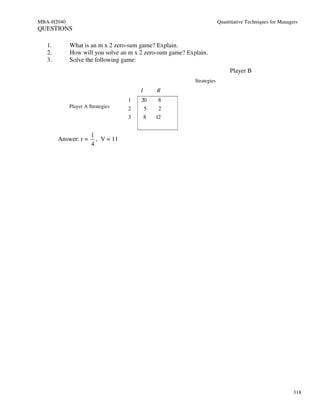
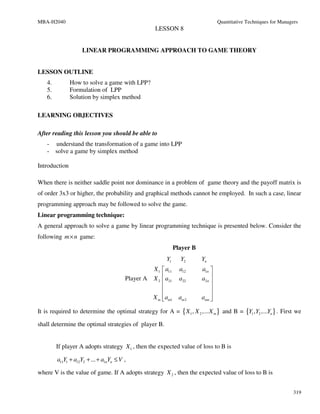
  • 6.
    MBA-H2040 Quantitative Techniques for Managers Thus the Operation Research started just before World War II in Britain with the establishment of teams of scientists to study the strategic and tactical problems involved in military operations. The objective was to find the most effective utilization of limited military resources by the use of quantitative techniques. Following the end of the war OR spread, although it spread in different ways in the UK and USA. In 1951 a committee on Operations Research formed by the National Research Council of USA, and the first book on “Methods of Operations Research”, by Morse and Kimball, was published. In 1952 the Operations Research Society of America came into being. Success of Operations Research in army attracted the attention of the industrial mangers who were seeking solutions to their complex business problems. Now a days, almost every organization in all countries has staff applying operations research, and the use of operations research in government has spread from military to wide variety of departments at all levels. The growth of operations research has not limited to the U.S.A. and U.K., it has reached many countries of the world. India was one the few first countries who started using operations research. In India, Regional Research Laboratory located at Hyderabad was the first Operations Research unit established during 1949. At the same time another unit was set up in Defense Science Laboratory to solve the Stores, Purchase and Planning Problems. In 1953, Operations Research unit was established in Indian Statistical Institute, Calcutta, with the objective of using Operations Research methods in National Planning and Survey. In 1955, Operations Research Society of India was formed, which is one of the first members of International Federation of Operations Research societies. Today Operations Research is a popular subject in management institutes and schools of mathematics. 1.3 Stages of Development of Operations Research The stages of development of O.R. are also known as phases and process of O.R, which has six important steps. These six steps are arranged in the following order: Step I: Observe the problem environment Step II: Analyze and define the problem Step III: Develop a model Step IV: Select appropriate data input Step V: Provide a solution and test its reasonableness Step VI: Implement the solution
  • 7.
    MBA-H2040 Quantitative Techniques for Managers Step I: Observe the problem environment The first step in the process of O.R. development is the problem environment observation. This step includes different activities; they are conferences, site visit, research, observations etc. These activities provide sufficient information to the O.R. specialists to formulate the problem. Step II: Analyze and define the problem This step is analyzing and defining the problem. In this step in addition to the problem definition the objectives, uses and limitations of O.R. study of the problem also defined. The outputs of this step are clear grasp of need for a solution and its nature understanding. Step III: Develop a model This step develops a model; a model is a representation of some abstract or real situation. The models are basically mathematical models, which describes systems, processes in the form of equations, formula/relationships. The different activities in this step are variables definition, formulating equations etc. The model is tested in the field under different environmental constraints and modified in order to work. Some times the model is modified to satisfy the management with the results. Step IV: Select appropriate data input A model works appropriately when there is appropriate data input. Hence, selecting appropriate input data is important step in the O.R. development stage or process. The activities in this step include internal/external data analysis, fact analysis, and collection of opinions and use of computer data banks. The objective of this step is to provide sufficient data input to operate and test the model developed in Step_III. Step V: Provide a solution and test its reasonableness This step is to get a solution with the help of model and input data. This solution is not implemented immediately, instead the solution is used to test the model and to find there is any limitations. Suppose if the solution is not reasonable or the behaviour of the model is not proper, the model is updated and modified at this stage. The output of this stage is the solution(s) that supports the current organizational objectives. Step VI: Implement the solution
  • 8.
    MBA-H2040 Quantitative Techniques for Managers At this step the solution obtained from the previous step is implemented. The implementation of the solution involves mo many behavioural issues. Therefore, before implementation the implementation authority has to resolve the issues. A properly implemented solution results in quality of work and gains the support from the management. The process, process activities, and process output are summarized in the following Table 1-1. Process Activities Process Process Output Site visits, Conferences, Sufficient information and Step 1: Observations, Research Observe the problem support to proceed environment Define: Use, Objectives, Clear grasp of need for and limitations Step 2: nature of solution requested Analyze and define the problem Define interrelationships, Models that works under stated Formulate equations, Step 3: environmental constraints Develop a Model Use known O.R. Model , Search alternate Model Analyze: internal-external data, Sufficient inputs to operate and facts Step 4: test model Select appropriate data Collect options, input Use computer data banks Test the model Solution(s) that support current Step 5: organizational goals find limitations Provide a solution and test its reasonableness update the model Step 6: Implement the
  • 9.
    MBA-H2040 Quantitative Techniques for Managers Resolve behavioural issues Improved working and Management support for longer Sell the idea run operation of model Give explanations Management involvement Table 1-1: Process, Process activities, Process output of O.R. development stages 1.4 Relationship between the Manager and O.R. Specialist The key responsibility of manager is decision making. The role of the O.R. specialist is to help the manager make better decisions. Figure 1-1 explains the relationship between the O.R. specialist and the manager/decision maker. STEPS IN PROBLEM RECOGNITION, INVOLVEMENT: O.R. SPECIALIST or FORMULATION AND SOLUTION MANAGER Recognize from organizational Manager symptoms that a problem exists. Decide what variables are involved; state the problem in quantitative relationships Manager and O.R. Specialist among the variables. Investigate methods for solving the problems as stated above; determine O.R. Specialist appropriate quantitative tools to be used. Attempt solutions to the problems; find various solutions; state assumptions underlying these solutions; test O.R. Specialist alternative solutions. Determine which solution is most effective because of practical constraints Manager and O.R. Specialist within the organization; decide what the solution means for the organization.
  • 10.
    MBA-H2040 Quantitative Techniques for Managers Choose the solution to be used. Manager ‘Sell’ the decision to operating managers; Manager and O.R. Specialist get their understanding and cooperation. Figure 1-1 Relationship between Manager/Decision Maker and O.R. Specialists 1.5 O.R. Tools and Techniques Operations Research uses any suitable tools or techniques available. The common frequently used tools/techniques are mathematical procedures, cost analysis, electronic computation. However, operations researchers given special importance to the development and the use of techniques like linear programming, game theory, decision theory, queuing theory, inventory models and simulation. In addition to the above techniques, some other common tools are non-linear programming, integer programming, dynamic programming, sequencing theory, Markov process, network scheduling (PERT/CPM), symbolic Model, information theory, and value theory. There is many other Operations Research tools/techniques also exists. The brief explanations of some of the above techniques/tools are as follows: Linear Programming: This is a constrained optimization technique, which optimize some criterion within some constraints. In Linear programming the objective function (profit, loss or return on investment) and constraints are linear. There are different methods available to solve linear programming. Game Theory: This is used for making decisions under conflicting situations where there are one or more players/opponents. In this the motive of the players are dichotomized. The success of one player tends to be at the cost of other players and hence they are in conflict. Decision Theory: Decision theory is concerned with making decisions under conditions of complete certainty about the future outcomes and under conditions such that we can make some probability about what will happen in future. Queuing Theory:
  • 11.
    MBA-H2040 Quantitative Techniques for Managers This is used in situations where the queue is formed (for example customers waiting for service, aircrafts waiting for landing, jobs waiting for processing in the computer system, etc). The objective here is minimizing the cost of waiting without increasing the cost of servicing. Inventory Models: Inventory model make a decisions that minimize total inventory cost. This model successfully reduces the total cost of purchasing, carrying, and out of stock inventory. Simulation: Simulation is a procedure that studies a problem by creating a model of the process involved in the problem and then through a series of organized trials and error solutions attempt to determine the best solution. Some times this is a difficult/time consuming procedure. Simulation is used when actual experimentation is not feasible or solution of model is not possible. Non-linear Programming: This is used when the objective function and the constraints are not linear in nature. Linear relationships may be applied to approximate non-linear constraints but limited to some range, because approximation becomes poorer as the range is extended. Thus, the non-linear programming is used to determine the approximation in which a solution lies and then the solution is obtained using linear methods. Dynamic Programming: Dynamic programming is a method of analyzing multistage decision processes. In this each elementary decision depends on those preceding decisions and as well as external factors. Integer Programming: If one or more variables of the problem take integral values only then dynamic programming method is used. For example number or motor in an organization, number of passenger in an aircraft, number of generators in a power generating plant, etc. Markov Process: Markov process permits to predict changes over time information about the behavior of a system is known. This is used in decision making in situations where the various states are defined. The probability from one state to another state is known and depends on the current state and is independent of how we have arrived at that particular state.
  • 12.
    MBA-H2040 Quantitative Techniques for Managers Network Scheduling: This technique is used extensively to plan, schedule, and monitor large projects (for example computer system installation, R & D design, construction, maintenance, etc.). The aim of this technique is minimize trouble spots (such as delays, interruption, production bottlenecks, etc.) by identifying the critical factors. The different activities and their relationships of the entire project are represented diagrammatically with the help of networks and arrows, which is used for identifying critical activities and path. There are two main types of technique in network scheduling, they are: Program Evaluation and Review Technique (PERT) – is used when activities time is not known accurately/ only probabilistic estimate of time is available. Critical Path Method (CPM) – is used when activities time is know accurately. Information Theory: This analytical process is transferred from the electrical communication field to O.R. field. The objective of this theory is to evaluate the effectiveness of flow of information with a given system. This is used mainly in communication networks but also has indirect influence in simulating the examination of business organizational structure with a view of enhancing flow of information. 1.6 Applications of Operations Research Today, almost all fields of business and government utilizing the benefits of Operations Research. There are voluminous of applications of Operations Research. Although it is not feasible to cover all applications of O.R. in brief. The following are the abbreviated set of typical operations research applications to show how widely these techniques are used today: Accounting: Assigning audit teams effectively Credit policy analysis Cash flow planning Developing standard costs Establishing costs for byproducts Planning of delinquent account strategy Construction: Project scheduling, monitoring and control Determination of proper work force Deployment of work force Allocation of resources to projects Facilities Planning: Factory location and size decision Estimation of number of facilities required Hospital planning
  • 13.
    MBA-H2040 Quantitative Techniques for Managers International logistic system design Transportation loading and unloading Warehouse location decision Finance: Building cash management models Allocating capital among various alternatives Building financial planning models Investment analysis Portfolio analysis Dividend policy making Manufacturing: Inventory control Marketing balance projection Production scheduling Production smoothing Marketing: Advertising budget allocation Product introduction timing Selection of Product mix Deciding most effective packaging alternative Organizational Behavior / Human Resources: Personnel planning Recruitment of employees Skill balancing Training program scheduling Designing organizational structure more effectively Purchasing: Optimal buying Optimal reordering Materials transfer Research and Development: R & D Projects control R & D Budget allocation Planning of Product introduction 1.7 Limitations of Operations Research Operations Research has number of applications; similarly it also has certain limitations. These limitations are mostly related to the model building and money and time factors problems involved in its application. Some of them are as given below: i) Distance between O.R. specialist and Manager Operations Researchers job needs a mathematician or statistician, who might not be aware of the business problems. Similarly, a manager is unable to understand the complex nature of Operations Research. Thus there is a big gap between the two personnel. ii) Magnitude of Calculations
  • 14.
    MBA-H2040 Quantitative Techniques for Managers The aim of the O.R. is to find out optimal solution taking into consideration all the factors. In this modern world these factors are enormous and expressing them in quantitative model and establishing relationships among these require voluminous calculations, which can be handled only by machines. iii) Money and Time Costs The basic data are subjected to frequent changes, incorporating these changes into the operations research models is very expensive. However, a fairly good solution at present may be more desirable than a perfect operations research solution available in future or after some time. iv) Non-quantifiable Factors When all the factors related to a problem can be quantifiable only then operations research provides solution otherwise not. The non-quantifiable factors are not incorporated in O.R. models. Importantly O.R. models do not take into account emotional factors or qualitative factors. v) Implementation Once the decision has been taken it should be implemented. The implementation of decisions is a delicate task. This task must take into account the complexities of human relations and behavior and in some times only the psychological factors. 1.8 Summary Operations Research is relatively a new discipline, which originated in World War II, and became very popular throughout the world. India is one of the few first countries in the world who started using operations research. Operations Research is used successfully not only in military/army operations but also in business, government and industry. Now a day’s operations research is almost used in all the fields. Proposing a definition to the operations research is a difficult one, because its boundary and content are not fixed. The tools for operations search is provided from the subject’s viz. economics, engineering, mathematics, statistics, psychology, etc., which helps to choose possible alternative courses of action. The operations research tool/techniques include linear programming, non-linear programming, dynamic programming, integer programming, Markov process, queuing theory, etc. Operations Research has a number of applications. Similarly it has a number of limitations, which is basically related to the time, money, and the problem involves in the model building. Day-by- day operations research gaining acceptance because it improve decision making effectiveness of the managers. Almost all the areas of business use the operations research for decision making. 1.9 Key Terms
  • 15.
    MBA-H2040 Quantitative Techniques for Managers OR: Operations Research. MS: Management Science. Symbolic Model: An abstract model, generally using mathematical symbols. Criterion: is measurement, which is used to evaluation of the results. Integer Programming: is a technique, which ensures only integral values of variables in the problem. Dynamic Programming: is a technique, which is used to analyze multistage decision process. Linear Programming: is a technique, which optimizes linear objective function under limited constraints. Inventory Model: these are the models used to minimize total inventory costs. Optimization: Means maximization or minimization. 1.10 Self Assessment Questions Q1. Define Operations Research. Q2. Describe the relationship between the manager and O.R. specialist. Q3. Explain the various steps in the O.R. development process. Q4. Discuss the applications of O.R. Q5. Discuss the limitation of O.R. Q6. Describe different techniques of O.R. Q7. Discuss few areas of O.R. applications in your organization or organization you are familiar with. 1.11 Further References Hamdy A Taha, 1999. Introduction to Operations Research, PHI Limited, New Delhi. Sharma, J.K., 1989. Mathematical Models in Operations Research, Tata McGraw Hill Publishing Company Ltd., New Delhi. Beer, Stafford, 1966. Decision and Control, John Wiley & Sons, Inc., New York. Levin, Rubin, Stinson, Gardner, 1992. Quantitative Approaches to Management, Tata McGraw Hill Publishing Company Ltd. New Delhi. Wagner, Harvery M., 1975. Principles of Operations Research, PHI, Egnlewood Cliffs, N.J.
  • 16.
    MBA-H2040 Quantitative Techniques for Managers UNIT I LESSON 2 LINEAR PROGRAMMING –GRAPHICAL METHOD LESSON STRUCTURE 2.1 Introduction to Linear Programming 2.2 Linear Programming Problem Formulation 2.3 Formulation with Different Types of Constraints 2.4 Graphical Analysis of Linear Programming 2.5 Graphical Linear Programming Solution 2.6 Multiple Optimal Solutions 2.7 Unbounded Solution 2.8 Infeasible Solution 2.9 Summary 2.10 Key Terms 2.11 Self Assessment Questions 2.12 Key Solutions 2.13 Further References
  • 17.
    MBA-H2040 Quantitative Techniques for Managers Objectives After studying this lesson, you should be able to: Formulate Linear Programming Problem Identify the characteristics of linear programming problem Make a graphical analysis of the linear programming problem Solve the problem graphically Identify the various types of solutions
  • 18.
    MBA-H2040 Quantitative Techniques for Managers 2.1 Introduction to Linear Programming Linear Programming is a special and versatile technique which can be applied to a variety of management problems viz. Advertising, Distribution, Investment, Production, Refinery Operations, and Transportation analysis. The linear programming is useful not only in industry and business but also in non-profit sectors such as Education, Government, Hospital, and Libraries. The linear programming method is applicable in problems characterized by the presence of decision variables. The objective function and the constraints can be expressed as linear functions of the decision variables. The decision variables represent quantities that are, in some sense, controllable inputs to the system being modeled. An objective function represents some principal objective criterion or goal that measures the effectiveness of the system such as maximizing profits or productivity, or minimizing cost or consumption. There is always some practical limitation on the availability of resources viz. man, material, machine, or time for the system. These constraints are expressed as linear equations involving the decision variables. Solving a linear programming problem means determining actual values of the decision variables that optimize the objective function subject to the limitation imposed by the constraints. The main important feature of linear programming model is the presence of linearity in the problem. The use of linear programming model arises in a wide variety of applications. Some model may not be strictly linear, but can be made linear by applying appropriate mathematical transformations. Still some applications are not at all linear, but can be effectively approximated by linear models. The ease with which linear programming models can usually be solved makes an attractive means of dealing with otherwise intractable nonlinear models. 2.2 Linear Programming Problem Formulation The linear programming problem formulation is illustrated through a product mix problem. The product mix problem occurs in an industry where it is possible to manufacture a variety of products. A product has a certain margin of profit per unit, and uses a common pool of limited resources. In this case the linear programming technique identifies the products combination which will maximize the profit subject to the availability of limited resource constraints. Example 2.1: Suppose an industry is manufacturing tow types of products P1 and P2. The profits per Kg of the two products are Rs.30 and Rs.40 respectively. These two products require processing in three types of machines. The following table shows the available machine hours per day and the time required on each 18
  • 19.
    MBA-H2040 Quantitative Techniques for Managers machine to produce one Kg of P1 and P2. Formulate the problem in the form of linear programming model. Profit/Kg P1 P2 Total available Machine Rs.30 Rs.40 hours/day Machine 1 3 2 600 Machine 2 3 5 800 Machine 3 5 6 1100 Solution: The procedure for linear programming problem formulation is as follows: Introduce the decision variable as follows: Let x1 = amount of P1 x2 = amount of P2 In order to maximize profits, we establish the objective function as 30x1 + 40x2 Since one Kg of P1 requires 3 hours of processing time in machine 1 while the corresponding requirement of P2 is 2 hours. So, the first constraint can be expressed as 3x1 + 2x2 ≤ 600 Similarly, corresponding to machine 2 and 3 the constraints are 3x1 + 5x2 ≤ 800 5x1 + 6x2 ≤ 1100 In addition to the above there is no negative production, which may be represented algebraically as x1 ≥ 0 ; x2 ≥ 0 Thus, the product mix problem in the linear programming model is as follows: Maximize 30x1 + 40x2 Subject to: 3x1 + 2x2 ≤ 600 3x1 + 5x2 ≤ 800 5x1 + 6x2 ≤ 1100 x1≥ 0, x2 ≥ 0 2.3 Formulation with Different Types of Constraints 19
  • 20.
    MBA-H2040 Quantitative Techniques for Managers The constraints in the previous example 2.1 are of “less than or equal to” type. In this section we are going to discuss the linear programming problem with different constraints, which is illustrated in the following Example 2.2. Example 2.2: A company owns two flour mills viz. A and B, which have different production capacities for high, medium and low quality flour. The company has entered a contract to supply flour to a firm every month with at least 8, 12 and 24 quintals of high, medium and low quality respectively. It costs the company Rs.2000 and Rs.1500 per day to run mill A and B respectively. On a day, Mill A produces 6, 2 and 4 quintals of high, medium and low quality flour, Mill B produces 2, 4 and 12 quintals of high, medium and low quality flour respectively. How many days per month should each mill be operated in order to meet the contract order most economically. Solution: Let us define x1 and x2 are the mills A and B. Here the objective is to minimize the cost of the machine runs and to satisfy the contract order. The linear programming problem is given by Minimize 2000x1 + 1500x2 Subject to: 6x1 + 2x2 ≥ 8 2x1 + 4x2 ≥ 12 4x1 + 12x2 ≥ 24 x1 ≥ 0, x2 ≥ 0 2.4 Graphical Analysis of Linear Programming This section shows how a two-variable linear programming problem is solved graphically, which is illustrated as follows: Example 2.3: Consider the product mix problem discussed in section 2.2 Maximize 30x1 + 40x2 Subject to: 3x1 + 2x2 ≤ 600 3x1 + 5x2 ≤ 800 5x1 + 6x2 ≤ 1100 x1≥ 0, x2 ≥ 0 20
  • 21.
    MBA-H2040 Quantitative Techniques for Managers From the first constraints 3x1 + 2x2 ≤ 600, draw the line 3x1 + 2x2 = 600 which passes through the point (200, 0) and (0, 300). This is shown in the following graph as line 1. 300 3x1 + 2x2 = 600(line 1) 200 B X2 C 100 3x1 + 5x2 = 800(line 2) 5x1 + 6x2 = 1100(line 3) A D 0 50 100 150 X1 200 275 Graph 1: Three closed half planes and Feasible Region Half Plane - A linear inequality in two variables is called as a half plane. Boundary - The corresponding equality (line) is called as the boundary of the half plane. Close Half Plane – Half plane with its boundary is called as a closed half plane. 21
  • 22.
    MBA-H2040 Quantitative Techniques for Managers In this case we must decide in which side of the line 3x1 + 2x2 = 600 the half plane is located. The easiest way to solve the inequality for x2 is 3x1 ≤ 600 – 2x2 And for the fixed x1, the coordinates satisfy this inequality are smaller than the corresponding ordinate on the line and thus the inequality is satisfied for all the points below the line 1. Similarly, we have to determine the closed half planes for the inequalities 3x1 + 5x2 ≤ 800 and 5x1 + 6x2 ≤ 1100 (line 2 and line 3 in the graph). Since all the three constraints must be satisfied simultaneously we have consider the intersection of these three closed half planes. The complete intersection of these three closed half planes is shown in the above graph as ABCD. The region ABCD is called the feasible region, which is shaded in the graph. Feasible Solution: Any non-negative value of x1, x2 that is x1 ≥ 0 and x2 ≥ 0 is known as feasible solution of the linear programming problem if it satisfies all the existing constraints. Feasible Region: The collection of all the feasible solution is called as the feasible region. Example 2.4: In the previous example we discussed about the less than or equal to type of linear programming problem, i.e. maximization problem. Now consider a minimization (i.e. greater than or equal to type) linear programming problem formulated in Example 2.2. Minimize 2000x1 + 1500x2 Subject to: 6x1 + 2x2 ≥ 8 2x1 + 4x2 ≥ 12 4x1 + 12x2 ≥ 24 x1 ≥ 0, x2 ≥ 0 The three lines 6x1 + 2x2 = 8, 2x1 + 4x2 = 12, and 4x1 + 12x2 = 24 passes through the point (1.3,0) (0,4), (6,0) (0,3) and (6,0) (0,2). The feasible region for this problem is shown in the following Graph 2. In this problem the constraints are of greater than or equal to type of feasible region, which is bounded on one side only. 22
  • 23.
    MBA-H2040 Quantitative Techniques for Managers 8 6 X2 A 4 6x1 + 2x2 ≥ 8 B 2 2x1 + 4x2 ≥ 12 0 C 4x1 + 12x2 ≥ 24 X1 2 4 6 8 Graph 2: Feasible Region 2.5 Graphical Liner Programming Solution A two variable linear programming problem can be easily solved graphically. The method is simple but the principle of solution is depends on certain analytical concepts, they are: Convex Region: A region R is convex if and only if for any two points on the region R the line connecting those points lies entirely in the region R. Extreme Point: The extreme point E of a convex region R is a point such that it is not possible to locate two distinct points in R, so that the line joining them will include E. The extreme points are also called as corner points or vertices. Thus, the following result provides the solution to the linear programming model: • “If the minimum or maximum value of a linear function defined over a convex region exists, then it must be on one of the extreme points”. 23
  • 24.
    MBA-H2040 Quantitative Techniques for Managers In this section we are going to describe linear programming graphical solution for both the maximization and minimization problems, discussed in Example 2.3 and Example 2.4. Example 2. 5: Consider the maximization problem described in Example 2.3. Maximize 30x1 + 40x2 Subject to: 3x1 + 2x2 ≤ 600 3x1 + 5x2 ≤ 800 5x1 + 6x2 ≤ 1100 M = 30x1 +40x2 x1 ≥ 0, x2 ≥ 0 The feasible region identified in the Example 2.3 is a convex polygon, which is illustrated in the following Graph 3. The extreme point of this convex region are A, B, C, D and E. 300 200 B X2 C 100 A D E 0 50 100 150 X1 200 275 24
  • 25.
    MBA-H2040 Quantitative Techniques for Managers Graph 3: Graphical Linear Programming Solution In this problem the objective function is 30x1 + 40x2. Let be M is a parameter, the graph 30x1 + 40x2 = M is a group of parallel lines with slope – 30/40. Some of these lines intersects the feasible region and contains many feasible solutions, whereas the other lines miss and contain no feasible solution. In order to maximize the objective function, we find the line of this family that intersects the feasible region and is farthest out from the origin. Note that the farthest is the line from the origin the greater will be the value of M. Observe that the line 30x1 + 40x2 = M passes through the point D, which is the intersection of the lines 3x1 + 5x2 = 800 and 5x1 + 6x2 = 1100 and has the coordinates x1 = 170 and x2 = 40. Since D is the only feasible solution on this line the solution is unique. The value of M is 6700, which is the objective function maximum value. The optimum value variables are x1 = 170 and X2 = 40. The following Table 1 shows the calculation of maximum value of the objective function. Extreme Point Coordinates Objective Function X1 X2 30x1 + 40x2 A X1 = 0 X2 = 0 0 B X1 = 0 X2 = 160 6400 C X1 = 110 X2 = 70 6100 D X1 = 170 X2 = 40 6700 E X1 = 200 X2 = 0 6000 Table 1: Shows the objective function Maximum value calculation Example 2.6: Consider the minimization problem described in Example 2.4. Minimize 2000x1 + 1500x2 Subject to: 6x1 + 2x2 ≥ 8 2x1 + 4x2 ≥ 12 4x1 + 12x2 ≥ 24 x1≥ 0, x2 ≥ 0 The feasible region for this problem is illustrated in the following Graph 4. Here each of the half planes lies above its boundary. In this case the feasible region is infinite. In this case, we are concerned with the minimization; also it is not possible to determine the maximum value. As in the previous 25
  • 26.
    MBA-H2040 Quantitative Techniques for Managers example let us introduce a parameter M in the objective function i.e. 2000x1 + 1500x2 = M and draw the lines for different values of M, which is shown in the following Table 2. 8 6 X2 A 4 B 2 C 0 2000x1+ 1500x2=M X1 2 4 6 8 Graph 4: Graphical Linear Programming Solution Extreme Point Coordinates Objective Function X1 X2 2000x1 + 1500x2 A X1 = 0 X2 = 4 6000 B X1 = 0.5 X2 = 2.75 5125 C X1 = 6 X2 = 0 12000 Table 2: Shows the objective function Minimum value computation The minimum value is 5125 at the extreme point B, which is the value of the M (objective function). The optimum values variables are X1 = 0.5 and X2 = 2.75. 2.6 Multiple Optimal Solutions 26
  • 27.
    MBA-H2040 Quantitative Techniques for Managers When the objective function passed through only the extreme point located at the intersection of two half planes, then the linear programming problem possess unique solutions. The previous examples i.e. Example 2.5 and Example 2.6 are of this types (which possessed unique solutions). When the objective function coincides with one of the half planes generated by the constraints in the problem, will possess multiple optimal solutions. In this section we are going to discuss about the multiple optimal solutions of linear programming problem with the help of the following Example 2.7. Example 2.7: A company purchasing scrap material has two types of scarp materials available. The first type has 30% of material X, 20% of material Y and 50% of material Z by weight. The second type has 40% of material X, 10% of material Y and 30% of material Z. The costs of the two scraps are Rs.120 and Rs.160 per kg respectively. The company requires at least 240 kg of material X, 100 kg of material Y and 290 kg of material Z. Find the optimum quantities of the two scraps to be purchased so that the company requirements of the three materials are satisfied at a minimum cost. Solution First we have to formulate the linear programming model. Let us introduce the decision variables x1 and x2 denoting the amount of scrap material to be purchased. Here the objective is to minimize the purchasing cost. So, the objective function here is Minimize 120x1 + 160x2 Subject to: 0.3x1 + 0.4x2 ≥ 240 0.2x1 + 0.1x2 ≥ 100 0.5x1 + 0.3x2 ≥ 290 x1 ≥ 0; x2 ≥ 0 Multiply by 10 both sides of the inequalities, then the problem becomes Minimize 120x1 + 160x2 Subject to: 3x1 + 4x2 ≥ 2400 2x1 + x2 ≥ 1000 5x1 + 3x2 ≥ 2900 x1 ≥ 0; x2 ≥ 0 27
  • 28.
    MBA-H2040 Quantitative Techniques for Managers Let us introduce parameter M in the objective function i.e. 120x1 + 160x2 = M. Then we have to determine the different values for M, which is shown in the following Table 3. Extreme Point Coordinates Objective Function X1 X2 120x1 + 160x2 A X1 = 0 X2 = 1000 160000 B X1 = 150 X2 = 740 136400 C X1 = 400 X2 = 300 96000 D X1=800 X2=0 96000 Table 3: Shows the calculation of Minimum objective function value Note that there are two minimum value for the objective function (M=96000). The feasible region and the multiple solutions are indicated in the following Graph 5. 1100 A 1000 900 800 B 700 5x1 + 3x2 ≥ 2900 600 X2 500 400 2x1 + x2 ≥ 1000 300 C 200 3x1 + 4x2 ≥ 2400 100 28 0 D
  • 29.
    MBA-H2040 Quantitative Techniques for Managers X1 Graph 5: Feasible Region, Multiple Optimal Solutions The extreme points are A, B, C, and D. One of the objective functions 120x1 + 160x2 = M family coincides with the line CD at the point C with value M=96000, and the optimum value variables are x1 = 400, and x2 = 300. And at the point D with value M=96000, and the optimum value variables are x1 = 800, and x2 = 0. Thus, every point on the line CD minimizes objective function value and the problem contains multiple optimal solutions. 2.7 Unbounded Solution When the feasible region is unbounded, a maximization problem may don’t have optimal solution, since the values of the decision variables may be increased arbitrarily. This is illustrated with the help of the following problem. Maximize 3x1 + x2 Subject to: x1 + x2 ≥ 6 -x1 + x2 ≤ 6 -x1 + 2x2 ≥ -6 and x1, x2 ≥ 0 Graph 6 shows the unbounded feasible region and demonstrates that the objective function can be made arbitrarily large by increasing the values of x1 and x2 within the unbounded feasible region. In this case, there is no point (x1, x2) is optimal because there are always other feasible points for which objective function is larger. Note that it is not the unbounded feasible region alone that precludes an optimal solution. The minimization of the function subject to the constraints shown in the Graph 6 would be solved at one the extreme point (A or B). The unbounded solutions typically arise because some real constraints, which represent a practical resource limitation, have been missed from the linear programming formulation. In such situation the problem needs to be reformulated and re-solved. 29
  • 30.
    MBA-H2040 Quantitative Techniques for Managers -x1 + x2 = 6 A 6 x1 + x2 = 6 5 4 -x1 + 2x2 = 6 X2 3 2 Graph 6: Unbounded Feasible Region 1 1 2 3 4 5 6 B X1 2.8 Infeasible Solution A linear programming problem is said to be infeasible if no feasible solution of the problem exists. This section describes infeasible solution of the linear programming problem with the help of the following Example 2.8. Example 2.8: 30
  • 31.
    MBA-H2040 Quantitative Techniques for Managers Minimize 200x1 + 300x2 Subject to: 0.4x1 + 0.6x2 ≥ 240 0.2x1 + 0.2x2 ≤ 80 0.4x1 + 0.3x2 ≥ 180 x1, x2 ≥ 0 On multiplying both sides of the inequalities by 10, we get 4x1 + 6x2 ≥ 2400 2x1 + 2x2 ≤ 800 4x1 + 3x2 ≥ 1800 700 A 600 4x1 + 3x2 = 1800 500 B 400 X2 300 200 F 2x1 + 2x2 = 800 100 4x1 + 6x2 = 2400 0 D C E 100 200 300 400 500 600 X1 Graph 7: Infeasible Solution The region right of the boundary AFE includes all the solutions which satisfy the first (4x1 + 6x2 ≥ 2400) and the third (4x1 + 3x2 ≥ 1800) constraints. The region left of the BC contains all solutions which satisfy the second constraint (2x1 + 2x2 ≤ 800). 31
  • 32.
    MBA-H2040 Quantitative Techniques for Managers Hence, there is no solution satisfying all the three constraints (first, second, and third). Thus, the linear problem is infeasible. This is illustrated in the above Graph 7. 2.9 Summary In Operations Research linear programming is a versatile technique with wide applications in various management problems. Linear Programming problem has a number of characteristics. That is first we have to identify the decision variable. The problem must have a well defined objective function, which are expressed in terms of the decision variables. The objective function may have to be maximized when it indicates the profit or production or contribution. If the objective function represents cost, in this case the objective function has to be minimized. The management problem is expressed in terms of the decision variables with the objective function and constraints. A linear programming problem is solved graphically if it contains only two variables. 2.10 Key Terms Objective Function: is a linear function of the decision variables representing the objective of the manager/decision maker. Constraints: are the linear equations or inequalities arising out of practical limitations. Decision Variables: are some physical quantities whose values indicate the solution. Feasible Solution: is a solution which satisfies all the constraints (including the non-negative) presents in the problem. Feasible Region: is the collection of feasible solutions. Multiple Solutions: are solutions each of which maximize or minimize the objective function. Unbounded Solution: is a solution whose objective function is infinite. Infeasible Solution: means no feasible solution. 2.11 Self Assessment Questions Q1. A juice company has its products viz. canned apple and bottled juice with profit margin Rs.4 and Rs.2 respectively pre unit. The following table shows the labour, equipment, and ingredients to produce each product per unit. Canned Apple Bottled Juice Total Labour 2.0 3.0 12.0 Equipment 3.2 1.0 8.0 32
  • 33.
    MBA-H2040 Quantitative Techniques for Managers Ingredients 2.4 2.0 9.0 Formulate the linear programming problem (model) specifying the product mix which will maximize the profit without exceeding the levels of resources. Q2. An organization is interested in the analysis of two products which can be produces from the idle time of labour, machine and investment. It was notified on investigation that the labour requirement of the first and the second products was 4 and 5 units respectively and the total available man hours was 48. Only first product required machine hour utilization of one hour per unit and at present only 10 spare machine hours are available. Second product needs one unit of byproduct per unit and the daily availability of the byproduct is 12 units. According to the marketing department the sales potential of first product cannot exceed 7 units. In a competitive market, first product can be sold at a profit of Rs.6 and the second product at a profit of Rs.10 per unit. Formulate the problem as a linear programming model. Also determine graphically the feasible region. Identify the redundant constraints if any. Q3. Find graphically the feasible region of the linear programming problem given in Q1. Q4. A bed mart company is in the business of manufacturing beds and pillows. The company has 40 hours for assembly and 32 hours for finishing work per day. Manufacturing of a bed requires 4 hours for assembly and 2 hours in finishing. Similarly a pillow requires 2 hours for assembly and 4 hours for finishing. Profitability analysis indicates that every bed would contribute Rs.80, while a pillow contribution is Rs.55 respectively. Find out the daily production of the company to maximize the contribution (profit). Q5. Maximize 1170x1 + 1110x2 Subject to: 9x1 + 5x2 ≥ 500 7x1 + 9x2 ≥ 300 5x1 + 3x2 ≤ 1500 7x1 + 9x2 ≤ 1900 2x1 + 4x2 ≤ 1000 x1, x2 ≥ 0 Find graphically the feasible region and the optimal solution. Q6. Solve the following LP problem graphically Minimize 2x1 +1.7x2 Subject to: 0.15x1 + 0.10x2 ≥ 1.0 0.75x1 + 1.70x2 ≥ 7.5 1.30x1 + 1.10x2 ≥ 10.0 x1, x2 ≥ 0 Q7. Solve the following LP problem graphically 33
  • 34.
    MBA-H2040 Quantitative Techniques for Managers Maximize 2x1 + 3x2 Subject to: x1 – x2 ≤ 1 x1 + x2 ≥ 3 x1, x2 ≥ 0 Q8. Graphically solve the following problem of LP Maximize 3x1 + 2x2 Subject to: 2x1 – 3x2 ≥ 0 3x1 + 4x2 ≤ -12 x1, x2 ≥ 0 Q9. Solve the following problem graphically Maximize 4x1 + 4x2 Subject to: -2x1 + x2 ≤ 1 x1 ≤ 2 x1 + x2 ≤ 3 x1, x2 ≥ 0 2.12 Key Solutions Q1. Canned Apple x1 Bottled Juice x2 Maximize 4x1 + 2x2 Subject to: 2x1 + 3x2 ≤ 12 3.2x1 + x2 ≤ 8 2.4x1 + 2x2 ≤ 9 x1, x2 ≥ 0 Q2. First Product x1 Second Product x2 Maximize 6x1 + 10x2 Subject to: 4x1 + 5x2 ≤ 48 x1 ≤ 10 34
  • 35.
    MBA-H2040 Quantitative Techniques for Managers x2 ≤ 12 x1 ≤ 7 x1, x2 ≥ 0 The constraints x1 ≤ 10 is redundant. Q4. Beds = 8 Pillows = 4 Maximum Profits is: Rs.860 Q5. Optimum variables values are: x1=271.4, x2=0 The maximum value is: 317573 Q6. Optimum variables values are: x1=6.32, x2=1.63 The minimum values is: 15.4 Q7. The solution is unbounded Q8. The problem has no feasible solution Q9. The problem has multiple solutions with the following optimum variable values: x1=2, x2 =1 or x1=2/3, x2=7/3 The Maximum objective function value is: 12 2.13 Further References Mittal, K.V. 1976. Optimization Methods in Operations Research and Systems Analysis, Wiley Eastern Ltd, New Delhi. Taha, H.A1999. Operations Research An Introduction, PHI Ltd., New Delhi. Richard I.Levin, David S. Rubin, Joel P. Stinson, Everette S.Gardner, Jr.1992. Quantitative Approaches to Management, McGraw Hill, NJ. 35
  • 36.
    MBA-H2040 Quantitative Techniques for Managers UNIT I LESSON 3 LINEAR PROGRAMMING – SIMPLEX METHOD LESSON STRUCTURE 3.1 Introduction 3.2 Basics of Simplex Method 3.3 Simplex Method Computation 3.4 Simplex Method with More Than Two Variables 3.5 Two Phase and M Method 3.5.1 Two Phase Method 3.5.2 M Method 3.6 Multiple Solutions 3.7 Unbounded Solution 3.8 Infeasible Solution 3.9 Summary 3.10 Key Terms 3.11 Self Assessment Questions 3.12 Key Solutions 3.13 3.13 Further References 36
  • 37.
    MBA-H2040 Quantitative Techniques for Managers Objectives After Studying this lesson, you should be able to: Understand the basics of simplex method Explain the simplex calculations Describe various solutions of Simplex Method Understand two phase and M method 37
  • 38.
    MBA-H2040 Quantitative Techniques for Managers 3.1 Introduction The Linear Programming with two variables can be solved graphically. The graphical method of solving linear programming problem is of limited application in the business problems as the number of variables is substantially large. If the linear programming problem has larger number of variables, the suitable method for solving is Simplex Method. The simplex method is an iterative process, through which it reaches ultimately to the minimum or maximum value of the objective function. The simplex method also helps the decision maker/manager to identify the following: • Redundant Constraints • Multiple Solutions • Unbounded Solution • Infeasible Problem 3.2 Basics of Simplex Method The basic of simplex method is explained with the following linear programming problem. Example 3.1: Maximize 60x1 + 70x2 Subject to: 2x1 + x2 ≤ 300 3x1 + 4x2 ≤ 509 4x1 + 7x2 ≤ 812 x1, x2 ≥ 0 Solution First we introduce the variables s3, s4, s5 ≥ 0 So that the constraints becomes equations, thus 2x1 + x2 + s3 = 300 3x1 + 4x2 + s4 = 509 4x1 + 7x2 + s5 = 812 Corresponding to the three constraints, the variables s3, s4, s5 are called as slack variables. Now, the system of equation has three equations and five variables. There are two types of solutions they are basic and basic feasible, which are discussed as follows: Basic Solution We may equate any two variables to zero in the above system of equations, and then the system will have three variables. Thus, if this system of three equations with three variables is solvable such a solution is called as basic solution. 38
  • 39.
    MBA-H2040 Quantitative Techniques for Managers For example suppose we take x1=0 and x2=0, the solution of the system with remaining three variables is s3=300, s4=509 and s5=812, this is a basic solution and the variables s3, s4, and s5 are known as basic variables where as the variables x1, x2 are known as non-basic variables. The number of basic solution of a linear programming problem is depends on the presence of the number of constraints and variables. For example if the number of constraints is m and the number of variables including the slack variables is n then there are at most nCn-m = nCm basic solutions. Basic Feasible Solution A basic solution of a linear programming problem is called as basic feasible solutions if it is feasible it means all the variables are non-negative. The solution s3=300, s4=509 and s5=812 is a basic feasible solution. The number of basic feasible solution of a linear programming problem is depends on the presence of the number of constraints and variables. For example if the number of constraints is m and the number of variables including the slack variables is n then there are at most nCn-m = nCm basic feasible solutions. Every basic feasible solution is an extreme point of the convex set of feasible solutions and every extreme point is a basic feasible solution of the set of given constraints. It is impossible to identify the extreme points geometrically if the problem has several variables but the extreme points can be identified using basic feasible solutions. Since one the basic feasible solution will maximize or minimize the objective function, the searching of extreme points can be carry out starting from one basic feasible solution to another. The Simplex Method provides a systematic search so that the objective function increases in the cases of maximization progressively until the basic feasible solution has been identified where the objective function is maximized. 3.3 Simplex Method Computation This section describes the computational aspect of simplex method. Consider the following linear programming problem Maximize 60x1 + 70x2 Subject to: 2x1 + x2 + s3 = 300 3x1 + 4x2 + s4 = 509 4x1 + 7x2 + s5 = 812 x1, x2, s3, s4 ,s5 ≥ 0 39
  • 40.
    MBA-H2040 Quantitative Techniques for Managers The profit Z=60x1 + 70x2 i.e. Maximize 60x1 + 70x2 The standard form can be summarized in a compact table form as In this problem the slack variables s3, s4, and s5 provide a basic feasible solution from which the simplex computation starts. That is s3==300, s4=509 and s5=812. This result follows because of the special structure of the columns associated with the slacks. If z represents profit then z=0 corresponding to this basic feasible solution. We represent by CB the coefficient of the basic variables in the objective function and by XB the numerical values of the basic variable. So that the numerical values of the basic variables are: XB1=300, XB2=509, XB3=812. The profit z=60x1+70x2 can also expressed as z-60x1-70x2=0. The simplex computation starts with the first compact standard simplex table as given below: CB Basic Cj 60 70 0 0 0 Variables XB x1 x2 s3 s4 s5 0 s3 300 2 1 1 0 0 0 s4 509 3 4 0 1 0 0 s5 812 4 7 0 0 1 z -60 -70 0 0 0 Table 1 In the objective function the coefficients of the variables are CB1=CB2=CB3=0. The topmost row of the Table 1 denotes the coefficient of the variables x1, x2, s3, s4, s5 of the objective function respectively. The column under x1 indicates the coefficient of x1 in the three equations respectively. Similarly the remaining column also formed. On seeing the equation z=60x1+70x2 we may observe that if either x1 or x2, which is currently non-basic is included as a basic variable so that the profit will increase. Since the coefficient of x2 is higher we choose x2 to be included as a basic variable in the next iteration. An equivalent criterion of choosing a new basic variable can be obtained the last row of Table 1 i.e. corresponding to z. Since the entry corresponding to x2 is smaller between the two negative values, x2 will be included as a basic variable in the next iteration. However with three constraints there can be only three basic variables. Thus, by bringing x2 a basic variable one of the existing basic variables becomes non-basic. The question here is How to identify this variable? The following statements give the solution to this question. Consider the first equation i.e. 2x1 + x2 + s3 = 300 40
  • 41.
    MBA-H2040 Quantitative Techniques for Managers From this equation 2x1+s3=300-x2 But x1=0. Hence, in order that s3≥0 300-x2≥0 i.e. x2≤300 Similarly consider the second equation i.e. 3x1 + 4x2 + s4 = 509 From this equation 3x1+s4=509-4x2 But, x1=0. Hence, in order that s4≥0 509-4x2≥0 i.e. x2≤509/9 Similarly consider the third equation i.e. 4x1 + 7x2 + s5 = 812 From this equation 4x1+s5=812-7x2 But x1=0. Hence, in order that s5≥0 812-7x2≥0 i.e. x2≤812/7 Therefore the three equation lead to x2≤300, x2≤509/9, x2≤812/7 Thus x2=Min (x2≤300, x2≤509/9, x2≤812/7) it means x2=Min (x2≤300/1, x2≤509/9, x2≤812/7)=116 Therefore x2=116 If x2=116, you may be note from the third equation 7x2+s5=812 i.e. s5=0 Thus, the variable s5 becomes non-basic in the next iteration. So that the revised values of the other two basic variables are S3=300-x2=184 S4=509-4*116=45 Refer to Table 1, we obtain the elements of the next Table i.e. Table 2 using the following rules: 1. We allocate the quantities which are negative in the z-row. Suppose if all the quantities are positive, the inclusion of any non-basic variable will not increase the value of the objective function. Hence the present solution maximizes the objective function. If there are more than one negative values we choose the variable as a basic variable corresponding to which the z value is least as this is likely to increase the more profit. 41
  • 42.
    MBA-H2040 Quantitative Techniques for Managers 2. Let xj be the incoming basic variable and the corresponding elements of the jth row column be denoted by Y1j, Y2j and Y3j respectively. If the present values of the basic variables are XB1, XB2 and XB3 respectively, then we can compute. Min [XB1/Y1j, XB2/Y2j, XB3/Y3j] for Y1j, Y2j, Y3j>0. Note that if any Yij≤0, this need not be included in the comparison. If the minimum occurs corresponding to XBr/Yrj then the rth basic variable will become non-basic in the next iteration. 3. Using the following rules the Table 2 is computed from the Table 1. i. The revised basic variables are s3, s4 and x2. Accordingly, we make CB1=0, CB2=0 and CB3=70. ii. As x2 is the incoming basic variable we make the coefficient of x2 one by dividing each element of row-3 by 7. Thus the numerical value of the element corresponding to x1 is 4/7, corresponding to s5 is 1/7 in Table 2. iii. The incoming basic variable should appear only in the third row. So we multiply the third-row of Table 2 by 1 and subtract it from the first-row of Table 1 element by element. Thus the element corresponding to x2 in the first-row of Table 2 is 0. Therefore the element corresponding to x1 is 2-1*4/7=10/7 and the element corresponding to s5 is 0-1*1/7=-1/7 In this way we obtain the elements of the first and the second row in Table 2. In Table 2 the numerical values can also be calculated in a similar way. CB Basic Cj 60 70 0 0 0 Variables XB x1 x2 s3 s4 s5 0 s3 184 10/7 0 1 0 -1/7 0 s4 45 5/7 0 0 1 -4/7 70 x2 116 4/7 1 0 0 1/7 zj-cj -140/7 0 0 0 70/7 Table 2 Let CB1, CB2, Cb3 be the coefficients of the basic variables in the objective function. For example in Table 2 CB1=0, CB2=0 and CB3=70. Suppose corresponding to a variable J, the quantity zj is defined as zj=CB1, Y1+CB2, Y2j+CB3Y3j. Then the z-row can also be represented as Zj-Cj. For example: z1 - c1 = 10/7*0+5/7*0+70*4/7-60 = -140/7 z5 – c5 = -1/7*0-4/7*0+1/7*70-0 = 70/7 1. Now we apply rule (1) to Table 2. Here the only negative zj-cj is z1-c1 = -140/7 Hence x1 should become a basic variable at the next iteration. 42
  • 43.
    MBA-H2040 Quantitative Techniques for Managers 2. We compute the minimum of the ratio 184 , 45, 116 644 , 63 , 203 Min 10 5 4 = Min 5 = 63 7 7 7 This minimum occurs corresponding to s4, it becomes a non basic variable in next iteration. 3. Like Table 2, the Table 3 is computed sing the rules (i), (ii), (iii) as described above. CB Basic Cj 60 70 0 0 0 Variables XB x1 x2 s3 s4 s5 0 s3 94 0 0 1 -2 1 60 x1 63 1 0 0 7/5 -4/5 70 x2 80 0 1 0 -4/5 3/5 zj-cj 0 0 0 28 -6 Table 3 1. z5 – c5 < 0 should be made a basic variable in the next iteration. 2. Now compute the minimum ratios 94, 80 Min 1 3 = 94 5 Note: Since y25 = -4/5 < 0, the corresponding ratio is not taken for comparison. The variable s3 becomes non basic in the next iteration. 3. From the Table 3, Table 4 is calculated following the usual steps. CB Basic Cj 60 70 0 0 0 Variables XB x1 x2 s3 s4 s5 0 s5 94 0 0 1 -2 1 60 x1 691/5 1 0 4/5 -1/5 0 70 x2 118/5 0 1 -3/5 2/5 0 zj-cj 0 0 6 16 0 43
  • 44.
    MBA-H2040 Quantitative Techniques for Managers Note that zj – cj ≥ 0 for all j, so that the objective function can’t be improved any further. Thus, the objective function is maximized for x1 = 691/5 and x2=118/5 and The maximum value of the objective function is 9944. 3.4 Simplex Method with More Than Two Variables In previous section we discussed the simplex method of linear programming problem with two decision variables. The simplex method computational procedure can be readily extended to linear programming problems with more than two variables. This is illustrated in this section with the help of the product mix problem given in the following Example 3.2. Example 3.2 An organization has three machine shops viz. A, B and C and it produces three product viz. X, Y and Z using these three machine shops. Each product involves the operation of the machine shops. The time available at the machine shops A, B and C are 100, 72 and 80 hours respectively. The profit per unit of product X, Y and Z is $22, $6 and $2 respectively. The following table shows the time 10 7 2 required for each operation for unit amount of each product. Determine an appropriate product mix so as to maximize 2 3 4 the profit. 1 2 1 Machine Shops A B C Products Profit/unit X $22 Y $6 Z $2 Available Hours 100 72 80 Solution First we have to develop linear programming formulation. The linear programming formulation of the product mix problem is: Maximize 22x1 + 6x2 + 2x3 Subject to: 10x1 + 2x2 + x3 ≤ 100 7x1 + 3x2 + 2x3 ≤ 72 2x1 + 4x2 + x3 ≤ 80 x1, x2, x3 ≥ 0 44
  • 45.
    MBA-H2040 Quantitative Techniques for Managers We introduce slack variables s4, s5 and s6 to make the inequalities equation. Thus, the problem can be stated as Maximize 22x1 + 6x2 + 2x3 Subject to: 10x1 + 2x2 + x3 + s4 = 100 7x1 + 3x2 + 2x3 + s5 = 72 2x1 + 4x2 + x3 + s6 = 80 x1, x2, x3, s4, s5, s6 ≥ 0 From the above equation the simplex Table 1 can be obtained in a straight forward manner. Here the basic variables are s4, s5 and s6. Therefore CB1 = CB2 = CB3 = 0. CB Basic Cj 22 6 2 0 0 0 Variable XB x1 x2 x3 s4 s5 s6 0 s4 100 10 2 1 1 0 0 0 s5 72 7 3 2 0 1 0 0 s6 80 2 4 1 0 0 1 zj-cj -22 -6 -2 0 0 0 Table 1 1. z1-c1 = -22 is the smallest negative value. Hence x1 should be taken as a basic variable in the next iteration. 2. Calculate the minimum of the ratios Min 100 , 72 , 80 = 10 10 7 2 The variable s4 corresponding to which minimum occurs is made a non basic variable. 3. From the Table 1, the Table 2 is calculated using the following rules: i. The revised basic variables are x1, s5, s6. Accordingly we make CB1=22, CB2=0 and CB3=0. ii. Since x1 is the incoming variable we make x1 coefficient one by dividing each element of row 1 by 10. Thus the numerical value of the element corresponding to x2 is 2/10, corresponding to x3 is 1/10, corresponding to s4 is 1/10, corresponding to s5 is 0/10 and corresponding to s6 is 0/10 in Table 2. iii. The incoming basic variable should only appear in the first row. So we multiply first row of Table 2 by 7 and subtract if from the second row of Table 1 element by element. Thus, The element corresponding to x1 in the second row of Table 2 is zero The element corresponding to x2 is 3 – 7 * 2 = 16 10 10 By using this way we get the elements of the second and the third row in Table 2. 45
  • 46.
    MBA-H2040 Quantitative Techniques for Managers Similarly, the calculation of numerical values of basic variables in Table 2 is done. CB Basic Cj 22 6 2 0 0 0 Variable XB x1 x2 x3 s4 s5 s6 22 x1 10 1 2/10 1/10 1/10 0 0 0 s5 2 0 16/10 13/10 -7/10 1 0 0 s6 60 0 18/5 4/5 -1/5 0 1 zj-cj 0 -8/5 1/5 12/5 0 0 Table 2 1. z2-c2 = -8/5. So x2 becomes a basic variable in the next iteration. 2. Calculate the minimum of the ratios 10, 7 , 60 Min 2 16 18 = Min 50, 70, 300 = 70 10 10 5 16 18 16 Hence the variable s5 will be a non basic variable in the next iteration. 3. From Table 2, the Table 3 is calculated using the rules (i), (ii) and (iii) mentioned above. CB Basic Cj 22 6 2 0 0 0 Variable XB x1 x2 x3 s4 s5 s6 22 x1 73/8 1 0 -1/16 3/16 -1/8 0 6 x2 30/8 0 1 13/16 -7/16 5/8 0 0 s6 177/4 0 0 -17/8 11/8 -9/4 1 zj-cj 0 0 24/16 24/16 1 0 Table 3 Note that all zj – cj ≥0, so that the solution is x1 = 73/8, x2 = 30/8 and s6 = 177/4 maximizes the objective function. The Maximum Profit is: 22*73/8 + 6*30/8 = 1606/8 + 180/8 = 1786/8 = $223.25 3.5 Tow Phase and M-Method In the last two section we discussed the simplex method was applied to linear programming problems with less than or equal to (≤) type constraints. Thus, there we could introduce slack variables which provide an initial basic feasible solution of the problem. 46
  • 47.
    MBA-H2040 Quantitative Techniques for Managers Generally, the linear programming problem can also be characterized by the presence of both ‘less than or equal to’ type or ‘greater than or equal to (≥)’ type constraints. In such case it is not always possible to obtain an initial basic feasible solution using slack variables. The greater than or equal to type of linear programming problem can be solved by using the following methods: 1. Two Phase Method 2. M Method In this section we will discuss these two methods. 3.5.1 Two Phase Method We discuss the Two Phase Method with the help of the following Example 3.3. Example 3.3 Minimize 12.5x1 + 14.5x2 Subject to: x1 + x2 ≥ 2000 0.4x1 + 0.75x2 ≥ 1000 0.075x1 + 0.1x2 ≤ 200 x1, x2 ≥ 0 Solution Here the objective function is to be minimized; the values of x1 and x2 which minimized this objective function are also the values which maximize the revised objective function i.e. Maximize -12.5x1 – 14.5x2 We can multiply the second and the third constraints by 100 and 1000 respectively for the convenience of calculation. Thus, the revised linear programming problem is: Maximize -12.5x1 – 14.5x2 Subject to: x1 + x2 ≥ 2000 40x1 + 75x2 ≥ 100000 75x1 + 100x2 ≤ 200000 x1, x2 ≥ 0 Now we convert the two inequalities by introducing surplus variables s3 and s4 respectively. The third constraint is changed into an equation by introducing a slack variable s5. Thus, the linear programming problem becomes as 47
  • 48.
    MBA-H2040 Quantitative Techniques for Managers Maximize -12.5x1 – 14.5x2 = -25/2x1 – 29/2x2 Subject to: x1 + x2 -s3 = 2000 40x1 + 75x2 -s4 = 100000 75x1 + 100x2 +s5 = 200000 x1, x2,s3,s4,s5 ≥ 0 Even though the surplus variables can convert greater than or equal to type constraints into equations they are unable to provide initial basic variables to start the simplex method calculation. So we may have to introduce two more additional variables a6 and a7 called as artificial variable to facilitate the calculation of an initial basic feasible solution. In this method the calculation is carried out in tow phases hence tow phase method. Phase I In this phase we will consider the following linear programming problem Maximize -a6 –a7 Subject to: x1 + x2 -s3 +a6 = 2000 40x1 + 75x2 -s4 + a7 = 100000 75x1 + 100x2 +s5 = 200000 x1, x2.s3,s4,s5,a6,a7 ≥ 0 The initial basic feasible solution of the problem is a6 = 2000, a7=100000 and s5 = 200000. As the minimum value of the objective function of the Phase I is zero at the end of the Phase I calculation both a6 and a7 become zero. CB Basic Cj 0 0 0 0 0 -1 -1 variables XB x1 x2 s3 s4 s5 a6 a7 -1 a6 2000 1 1 -1 0 0 1 0 -1 a7 100000 40 75 0 -1 0 0 1 0 s5 200000 75 100 0 0 1 0 0 zj-cj -41 -76 1 1 0 0 0 Table 1 Here x2 becomes a basic variable and a7 becomes non basic variable in the next iteration. It is no longer considered for re-entry in the table. 48
  • 49.
    MBA-H2040 Quantitative Techniques for Managers CB Basic Cj 0 0 0 0 0 -1 variables XB x1 x2 s3 s4 s5 a6 -1 a6 2000/3 7/15 0 -1 1/75 0 1 0 x2 4000/3 8/15 1 0 -1/75 0 0 0 s5 200000/3 65/3 0 0 4/3 1 0 zj-cj -1/15 0 1 -1/75 0 0 Table 2 Then x1 becomes a basic variable and a6 becomes a non basic variable in the next iteration. CB Basic Cj 0 0 0 0 0 variables XB x1 x2 s3 s4 s5 0 x1 10000/7 1 0 -15/7 1/35 0 0 x2 4000/7 0 1 8/7 -1/35 0 0 s5 250000/7 0 0 325/7 16/21 1 zj-cj 0 0 0 0 0 Table 3 The calculation of Phase I end at this stage. Note that, both the artificial variable have been removed and also found a basic feasible solution of the problem. The basic feasible solution is: x1 = 10000/7, x2 = 4000/2, s5 = 250000/7. Phase II The initial basic feasible solution obtained at the end of the Phase I calculation is used as the initial basic feasible solution of the problem. In this Phase II calculation the original objective function is introduced and the usual simplex procedure is applied to solve the linear programming problem. 49
  • 50.
    MBA-H2040 Quantitative Techniques for Managers CB Basic Cj -25/2 -29/2 0 0 0 variables XB x1 x2 s3 s4 s5 -25/2 x1 10000/7 1 0 -15/7 1/35 0 -29/2 x2 4000/7 0 1 8/7 -1/35 0 0 s5 250000/7 0 0 325/7 5/7 1 zj-cj 0 0 143/14 2/35 0 Table 1 In this Table 1 all zj-cj ≥ 0 the current solution maximizes the revised objective function. Thus, the solution of the problem is: x1 = 10000/7 = 1428 and x2 = 4000/7 = 571.4 and The Minimum Value of the objective function is: 26135.3 3.5.2 M Method In this method also we need artificial variables for determining the initial basic feasible solution. The M method is explained in the next Example 3.4 with the help of the previous Example 3.3. Example 3.4 Maximize -12.5x1 – 14.5x2 Subject to: x1 + x2 –s3 = 2000 40x1 + 75x2 -s4 = 100000 75x1 + 100x2 +s5 = 200000 x1, x2, s3, s4, s5 ≥ 0. Introduce the artificial variables a6 and a7 in order to provide basic feasible solution in the second and third constraints. The objective function is revised using a large positive number say M. Thus, instead of the original problem, consider the following problem i.e. Maximize -12.5x1 – 14.5x2 – M (a6 + a7) Subject to: x1 + x2 –s3 + a6 = 2000 40x1 + 75x2 -s4 +a7 = 100000 75x1 + 100x2 +s5 = 200000 x1, x2, s3, s4, s5, a6, a7 ≥ 0. 50
  • 51.
    MBA-H2040 Quantitative Techniques for Managers The coefficient of a6 and a7 are large negative number in the objective function. Since the objective function is to be maximized in the optimum solution, the artificial variables will be zero. Therefore, the basic variable of the optimum solution are variable other than the artificial variables and hence is a basic feasible solution of the original problem. The successive calculation of simplex tables is as follows: CB Basic Cj -12.5 -14.5 0 0 0 -M -M variables XB x1 x2 s3 s4 s5 a6 a7 -M a6 2000 1 1 -1 0 0 1 0 -M a7 100000 40 75 0 -1 0 0 1 0 s5 200000 75 100 0 0 1 0 0 zj-cj -41M -76M M M 0 0 0 +12.5 +14.5 Table 1 Since M is a large positive number, the coefficient of M in the zj – cj row would decide the entering basic variable. As -76M < -41M, x2 becomes a basic variable in the next iteration replacing a7. The artificial variable a7 can’t be re-entering as basic variable. CB Basic Cj -12.5 -14.5 0 0 0 -M variables XB x1 x2 s3 s4 s5 a6 -M a6 2000/3 7/15 0 -1 1/75 0 1 -14.5 x2 4000/3 8/15 1 0 -1/75 0 0 0 s5 200000/3 65/3 0 0 4/3 1 0 zj-cj -7/15M 0 M -M/75 0 0 +143/30 +29/150 Table 2 Now x1 becomes a basic variable replacing a6. Like a7 the variable a6 also artificial variable so it can’t be re-entering in the table. 51
  • 52.
    MBA-H2040 Quantitative Techniques for Managers CB Basic Cj -12.5 -14.5 0 0 0 variables XB x1 x2 s3 s4 s5 -12.5 x1 10000/7 1 0 -15/7 1/35 0 -14.5 x2 4000/7 0 1 8/7 -1/35 0 0 s5 250000/7 0 0 325/7 16/21 1 zj-cj 0 0 143/14 2/35 0 Table 3 Hence The optimum solution of the problem is x1 = 10000/7, x2 = 4000/7 and The Minimum Value of the Objective Function is: 26135.3 3.6 Multiple Solutions The simplex method also helps in identifying multiple solutions of a linear programming problem. This is explained with the help of the following Example 3.5. Example 3.5 Consider the following linear programming problem. Maximize 2000x1 + 3000x2 Subject to: 6x1 + 9x2 ≤ 100 2x1 + x2 ≤ 20 x1, x2 ≥ 0. Solution Introduce the slack variables s3 and s4, so that the inequalities can be converted in to equation as follows: 6x1 + 9x2 + s3 = 100 2x1 + x2 + s4 = 20 x1, x2, s3, s4 ≥ 0. The computation of simple procedure and tables are as follows: 52
  • 53.
    MBA-H2040 Quantitative Techniques for Managers CB Basic Cj 2000 3000 0 0 variables XB x1 x2 s3 s4 0 s3 100 6 9 1 0 0 s4 20 2 1 0 1 zj-cj -2000 -3000 0 0 Table 1 CB Basic Cj 2000 3000 0 0 variables XB x1 x2 s3 s4 0 x2 100/9 2/3 1 1/9 0 0 s4 80/9 4/3 0 -1/9 1 zj-cj 0 0 3000/9 0 Table 2 Here zj-cj ≥ 0 for all the variables so that we can’t improve the simplex table any more. Hence it is optimum. The optimum solution is x1 = 0, x2 = 100/9 and The maximum value of the objective function is: 100000/3 = 33333.33. However, the zj-cj value corresponding to the non basic variable x1 is also zero. This indicates that there is more than one optimum solution for the problem exists. In order to calculate the value of the alternate optimum solution we have to introduce x1 as a basic variable replacing s4. The next Table 3 shows the computation of this. 53
  • 54.
    MBA-H2040 Quantitative Techniques for Managers CB Basic Cj 2000 3000 0 0 variables XB x1 x2 s3 s4 3000 x2 20/3 0 1 1/6 1/2 2000 x1 20/3 1 0 -1/12 3/4 zj-cj 0 0 1000/3 3000 Table 3 Thus, x1 = 20/3, x2 = 20/3 also maximize the objective function and The Maximum value of the objective function is: 100000/3 = 33333.33 Thus, the problem has multiple solutions. 3.7 Unbounded Solution In this section we will discuss how the simplex method is used to identify the unbounded solution. This is explained with the help of the following Example 3.6. Example 3.6 Consider the following linear programming problem. Maximize 5x1 + 4x2 Subject to: x1 – x2 ≤ 8 x1 ≤ 7 x1, x2 ≥ 0. Solution : Introduce the slack variables s3 and s4, so that the inequalities becomes as equation as follows: x1 + s3 = 7 x1 – x2 + s4 = 8 x1, x2, s3, s4 ≥ 0. The calculation of simplex procedures and tables are as follows: 54
  • 55.
    MBA-H2040 Quantitative Techniques for Managers CB Basic Cj 5 4 0 0 variables XB x1 x2 s3 s4 0 s3 7 1 0 1 0 0 s4 8 1 -1 0 1 zj-cj -5 -4 0 0 Table 1 CB Basic Cj 5 4 0 0 variables XB x1 x2 s3 s4 5 x1 7 1 0 1 0 0 s4 1 0 -1 -1 1 zj-cj 0 -4 5 0 Table 2 Note that z2-c2 < 0 which indicates x2 should be introduced as a basic variable in the next iteration. However, both y12≤0, y22≤0. Thus, it is not possible to proceed with the simplex method of calculation any further as we cannot decide which variable will be non basic at the next iteration. This is the criterion for unbounded solution. NOTE: If in the course of simplex computation zj-cj < 0 but yij ≤ 0 for all i then the problem has no finite solution. But in this case we may observe that the variable x2 is unconstrained and can be increased arbitrarily. This is why the solution is unbounded. 3.8 Infeasible Solution This section illustrates how to identify the infeasible solution using simplex method. This is explained with the help of the following Example 3.7. Example 3.7 55
  • 56.
    MBA-H2040 Quantitative Techniques for Managers Consider the following problem. Minimize 200x1 + 300x2 Subject to: 2x1 + 3x2 ≥ 1200 x1 + x2 ≤ 400 2x1 + 3/2x2 ≥ 900 x1, x2 ≥ 0 Solution Since it is a minimization problem we have to convert it into maximization problem and introduce the slack, surplus and artificial variables. The problem appears in the following manner after doing all these procedure. Maximize -200x1 - 300x2 Subject to: 2x1 + 3x2 -s3 +a6 = 1200 x1 + x2 +s4 = 400 2x1 + 3/2x2 - s5 + a7 = 900 x1, x2, s3, s4, s5, a6, a7 ≥ 0 Here the a6 and a7 are artificial variables. We use two phase method to solve this problem. Phase I Maximize -a6 –a7 Subject to: 2x1 + 3x2 -s3 +a6 = 1200 x1 + x2 +s4 = 400 2x1 + 3/2x2 - s5 + a7 = 900 x1, x2, s3, s4, s5, a6, a7 ≥ 0 The calculation of simplex procedures and tables are as follows: CB Basic Cj 0 0 0 0 0 -1 -1 variables XB x1 x2 s3 s4 s5 a6 a7 -1 a6 1200 2 3 -1 0 0 1 0 0 s4 400 1 1 0 1 0 0 1 -1 a7 900 2 3/2 0 0 -1 0 0 zj-cj -4 -9/2 1 0 1 0 0 Table 1 56
  • 57.
    MBA-H2040 Quantitative Techniques for Managers CB Basic Cj 0 0 0 0 0 -1 variables XB x1 x2 s3 s4 s5 a7 0 x2 400 2/3 1 -1/3 0 0 0 0 s4 0 1/3 0 1/3 1 0 0 -1 a7 300 1 0 1/2 0 -1 1 zj-cj -1 0 -1/2 0 1 0 Table 2 CB Basic Cj 0 0 0 0 0 -1 variables XB x1 x2 s3 s4 s5 a7 0 x2 400 0 1 -1 -2 0 0 0 x1 0 1 0 1 3 0 0 -1 a7 300 0 0 -1/2 -3 -1 1 zj-cj 0 0 1/2 3 1 0 Table 3 Note that zj-cj ≥ 0 for all the variables but the artificial variable a7 is still a basic variable. This situation indicates that the problem has no feasible solution. 3.9 Summary The simplex method is very useful and appropriate method for solving linear programming problem having more than tow variables. The slack variables are introduced for less that or equal to type, surplus variables are introduce for greater than or equal to type of linear programming problem. The basic feasible solution is important in order to solve the problem using the simplex method. A basic feasible solution of a system with m-equations and n-variables has m non-negative variables called as basic variables and n-m variables with value zero known as non-basic variables. The objective function is maximized or minimized at one of the basic feasible solutions. Surplus variables can’t provide the basic feasible solution instead artificial variables are used to get the basic feasible solutions and it initiate the simplex procedure. Two phase and M-Method are available to solve linear programming problem in these case. The simplex method also used to identify the multiple, unbounded and infeasible solutions. 3.10 Key Terms Basic Variable: Variable of a basic feasible solution has n non-negative value. Non Basic Variable: Variable of a feasible solution has a value equal to zero. 57
  • 58.
    MBA-H2040 Quantitative Techniques for Managers Artificial Variable: A non-negative variable introduced to provide basic feasible solution and initiate the simplex procedures. Slack Variable: A variable corresponding to a ≤ type constraint is a non-negative variable introduced to convert the inequalities into equations. Surplus Variable: A variable corresponding to a ≥ type constraint is a non-negative variable introduced to convert the constraint into equations. Basic Solution: System of m-equation and n-variables i.e. m<n is a solution where at least n-m variables are zero. Basic Feasible Solution: System of m-equation and n-variables i.e. m<n is a solution where m variables are non-negative and n-m variables are zero. Optimum Solution: A solution where the objective function is minimized or maximized. 3.11 Self Assessment Questions Q1. A soft drinks company has a two products viz. Coco-cola and Pepsi with profit of $2 an $1 per unit. The following table illustrates the labour, equipment and materials to produce per unit of each product. Determine suitable product mix which maximizes the profit using simplex method. Pepsi Coco-cola Total Resources Labour 3 2 12 1 2.3 Equipment 6.9 1 1.4 Material 4.9 Q2. A factory produces three using three types of ingredients viz. A, B and C in different proportions. The following table shows the requirements o various ingredients as inputs per kg of the products. Ingredients Products A B C 1 4 8 8 2 4 6 4 3 8 4 0 The three profits coefficients are 20, 20 and 30 respectively. The factory has 800 kg of ingredients A, 1800 kg of ingredients B and 500 kg of ingredient C. Determine the product mix which will maximize the profit and also find out maximum profit. 58
  • 59.
    MBA-H2040 Quantitative Techniques for Managers Q3. Solve the following linear programming problem using two phase and M method. Maximize 12x1 + 15x2 + 9x3 Subject to: 8x1 + 16x2 + 12x3 ≤ 250 4x1 + 8x2 + 10x3 ≥ 80 7x1 + 9x2 + 8x3 =105 x1, x2, x3 ≥ 0 Q4. Solve the following linear programming problem using simplex method. Maximize 3x1 + 2x2 Subject to: x1 –x2 ≤ 1 x1 + x2 ≥ 3 x1, x2 ≥ 0 Q5. Solve the following linear programming problem using simplex method. Maximize x1 + x2 Subject to: -2x1 + x2 ≤ 1 x1 ≤2 x1 + x2 ≤ 3 x1, x2, x3 ≥ 0 Q6. Maximize P = 3x1 + 4x2 + x3 Subject to: x1 + 2x2 + x3 ≤ 6 2x1 +2x3 ≤ 4 3x1 + x2 + x3 ≤ 9 x1, x2, x3 ≥ 0 3.12 Key Solutions Q1. Coco-Cola = 20/9, Pepsi = 161/90 Maximum Profit = $6.23 Q2. x1 = 0, x2 = 125, x3 = 75/2 Maximum Profit = 5375 Q3. x1 = 6, x2 = 7, x3 = 0 Maximum Profit = 177 Q4. Unbounded Solution Q5. x1 = 2, x2 = 1 or x1 = 2/3, x2 = 7/3 59
  • 60.
    MBA-H2040 Quantitative Techniques for Managers Maximum Profit = 3. Q6. x1 = 2, x2 = 2, x3 = 0 Maximum P = 14 3.13. Further References Hamdy A Taha, 1999. Introduction to Operations Research, PHI Limited, New Delhi. Mustafi, C.K. 1988. Operations Research Methods and Practices, Wiley Eastern Limited, New Delhi. Levin, R and Kirkpatrick, C.A. 1978. Quantitative Approached to Management, Tata McGraw Hill, Kogakusha Ltd., International Student Edition. Peterson R and Silver, E. A. 1979. Decision Systems for Inventory Management and Production Planning. Handley, G and T.N. Whitin. 1983. Analysis of Inventory Systems, PHI. Starr, M.K. and D.W. Miller. 1977. Inventory Control Theory and Practice, PHI. UNIT I 60
  • 61.
    MBA-H2040 Quantitative Techniques for Managers LESSON 4 DUAL LINEAR PROGRAMMING PROBLEMS LESSON STRUCTURE 4.1 Introduction 4.2 Dual Problem Formulation 4.3 Dual Problem Properties 4.4 Simple Way of Solving Dual Problem 4.5 Summary 4.6 Key Terms 4.7 Self Assessment Questions 4.8 Key Solutions 4.9 Further References Objectives After Studying this lesson, you should be able to: Understand the Dual Linear programming Problem Formulate a Dual Problem Solve the Dual Linear Programming Problem Understand the Properties of a Dual Problem 61
  • 62.
    MBA-H2040 Quantitative Techniques for Managers 4.1 Introduction For every linear programming problem there is a corresponding linear programming problem called the dual. If the original problem is a maximization problem then the dual problem is minimization problem and if the original problem is a minimization problem then the dual problem is maximization problem. In either case the final table of the dual problem will contain both the solution to the dual problem and the solution to the original problem. The solution of the dual problem is readily obtained from the original problem solution if the simplex method is used. The formulation of the dual problem also sometimes referred as the concept of duality is helpful for the understanding of the linear programming. The variable of the dual problem is known as the dual variables or shadow price of the various resources. The dual problem is easier to solve than the original problem. The dual problem solution leads to the solution of the original problem and thus efficient computational techniques can be developed through the concept of duality. Finally, in the competitive strategy problem solution of both the original and dual problem is necessary to understand the complete problem. 4.2 Dual Problem Formulation If the original problem is in the standard form then the dual problem can be formulated using the following rules: The number of constraints in the original problem is equal to the number of dual variables. The number of constraints in the dual problem is equal to the number of variables in the original problem. The original problem profit coefficients appear on the right hand side of the dual problem constraints. If the original problem is a maximization problem then the dual problem is a minimization problem. Similarly, if the original problem is a minimization problem then the dual problem is a maximization problem. The original problem has less than or equal to (≤) type of constraints while the dual problem has greater than or equal to (≥) type constraints. The coefficients of the constraints of the original problem which appear from left to right are placed from top to bottom in the constraints of the dual problem and vice versa. The Dual Linear Programming Problem is explained with the help of the following Example 4.1. Example 4.1 Consider the following product mix problem: 62
  • 63.
    MBA-H2040 Quantitative Techniques for Managers Three machine shops A, B, C produces three types of products X, Y, Z respectively. Each product involves operation of each of the machine shops. The time required for each operation on various products is given as follows: Machine Shops Products A B C Profit per unit X $12 10 7 2 Y $3 2 3 4 Z $1 1 2 1 Available Hours 100 77 80 The available hours at the machine shops A, B, C are 100, 77, and 80 only. The profit per unit of products X, Y, and Z is $12, $3, and $1 respectively. Solution: The formulation of Linear Programming (original problem) is as follows: Maximize 12x1 + 3x2 + x3 Subject to: 10x1 + 2x2 + x3 ≤ 100 7x1 + 3x2 + 2x3 ≤ 77 2x1 + 4x2 + x3 ≤ 80 x1, x2, x3 ≥ 0 We introduce the slack variables s4, s5 and s6 then the equalities becomes as: Maximize 12x1 + 3x2 + x3 Subject to: 10x1 + 2x2 + x3 + s4 = 100 7x1 + 3x2 + 2x3 + s5 = 77 2x1 + 4x2 + x3 +s6 = 80 x1, x2, x3, s4, s5, s6 ≥ 0 Form the above equations, the first simplex table is obtained is as follows: CB Basic Cj 12 3 1 0 0 0 Variable XB x1 x2 x3 s4 s5 s6 0 s4 100 10 2 1 1 0 0 63
  • 64.
    MBA-H2040 Quantitative Techniques for Managers 0 s5 77 7 3 2 0 1 0 0 s6 80 2 4 1 0 0 1 zj-cj -12 -3 -1 0 0 0 Table 1 Note that the basic variables are s4, s5 and s6. Therefore CB1 = 0, CB2 = 0, CB3 = 0. 1. The smallest negative element in the above table of z1 – c1 is -12. Hence, x1 becomes a basic variable in the next iteration. 2. Determine the minimum ratios Min 100, 72, 80 = 10 10 7 2 Here the minimum value is s4, which is made as a non-basic variable. 3. The next Table 2 is calculated using the following rules: (i) The revised basic variables are x1, s5, s6. Accordingly we make CB1=22, CB2=0 and CB3=0. (ii) Since x1 is the incoming variable we make x1 coefficient one by dividing each element of row 1 by 10. Thus the numerical value of the element corresponding to x2 is 2/10, corresponding to x3 is 1/10, corresponding to s4 is 1/10, corresponding to s5 is 0/10 and corresponding to s6 is 0/10 in Table 2. (iii) The incoming basic variable should only appear in the first row. So we multiply first row of Table 2 by 7 and subtract if from the second row of Table 1 element by element. Thus, The element corresponding to x1 in the second row of Table 2 is zero The element corresponding to x2 is 3 – 7 * 2 = 16 10 10 By using this way we get the elements of the second and the third row in Table 2. Similarly, the calculation of numerical values of basic variables in Table 2 is done. CB Basic Cj 22 6 2 0 0 0 Variable XB x1 x2 x3 s4 s5 s6 12 x1 10 1 2/10 1/10 1/10 0 0 0 s5 7 0 16/10 13/10 -7/10 1 0 0 s6 60 0 18/5 4/5 -1/5 0 1 zj-cj 0 -3/5 1/5 6/5 0 0 Table 2 64
  • 65.
    MBA-H2040 Quantitative Techniques for Managers 4. z2-c2 = -3/5. So x2 becomes a basic variable in the next iteration. 5. Determine the minimum of the ratios 10, 7 , 60 Min 2 16 18 = Min 50, 70, 300 = 70 10 10 5 16 18 16 So that the variable s5 will be a non basic variable in the next iteration. 6. From Table 2, the Table 3 is calculated using the rules (i), (ii) and (iii) mentioned above. CB Basic Cj 12 3 1 0 0 0 Variable XB x1 x2 x3 s4 s5 s6 12 x1 73/8 1 0 -1/16 3/16 -1/8 0 3 s5 35/8 0 1 13/16 -7/16 5/8 0 0 s6 177/4 0 0 -17/8 11/8 -9/4 1 zj-cj 0 0 11/16 15/16 3/8 0 Table 3 Since all the zi – cj ≥ 0, the optimum solution is as: x1 = 73/8 and x2 = 35/8 and The Maximum Profit is: $981/8 = $122.625 Suppose an investor is deciding to purchase the resources A, B, C. What offers is he going to produce? Let, assume that W1, W2 and W3 are the offers made per hour of machine time A, B and C respectively. Then these prices W1, W2 and W3 must satisfy the conditions given below: 1. W1, W2, W3 ≥ 0 2. Assume that the investor is behaving in a rational manner; he would try to bargain as much as possible so that the total annual payable to the produces would be as little as possible. This leads to the following condition: Minimize 100W1 + 77W2 + 80W3 65
  • 66.
    MBA-H2040 Quantitative Techniques for Managers 3. The total amount offer by the investor to the three resources viz. A, B and C required to produce one unit of each product must be at least as high as the profit gained by the producer per unit. Since, these resources enable the producer to earn the specified profit corresponding to the product he would not like to sell it for anything less assuming he is behaving rationally. This leads to the following conditions: 10w1 + 7w2 + 2w3 ≥ 12 2w1 + 3w2 + 4w3 ≥ 3 w1 + 2w2 + w3 ≥ 1 Thus, in this case we have a linear problem to ascertain the values of the variable w1, w2, w3. The variables w1, w2 and w3 are called as dual variables. Note: The original (primal) problem illustrated in this example a. considers the objective function maximization b. contains ≤ type constraints c. has non-negative constraints This original problem is called as primal problem in the standard form. 4.3 Dual Problem Properties The following are the different properties of dual programming problem: i. If the original problem is in the standard form, then the dual problem solution is obtained from the zj – cj values of slack variables. For example: In the Example 4.1, the variables s4, s4 and s6 are the slack variables. Hence the dual problem solution is w1 = z4 – c4 = 15/16, w2 = z5 – c5 = 3/8 and w3 = z6 – c6 = 0. ii. The original problem objective function maximum value is the minimum value of the dual problem objective function. For example: From the above Example 4.1 we know that the original problem maximum values is 981/8 = 122.625. So that the minimum value of the dual problem objective function is 100*15/16 + 77*3/8 + 80*0 = 981/8 Here the result has an important practical implication. If both producer and investor analyzed the problem then neither of the two can outmaneuver the other. iii. Shadow Price: A resource shadow price is its unit cost, which is equal to the increase in profit to be realized by one additional unit of the resource. For example: Let the minimum objective function value is expressed as: 66
  • 67.
    MBA-H2040 Quantitative Techniques for Managers 100*15/16 + 77*3/8 + 80*0 If the first resource is increased by one unit the maximum profit also increases by 15/16, which is the first dual variable of the optimum solution. Therefore, the dual variables are also referred as the resource shadow price or imputed price. Note that in the previous example the shadow price of the third resource is zero because there is already an unutilized amount, so that profit is not increased by more of it until the current supply is totally exhausted. iv. In the originals problem, if the number of constraints and variables is m and n then the constraint and variables in the dual problem is n and m respectively. Suppose the slack variables in the original problem is represented by y1, y1, ….., yn and the surplus variables are represented by z1, z2, …, zn in the dual problem. v. Suppose, the original problem is not in a standard form, then the dual problem structure is unchanged. However, if a constraint is greater than or equal to type, the corresponding dual variable is negative or zero. Similarly, if a constraint in the original problem is equal to type, then the corresponding dual variables is unrestricted in sign. Example 4.2 Consider the following linear programming problem Maximize 22x1 + 25x2 +19x3 Subject to: 18x1 + 26x2 + 22x3 ≤ 350 14x1 + 18x2 + 20x3 ≥180 17x1 + 19x2 + 18x3 = 205 x1, x2, x3 ≥ 0 Note that this is a primal or original problem. The corresponding dual problem for this problem is as follows: Minimize 250w1 + 80w2 +105w3 Subject to: 18w1 + 4w2 + 7w3 ≥ 22 26w1 + 18w2 + 19w3 ≥ 25 22w1 + 20w2 + 18w3 ≥ 19 w1 ≥ 0, w2 ≤, and w3 is unrestricted in sign (+ or -). Now, we can solve this using simplex method as usual. 4.4 Simple Way of Solving Dual Problem Solving of dual problem is simple; this is illustrated with the help of the following Example 4.3. 67
  • 68.
    MBA-H2040 Quantitative Techniques for Managers Example 4.3: Minimize P = x1 + 2x2 Subject to: x1 + x2 ≥ 8 2x1 + y ≥ 12 x1 ≥ 1 Solution: Step 1: Set up the P-matrix and its transpose 1 1 8 2 1 12 P= 1 0 1 1 2 0 1 2 1 1 PT = 1 1 0 2 8 12 1 0 w1 w2 w3 s1 s2 g z 1 2 1 1 0 0 1 Step 2: Form the 1 1 0 0 1 0 2 constraints and the objective function for the dual -8 -12 -1 0 0 1 0 w1 + 2w2 + w3 ≤ 1 w1 + w2 ≤ 2 z = 8w1 = 12w2 + 2 Step 3: Construct the initial simplex tableau for the dual Since there are no negative entries in the last column above the third row, we have a standard simplex problem. The most negative number in the bottom row to the left of the last column is -12. This establishes the pivot column. The smallest nonnegative ratio is 1/2. The pivot element is 2 in the w2-column. 68
  • 69.
    MBA-H2040 Quantitative Techniques for Managers Step 4: Pivoting Pivoting about the 2 we get: w1 w2 w3 s1 s2 g z 1/2 1 1/2 1/2 0 0 1/2 1 1 0 0 1 0 2 -8 -12 -1 0 0 1 0 w1 w2 w3 s1 s2 g z 1/2 1 1/2 1/2 0 0 1/2 1/2 0 -1/2 -1/2 1 0 3/2 -2 0 5 6 0 1 6 The most negative entry in the bottom row to the left of the last column is -2. The smallest non- negative ratio is the 1/2 in the first row. This is the next pivot element. w1 w2 w3 s1 s2 g z 1/2 1 1/2 1/2 0 0 1/2 1/2 0 -1/2 -1/2 1 0 3/2 Pivoting about the -2 0 5 6 0 1 6 1/2: 69
  • 70.
    MBA-H2040 Quantitative Techniques for Managers w1 w2 w3 s1 s2 g z 1 2 1 1 0 0 1 1/2 0 -1/2 -1/2 1 0 3/2 Since there are no negative -2 0 5 6 0 1 6 entries in the bottom row and to the left of the last column, the w1 w2 w3 s1 s2 g z process is complete. The solutions are at the 1 2 1 1 0 0 1 feet of the slack variable columns. 0 -1 -1 -1 1 0 1 0 4 7 8 0 1 8 Therefore, The optimum solution provided by x1 = 8 and x2 = 0 The Minimum Value is: 8 4.5 Summary For every linear programming problem there is a dual problem. The variables of the dual problem are called as dual variables. The variables have economic value, which can be used for planning its resources. The dual problem solution is achieved by the simplex method calculation of the original (primal) problem. The dual problem solution has certain properties, which may be very useful for calculation purposes. 4.6 Key Terms Original Problem: This is the original linear programming problem, also called as primal problem. Dual Problem: A dual problem is a linear programming problem is another linear programming problem formulated from the parameters of the primal problem. Dual Variables: Dual programming problem variables. Optimum Solution: The solution where the objective function is minimized or maximized. Shadow Price: Price of a resource is the change in the optimum value of the objective function per unit increase of the resource. 4.7 Self Assessment Questions Q1. An organization manufactures three products viz. A, B and c. The required raw material per piece of product A, B and C is 2kg, 1kg, and 2kg. Assume that the total weekly availability is 50 kg. In order to 70
  • 71.
    MBA-H2040 Quantitative Techniques for Managers produce the products the raw materials are processed on a machine by the labour force and on a weekly the availability of machine hours is 30. Assume that the available total labour hour is 26. The following table illustrates time required per unit of the three products. The profit per unit from the products A, B and C are #25, #30 and #40. Formulate the dual linear programming problem and determine the optimum values of the dual variables. Q2. Consider the following dual problem Minimize 3w1 + 4w2 Subject to: 3w1 + 4w2 ≥ 24 2w1 + w2 ≥ 10 5w1 + 3w2 ≥ 29 w1, w2 ≥ 0 4.8 Key Solutions Q1. Minimize 50w1 + 30w2 + 26w3 Subject to: 2w1 + 0.5w2 + w3 ≥ 25 w1 + 3w2 + 2w3 ≥ 30 2w1 + w2 + w3 ≥ 40 w1 = 50/3 = 16.6, w2 = 0 and w3 = 20/3 = 6.6 Q2. Maximize 24x1 + 10x2 + 29x3 Product Labour Machine Subject Hour Hour to: 3x1 + 2x2 + 5x3 ≤ 3 A 0.5 1 4x1 + x2 + 3x3 ≤ 4 B 3 2 x1, x2, x3 ≥ 0 and w1 = 4, w2 = 3 C 1 1 71
  • 72.
    MBA-H2040 Quantitative Techniques for Managers Objective Function Maximum Value is: 24 4.9 Further References Mustafi, C.K. 1988. Operations Research Methods and Practices, Wiley Eastern Limited, New Delhi. Hamdy A Taha, 1999. Introduction to Operations Research, PHI Limited, New Delhi. Peterson R and Silver, E. A. 1979. Decision Systems for Inventory Management and Production Planning. Levin, R and Kirkpatrick, C.A. 1978. Quantitative Approached to Management, Tata McGraw Hill, Kogakusha Ltd., International Student Edition. 72
  • 73.
    MBA-H2040 Quantitative Techniques for Managers UNIT II LESSON 1 TRANSPORTATION PROBLEM LESSON STRUCTURE 1.5 Introduction 1.6 Transportation Algorithm 1.7 Basic Feasible Solution of a Transportation Problem 1.8 Modified Distribution Method 1.9 Unbalanced Transportation Problem 1.10 Degenerate Transportation Problem 1.11 Transshipment Problem 1.12 Transportation Problem Maximization 1.13 Summary 1.14 Key Terms 1.15 Self Assessment Questions 1.16 Key Solutions 1.17 Further References Objectives After Studying this lesson, you should be able to: Formulation of a Transportation Problem Determine basic feasible solution using various methods Understand the MODI, Stepping Stone Methods for cost minimization Make unbalanced Transportation Problem into balanced one using appropriate method Solve Degenerate Problem Formulate and Solve Transshipment Problem Describe suitable method for maximizing the objective function instead of minimizing 73
  • 74.
    MBA-H2040 Quantitative Techniques for Managers 1.1 Introduction A special class of linear programming problem is Transportation Problem, where the objective is to minimize the cost of distributing a product from a number of sources (e.g. factories) to a number of destinations (e.g. warehouses) while satisfying both the supply limits and the demand requirement. Because of the special structure of the Transportation Problem the Simplex Method of solving is unsuitable for the Transportation Problem. The model assumes that the distributing cost on a given rout is directly proportional to the number of units distributed on that route. Generally, the transportation model can be extended to areas other than the direct transportation of a commodity, including among others, inventory control, employment scheduling, and personnel assignment. The transportation problem special feature is illustrated here with the help of following Example 1.1. Example 1.1: Suppose a manufacturing company owns three factories (sources) and distribute his products to five different retail agencies (destinations). The following table shows the capacities of the three factories, the quantity of products required by the various retail agencies and the cost of shipping one unit of the product from each of the three factories to each of the five retail agencies. Retail Agency Factories 1 2 3 4 5 Capacity 1 1 9 13 36 51 50 2 24 12 16 20 1 100 3 14 33 1 23 26 150 Requirement 100 60 50 50 40 300 Usually the above table is referred as Transportation Table, which provides the basic information regarding the transportation problem. The quantities inside the table are known as transportation cost per unit of product. The capacity of the factories 1, 2, 3 is 50, 100 and 150 respectively. The requirement of the retail agency 1, 2, 3, 4, 5 is 100,60,50,50, and 40 respectively. In this case, the transportation cost of one unit from factory 1 to retail agency 1 is 1, from factory 1 to retail agency 2 is 9, from factory 1 to retail agency 3 is 13, and so on. A transportation problem can be formulated as linear programming problem using variables with two subscripts. Let 74
  • 75.
    MBA-H2040 Quantitative Techniques for Managers x11=Amount to be transported from factory 1 to retail agency 1 x12= Amount to be transported from factory 1 to retail agency 2 …….. …….. …….. …….. x35= Amount to be transported from factory 3 to retail agency 5. Let the transportation cost per unit be represented by C11, C12, …..C35 that is C11=1, C12=9, and so on. Let the capacities of the three factories be represented by a1=50, a2=100, a3=150. Let the requirement of the retail agencies are b1=100, b2=60, b3=50, b4=50, and b5=40. Thus, the problem can be formulated as Minimize C11x11+C12x12+……………+C35x35 Subject to: x11 + x12 + x13 + x14 + x15 = a1 x21 + x22 + x23 + x24 + x25 = a2 x31 + x32 + x33 + x34 + x35 = a3 x11 + x21 + x31 = b1 x12 + x22 + x32 = b2 x13 + x23 + x33 = b3 x14 + x24 + x34 = b4 x15 + x25 + x35 = b5 x11, x12, ……, x35 ≥ 0. Thus, the problem has 8 constraints and 15 variables. So, it is not possible to solve such a problem using simplex method. This is the reason for the need of special computational procedure to solve transportation problem. There are varieties of procedures, which are described in the next section. 1.2 Transportation Algorithm The steps of the transportation algorithm are exact parallels of the simplex algorithm, they are: Step 1: Determine a starting basic feasible solution, using any one of the following three methods 1. North West Corner Method 2. Least Cost Method 3. Vogel Approximation Method Step 2: Determine the optimal solution using the following method 1. MODI (Modified Distribution Method) or UV Method. 1.3 Basic Feasible Solution of a Transportation Problem 75
  • 76.
    MBA-H2040 Quantitative Techniques for Managers The computation of an initial feasible solution is illustrated in this section with the help of the example1.1 discussed in the previous section. The problem in the example 1.1 has 8 constraints and 15 variables we can eliminate one of the constraints since a1 + a2 + a3 = b1 + b2 + b3 + b4 +b5. Thus now the problem contains 7 constraints and 15 variables. Note that any initial (basic) feasible solution has at most 7 non-zero Xij. Generally, any basic feasible solution with m sources (such as factories) and n destination (such as retail agency) has at most m + n -1 non-zero Xij. The special structure of the transportation problem allows securing a non artificial basic feasible solution using one the following three methods. 4. North West Corner Method 5. Least Cost Method 6. Vogel Approximation Method The difference among these three methods is the quality of the initial basic feasible solution they produce, in the sense that a better that a better initial solution yields a smaller objective value. Generally the Vogel Approximation Method produces the best initial basic feasible solution, and the North West Corner Method produces the worst, but the North West Corner Method involves least computations. North West Corner Method: The method starts at the North West (upper left) corner cell of the tableau (variable x11). Step -1: Allocate as much as possible to the selected cell, and adjust the associated amounts of capacity (supply) and requirement (demand) by subtracting the allocated amount. Step -2: Cross out the row (column) with zero supply or demand to indicate that no further assignments can be made in that row (column). If both the row and column becomes zero simultaneously, cross out one of them only, and leave a zero supply or demand in the uncrossed out row (column). Step -3: If exactly one row (column) is left uncrossed out, then stop. Otherwise, move to the cell to the right if a column has just been crossed or the one below if a row has been crossed out. Go to step -1. Example 1.2: Consider the problem discussed in Example 1.1 to illustrate the North West Corner Method of determining basic feasible solution. Retail Agency Factories 1 2 3 4 5 Capacity 1 1 9 13 36 51 50 2 24 12 16 20 1 100 3 14 33 1 23 26 150 Requirement 100 60 50 50 40 300 76
  • 77.
    MBA-H2040 Quantitative Techniques for Managers The allocation is shown in the following tableau: Capacity 1 9 13 36 51 50 50 24 12 16 20 1 100 50 50 50 14 33 1 23 26 10 50 50 40 150 140 90 40 Requirement 100 60 50 50 40 50 10 The arrows show the order in which the allocated (bolded) amounts are generated. The starting basic solution is given as x11 = 50, x21 = 50, x22 = 50 x32 = 10, x33 = 50, x34 = 50, x35 = 40 The corresponding transportation cost is 50 * 1 + 50 * 24 + 50 * 12 + 10 * 33 + 50 * 1 + 50 * 23 + 40 * 26 = 4420 It is clear that as soon as a value of Xij is determined, a row (column) is eliminated from further consideration. The last value of Xij eliminates both a row and column. Hence a feasible solution computed by North West Corner Method can have at most m + n – 1 positive Xij if the transportation problem has m sources and n destinations. Least Cost Method The least cost method is also known as matrix minimum method in the sense we look for the row and the column corresponding to which Cij is minimum. This method finds a better initial basic feasible solution by concentrating on the cheapest routes. Instead of starting the allocation with the northwest cell as in the North West Corner Method, we start by allocating as much as possible to the cell with the smallest unit cost. If there are two or more minimum costs then we should select the row and the column corresponding to the lower numbered row. If they appear in the same row we should select the lower numbered column. We then cross out the satisfied row or column, and adjust the amounts of capacity and requirement accordingly. If both a row and a column is satisfied simultaneously, only one is crossed out. Next, we look for the uncrossed-out cell with the smallest unit cost and repeat the process until we are left at the end with exactly one uncrossed-out row or column. 77
  • 78.
    MBA-H2040 Quantitative Techniques for Managers Example 1.3: The least cost method of determining initial basic feasible solution is illustrated with the help of problem presented in the section 1.1. Capacity 1 9 13 36 51 50 50 24 12 16 20 1 100 60 60 40 14 33 1 23 26 50 50 50 150 100 50 Requirement 100 60 50 50 40 50 The Least Cost method is applied in the following manner: We observe that C11=1 is the minimum unit cost in the table. Hence X11=50 and the first row is crossed out since the row has no more capacity. Then the minimum unit cost in the uncrossed-out row and column is C25=1, hence X25=40 and the fifth column is crossed out. Next C33=1is the minimum unit cost, hence X33=50 and the third column is crossed out. Next C22=12 is the minimum unit cost, hence X22=60 and the second column is crossed out. Next we look for the uncrossed-out row and column now C31=14 is the minimum unit cost, hence X31=50 and crossed out the first column since it was satisfied. Finally C34=23 is the minimum unit cost, hence X34=50 and the fourth column is crossed out. So that the basic feasible solution developed by the Least Cost Method has transportation cost is 1 * 50 + 12 * 60 + 1 * 40 + 14 * 50 + 1 * 50 + 23 * 50 = 2710 Note that the minimum transportation cost obtained by the least cost method is much lower than the corresponding cost of the solution developed by using the north-west corner method. Vogel Approximation Method (VAM): VAM is an improved version of the least cost method that generally produces better solutions. The steps involved in this method are: Step 1: For each row (column) with strictly positive capacity (requirement), determine a penalty by subtracting the smallest unit cost element in the row (column) from the next smallest unit cost element in the same row (column). 78
  • 79.
    MBA-H2040 Quantitative Techniques for Managers Step 2: Identify the row or column with the largest penalty among all the rows and columns. If the penalties corresponding to two or more rows or columns are equal we select the topmost row and the extreme left column. Step 3: We select Xij as a basic variable if Cij is the minimum cost in the row or column with largest penalty. We choose the numerical value of Xij as high as possible subject to the row and the column constraints. Depending upon whether ai or bj is the smaller of the two ith row or jth column is crossed out. Step 4: The Step 2 is now performed on the uncrossed-out rows and columns until all the basic variables have been satisfied. Example 1.4: Consider the following transportation problem Destination Origin 1 2 3 4 ai 1 20 22 17 4 120 2 24 37 9 7 70 3 32 37 20 15 50 bj 60 40 30 110 240 Note: ai=capacity (supply) bj=requirement (demand) Now, compute the penalty for various rows and columns which is shown in the following table: Destination Origin 1 2 3 4 ai Column Penalty 1 20 22 17 4 120 13 2 24 37 9 7 70 2 3 32 37 20 15 50 5 bj 60 40 30 110 240 Row Penalty 4 15 8 3 Look for the highest penalty in the row or column, the highest penalty occurs in the second column and the minimum unit cost i.e. cij in this column is c12=22. Hence assign 40 to this cell i.e. x12=40 and cross out the second column (since second column was satisfied. This is shown in the following table: Destination Origin 1 2 3 4 ai Column Penalty 1 20 22 40 17 4 80 13 2 24 37 9 7 70 2 3 32 37 20 15 50 5 bj 60 40 30 110 240 79
  • 80.
    MBA-H2040 Quantitative Techniques for Managers Row Penalty 4 15 8 3 The next highest penalty in the uncrossed-out rows and columns is 13 which occur in the first row and the minimum unit cost in this row is c14=4, hence x14=80 and cross out the first row. The modified table is as follows: Destination Origin 1 2 3 4 ai Column Penalty 1 20 22 17 4 0 13 40 80 2 24 37 9 7 70 2 3 32 37 20 15 50 5 bj 60 40 30 110 240 Row Penalty 4 15 8 3 The next highest penalty in the uncrossed-out rows and columns is 8 which occurs in the third column and the minimum cost in this column is c23=9, hence x23=30 and cross out the third column with adjusted capacity, requirement and penalty values. The modified table is as follows: Destination Origin 1 2 3 4 ai Column Penalty 1 20 22 17 4 0 13 40 80 2 24 37 9 7 40 17 30 3 32 37 20 15 50 17 bj 60 40 30 110 240 Row Penalty 8 15 8 8 The next highest penalty in the uncrossed-out rows and columns is 17 which occurs in the second row and the smallest cost in this row is c24=15, hence x24=30 and cross out the fourth column with the adjusted capacity, requirement and penalty values. The modified table is as follows: Destination Origin 1 2 3 4 ai Column Penalty 1 20 22 17 4 0 13 40 80 2 24 37 9 7 10 17 30 30 3 32 37 20 15 50 17 bj 60 40 30 110 240 80
  • 81.
    MBA-H2040 Quantitative Techniques for Managers Row Penalty 8 15 8 8 The next highest penalty in the uncrossed-out rows and columns is 17 which occurs in the second row and the smallest cost in this row is c21=24, hence xi21=10 and cross out the second row with the adjusted capacity, requirement and penalty values. The modified table is as follows: Destination Origin 1 2 3 4 ai Column Penalty 1 20 22 17 4 0 13 40 80 2 24 37 9 7 0 17 10 30 30 3 32 37 20 15 50 17 bj 60 40 30 110 240 Row Penalty 8 15 8 8 The next highest penalty in the uncrossed-out rows and columns is 17 which occurs in the third row and the smallest cost in this row is c31=32, hence xi31=50 and cross out the third row or first column. The modified table is as follows: Destination Origin 1 2 3 4 ai Column Penalty 1 20 22 17 4 0 13 40 80 2 24 37 9 7 0 17 10 30 30 3 32 37 20 15 0 17 50 bj 60 40 30 110 240 Row Penalty 8 15 8 8 The transportation cost corresponding to this choice of basic variables is 22 * 40 + 4 * 80 + 9 * 30 + 7 * 30 + 24 * 10 + 32 * 50 = 3520 1.4 Modified Distribution Method The Modified Distribution Method, also known as MODI method or u-v method, which provides a minimum cost solution (optimal solution) to the transportation problem. The following are the steps involved in this method. 81
  • 82.
    MBA-H2040 Quantitative Techniques for Managers Step 1: Find out the basic feasible solution of the transportation problem using any one of the three methods discussed in the previous section. Step 2: Introduce dual variables corresponding to the row constraints and the column constraints. If there are m origins and n destinations then there will be m+n dual variables. The dual variables corresponding to the row constraints are represented by ui, i=1,2,…..m where as the dual variables corresponding to the column constraints are represented by vj, j=1,2,…..n. The values of the dual variables are calculated from the equation given below ui + vj = cij if xij > 0 Step 3: Any basic feasible solution has m + n -1 xij > 0. Thus, there will be m + n -1 equation to determine m + n dual variables. One of the dual variables can be chosen arbitrarily. It is also to be noted that as the primal constraints are equations, the dual variables are unrestricted in sign. Step 4: If xij=0, the dual variables calculated in Step 3 are compared with the cij values of this allocation as cij – ui – vj. If al cij – ui – vj ≥ 0, then by the theorem of complementary slackness it can be shown that the corresponding solution of the transportation problem is optimum. If one or more cij – ui – vj < 0, we select the cell with the least value of cij – ui – vj and allocate as much as possible subject to the row and column constraints. The allocations of the number of adjacent cell are adjusted so that a basic variable becomes non-basic. Step 5: A fresh set of dual variables are calculated and repeat the entire procedure from Step 1 to Step 5. Example 1.5: For example consider the transportation problem given below: Supply 1 9 13 36 51 50 24 12 16 20 1 100 14 33 1 23 26 150 Demand 100 70 50 40 40 300 Step 1: First we have to determine the basic feasible solution. The basic feasible solution using least cost method is x11=50, x22=60, x25=40, x31=50, x32=10, x33=50 and x34=40 Step 2: The dual variables u1, u2, u3 and v1, v2, v3, v4, v5 can be calculated from the corresponding cij values, that is u1+v1=1 u2+v2=12 u2+v5=1 u3+v1=14 u3+v2=33 u3+v3=1 u3+v4=23 Step 3: Choose one of the dual variables arbitrarily is zero that is u3=0 as it occurs most often in the above equations. The values of the variables calculated are 82
  • 83.
    MBA-H2040 Quantitative Techniques for Managers u1= -13, u2= -21, u3=0 v1=14, v2=33, v3=1, v4=23, v5=22 Step 4: Now we calculate cij – ui – vj values for all the cells where xij=0 (.e. unallocated cell by the basic feasible solution) That is Cell(1,2)= c12-u1-v2 = 9+13-33 = -11 Cell(1,3)= c13-u1-v3 = 13+13-1 = 25 Cell(1,4)= c14-u1-v4 = 36+13-23 = 26 Cell(1,5)= c15-u1-v5 = 51+13-22 = 42 Cell(2,1)= c21-u2-v1 = 24+21-14 = 31 Cell(2,3)= c23-u2-v3 = 16+21-1 = 36 Cell(2,4)= c24-u2-v4 = 20+21-23 = 18 Cell(3,5)= c35-u3-v5 = 26-0-22 = 4 Note that in the above calculation all the cij – ui – vj ≥ 0 except for cell (1, 2) where c12 – u1 – v2 = 9+13- 33 = -11. Thus in the next iteration x12 will be a basic variable changing one of the present basic variables non-basic. We also observe that for allocating one unit in cell (1, 2) we have to reduce one unit in cells (3, 2) and (1, 1) and increase one unit in cell (3, 1). The net transportation cost for each unit of such reallocation is -33 -1 + 9 +14 = -11 The maximum that can be allocated to cell (1, 2) is 10 otherwise the allocation in the cell (3, 2) will be negative. Thus, the revised basic feasible solution is x11=40, x12=10, x22=60, x25=40, x31=60, x33=50, x34=40 1.5 Unbalanced Transportation Problem In the previous section we discussed about the balanced transportation problem i.e. the total supply (capacity) at the origins is equal to the total demand (requirement) at the destination. In this section we are going to discuss about the unbalanced transportation problems i.e. when the total supply is not equal to the total demand, which are called as unbalanced transportation problem. In the unbalanced transportation problem if the total supply is more than the total demand then we introduce an additional column which will indicate the surplus supply with transportation cost zero. Similarly, if the total demand is more than the total supply an additional row is introduced in the transportation table which indicates unsatisfied demand with zero transportation cost. Example 1.6: Consider the following unbalanced transportation problem Warehouses 83
  • 84.
    MBA-H2040 Quantitative Techniques for Managers Plant w1 w2 w3 Supply 20 17 25 X 400 10 10 20 Y 500 Demand 400 400 500 In this problem the demand is 1300 whereas the total supply is 900. Thus, we now introduce an additional row with zero transportation cost denoting the unsatisfied demand. So that the modified transportation problem table is as follows: Warehouses Plant w1 w2 w3 Supply 20 17 25 X 400 10 10 20 Y 500 Unsatisfied 0 0 0 Demand 400 Demand 400 400 500 1300 Now we can solve as balanced problem discussed as in the previous sections. 1.6. Degenerate Transportation Problem In a transportation problem, if a basic feasible solution with m origins and n destinations has less than m + n -1 positive Xij i.e. occupied cells, then the problem is said to be a degenerate transportation problem. The degeneracy problem does not cause any serious difficulty, but it can cause computational problem wile determining the optimal minimum solution. There fore it is important to identify a degenerate problem as early as beginning and take the necessary action to avoid any computational difficulty. The degeneracy can be identified through the following results: “In a transportation problem, a degenerate basic feasible solution exists if and only if some partial sum of supply (row) is equal to a partial sum of demand (column). For example the following transportation problem is degenerate. Because in this problem a1 = 400 = b1 a2 + a3 = 900 = b2 + b3 Warehouses Plant w1 w2 w3 Supply (ai) 84
  • 85.
    MBA-H2040 Quantitative Techniques for Managers 20 17 25 X 400 10 10 20 Y 500 Unsatisfied 0 0 0 demand 400 Demand (bj) 400 400 500 1300 There is a technique called perturbation, which helps to solve the degenerate problems. Perturbation Technique: The degeneracy of the transportation problem can be avoided if we ensure that no partial sum of ai (supply) and bj (demand) is equal. We set up a new problem where ai = ai +d i = 1, 2, ……, m bj = bj j = 1, 2, ……, n -1 bn = bn + md d>0 This modified problem is constructed in such a way that no partial sum of ai is equal to the bj. Once the problem is solved, we substitute d = 0 leading to optimum solution of the original problem. Example: 1.7 Consider the above problem Warehouses Plant w1 w2 w3 Supply (ai) 20 17 25 X 400 + d 10 10 20 Y 500 + d Unsatisfied 0 0 0 demand 400 + d Demand (bj) 400 400 500 + 3d 1300 + 3d Now this modified problem can be solved by using any of the three methods viz. North-west Corner, Least Cost, or VAM. 1.7 Transshipment Problem There could be a situation where it might be more economical to transport consignments in several sages that is initially within certain origins and destinations and finally to the ultimate receipt points, instead of transporting the consignments from an origin to a destination as in the transportation problem. 85
  • 86.
    MBA-H2040 Quantitative Techniques for Managers The movement of consignment involves tow different modes of transport viz. road and railways or between stations connected by metre gauge and broad gauge lines. Similarly it is not uncommon to maintain dumps for central storage of certain bulk material. These require transshipment. Thus for the purpose of transshipment the distinction between an origin and destination is dropped so that from a transportation problem with m origins and n destinations we obtain a transshipment problem with m + n origins and m + n destinations. The formulation and solution of a transshipment problem is illustrated with the following Example 1.8. Example 1.8: Consider the following transportation problem where the origins are plants and destinations are depots. Table 1 Depot Plant X Y Z Supply A 150 $1 $3 $15 B 300 $3 $5 $25 Demand 150 150 150 450 When each plant is also considered as a destination and each depot is also considered as an origin, there are altogether five origins and five destinations. So that some additional cost data are necessary, they are as follows: Table 2 Unit transportation cost From Plant To Plant To Plant A Plant B From Plant A 0 55 Plant B 2 0 Table 3 Unit transportation cost From Depot To Depot To Depot X Depot Y Depot Z 86
  • 87.
    MBA-H2040 Quantitative Techniques for Managers From Depot X 0 25 2 Depot Y 2 0 3 Depot Z 55 3 0 Table 4 Unit transportation cost From Depot to Plant To Plant A Plant B From Depot X 3 15 Depot Y 25 3 Depot Z 45 55 Now, from the Table 1, Table 2, Table 3, Table 4 we obtain the transportation formulation of the transshipment problem, which is shown in the Table 5. Table 5 Transshipment Table Supply A B X Y Z A 0 55 1 3 15 150+450=600 B 2 0 3 5 25 300+450=750 X 3 15 0 25 2 450 Y 25 3 2 0 3 450 Z 45 55 55 3 0 450 Demand 450 450 150+450= 150+450= 150+450= 600 600 600 A buffer stock of 450 which is the total supply and total demand in the original transportation problem is added to each row and column of the transshipment problem. The resulting transportation problem has m + n = 5 origins and m + n = 5 destinations. By solving the transportation problem presented in the Table 5, we obtain x11=150 x13=300 x14=150 x21=3001 x22=450 x33=300 x35=150 x44=450 x55=450 The transshipment problem explanation is as follows: 87
  • 88.
    MBA-H2040 Quantitative Techniques for Managers 1. Transport x21=300 from plant B to plant A. This increase the availability at plant A to 450 units including the 150 originally available from A. 2. From plant A transport x13=300 to depot X and x14=150 to depot Y. 3. From depot X transport x35=150 to depot Z. Thus, the total cost of transshipment is: 2*300 + 3 * 150 + 1*300 + 2*150 = $1650 Note: The consignments are transported from pants A, B to depots X, Y, Z only according to the transportation Table 1, the minimum transportation cost schedule is x13=150 x21=150 x22=150 with a minimum cost of 3450. Thus, transshipment reduces the cost of consignment movement. 1.8 Transportation Problem Maximization There are certain types of transportation problem where the objective function is to be maximized instead of minimized. These kinds of problems can be solved by converting the maximization problem into minimization problem. The conversion of maximization into minimization is done by subtracting the unit costs from the highest unit cost of the table. The maximization of transportation problem is illustrated with the following Example 1.9. Example 1.9: A company has three factories located in three cities viz. X, Y, Z. These factories supplies consignments to four dealers viz. A, B, C and D. The dealers are spread all over the country. The production capacity of these factories is 1000, 700 and 900 units per month respectively. The net return per unit product is given in the following table. Dealers Factory A B C D capacity X 6 6 6 4 1000 Y 4 2 4 5 700 Z 5 6 7 8 900 Requirement 900 800 500 400 2600 Determine a suitable allocation to maximize the total return. 88
  • 89.
    MBA-H2040 Quantitative Techniques for Managers This is a maximization problem. Hence first we have to convert this in to minimization problem. The conversion of maximization into minimization is done by subtracting the unit cost of the table from the highest unit cost. Look the table, here 8 is the highest unit cost. So, subtract all the unit cost from the 8, and then we get the revised minimization transportation table, which is given below. Dealers Factory A B C D capacity X 2 2 2 4 1000 = a1 Y 4 6 4 3 700 =a2 Z 3 2 1 0 900 =a3 Requirement 900=b1 800=b2 500=b3 400=b4 2600 Now we can solve the problem as a minimization problem. The problem here is degenerate, since the partial sum of a1=b2+b3 or a3=b3. So consider the corresponding perturbed problem, which is shown below. Dealers Factory A B C D capacity X 2 2 2 4 1000+d Y 4 6 4 3 700+d Z 3 2 1 0 900+d Requirement 900 800 500 400+3d 2600+3d First we have to find out the basic feasible solution. The basic feasible solution by lest cost method is x11=100+d, x22=700-d, x23=2d, x33=500-2d and x34=400+3d. Once if the basic feasible solution is found, next we have to determine the optimum solution using MODI (Modified Distribution Method) method. By using this method we obtain u1+v1=2 u1+v2=2 u2+v2=6 u2+v3=4 u3+v3=1 u3+v4=0 Taking u1=0 arbitrarily we obtain u1=0, u2=4, u3=1 and v1=2, v2=3, v3=0 On verifying the condition of optimality, we know that 89
  • 90.
    MBA-H2040 Quantitative Techniques for Managers C12-u1-v2 < 0 and C32-u3-v2 <0 So, we allocate x12=700-d and make readjustment in some of the other basic variables. The revised values are: x11=200+d, x12=800, x21=700-d, x23=2d, x33=500-3d, and x34=400+3d u1+v1=2 u1+v2=2 u2+v1=4 u2+v3=4 u3+v3=1 u3+v4=0 Taking u1=0 arbitrarily we obtain u1=0, u2=2, u3=-1 v1=2, v2=2, v3=2, v4=1 Now, the optimality condition is satisfied. Finally, taking d=0 the optimum solution of the transportation problem is X11=200, x12=800, x21=700, x33=500 and x34=400 Thus, the maximum return is: 6*200 + 6*800 + 4*700 + 7*500 + 8*400 = 15500 1.9 Summary Transportation Problem is a special kind of linear programming problem. Because of the transportation problem special structure the simplex method is not suitable. But which may be utilized to make efficient computational techniques for its solution. Generally transportation problem has a number of origins and destination. A certain amount of consignment is available in each origin. Similarly, each destination has a certain demand/requirements. The transportation problem represents amount of consignment to be transported from different origins to destinations so that the transportation cost is minimized with out violating the supply and demand constraints. There are two phases in the transportation problem. First is the determination of basic feasible solution and second is the determination of optimum solution. There are three methods available to determine the basic feasible solution, they are 1. North West Corner Method 2. Least Cost Method or Matrix Minimum Method 3. Vogel’s Approximation Method (VAM) In order to determine optimum solution we can use either one of the following method 1. Modified Distribution (MODI) Method Or 2. Stepping Stone Method Transportation problem can be generalized into a Transshipment Problem where transportation of consignment is possible from origin to origin or destination as well as destination to origin or 90
  • 91.
    MBA-H2040 Quantitative Techniques for Managers destination. The transshipment problem may be result in an economy way of shipping in some situations. 1.10 Key Terms Origin: is the location from which the shipments are dispatched. Destination: is the location to which the shipments are transported. Unit Transportation Cost: is the transportation cost per unit from an origin to destination. Perturbation Technique: is a method of modifying a degenerate transportation problem in order to solve the degeneracy. 1.11 Self Assessment Questions Q1. Four companies viz. W, X, Y and Z supply the requirements of three warehouses viz. A, B and C respectively. The companies’ availability, warehouses requirements and the unit cost of transportation are given in the following table. Find an initial basic feasible solution using a. North West Corner Method b. Least Cost Method c. Vogel Approximation Method (VAM) Warehouses Company A B C Supply W 10 8 9 15 X 5 2 3 20 Y 6 7 4 30 Z 7 6 9 35 Requirement 25 26 49 100 Q2. Find the optimum Solution of the following Problem using MODI method. Destination Source 1 2 3 Capacity A 42 8 9 10 B 30 9 11 11 C 28 10 12 9 Demand 35 40 25 100 91
  • 92.
    MBA-H2040 Quantitative Techniques for Managers Q3. The ABT transport company ships truckloads of food grains from three sources viz. X, Y, Z to four mills viz. A, B, C, D respectively. The supply and the demand together with the unit transportation cost per truckload on the different routes are described in the following transportation table. Assume that the unit transportation costs are in hundreds of dollars. Determine the optimum minimum shipment cost of transportation using MODI method. Mill Source A B C D Supply X 10 2 20 11 15 Y 12 7 9 20 25 Z 4 14 16 18 10 Demand 5 15 15 15 Q4. An organization has three plants at X, Y, Z which supply to warehouses located at A, B, C, D, and E respectively. The capacity of the plants is 800, 500 and 900 per month and the requirement of the warehouses is 400, 400, 500, 400 and 800 units respectively. The following table shows the unit transportation cost. A B C D E X $5 $8 $6 $6 $3 Y $4 $7 $7 $6 $6 Z $8 $4 $6 $6 $3 Determine an optimum distribution for the organization in order to minimize the total cost of transportation. Q5. Solve the following transshipment problem Consider a transportation problem has tow sources and three depots. The availability, requirements and unit cost are as follows: Depot Source D1 D2 D3 Availability S1 30 9 8 1 S2 1 7 8 30 Requirement 20 20 20 60 In addition to the above, suppose that the unit cost of transportation from source to source and from depot to depot are as: Source 92
  • 93.
    MBA-H2040 Quantitative Techniques for Managers S1 S2 S1 Source 0 1 S2 2 0 Depot D1 D2 D3 D1 0 2 1 Depot D2 2 0 9 D3 1 9 0 Find out minimum transshipment cost of the problem and also compare this cost with the corresponding minimum transportation cost. Q6. Saravana Store, T.Nagar, Chennai interested to purchase the following type and quantities of dresses Dress V W X Y Z Type Quantity 150 100 75 250 200 Four different dress makers are submitted the tenders, who undertake to supply not more than the quantities indicated below: Dress A B C D Maker Dress 300 250 150 200 Quantity Saravana Store estimates that its profit per dress will vary according to the dress maker as indicates in the following table: V W X Y Z A 2.75 3.5 4.25 2.25 1.5 B 3 3.25 4.5 1.75 1 C 2.5 3.5 4.75 2 1.25 D 3.25 2.75 4 2.5 1.75 Determine how should the orders to be places for the dresses so as to maximize the profit. 93
  • 94.
    MBA-H2040 Quantitative Techniques for Managers 1.12 Key Solutions Q1. a. x11 = 15, x21 = 10, x22 = 10, x32 = 16, x33 = 14, x43 = 35 Minimum Cost is: 753 b. x13 = 15, x22 = 20, x33 = 30, x41 = 25, x42 = 6, x43 = 4 Minimum Cost is: 542 c. x13=15, x22=20, x33=30, x41=25, x42=6, x43=4 Minimum Cost is: 542 Q2. x11=2, x12=40, x21=30, x31=3, x33=25 Minimum Transportation Optimal cost is: 901. Q3. x12=5, x14=10, x22=10, x23=15, x31=5, x34=5 Minimum Optimal Cost is: $435 Q4. x15=800, x21=400, x24=100, x32=400, x33=200, x34=300, x43=300 (supply shortage) Minimum Cost of Transportation is: $9200 Q5. Transportation Problem S1-D2=10, S1-D3=20, S2-D1=20, S2-D2=10 and Minimum Transportation Cost is: 100 Transshipment Problem x11=60, x12=10, x15=20, x22=50, x23=40, x33=40, x34=20, x44=60, x55=60 and Minimum Transshipment Cost is: 100 Q6. 150 dresses of V and 50 dresses of Z by Dress Maker A 250 dresses of Y by Dress Maker B 150 dress of Z by Dress Maker C 100 dress of W and 75 dresses of X by Dress Maker D Maximum Profit is: 1687.50 1.13 Further References Hamdy A Taha. 1999. Introduction to Operations Research, PHI Limited, New Delhi. Mustafi, C.K. 1988. Operations Research Methods and Practice, Wiley Eastern Ltd., New Delhi. Mittal, K.V. 1976. Optimization Methods in Operations Research and Systems Analysis, Wiley Eastern Ltd., New Delhi. 94
  • 95.
    MBA-H2040 Quantitative Techniques for Managers UNIT II LESSON 2 ASSIGNMENT PROBLEM LESSON STRUCTURE 2.1 Introduction 2.2 Assignment Problem Structure and Solution 2.3 Unbalanced Assignment Problem 2.4 Infeasible Assignment Problem 2.5 Maximization in an Assignment Problem 2.6 Crew Assignment Problem 2.7 Summary 2.8 Key Solutions 2.9 Self Assessment Questions 2.10 Key Answers 2.11 Further References 95
  • 96.
    MBA-H2040 Quantitative Techniques for Managers Objectives After Studying this lesson, you should be able to: Assignment Problem Formulation How to solve the Assignment Problem How to solve the unbalanced problem using appropriate method Make appropriate modification when some problems are infeasible Modify the problem when the objective is to maximize the objective function Formulate and solve the crew assignment problems 96
  • 97.
    MBA-H2040 Quantitative Techniques for Managers 2.1 Introduction The Assignment Problem can define as follows: Given n facilities, n jobs and the effectiveness of each facility to each job, here the problem is to assign each facility to one and only one job so that the measure of effectiveness if optimized. Here the optimization means Maximized or Minimized. There are many management problems has a assignment problem structure. For example, the head of the department may have 6 people available for assignment and 6 jobs to fill. Here the head may like to know which job should be assigned to which person so that all tasks can be accomplished in the shortest time possible. Another example a container company may have an empty container in each of the location 1, 2,3,4,5 and requires an empty container in each of the locations 6, 7, 8,9,10. It would like to ascertain the assignments of containers to various locations so as to minimize the total distance. The third example here is, a marketing set up by making an estimate of sales performance for different salesmen as well as for different cities one could assign a particular salesman to a particular city with a view to maximize the overall sales. Note that with n facilities and n jobs there are n! possible assignments. The simplest way of finding an optimum assignment is to write all the n! possible arrangements, evaluate their total cost and select the assignment with minimum cost. Bust this method leads to a calculation problem of formidable size even when the value of n is moderate. For n=10 the possible number of arrangements is 3268800. 2.2 Assignment Problem Structure and Solution The structure of the Assignment problem is similar to a transportation problem, is as follows: Jobs 1 2 … n 1 c11 c12 … c1n 1 2 c21 c21 … c2n 1 . . . . . Workers . . . . . . . . n cn1 cn2 … cnn 1 1 1 … 1 97
  • 98.
    MBA-H2040 Quantitative Techniques for Managers The element cij represents the measure of effectiveness when ith person is assigned jth job. Assume that the overall measure of effectiveness is to be minimized. The element xij represents the number of ith individuals assigned to the jth job. Since ith person can be assigned only one job and jth job can be assigned to only one person we have the following xi1 + xi2 + ……………. + xin = 1, where i = 1, 2, . . . . . . . , n x1j + x2j + ……………. + xnj = 1, where j = 1, 2, . . . . . . . , n and the objective function is formulated as Minimize c11x11 + c12x12 + ……….. + cnnxnn xij ≥ 0 The assignment problem is actually a special case of the transportation problem where m = n and ai = bj = 1. However, it may be easily noted that any basic feasible solution of an assignment problem contains (2n – 1) variables of which (n – 1) variables are zero. Because of this high degree of degeneracy the usual computation techniques of a transportation problem become very inefficient. So, hat a separate computation technique is necessary for the assignment problem. The solution of the assignment problem is based on the following results: “If a constant is added to every element of a row/column of the cost matrix of an assignment problem the resulting assignment problem has the same optimum solution as the original assignment problem and vice versa”. – This result may be used in two different methods to solve the assignment problem. If in an assignment problem some cost elements cij are negative, we may have to convert them into an equivalent assignment problem where all the cost elements are non-negative by adding a suitable large constant to the cost elements of the relevant row or column, and then we look for a feasible solution which has zero assignment cost after adding suitable constants to the cost elements of the various rows and columns. Since it has been assumed that all the cost elements are non-negative, this assignment must be optimum. On the basis of this principle a computational technique known as Hungarian Method is developed. The Hungarian Method is discussed as follows. Hungarian Method: The Hungarian Method is discussed in the form of a series of computational steps as follows, when the objective function is that of minimization type. Step 1: 98
  • 99.
    MBA-H2040 Quantitative Techniques for Managers From the given problem, find out the cost table. Note that if the number of origins is not equal to the number of destinations then a dummy origin or destination must be added. Step 2: In each row of the table find out the smallest cost element, subtract this smallest cost element from each element in that row. So, that there will be at least one zero in each row of the new table. This new table is known as First Reduced Cost Table. Step 3: In each column of the table find out the smallest cost element, subtract this smallest cost element from each element in that column. As a result of this, each row and column has at least one zero element. This new table is known as Second Reduced Cost Table. Step 4: Now determine an assignment as follows: 1. For each row or column with a single zero element cell that has not be assigned or eliminated, box that zero element as an assigned cell. 2. For every zero that becomes assigned, cross out all other zeros in the same row and for column. 3. If for a row and for a column there are two or more zero and one can’t be chosen by inspection, choose the assigned zero cell arbitrarily. 4. The above procedures may be repeated until every zero element cell is either assigned (boxed) or crossed out. Step 5: An optimum assignment is found, if the number of assigned cells is equal to the number of rows (and columns). In case we had chosen a zero cell arbitrarily, there may be an alternate optimum. If no optimum solution is found i.e. some rows or columns without an assignment then go to Step 6. Step 6: Draw a set of lines equal to the number of assignments which has been made in Step 4, covering all the zeros in the following manner 1. Mark check (√) to those rows where no assignment has been made. 2. Examine the checked (√) rows. If any zero element cell occurs in those rows, check (√) the respective columns that contains those zeros. 3. Examine the checked (√) columns. If any assigned zero element occurs in those columns, check (√) the respective rows that contain those assigned zeros. 4. The process may be repeated until now more rows or column can be checked. 5. Draw lines through all unchecked rows and through all checked columns. Step 7: Examine those elements that are not covered by a line. Choose the smallest of these elements and subtract this smallest from all the elements that do not have a line through them. 99
  • 100.
    MBA-H2040 Quantitative Techniques for Managers Add this smallest element to every element that lies at the intersection of two lines. Then the resulting matrix is a new revised cost table. Example 2.1: Problem A work shop contains four persons available for work on the four jobs. Only one person can work on any one job. The following table shows the cost of assigning each person to each job. The objective is to assign person to jobs such that the total assignment cost is a minimum. Jobs 1 2 3 4 20 25 22 28 A 15 18 23 17 Persons B 19 17 21 24 C 25 23 24 24 D Solution As per the Hungarian Method Step 1: The cost Table Jobs 1 2 3 4 A 20 25 22 28 Persons B 15 18 23 17 C 19 17 21 24 D 25 23 24 24 100
  • 101.
    MBA-H2040 Quantitative Techniques for Managers Step 2: Find the First Reduced Cost Table Jobs 1 2 3 4 A 0 5 2 8 0 3 8 2 Persons B 2 0 4 7 C 2 0 1 1 D Step 3: Find the Second Reduced Cost Table Jobs 1 2 3 4 A 0 5 1 7 0 3 7 1 Persons B 2 0 3 6 C 2 0 0 0 D Step 4: Determine an Assignment By examine row A of the table in Step 3, we find that it has only one zero (cell A1) box this zero and cross out all other zeros in the boxed column. In this way we can eliminate cell B1. Now examine row C, we find that it has one zero (cell C2) box this zero and cross out (eliminate) the zeros in the boxed column. This is how cell D2 gets eliminated. There is one zero in the column 3. Therefore, cell D3 gets boxed and this enables us to eliminate cell D4. Therefore, we can box (assign) or cross out (eliminate) all zeros. The resultant table is shown below: 101
  • 102.
    MBA-H2040 Quantitative Techniques for Managers Jobs 1 2 3 4 A 0 5 1 7 Persons B 0 3 7 1 C 2 0 3 6 D 2 0 0 0 Step 5: The solution obtained in Step 4 is not optimal. Because we were able to make three assignments when four were required. Step 6: Cover all the zeros of the table shown in the Step 4 with three lines (since already we made three assignments). Check row B since it has no assignment. Note that row B has a zero in column 1, therefore check column1. Then we check row A since it has a zero in column 1. Note that no other rows and columns are checked. Now we may draw three lines through unchecked rows (row C and D) and the checked column (column 1). This is shown in the table given below: Jobs 1 2 3 4 A 0 5 1 7 Persons B 0 3 7 1 C 2 0 3 6 D 2 0 0 0 102
  • 103.
    MBA-H2040 Quantitative Techniques for Managers Step 7: Develop the new revised table. Examine those elements that are not covered by a line in the table given in Step 6. Take the smallest element in this case the smallest element is 1. Subtract this smallest element from the uncovered cells and add 1 to elements (C1 and D1) that lie at the intersection of two lines. Finally, we get the new revised cost table, which is shown below: Jobs 1 2 3 4 A 0 4 0 6 Persons B 0 2 6 0 C 3 0 3 6 D 3 0 0 0 Step 8: Now, go to Step 4 and repeat the procedure until we arrive at an optimal solution (assignment). Step 9: Determine an assignment Examine each of the four rows in the table given in Step 7, we may find that it is only row C which has only one zero box this cell C2 and cross out D2. Note that all the remaining rows and columns have two zeros. Choose a zero arbitrarily, say A1 and box this cell so that the cells A3 and B1 get eliminated. Now row B (cell B4) and column 3 (cell D4) has one zero box these cells so that cell D4 is eliminated. Thus, all the zeros are either boxed or eliminated. This is shown in the following table 103
  • 104.
    MBA-H2040 Quantitative Techniques for Managers Jobs 1 2 3 4 A 0 4 0 6 Persons B 0 2 6 0 C 3 0 3 6 D 3 0 0 0 Since the number of assignments equal to the number of rows (columns), the assignment shown in the above tale is optimal. The total cost of assignment is: 78 that is A1 + B4 + C2 + D3 20 + 17 + 17 + 24 = 78 2.3 Unbalanced Assignment Problem In the previous section we assumed that the number of persons to be assigned and the number of jobs were same. Such kind of assignment problem is called as balanced assignment problem. Suppose if the number of person is different from the number of jobs then the assignment problem is called as unbalanced. If the number of jobs is less than the number of persons, some of them can’t be assigned any job. So that we have to introduce on or more dummy jobs of zero duration to make the unbalanced assignment problem into balanced assignment problem. This balanced assignment problem can be solved by using the Hungarian Method as discussed in the previous section. The persons to whom the dummy jobs are assigned are left out of assignment. Similarly, if the number of persons is less than number of jobs then we have introduce one or more dummy persons with zero duration to modify the unbalanced into balanced and then the problem is solved using the Hungarian Method. Here the jobs assigned to the dummy persons are left out. 104
  • 105.
    MBA-H2040 Quantitative Techniques for Managers Example 2.2: Solve the following unbalanced assignment problem of minimizing the total time for performing all the jobs. Jobs 1 2 3 4 5 A 5 2 4 2 5 B 2 4 7 6 6 Workers C 6 7 5 8 7 D 5 2 3 3 4 E 8 3 7 8 6 F 3 6 3 5 7 Solution In this problem the number of jobs is less than the number of workers so we have to introduce a dummy job with zero duration. 105
  • 106.
    MBA-H2040 Quantitative Techniques for Managers The revised assignment problem is as follows: Jobs 1 2 3 4 5 6 A 5 2 4 2 5 0 B 2 4 7 6 6 0 Workers C 6 7 5 8 7 0 D 5 2 3 3 4 0 E 8 3 7 8 6 0 F 3 6 3 5 7 0 Now the problem becomes balanced one since the number of workers is equal to the number jobs. So that the problem can be solved using Hungarian Method. Step 1: The cost Table Jobs 1 2 3 4 5 6 A 5 2 4 2 5 0 Workers B 2 4 7 6 6 0 C 6 7 5 8 7 0 D 5 2 3 3 4 0 E 8 3 7 8 6 0 F 3 6 3 5 7 0 106
  • 107.
    MBA-H2040 Quantitative Techniques for Managers Step 2: Find the First Reduced Cost Table Jobs 1 2 3 4 5 6 A 5 2 4 2 5 0 B 2 4 7 6 6 0 Workers C 6 7 5 8 7 0 D 5 2 3 3 4 0 E 8 3 7 8 6 0 F 3 6 3 5 7 0 Step 3: Find the Second Reduced Cost Table Jobs 1 2 3 4 5 6 A 3 0 1 0 1 0 B 0 2 4 4 2 0 Workers C 4 5 2 6 3 0 D 3 0 0 1 0 0 E 6 1 4 6 2 0 F 1 4 0 3 3 0 107
  • 108.
    MBA-H2040 Quantitative Techniques for Managers Step 4: Determine an Assignment By using the Hungarian Method the assignment is made as follows: Jobs 1 2 3 4 5 6 A 3 0 1 0 1 0 B 0 2 4 4 2 0 Workers C 4 5 2 6 3 0 D 3 0 0 1 0 0 E 6 1 4 6 2 0 F 1 4 0 3 3 0 Step 5: The solution obtained in Step 4 is not optimal. Because we were able to make five assignments when six were required. Step 6: Cover all the zeros of the table shown in the Step 4 with five lines (since already we made five assignments). Check row E since it has no assignment. Note that row B has a zero in column 6, therefore check column6. Then we check row C since it has a zero in column 6. Note that no other rows and columns are checked. Now we may draw five lines through unchecked rows (row A, B, D and F) and the checked column (column 6). This is shown in the table given below: 108
  • 109.
    MBA-H2040 Quantitative Techniques for Managers Jobs 1 2 3 4 5 6 A 3 0 1 0 1 0 B 0 2 4 4 2 0 Workers C 4 5 2 6 3 0 D 3 0 0 1 0 0 E 6 1 4 6 2 0 F 1 4 0 3 3 0 Step 7: Develop the new revised table. Examine those elements that are not covered by a line in the table given in Step 6. Take the smallest element in this case the smallest element is 1. Subtract this smallest element from the uncovered cells and add 1 to elements (A6, B6, D6 and F6) that lie at the intersection of two lines. Finally, we get the new revised cost table, which is shown below: Jobs 1 2 3 4 5 6 109
  • 110.
    MBA-H2040 Quantitative Techniques for Managers A 3 0 1 0 1 1 B 0 2 4 4 2 1 Workers C 3 4 1 5 2 0 D 3 0 0 1 0 1 E 5 0 3 5 1 0 F 1 4 0 3 3 1 Step 8: Now, go to Step 4 and repeat the procedure until we arrive at an optimal solution (assignment). Step 9: Determine an assignment Jobs 1 2 3 4 5 6 3 0 1 0 1 1 A B 0 2 4 4 2 1 Workers C 3 4 1 5 2 0 3 0 0 1 0 1 D E 5 0 3 5 1 0 F 1 4 0 3 3 1 110
  • 111.
    MBA-H2040 Quantitative Techniques for Managers Since the number of assignments equal to the number of rows (columns), the assignment shown in the above tale is optimal. Thus, the worker A is assigned to Job4, worker B is assigned to job 1, worker C is assigned to job 6, worker D is assigned to job 5, worker E is assigned to job 2, and worker F is assigned to job 3. Since the Job 6 is dummy so that worker C can’t be assigned. The total minimum time is: 14 that is A4 + B1 + D5 + E2 + F3 2 + 2 + 4 + 3 + 3 = 14 Example 2.3: A marketing company wants to assign three employees viz. A, B, and C to four offices located at W, X, Y and Z respectively. The assignment cost for this purpose is given in following table. Offices W X Y Z A 160 220 240 200 Employees B 100 320 260 160 C 100 200 460 250 Solution Since the problem has fewer employees than offices so that we have introduce a dummy employee with zero cost of assignment. The revised problem is as follows: Offices W X Y Z 111
  • 112.
    MBA-H2040 Quantitative Techniques for Managers A 160 220 240 200 Employees B 100 320 260 160 C 100 200 460 250 D 0 0 0 0 Now the problem becomes balanced. This can be solved by using Hungarian Method as in the case of Example 2.2. Thus as per the Hungarian Method the assignment made as follows: Employee A is assigned to Office X, Employee B is assigned to Office Z, Employee C is assigned to Office W and Employee D is assigned to Office Y. Note that D is empty so that no one is assigned to Office Y. The minimum cost of assignment is: 220 + 160 + 100 = 480 2.4 Infeasible Assignment Problem Sometimes it is possible a particular person is incapable of performing certain job or a specific job can’t be performed on a particular machine. In this case the solution of the problem takes into account of these restrictions so that the infeasible assignment can be avoided. The infeasible assignment can be avoided by assigning a very high cost to the cells where assignments are restricted or prohibited. This is explained in the following Example 2.4. Example 2.4: A computer centre has five jobs to be done and has five computer machines to perform them. The cost of processing of each job on any machine is shown in the table below. Jobs 1 2 3 4 5 112
  • 113.
    MBA-H2040 Quantitative Techniques for Managers 1 70 30 X 60 30 Computer 2 X 70 50 30 30 Machines 3 60 X 50 70 60 4 60 70 20 40 X 5 30 30 40 X 70 Because of specific job requirement and machine configurations certain jobs can’t be done on certain machines. These have been shown by X in the cost table. The assignment of jobs to the machines must be done on a one to one basis. The objective here is to assign the jobs to the available machines so as to minimize the total cost without violating the restrictions as mentioned above. Solution Step 1: The cost Table Because certain jobs cannot be done on certain machines we assign a high cost say for example 500 to these cells i.e. cells with X and modify the cost table. The revised assignment problem is as follows: Jobs 1 2 3 4 5 1 70 30 500 60 30 Computer 2 500 70 50 30 30 Machines 3 60 500 50 70 60 4 60 70 20 40 500 5 30 30 40 500 70 113
  • 114.
    MBA-H2040 Quantitative Techniques for Managers Now we can solve this problem using Hungarian Method as discussed in the previous sections. Step 2: Find the First Reduced Cost Table Jobs 1 2 3 4 5 1 40 0 470 30 0 Computer 2 470 40 20 0 0 Machines 3 10 450 0 20 10 4 40 50 0 20 480 5 0 0 10 470 40 Step 3: Find the Second Reduced Cost Table Jobs 1 2 3 4 5 114
  • 115.
    MBA-H2040 Quantitative Techniques for Managers 1 40 0 470 30 0 Computer 2 470 40 20 0 0 Machines 3 10 450 0 20 10 4 40 50 0 20 480 5 0 0 10 470 40 Step 4: Determine an Assignment Jobs 1 2 3 4 5 1 40 0 470 30 0 470 40 20 0 0 Computer 2 Machines 3 10 450 0 20 10 4 40 50 0 20 480 5 0 0 10 470 40 Step 5: The solution obtained in Step 4 is not optimal. Because we were able to make four assignments when five were required. Step 6: Cover all the zeros of the table shown in the Step 4 with four lines (since already we made four assignments). 115
  • 116.
    MBA-H2040 Quantitative Techniques for Managers Check row 4 since it has no assignment. Note that row 4 has a zero in column 3, therefore check column3. Then we check row 3 since it has a zero in column 3. Note that no other rows and columns are checked. Now we may draw four lines through unchecked rows (row 1, 2, 3 and 5) and the checked column (column 3). This is shown in the table given below: Jobs 1 2 3 4 5 1 40 0 470 30 0 470 40 20 0 0 Computer 2 Machines 3 10 450 0 20 10 4 40 50 0 20 480 0 0 10 470 40 5 Step 7: Develop the new revised table. Examine those elements that are not covered by a line in the table given in Step 6. Take the smallest element in this case the smallest element is 10. Subtract this smallest element from the uncovered cells and add 1 to elements (A6, B6, D6 and F6) that lie at the intersection of two lines. Finally, we get the new revised cost table, which is shown below: Jobs 1 2 3 4 5 1 40 0 471 30 0 Computer 2 470 40 21 0 0 Machines 3 0 440 0 10 0 4 30 40 0 10 470 5 0 0 11 470 40 Step 8: Now, go to Step 4 and repeat the procedure until we arrive at an optimal solution (assignment). 116
  • 117.
    MBA-H2040 Quantitative Techniques for Managers Step 9: Determine an assignment Jobs 1 2 3 4 5 1 40 0 471 30 0 Computer 2 470 40 21 0 Machines 0 440 0 10 0 3 4 30 40 0 10 470 5 0 0 11 470 40 Since the number of assignments equal to the number of rows (columns), the assignment shown in the above tale is optimal. Thus, the Machine1 is assigned to Job5, Machine 2 is assigned to job4, Machine3 is assigned to job1, Machine4 is assigned to job3 and Machine5 is assigned to job2. The minimum assignment cost is: 170 2.5 Maximization in an Assignment Problem There are situations where certain facilities have to be assigned to a number of jobs so as to maximize the overall performance of the assignment. In such cases the problem can be converted into a minimization problem and can be solved by using Hungarian Method. Here the conversion of maximization problem into a minimization can be done by subtracting all the elements of the cost table from the highest value of that table. Example 2.5: Consider the problem of five different machines can do any of the required five jobs with different profits resulting from each assignment as illustrated below: Machines 1 2 3 4 5 117
  • 118.
    MBA-H2040 Quantitative Techniques for Managers 1 40 47 50 38 50 2 50 34 37 31 46 Jobs 3 50 42 43 40 45 4 35 48 50 46 46 5 38 72 51 51 49 Find out the maximum profit through optimal assignment. Solution This is a maximization problem, so that first we have to find out the highest value in the table and subtract all the values from the highest value. In this case the highest value is 72. The new revised table is given below: Machines 1 2 3 4 5 1 32 35 22 34 22 2 22 38 35 41 26 Jobs 3 22 30 29 32 27 4 37 24 22 26 26 5 34 0 21 21 23 This can be solved by using the Hungarian Method. By solving this, we obtain the solution is as follows: 118
  • 119.
    MBA-H2040 Quantitative Techniques for Managers Jobs Machines 1 3 2 5 3 1 4 4 5 2 The maximum profit through this assignment is: 264 2.6 Crew Assignment Problem The crew assignment problem is explained with the help of the following problem Problem: A trip from Chennai to Coimbatore takes six hours by bus. A typical time table of the bus service in both the direction is given in the Table 1. The cost of providing this service by the company based on the time spent by the bus crew i.e. driver and conductor away from their places in addition to service times. The company has five crews. The condition here is that every crew should be provided with more than 4 hours of rest before the return trip again and should not wait for more than 24 hours for the return trip. Also the company has guest house facilities for the crew of Chennai as well as at Coimbatore. Find which line of service is connected with which other line so as to reduce the waiting time to the minimum. Table 1 Departure from Route Number Arrival at Arrival at Route Number Departure from Chennai Coimbatore Chennai Coimbatore 06.00 1 12.00 11.30 a 05.30 07.30 2 13.30 15.00 b 09.00 11.30 3 17.30 21.00 c 15.00 19.00 4 01.00 00.30 d 18.30 00.30 5 06.30 06.00 e 00.00 Solution For each line the service time is constant so that it does not include directly in the computation. Suppose if the entire crew resides at Chennai then the waiting times in hours at Coimbatore for different route connections are given below in Table 2. If route 1 is combined with route a, the crew after arriving at Coimbatore at 12 Noon start at 5.30 next morning. Thus the waiting time is 17.5 hours. Some of the assignments are infeasible. Route c 119
  • 120.
    MBA-H2040 Quantitative Techniques for Managers leaves Coimbatore at 15.00 hours. Thus the crew of route 1 reaching Coimbatore at 12 Noon are unable to take the minimum stipulated rest of four hours if they are asked to leave by route c. Hence 1-c is an infeasible assignment. Thus it cost is M (a large positive number). Table 2 Route a b c d e 1 17.5 21 M 6.5 12 2 16 19.5 M 5 10.5 3 12 15.5 21.5 M 6.5 4 4.5 8 4 17.5 23 5 23 M 8.5 12 17.5 Similarly, if the crews are assumed to reside at Coimbatore then the waiting times of the crew in hours at Chennai for different route combinations are given below in Table 3. Table 3 Route a b c d e 1 18.5 15 9 5.5 M 2 20 16.5 10.5 7 M 3 M 20.5 14.5 11 5.5 4 7.5 M 22 18.5 13 5 13 9.5 M M 18.5 120
  • 121.
    MBA-H2040 Quantitative Techniques for Managers Suppose, if the crew can be instructed to reside either at Chennai or at Coimbatore, minimum waiting time from the above operation can be computed for different route combination by choosing the minimum of the two waiting times (shown in the Table 2 and Table 3). This is given in the following Table 4. Table 4 Route a b c d e 1 17.5* 15 9 5.5 12* 2 16* 16.5 10.5 5* 10.5* 3 12* 15.5* 14.5 11 5.5 4 4.5* 8* 14* 17.5* 13 5 13 9.5 8.5* 12* 17.5* Note: The asterisk marked waiting times denotes that the crew are based at Chennai; otherwise they are based at Coimbatore. Now we can solve the assignment problem (presented in Table 4) using Hungarian Method. Step 1: Cost Table (Table 5) Table 5 Route a b c d e 1 17.5* 15 9 5.5 12* 2 16* 16.5 10.5 5* 10.5* 3 12* 15.5* 14.5 11 5.5 4 4.5* 8* 14* 17.5* 13 5 13 9.5 8.5* 12* 17.5* 121
  • 122.
    MBA-H2040 Quantitative Techniques for Managers Step 2: Find the First Reduced cost table (Table 6) Table 6 Route a b c d e 1 12 9.5 3.5 0 6.5 2 11 11.5 5.5 0 5.5 3 6.5 10 9 5.5 0 4 0 3.5 9.5 13 8.5 5 4.5 1 0 3.5 9 Step 3: Find the Second Reduced cost table (Table 7) Table 7 Route a b c d e 1 12 8.5 3.5 0 6.5 2 11 10.5 5.5 0 5.5 3 6.5 9 9 5.5 0 4 0 2.5 9.5 13 8.5 5 4.5 0 0 3.5 9 122
  • 123.
    MBA-H2040 Quantitative Techniques for Managers Step 4: Determine an Assignment (Table 8) Table 8 Route a b c d e 12 8.5 3.5 0 6.5 1 2 11 10.5 5.5 0 5.5 3 6.5 9 9 5.5 0 0 2.5 9.5 13 8.5 4 5 4.5 0 0 3.5 9 Step 5: The solution obtained in Step 4 is not optimal since the number of assignments are less than the number of rows (columns). Step 6: Check (√) row 2 since it has no assignment and note that row 2 has a zero in column d, therefore check (√) column d also. Then check row 1 since it has zero in column d. Draw the lines through the unchecked rows and checked column using 4 lines (only 4 assignments are made). This is shown in Table 9. Table 9 Route a b c d e 12 8.5 3.5 0 6.5 1 2 11 10.5 5.5 0 5.5 3 6.5 9 9 5.5 0 0 2.5 9.5 13 8.5 4 5 4.5 0 0 3.5 9 123
  • 124.
    MBA-H2040 Quantitative Techniques for Managers Step 7: Develop a new revised table (Table 10) Take the smallest element from the elements not covered by the lines in this case 3.5 is the smallest element. Subtract all the uncovered elements from 3.5 and add 3.5 to the elements lie at the intersection of two lines (cells 3d, 4d and 5d). The new revised table is presented in Table 10. Table 10 Route a b c d e 1 8.5 5 0 0 3 2 7.5 7 2 0 2 3 6.5 9 9 9 0 4 0 2.5 9.5 16.5 8.5 5 4.5 0 0 7 9 Step 8: Go to Step 4 and repeat the procedure until an optimal solution if arrived. Step 9: Determine an Assignment (Table 11) Table 11 Route a b c d e 124
  • 125.
    MBA-H2040 Quantitative Techniques for Managers 1 8.5 5 0 0 3 2 7.5 7 2 0 2 6.5 9 9 9 0 3 4 0 2.5 9.5 16.5 8.5 4.5 0 0 7 9 5 The assignment illustrated in the above Table 11 is optimal since the number of assignments is equal to the number of rows (columns). Thus, the routes to be prepared to achieve the minimum waiting time are as follows: 1 – c, 2 – d, 3 – e, 4 – a and 5 – b By referring Table 5, we can obtain the waiting times of these assignments as well as the residence (guest house) of the crews. This is presented in the following Table 12. Table 12 Routes Residence of the Crew Waiting Time 1–c Coimbatore 9 2–d Chennai 5 3–e Coimbatore 5.5 4–a Chennai 4.5 5-b Coimbatore 9.5 2.7 Summary The assignment problem is used for the allocation of a number of persons to a number of jobs so that the total time of completion is minimized. The assignment problem is said to be balanced if it has equal number of person and jobs to be assigned. If the number of persons (jobs) is different from the number of jobs (persons) then the problem is said to be unbalanced. An unbalanced assignment problem can be solved by converting into a balanced assignment problem. The conversion is done by introducing dummy person or a dummy job with zero cost. Because of the special structure of the assignment problem, it is solved by using a special method known as Hungarian Method. 2.8 Key Terms Cost Table: The completion time or cost corresponding to every assignment is written down in a table form if referred as a cost table. 125
  • 126.
    MBA-H2040 Quantitative Techniques for Managers Hungarian Method: is a technique of solving assignment problems. Assignment Problem: is a special kind of linear programming problem where the objective is to minimize the assignment cost or time. Balanced Assignment Problem: is an assignment problem where the number of persons equal to the number of jobs. Unbalanced Assignment Problem: is an assignment problem where the number of jobs is not equal to the number of persons. Infeasible Assignment Problem: is an assignment problem where a particular person is unable to perform a particular job or certain job cannot be done by certain machines. 2.9 Self Assessment Questions Q1. A tourist company owns a one car in each of the five locations viz. L1, L2, L3, L4, L5 and a passengers in each of the five cities C1, C2, C3, C4, C5 respectively. The following table shows the distant between the locations and cities in kilometer. How should be cars be assigned to the passengers so as to minimize the total distance covered. Cities C1 C2 C3 C4 C5 L1 120 110 115 30 36 Locations L2 125 100 95 30 16 L3 155 90 135 60 50 L4 160 140 150 60 60 L5 190 155 165 90 85 Q2. Solve the following assignment problem 1 2 3 4 5 126
  • 127.
    MBA-H2040 Quantitative Techniques for Managers 1 Rs.3 Rs.8 Rs.2 Rs.10 Rs.3 2 Rs.8 Rs.7 Rs.2 Rs.9 Rs.7 3 Rs.6 Rs.4 Rs.2 Rs.7 Rs.5 4 Rs.8 Rs.4 Rs.2 Rs.3 Rs.5 5 Rs.9 Rs.10 Rs.6 Rs.9 Rs.10 Q3. Work out the various steps of the solution of the Example 2.3. Q4. A steel company has five jobs to be done and has five softening machines to do them. The cost of softening each job on any machine is given in the following cost matrix. The assignment of jobs to machines must be done on a one to one basis. Here is the objective is to assign the jobs to the machines so as to minimize the total assignment cost without violating the restrictions. Jobs 1 2 3 4 5 1 80 30 X 70 30 Softening 2 70 X 60 40 30 Machines 3 X 80 60 80 70 4 70 80 30 50 X 5 30 30 50 X 80 Q5. Work out the various steps of the solution of the problem presented in Example 2.5. Q6. A marketing manager wants to assign salesman to four cities. He has four salesmen of varying experience. The possible profit for each salesman in each city is given in the following table. Find out an assignment which maximizes the profit. 127
  • 128.
    MBA-H2040 Quantitative Techniques for Managers Cities 1 2 3 4 1 25 27 28 38 Salesmen 2 28 34 29 40 3 35 24 32 33 4 24 32 25 28 Q7. Shiva’s three wife, Rani, Brinda, and Fathima want to earn some money to take care of personal expenses during a school trip to the local beach. Mr. Shiva has chosen three chores for his wife: washing, cooking, sweeping the cars. Mr. Shiva asked them to submit bids for what they feel was a fair pay for each of the three chores. The three wife of Shiva accept his decision. The following table summarizes the bid received. Chores Washing Cooking Sweeping 1 2 3 Rani 25 18 17 Wife’s Brinda 17 25 15 Fathima 18 22 32 Q8. Solve the following problem Office O1 O2 O3 O4 128
  • 129.
    MBA-H2040 Quantitative Techniques for Managers E1 2600 3200 3400 3000 Employees E2 2000 4200 3600 2600 E3 2000 3000 5600 4000 Q9. The railway operates seven days a week has a time table shown in the following table. Crews (Driver and Guard) must have minimum rest of six hours between trans. Prepare the combination of trains that minimizes waiting time away from the city. Note that for any given combination the crew will be based at the city that results in the smaller waiting time and also find out for each combination the city where the crew should be based at. Train No. Departure at Arrival at Train No. Departure at Arrival at Bangalore Chennai Chennai Bangalore 101 7 AM 9 AM 201 9 AM 11 AM 102 9 AM 11 AM 202 10 AM 12 Noon 103 1.30 PM 3.30 PM 203 3.30 PM 5.30 PM 104 7.30 PM 9.30 PM 204 8 PM 10 PM 2.10 Key Solutions Q1. L1 – C1, L2 – C3, L3 – C2, L4 _ C4, L5 – C5 and Minimum Distance is: 450 Q2. 1 – 5, 2 – 3, 3 – 2, 4 – 4, 5 – 1 and Minimum Cost is: Rs.21 Q4. 1 – 2, 2 – 4, 3 – 3, 4 – 4, 5 – 1 and Minimum Assignment Cost is: Q6. 1 - 1, 2 – 4, 3 – 3, 4 – 2 and Maximum Profit is: 139 Q7. Rani – Cooking, Brinda – Sweeping, Fathima – Washing and Minimum Bids Rate is: 51 Q8. E1 – O2, E2 – O4, E3 – O1 Since E4 is empty, Office O3 cannot be assigned to any one. Minimum Cost is: 7800 Q9. Trains Cities 201 – 103 Bangalore 202 – 104 Chennai 129
  • 130.
    MBA-H2040 Quantitative Techniques for Managers 203 – 101 Bangalore 204 – 102 Bangalore 2.11 Further References Hamdy A Taha, 1999. Introduction to Operations Research, PHI Limited, New Delhi. Cooper, L and D. Steinberg, 1974. Methods and Applications of Linear Programmings, Saunders, Philadelphia, USA. Mustafi, C.K. 1988. Operations Research Methods and Practices, Wiley Eastern Limited, New Delhi. 130
  • 131.
    MBA-H2040 Quantitative Techniques for Managers UNIT II LESSON 3 INTRODUCTION TO INVENTORY MANAGEMENT LESSON STRUCTURE 3.1 Introduction 3.2 Objectives of Inventory 3.3 Inventory is an Essential Requirement 3.4 Basic Functions of Inventory 3.5 Types of Inventory 3.6 Factors Affecting Inventory 3.7 Summary 3.8 Key Terms Objectives 3.9 Self Assessment Questions After Studying this lesson, you should be able 3.10 Further References to: Understand what is inventory Describe various inventory concepts Describe the objectives of inventory Explain the functions of inventory Describe requirements of inventory Explain different types of inventory Describe different factors affecting inventory 131
  • 132.
    MBA-H2040 Quantitative Techniques for Managers 3.1 Introduction Simply inventory is a stock of physical assets. The physical assets have some economic value, which can be either in the form of material, men or money. Inventory is also called as an idle resource as long as it is not utilized. Inventory may be regarded as those goods which are procured, stored and used for day to day functioning of the organization. Inventory can be in the form of physical resource such as raw materials, semi-finished goods used in the process of production, finished goods which are ready for delivery to the consumers, human resources, or financial resources such as working capital etc. Inventories means measures of power and wealth of a nation or of an individual during centuries ago. That is a business man or a nation’s wealth and power were assessed in terms of grammes of gold, heads of cattle, quintals of rice etc. In recent past, inventories mean measure of business failure. Therefore, businessmen have started to put more emphasis on the liquidity of assets as inventories, until fast turnover has become a goal to be pursues for its own sake. Today inventories are viewed as a large potential risk rather than as a measure of wealth due to the fast developments and changes in product life. The concept of inventories at present has necessitated the use of scientific techniques in the inventory management called as inventory control. Thus, inventory control is the technique of maintaining stock items at desired levels. In other words, inventory control is the means by which material of the correct quality and quantity is made available as and when it is needed with due regard to economy in the holding cost, ordering costs, setup costs, production costs, purchase costs and working capital. Inventory Management answers two questions viz. How much to order? and when to order? Management scientist insisting that the inventory is an very essential requirement. Why? This is illustrated in the next section with the help of materials conversion process diagram. 3.2 Objectives of Inventory Inventory has the following main objectives: To supply the raw material, sub-assemblies, semi-finished goods, finished goods, etc. to its users as per their requirements at right time and at right price. To maintain the minimum level of waste, surplus, inactive, scrap and obsolete items. To minimize the inventory costs such as holding cost, replacement cost, breakdown cost and shortage cost. To maximize the efficiency in production and distribution. To maintain the overall inventory investment at the lowest level. To treat inventory as investment which is risky? For some items, investment may lead to higher profits and for others less profit. 132
  • 133.
    MBA-H2040 Quantitative Techniques for Managers 3.3 Inventory is an Essential Requirement Inventory is a part and parcel of every facet of business life. Without inventory no business activity can be performed, whether it being a manufacturing organization or service organization such as libraries, banks, hospitals etc. Irrespective of the specific organization, inventories are reflected by way of a conversion process of inputs to outputs. The conversion process is illustrated in the figure 3.1 as given below. From the figure 3.1 we can see that there may be stock pints at three stages viz. Input, Conversion Process and Output. The socks at input are called raw materials whereas the stocks at the output are called products. The stocks at the conversion process may be called finished or semi-finished goods or sometimes may be raw material depending on the requirement of the product at conversion process, where the input and output are based on the market situations of uncertainty, it becomes physically impossible and economically impractical for each stock item to arrive exactly where it is required and when it is required. Random Fluctuations Conversion Inputs Inventory process Inventory Sock-points Comparing Actual Material Stock levels to planned levels Material Sock-Points • Land Outputs • Labour • Capital • Management Feed Back Product Inventory Stock-points Corrective action: More or less Stocks Fig: 3.1 Materials Conversion Process Even it is physically possible to deliver the stock when it is required, it costs more expensive. This is the basic reason for carrying the inventory. Thus, inventories play an essential and pervasive role in any organization because they make it possible: 133
  • 134.
    MBA-H2040 Quantitative Techniques for Managers To meet unexpected demand To achieve return on investment To order largest quantities of goods, components or materials from the suppliers at advantageous prices To provide reasonable customer service through supplying most of the requirements from stock without delay To avoid economically impractical and physically impossible delivering/getting right amount of stock at right time of required To maintain more work force levels To facilitate economic production runs To advantage of shipping economies To smooth seasonal or critical demand To facilitate the intermittent production of several products on the same facility To make effective utilization of space and capital To meet variations in customer demand To take the advantage of price discount To hedge against price increases To discount quantity 3.4 Basic Functions of Inventory The important basic function of inventory is • Increase the profitability- through manufacturing and marketing support. But zero inventory manufacturing- distribution system is not practically possible, so it is important to remember that each rupee invested in inventory should achieve a specific goal. The other inventory basic functions are • Geographical Specialization • Decoupling • Balancing supply and demand and • Safety stock Inventory Investment Alternative Investment is most important and major part of asset, which should be required to produce a minimum investment return. The MEC (Marginal Efficiency of Capital) concept holds that an organization should invest in those alternatives that produce a higher investment return than capital to borrow. The following figure 3.2 shows that investment alternative A on the MEC curve is acceptable. 134
  • 135.
    MBA-H2040 Quantitative Techniques for Managers 100 Return On Investment ( %) Accepted Inventory Investment A Cost of Capital Reject Inventory Investment 0 20 40 60 80 100 Total Investment Alternatives (in %) Fig 3.2 Typical MEC curve The curve shows that about 20% of the inventory investment alternatives will produce a return on investment above the capital cost. Geographical Specialization Another basic inventory function is to allow the geographical specialization individual operating units. There is a considerable distance between the economical manufacturing location and demand areas due to factors of production such as raw material, labour, water, power. So that the goods from various manufacturing locations are collected at a simple warehouse or plant to assemble in final product or to offer consumers a single mixed product shipment. This also provides economic specialization between manufacturing and distribution units/locations of an organization. Decoupling The provision of maximum efficiency of operations within a single facility is also one of the important basic functions of the inventory. This is achieved by decoupling, which is done by breaking operations apart so that one operation(s) supply is independent of another(s) supply. The decoupling function serves in two ways of purposes, they are 1. Inventories are needed to reduce the dependencies among successive stages of operations so that shortage of materials, breakdowns or other production fluctuations at one stage do not cause later stage to shut down. This is illustrated in the following figure 3.3 in an engineering unit. Raw Die casting Drilling De-burning Packing Finished Material Products Inventory Inventory 135
  • 136.
    MBA-H2040 Quantitative Techniques for Managers Fig: 3.3 Decoupling of operation using inventory The figure shows that the de-burning, packing could continue to operate from inventories should die-casting and drilling be shut down or they can be decoupled from the production processes that precede them. 2. One organizational unit schedules its operations independently of another organizational unit. For example: Consider an automobile organization, here assembly process can be schedule separately from engine built up operation, and each can be decoupled from final automobile assembly operations through in process inventories. Supply and Demand Balancing The function of Balancing concerns elapsed time between manufacturing and using the product. Balancing inventories exist to reconcile supply with demand. The most noticeable example of balancing is seasonal production and year round usage like sugar, rice, woolen textiles, etc. Thus the investment of balancing inventories links the economies of manufacturing with variations of usage. Safety Stock The safety stock also called as buffer stock. The function of safety stock concerns short range variations in either replacement or demand. Determination of the safety stock size requires a great deal of inventory planning. Safety stock provides protection against two types of uncertainty, they are 1. Sales in excess of forecast during the replenishment period 2. Delays in replenishment Thus, the inventories committed to safety stocks denote the greatest potential for improved performances. There are different techniques are available to develop safety stocks. 3.5 Types of Inventory Inventory may be classified into manufacturing, service and control aspects, which is illustrated in the figure 3.4 as given below: 136
  • 137.
    MBA-H2040 Quantitative Techniques for Managers Raw Materials/Production Inventory Work-in-Process Inventory Manufacturing M.R.O Inventory Aspect Finished Goods Inventory Miscellaneous Inventory Lot Size Stocks Fig: 3.4 Types of Inventory Anticipation Stocks Inventory Service Aspect Fluctuation Stocks Risk Stocks A-Items Inventory B-Items Inventory Control Aspect C-Items Inventory 137
  • 138.
    MBA-H2040 Quantitative Techniques for Managers Each inventory type is discussed in detail are as follows: Raw Material/Manufacturing Inventory There are five types of Manufacturing Inventory, they are Production Inventory Items going to final product such a raw materials, sub-assemblies purchased from outside are called production inventory. Work-in-Process Inventory The items in the form of semi-finished or products at different stage of production process are known as work-in-process inventory. M.R.O. Inventory Maintenance, Repair and Operating supplies such as spare parts and consumable stores, which do not go into final product but are consumed during the production process. Finished Goods Inventory Finished Goods Inventory includes the products ready for dispatch to the consumers or distributors/retailers. Miscellaneous Inventory Items excluding those mentioned above, such as waste, scrap, obsolete, and un-saleable items arising from the main production process, stationery used in the office and other items required by office, factory and other departments, etc. are called miscellaneous inventory. Service Inventory The service inventory can be classified into four types, they are: Lot Size Stocks Lot size means purchasing in lots. The reasons for this is to Obtain quantity discounts Minimize receiving and handling costs Reduce purchase and transport costs For example: It would be uneconomical for a textile factory to buy cotton everyday rather than in bulk during the cotton season. Anticipation Stocks Anticipation stocks are kept to meet predictable changes in demand or in availability of raw materials. 138
  • 139.
    MBA-H2040 Quantitative Techniques for Managers For example: The purchase of potatoes in the potato season for sale of roots preservation products throughout the year. Fluctuation Stocks Fluctuation stocks are carried to ensure ready supplies to consumers in the face of irregular fluctuations in their demands Risk Stocks Risk stocks are the items required to ensure that there is no risk of complete production breakdown. Risk stocks are critical and important for production. Control Inventory A good way of examining an inventory control is: to make ABC classification, which is also known as ABC analysis. ABC analysis means the “control” will be “Always Better” if we start with the ABC classification of inventory. The ABC concepts classifies inventories into three groups in terms of percentage of total value and percentage of number of inventory items, this is illustrated in the figure 3.5 and 3.6 as given below. Values Percentage of Value A A 10% 70% A items 20% 20% B B B items 70% 10% C items C C Percentage of Numbers Numbers Fig: 3.5 ABC Classification (Frequency Form) Fig: 3.6 ABC Classification (Tabular Form) The three groups of inventory items are called A-items group, B-items group, C-items group, which are explained as follows: A-items Group: This constitutes 10% of the total number of inventory items and 70% of total money value for all the items. 139
  • 140.
    MBA-H2040 Quantitative Techniques for Managers B-items Group: This constitutes 20% of the total number of inventory items and 20 % of total money value for all the items. C-items Group: This constitutes 70% of the total number of inventory items and 10 % of total money value for all the items. This is just opposite of A-items group. The ABC classification provides us clear indication for setting properties of control to the items, and A-class item receive the importance first in every respect such as tight control, more security, and high operating doctrine of the inventory control. The coupling of ABC classification with VED classification enhances the inventory control efficiency. VED classification means Vital, Essential and Desirable Classification. From the above description, it may be noted that ABC classification is based on the logic of proportionate value while VED classification based on experience, judgment, etc. The ABC /VED classification is presented in the following figure 3.7. V E D Total A 3 5 2 10 B 5 7 8 20 C 10 40 20 70 Total 18 52 30 100 Fig: 3.7 ABC/VED Classifications • This is an example of a particular case • The values are expressed in percentage Note that the total number of categories becomes nine. 3.6 Factors Affecting Inventory The main problem of inventory control is to answer tow questions viz. 1. How much to order? and 2. When to order? These questions are answered by developing a inventory model, which is based on the consideration of the main aspects of inventory viz. demand and cost. There are many factors related with these tow main factors (Demand and Cost). In this section we will discuss these different factors. The different factors are: • Economic Parameters • Demand • Ordering Cycle • Delivery Lag • Time Horizon 140
  • 141.
    MBA-H2040 Quantitative Techniques for Managers • Stages of Inventory • Number of Supply Echelons • Number and Availability of Items • Government’s and Organization’s Policy Economic Parameters There are different types of economic parameters, they are: • Purchase Price • Procurement Costs • Selling Price • Holding Costs • Shortage costs • Information Processing System Operating Costs Purchase Cost The cost of the item is the direct manufacturing cost if it is produced in in-house or the cost paid to the supplier for the item received. This cost usually equal to the purchase price. When the marketing price goes on fluctuating, inventory planning is based on the average price mostly it is called as a fixed price. When price discounts can be secured or when large production runs may result in a decrease in the production cost, the price factor is of special interest. Procurement Costs The costs of placing a purchase order is known as ordering costs and the costs of initial preparation of a production system (if in-house manufacturing) is called as set up cost. These costs are called as procurement cost, but these costs vary directly with each purchase order placed or with set up made and are normally assumed independent of the quantity ordered or produced. Procurement costs include costs of transportation of items ordered, expediting and follow up, goods receiving and inspection, administration (includes telephone bills, computer cost, postage, salaries of the persons working for tendering, purchasing, paper work, etc.), payment processing etc. This cost is expressed as the cost per order/setup. Holding Costs The holding costs also called as carrying costs. The cost associated with holding/carrying of stocks is called holding cost or carrying cost or possession cost. Holding costs includes handling/carrying cost, maintenance cost, insurance, safety measures, warehouse rent, depreciation, theft, obsolescence, salaries, interest on the locked money, etc. Thus, by considering all these elements the storage cost is expressed either as per unit of item held per unit of time or as a percentage of average money value of investment held. Therefore the size of all these holding costs usually increases or decreases in proportion to the amount of inventory that is carried. Shortage Costs 141
  • 142.
    MBA-H2040 Quantitative Techniques for Managers These costs are penalty costs as a result of running out of stock at the time of item is required. There are different forms of shortage cost, which is illustrated in the following figure 3.8. One form of the shortage costs is called as back order on the selling side or backlogging cost on the production side when the unsatisfied demand can be satisfied at later stage that is consumers has to wait till they gests the supply. The second form of shortage costs is called as lost sales costs on the selling side or no backlogging costs on the production side, when the unsatisfied demand is lost or the consumers goes some where else instead of waiting for the supply. Shortage Costs Selling Side Production Side Back order Costs Lost Sales Costs Backlogging No Backlogging Costs Costs Fig: 3.8 Nature of Shortage Costs These includes the costs of production stoppage, overtime payments, idle machine, loss of goodwill, loss of sales opportunity, special order at higher price, loss of profits etc. Information System Operation Costs Today there are more inventory records should be maintain in the organization, so that some person must update the records either by hand or by using computer. If the inventory levels are not recorded daily, this operating cost is incurred in obtaining accurate physical inventory record counts. The operating costs are fixed. Demand A commodity demand pattern may be deterministic or probabilistic. Deterministic Demand In this case, the demand is assumed that the quantities of commodity needed over subsequent periods of time are known with certainty. This is expressed over equal time periods in terms of known constant demands or in terms of variable demands. The two cases are called as static and dynamic demands. Probabilistic Demand This occurs when requirements over a certain time period are not known with certainty but their pattern can be denoted by a known probability distribution. In this case, the probability distribution is said to be 142
  • 143.
    MBA-H2040 Quantitative Techniques for Managers stationary or non-stationary over time periods. The terms stationary and non-stationary are equivalent to the terms static and dynamic in the deterministic demand. For a given time period the demand may be instantaneously satisfied at the beginning of the time period or uniformly during that time period. The effect of uniform and instantaneous demand directly reflects on the total cost of carrying inventory. Ordering Cycle The ordering cost is related with the inventory situation time measurement. An ordering cycle can be identified by the time period between two successive placements of orders. The later may be initiated in one of two ways as: • Periodic Review • Continuous Review Periodic Review In this case, the orders are placed at equally intervals of time. Continuous Review In this case, an inventory record is updated continuously until a certain lower limit is reached at this point a new order is placed. Some times this is referred as the two-bin system. Delivery Lag The requirement of the inventory is felt and an order is placed, it may be delivered instantaneously or some times it may be needed before delivery if affected. The time period between the placement of the requisition for an item and its receipt for actual use is called as delivery lag. The delivery lags also known as lead time. There are four different types of lead time, they are • Administrative Lead Time • Transportation Lead Time • Suppliers Lead Time • Inspection Lead Time The Inspection Lead Time and Administrative Lead Time can be fixed in nature, where as the Transportation Lead Time and Suppliers Lead Time can never be fixed. It means generally the lead time may be deterministic or probabilistic. Time Horizon Time horizon is, the planning period over which inventory is to be controlled. The planning period may be finite or infinite in nature. Generally, inventory planning is done on annual basis in most of the organizations. 143
  • 144.
    MBA-H2040 Quantitative Techniques for Managers Stages of Inventory In the sequential production process, if the items/parts are stocked at more than one point they are called multi-stage inventories. This is illustrated in the following figure 3.9. Raw Die casting Drilling De-burning Packing Finished Material Products Inventory Inventory Fig: 3.9 Multistage Inventories Number of Supply Echelons Already we saw that there are several stocking points in the inventory system. These stocking points are organized in such that one points act as a supply source for some other points. For example, the production factories supplies the products to warehouse and the warehouse supplies to the retailer and then to the consumers. In this the each level of movement of the product is called on echelon. This is illustrated in the figure 3.10 given below. Consumer Consumer Retailer Consumer Warehouse Retailer Production Factory Warehouse Fig: 3.10 Multi Echelon Supply Systems Number and Availability of Items Due to different marker situations some times supply position is poorly affected, which in turn affects the poison of inventory in the organizations. Generally inventory includes more than one item. Therefore the number of items in inventory affects the situation when these items complete for limited total capital or limited space. Government’s and Organization’s Policy 144
  • 145.
    MBA-H2040 Quantitative Techniques for Managers There are different governments and as well as organization policies such as import and export, availability of capital, land, labour, pollutions systems, etc. The government has laid down some policy norms for items to be imported as well as for other items like highly inflammable, explosive and other important materials. Similarly, an organization also has certain policies based on the availability of capital, labour, etc. All these policies affect organization inventories level. We have discussed different factors that affect the inventory in an organization (above). These factors are responsible for the development of proper inventory system is called as characteristics of inventory. 3.7 Summary This lesson illustrated the introduction of inventory and inventory management/control. This lesson also illustrated the objectives of inventory, inventory functions, inventory types and the various factors affecting the inventory. 3.8 Key Terms Carrying Cost: Cost of maintaining one unit of an item in the stock per unit of time (normally one year). The carrying cost also called as Holding Cost. Decoupling: Use of inventories to break apart operations so that one operations supply is independent of another. Backlog: Accumulation of unsatisfied demands Delivery Lag: Time between the placing of an order for the item and receipt of the items for use. ABC Classification: Classifications of inventories in terms of annual usage value in different categories of high value (A), medium value (B) and low value (C). VED Classification: Vital Essential Desirable Classification. This is based on experience/judgment. VED classification when coupled with ABC classification enhances the inventory control efficiency. 3.9 Self Assessment Questions Q1. What is inventory and their Objectives? Q2. Discuss different types of inventory. Q3. What are the major functions of inventory in an organization? Q4. Explain different factors affect the inventory? Q5. Some business peoples think that inventory as necessary evil while others think inventory as an asset. What is your view? 3.10 Further References Hamdy A Taha, 1999. Introduction to Operations Research, PHI Limited, New Delhi. 145
  • 146.
    MBA-H2040 Quantitative Techniques for Managers Mustafi, C.K. 1988. Operations Research Methods and Practices, Wiley Eastern Limited, New Delhi. Levin, R and Kirkpatrick, C.A. 1978. Quantitative Approached to Management, Tata McGraw Hill, Kogakusha Ltd., International Student Editon. Levin and Rubin. Quantitative Techniques for Managers, PHI, New Delhi. UNIT II LESSON 4 INVENTORY MODELS LESSON STRUCTURE 4.1 Introduction 4.2 Deterministic Inventory Model 4.3 Deterministic Single Item Inventory Model 4.3.1 Economic Order Quantity Model I 4.3.2 Economic Order Quantity Model II 4.3.3 Economic Production Quantity Model 4.3.4 Price Discounts Model 4.3.5 Dynamic Demand Models 4.4 Deterministic Multi Items Inventory Model 4.4.1 Unknown Cost Structure Model 4.4.2 Known Cost Structure Model Objectives 4.5 Probabilistic Inventory Models After Studying this lesson, you should be able 4.5.1 Single Period Probabilistic Model to: 4.5.2 Single Period Discrete Probabilistic Understand Simple Deterministic Demand Model Inventory Models 4.6 Summary Understand Simple Probabilistic 4.7 Key Terms Inventory Models 4.8 Self Assessment Questions Develop Simple Deterministic Inventory 4.9 Further References Models Illustrate the use of Simple Inventory Models in Practical Situations Briefly explain Single Item Inventory Models Briefly explain Multi Item Inventory Models Describe static and dynamic Inventory Models Develop Single Period Probabilistic Models 146
  • 147.
    MBA-H2040 Quantitative Techniques for Managers 4.1 Introduction The methodology for inventory situation modeling is based on four concepts, they are: 1. Examine the inventory situation, list characteristics and assumption related to the inventory situation. 2. Develop the total annual relevant cost equation in narrative form as: Total annual Procurement Carrying cost Stock out costs relevant cost = Item cost + cost + (cycle stocks + (cost/sales back + safety order) stocks) 3. Convert the total annual relevant cost equation from narrative form into the shorthand logic of mathematics. 4. Optimize the cost equation by finding the optimum for how much to order (also called order quantity), when to re-order (also called re-order point) and the total annual relevant cost. In general, the situation of inventory can be classified into tow types viz. deterministic and stochastic. Deterministic- in this variables are known with certainty Stochastic – in this variables are probabilistic This lesson briefly outlines Deterministic Inventory Models and Probabilistic (Discrete Demand Distribution Model) Inventory Models. In this section we will discuss deterministic inventory models and later we will discuss probabilistic inventory models (section 4.5). 4.2 Deterministic Inventory Models There are different deterministic inventory models, they are: a. Deterministic single item Inventory Models i. EOQ – Economic Order Quantity Model – I ii. EOQ – Economic Order Quantity Model – II (instantaneous supply when shortages are allowed) iii. EPQ – Economic Production Model (Gradual supply case and shortage not allowed) iv. Price Discounts Model (instantaneous supply with no shortages) v. Dynamic Demand Models b. Deterministic multi-item Inventory Models i. Unknown cost structure Model ii. Known cost structure Model 147
  • 148.
    MBA-H2040 Quantitative Techniques for Managers 4.3 Deterministic Single Item inventory Models Inventory models with all the known parameters with certainty are known as deterministic inventory model. In this section we will discuss the deterministic inventory models for sing item. 4.3.1 Economic Order Quantity (EOQ) Model I The EOQ concept applies to the items which are replenished periodically into inventory in lots covering several periods’ needs, subject to the following conditions: • Consumption of item or sales or usage is uniform and continuous • The item is replenished in lots or batches, either by manufacturing or by purchasing Description The EOQ model is described under the following situations: a. Demand is deterministic and it is denoted by D units per year. b. Price per Unit or cost of purchase is C. c. Planning period is one year. d. Ordering Cost or Procurement Cost or Replenishment Cost is Co. Suppose if the items are manufactured it is known as set up cost. e. Holding Cost (or carrying cost) is Ch per unit of item per one year time period. The Ch is expressed either in terms of cost per unit per period or in terms of percentage charge of the purchase price. f. Shortage Cost (mostly it is back order cost) is Cs per unit per year. g. Order Size is Q. h. Cycle period of replenishment is t. i. Delivery lad/Lead Time is L (expressed in units of time) In this section we will discuss about instantaneous supply when shortages are not allowed. That is whatever is demanded, is supplied immediately after the lead time. If we assume these constraints, a graph of inventory against time will be look like a regular saw-tooth pattern as given below (Fig: 4.1). 148
  • 149.
    MBA-H2040 Quantitative Techniques for Managers Inventory Inventory Reorder Point Q Q/2 L L Time Reorder Level t t t Fig: 4.1. Saw-Tooth Inventory Model - In this model we assumed that the shortages are not allowed, it means that shortage cost is prohibitive or Cs is too much large or infinite. - Everything is so known and regular, there is no need of safety stock. - Inventory will run out altogether just as the next lot is received. The different levels of inventories for this model are fixed as follows: - Minimum level = Safety Stock (Buffer Stock) - Maximum level = Minimum level + EOQ - Reorder level = Minimum level + Lead Time Consumption -- In this case safety stock is not needed, so that safety stock is zero i.e. Minimum level = 0. -- Maximum Inventory is the ORDER SIZE (lot size). -- Maximum Inventory is the ORDER SIZE (lot size). Therefore, the average inventory per cycle = ½(Maximum level + Minimum level). Here cycle is the intermittent pattern, in which inventory vary from maximum to minimum and then back to maximum. -- Maximum inventory is Q Therefore, the average inventory per cycle = ½(Q+O) =Q/2, and the average inventory is time independent. 149
  • 150.
    MBA-H2040 Quantitative Techniques for Managers In this case, the Total Annual Relevant Cost is as follows: Total annual Annual Purchase = + Annual Ordering relevant cost Cost (PC) + Cost (OC) (TC) Annual Carrying Cost (CC) Quantity Ordering Number of Carrying Cost Average = (Price/Unit) Purchased + Cost/Order Orders placed / + per unit number of Per Year year units carried -------------- eq.1 Note that, Number of Orders/Year = Annual Demand/Order Size = D/Q Thus, the eq.1 is written as: TC = CD + Co D/Q + Ch Q/2 ------------------- eq.2 The EOQ or Order Size is that quantity, which minimizes the Total Cost. Total Cost is the sum of Fixed Cost and Variable Cost. The Fixed Cost (CD) is independent of Order Size while the variable Cost is dependent on the Order Size (Q). Since, the fixed cost does not play any in minimization or maximization process, only variable cost will be minimized here. For the total cost to be minimum, the first order derivative of TC is zero, that is, dTC/dQ = -CoD/Q2 +Ch/2 = 0 ----- eq.3 or CoD/Q = ChQ/2 --------- eq.4 or Annual Ordering Cost = Annual Carrying Cost ----------- eq.5 The eq.5 may also be obtained from the following fig: 4.2 150
  • 151.
    MBA-H2040 Quantitative Techniques for Managers TOTAL COST Total Cost Curve Annual Carrying Cost Curve TC Annual Ordering Cost Curve Annual Purchase Cost Curve Q* ORDER SIZE = Q Fig: 4.2. Inventory Control Cost Trade-offs Now, if we examine the eq.2 that is the total cost equation, we obtain the relationship between the fixed cost and variable cost. This relationship is shown in the above fig.4.2. Note that the total cost curve has the lowest value just above the intersection of the ordering cost curve and carrying cost curve, and also at the intersection annual cost is equal to the annual carrying cost. From the eq.4, now we will get EOQ = Q* = 2CoD ----------- eq.6 Ch The cycle period t = Optimal Order Quantity or t* = Q* = 2Co ---------- eq.7 Annual Demand D ChD N = Total number of orders per year , which is the reciprocal of cycle period (1/t*) That is N=D = Ch D ------------------ eq.8 151
  • 152.
    MBA-H2040 Quantitative Techniques for Managers Q 2Co The annual cost = TC = CD + 2CoChD ----------- eq.9 Lead Time Consumption = (Lead time in years) * (Demand Rate per year) Minimum Level = O Maximum Level = Q* Reorder Level = LD Let us see few example of this case. Example 4.1 A manufacturer uses Rs.20, 000 worth of an item during the year. Manufacturer estimated the ordering cost as Rs.50 per order and holding costs as 12.5% of average inventory value. Find the optimal order size, number of orders per year, time period per order and total cost. Solution Given that: D = Rs.20, 000 Co = Rs.50 Ch = 12.5% of average inventory value / unit Total Cost = TC = 25D + (0.125) Q , where Q is order size in Rs. Q D By applying the equations (eq.6) to (eq.9), we will get Q*, t*, N Ñ Q* = 2CoD Ch = 2 * 50 * 20000 = Rs.4000 0.125 t* = 2Co Ch D = 2 * 50 = 1 years = 73 days (0.125) * (20000) 5 N=1 =5 t* Note: TC means in this case variable cost only 152
  • 153.
    MBA-H2040 Quantitative Techniques for Managers TC* = 2 * 50 * 0.125 * 20000 = Rs.500 Therefore Order Size = Q = Rs.4000 Number of order / year = N = 5 Time period / order = t* = 73 days Total Cost = TC* = Rs.500 Example 4.2 A manufacturer uses an item at a uniform rate of 25,000 units per year. Assume that no shortage is allowed and delivery is at an infinite rate. The ordering, receiving and hauling cost is Rs.23 per order, while inspection cost is Rs.22 per order. Interest costs is Rs.0.056 and deterioration and obsolescence cost is Rs.0.004 respectively per year for each item actually held in inventory plus Rs.0.02 per year per unit based on the maximum number of units in inventory. Determine the EOQ. If lead time is 40 days, find reorder level. Solution Given that Demand = D = 25000 units/year Ordering Cost = Co = 23 + 22 = Rs.45 per order Storage cost Ch = 0.056 + 0.004 = Rs0.060 (based on actual inventory (=average inventory) Storage cost Ch = Rs.0.02 per unit/year (based on maximum inventory) Total Variable Cost = TC = 25 * 25000 + 0.060 * Q + 0.02 * Q Q 2 = 625000 + 0.1*Q Q 2 Thus, Q* = 2CoD = Q* = 2*25*25000 =3535.5 units (3535 units approximately) Ch 0.1 Reorder level = L*D = 40*25000 = 2739.7 units 365 That is = 2740 units Therefore EOQ = Q* = 3535 units Reorder level = 2740 units 153
  • 154.
    MBA-H2040 Quantitative Techniques for Managers Look in to the fig.4.2; in this the total cost curve is almost flat near the minimum cost point. This indicates that small variations in optimal order size will not change the total cost appreciably. For this purpose we will examine the model of sensitivity in the next section. Model Sensitivity In order to examine sensitivity of the model, we compare the sensitivity of the total costs (TC) for any operating system with the total variable costs for an optimal inventory system (TC*) by using the ratio TC/TC*. To do this, we have to calculate TC/TC* as a function of Q/Q*. 154
  • 155.
    MBA-H2040 Quantitative Techniques for Managers Therefore CoD + ChQ CoD + ChQ* TC = Q 2 Q* 2 ---------- eq.10 Now by substituting Q* = 2CoD/Ch into equation eq.10 and solving algebraically we get the relationship as TC = 1 Q* + Q ---------------------- eq.11 TC* 2 Q Q* , which is shown in the following figure fig.4.3 TC/TC* 2.0 1.5 1.0 0.5 0.5 1.0 1.5 2.0 2.5 3.0 Q/Q* Fig: 4.3 Inventory Sensitivity (in case of simple lot size) According to this if Q is off from optimal either direction by a factor of 2; costs are increased by only 25%. This has an important practical implication. The model sensitivity is explained with the help of the following example, so that we will understand more. Example 4.3 Consider the Example 4.1. The sensitivity of total cost if order size is Rs.4000, then we will get that TC/TC* = 1 4000 + 4000 =1 2 4000 4000 155
  • 156.
    MBA-H2040 Quantitative Techniques for Managers This indicates that even though order quantity deviates from optimal by Rs.4000 or 100%, the costs are only 25% higher than the optimal. This excess cost of the non-optimal order quantity can be found as: Excess Cost (Marginal Cost) = 0.25(TC*) = 0.25(500) = Rs.125. 4.3.2 The EOQ Model II Here we are going to discuss, Instantaneous Supply When shortages are allowed. In this case, stock outs are permitted which means that shortage cost is finite or it is not more. The entire Model I assumptions (a to i) are also good applicable here. The Inventory situation with shortages is represented diagrammatically in the following figure fig.4.4. Look the figure there are two triangles viz. ABC and CEF. The triangle ABC denotes inventory, whereas The triangle CEF denotes the shortage I = inventory level S = shortage level Q = order size = I + S Cycle period = t = t1 + t2 Where t1 is the proportion of cycle period for inventory holding t2 is the time of stock out Inventory Reorder Point A I Q t2 t2 B t1 C F t1 S S Shortage D E t t Fig: 4.4 Inventory Situation with Shortages Total Variable Cost = Annual Ordering Cost + Annual Holding Cost + Annual Shortage Cost = CoD + I2Ch + (Q-I)2Cs ---------------- eq.12 156
  • 157.
    MBA-H2040 Quantitative Techniques for Managers Q 2Q 2Q From this we will get EOQ = Q* = ( 2CoD ) ( Co+Ch) -------- eq.13 Ch Cs Inventory Level = I* = ( 2CoD ) ( Cs ) -------- eq.14 Ch Co+Ch Shortage Level = Q* - I* ------------------ eq.15 Cycle Period = t* = Q* ----------------- eq.16 D Number of Orders/Year = 1 t* Therefore Total Variable Cost = TC* = 2CoChCsD (Ch + Cs) -------------- eq.18 Thus, if we compare the total variable cost of Model I and Model II we will see that 2CoChD > 2CoChCsD ---- This implies that the annual (Ch + Cs) Cost when shortage is allowed is less than the annual inventory management cost when shortages are not allowed. That is shortage should be allowed whenever the shortage cost is not very large for reducing the total cost. Example 4.4 Consider the following problem. Problem The demand for an inventory item each costing Re5, is 20000 units per year. The ordering cost is Rs.10. The inventory carrying cost is 30% based on the average inventory per year. Stock out cost is Rs.5 per unit of shortage incurred. Find out various parameters. Solution Given that Demand = D = 20000 Ordering Cost = Co = Rs.10 Carrying Cost = Ch = 30% of Re 5 = 30 * 5 = 1.5 100 157
  • 158.
    MBA-H2040 Quantitative Techniques for Managers Stock out Cost = Cs = Rs.5 Now we have to determine the various parameter of EOQ Model II such as EOQ, Inventory Level, Shortage Level, Cycle Period, number of orders/year and Total Cost. EOQ = Q* = (2CoD ) ( Co+Ch) Ch Cs = 2*10*20000 0.30 + 10 = 1657 units 0.30 5 Inventory Level = I* = ( 2CoD ) (Cs ) Ch Co+Ch Inventory Level = I* = 2*10*20000 5 = 804 units 0.30 10+0.30 Shortage Level = Q* - I* = 1657 – 804 = 853 units Cycle Period = t* = Q* = 1657 = 30.24 days = 30 days D 20000 Number of Orders/Year = 1 = 1 = D = 20000 = 12 Orders/year t* Q*/D Q* 1657 Total Cost = 2CoChCsD (Ch + Cs) = 2*10*0.30*5*20000 = RS.336.4 0.30+5 4.3.3 Economic Production Quantity (EPQ) Model Here we will discuss about Graduate Supply case when Shortages are not allowed. EOQ model is more common in retail situation, while economic production quantity EPQ is basically associated with manufacturing environment. EPQ shows that over a period of time inventory gradually built and the consumption go side by side where production rate is higher than that of consumption rate. 158
  • 159.
    MBA-H2040 Quantitative Techniques for Managers Assumption (a) to (i) of EOQ Model I also hold good for this model. In this model the Order Size (Q) is taken as Production Size, the annual production rate is taken as P such that P > D, otherwise, if P ≤ D, the item will be used as fast as it is produced. This situation is illustrated in the following figure fig: 4.5. 159
  • 160.
    MBA-H2040 Quantitative Techniques for Managers Maximum Inventory Level B Rate of Decrease of Inventory=D Rate of increase of Inventory = P-D t1 t2 t1 t2 A D C Time t t Fig: 4.5 Gradual Replacement Inventory Situation In the above figure, t = Cycle Time t1 = Production Time t2 = Depletion Time and t = t1 + t2 of maximum inventory level BD. Production Time = t1 = Q P Cycle Time = t = Q D Maximum Inventory Level = BD = (P – D) * t1 = (P – D) * Q P Minimum Inventory Level = 0 Average Inventory Carried = (P – D) Q + O P (P – D) Q = 2 2P 160
  • 161.
    MBA-H2040 Quantitative Techniques for Managers Total Variable Cost/Year = Annual Setup Cost + Annual Carrying Cost CoD (P – D) Q = + Ch ----- eq.19 Q P 2 Thus, EPQ = Q* = 2CoD ------------------------ eq.20 Ch(P-D) P Total Variable Cost = TC* = 2CoCh(P-D) D --------- eq.21 P The economic production quantity model (gradual supply case and shortage not allowed) is explained with the help of following Example 4.5. Example 4.5 Problem An inventory item unit is used at the rate of 200/day, and can be manufactured at a rate of 700/day. It costs Rs.3000 to set up the manufacturing process and Rs.0.2 per unit per day held in inventory based on the actual inventory any time. Assume that shortage is not allowed. Find out the minimum cost and the optimum number of units per manufacturing run. Solution Given that Demand, D = 200 units Production, P = 700 units Set up Cost, Co = Rs.3000 Holding Cost, Ch = Rs.0.2 Ñ Minimum Cost = TC* = 2CoCh(P-D) D P = 2*3000*0.2(700-200) (200) = Rs.414 700 EPQ = Q* = 2CoD = 2CoD * P 161
  • 162.
    MBA-H2040 Quantitative Techniques for Managers Ch(P-D) Ch(P-D) P = 2*3000*200*700 = 2898.2 = 2898 units 0.2(700-200) Minimum Cost = Rs.414 Therefore Number of units per Manufacturing Run = 2898 units 4.3.4 Price Discounts Model In this section we will discuss, instantaneous supply with no shortages. We know very well that whenever we make bulk purchasing of items there may be some discount in price is usually offered by the suppliers. As far as discount concern, there are two types: 1. Incremental Discount – discount allowed only for items which are in excess of the specified amount. In this case, all the prices offered in different slabs are applicable in finding the total cost. 2. All units Discount – discount allowed fro all the items purchased. In this, only one price at any one slab is applicable for finding the total cost. Here we are going to discuss only all units’ discount type. Advantages of Bulk Purchase Buying in bulk may results in the following advantages: • less unit price • less ordering cost • cheaper transportation • fewer stock outs • sellers preferential treatment Disadvantages of Bulk Purchase Bulk purchase also has the following disadvantages in addition to the above advantages: • high carrying cost • lower stock turnover • huge capital required • less flexibility • older stocks • heavy deterioration • heavy depreciation 162
  • 163.
    MBA-H2040 Quantitative Techniques for Managers In case of purchased items, if the discounts are allowed, the price C may vary according to the following pattern: C = P0 if purchase quantity Q = Q0 < q1 = P1 if purchase quantity q1 ≤ Q1 < q2 ………………………………………. ……………………………………….. = Pn if purchase quantity qn < Qn where Pj-1 is > Pj, for j = 1, 2, …….., n. -------- eq.22 Pj = Price per unit for the jth lot size Suppose, shortages are not permitted, the total cost per year is obtained by the following set of relations: TC(Qj) = DPj + CoD + 1 ChQj , where qj≤Qj<qj+1 ----------- eq.23 and Ch=ipj, i being percentage change for j=0 to n. Since price (or unit cost) varies with purchase size (Q), the fixed cost term CD in equation eq.23 can’t be omitted for minimizing the total cost (TC). Equation eq.23 for quantity discounts are represented in the figure fig: 4.6. Total Cost (TC) 163
  • 164.
    MBA-H2040 Quantitative Techniques for Managers O q1 q2 q3 q4 Quantity (Q) Fig: 4.6 Quantity Discount The heavy curve on the various price discounts shows feasible portion of the total cost which is a step function. Therefore, for determining the overall optimum, the following steps of procedure is adopted: Step 1: Find EOQ for the lowest price That is compute Q*n = 2CoD iPn If Q*n ≥ qn, the optimum order quantity is Q*n. If Q*n < qn, then go to Step 2. Step 2: Compute Q*n -1 = 2CoD for the next lowest price. iPn-1 If Q*n -1 ≥ qn-1, then compare the total cost TCn-1 for purchasing Q*n -1 with the total cost TCn for purchasing quantity qn and select least cost purchase quantity. If Q*n -1 < qn-1 then go to Step 3. Step 3: Compute Q*n -2 = 2CoD for the next lowest price. iPn-2 If Q*n -2 ≥ qn-2, then compare the total cost TCn-2, TCn-1 and TCn for purchase quantities Q*n -2 , qn-1 and qn respectively and select the optimum purchase quantity. If Q*n -1 < qn-2 then go to Step 4. Step 4: Continue the procedure until Q*n -j ≥ qn-j. Then compare the total costs TCn-j with TCn- * j+1, …. , TCn-1, TCn for purchase quantities Q n -j , qn-j+1, …. , qn-1, qn respectively, and select the optimum purchase quantity. The price discount model is explained with the help of the following examples. Example 4.6 Consider the following problem, which explains the price discount model. Problem Suppose, annual demand for an item is 1500 units, ordering cost is Rs.250, inventory carrying charge is 12% of the purchase price per year and the purchase prices are: 164
  • 165.
    MBA-H2040 Quantitative Techniques for Managers P1 = Rs.5 for purchasing Q1 < 250 P2 = Rs.4.25 for purchasing 250 ≤ Q2 < 500 P3 = Rs.3.75 for purchasing 500 ≤ Q3 Find out the optimum purchase quantity. Solution Given that Demand, D = 1500 units Ordering Cost, Co = Rs.250 Carrying Cost, Ch = 12% = i This problem belongs to the Step 1. So that as per Step 1 Q*3 = 2CoD = 2*250*1500 = 1290 units iPn (0.12)(3.75) Note that 1290 > 500, Optimum Purchase Quantity = 1290 units. Example 4.7 Problem Consider the problem in Example 4.6 with ordering cost of Rs.10 only. Find out the optimum purchase quantity. Solution Given that Demand, D = 1500 units Ordering Cost, Co = Rs.10 Carrying Cost, Ch = 12% = i In this case, Q*3 = 2CoD = 2*10*1500 = 258 units iPn (0.12)(3.75) Since 258 < 500 = q3, so that we may have to compute Q*2 = 2CoD = 2*10*1500 = 242 units iPn (0.12)(4.25) Since 242 < 250 = q2, next we may have to compute 165
  • 166.
    MBA-H2040 Quantitative Techniques for Managers Q*1 = 2CoD = 2*10*1500 = 224 units iPn (0.12)(5) Since 224 > 0, now we have to compare the total cost for purchasing Q*1 = 224, q2 = 250 and q3 = 500 units respectively. From equation eq.23 TC (Qj) = DPj + CoD + 1 ChQj , where qj≤Qj<qj+1 We will get TC1 (for purchasing 224) = 5*1500 + 10*1500 + 1 (0.12) (5)224 = 7634.2 224 2 TC2 (for Q2=250) = 4.25*1500 + 10*1500 + 1 (0.12) (4.25)250 = 6498.75 250 2 TC3 (for Q3=500) = 3.75*1500 + 10*1500 + 1 (0.12) (3.75)500 = 5767.5 500 2 The EPQ for his problem is Q*3 = 500 units 4.3.5 Dynamic Demand Models In this model, assume that demand is known with certainty, and although may vary from one period to the next period. There are five types of dynamic demand inventory models, they are: i) Production Inventory Model (Incremental Cost Method) ii) Dynamic Inventory Model (Prescribed Rule Method) iii) Dynamic Inventory Model (Fixed EOQ Method) The above five dynamic demand models of inventory are discussed in details in the following subsequent sections. i) Production Inventory Model This is also called as Incremental Cost Method. This situation is explained with the help of the following example 4.8. Example 4.8 Consider the following problem. Problem A production factory has a fixed weekly cyclic demand as follows: 166
  • 167.
    MBA-H2040 Quantitative Techniques for Managers Days Mon Tue Wed Thu Fri Sat Sun Demand 9 17 2 0 19 9 14 in units Here the policy is to maintain constant daily production seven days a week. Shortage cost is Rs.4 per unit per day and storage cost depends upon the size of Q, the quantity carried, as follows: Cost per unit for one =1 =4 =10 day(Rs.) Q 1≤Q≤3 4≤Q≤20 20≤Q And the chargers are based on the situation at the end of the day. Determine the optimal starting stock level. Solution Let the production rate be the average of the total sales which is = 9 + 17 + 2 + 0 + 19 + 9 + 14 = 10 units/days Day On hand Demand Inventory Shortage Carrying stock start cost (Rs.) cost (Rs.) of day Mon 8 9 -1 4 0 7 Tue -1+10=9 17 -8 32 0 Wed -8+10+=2 2 0 0 0 Next Thu 0+10=10 0 10 0 44 we will Fri 10+10=20 19 1 0 1 find the Sat 1+10=11 9 2 0 2 total Sun 2+10=12 14 -2 8 0 weekly Mon -2+10=8 Total Cost 44 + 43 = 87 cost for different starting stocks, which is illustrated in the following tables. Table 4.1 shows for starting stock 8, Table 4.2 shows for starting stock 9 and Table 4.3 shows for starting stock 10. 167
  • 168.
    MBA-H2040 Day On hand Demand Inventory QuantitativeCarrying Shortage Techniques for Managers stock start cost (Rs.) cost (Rs.) of day Mon 9 9 0 0 0 Tue 0+10=10 17 -7 28 0 Table Wed -7+10+=3 2 1 0 1 4.1 Thu 1+10=11 0 11 0 44 Cost Fri 11+10=21 19 2 0 2 Analysi Sat 2+10=12 9 3 0 3 s with Sun 3+10=13 14 -1 4 0 Initial Mon -1+10=9 Total Cost 32 + 50 = 82 Stock 8 Day On hand Demand Inventory Shortage Carrying stock start cost (Rs.) cost (Rs.) of day Mon 10 9 1 0 1 Tue 1+10=11 17 -6 24 0 Wed -6+10+=4 2 2 0 2 Thu 2+10=12 0 12 0 48 Fri 12+10=22 19 3 0 3 Sat 3+10=13 9 4 0 16 Sun 4+10=14 14 0 0 0 Mon 0+10=10 Total Cost 24 + 70 = 94 Table 4.2 Cost Analysis with Initial Stock 9 Table 4.3 Cost Analysis with Initial Stock 10 Therefore The optimal solution for starting stock of 9 units is on MONDAY. Minimum Total Cost for this is Rs.82. 168
  • 169.
    MBA-H2040 Quantitative Techniques for Managers Procedure for solving such incremental problem is cost analysis, which is self explanatory. ii) Dynamic Inventory Model (Prescribed Rule Method) Some times, the organization dealing with inventory may prescribe some rule of procurement of items of inventory. For example - Procuring every month - Procuring every three months The prescribed rule method is explained with the help of the following Example 4.9. Example 4.9 Consider the following problem. 169
  • 170.
    MBA-H2040 Quantitative Techniques for Managers Problem An organization estimates the demand of an item as follows: Month Jan Feb Mar Apr May Jun Jul Aug Sep Oct Nov Dec Total Demand 140 98 62 134 20 72 22 164 139 170 248 51 1320 The organization has decided that their ordering cost is Rs.54 and carrying charge per unit per month is 2% at the end of each month. The cost of item per unit is Rs.20. Assume that the supply is instantaneous, there in no stock outs and no lead time. Only full month requirement is ordered. Solution The following table is used for determining the total cost for the policy of quarterly ordering. Month Jan Feb Mar Apr May Jun Jul Aug Sep Oct Nov Dec Total Starting 0 160 62 0 92 72 0 303 139 0 299 51 -- Inventory 300 -- -- 226 -- -- 325 -- -- 469 -- -- 1320 Replenishment 140 98 62 134 20 72 22 164 139 170 248 51 1320 Requirements 160 62 0 92 72 0 303 139 0 299 51 0 1178 Ending Inventory Table 4.4 Total Cost Analysis for Quarterly Policy Therefore Total Carrying Cost = 1178*(0.02)*(20) = Rs.471.2 Total Replenishment Cost = 4*54 = Rs.216 Total Annual Cost = 216 + 471.2 = Rs.687.2 iii) Dynamic Inventory Model (Fixed EOQ Method) The Fixed EOQ Method is explained with the help of the following Example 4.10. Example 4.10 Consider the problem of Example 4.9. Problem An organization estimates the demand of an item as follows: Month Jan Feb Mar Apr May Jun Jul Aug Sep Oct Nov Dec Total Demand 140 98 62 134 20 72 22 164 139 170 248 51 1320 170
  • 171.
    MBA-H2040 Quantitative Techniques for Managers The organization has decided that their ordering cost is Rs.54 and carrying charge per unit per month is 2% at the end of each month. The cost of item per unit is Rs.20. Assume that the supply is instantaneous, there in no stock outs and no lead time. Only full month requirement is ordered. Solution Average Monthly Demand = ΣDemand = 1320 = 110 units/month ΣMonth 12 EOQ = 2*54*110 = 172 (approximately) (0.02)*(20) In this case the organization has to ordered full month requirement, therefore 172 lies between 140 and 248 units, but 172 is more closer to 140 than 248, so that the organization order one month requirement at the beginning of the January. Similarly, at the beginning of the February, the organization order two month requirement. The detailed result is illustrated in the following Table 4.5 Month Jan Feb Mar Apr May Jun Jul Aug Sep Oct Nov Dec Total Starting 0 0 62 0 92 72 0 164 0 0 0 0 -- Inventory 140 160 -- 226 -- -- 186 -- 139 170 248 51 1320 Replenishment Requirements 140 98 62 134 20 72 22 164 139 170 248 51 1320 Ending 0 62 0 92 72 0 164 0 0 0 0 0 390 Inventory Table 4.5 EOQ Total Cost Analysis Therefore Total Ordering Cost = 8*54 = Rs.432 Total Carrying Cost = 390*0.4 = Rs.156 Thus, the Total Cost is reduced if EOQ policy is used instead of three month (quarterly) rule. 4.4 Deterministic Multi Item Inventory Models When there is more than one item in the inventory is called as multi item inventory. Since this contains more items, the inventory control requires special type of care. This type of 171
  • 172.
    MBA-H2040 Quantitative Techniques for Managers inventory problems may different types of constraints like capital, cost structure, storage space, purchasing load etc. As the number of constraints increase the problem becomes more complex. In this section we will discuss some examples of this type of inventory. There are two types of multi item inventory model which is based on the structure of the cost, they are: 1. Model with Unknown Cost Structure 2. Model with Known Cost Structure 4.4.1 Unknown Cost Structure Model In India most of the organizations do not maintain the proper inventory records which may provide sufficient cost information to generate the two basic parameters viz. procurement cost and carrying cost of inventory control. Some organizations in some situations have not developed cost structure related to inventory control, but still they wish to minimize total cost of inventory. There may be critical situations, in which an organization may need to take immediate actions to improve the situation without considering the structure of cost. The use of inventory models without cost information is impossible, but we will show here that it is possible to get many of benefits of inventory techniques even when carrying cost and ordering cost are not known. In such a problem, there are two different approaches, they are: 1. Minimize the Total Carrying Cost while keeping the number of orders/year fixed or 2. Minimize the Total Number of orders/year while keeping the same level of inventory. Minimize the Total Carrying Cost while keeping the number of orders/year fixed Model As per the EOQ model Q* = √ 2CoD or Q* = √ 2CoD * √D Ch Ch Suppose α = √ 2Co = Constant, because ordering cost and carrying cost are deterministic values. Ch Therefore Q* = α * √D ------------ eq.24 The equation eq.24 tells that EOQ is proportional to the square root of demand for any inventory item of control. 172
  • 173.
    MBA-H2040 Quantitative Techniques for Managers For this equation, we get α = Q* = Q*√D = √D = Square root of Demand ----------- eq.25 √D D (D/Q*) Number of orders/year Since α is constant for any single item of inventory, we take α as the constant for all the inventory items. Thus, we take α = Σ√D or α = Sum of square roots of Demand of each inventory item - eq.26 Σ(D/Q*) Sum of the number of orders/year for each item This model is explained with the help of the following Example 4.11. Example 4.11 Consider the following problem. Problem An organization has the following procurement pattern of six items irrespective of their demand level. Reduce the inventory levels while keeping total number of orders/year fixed. Item No. Number of Demand Order Size Average Orders/Year (Rs.) (Rs.) Inventory 1 5 2000,000 500000 250000 2 5 700,000 260000 130000 3 5 100,000 23500 11750 4 5 9,000 10000 5000 5 5 5,000 700 350 6 5 2,700 500 250 Solution First we find the value of α = Σ√D ---------- eq.27 Σ(D/Q*) Therefore Σ√D = 1414 + 836 + 316 + 95 + 70 + 52 = Rs.2783 Σ(D/Q*) = 5 + 5 + 5 + 5 + 5 + 5 = 30 Thus, α = Σ√D = 2783 = 92.7 Σ(D/Q*) 30 Now we will analyze the ordering quantity, which is illustrated in the following Table 4.6. Demand √D α EOQ= Number of Average Item No. (D) (Rs.) α√D orders/year Inventory = =D/EOQ EOQ/Σ Number of orders/year 1 2000,000 1414 92.7 131077.8 15.258 4369 2 700,000 836 92.7 77497.2 9.0 2583 3 100,000 316 92.7 29293.2 3.41 976 4 9,000 95 92.7 8806.5 1.0 293 173
  • 174.
    MBA-H2040 Quantitative Techniques for Managers 5 5,000 70 92.7 6489 0.77 216 6 2,700 52 92.7 4820.4 0.56 160 Σ 29.998 Σ 8597 Table 4.6 Analysis of Ordering Quantity Thus, according to the policy of the organization ordering for six items a year each item, Total Average Inventory becomes Rs.397350. But, as per the new schedule as obtained in the above Table , the Average Inventory is Rs.8597 which is much less and at the same time total Number of Orders remains same. Therefore, substantial savings can still be achieved when cost information is known. Minimize the Total Number of orders/year (or purchasing workload) while keeping the same level of inventory Model We will know that Q* = α √D or α = Q* √D Now onwards, we will take α = ΣQ* ------- eq.28 for all inventory items. Σ√D This model is explained with the help of the previous Example 4.11. Here we will discuss about how to minimize the number of orders or purchasing workload. Problem An organization has the following procurement pattern of six items irrespective of their demand level. Reduce the inventory levels while keeping total number of orders/year fixed. Item No. Number of Demand Order Size Average Orders/Year (Rs.) (Rs.) Inventory 1 5 2000,000 500000 250000 2 5 700,000 260000 130000 3 5 100,000 23500 11750 4 5 9,000 10000 5000 5 5 5,000 700 350 6 5 2,700 500 250 Solution Here K= Sum of the order size Sum of square root of Demand 174
  • 175.
    MBA-H2040 Quantitative Techniques for Managers K= 50000+260000+23500+10000+700+500 = 794700 = 285.555 1414+836+316+95+70+52 2783 175
  • 176.
    MBA-H2040 Quantitative Techniques for Managers Item Demand √D α EOQ= α√D Number of Average No. (D) (Rs.) orders/year Inventory = =D/EOQ EOQ/2 1 2000,000 1414 285.555 403774.77 4.95 201887.385 2 700,000 836 285.555 238723.98 2.93 119361.99 3 100,000 316 285.555 90235.38 1.10 45117.69 4 9,000 95 285.555 27127.725 0.33 13563.8625 5 5,000 70 285.555 19988.85 0.25 9994.425 6 2,700 52 285.555 14848.86 0.18 7424.43 Σ 9.74 Σ 397349.8 ΣEOQ=794700 Table 4.7 Analysis for Reducing Number of Orders Thus, from the Table 4.7, it is obvious that the total purchasing workload has reduced by 35%. Therefore, there is a definite saving of cost by applying these methods for multiple items even when cost information is not known. 4.4.2 Known Cost Structure Model We may classify the models with known cost structures into two main types, they are: • Model without Limitations • Model with Limitations Here we will discuss these models, if we know the complete cost structure. In this model let us consider the following symbolic notation: Dj - Demand Coj - Ordering Cost Chj - Holding Cost or Carrying Cost for jth item respectively. Model without Limitations In any situation the items may be purchased according to their individual economic order quantities, if there are no restrictions for the items being storing. In this case, Total Variable Cost per annum for n-items can be represented as n TC = Σ CojDj + ChjQj and ------------------- eq.29 J=1 Qj 2 176
  • 177.
    MBA-H2040 Quantitative Techniques for Managers The optimum Order Size for each item is Qj* = 2CojDj for j = 1,………, n ---------------- eq.30 Chj Model with Limitations We know that the different constraints on inventories are available capital, order size per year, storage space, etc. In this case we will consider a single constraint for the discussion of this model. Note that the constraints capital and storage space are interchangeable. Let Qj is the order quantity for item j Fj is the storage space (or floor space) for one unit of item j (or) Fj – the capital requirement for one unit of item j, since the storage space and the capital are interchangeable. F is the total available storage space (floor space) or available capital Then the constraints are as follows: n Σ F1Q1 + F2Q2 + ………… FnQn ≤ F ------------- eq.31 j=1 Here the objective is to minimize the total inventory cost expressed by the equation eq.29. So that in order to solve this problem first we have to convert the constraint problem into unconstrained minimization problem and then the optimum result is obtained. The problem is to minimize the function known as Lagrange Function: n n L(ρ, Q1, Q2, …, Qn) = Σ CojDj + ChjQj + ρ( Σ FjQj - F) --------- eq.32 j=1 Qj 2 j=1 Then, the values of optimal sizes are Qj* = 2CojDj for j = 1,………, n ------------ eq.33 (Chj+2 ρFj) 177
  • 178.
    MBA-H2040 Quantitative Techniques for Managers The known cost structures model is explained with the following Example 4.12. Example 4.12 Consider the following problem. Problem A retail shop purchases three items of inventory viz. A, B and C respectively. The shop works on the limitations that the shop is not able to invest more than Rs.40000 at any time. The other shop relevant information is given in the following table: Item A B C Demand rage (units/year) – Dj 20000 1000 2000 Purchase Cost/unit – Cj 40 200 100 Ordering Cost/Order – Coj 100 150 200 Holding or Carrying Cost - J 40% 40% 40% Solution In the absence of constraints, the Optimal Order Sizes are: Q1 = 2*100*20000 = 500 (.40) (40) Q2 = 2*150*1000 = 61 (.40)(200) Q3 = 2*200*2000 = 141 (.40) (100) Now we know the optimal sizes, so that with these optimal sizes we may determine the maximum investment, that is Maximum Investment = 500 * 40 + 61 * 200 + 141 * 100 = 20000 + 12200 + 14100 = Rs. 46300 178
  • 179.
    MBA-H2040 Quantitative Techniques for Managers Note that the Maximum Investment Rs.46300 is greater than the allowable investment capacity i.e. Rs.40000 in inventory. Therefore, equation eq.33 is used with the following alteration Qj* = 2*Coj*Dj for j = 1, 2, 3. Since, there are only three items. --- eq.34 Cj(J+2ρ) Note that here ρ = is the solution of the equation. 3 Qj* = Σ 2*Coj*Dj * Cj = 40000 j=1 Cj(J+2ρ) or 40*20000*100 + 150*1000*200 + 200*2000*100 = 40000 0.1+ ρ 0.1+ ρ 0.1+ ρ or ρ = 0.16899919 Now we will substitute the value of ρ in equation eq.34 Therefore, now the order size becomes Q*1 = 368 Q*2 = 45 Q*3 = 104 That is, If limitations are not imposed on the purchase of quantities, The optimal Total Cost = 2*100*20000 + 2*150*1000 + 2*200*2000 500 61 141 = 8000 + 4918 + 5674 = Rs.18592 But, under the limitations, 179
  • 180.
    MBA-H2040 Quantitative Techniques for Managers The optimal Total Cost = 2*100*20000 + 2*150*1000 + 2*200*2000 368+2*0.17*40 45+2*0.17*200 104+2*0.17*100 = 18934.19, which is higher than the total cost without limitations. Note: Many times the application of the equation Q*j = 2CojDj for j = 1,………, n ------------ eq.33 (Chj+2 ρFj) to find optimal order quantities under limitations does not help to obtain the result. Therefore, we have to apply trial and error procedure in the following manner: i) First determine the EOQ’s for all type of inventory items without considering the limitation that is taking ρ=0 and then find Qj. If these values satisfy the constraint (eq.31), then this solution becomes optimal because the constraint is not active. ii) If the constraint is not satisfied by the values obtained under (i) above, we give some value to ρ (arbitrarily but institutively) for example say ρ=h and solve for Qjs. Qjs satisfy the constraint, these are optimal quantities. Otherwise, we interpolate or extrapolate the value ρ in between 0 and h or beyond h. With this value of ρ, the order sizes obtained will be approximately optimal. 4.5 Probabilistic Inventory Models In previous sections, we have discussed simple deterministic inventory models where each and every influencing factor is completely known. Generally in actual business environment complete certainty never occurs. Therefore, here we will discuss some practical situations of inventory problems by relaxing the condition of certainty for some of the factors. The major influencing factors for the inventory problems are Demand, Price and Lead Time. There are also other factors like Ordering Cost, Carrying Cost or Holding Cost and Stock out Costs, but their nature is not so much disturbing. Because of this their estimation provides almost, on the average, as known as values. Even Price can also be averaged out to reflect the condition of certainty. But there are situations where Price fluctuations are too much in the market and hence they influence the inventory decisions. Similarly, the demand variations or consumption variation of an item as well as the lead time variation influence the overall inventory policy. In this section we will discuss single period probabilistic models. 4.5.1 Single Period Probabilistic Models 180
  • 181.
    MBA-H2040 Quantitative Techniques for Managers Single Period Discrete Probabilistic Model deals with the inventory situation of the items like perishable goods, seasonal goods and spare parts requiring one time purchase only. These items demand may by discrete or continuous. In these models the lead time is very much important because purchases are made only once. In single period model, the problem is analyzed using incremental (or marginal) analysis and the decision procedure consists of a sequence of steps. In such cases, there are two types of cost involved. There are Under Stocking Cost and Over Stocking Cost. These two costs describe opportunity losses incurred when the number of units stocked is not exactly equal to the number of units actually demanded. In this section we will use the following symbols: D = Demand for each unit of item (or a random variable) Q = Number of units stocked or to be purchased C1 = Under Stocking Cost some times also known as over ordering cost. This is an opportunity loss associated with each unit left unsold i.e. C1 = S – Ch/2 – Cs C2 = Over Stocking Cost some times also known as under ordering cost. This is an opportunity loss due to not meeting the demand, i.e C2 = C + Ch – V Where C = cost/unit Ch = carrying cost/unit for the entire period Cs = shortage cost V = salvage value S = selling price In this section we are going to discuss only discrete demand distribution. 4.5.2 Single Period Discrete Probabilistic Demand Model (Discrete Demand Distribution) Here we will discuss the following methods of solving the single period discrete probabilistic demand. a. Incremental Analysis Method b. Payoff Matrix Method a. Incremental Analysis Method The Cost equation is developed as follows: For any quantity in stock Q, only D units are consumed (or demanded). Then for specific period of time, the cost associated with Q units in stock is either: 181
  • 182.
    MBA-H2040 Quantitative Techniques for Managers i) (Q-D)C2, where D is the number of units demanded or consumed is less that or equal to the number of units Q in stock. That is D ≤ Q. ii) (D-Q)C1, where the number of units required is greater than the number of units Q in stock. That is D > Q. We know that D is a random variable, so its probability distribution of demand is known. ρ(D) represents the probability that the demand is D units, such that total probability is one. ∞ That is ρ(0) + ρ(1) + …………….. + ρ(D) + ………….. = Σ ρ(D) = 1 ------- eq. p1 D=0 The total expected cost is the sum of expected cost of under-stocking and over-stocking. Therefore The Total Expected Cost, say f(Q), is given by Q ∞ f(Q) = C2 Σ (Q-D) ρ(D) + C1 Σ (D-Q) ρ(D) -------------------- eq.p2 D=0 D=Q+1 Suppose, Q* is the optimal quantity stocked, then the total expected cost f(Q*) will be minimum. Thus, if we stock one unit more or less than the optimal quantity, the total expected cost will be higher than the optimal. Thus, Q*+1 ∞ f(Q*+1) = C2 Σ (Q*+1-D) ρ(D) + C1 Σ (D-Q*-1) ρ(D) D=0 D=Q*+2 Q* ∞ Q* ∞ = C2 Σ (Q*-D) ρ(D) + C2 Σ (D-Q*) ρ(D) + C2 Σ ρ(D) - C1 Σ ρ(D) D=0 D=Q*+1 D=0 D=Q*+1 Q* = f(Q*) + (C2+C1) Σ ρ(D) - C1 --------------- eq.p3 D=0 Thus, f(Q*+1) – f(Q*) = (C2+C1) ρ(D≤Q*) – C1 ≥ 0 --------- eq.p4 Q* where ρ(D≤Q*) = Σ ρ(D) - is a cumulative probability. D=0 Similarly, we obtain f(Q*-1) – f(Q*) = C1 – (C2+C1) ρ(D≤Q*-1) ≥ 0 ------ eq.p5 182
  • 183.
    MBA-H2040 Quantitative Techniques for Managers We will obtain the following from the above equations eq.p4 and eq.p5 ρ(D≤Q*-1) ≤ C1 ≤ ρ(D≤Q*) --------------------- eq.p6 C2+C1 Therefore, the optimal stock level Q* satisfies the relationship (eq.p6). Note that for practical application of (eq.p6), the three step procedure is as follows: Step 1: From the data, prepare a table showing the probability ρ(D), and cumulative probability ρ(D≤Q) for each reasonable value of D. Step 2: Calculate the ratio C1 which is called as service level. C2+C1 Step 3: Determine the value of Q which satisfies the inequality eq.p6. This situation is explained with the following Example 4.13. Example 4.13 An organization stocks seasonal products at the start of the season and cannot reorder. The inventory item costs him Rs.35 each and he sells at Rs.50 each. For any item that cannot be met on demand, the organization has estimated a goodwill cost of Rs.25. Any unsold item will have a salvage value of Rs.20. Holding cost during the period is estimated to be 10% of the price. The probability distribution of demand is as follows: Units Stocked 2 3 4 5 6 Probability of 0.35 0.25 0.20 0.15 0.05 Demand ρ(D=Q) Determine the Optimum Number of Items to be stocked. Solution Now we have to follow the above sequence of steps. Step 1: We will prepare the Table 4.8 containing the data regarding demand distribution as follows: 183
  • 184.
    MBA-H2040 Quantitative Techniques for Managers Units Stocked Probability of Cumulative Demand ρ(D=Q) Probability ρ(D≤Q) 2 0.35 0.35 3 0.25 0.60 4 0.20 0.80 5 0.15 0.95 6 0.05 1.00 Table 4.8 Probability Distribution of Demand Step 2: Calculate the ratio C1 which is called as service level. C2+C1 We see that S=50, C=35, Ch=0.1*35= 3.5, V=20, Cs=25 Therefore C2 = C+Ch-V = 35+3.5-20 = 18.5 C1 = S-C-Ch + Cs = 50-35-3.5 + 25 = 38.25 2 2 Thus, C1 = 38.25 = 0.6740 C2+C1 18.5+38.25 Step 3: Look into the Table 4.8, the ratio 0.6740 lies between cumulative probabilities of 0.60 and 0.80 which in turn reflect the values of Q as 3 and 4 (units stocked). That is ρ(D≤3) = 0.60<0.6740<0.80 = ρ(D≤4) Therefore, the optimal number of units to stock is 4 units. Cost of Under Stocking Estimation Suppose, in the previous Example 4.13, the under stocking cost is not known, but the decision maker policy is to maintain a stock level of say 5 units. We can determine for what values of C1(under estimating cost) does Q*=5? In this case, we have the following inequality: ρ(D≤4) ≤ C1 ≤ ρ(D≤5) C2+C1 That is ρ(D≤4) ≤ C1 ≤ ρ(D≤5) or 18.5+C1 Or 184
  • 185.
    MBA-H2040 Quantitative Techniques for Managers 0.80 ≤ C1 ≤ 0.95 18.5+C1 So that the Minimum Value of C1 is determine by letting C1 = 0.80 or C1 = (0.80)(18.5) = Rs.74 18.5+C1 (1-0.80) Similarly, the Maximum Value of C1 is determine by letting C1 = 0.95 or C1 = (0.95)(18.5) = Rs.351.5 18.5+C1 (1-0.95) Therefore 74≤C1≤351.5 Perishable Products Inventory Many of the organization manage merchandise which contains negligible utility if it is not sold almost immediately. The examples of such kind of products are newspaper, fresh produce, printed programmes for special events and other perishable products. Generally such inventory items have high mark-up. The major difference between the wholesale cost and the retail price is due to the risk vendor faces in stocking the inventory. Vendor faces obsolescence costs on the one hand and opportunity costs on the other. All this kind of problems can be very easily solved with the help of the above discussed model. This is explained in the following Example 4.14. Example 4.14 A boy selling newspaper, he buys papers for Rs.0.45 each and sells them for Rs.0.70 each. The condition here is the boy cannot return unsold newspapers. The following table shows the daily demand distribution. If each days demand is independent of the pervious days demand, how many news papers should he order each day? Number of 240 250 260 270 280 290 300 310 320 330 Customers Probability 0.01 0.03 0.06 0.10 0.20 0.25 0.15 0.10 0.05 0.05 Solution Step 1: 185
  • 186.
    MBA-H2040 Quantitative Techniques for Managers Prepare a following Table 4.9 showing the probability ρ(D), and cumulative probability ρ(D≤Q) for each reasonable value of D. Number of 240 250 260 270 280 290 300 310 320 330 Customers Probability 0.01 0.03 0.06 0.10 0.20 0.25 0.15 0.10 0.05 0.05 Cumulative 0.01 0.04 0.10 0.20 0.40 0.65 0.80 0.90 0.95 1.00 Probability Table 4.9 Probability Discrete Distribution of Demand Step 2: C1 = 0.25 = 0.25 = 0.357 C2+C1 0.45+0.25 0.70 Step 3: Thus, the Value of Q such that ρ(D≤Q*-1) ≤ 0.357 ≤ ρ(D≤Q*) this gives Q* = 280 Therefore The newspaper boy should buy 280 papers each day. b. Payoff Matrix Method The Payoff Matrix Method of single period Discrete Probabilistic Demand Model is explained with the help of the following Example 4.15. Example 4.15 Consider the example 4.13 i.e. An organization stocks seasonal products at the start of the season and cannot reorder. The inventory item costs him Rs.35 each and he sells at Rs.50 each. For any item that cannot be met on demand, the organization has estimated a goodwill cost of Rs.25. Any unsold item will have a salvage value of Rs.20. Holding cost during the period is estimated to be 10% of the price. The probability distribution of demand is as follows: Units Stocked 2 3 4 5 6 Probability of 0.35 0.25 0.20 0.15 0.05 Demand ρ(D=Q) Determine the Optimum Number of Items to be stocked. In this case the organization has five reasonable courses of action. The organization can stock the items from 2 to 6 units. There is no possible reason to stock more than 6 items 186
  • 187.
    MBA-H2040 Quantitative Techniques for Managers since the organization can never sell more than 6 items and there is no possible reason for ordering less than 2 items. Since there are five courses of action for stocking and five levels of demand, it follows that there are 25 combinations of one course of action and one level of demand. For these 25 combinations, we can determine the organization payoffs in the form of payoff matrix. As per the information of cost given in the problem, the payoffs are obtained for the following two situations: • When demand is not more than the stock level • When demand is more than the stock quantity. That is Payoffs For Q≥D Q<D Item Cost -35Q -35Q Sale of items 50D 50Q Goodwill Cost - -25(D-Q) Salvage Cost 20(Q-D) - Holding Cost -3.5(Q-D)-3.5D/2 -3.5Q/2 Total payoff -18.50Q+31.75D 38.25Q-25D The payoff matrix will be 5X5. Each element of the matrix can be computed by above total payoffs for demand less than, equal to, or greater than the order size (Q). When demand is less than or equal to the order size, we have the following contributions to the payoff. Here the organization buys the items for Rs.Rs.35Q and the organization sells D of them for Rs.50D, the organization earns salvage of Rs.20 (Q-D) for unsold items, and the organization incurs holding cost of Rs.(.10)(35)(Q-D) on unsold items an average holding cost of (.10)(35)D/2 on the sold items during the period. Thus the total payoff becomes - 128.5Q+31.75D for demand less or equal to order size. If demand is more than the order size, the contributory payoff will consist of the following: - Purchase Cost Rs.35Q - Selling Profit of Rs.50Q - Goodwill Cost Rs.25(D-Q) and - Holding Cost of Rs. (0.10)(35)Q/2 Thus, the total payoff for demand more than order size is 38.25Q-25D. The payoff matrix is as follows (Table 4.10): Units Demanded D 2 3 4 5 6 Units stocked or 2 26.50 1.50 -23.50 -48.5 - 187
  • 188.
    MBA-H2040 Quantitative Techniques for Managers 73.5 Order Size (Q) 3 8.0 39.75 14.75 -10.25 - 35.25 4 -10.5 21.25 53.0 28.0 3.0 5 -29.0 2.75 34.5 66.25 41.25 6 -47.5 -15.75 16.0 47.75 79.5 Probability of Demand 0.35 0.25 0.20 0.15 0.05 Table 4.10 Payoff Matrix Now we will determine the expected payoff for each order size or courses of action. The procedure for computing the expected values is simple, as follows: Procedure: For any given course of action multiply each possible payoff for that course of action by the corresponding probability of the given level of demand and add all of these products up. Thus, for first course of action of order size 2 units, the expected value of payoff is: (26.5)(0.35) + (1.5)(0.25) + (-23.5)(0.2) + (-48.5)(0.15) + (-73.5)(0.05) = Rs.-6 For order size 3 units (8.0)(0.35) + (39.75)(0.25) + (14.75)(0.2) + (-10.25)(0.15) + (-35.25)(0.05) = Rs.12.3875 For order size 4 units (-10.5)(0.35) + (21.25)(0.25) + (53)(0.2) + (28)(0.15) + (3)(0.05) = Rs.20.2625 For order size 5 units (-29)(0.35) + (2.75)(0.25) + (34.5)(0.2) + (66.25)(0.15) + (41.25)(0.05) = Rs.9.4375 For order size 6 units (-47.5)(0.35) + (-15.75)(0.25) + (16)(0.2) + (47.75)().15) + (79.5)(0.05) = Rs.- 6.225 Therefore, we compute all the expected values: Order Size Q 2 3 4 5 6 Expected value Rs.-6 Rs.12.3875 Rs.20.2625 Rs.9.4375 Rs.- 6.225 188
  • 189.
    MBA-H2040 Quantitative Techniques for Managers Here the objective is to select course of action which provides the highest payoff. Thus, the organization should order for 4 units for the highest expected payoff value of Rs.20.2625. Note: If we compare the two methods i.e. incremental analysis and payoff matrix, if we see the solution that incremental analysis provides only the optimum level of purchase quantity and does not indicate about the level of expected profit. But, the payoff matrix method provides both the answers i.e. optimum purchase quantity as well as the optimum expected profit. The interesting is here, we may also convert the payoff matrix to opportunity cost matrix, where the opportunity cost is, in short, a cost sustained because the decision taken is not the best in terms of the level of demand which actually occurs. The computation of opportunity cost matrix from the payoff matrix is very easy. Take any column of the payoff matrix corresponding to a specific level of demand and select the largest payoff if the payoffs are profits, the smallest payoff if the payoffs are costs. Then subtract each payoff in the same column from the largest payoff to get the corresponding opportunity costs in the case of profits. If it is cost, subtract the smallest payoff from each payoff in the same column to get the opportunity costs. In this Example 4.15, we may obtain the opportunity cost matrix as follows (Table 4.11): Units Demanded D 2 3 4 5 6 Order size 2 0 38.25 76.5 114.75 153.0 3 18.5 0 38.25 76.5 114.75 4 37.0 18.5 0 38.25 76.5 5 55.5 37.0 18.5 0 38.0 6 74.0 55.5 37.0 18.5 0 Probability of Demand 0.35 0.25 0.20 0.15 0.05 Table 4.11 Opportunity Cost Matrix Now, we have to determine the expected opportunity costs for each alternative courses of action. The objective is to select the course of action which provides minimum expected opportunity costs. Therefore, The expected opportunity cost for the first alternative course of action of order size 2 is: 189
  • 190.
    MBA-H2040 Quantitative Techniques for Managers (0)(.35) + (38.25)(.25) + (76.5)(.2) + (114.75)(0.15) + (153)(.05) = Rs.49.725 For order size 3 units (18.5)(.35) + (0)(.25) + (38.25)(.2) + (76.5)(.15) + (114.75)(.05) = Rs.31.3375 For order size 4 units (37)(.35) + (18.5)(.25) + (0)(.2) + (38.25)(.15) + (76.5)(.05) = Rs.27.1375 For order size 5 units (55.5)(.35) + (37)(.25) + (18.5)(.2) + (0)(.15) + (38)(.05) = Rs.34.275 For order size 6 units (74)(.35) + (55.5)(.25) + (37)(.2) + (18.5)(.15) + (0)(.05) = Rs.49.95 That is, the following are the obtained expected opportunity costs; Order Size Q 2 3 4 5 6 Expected Cost Rs. Rs.31.3375 Rs.27.1375 Rs.34.275 Rs.49.95 49.725 Thus, the decision is to select the minimum expected cost is that, the organization should store 4 units for the lowest cost of Rs.27.1375 Relationship between the Payoff Matrix and Opportunity Cost Matrix Here, we may find a relationship between the payoff matrix and the opportunity cost matrix, as follows: Let EOC = K – EP Where, EOC = Expected Opportunity Cost EP = Expected Payoff or profit K = Constant or K = (26.5)(.35) + (39.75)(.25) + (53)(.2) + (66.25)(.15) + (79.5)(.05) = 43.735 That is K = sum of the expected value of the largest elements in each column of the payoff matrix. = the expected value of the payoffs for all the best courses of action. Or The expected opportunity cost for a given courses of action= K(43.735)-Expected pay of for each courses of action - (eq1) 190
  • 191.
    MBA-H2040 Quantitative Techniques for Managers Thus, it is obvious from the above equation eq1 that the maximum value of EP will simultaneously produce, the minimum of EOC. The two analyses namely, the payoff matrix method and the opportunity cost matrix method produce the same result. Suppose, if the original matrix is in terms of costs it can by similar reasoning, be shown that the above relationship (eq1) will be of the following form: EOC = EP – K In this case EP is in terms of costs. 4.6 Summary In this lesson various deterministic inventory models have been developed for various operating conditions. Here we discussed single item inventory and as well as multi item inventory models. In this lesson we also discussed probabilistic discrete demand models for single period inventory items. 4.7 Key Terms Inventory – stores of goods or stocks. Ordering Cost - Cost involved in placing an order. Procurement Cost – Same as ordering cost. Replenishment Cost – Same as ordering cost. Set up Cost – Cost associated with the setting of machine for production. Shortage Cost – Costs associated with the demand when stocks have been depleted, it is generally called as back order costs. Safety Stock – Extra Stocks. Perishable Product – The inventories that deteriorate with time. Deterministic Model – An inventory model where all the factors are completely known. Discrete Probability Distribution – A probability distribution in which the variable is allowed to take only limited number of values. Expected Opportunity Cost – Expected value of the variable indicating opportunity costs. Expected payoff – Expected value of the variable indicating payoffs. Expected Value – The average value or mean. Minimum Value – This is also known as safety stock or the buffer stock. Maximum Value – Level of inventory beyond which inventory is not allowed. Payoff – The benefit which accrues form a given combination of decision alternative courses of action and state of nature. Reorder Level – The stock level which is sufficient for the lead time consumption, and an order is initiated when inventory dips to this level. Under Stocking Cost – Cost relating to the out of stock situation under the probabilistic 191
  • 192.
    MBA-H2040 Quantitative Techniques for Managers situation. Over Stocking Cost – This is the cost of keeping more units than demanded. Opportunity Cost Matrix – Matrix of opportunity Costs. 4.8 Self Assessment Questions Q1. A Production unit uses Rs.10,000 worth of an item during the year. The production units estimated the ordering cost as Rs.25 per order and holding cost as 12.5 percent of the average inventory value. Determine the optimal order size, number of orders per year, time period per order and total cost. Answer Order Size = Q* = Rs.2000 No. of orders per year = N = 5 Time period per order = t* = 73 days Total Cost = TC* = Rs.250 Q2. The usage of an inventory item each costing Re 1, is 10000 units/year and the ordering cost is Rs.10, carrying charge is 20% based on the average inventory per year, stock out cost is Rs.5 per unit of shortage incurred. Determine EOQ, inventory level, shortage level, cycle period, number of order per year and the total cost. Answer EOQ = Q* = 1020 units Inventory Level = I* = 980 units Shortage Level = 40 units Cycle Period = t* = 37 days No. of orders/year = 10 Total Cost = Rs.400 Q3. The demand for a unit of item is at the rate of 200 per day and can be produced at a rate of 800 per day. It costs Rs.5000 to set up the production process and Rs.0.2 per unit per day held in inventory based on the actual inventory any time. Assume that the shortage is not allowed. Find out the minimum cost and the optimum number of units per production run. Answer Hint: D=200 P=800 Co=Rs.5000 Ch=Rs.0.2 Q* = 3651 units TC* = Rs.547.7 Q4. The demand for an item is 2400 units per year. The ordering cost is Rs.100, inventory holding cost is 24 percent of the purchase price per year. Determine the optimum purchase quantity if the purchase prices are as follows: 192
  • 193.
    MBA-H2040 Quantitative Techniques for Managers P1 = Rs.10 for purchasing Q1 < 500 P2 = Rs.9.25 for purchasing 500 ≤ Q2 < 750 P3 = Rs.8.75 for purchasing 750 ≤ Q3 Answer Economic Purchase Quantity = EPQ = Q* = 750 units Q5. A company follows the following procurement pattern of five items irrespective of their level of demand. Reduce the inventory levels while keeping the same total number of orders per annum. Item Demand/Year Number of Order size ($) Average ($) orders/year Inventory 1 1000,000 5 250,000 125,000 2 640,000 5 160,000 80,000 3 90,000 5 22,500 11,250 4 2,500 5 625 350 5 1,600 5 400 200 Answer According to the company policy, ordering five times a year each item, total average inventory becomes $.216800. But after the analysis of ordering quantity the average inventory becomes $.7698.32, which is much less, at the same time the number of orders almost remain same. Thus, substantial savings can still be achieved when cost information is not known. Q6. Suppose the carrying cost is 30% per unit/year, unit price is Rs.4, and the ordering cost is Rs.30 per order for an item used in an organization in the following pattern: Month Jan Feb Mar Apr May Jun Jul Aug Sep Oct Nov Dec Demand 200 220 150 170 210 200 180 220 170 200 160 140 Determine the ordering schedule and the total inventory cost using the following method. 1. Prescribed Rule Method 2. Fixed EOQ Method Q7. The following numbers indicate the annual values in dollars of some thirty inventory items of materials selected at random. Carry out an ABC analysis and list out the values of three items viz. A-items, B-items and C-items. 1 2 3 9 75 3 4 6 13 2 3 12 193
  • 194.
    MBA-H2040 Quantitative Techniques for Managers 100 2 7 40 15 55 1 12 25 15 8 10 1 20 30 1 4 5 194
  • 195.
    MBA-H2040 Quantitative Techniques for Managers Q8. An organization stoking two products. The organization has limited storage space and can’t store more than 40 units. The following are the demand distribution for the products: Product1 Product2 Demand Probability of Demand Demand Probability of Demand 10 0.10 10 0.05 20 0.20 20 0.20 30 0.35 30 0.30 40 0.25 40 0.13 50 0.10 50 0.10 If the inventory holding cost is Rs.10 (product 1) and Rs15 (product 2) per unit of the ending inventories, the shortage costs are Rs.20 and Rs.50 per unit at the ending shortage for the first and second products respectively. Determine the economic order quantities for both the products. 4.9 Further References Hamdy A Taha, 1999. Introduction to Operations Research, PHI Limited, New Delhi. Mustafi, C.K. 1988. Operations Research Methods and Practices, Wiley Eastern Limited, New Delhi. Levin, R and Kirkpatrick, C.A. 1978. Quantitative Approached to Management, Tata McGraw Hill, Kogakusha Ltd., International Student Edition. Peterson R and Silver, E. A. 1979. Decision Systems for Inventory Management and Production Planning. Handley, G and T.N. Whitin. 1983. Analysis of Inventory Systems, PHI. Starr, M.K. and D.W. Miller. 1977. Inventory Control Theory and Practice, PHI. 195
  • 196.
    MBA-H2040 Quantitative Techniques for Managers UNIT III NETWORK PROBLEMS Introduction A network consists of several destinations or jobs which are linked with one another. A manager will have occasions to deal with some network or other. Certain problems pertaining to networks are taken up for consideration in this unit. LESSON 1 SHORTEST PATH PROBLEM LESSON OUTLINE • The description of a shortest path problem. • The determination of the shortest path. LEARNING OBJECTIVES After reading this lesson you should be able to - understand a shortest path problem - understand the algorithm for a shortest path problem - work out numerical problems THE PROBLEM Imagine a salesman or a milk vendor or a post man who has to cover certain previously earmarked places to perform his daily routines. It is assumed that all the places to be visited by him are connected well for a suitable mode of transport. He has to cover all the locations. While doing so, if he visits the same place again and again on the same day, it will be a loss of several resources such as time, money, etc. Therefore he shall place a constraint upon himself not to visit the same place again and again on the same day. He shall be in a position to determine a route which would enable him to cover all the locations, fulfilling the constraint. The shortest route method aims to find how a person can travel from one location to another, keeping the total distance traveled to the minimum. In other words, it seeks to identify the shortest route to a series of destinations. EXAMPLE Let us consider a real life situation involving a shortest route problem. A leather manufacturing company has to transport the finished goods from the factory to the store house. The path from the factory to the store house is through certain 196
  • 197.
    MBA-H2040 Quantitative Techniques for Managers intermediate stations as indicated in the following diagram. The company executive wants to identify the path with the shortest distance so as to minimize the transportation cost. The problem is to achieve this objective. 95 Store house 2 4 Factory 40 40 35 65 70 6 40 1 100 5 20 3 Linkages from Factory to Store house The shortest route technique can be used to minimize the total distance from a node designated as the starting node or origin to another node designated as the final node. In the example under consideration, the origin is the factory and the final node is the store house. STEPS IN THE SHORTEST ROUTE TECHNIQUE The procedure consists of starting with a set containing a node and enlarging the set by choosing a node in each subsequent step. Step 1: First, locate the origin. Then, find the node nearest to the origin. Mark the distance between the origin and the nearest node in a box by the side of that node. In some cases, it may be necessary to check several paths to find the nearest node. Step 2: Repeat the above process until the nodes in the entire network have been accounted for. The last distance placed in a box by the side of the ending node will be the distance of the shortest route. We note that the distances indicated in the boxes by each node constitute the shortest route to that node. These distances are used as intermediate results in determining the next nearest node. SOLUTION FOR THE EXAMPLE PROBLEM Looking at the diagram, we see that node 1 is the origin and the nodes 2 and 3 are neighbours to the origin. Among the two nodes, we see that node 2 is at a distance of 40 units from node 1 whereas node 3 is at a distance of 100 units from node 1. The minimum of {40, 100} is 40. Thus, the node nearest to the origin is node 2, with a distance of 40 units. So, out of the two nodes 2 and 3, we select node 2. We form a set of nodes {1, 2} and construct a path connecting the node 2 with node 1 by a thick line and mark the distance of 40 in a box by the side of node 2. This first iteration is shown in the following diagram. 40 197
  • 198.
    MBA-H2040 Quantitative Techniques for Managers 95 Store house 2 4 40 40 6 Factory 35 65 70 1 40 5 100 3 20 ITERATION No. 1 Now we search for the next node nearest to the set of nodes {1, 2}. For this purpose, consider those nodes which are neighbours of either node 1 or node 2. The nodes 3, 4 and 5 fulfill this condition. We calculate the following distances. The distance between nodes 1 and 3 = 100. The distance between nodes 2 and 3 = 35. The distance between nodes 2 and 4 = 95. The distance between nodes 2 and 5 = 65. Minimum of {100, 35, 95, 65} = 35. Therefore, node 3 is the nearest one to the set {1, 2}. In view of this observation, the set of nodes is enlarged from {1, 2} to {1, 2, 3}. For the set {1, 2, 3}, there are two possible paths, viz. Path 1 → 2 → 3 and Path 1 → 3 → 2. The Path 1 → 2 → 3 has a distance of 40 + 35 = 75 units while the Path 1 → 3 → 2 has a distance of 100 + 35 = 135 units. Minimum of {75, 135} = 75. Hence we select the path 1 → 2 → 3 and display this path by thick edges. The distance 75 is marked in a box by the side of node 3. We obtain the following diagram at the end of Iteration No. 2. 40 95 Store house 2 4 Factory 40 40 6 35 65 70 1 40 5 100 3 20 75 ITERATION No. 2 REPEATING THE PROCESS We repeat the process. The next node nearest to the set {1, 2, 3} is either node 4 or node 5. Node 4 is at a distance of 95 units from node 2 while node 2 is at a distance of 40 units from node 1. Thus, node 4 is at a distance of 95 + 40 = 135 units from the origin. 198
  • 199.
    MBA-H2040 Quantitative Techniques for Managers As regards node 5, there are two paths viz. 2 → 5 and 3 → 5, providing a link to the origin. We already know the shortest routes from nodes 2 and 3 to the origin. The minimum distances have been indicated in boxes near these nodes. The path 3 → 5 involves the shortest distance. Thus, the distance between nodes 1 and 5 is 95 units (20 units between nodes 5 and 3 + 75 units between node 3 and the origin). Therefore, we select node 5 and enlarge the set from {1, 2, 3} to {1, 2, 3, 5}. The distance 95 is marked in a box by the side of node 5. The following diagram is obtained at the end of Iteration No. 3. 40 95 Store house 2 4 40 40 6 35 65 70 1 40 5 Factory 100 3 20 95 75 ITERATION No. 3 Now 2 nodes remain, viz., nodes 4 and 6. Among them, node 4 is at a distance of 135 units from the origin (95 units from node 4 to node 2 + 40 units from node 2 to the origin). Node 6 is at a distance of 135 units from the origin (40 + 95 units). Therefore, nodes 4 and 6 are at equal distances from the origin. If we choose node 4, then travelling from node 4 to node 6 will involve an additional distance of 40 units. However, node 6 is the ending node. Therefore, we select node 6 instead of node 4. Thus the set is enlarged from {1, 2, 3, 5} to {1, 2, 3, 5, 6}. The distance 135 is marked in a box by the side of node 6. Since we have got a path beginning from the start node and terminating with the stop node, we see that the solution to the given problem has been obtained. We have the following diagram at the end of Iteration No. 4. 40 95 Store house 2 4 40 40 6 35 65 70 1 40 135 5 Factory 100 3 20 95 75 ITERATION No. 4 MINIMUM DISTANCE Referring to the above diagram, we see that the shortest route is provided by the path 1 → 2 → 3 → 5 → 6 with a minimum distance of 135 units. 199
  • 200.
    MBA-H2040 Quantitative Techniques for Managers QUESTIONS 1. Explain the shortest path problem. 2. Explain the algorithm for a shortest path problem 3. Find the shortest path of the following network: 30 3 5 40 40 1 30 50 30 45 6 25 35 2 4 4. Determine the shortest path of the following network: 2 16 5 7 9 7 1 4 15 6 8 4 25 3 LESSON 2 MINIMUM SPANNING TREE PROBLEM LESSON OUTLINE • The description of a minimum spanning tree problem. • The identification of the minimum spanning tree. LEARNING OBJECTIVES After reading this lesson you should be able to - understand a minimum spanning tree problem - understand the algorithm for minimum spanning tree problem - locate the minimum spanning tree 200
  • 201.
    MBA-H2040 Quantitative Techniques for Managers - carry out numerical problems Tree: A minimally connected network is called a tree. If there are n nodes in a network, it will be a tree if the number of edges = n-1. Minimum spanning tree algorithm Problem : Given a connected network with weights assigned to the edges, it is required to find out a tree whose nodes are the same as those of the network. The weight assigned to an edge may be regarded as the distance between the two nodes with which the edge is incident. Algorithm: The problem can be solved with the help of the following algorithm. The procedure consists of selection of a node at each step. Step 1: First select any node in the network. This can be done arbitrarily. We will start with this node. Step 2: Connect the selected node to the nearest node. Step 3: Consider the nodes that are now connected. Consider the remaining nodes. If there is no node remaining, then stop. On the other hand, if some nodes remain, among them find out which one is nearest to the nodes that are already connected. Select this node and go to Step 2. Thus the method involves the repeated application of Steps 2 and 3. Since the number of nodes in the given network is finite, the process will end after a finite number of steps. The algorithm will terminate with step 3. How to break ties: While applying the above algorithm, if some nodes remain in step 3 and if there is a tie in the nearest node, then the tie can be broken arbitrarily. As a consequence of tie, we may end up with more than one optimal solution. Problem 1: Determine the minimum spanning tree for the following network. 60 5 2 70 60 60 80 100 7 1 3 40 120 50 8 201 6
  • 202.
    MBA-H2040 Quantitative Techniques for Managers 80 50 60 30 90 Solution: Step 1: First select node 1. (This is done arbitrarily) Step 2: We have to connect node 1 to the nearest node. Nodes 2, 3 and 4 are adjacent to node 1. They are at distances of 60, 40 and 80 units from node 1. Minimum of {60, 40, 80} = 40. Hence the shortest distance is 40. This corresponds to node 3. So we connect node 1 to node 3 by a thick line. This is Iteration No. 1. 60 5 2 70 60 60 80 100 7 1 3 40 120 50 8 80 50 60 30 4 90 6 Iteration No. 1 Step 3: Now the connected nodes are 1 and 3. The remaining nodes are 2, 4, 5, 6, 7 and 8. Among them, nodes 2 and 4 are connected to node 1. They are at distances of 60 and 80 from node 1. Minimum of {60, 80} = 60. So the shortest distance is 60. Next, among the nodes 2, 4, 5, 6, 7 and 8, find out which nodes are connected to node 3. We find that all of them are connected to node 3. They are at distances of 60, 50, 80, 60, 100 and 120 from node 3. Minimum of {60, 50, 80, 60, 100, 120} = 50. Hence the shortest distance is 50. Among these nodes, it is seen that node 4 is nearest to node 3. Now we go to Step 2. We connect node 3 to node 4 by a thick line. This is Iteration No.2. 60 5 2 70 60 60 80 100 7 1 3 202
  • 203.
    MBA-H2040 Quantitative Techniques for Managers 40 120 50 8 80 50 60 30 4 90 6 Iteration No. 2 Next go to step 3. Now the connected nodes are 1, 3 and 4. The remaining nodes are 2, 5, 6, 7 and 8. Node 2 is at a distance of 60 from node 1. Nodes 5, 6, 7 and 8 are not adjacent to node 1. All of the nodes 2, 5, 6, 7 and 8 are adjacent to node 3. Among them, nodes 2 and 6 are nearer to node 3, with equal distance of 60. Node 6 is adjacent to node 4, at a distance of 90. Now there is a tie between nodes 2 and 6. The tie can be broken arbitrarily. So we select node 2. Connect node 3 to Node 2 by a thick line. This is Iteration No. 3. 60 5 2 70 60 60 80 100 7 1 3 40 120 50 8 80 50 60 30 4 90 6 Iteration No. 3 We continue the above process. Now nodes 1, 2, 3 and 4 are connected. The remaining nodes are 5, 6, 7 and 8. None of them is adjacent to node 1. Node 5 is adjacent to node 2 at a distance of 60. Node 6 is at a distance of 60 from node 3. Node 6 is at a distance of 90 from node 4. There is a tie between 203
  • 204.
    MBA-H2040 Quantitative Techniques for Managers nodes 5 and 6. We select node 5. Connect node 2 to node 5 by a thick line. This is Iteration No. 4. 60 5 2 70 60 60 80 100 7 1 3 40 120 50 8 80 50 60 30 4 90 6 Iteration No. 4 Now nodes 1, 2, 3, 4 and 5 are connected. The remaining nodes are 6, 7 and 8. Among them, node 6 is at the shortest distance of 60 from node 3. So, connect node 3 to node 6 by a thick line. This is Iteration No. 5. 60 5 2 70 60 60 80 100 7 1 3 40 120 50 8 80 50 60 30 4 90 6 Iteration No. 5 Now nodes 1, 2, 3, 4, 5 and 6 are connected. The remaining nodes are 7 and 8. Among them, node 8 is at the shortest distance of 30 from node 6. Consequently we connect node 6 to node 8 by a thick line. This is Iteration No. 6. 204
  • 205.
    MBA-H2040 Quantitative Techniques for Managers 60 5 2 70 60 60 80 100 7 1 3 40 120 50 8 80 50 60 30 4 90 6 Iteration No. 6 Now nodes 1, 2, 3, 4, 5, 6 and 8 are connected. The remaining node is 7. It is at the shortest distance of 50 from node 8. So, connect node 8 to node 7 by a thick line. This is Iteration No.7. 60 5 2 70 60 60 80 100 7 1 3 40 120 50 8 80 50 60 30 4 90 6 Iteration No. 7 Now all the nodes 1, 2, 3, 4, 5, 6, 7 and 8 are connected by seven thick lines. Since no node is remaining, we have reached the stopping condition. Thus we obtain the following minimum spanning tree for the given network. 60 5 2 60 7 1 3 205 8
  • 206.
    MBA-H2040 Quantitative Techniques for Managers 40 50 50 60 30 Minimum Spanning Tree QUESTIONS 1. Explain the minimum spanning tree algorithm. 2. From the following network, find the minimum spanning tree. 75 6 2 80 55 90 100 1 3 70 40 25 60 5 4 30 3. Find the minimum spanning tree of the following network: 12 5 2 15 5 8 2 10 13 8 1 3 6 9 4 10 5 7 4 4 206
  • 207.
    MBA-H2040 Quantitative Techniques for Managers 207
  • 208.
    MBA-H2040 Quantitative Techniques for Managers LESSON 3 PROJECT NETWORK LESSON OUTLINE • The key concepts • Construction of project network diagram LEARNING OBJECTIVES After reading this lesson you should be able to - understand the definitions of important terms - understand the development of project network diagram - work out numerical problems KEY CONCEPTS Certain key concepts pertaining to a project network are described below: 1. Activity An activity means a work. A project consists of several activities. An activity takes time. It is represented by an arrow in a diagram of the network. For example, an activity in house construction can be flooring. This is represented as follows: flooring Construction of a house involves various activities. Flooring is an activity in this project. We can say that a project is completed only when all the activities in the project are completed. 2. Event It is the beginning or the end of an activity. Events are represented by circles in a project network diagram. The events in a network are called the nodes. Example: Start Stop Punching Starting a punching machine is an activity. Stopping the punching machine is another activity. 3. Predecessor Event The event just before another event is called the predecessor event. 4. Successor Event The event just following another event is called the successor event. Example: Consider the following. 3 208 1 2 4 6
  • 209.
    MBA-H2040 Quantitative Techniques for Managers In this diagram, event 1 is predecessor for the event 2. Event 2 is successor to event 1. Event 2 is predecessor for the events 3, 4 and 5. Event 4 is predecessor for the event 6. Event 6 is successor to events 3, 4 and 5. 5. Network A network is a series of related activities and events which result in an end product or service. The activities shall follow a prescribed sequence. For example, while constructing a house, laying the foundation should take place before the construction of walls. Fitting water tapes will be done towards the completion of the construction. Such a sequence cannot be altered. 6. Dummy Activity A dummy activity is an activity which does not consume any time. Sometimes, it may be necessary to introduce a dummy activity in order to provide connectivity to a network or for the preservation of the logical sequence of the nodes and edges. 7. Construction of a Project Network A project network consists of a finite number of events and activities, by adhering to a certain specified sequence. There shall be a start event and an end event (or stop event). All the other events shall be between the start and the end events. The activities shall be marked by directed arrows. An activity takes the project from one event to another event. An event takes place at a point of time whereas an activity takes place from one point of time to another point of time. CONSTRUCTION OF PROJECT NETWORK DIAGRAMS Problem 1: Construct the network diagram for a project with the following activities: Activity Name of Immediate 209
  • 210.
    MBA-H2040 Quantitative Techniques for Managers Event→Event Activity Predecessor Activity 1→2 A - 1→3 B - 1→4 C - 2→5 D A 3→6 E B 4→6 F C 5→6 G D Solution: The start event is node 1. The activities A, B, C start from node 1 and none of them has a predecessor activity. A joins nodes1 and 2; B joins nodes 1 and 3; C joins nodes 1 and 4. So we get the following: A 2 1 3 B C 4 This is a part of the network diagram that is being constructed. Next, activity D has A as the predecessor activity. D joins nodes 2 and 5. So we get 1 A 2 D 5 Next, activity E has B as the predecessor activity. E joins nodes 3 and 6. So we get 1 B 3 E 6 Next, activity G has D as the predecessor activity. G joins nodes 5 and 6. Thus we obtain D G 2 5 6 Since activities E, F, G terminate in node 6, we get 5 G 3 6 E 4 210
  • 211.
    MBA-H2040 Quantitative Techniques for Managers F 6 is the end event. Combining all the pieces together, the following network diagram is obtained for the given project: D 2 5 A G Start event End event 1 B 3 E 6 C F 4 We validate the diagram by checking with the given data. Problem 2: Develop a network diagram for the project specified below: Activity Immediate Predecessor Activity A - B A C, D B E C F D G E, F Solution: Activity A has no predecessor activity. i.e., It is the first activity. Let us suppose that activity A takes the project from event 1 to event 2. Then we have the following representation for A: 211
  • 212.
    MBA-H2040 Quantitative Techniques for Managers A 1 2 For activity B, the predecessor activity is A. Let us suppose that B joins nodes 2 and 3. Thus we get 1 A 2 B 3 Activities C and D have B as the predecessor activity. Therefore we obtain the following: C B 4 2 3 D 5 Activity E has D as the predecessor activity. So we get C E 3 4 6 Activity F has D as the predecessor activity. So we get D F 3 5 6l ” Activity G has E and F as predecessor activities. This is possible only if nodes 6 and 6l are one and the same. So, rename node 6l as node 6. Then we get D F 3 5 6! and 4 E 6 7 G 5 212
  • 213.
    MBA-H2040 Quantitative Techniques for Managers F G is the last activity. Putting all the pieces together, we obtain the following diagram the project network: Start event C 4 E End event 1 A 2 B 3 G 6 7 D F 5 The diagram is validated by referring to the given data. Note: An important point may be observed for the above diagram. Consider the following parts in the diagram C E 3 4 6 and D F 3 5 6l ” We took nodes 6 and 6l as one and the same. Instead, we can retain them as different nodes. Then, in order to provide connectivity to the network, we join nodes 6l and 6 by a dummy activity. Then we arrive at the following diagram for the project network: 4 Start event C E 6 1 2 3 G A B dummy activity 7 D 5 F 6l End event ! 213
  • 214.
    MBA-H2040 Quantitative Techniques for Managers QUESTIONS: 1. Explain the terms: event, predecessor event, successor event, activity, dummy activity, network. 2. Construct the network diagram for the following project: Activity Immediate Predecessor Activity A - B - C A D B E A F C, D G E H E I F, G J H, I 214
  • 215.
    MBA-H2040 Quantitative Techniques for Managers LESSON 4 CRITICAL PATH METHOD (CPM) LESSON OUTLINE • The concepts of critical path and critical activities • Location of the critical path • Evaluation of the project completion time LEARNING OBJECTIVES After reading this lesson you should be able to - understand the definitions of critical path and critical activities - identify critical path and critical activities - determine the project completion time INTRODUCTION The critical path method (CPM) aims at the determination of the time to complete a project and the important activities on which a manager shall focus attention. ASSUMPTION FOR CPM In CPM, it is assumed that precise time estimate is available for each activity. PROJECT COMPLETION TIME From the start event to the end event, the time required to complete all the activities of the project in the specified sequence is known as the project completion time. PATH IN A PROJECT A continuous sequence, consisting of nodes and activities alternatively, beginning with the start event and stopping at the end event of a network is called a path in the network. CRITICAL PATH AND CRTICAL ACTIVITIES Consider all the paths in a project, beginning with the start event and stopping at the end event. For each path, calculate the time of execution, by adding the time for the individual activities in that path. The path with the largest time is called the critical path and the activities along this path are called the critical activities or bottleneck activities. The activities are called critical 215
  • 216.
    MBA-H2040 Quantitative Techniques for Managers because they cannot be delayed. However, a non-critical activity may be delayed to a certain extent. Any delay in a critical activity will delay the completion of the whole project. However, a certain permissible delay in a non –critical activity will not delay the completion of the whole project. It shall be noted that delay in a non-critical activity beyond a limit would certainly delay the completion the whole project. Sometimes, there may be several critical paths for a project. A project manager shall pay special attention to critical activities. Problem 1: The following details are available regarding a project: Activity Predecessor Duration (Weeks) Activity A - 3 B A 5 C A 7 D B 10 E C 5 F D,E 4 Determine the critical path, the critical activities and the project completion time. Solution: First let us construct the network diagram for the given project. We mark the time estimates along the arrows representing the activities. We obtain the following diagram: Start event B 3 D End event 5 10 1 A 2 3 5 F 6 C 4 7 E 4 5 Consider the paths, beginning with the start node and stopping with the end node. There are two such paths for the given project. They are as follows: Path I 216
  • 217.
    MBA-H2040 Quantitative Techniques for Managers A B D F 1 2 3 5 6 3 5 10 4 with a time of 3 + 5 + 10 + 4 = 22 weeks. Path II A C E F 1 2 4 5 6 3 7 5 4 with a time of 3 + 7 + 5 + 4 = 19 weeks. Compare the times for the two paths. Maximum of {22,19} = 22. We see that path I has the maximum time of 22 weeks. Therefore, path I is the critical path. The critical activities are A, B, D and F. The project completion time is 22 weeks. We notice that C and E are non- critical activities. Time for path I - Time for path II = 22- 19 = 3 weeks. Therefore, together the non- critical activities can be delayed upto a maximum of 3 weeks, without delaying the completion of the whole project. Problem 2: Find out the completion time and the critical activities for the following project: D 5 2 20 A 8 G 8 B E H 11 K 6 1 6 8 10 3 10 16 I 14 L 5 C 7 J 9 F 7 10 4 25 Solution: In all, we identify 4 paths, beginning with the start node of 1 and terminating at the end node of 10. They are as follows: Path I A D G K 1 2 5 8 10 217
  • 218.
    MBA-H2040 Quantitative Techniques for Managers 8 20 8 6 Time for the path = 8 + 20 + 8 + 6 = 42 units of time. Path II B E H K 1 3 6 8 10 10 16 11 6 Time for the path = 10 + 16 + 11 + 6 = 43 units of time. Path III B E I L 1 3 6 9 10 10 16 14 5 Time for the path = 10 + 16 + 14 + 5 = 45 units of time. Path IV C F J L 1 4 7 9 10 7 25 10 5 Time for the path = 7 + 25 + 10 + 5 = 47 units of time. Compare the times for the four paths. Maximum of {42, 43, 45, 47} = 47. We see that the following path has the maximum time and so it is the critical path: C F J L 1 4 7 9 10 7 25 10 5 The critical activities are C, F, J and L. The non-critical activities are A, B, D, E, G, H, I and K. The project completion time is 47 units of time. Problem 3: Draw the network diagram and determine the critical path for the following project: Activity Time estimate (Weeks) 1- 2 5 1- 3 6 218
  • 219.
    MBA-H2040 Quantitative Techniques for Managers 1- 4 3 2 -5 5 3 -6 7 3 -7 10 4 -7 4 5 -8 2 6 -8 5 7 -9 6 8 -9 4 Solution: We have the following network diagram for the project: D 5 2 5 2 H A 5 1 B 3 E 6 I 8 K 6 7 5 4 9 3 C F 10 J 6 7 4 G 4 Solution: We assert that there are 4 paths, beginning with the start node of 1 and terminating at the end node of 9. They are as follows: Path I A D H K 1 2 5 8 9 5 5 2 4 Time for the path = 5 + 5 + 2 + 4 = 16 weeks. Path II B E I K 1 3 6 8 9 219
  • 220.
    MBA-H2040 Quantitative Techniques for Managers 6 7 5 4 Time for the path = 6 + 7 + 5 + 4 = 22 weeks. Path III B F J 1 3 7 9 6 10 6 Time for the path = 6 + 10 + 6 = 16 weeks. Path IV C G J 1 4 7 9 3 4 6 Time for the path = 3 + 4 + 6 = 13 weeks. Compare the times for the four paths. Maximum of {16, 22, 16, 13} = 22. We see that the following path has the maximum time and so it is the critical path: B E I K 1 3 6 8 9 6 7 5 4 The critical activities are B, E, I and K. The non-critical activities are A, C, D, F, G, H and J. The project completion time is 22 weeks. 220
  • 221.
    MBA-H2040 Quantitative Techniques for Managers QUESTIONS: 1. Explain the terms: critical path, critical activities. 2. The following are the time estimates and the precedence relationships of the activities in a project network: Activity IMMEDIATE time estimate Predecessor (weeks) Activity A - 4 B - 7 C - 3 D A 6 E B 4 F B 7 G C 6 H E 10 I D 3 J F, G 4 K H, I 2 Draw the project network diagram. Determine the critical path and the project completion time. 221
  • 222.
    MBA-H2040 Quantitative Techniques for Managers LESSON 5 PERT LESSON OUTLINE • The concept of PERT • Estimates of the time of an activity • Determination of critical path • Probability estimates LEARNING OBJECTIVES After reading this lesson you should be able to - understand the importance of PERT - locate the critical path - determine the project completion time - find out the probability of completion of a project before a stipulated time INTRODUCTION Programme Evaluation and Review Technique (PERT) is a tool that would help a project manager in project planning and control. It would enable him in continuously monitoring a project and taking corrective measures wherever necessary. This technique involves statistical methods. ASSUMPTIONS FOR PERT Note that in CPM, the assumption is that precise time estimate is available for each activity in a project. However, one finds most of the times that this is not practically possible. In PERT, we assume that it is not possible to have precise time estimate for each activity and instead, probabilistic estimates of time alone are possible. A multiple time estimate approach is followed here. In probabilistic time estimate, the following 3 types of estimate are possible: 1. Pessimistic time estimate ( t p ) 2. Optimistic time estimate ( to ) 3. Most likely time estimate ( tm ) The optimistic estimate of time is based on the assumption that an activity will not involve any difficulty during execution and it can be completed within a short period. On the other hand, a pessimistic estimate is made on the assumption that there would be unexpected 222
  • 223.
    MBA-H2040 Quantitative Techniques for Managers problems during the execution of an activity and hence it would consume more time. The most likely time estimate is made in between the optimistic and the pessimistic estimates of time. Thus the three estimates of time have the relationship to ≤ t m ≤ t p . Practically speaking, neither the pessimistic nor the optimistic estimate may hold in reality and it is the most likely time estimate that is expected to prevail in almost all cases. Therefore, it is preferable to give more weight to the most likely time estimate. We give a weight of 4 to most likely time estimate and a weight of 1 each to the pessimistic and optimistic time estimates. We arrive at a time estimate ( te ) as the weighted average of these estimates as follows: to + 4 tm + t p te = 6 Since we have taken 6 units ( 1 for t p , 4 for tm and 1 for to ), we divide the sum by 6. With this time estimate, we can determine the project completion time as applicable for CPM. Since PERT involves the average of three estimates of time for each activity, this method is very practical and the results from PERT will be have a reasonable amount of reliability. MEASURE OF CERTAINTY The 3 estimates of time are such that to ≤ t m ≤ t p . Therefore the range for the time estimate is t p − to . The time taken by an activity in a project network follows a distribution with a standard deviation of one sixth of the range, approximately. t p − to i.e., The standard deviation = σ = 6 2  t p − to  and the variance = σ 2 =    6  The certainty of the time estimate of an activity can be analysed with the help of the variance. The greater the variance, the more uncertainty in the time estimate of an activity. Problem 1: Two experts A and B examined an activity and arrived at the following time estimates. Expert Time Estimate 223
  • 224.
    MBA-H2040 Quantitative Techniques for Managers to tm tp A 4 6 8 B 4 7 10 Determine which expert is more certain about his estimates of time: Solution: 2  t −t  Variance ( σ ) in time estimates =  p o  2  6  2 8−4 4 In the case of expert A, the variance =   =  6  9 2  10 − 4  As regards expert B, the variance =   =1  6  So, the variance is less in the case of A. Hence, it is concluded that the expert A is more certain about his estimates of time. Determination of Project Completion Time in PERT Problem 2: Find out the time required to complete the following project and the critical activities: Activity Predecessor Optimistic time Most likely time Pessimistic time Activity estimate (to days) estimate (tm days) estimate (tp days) A - 2 4 6 B A 3 6 9 C A 8 10 12 D B 9 12 15 E C 8 9 10 F D, E 16 21 26 G D, E 19 22 25 H F 2 5 8 I G 1 3 5 Solution: From the three time estimates t p , tm and to , calculate te for each activity. We obtain the following table: Activity Optimistic 4 x Most likely Pessimistic to+ 4tm+ tp Time estimate time estimate time estimate time estimate to + 4 t m + t p (to) (tp) te = 6 A 2 16 6 24 4 B 3 24 9 36 6 C 8 40 12 60 10 D 9 48 15 72 12 E 8 36 10 54 9 F 16 84 26 126 21 224
  • 225.
    MBA-H2040 Quantitative Techniques for Managers G 19 88 25 132 22 H 2 20 8 30 5 I 1 12 5 18 3 Using the single time estimates of the activities, we get the following network diagram for the project. B 3 D F H6 6 12 21 5 A 1 4 2 C 10 E 5G I 8 9 22 3 4 7 Consider the paths, beginning with the start node and stopping with the end node. There are four such paths for the given project. They are as follows: Path I A D B F H 1 3 2 5 6 8 4 6 12 21 5 Time for the path: 4+6+12+21+5 = 48 days. Path II A B D G I 1 2 3 5 7 8 4 6 12 6 3 6 Time for the path: 4+6+12+ 6+3 = 31 days. Path III A C E F H 1 4 6 8 4 2 10 9 215 5 3 7 Time for the path: 4+10+9+ 21+5 = 49 days. Path IV A C E G I 1 2 4 5 7 8 4 10 9 6 3 6 Time for the path: 4+10+9+ 6+3 = 32 days. Compare the times for the four paths. Maximum of {48, 31, 49, 32} = 49. We see that Path III has the maximum time. Therefore the critical path is Path III. i.e., 1 → 2 → 4 → 5 → 6 → 8. The critical activities are A, C, E, F and H. The non-critical activities are B, D, G and I. Project time (Also called project length) = 49 days. Problem 3: Find out the time, variance and standard deviation of the project with the following time estimates in weeks: 225
  • 226.
    MBA-H2040 Quantitative Techniques for Managers Activity Optimistic time Most likely time Pessimistic time estimate (to) estimate (tm) estimate (tp) 1-2 3 6 9 1-6 2 5 8 2-3 6 12 18 2-4 4 5 6 3-5 8 11 14 4-5 3 7 11 6-7 3 9 15 5-8 2 4 6 7-8 8 16 18 Solution: From the three time estimates t p , tm and to , calculate te for each activity. We obtain the following table: Activity Optimistic 4 x Most likely Pessimistic to+ 4tm+ tp Time estimate time estimate time estimate time estimate to + 4 t m + t p (to) (tp) te = 6 1-2 3 24 9 36 6 1-6 2 20 8 30 5 2-3 6 48 18 72 12 2-4 4 20 6 30 5 3-5 8 44 14 66 11 4-5 3 28 11 42 7 6-7 3 36 15 54 9 5-8 2 16 6 24 4 7-8 8 64 18 90 15 With the single time estimates of the activities, we get the following network diagram for the project. C 3 F 12 11 2 D 5 G 5I A 6 7 4 4 1 5 B H 8 E 15 9 6 Consider the paths, beginning with the start node and stopping with the end node. There are three such paths for 7 the given project. They are as follows: Path I A C F I 1 2 3 5 8 226
  • 227.
    MBA-H2040 Quantitative Techniques for Managers 6 12 11 4 Time for the path: 6+12+11+4 = 33 weeks. Path II A D G I 1 2 4 5 8 6 5 7 3 4 Time for the path: 6+5+7+ 4= 22 weeks. Path III B E H 1 6 9 7 8 5 15 3 Time for the path: 5+9+15 = 29 weeks. Compare the times for the three paths. Maximum of {33, 22, 29} = 33. It is noticed that Path I has the maximum time. Therefore the critical path is Path I. i.e., 1 → 2 → 3 → 5 → 8 The critical activities are A, C, F and I. The non-critical activities are B, D, G and H. Project time = 33 weeks. Calculation of Standard Deviation and Variance for the Critical Activities: Critical Optimistic Most likely Pessimistic Range Standard Variance Activity time time time (tp - to) deviation = 2  t −t  estimate estimate estimate t −t σ = p o  2 (to) (tm) (tp) σ= p o  6  6 A: 1→2 3 6 9 6 1 1 C: 2→3 6 12 18 12 2 4 F: 3→5 8 11 14 6 1 1 I: 5→8 2 4 6 4 2/3 4/9 Variance of project time (Also called Variance of project length) = Sum of the variances for the critical activities = 1+4+1+ 4/9 = 58/9 Weeks. Standard deviation of project time = √ Variance = √ 58/9 = 2.54 weeks. Problem 4 A project consists of seven activities with the following time estimates. Find the probability that the project will be completed in 30 weeks or less. Activity Predecessor Optimistic time Most likely time Pessimistic time Activity estimate (to days) estimate (tm days) estimate (tp days) A - 2 5 8 B A 2 3 4 C A 6 8 10 D A 2 4 6 E B 2 6 10 F C 6 7 8 G D, E, F 6 8 10 Solution: 227
  • 228.
    MBA-H2040 Quantitative Techniques for Managers From the three time estimates t p , tm and to , calculate te for each activity. The results are furnished in the following table: Activity Optimistic 4 x Most Pessimistic time to+ 4tm+ tp Time estimate time estimate likely time estimate (tp) to + 4 t m + t p (to) estimate te = 6 A 2 20 8 30 5 B 2 12 4 18 3 C 6 32 10 48 8 D 2 16 6 24 4 E 2 24 10 36 6 F 6 28 8 42 7 G 6 32 10 48 8 With the single time estimates of the activities, the following network diagram is constructed for the project. 3 B 3 6 E C 4F 8 7 A D G 5 4 8 1 2 5 6 Consider the paths, beginning with the start node and stopping with the end node. There are three such paths for the given project. They are as follows: Path I A B E G 1 2 3 5 6 5 3 46 8 8 Time for the path: 5+3+6+8 = 22 weeks. Path II A C F G 1 2 4 5 6 5 8 47 8 8 Time for the path: 5+8+7+ 8 = 28 weeks. Path III A D G 1 2 5 6 5 4 4 8 Time for the path: 5+4+8 = 17 weeks. Compare the times for the three paths. Maximum of {22, 28, 17} = 28. It is noticed that Path II has the maximum time. 228
  • 229.
    MBA-H2040 Quantitative Techniques for Managers Therefore the critical path is Path II. i.e., 1 → 2 → 4 → 5 → 6. The critical activities are A, C, F and G. The non-critical activities are B, D and E. Project time = 28 weeks. Calculation of Standard Deviation and Variance for the Critical Activities: Critical Optimistic Most likely Pessimistic Range Standard Variance Activity time time time estimate (tp -to) deviation = 2  t −t  estimate estimate (tp) t p − to σ = p o  2 (to) (tm) σ=  6  6 A: 1→2 2 5 8 6 1 1 C: 2→4 6 8 10 2 4 3 9 4 F: 4→5 6 7 8 1 1 3 9 2 G: 5→6 6 8 10 2 4 4 3 9 Standard deviation of the critical path = √2 = 1.414 The standard normal variate is given by the formula Given value of t − Expected value of t in the critical path Z= SD for the critical path 30 − 28 So we get Z= = 1.414 1.414 We refer to the Normal Probability Distribution Table. Corresponding to Z = 1.414, we obtain the value of 0.4207 We get 0.5 + 0.4207 = 0. 9207 Therefore the required probability is 0.92 i.e., There is 92% chance that the project will be completed before 30 weeks. In other words, the chance that it will be delayed beyond 30 weeks is 8% QUESTIONS: 1. Explain how time of an activity is estimated in PERT. 2. Explain the measure of certainty in PERT. 3. The estimates of time in weeks of the activities of a project are as follows: Activity Predecessor Optimistic Most likely Pessimistic Activity estimate of time estimate of time estimate of time A - 2 4 6 B A 8 11 20 C A 10 15 20 D B 12 18 24 229
  • 230.
    MBA-H2040 Quantitative Techniques for Managers E C 8 13 24 F C 4 7 16 G D,F 14 18 28 H E 10 12 14 I G,H 7 10 19 Determine the critical activities and the project completion time. 4. Draw the network diagram for the following project. Determine the time, variance and standard deviation of the project.: Activity Predecessor Optimistic Most likely Pessimistic Activity estimate of time estimate of time estimate of time A - 12 14 22 B - 16 17 24 C A 14 15 16 D A 13 18 23 E B 16 18 20 F D,E 13 14 21 G C,F 6 8 10 230
  • 231.
    MBA-H2040 Quantitative Techniques for Managers 5. Consider the following project with the estimates of time in weeks: Activity Predecessor Optimistic Most likely Pessimistic Activity estimate of time estimate of time estimate of time A - 2 4 6 B - 3 5 7 C A 5 6 13 D A 4 8 12 E B,C 5 6 13 F D,E 6 8 14 Find the probability that the project will be completed in 27 weeks. 231
  • 232.
    MBA-H2040 Quantitative Techniques for Managers NORMAL DISTRIBUTION TABLE Area Under Standard Normal Distribution 0.00 0.01 0.02 0.03 0.04 0.05 0.06 0.07 0.08 0.09 0.0 0.0000 0.0040 0.0080 0.0120 0.0160 0.0199 0.0239 0.0279 0.0319 0.0359 0.1 0.0398 0.0438 0.0478 0.0517 0.0557 0.0596 0.0636 0.0675 0.0714 0.0753 0.2 0.0793 0.0832 0.0871 0.0910 0.0948 0.0987 0.1026 0.1064 0.1103 0.1141 0.3 0.1179 0.1217 0.1255 0.1293 0.1331 0.1368 0.1406 0.1443 0.1480 0.1517 0.4 0.1554 0.1591 0.1628 0.1664 0.1700 0.1736 0.1772 0.1808 0.1844 0.1879 0.5 0.1915 0.1950 0.1985 0.2019 0.2054 0.2088 0.2123 0.2157 0.2190 0.2224 0.6 0.2257 0.2291 0.2324 0.2357 0.2389 0.2422 0.2454 0.2486 0.2517 0.2549 0.7 0.2580 0.2611 0.2642 0.2673 0.2704 0.2734 0.2764 0.2794 0.2823 0.2852 0.8 0.2881 0.2910 0.2939 0.2967 0.2995 0.3023 0.3051 0.3078 0.3106 0.3133 0.9 0.3159 0.3186 0.3212 0.3238 0.3264 0.3289 0.3315 0.3340 0.3365 0.3389 1.0 0.3413 0.3438 0.3461 0.3485 0.3508 0.3531 0.3554 0.3577 0.3599 0.3621 1.1 0.3643 0.3665 0.3686 0.3708 0.3729 0.3749 0.3770 0.3790 0.3810 0.3830 1.2 0.3849 0.3869 0.3888 0.3907 0.3925 0.3944 0.3962 0.3980 0.3997 0.4015 1.3 0.4032 0.4049 0.4066 0.4082 0.4099 0.4115 0.4131 0.4147 0.4162 0.4177 1.4 0.4192 0.4207 0.4222 0.4236 0.4251 0.4265 0.4279 0.4292 0.4306 0.4319 1.5 0.4332 0.4345 0.4357 0.4370 0.4382 0.4394 0.4406 0.4418 0.4429 0.4441 1.6 0.4452 0.4463 0.4474 0.4484 0.4495 0.4505 0.4515 0.4525 0.4535 0.4545 1.7 0.4554 0.4564 0.4573 0.4582 0.4591 0.4599 0.4608 0.4616 0.4625 0.4633 1.8 0.4641 0.4649 0.4656 0.4664 0.4671 0.4678 0.4686 0.4693 0.4699 0.4706 1.9 0.4713 0.4719 0.4726 0.4732 0.4738 0.4744 0.4750 0.4756 0.4761 0.4767 2.0 0.4772 0.4778 0.4783 0.4788 0.4793 0.4798 0.4803 0.4808 0.4812 0.4817 2.1 0.4821 0.4826 0.4830 0.4834 0.4838 0.4842 0.4846 0.4850 0.4854 0.4857 2.2 0.4861 0.4864 0.4868 0.4871 0.4875 0.4878 0.4881 0.4884 0.4887 0.4890 2.3 0.4893 0.4896 0.4898 0.4901 0.4904 0.4906 0.4909 0.4911 0.4913 0.4916 2.4 0.4918 0.4920 0.4922 0.4925 0.4927 0.4929 0.4931 0.4932 0.4934 0.4936 2.5 0.4938 0.4940 0.4941 0.4943 0.4945 0.4946 0.4948 0.4949 0.4951 0.4952 2.6 0.4953 0.4955 0.4956 0.4957 0.4959 0.4960 0.4961 0.4962 0.4963 0.4964 2.7 0.4965 0.4966 0.4967 0.4968 0.4969 0.4970 0.4971 0.4972 0.4973 0.4974 2.8 0.4974 0.4975 0.4976 0.4977 0.4977 0.4978 0.4979 0.4979 0.4980 0.4981 2.9 0.4981 0.4982 0.4982 0.4983 0.4984 0.4984 0.4985 0.4985 0.4986 0.4986 3.0 0.4987 0.4987 0.4987 0.4988 0.4988 0.4989 0.4989 0.4989 0.4990 0.4990 LESSON 6 EARLIEST AND LATEST TIMES 232
  • 233.
    MBA-H2040 Quantitative Techniques for Managers LESSON OUTLINE • The concepts of earliest and latest times • The concept of slack • Numerical problems LEARNING OBJECTIVES After reading this lesson you should be able to - understand the concepts of earliest and latest times - understand the concept of slack - calculate the earliest and latest times - find out the slacks - identify the critical activities - carry out numerical problems INTRODUCTION A project manager has the responsibility to see that a project is completed by the stipulated date, without delay. Attention is focused on this aspect in what follows. Key concepts Certain key concepts are introduced below. EARLIEST TIMES OF AN ACTIVITY We can consider (i) Earliest Start Time of an activity and (ii) Earliest Finish Time of an activity. Earliest Start Time of an activity is the earliest possible time of starting that activity on the condition that all the other activities preceding to it were began at the earliest possible times. Earliest Finish Time of an activity is the earliest possible time of completing that activity. It is given by the formula. The Earliest Finish Time of an activity = The Earliest Start Time of the activity + The estimated duration to carry out that activity. LATEST TIMES OF AN ACTIVITY We can consider (i) Latest Finish Time of an activity and (ii) Latest Start Time of an activity. Latest Finish Time of an activity is the latest possible time of completing that activity on the condition that all the other activities succeeding it are carried out as per the plan of the management and without delaying the project beyond the stipulated time. Latest Start Time of an activity is the latest possible time of beginning that activity. It is given by the formula Latest Start Time of an activity = The Latest Finish Time of the activity - The estimated duration to carry out that activity. 233
  • 234.
    MBA-H2040 Quantitative Techniques for Managers TOTAL FLOAT OF AN ACTIVITY Float seeks to measure how much delay is acceptable. It sets up a control limit for delay. The total float of an activity is the time by which that activity can be delayed without delaying the whole project. It is given by the formula Total Float of an Activity = Latest Finish Time of the activity - Earliest Finish Time of that activity. It is also given by the formula Total Float of an Activity = Latest Start Time of the activity - Earliest Start Time of that activity. Since a delay in a critical activity will delay the execution of the whole project, the total float of a critical activity must be zero. EXPECTED TIMES OF AN EVENT An event occurs at a point of time. We can consider (i) Earliest Expected Time of Occurrence of an event and (ii) Latest Allowable Time of Occurrence an event. The Earliest Expected Time of Occurrence of an event is the earliest possible time of expecting that event to happen on the condition that all the preceding activities have been completed. The Latest Allowable Time of Occurrence of an event is the latest possible time of expecting that event to happen without delaying the project beyond the stipulated time. PROCUDURE TO FIND THE EARLIEST EXPECTED TIME OF AN EVENT Step 1. Take the Earliest Expected Time of Occurrence of the Start Event as zero. Step 2. For an event other than the Start Event, find out all paths in the network which connect the Start node with the node representing the event under consideration. Step 3. In the “Forward Pass” (i.e., movement in the network from left to right), find out the sum of the time durations of the activities in each path identified in Step 2. Step 4. The path with the longest time in Step 3 gives the Earliest Expected Time of Occurrence of the event Working Rule for finding the earliest expected time of an event: For an event under consideration, locate all the predecessor events and identify their earliest expected times. With the earliest expected time of each event, add the time duration of the activity connecting that event to the event under consideration. The maximum among all these values gives the Earliest Expected Time of Occurrence of the event. 234
  • 235.
    MBA-H2040 Quantitative Techniques for Managers PROCUDURE TO FIND THE LATEST ALLOWABLE TIME OF AN EVENT We consider the “Backward Pass” (i.e., movement in the network from right to left). The latest allowable time of occurrence of the End Node must be the time of completion of the project. Therefore it shall be equal to the time of the critical path of the project. Step 1. Identify the latest allowable time of occurrence of the End Node. Step 2. For an event other than the End Event, find out all paths in the network which connect the End node with the node representing the event under consideration. Step 3. In the “Backward Pass” (i.e., movement in the network from right to left), subtract the time durations of the activities along each such path. Step 4. The Latest Allowable Time of Occurrence of the event is determined by the path with the longest time in Step 3. In other words, the smallest value of time obtained in Step 3 gives the Latest Allowable Time of Occurrence of the event. Working Rule for finding the latest allowable time of an event: For an event under consideration, locate all the successor events and identify their latest allowable times. From the latest allowable time of each successor event, subtract the time duration of the activity that begins with the event under consideration. The minimum among all these values gives the Latest Allowable Time of Occurrence of the event. SLACK OF AN EVENT The allowable time gap for the occurrence of an event is known as the slack of that event. It is given by the formula Slack of an event = Latest Allowable Time of Occurrence of the event - Earliest Expected Time of Occurrence of that event. SLACK OF AN ACTIVITY The slack of an activity is the float of the activity. Problem 1: The following details are available regarding a project: Activity Predecessor Duration (Weeks) Activity A - 12 235
  • 236.
    MBA-H2040 Quantitative Techniques for Managers B A 7 C A 11 D A 8 E A 6 F B 10 G C 9 H D, F 14 I E, G 13 J H, I 16 Determine the earliest and latest times, the total float for each activity, the critical activities and the project completion time. Solution: With the given data, we construct the following network diagram for the project. 3 F 10 B 7 H D 14 5 A 8 J 1 12 2 E 16 7 8 6 I C 11 13 G 6 9 4 Consider the paths, beginning with the start node and stopping with the end node. There are four such paths for the given project. They are as follows: Path I A B F H J 1 2 3 5 7 1 12 7 10 14 16 Time of the path = 12 + 7 + 10 + 14 + 16 = 59 weeks. Path II A D H J 1 2 5 7 8 236
  • 237.
    MBA-H2040 Quantitative Techniques for Managers 12 8 14 16 Time of the path = 12 + 8 + 14 + 16 = 50 weeks. Path III A E I J 1 2 6 7 8 12 6 13 16 Time of the path = 12 + 6 + 13 + 16 = 47 weeks. Path IV A C G I J 1 2 4 6 7 8 12 11 9 13 16 Time of the path = 12 + 11 + 9 + 13 + 16 = 61 weeks. Compare the times for the four paths. Maximum of {51, 50, 47, 61} = 61. We see that the maximum time of a path is 61 weeks. Forward pass: Calculation of Earliest Expected Time of Occurrence of Events Node Earliest Time of Occurrence of Node 1 0 2 Time for Node 1 + Time for Activity A = 0 + 12 = 12 3 Time for Node 2 + Time for Activity B = 12 + 7 = 19 4 Time for Node 2 + Time for Activity C = 12 + 11 = 23 5 Max {Time for Node 2 + Time for Activity D, Time for Node 3 + Time for Activity F} = Max {12 + 8, 19 + 10} = Max {20, 29} = 29 6 Max {Time for Node 2 + Time for Activity E, Time for Node 4 + Time for Activity G} = Max {12 + 6, 23 + 9} = Max {18, 32} = 32 7 Max {Time for Node 5 + Time for Activity H, Time for Node 6 + Time for Activity I} = Max {29 + 14, 32 + 13} = Max {43, 45} = 45 8 Time for Node 7 + Time for Activity J = 45 + 16 = 61 Using the above values, we obtain the Earliest Start Times of the activities as follows: Activity Earliest Start Time (Weeks) 237
  • 238.
    MBA-H2040 Quantitative Techniques for Managers A 0 B 12 C 12 D 12 E 12 F 19 G 23 H 29 I 32 J 45 Backward pass: Calculation of Latest Allowable Time of Occurrence of Events Node Latest Allowable Time of Occurrence of Node 8 Maximum time of a path in the network = 61 7 Time for Node 8 - Time for Activity J = 61 -16 = 45 6 Time for Node 7 - Time for Activity I = 45 -13 = 32 5 Time for Node 7 - Time for Activity H = 45 -14 = 31 4 Time for Node 6 - Time for Activity G = 32 - 9 = 23 3 Time for Node 5 - Time for Activity F = 31- 10 = 21 2 Min {Time for Node 3 - Time for Activity B, Time for Node 4 - Time for Activity C, Time for Node 5 - Time for Activity D, Time for Node 6 - Time for Activity E} = Min {21 - 7, 23 - 11, 31 - 8, 32 - 6} = Min {14, 12, 23, 26} = 12 1 Time for Node 2 - Time for Activity A = 12- 12 = 0 Using the above values, we obtain the Latest Finish Times of the activities as follows: Activity Latest Finish Time (Weeks) J 61 I 45 H 45 G 32 F 31 238
  • 239.
    MBA-H2040 Quantitative Techniques for Managers E 32 D 31 C 23 B 21 A 12 Calculation of Total Float for each activity: Activity Duration Earliest Start Earliest Latest Latest Total Float = Latest (Weeks) Time Finish Time Start Time Finish Finish Time - Earliest Time Finish Time A 12 0 12 0 12 0 B 7 12 19 14 21 2 C 11 12 23 12 23 0 D 8 12 20 23 31 11 E 6 12 18 26 32 14 F 10 19 29 21 31 2 G 9 23 32 23 32 0 H 14 29 43 31 45 2 I 13 32 45 32 45 0 J 16 45 61 45 61 0 The activities with total float = 0 are A, C, G, I and J. They are the critical activities. Project completion time = 61 weeks. Problem 2: The following are the details of the activities in a project: Activity Predecessor Duration (Weeks) Activity A - 15 B A 17 C A 21 D B 19 E B 22 239
  • 240.
    MBA-H2040 Quantitative Techniques for Managers F C, D 18 G E, F 15 Calculate the earliest and latest times, the total float for each activity and the project completion time. Solution: The following network diagram is obtained for the given project. 3E 22 B A 17 D 19 G 1 15 2 15 5 6 C 21 F 18 4 Consider the paths, beginning with the start node and stopping with the end node. There are three such paths for the given project. They are as follows: Path I A B E G 1 2 3 5 6 15 17 22 15 Time of the path = 15 + 17 + 22 + 15 = 69 weeks. Path II A B D F G 1 2 3 4 5 6 15 17 19 18 15 Time of the path = 15 + 17 + 19 + 18 + 15 = 84 weeks. Path III A C F G 1 2 4 5 6 15 21 18 15 Time of the path = 15 + 21 + 18 + 15 = 69 weeks. Compare the times for the three paths. Maximum of {69, 84, 69} = 84. We see that the maximum time of a path is 84 weeks. 240
  • 241.
    MBA-H2040 Quantitative Techniques for Managers Forward pass: Calculation of Earliest Time of Occurrence of Events Node Earliest Time of Occurrence of Node 1 0 2 Time for Node 1 + Time for Activity A = 0 + 15 = 15 3 Time for Node 2 + Time for Activity B = 15 + 17 = 32 4 Max {Time for Node 2 + Time for Activity C, Time for Node 3 + Time for Activity D} = Max {15 + 21, 32 + 19} = Max {36, 51} = 51 5 Max {Time for Node 3 + Time for Activity E, Time for Node 4 + Time for Activity F} = Max {32 + 22, 51 + 18} = Max {54, 69} = 69 6 Time for Node 5 + Time for Activity G = 69 + 15 = 84 Calculation of Earliest Time for Activities Activity Earliest Start Time (Weeks) A 0 B 15 C 15 D 32 E 32 F 51 G 69 Backward pass: Calculation of the Latest Allowable Time of Occurrence of Events Node Latest Allowable Time of Occurrence of Node 6 Maximum time of a path in the network = 84 5 Time for Node 6 - Time for Activity G = 84 -15 = 69 4 Time for Node 5 - Time for Activity F = 69 - 18 = 51 3 Min {Time for Node 4 - Time for Activity D, Time for Node 5 - Time for Activity E} = Min {51 - 19, 69 - 22} = Min {32, 47} = 32 2 Min {Time for Node 3 - Time for Activity B, Time for Node 4 - Time for Activity C} = Min {32 - 17, 51 - 21} = Min {15, 30} = 15 1 Time for Node 2 - Time for Activity A = 15 - 15 = 0 Calculation of the Latest Finish Times of the activities Activity Latest Finish Time (Weeks) G 84 241
  • 242.
    MBA-H2040 Quantitative Techniques for Managers F 69 E 69 D 51 C 51 B 32 A 15 Calculation of Total Float for each activity: Activity Duration Earliest Start Earliest Latest Latest Total Float = Latest (Weeks) Time Finish Time Start Time Finish Finish Time - Earliest Time Finish Time A 15 0 15 0 15 0 B 17 15 32 15 32 0 C 21 15 36 30 51 15 D 19 32 51 32 51 0 E 22 32 54 47 69 15 F 18 51 69 51 69 0 G 15 69 84 69 84 0 The activities with total float = 0 are A, B, D, F and G. They are the critical activities. Project completion time = 84 weeks. Problem 3: Consider a project with the following details: Name of Predecessor Duration Activity Activity (Weeks) A - 8 B A 13 C A 9 D A 12 E B 14 F B 8 G D 7 H C, F, G 12 I C, F, G 9 J E, H 10 K I, J 7 Determine the earliest and latest times, the total float for each activity, the critical activities, the slacks of the events and the project completion time. 242
  • 243.
    MBA-H2040 Quantitative Techniques for Managers Solution: The following network diagram is got for the given project: E 3 6 14 B 13 H 12 8 J 10 F A C I K 9 9 7 1 8 2 5 7 8 D 12 G 7 4 Path I A B E J K 1 2 3 6 7 8 8 13 14 10 7 Time of the path = 8 + 13 + 14 + 10 + 7 = 52 weeks. Path II A B F H J K 1 2 3 5 6 7 8 8 13 8 12 10 7 Time of the path = 8 + 13 + 8 + 12 + 10 + 7 = 58 weeks. Path III A B F I K 1 2 3 5 7 8 8 13 8 9 7 Time of the path = 8 + 13 + 8 + 9 + 7 = 45 weeks. Path IV A C H J K 1 2 5 6 7 8 8 9 12 10 5 7 Time of the path = 8 + 9 + 12 + 10 + 7 = 46 weeks. 243
  • 244.
    MBA-H2040 Quantitative Techniques for Managers Path V A C I K 1 2 5 7 8 8 9 9 5 7 6 Time of the path = 8 + 9 + 9 + 7 = 33 weeks. Path VI A D G H J K 1 2 4 5 6 7 8 8 12 7 12 10 7 Time of the path = 8 + 12 + 7 + 12 + 10 + 7 = 56 weeks. Path VII A D G I K 1 2 4 5 7 8 8 12 7 9 7 Time of the path = 8 + 12 + 7 + 9 + 7 = 43 weeks. Compare the times for the three paths. Maximum of {52, 58, 45, 46, 33, 56, 43} = 58. We see that the maximum time of a path is 58 weeks. 244
  • 245.
    MBA-H2040 Quantitative Techniques for Managers Forward pass: Calculation of Earliest Time of Occurrence of Events Node Earliest Time of Occurrence of Node 1 0 2 Time for Node 1 + Time for Activity A = 0 + 8 = 8 3 Time for Node 2 + Time for Activity B = 8 + 13 = 21 4 Time for Node 2 + Time for Activity D = 8+ 12 = 20 5 Max {Time for Node 2 + Time for Activity C, Time for Node 3 + Time for Activity F, Time for Node 4 + Time for Activity G} = Max { 8 + 9, 21 + 8 , 20 + 7 } = Max {17, 29, 27} = 29 6 Max {Time for Node 3 + Time for Activity E, Time for Node 5 + Time for Activity H} = Max {21 + 14 , 29 + 12} = Max {35, 41} = 41 7 Max {Time for Node 5 + Time for Activity I, Time for Node 6 + Time for Activity J} = Max {29 + 9, 41 + 10} = Max {38, 51} = 51 8 Time for Node 7 + Time for Activity J = 51+ 7 = 58 Earliest Start Times of the activities Activity Earliest Start Time (Weeks) A 0 B 8 C 8 D 8 E 21 F 21 G 20 H 29 I 29 J 41 K 51 Backward pass: Calculation of Latest Allowable Time of Occurrence of Events Node Latest Allowable Time of Occurrence of Node 8 Maximum time of a path in the network = 58 7 Time for Node 8 - Time for Activity K = 58 -7 = 51 6 Time for Node 7 - Time for Activity J = 51 -10 = 41 245
  • 246.
    MBA-H2040 Quantitative Techniques for Managers 5 Min {Time for Node 6 - Time for Activity H, Time for Node 7 - Time for Activity I} = Min {41 - 12, 51 - 9} = Min {29, 42} = 29 4 Time for Node 5 - Time for Activity G = 29 - 7 = 22 3 Min {Time for Node 5 - Time for Activity F, Time for Node 6 - Time for Activity E} = Min {29 - 8, 41 - 14} = Min {21, 27} = 21 2 Min {Time for Node 3 - Time for Activity B, Time for Node 4 - Time for Activity D, Time for Node 5 - Time for Activity C} = Min {21 - 13, 22 - 12, 29 - 9} = Min {8, 10, 20} = 8 1 Time for Node 2 - Time for Activity A = 8 - 8 = 0 Latest Finish Times of the activities Activity Latest Finish Time (Weeks) K 58 J 51 I 51 H 41 G 29 F 29 E 41 D 22 C 29 B 21 A 8 Calculation of Total Float for each activity: Activity Duration Earliest Start Earliest Latest Latest Total Float = Latest (Weeks) Time Finish Time Start Time Finish Finish Time - Earliest Time Finish Time A 8 0 8 0 8 0 B 13 8 21 8 21 0 C 9 8 17 20 29 12 D 12 8 20 10 22 2 E 14 21 35 27 41 6 F 8 21 29 21 29 0 246
  • 247.
    MBA-H2040 Quantitative Techniques for Managers G 7 20 27 22 29 2 H 12 29 41 29 41 0 I 9 29 38 42 51 13 J 10 41 51 41 51 0 K 7 51 58 51 58 0 The activities with total float = 0 are A, B, F, H, J and K. They are the critical activities. Project completion time = 58 weeks. Calculation of slacks of the events Slack of an event = Latest Allowable Time of Occurrence of the event - Earliest Expected Time of Occurrence of that event. Event Earliest Expected Time Latest Allowable Time Slack of the (Node) of Occurrence of Event of Occurrence of Event Event 1 0 0 0 2 8 8 0 3 21 21 0 4 20 22 2 5 29 29 0 6 41 41 0 7 51 51 0 8 58 58 0 Interpretation: On the basis of the slacks of the events, it is concluded that the occurrence of event 4 may be delayed upto a maximum period of 2 weeks while no other event cannot be delayed. QUESTIONS 1. Explain the terms: The earliest and latest times of the activities of a project. 2. Explain the procedure to find the earliest expected time of an event. 3. Explain the procedure to find the latest allowable time of an event. 4. What is meant by the slack of an activity? How will you determine it? 5. Consider the project with the following details: activity Duration (weeks) 1→2 1 2→3 3 247
  • 248.
    MBA-H2040 Quantitative Techniques for Managers 2→4 7 3→4 5 3→5 8 4→5 4 5→6 1 Determine the earliest and the latest times of the activities. Calculate the total float for each activity and the slacks of the events. 248
  • 249.
    MBA-H2040 Quantitative Techniques for Managers LESSON 7 CRASHING OF A PROJECT LESSON OUTLINE • The idea of crashing of a project • The criterion of selection of an activity for crashing • Numerical problems LEARNING OBJECTIVES After reading this lesson you should be able to - understand the concept of crashing of a project - choose an activity for crashing - work out numerical problems THE MEANING OF CRASHING: The process of shortening the time to complete a project is called crashing and is usually achieved by putting into service additional labour or machines to one activity or more activities. Crashing involves more costs. A project manager would like to speed up a project by spending as minimum extra cost as possible. Project crashing seeks to minimize the extra cost for completion of a project before the stipulated time. STEPS IN PROJECT CRASHING: Assumption: It is assumed that there is a linear relationship between time and cost. Let us consider project crashing by the critical path method. The following four-step procedure is adopted. Step 1: Find the critical path with the normal times and normal costs for the activities and identify the critical activities. Step 2: Find out the crash cost per unit time for each activity in the network. This is calculated by means of the following formula. Crash cos t Crash cos t − Normal cos t = Time period Normal time − Crash time 249
  • 250.
    MBA-H2040 Quantitative Techniques for Managers Activity Cost Crash time & Cost Crash Cost Normal Cost Normal time & Cost Activity Time Crash Time Normal Time Step 3: Select an activity for crashing. The criteria for the selection is as follows: Select the activity on the critical path with the smallest crash cost per unit time. Crash this activity to the maximum units of time as may be permissible by the given data. Crashing an activity requires extra amount to be spent. However, even if the company is prepared to spend extra money, the activity time cannot be reduced beyond a certain limit in view of several other factors. In step 1, we have to note that reducing the time of on activity along the critical path alone will reduce the completion time of a project. Because of this reason, we select an activity along the critical path for crashing. In step 3, we have to consider the following question: If we want to reduce the project completion time by one unit, which critical activity will involve the least additional cost? On the basis of the least additional cost, a critical activity is chosen for crashing. If there is a tie between two critical activities, the tie can be resolved arbitrarily. Step 4: After crashing an activity, find out which is the critical path with the changed conditions. Sometimes, a reduction in the time of an activity in the critical path may cause a non-critical path to become critical. If the critical path with which we started is still the longest path, then go to Step 3. Otherwise, determine the new critical path and then go to Step 3. Problem 1: A project has activities with the following normal and crash times and cost: 250
  • 251.
    MBA-H2040 Quantitative Techniques for Managers Activity Predecessor Normal Time Crash Time Normal Cost Crash Cost Activity (Weeks) (Weeks) (Rs.) (Rs.) A - 4 3 8,000 9,000 B A 5 3 16,000 20,000 C A 4 3 12,000 13,000 D B 6 5 34,000 35,000 E C 6 4 42,000 44,000 F D 5 4 16,000 16,500 G E 7 4 66,000 72,000 H G 4 3 2,000 5,000 Determine a crashing scheme for the above project so that the total project time is reduced by 3 weeks. Solution: We have the following network diagram for the given project with normal costs: E G C 3 6 7 5 H 7 A 4 4 4 4 3 1 4 2 5 B 8 D F 5 5 6 4 6 4 Beginning from the Start Node and terminating with the End Node, there are two paths for the network as detailed below: Path I: A B D F 1 2 5 7 8 4 5 6 5 The time for the path = 4 + 5 + 6 + 5 = 20 weeks. Path II: A C E G H 1 2 4 3 5 7 8 4 6 7 4 The time for the path = 4 + 4 + 6 + 7 + 4 = 25 weeks. Maximum of {20, 25} = 25. 251
  • 252.
    MBA-H2040 Quantitative Techniques for Managers Therefore Path II is the critical path and the critical activities are A, C, E, G and H. The non-critical activities are B, D and F. Given that the normal time of activity A is 4 weeks while its crash time is 3 weeks. Hence the time of this activity can be reduced by one week if the management is prepared to spend an additional amount. However, the time cannot be reduced by more than one week even if the management may be prepared to spend more money. The normal cost of this activity is Rs. 8,000 whereas the crash cost is Rs. 9,000. From this, we see that crashing of activity A by one week will cost the management an extra amount of Rs. 1,000. In a similar fashion, we can work out the crash cost per unit time for the other activities also. The results are provided in the following table. Activity Normal Crash Normal Crash Cost Crash cost Normal Crash Cost Time Time Cost - Time - per unit Normal Crash time Cost Time A 4 3 8,000 9,000 1,000 1 1,000 B 5 3 16,000 20,000 4,000 2 2,000 C 4 3 12,000 13,000 1,000 1 1,000 D 6 5 34,000 35,000 1,000 1 1,000 E 6 4 42,000 44,000 2,000 2 1,000 F 5 4 16,000 16,500 500 1 500 G 7 4 66,000 72,000 6,000 1 6,000 H 4 3 2,000 5,000 3,000 1 3,000 A non-critical activity can be delayed without delaying the execution of the whole project. But, if a critical activity is delayed, it will delay the whole project. Because of this reason, we have to select a critical activity for crashing. Here we have to choose one of the activities A, C, E, G and H The crash cost per unit time works out as follows: Rs. 1,000 for A; Rs. 1,000 for C; Rs. 1,000 for E; Rs. 6,000 for G; Rs. 3,000 for H. The maximum among them is Rs. 1,000. So we have to choose an activity with Rs.1,000 as the crash cost per unit time. However, there is a tie among A, C and E. The tie can be resolved arbitrarily. Let us select A for crashing. We reduce the time of A by one week by spending an extra amount of Rs. 1,000. After this step, we have the following network with the revised times for the activities: E G C 3 6 7 5 H 7 A 4 4 4 4 3 1 3 2 5 B 8 D F 5 5 6 4 6 4 The revised time for Path I = 3 + 5 + 6 + 5 = 19 weeks. The time for Path II = 3 + 4 + 6 + 7 + 4 = 24 weeks. Maximum of {19, 24} = 24. 252
  • 253.
    MBA-H2040 Quantitative Techniques for Managers Therefore Path II is the critical path and the critical activities are A, C, E, G and H. However, the time for A cannot be reduced further. Therefore, we have to consider C, E, G and H for crashing. Among them, C and E have the least crash cost per unit time. The tie between C and E can be resolved arbitrarily. Suppose we reduce the time of C by one week with an extra cost of Rs. 1,000. After this step, we have the following network with the revised times for the activities: 253
  • 254.
    MBA-H2040 Quantitative Techniques for Managers E G C 3 6 7 5 H 7 A 3 4 4 4 3 1 3 2 5 B 8 D F 5 5 6 4 6 4 The time for Path I = 3 + 5 + 6 + 5 = 19 weeks. The time for Path II = 3 + 3 + 6 + 7 + 4 = 23 weeks. Maximum of {19, 23} = 23. Therefore Path II is the critical path and the critical activities are A, C, E, G and H. Now the time for A or C cannot be reduced further. Therefore, we have to consider E, G and H for crashing. Among them, E has the least crash cost per unit time. Hence we reduce the time of E by one week with an extra cost of Rs. 1,000. By the given condition, we have to reduce the project time by 3 weeks. Since this has been accomplished, we stop with this step. Result: We have arrived at the following crashing scheme for the given project: Reduce the time of A, C and E by one week each. Project time after crashing is 22 weeks. Extra amount required = 1,000 + 1,000 + 1,000 = Rs. 3,000. Problem 2: The management of a company is interested in crashing of the following project by spending an additional amount not exceeding Rs. 2,000. Suggest how this can be accomplished. Activity Predecessor Normal Time Crash Time Normal Cost Crash Cost Activity (Weeks) (Weeks) (Rs.) (Rs.) A - 7 6 15,000 18,000 B A 12 9 11,000 14,000 C A 22 21 18,500 19,000 D B 11 10 8,000 9,000 E C, D 6 5 4,000 4,500 Solution: We have the following network diagram for the given project with normal costs: 3 B D 11 12 A C E 1 2 4 5 7 22 6 254
  • 255.
    MBA-H2040 Quantitative Techniques for Managers There are two paths for this project as detailed below: Path I: A B D E 1 7 2 12 113 6 4 5 The time for the path = 7 + 12 + 11 + 6 = 36 weeks. Path II: A C E 1 2 4 5 7 22 6 The time for the path = 7 + 22 + 6 = 35 weeks. Maximum of {36, 35} = 36. Therefore Path I is the critical path and the critical activities are A, B, D and E. The non-critical activity is C. The crash cost per unit time for the activities in the project are provided in the following table. 255
  • 256.
    MBA-H2040 Quantitative Techniques for Managers Activity Normal Crash Normal Crash Cost Crash cost Normal Crash Cost Time Time Cost - Time - per unit Normal Crash time Cost Time A 7 6 15,000 18,000 3,000 1 3,000 B 12 9 11,000 14,000 3,000 3 1,000 C 22 21 18,500 19,000 500 1 500 D 11 10 8,000 9,000 1,000 1 1,000 E 6 5 4,000 4,500 500 1 500 We have to choose one of the activities A, B, D and E for crashing. The crash cost per unit time is as follows: Rs. 3,000 for A; Rs. 1,000 for B; Rs. 1,000 for D; Rs. 500 for E. The least among them is Rs. 500. So we have to choose the activity E for crashing. We reduce the time of E by one week by spending an extra amount of Rs. 500. After this step, we have the following network with the revised times for the activities: B 3 D 11 12 A C E 1 2 4 5 7 22 5 The revised time for Path I = 7 + 12 + 11 + 5 = 35 weeks. The time for Path II = 7 + 22 + 5 = 34 weeks. Maximum of {35, 34} = 35. Therefore Path I is the critical path and the critical activities are A, B, D and E. The non-critical activity is C. The time of E cannot be reduced further. So we cannot select it for crashing. Next B and have the smallest crash cost per unit time. Let us select B for crashing. Let us reduce the time of E by one week at an extra cost of Rs. 1,000. After this step, we have the following network with the revised times for the activities: 3 B D 11 11 A C E 1 2 4 5 7 22 5 The revised time for Path I = 7 + 11 + 11 + 5 = 34 weeks. 256
  • 257.
    MBA-H2040 Quantitative Techniques for Managers The time for Path II = 7 + 22 + 5 = 34 weeks. Maximum of {34, 34} = 34. Since both paths have equal times, both are critical paths. So, we can choose an activity for crashing from either of them depending on the least crash cost per unit time. In path I, the activities are A, B, D and E. In path II, the activities are A, C and E. The crash cost per unit time is the least for activity C. So we select C for crashing. Reduce the time of C by one week at an extra cost of Rs. 500. By the given condition, the extra amount cannot exceed Rs. 2,000. Since this state has been met, we stop with this step. Result: The following crashing scheme is suggested for the given project: Reduce the time of E, B and C by one week each. Project time after crashing is 33 weeks. Extra amount required = 500 + 1,000 + 500 = Rs. 2,000. 257
  • 258.
    MBA-H2040 Quantitative Techniques for Managers Problem 3: The manager of a company wants to apply crashing for the following project by spending an additional amount not exceeding Rs. 2,000. Offer your suggestion to the manager. Activity Predecessor Normal Time Crash Time Normal Cost Crash Cost Activity (Weeks) (Weeks) (Rs.) (Rs.) A - 20 19 8,000 10,000 B - 15 14 16,000 19,000 C A 22 20 13,000 14,000 D A 17 15 7,500 9,000 E B 19 18 4,000 5,000 F C 28 27 3,000 4,000 G D, E 25 24 12,000 13,000 Solution: We have the following network diagram for the given project with normal costs: C 3 5 A 22 28 20 F 1 17 D 15 7 B E G 25 19 2 4 There are three paths for this project as detailed below: Path I: A C F 1 2 4 6 20 22 28 The time for the path = 20 + 22 + 28= 70 weeks. 258
  • 259.
    MBA-H2040 Quantitative Techniques for Managers Path II: A D G 1 2 5 6 20 17 25 The time for the path = 20 + 17 + 25= 62 weeks. Path III: B E G 1 3 5 6 15 19 25 The time for the path = 15+19 +25 = 69 weeks. Maximum of {70, 62, 69} = 70. Therefore Path I is the critical path and the critical activities are A, C and F. The non-critical activities are B, D, E and G. The crash cost per unit time for the activities in the project are provided in the following table Activity Normal Crash Normal Crash Cost Crash cost Normal Crash Cost Time Time Cost - Time - per unit Normal Crash time Cost Time A 20 19 8,000 10,000 2,000 1 2,000 B 15 14 16,000 19,000 3,000 1 3,000 C 22 20 13,000 14,000 1,000 2 500 D 17 15 7,500 9,000 1,500 2 750 E 19 18 4,000 5,000 1,000 1 1,000 F 28 27 3,000 4,000 1,000 1 1,000 G 25 24 12,000 13,000 1,000 1 1,000 We have to choose one of the activities A, C and F for crashing. The crash cost per unit time is as follows: Rs. 2,000 for A; Rs. 500 for C; Rs. 1,000 for F. The least among them is Rs. 500. So we have to choose the activity C for crashing. We reduce the time of C by one week by spending an extra amount of Rs. 500. After this step, we have the following network with the revised times for the activities: C 3 5 A 21 28 20 F 1 17 D 15 7 B E G 25 19 2 4 259
  • 260.
    MBA-H2040 Quantitative Techniques for Managers The revised time for Path I = 20 + 21 + 28= 69 weeks. The time for Path II = 20 + 17 + 25= 62 weeks. The time for Path III = 15+19 +25 = 69 weeks. Maximum of {69, 62, 69} = 69. Since paths I and III have equal times, both are critical paths. So, we can choose an activity for crashing from either of them depending on the least crash cost per unit time. In path I, the activities are A, C and F. In path III, the activities are B, E and G. The crash cost per unit time is the least for activity C. So we select C for crashing. Reduce the time of C by one week at an extra cost of Rs. 500. After this step, we have the following network with the revised times for the activities: C 3 5 A 20 28 20 F 1 17 D 15 7 B E G 25 19 2 4 The revised time for Path I = 20 + 20 + 28= 68 weeks. The time for Path II = 20 + 17 + 25= 62 weeks. The time for Path III = 15+19 +25 = 69 weeks. Maximum of {68, 62, 69} = 69. Therefore path III is the critical activities. Hence we have to select an activity from Path III for crashing. We see that the crash cost per unit time is as follows: Rs. 3,000 for B; Rs. 1,000 for E; Rs. 1,000 for G. The least among them is Rs. 1,000. So we can select either E or G for crashing. Let us select E for crashing. We reduce the time of E by one week by spending an extra amount of Rs. 1,000. By the given condition, the extra amount cannot exceed Rs. 2,000. Since this condition has been reached, we stop with this step. Result: The following crashing scheme is suggested for the given project: Reduce the time of C by 2 weeks and that of E by one week. Project time after crashing is 67 weeks. Extra amount required = 2 x 500 + 1,000 = Rs. 2,000. QUESTIONS 1. Explain the concept of crashing of a project. 2. Explain the criterion for selection of an activity for crashing. 260
  • 261.
    MBA-H2040 Quantitative Techniques for Managers 261
  • 262.
    MBA-H2040 Quantitative Techniques for Managers UNIT IV GAME THEORY & GOAL PROGRAMMING LESSON 1 BASIC CONCEPTS IN GAME THEORY LESSON OUTLINE • Introduction to the theory of games • The definition of a game • Competitive game • Managerial applications of the theory of games • Key concepts in the theory of games • Types of games LEARNING OBJECTIVES After reading this lesson you should be able to - understand the concept of a game - grasp the assumptions in the theory of games - appreciate the managerial applications of the theory of games - understand the key concepts in the theory of games - distinguish between different types of games Introduction to game theory Game theory seeks to analyse competing situations which arise out of conflicts of interest. Abraham Maslow’s hierarchical model of human needs lays emphasis on fulfilling the basic needs such as food, water, clothes, shelter, air, safety and security. There is conflict of interest between animals and plants in the consumption of natural resources. Animals compete among themselves for securing food. Man competes with animals to earn his food. A man also competes with another man. In the past, nations waged wars to expand the territory of their rule. In the present day world, business organizations compete with each other in getting the market share. The conflicts of interests of human beings are not confined to the basic needs alone. Again considering Abraham Maslow’s model of human needs, one can realize that conflicts also arise due to the higher levels of human needs such as love, affection, affiliation, recognition, status, dominance, power, esteem, ego, self-respect, etc. Sometimes one witnesses clashes of ideas of intellectuals also. Every intelligent and rational participant in a conflict wants to be a winner but not all participants can be the winners at a time. The situations of conflict gave birth to Darwin’s theory of the ‘survival of the fittest’. Nowadays 262
  • 263.
    MBA-H2040 Quantitative Techniques for Managers the concepts of conciliation, co-existence, co-operation, coalition and consensus are gaining ground. Game theory is another tool to examine situations of conflict so as to identify the courses of action to be followed and to take appropriate decisions in the long run. Thus this theory assumes importance from managerial perspectives. The pioneering work on the theory of games was done by von Neumann and Morgenstern through their publication entitled ‘The Theory of Games and Economic Behaviour’ and subsequently the subject was developed by several experts. This theory can offer valuable guidelines to a manager in ‘strategic management’ which can be used in the decision making process for merger, take-over, joint venture, etc. The results obtained by the application of this theory can serve as an early warning to the top level management in meeting the threats from the competing business organizations and for the conversion of the internal weaknesses and external threats into opportunities and strengths, thereby achieving the goal of maximization of profits. While this theory does not describe any procedure to play a game, it will enable a participant to select the appropriate strategies to be followed in the pursuit of his goals. The situation of failure in a game would activate a participant in the analysis of the relevance of the existing strategies and lead him to identify better, novel strategies for the future occasions. Definitions of game theory There are several definitions of game theory. A few standard definitions are presented below. In the perception of Robert Mockler, “Game theory is a mathematical technique helpful in making decisions in situations of conflicts, where the success of one part depends at the expense of others, and where the individual decision maker is not in complete control of the factors influencing the outcome”. The definition given by William G. Nelson runs as follows: “Game theory, more properly the theory of games of strategy, is a mathematical method of analyzing a conflict. The alternative is not between this decision or that decision, but between this strategy or that strategy to be used against the conflicting interest”. In the opinion of Matrin Shubik, “Game theory is a method of the study of decision making in situation of conflict. It deals with human processes in which the individual decision-unit is not in complete control of other decision-units entering into the environment”. According to von Neumann and Morgenstern, “The ‘Game’ is simply the totality of the rules which describe it. Every particular instance at which the game is played – in a particular way – from beginning to end is a ‘play’. The game consists of a sequence of moves, and the play of a sequence of choices”. 263
  • 264.
    MBA-H2040 Quantitative Techniques for Managers J.C.C McKinsey points out a valid distinction between two words, namely ‘game’ and ‘play’. According to him, “game refers to a particular realization of the rules”. In the words of O.T. Bartos, “The theory of games can be used for ‘prescribing’ how an intelligent person should go about resolving social conflicts, ranging all the way from open warfare between nations to disagreements between husband and wife”. Martin K Starr gave the following definition: “Management models in the competitive sphere are usually termed game models. By studying game theory, we can obtain substantial information into management’s role under competitive conditions, even though much of the game theory is neither directly operational nor implementable”. According to Edwin Mansfield, “A game is a competitive situation where two or more persons pursue their own interests and no person can dictate the outcome. Each player, an entity with the same interests, make his own decisions. A player can be an individual or a group”. Assumptions for a Competitive Game Game theory helps in finding out the best course of action for a firm in view of the anticipated countermoves from the competing organizations. A competitive situation is a competitive game if the following properties hold: 1. The number of competitors is finite, say N. 2. A finite set of possible courses of action is available to each of the N competitors. 3. A play of the game results when each competitor selects a course of action from the set of courses available to him. In game theory we make an important assumption that al the players select their courses of action simultaneously. As a result, no competitor will be in a position to know the choices of his competitors. 4. The outcome of a play consists of the particular courses of action chosen by the individual players. Each outcome leads to a set of payments, one to each player, which may be either positive, or negative, or zero. Managerial Applications of the Theory of Games The techniques of game theory can be effectively applied to various managerial problems as detailed below: 1) Analysis of the market strategies of a business organization in the long run. 2) Evaluation of the responses of the consumers to a new product. 3) Resolving the conflict between two groups in a business organization. 4) Decision making on the techniques to increase market share. 264
  • 265.
    MBA-H2040 Quantitative Techniques for Managers 5) Material procurement process. 6) Decision making for transportation problem. 7) Evaluation of the distribution system. 8) Evaluation of the location of the facilities. 9) Examination of new business ventures and 10) Competitive economic environment. Key concepts in the Theory of Games Several of the key concepts used in the theory of games are described below: Players: The competitors or decision makers in a game are called the players of the game. Strategies: The alternative courses of action available to a player are referred to as his strategies. Pay off: The outcome of playing a game is called the pay off to the concerned player. Optimal Strategy: A strategy by which a player can achieve the best pay off is called the optimal strategy for him. Zero-sum game: A game in which the total payoffs to all the players at the end of the game is zero is referred to as a zero-sum game. Non-zero sum game: Games with “less than complete conflict of interest” are called non-zero sum games. The problems faced by a large number of business organizations come under this category. In such games, the gain of one player in terms of his success need not be completely at the expense of the other player. Payoff matrix: The tabular display of the payoffs to players under various alternatives is called the payoff matrix of the game. Pure strategy: If the game is such that each player can identify one and only one strategy as the optimal strategy in each play of the game, then that strategy is referred to as the best strategy for that player and the game is referred to as a game of pure strategy or a pure game. 265
  • 266.
    MBA-H2040 Quantitative Techniques for Managers Mixed strategy: If there is no one specific strategy as the ‘best strategy’ for any player in a game, then the game is referred to as a game of mixed strategy or a mixed game. In such a game, each player has to choose different alternative courses of action from time to time. N-person game: A game in which N-players take part is called an N-person game. Maximin-Minimax Principle : The maximum of the minimum gains is called the maximin value of the game and the corresponding strategy is called the maximin strategy. Similarly the minimum of the maximum losses is called the minimax value of the game and the corresponding strategy is called the minimax strategy. If both the values are equal, then that would guarantee the best of the worst results. Negotiable or cooperative game: If the game is such that the players are taken to cooperate on any or every action which may increase the payoff of either player, then we call it a negotiable or cooperative game. Non-negotiable or non-cooperative game: If the players are not permitted for coalition then we refer to the game as a non-negotiable or non-cooperative game. Saddle point: A saddle point of a game is that place in the payoff matrix where the maximum of the row minima is equal to the minimum of the column maxima. The payoff at the saddle point is called the value of the game and the corresponding strategies are called the pure strategies. Dominance: One of the strategies of either player may be inferior to at least one of the remaining ones. The superior strategies are said to dominate the inferior ones. Types of Games: There are several classifications of a game. The classification may be based on various factors such as the number of participants, the gain or loss to each participant, the number of strategies available to each participant, etc. Some of the important types of games are enumerated below. Two person games and n-person games: In two person games, there are exactly two players and each competitor will have a finite number of strategies. If the number of players in a game exceeds two, then we refer to the game as n-person game. 266
  • 267.
    MBA-H2040 Quantitative Techniques for Managers Zero sum game and non-zero sum game: If the sum of the payments to all the players in a game is zero for every possible outcome of the game, then we refer to the game as a zero sum game. If the sum of the payoffs from any play of the game is either positive or negative but not zero, then the game is called a non-zero sum game Games of perfect information and games of imperfect information: A game of perfect information is the one in which each player can find out the strategy that would be followed by his opponent. On the other hand, a game of imperfect information is the one in which no player can know in advance what strategy would be adopted by the competitor and a player has to proceed in his game with his guess works only. Games with finite number of moves / players and games with unlimited number of moves: A game with a finite number of moves is the one in which the number of moves for each player is limited before the start of the play. On the other hand, if the game can be continued over an extended period of time and the number of moves for any player has no restriction, then we call it a game with unlimited number of moves. Constant-sum games: If the sum of the game is not zero but the sum of the payoffs to both players in each case is constant, then we call it a constant sum game. It is possible to reduce such a game to a zero- sum game. 2x2 two person game and 2xn and mx2 games: When the number of players in a game is two and each player has exactly two strategies, the game is referred to as 2x2 two person game. A game in which the first player has precisely two strategies and the second player has three or more strategies is called an 2xn game. A game in which the first player has three or more strategies and the second player has exactly two strategies is called an mx2 game. 3x3 and large games: When the number of players in a game is two and each player has exactly three strategies, we call it a 3x3 two person game. Two-person zero sum games are said to be larger if each of the two players has 3 or more choices. 267
  • 268.
    MBA-H2040 Quantitative Techniques for Managers The examination of 3x3 and larger games is involves difficulties. For such games, the technique of linear programming can be used as a method of solution to identify the optimum strategies for the two players. Non-constant games : Consider a game with two players. If the sum of the payoffs to the two players is not constant in all the plays of the game, then we call it a non-constant game. Such games are divided into negotiable or cooperative games and non-negotiable or non-cooperative games. QUESTIONS 1. Explain the concept of a game. 2. Define a game. 3. State the assumptions for a competitive game. 4. State the managerial applications of the theory of games. 5. Explain the following terms: strategy, pay-off matrix, saddle point, pure strategy and mixed strategy. 6. Explain the following terms: two person game, two person zero sum game, value of a game, 2xn game and mx2 game. 268
  • 269.
    MBA-H2040 Quantitative Techniques for Managers LESSON 2 TWO-PERSON ZERO SUM GAMES LESSON OUTLINE • The concept of a two-person zero sum game • The assumptions for a two-person zero sum game • Minimax and Maximin principles LEARNING OBJECTIVES After reading this lesson you should be able to - understand the concept of a two-person zero sum game - have an idea of the assumptions for a two-person zero sum game - understand Minimax and Maximin principles - solve a two-person zero sum game - interpret the results from the payoff matrix of a two-person zero sum game Definition of two-person zero sum game A game with only two players, say player A and player B, is called a two-person zero sum game if the gain of the player A is equal to the loss of the player B, so that the total sum is zero. Payoff matrix: When players select their particular strategies, the payoffs (gains or losses) can be represented in the form of a payoff matrix. Since the game is zero sum, the gain of one player is equal to the loss of other and vice-versa. Suppose A has m strategies and B has n strategies. Consider the following payoff matrix. Player B’s strategies B1 B2 L Bn A1  a11 a12 L a1n   L a2 n  Player A’s strategies A1  a21 a22  M  M M L M    Am  am1  am 2 L amn  Player A wishes to gain as large a payoff aij as possible while player B will do his best to reach as small a value aij as possible where the gain to player B and loss to player A be (- aij ). 269
  • 270.
    MBA-H2040 Quantitative Techniques for Managers Assumptions for two-person zero sum game: For building any model, certain reasonable assumptions are quite necessary. Some assumptions for building a model of two-person zero sum game are listed below. a) Each player has available to him a finite number of possible courses of action. Sometimes the set of courses of action may be the same for each player. Or, certain courses of action may be available to both players while each player may have certain specific courses of action which are not available to the other player. b) Player A attempts to maximize gains to himself. Player B tries to minimize losses to himself. c) The decisions of both players are made individually prior to the play with no communication between them. d) The decisions are made and announced simultaneously so that neither player has an advantage resulting from direct knowledge of the other player’s decision. e) Both players know the possible payoffs of themselves and their opponents. Minimax and Maximin Principles The selection of an optimal strategy by each player without the knowledge of the competitor’s strategy is the basic problem of playing games. The objective of game theory is to know how these players must select their respective strategies, so that they may optimize their payoffs. Such a criterion of decision making is referred to as minimax-maximin principle. This principle in games of pure strategies leads to the best possible selection of a strategy for both players. For example, if player A chooses his ith strategy, then he gains at least the payoff min aij , which is minimum of the ith row elements in the payoff matrix. Since his objective is to maximize his payoff, he can choose strategy i so as to make his payoff as large as possible. i.e., a payoff which is not less than max min aij . 1≤i ≤ m 1≤ j ≤ n Similarly player B can choose jth column elements so as to make his loss not greater than min max aij . 1≤ j ≤ n 1≤ i ≤ m If the maximin value for a player is equal to the minimax value for another player, i.e. max min aij = V = min max aij 1≤i ≤ m 1≤ j ≤ n 1≤ j ≤ n 1≤i ≤ m then the game is said to have a saddle point (equilibrium point) and the corresponding strategies are called optimal strategies. If there are two or more saddle points, they must be equal. 270
  • 271.
    MBA-H2040 Quantitative Techniques for Managers The amount of payoff, i.e., V at an equilibrium point is known as the value of the game. The optimal strategies can be identified by the players in the long run. Fair game: The game is said to be fair if the value of the game V = 0. Problem 1: Solve the game with the following pay-off matrix. Player B Strategies I II III IV V 1 −2 5 −3 6 7 Player A Strategies 2 4 6 8 −1 6 3 8 2 3 5 4 4 15 14 18 12 20 Solution: First consider the minimum of each row. Row Minimum Value 1 -3 2 -1 3 2 4 12 Maximum of {-3, -1, 2, 12} = 12 Next consider the maximum of each column. Column Maximum Value 1 15 2 14 3 18 4 12 5 20 Minimum of {15, 14, 18, 12, 20}= 12 We see that the maximum of row minima = the minimum of the column maxima. So the game has a saddle point. The common value is 12. Therefore the value V of the game = 12. Interpretation: In the long run, the following best strategies will be identified by the two players: 271
  • 272.
    MBA-H2040 Quantitative Techniques for Managers The best strategy for player A is strategy 4. The best strategy for player B is strategy IV. The game is favourable to player A. Problem 2: Solve the game with the following pay-off matrix Player Y Strategies I II III IV V 1 9 12 7 14 26 Player X Strategies 2 25 35 20 28 30 3 7 6 −8 3 2 4 8 11 13 −2 1 Solution: First consider the minimum of each row. Row Minimum Value 1 7 2 20 3 -8 4 -2 Maximum of {7, 20, –8, -2} = 20 Next consider the maximum of each column. Column Maximum Value 1 25 2 35 3 20 4 28 5 30 Minimum of {25, 35, 20, 28, 30}= 20 It is observed that the maximum of row minima and the minimum of the column maxima are equal. Hence the given the game has a saddle point. The common value is 20. This indicates that the value V of the game is 20. Interpretation. 272
  • 273.
    MBA-H2040 Quantitative Techniques for Managers The best strategy for player X is strategy 2. The best strategy for player Y is strategy III. The game is favourable to player A. Problem 3: Solve the following game: Player B Strategies I II III IV 1 1 −6 8 4 Player A Strategies 2 3 −7 2 −8 3 5 −5 −1 0 4 3 −4 5 7 Solution First consider the minimum of each row. Row Minimum Value 1 -6 2 -8 3 -5 4 -4 Maximum of {-6, -8, -5, -4} = -4 Next consider the maximum of each column. Column Maximum Value 1 5 2 -4 3 8 4 7 Minimum of {5, -4, 8, 7}= - 4 Since the max {row minima} = min {column maxima}, the game under consideration has a saddle point. The common value is –4. Hence the value of the game is –4. Interpretation. The best strategy for player A is strategy 4. The best strategy for player B is strategy II. 273
  • 274.
    MBA-H2040 Quantitative Techniques for Managers Since the value of the game is negative, it is concluded that the game is favourable to player B. QUESTIONS 1. What is meant by a two-person zero sum game? Explain. 2. State the assumptions for a two-person zero sum game. 3. Explain Minimax and Maximin principles. 4. How will you interpret the results from the payoff matrix of a two-person zero sum game? Explain. 5. What is a fair game? Explain. 6. Solve the game with the following pay-off matrix. Player B Strategies I II III IV V 1 7 5 2 3 9 Player A Strategies 2 10 8 7 4 5 3 9 12 0 2 1 4 11 −2 −1 3 4 Answer: Best strategy for A: 2 Best strategy for B: IV V=4 The game is favourable to player A 7. Solve the game with the following pay-off matrix. Player B Strategies I II III IV V 1 −2 −3 8 7 0 Player A Strategies 2 1 − 7 −5 −2 3 3 4 −2 3 5 −1 4 6 −4 5 4 7 Answer: Best strategy for A: 3 Best strategy for B: II V = -2 The game is favourable to player B 8. Solve the game with the following pay-off matrix. 274
  • 275.
    MBA-H2040 Quantitative Techniques for Managers Player B 6 4 Player A 7 5 Answer: Best strategy for A: 2 Best strategy for B: II V=5 The game is favourable to player A 9. Solve the following game and interpret the result. Player B Strategies I II III IV 1 −3 −7 1 3 Player A Strategies 2 −1 2 −3 1 3 0 4 2 6 4 −2 −1 −5 1 Answer: Best strategy for A: 3 Best strategy for B: I V=0 The value V = 0 indicates that the game is a fair one. 10. Solve the following game: Player B Strategies I II III 1 1 8 2 Player A Strategies 2 3 5 6 3 2 2 1 Answer: Best strategy for A: 2 Best strategy for B: I V=3 The game is favourable to player A 11. Solve the game 275
  • 276.
    MBA-H2040 Quantitative Techniques for Managers Player B I II III IV 1 4 −1 2 0 Player A 2 −3 −5 −9 − 2 3 2 −8 0 − 11 Answer : V = -1 12. Solve the game Player Y I II III IV V 1 4 0 1 7 −1 2 0 −3 −5 −7 5 Player X 3 3 2 3 4 3 4 −6 4 −1 0 5 5 0 0 6 0 0 Answer : V = 2 13. Solve the game Player B I II III IV V 1 9 3 4 4 2 2 8 6 8 5 12 Player A 3 10 7 19 18 14 4 8 6 8 11 6 5 3 5 16 10 8 Answer : V = 7 276
  • 277.
    MBA-H2040 Quantitative Techniques for Managers 14. Solve the game Player Y 17 10 12 5 4 8 2 5 6 7 6 9 7 6 9 2 3 1 Player X 10 11 14 8 13 8 20 18 17 10 15 17 12 11 15 9 5 11 Answer : V = 10 15. Solve the game Player B 12 14 8 7 4 9 2 13 6 7 9 8 13 6 8 6 3 1 Player A 14 9 10 8 9 6 20 18 17 11 14 16 8 12 16 9 6 13 Answer : V = 11 16. Examine whether the following game is fair. Player Y 6 −4 −3 −2 Player X 3 5 0 8 7 −2 −6 5 Answer : V = 0. Therefore, it is a fair game. 277
  • 278.
    MBA-H2040 Quantitative Techniques for Managers LESSON 3 GAMES WITH NO SADDLE POINT LESSON OUTLINE • The concept of a 2x2 game with no saddle point • The method of solution LEARNING OBJECTIVES After reading this lesson you should be able to - understand the concept of a 2x2 game with no saddle point - know the method of solution of a 2x2 game without saddle point - solve a game with a given payoff matrix - interpret the results obtained from the payoff matrix 2 x 2 zero-sum game When each one of the first player A and the second player B has exactly two strategies, we have a 2 x 2 game. Motivating point First let us consider an illustrative example. Problem 1: Examine whether the following 2 x 2 game has a saddle point Player B 3 5 Player A 4 2 Solution: First consider the minimum of each row. Row Minimum Value 1 3 2 2 Maximum of {3, 2} = 3 Next consider the maximum of each column. Column Maximum Value 1 4 2 5 Minimum of {4, 5}= 4 278
  • 279.
    MBA-H2040 Quantitative Techniques for Managers We see that max {row minima} and min {column maxima} are not equal. Hence the game has no saddle point. Method of solution of a 2x2 zero-sum game without saddle point Suppose that a 2x2 game has no saddle point. Suppose the game has the following pay-off matrix. Player B Strategy a b Player A Strategy c d Since this game has no saddle point, the following condition shall hold: Max {Min {a, b}, Min {c, d }} ≠ Min {Max {a, c}, Max {b, d }} In this case, the game is called a mixed game. No strategy of Player A can be called the best strategy for him. Therefore A has to use both of his strategies. Similarly no strategy of Player B can be called the best strategy for him and he has to use both of his strategies. Let p be the probability that Player A will use his first strategy. Then the probability that Player A will use his second strategy is 1-p. If Player B follows his first strategy Expected value of the pay-off to Player A Expected value of the pay-off to Player A Expected value of the pay-off to Player A ={ }+ { } arising from his first strategy arising from his second strategy = ap + c(1 − p) (1) In the above equation, note that the expected value is got as the product of the corresponding values of the pay-off and the probability. If Player B follows his second strategy Expected value of the   = bp + d (1 − p) (2) pay-off to Player A  If the expected values in equations (1) and (2) are different, Player B will prefer the minimum of the two expected values that he has to give to player A. Thus B will have a pure strategy. This contradicts our assumption that the game is a mixed one. Therefore the expected values of the pay-offs to Player A in equations (1) and (2) should be equal. Thus we have the condition 279
  • 280.
    MBA-H2040 Quantitative Techniques for Managers ap + c(1 − p) = bp + d (1 − p) ap − bp = (1 − p)[d − c] p ( a − b) = (d − c ) − p (d − c ) p ( a − b) + p ( d − c ) = d −c p (a − b + d − c) = d −c d −c p = (a + d ) − (b + c) a + d −b−c−d +c 1− p = (a + d ) − (b + c) a−b = (a + d ) − (b + c) The number of times A The number of times A d −c a−b { }:{ }= : will use first strategy will use second strategy (a + d ) − (b + c) (a + d ) − (b + c) The expected pay-off to Player A = ap + c(1 − p ) = c + p (a − c ) (d − c)(a − c) =c+ (a + d ) − (b + c) c {(a + d ) − (b + c)} + (d − c)(a − c) = (a + d ) − (b + c) ac + cd − bc − c 2 + ad − cd − ac + c 2 ) = (a + d ) − (b + c) ad − bc = (a + d ) − (b + c) Therefore, the value V of the game is ad − bc (a + d ) − (b + c) To find the number of times that B will use his first strategy and second strategy: Let the probability that B will use his first strategy be r. Then the probability that B will use his second strategy is 1-r. When A use his first strategy The expected value of loss to Player B with his first strategy = ar The expected value of loss to Player B with his second strategy = b(1-r) Therefore the expected value of loss to B = ar + b(1-r) (3) When A use his second strategy The expected value of loss to Player B with his first strategy = cr 280
  • 281.
    MBA-H2040 Quantitative Techniques for Managers The expected value of loss to Player B with his second strategy = d(1-r) Therefore the expected value of loss to B = cr + d(1-r) (4) If the two expected values are different then it results in a pure game, which is a contradiction. Therefore the expected values of loss to Player B in equations (3) and (4) should be equal. Hence we have the condition ar + b(1 − r ) = cr + d (1 − r ) ar + b − br = cr + d − dr ar − br − cr + dr = d − b r (a − b − c + d ) = d − b d −b r= a −b−c+ d d −b = (a + d ) − (b + c) Problem 2: Solve the following game Y  2 5 X  4 1   Solution: First consider the row minima. Row Minimum Value 1 2 2 1 Maximum of {2, 1} = 2 Next consider the maximum of each column. Column Maximum Value 1 4 2 5 Minimum of {4, 5}= 4 We see that 281
  • 282.
    MBA-H2040 Quantitative Techniques for Managers Max {row minima} ≠ min {column maxima} So the game has no saddle point. Therefore it is a mixed game. We have a = 2, b = 5, c = 4 and d = 1. Let p be the probability that player X will use his first strategy. We have d −c p= (a + d ) − (b + c) 1− 4 = (2 + 1) − (5 + 4) −3 = 3−9 −3 = −6 1 = 2 1 1 The probability that player X will use his second strategy is 1-p = 1- = . 2 2 ad − bc 2 − 20 −18 Value of the game V = = = = 3. (a + d ) − (b + c) 3 − 9 −6 Let r be the probability that Player Y will use his first strategy. Then the probability that Y will use his second strategy is (1-r). We have d −b r= (a + d ) − (b + c) 1− 5 = (2 + 1) − (5 + 4) −4 = 3−9 −4 = −6 2 = 3 2 1 1− r = 1− = 3 3 Interpretation. 1 1 p : (1-p) = : 2 2 Therefore, out of 2 trials, player X will use his first strategy once and his second strategy once. 282
  • 283.
    MBA-H2040 Quantitative Techniques for Managers 2 1 r : (1-r) = : 3 3 Therefore, out of 3 trials, player Y will use his first strategy twice and his second strategy once. QUESTIONS 1. What is a 2x2 game with no saddle point? Explain. 2. Explain the method of solution of a 2x2 game without saddle point. 3. Solve the following game Y 12 4  X  3 7   1 1 Answer: p = ,r= ,V=6 3 4 4. Solve the following game Y  5 −4  X  −9 3    4 1 Answer: p = , r = , V = -1 7 3 5. Solve the following game Y  10 4 X  6  8  1 1 Answer: p = ,r= ,V=7 4 2 6. Solve the following game Y  20 8  X  − 2 10    1 1 Answer: p = ,r= ,V=9 2 12 7. Solve the following game Y 283
  • 284.
    MBA-H2040 Quantitative Techniques for Managers  10 2 X  1  5  1 1 Answer: p = ,r= ,V=4 3 4 8. Solve the following game Y  12 6 X  6  9  1 1 Answer: p = ,r= ,V=8 3 3 9. Solve the following game Y  10 8 X   8 10   1 1 Answer: p = ,r= ,V=9 2 2 10. Solve the following game Y  16 4 X  4  8  1 1 Answer: p = ,r= ,V=7 4 4 11. Solve the following game Y  − 11 5 X   7 −9   1 7 Answer: p = ,r= ,V=-2 2 16 12. Solve the following game Y  −9 3 X  5  −7   1 5 Answer: p = ,r= ,V=-2 2 12 284
  • 285.
    MBA-H2040 Quantitative Techniques for Managers LESSON 4 THE PRINCIPLE OF DOMINANCE LESSON OUTLINE • The principle of dominance • Dividing a game into sub games LEARNING OBJECTIVES After reading this lesson you should be able to - understand the principle of dominance - solve a game using the principle of dominance - solve a game by dividing a game into sub games The principle of dominance In the previous lesson, we have discussed the method of solution of a game without a saddle point. While solving a game without a saddle point, one comes across the phenomenon of the dominance of a row over another row or a column over another column in the pay-off matrix of the game. Such a situation is discussed in the sequel. In a given pay-off matrix A, we say that the ith row dominates the kth row if aij ≥ akj for all j = 1,2,…,n and aij > akj for at least one j. In such a situation player A will never use the strategy corresponding to kth row, because he will gain less for choosing such a strategy. Similarly, we say the pth column in the matrix dominates the qth column if aip ≤ aiq for all i = 1,2,…,m and aip < aiq for at least one i. In this case, the player B will loose more by choosing the strategy for the qth column than by choosing the strategy for the pth column. So he will never use the strategy corresponding to the qth column. When dominance of a row ( or a column) in the pay-off matrix occurs, we can delete a row (or a column) from that matrix and arrive at a reduced matrix. This principle of dominance can be used in the determination of the solution for a given game. 285
  • 286.
    MBA-H2040 Quantitative Techniques for Managers Let us consider an illustrative example involving the phenomenon of dominance in a game. Problem 1: Solve the game with the following pay-off matrix: Player B I II III IV 1 4 2 3 6 Player A 2 3  4 7 5  3 6  3 5 4  Solution: First consider the minimum of each row. Row Minimum Value 1 2 2 3 3 3 Maximum of {2, 3, 3} = 3 Next consider the maximum of each column. Column Maximum Value 1 6 2 4 3 7 4 6 Minimum of {6, 4, 7, 6}= 4 The following condition holds: Max {row minima} ≠ min {column maxima} Therefore we see that there is no saddle point for the game under consideration. Compare columns II and III. Column II Column III 2 3 4 7 3 5 286
  • 287.
    MBA-H2040 Quantitative Techniques for Managers We see that each element in column III is greater than the corresponding element in column II. The choice is for player B. Since column II dominates column III, player B will discard his strategy 3. Now we have the reduced game I II IV 1 4 2 6 2 3  4 5  3 6  3 4  For this matrix again, there is no saddle point. Column II dominates column IV. The choice is for player B. So player B will give up his strategy 4 The game reduces to the following: I II 1 4 2 2 3 4    3 6 3    This matrix has no saddle point. The third row dominates the first row. The choice is for player A. He will give up his strategy 1 and retain strategy 3. The game reduces to the following: 3 4 6 3    a b  Again, there is no saddle point. We have a 2x2 matrix. Take this matrix as   c d  Then we have a = 3, b = 4, c = 6 and d = 3. Use the formulae for p, 1-p, r, 1-r and V. d −c p= (a + d ) − (b + c) 3−6 = (3 + 3) − (6 + 4) −3 = 6 − 10 −3 = −4 3 = 4 3 1 1− p = 1− = 4 4 287
  • 288.
    MBA-H2040 Quantitative Techniques for Managers d −b r= (a + d ) − (b + c) 3− 4 = (3 + 3) − (6 + 4) −1 = 6 − 10 −1 = −4 1 = 4 1 3 1− r = 1− = 4 4 The value of the game ad − bc V= (a + d ) − (b + c) 3 x3 − 4 x 6 = −4 −15 = −4 15 = 4 3 1  1 3  Thus, X =  , , 0, 0  and Y =  , , 0, 0  are the optimal strategies. 4 4  4 4  Method of convex linear combination A strategy, say s, can also be dominated if it is inferior to a convex linear combination of several other pure strategies. In this case if the domination is strict, then the strategy s can be deleted. If strategy s dominates the convex linear combination of some other pure strategies, then one of the pure strategies involved in the combination may be deleted. The domination will be decided as per the above rules. Let us consider an example to illustrate this case. Problem 2: Solve the game with the following pay-off matrix for firm A: Firm B B1 B2 B3 B4 B5 A1  4 8 −2 5 6 A2  4 0 6 8 5 Firm A   A3  −2 −6 −4 4 2   A4  4 −3 5 6 3 A5  4 −1 5 7  3  288
  • 289.
    MBA-H2040 Quantitative Techniques for Managers Solution: First consider the minimum of each row. Row Minimum Value 1 -2 2 0 3 -6 4 -3 5 -1 Maximum of {-2, 0, -6, -3, -1} = 0 Next consider the maximum of each column. Column Maximum Value 1 4 2 8 3 6 4 8 5 6 Minimum of { 4, 8, 6, 8, 6}= 4 Hence, Maximum of {row minima} ≠ minimum of {column maxima}. So we see that there is no saddle point. Compare the second row with the fifth row. Each element in the second row exceeds the corresponding element in the fifth row. Therefore, A2 dominates A5 . The choice is for firm A. It will retain strategy A2 and give up strategy A5 . Therefore the game reduces to the following. B1 B2 B3 B4 B5 A1  4 8 −2 5 6 A2  4 0 6 8 5   A3  −2 −6 −4 4 2   A4  4 −3 5 6 3 Compare the second and fourth rows. We see that A2 dominates A4 . So, firm A will retain the strategy A2 and give up the strategy A4 . Thus the game reduces to the following: 289
  • 290.
    MBA-H2040 Quantitative Techniques for Managers B1 B2 B3 B4 B5 A1  4 8 −2 5 6  A2  4 0 6 8 5    A3  −2 −6 −4 4 2    Compare the first and fifth columns. It is observed that B1 dominates B5. The choice is for firm B. It will retain the strategy B1 and give up the strategy B5 . Thus the game reduces to the following B1 B2 B3 B4 A1  4 8 −2 5  A2  4 0  6 8 A3  −2 −6 −4 4    Compare the first and fourth columns. We notice that B1 dominates B4. So firm B will discard the strategy B4 and retain the strategy B1 . Thus the game reduces to the following: B1 B2 B3 A1  4 8 −2  A2  4 0 6    A3  −2 −6 −4    For this reduced game, we check that there is no saddle point. Now none of the pure strategies of firms A and B is inferior to any of their other strategies. But, we observe that convex linear combination of the strategies B2 and B3 dominates B1 , i.e. the averages of payoffs due to strategies B2 and B3 ,  8 − 2 0 + 6 −6 − 4   , ,  = {3,3, −5}  2 2 2  dominate B1 . Thus B1 may be omitted from consideration. So we have the reduced matrix B2 B3 A1  8 −2  A2  0 6    A3  −6 −4    Here, the average of the pay-offs due to strategies A1 and A2 of firm A, i.e.  8 + 0 −2 + 6   ,  = {4, 2} dominates the pay-off due to A3 . So we get a new reduced 2x2 pay-  2 2  off matrix. 290
  • 291.
    MBA-H2040 Quantitative Techniques for Managers Firm B’s strategy B2 B3 Firm A’s strategy A1 8 −2  A2  0 6    We have a = 8, b = -2, c = 0 and d = 6. d −c p= (a + d ) − (b + c) 6−0 = (6 + 8) − (−2 + 0) 6 = 16 3 = 8 3 5 1− p = 1− = 8 8 d −b r= (a + d ) − (b + c) 6 − (−2) = 16 8 = 16 1 = 2 1 1 1− r = 1− = 2 2 Value of the game: ad − bc V= (a + d ) − (b + c) 6 x8 − 0 x (−2) = 16 48 = =3 16 So the optimal strategies are 3 5   1 1  A =  , , 0, 0, 0  and B = 0, , , 0, 0  . 8 8   2 2  The value of the game = 3. Thus the game is favourable to firm A. 291
  • 292.
    MBA-H2040 Quantitative Techniques for Managers Problem 3: For the game with the following pay-off matrix, determine the saddle point Player B I II III IV 1  2 −1 0 −3 Player A 2 1 0  3 2 3  −3 −2 −1 4    Solution: Column II Column III 1 −1 0 0 > −1 2 0 3 3> 0 3 −2 −1 − 1 > −2 The choice is with the player B. He has to choose between strategies II and III. He will lose more in strategy III than in strategy II, irrespective of what strategy is followed by A. So he will drop strategy III and retain strategy II. Now the given game reduces to the following game. I II IV 1  2 −1 −3  2 1 0  2 3  −3 −2 4    Consider the rows and columns of this matrix. Row minimum: I Row : -3 II Row : 0 Maximum of {-3, 0, -3} = 0 III Row : -3 Column maximum: I Column : 2 II Column : 0 Minimum of {2, 0, 4} = 0 III Column : 4 We see that Maximum of row minimum = Minimum of column maximum = 0. So, a saddle point exists for the given game and the value of the game is 0. 292
  • 293.
    MBA-H2040 Quantitative Techniques for Managers Interpretation: No player gains and no player loses. i.e., The game is not favourable to any player. i.e. It is a fair game. Problem 4: Solve the game Player B 4 8 6  Player A  6 2 10    4 5 7    Solution: First consider the minimum of each row. Row Minimum 1 4 2 2 3 4 Maximum of {4, 2, 4} = 4 Next, consider the maximum of each column. Column Maximum 1 6 2 8 3 10 Minimum of {6, 8, 10} = 6 Since Maximum of { Row Minima} and Minimum of { Column Maxima } are different, it follows that the given game has no saddle point. Denote the strategies of player A by A1 , A2 , A3 . Denote the strategies of player B by B1 , B2 , B3 . Compare the first and third columns of the given matrix. B1 B3 4 6 6 10 7 7 The pay-offs in B3 are greater than or equal to the corresponding pay-offs in B1 . The player B has to make a choice between his strategies 1 and 3. He will lose more if he follows 293
  • 294.
    MBA-H2040 Quantitative Techniques for Managers strategy 3 rather than strategy 1. Therefore he will give up strategy 3 and retain strategy 1. Consequently, the given game is transformed into the following game: B1 B2 A1  4 8 A2  6  2  A3  4  5  Compare the first and third rows of the above matrix. B1 B2 A1  4 8 A3  4  5  The pay-offs in A1 are greater than or equal to the corresponding pay-offs in A3 . The player A has to make a choice between his strategies 1 and 3. He will gain more if he follows strategy 1 rather than strategy 3. Therefore he will retain strategy 1 and give up strategy 3. Now the given game is transformed into the following game. B1 B2 A1  4 8 A2  6  2  It is a 2x2 game. Consider the row minima. Row Minimum 1 4 2 2 Maximum of {4, 2} = 4 Next, consider the maximum of each column. Column Maximum 1 6 2 8 Minimum of {6, 8} = 6 Maximum {row minima} and Minimum {column maxima } are not equal Therefore, the reduced game has no saddle point. So, it is a mixed game a b  4 8  Take  =  . We have a = 4, b = 8, c = 6 and d = 2.  c d  6 2 The probability that player A will use his first strategy is p. This is calculated as 294
  • 295.
    MBA-H2040 Quantitative Techniques for Managers d −c p= (a + d ) − (b + c) 2−6 = (4 + 2) − (8 + 6) −4 = 6 − 14 −4 1 = = −8 2 The probability that player B will use his first strategy is r. This is calculated as d −b r= (a + d ) − (b + c) 2 −8 = −8 −6 = −8 3 = 4 Value of the game is V. This is calculated as ad − bc V= (a + d ) − (b + c) 4 x2 − 8x6 = −8 8 − 48 = −8 −40 = =5 −8 Interpretation Out of 3 trials, player A will use strategy 1 once and strategy 2 once. Out of 4 trials, player B will use strategy 1 thrice and strategy 2 once. The game is favourable to player A. Problem 5: Dividing a game into sub-games Solve the game with the following pay-off matrix. Player B 1 2 3 I  −4 6 3 Player A II  −3 3  4  III  2 −3  4  Solution: First, consider the row mimima. 295
  • 296.
    MBA-H2040 Quantitative Techniques for Managers Row Minimum 1 -4 2 -3 3 -3 Maximum of {-4, -3, -3} = -3 Next, consider the column maxima. Column Maximum 1 2 2 6 3 4 Minimum of {2, 6, 4} = 2 We see that Maximum of { row minima} ≠ Minimum of { column maxima}. So the game has no saddle point. Hence it is a mixed game. Compare the first and third columns. I Column III Column −4 3 −4≤3 −3 4 −3≤ 4 2 4 2≤4 We assert that Player B will retain the first strategy and give up the third strategy. We get the following reduced matrix.  −4 6  −3 3    2  −3   We check that it is a game with no saddle point. Sub games Let us consider the 2x2 sub games. They are:  −4 6   −4 6   −3 3   −3 3   2 −3  2 −3     First, take the sub game  −4 6   −3 3    296
  • 297.
    MBA-H2040 Quantitative Techniques for Managers Compare the first and second columns. We see that −4 ≤ 6 and −3 ≤ 3 . Therefore, the  −4  game reduces to   . Since −4 < −3 , it further reduces to –3.  −3  Next, consider the sub game  −4 6   2 −3    We see that it is a game with no saddle point. Take a = -4, b = 6, c = 2, d = -3. Then the value of the game is ad − bc V= (a + d ) − (b + c) (−4)(−3) − (6)(2) = (−4 + 3) − (6 + 2) =0  −3 3  Next, take the sub game   . In this case we have a = -3, b = 3, c = 2 and d = -3. The  2 −3 value of the game is obtained as ad − bc V= (a + d ) − (b + c) (−3)(−3) − (3)(2) = (−3 − 3) − (3 + 2) 9−6 3 = =− −6 − 5 11 Let us tabulate the results as follows: Sub game Value  −4 6   −3 3  -3    −4 6   2 −3 0    −3 3   2 −3 - 3   11 The value of 0 will be preferred by the player A. For this value, the first and third strategies of A correspond while the first and second strategies of the player B correspond to the value 0 of the game. So it is a fair game. 297
  • 298.
    MBA-H2040 Quantitative Techniques for Managers QUESTIONS 1. Explain the principle of dominance in the theory of games. 2. Explain how a game can be solved through sub games. 3. Solve the following game by the principle of dominance: Player B Strategies I II III IV 1 8 10 9 14 Player A Strategies 2 10 11 8 12 3 13 12 14 13 Answer: V = 12 4. Solve the game by the principle of dominance: 1 7 2  6 2 7    5 2 6    Answer: V = 4 5. Solve the game with the following pay-off matrix 6 3 −1 0 −3  3 2 −4 2 −1   3 2 11 Answer : p = , r = , V = − 5 5 5 6. Solve the game  8 7 6 −1 2  12 10 12 0 4    14 6 8 14 16    4 7 70 Answer : p= ,r= , V = 9 9 9 298
  • 299.
    MBA-H2040 Quantitative Techniques for Managers LESSON 5 GRAPHICAL SOLUTION OF A 2x2 GAME WITH NO SADDLE POINT LESSON OUTLINE • The principle of graphical solution • Numerical example LEARNING OBJECTIVES After reading this lesson you should be able to - understand the principle of graphical solution - derive the equations involving probability and expected value - solve numerical problems Example: Consider the game with the following pay-off matrix. Player B  2 5 Player A    4 1 First consider the row minima. Row Minimum 1 2 2 1 Maximum of {2, 1} = 2. Next, consider the column maxima. Column Maximum 1 4 2 5 Minimum of {4, 5} = 4. We see that Maximum { row minima} ≠ Minimum { column maxima } So, the game has no saddle point. It is a mixed game. Equations involving probability and expected value: Let p be the probability that player A will use his first strategy. Then the probability that A will use his second strategy is 1-p. 299
  • 300.
    MBA-H2040 Quantitative Techniques for Managers Let E be the expected value of pay-off to player A. When B uses his first strategy The expected value of pay-off to player A is given by E = 2 p + 4(1 − p ) = 2p + 4−4p (1) = 4−2p When B uses his second strategy The expected value of pay-off to player A is given by E = 5 p + 1(1 − p ) = 5 p +1− p (2) = 4 p +1 300
  • 301.
    MBA-H2040 Quantitative Techniques for Managers Consider equations (1) and (2). For plotting the two equations on a graph sheet, get some points on them as follows: E = -2p+4 p 0 1 0.5 E 4 2 3 E = 4p+1 p 0 1 0.5 E 1 5 3 Graphical solution: Procedure: Take probability and expected value along two rectangular axes in a graph sheet. Draw two straight lines given by the two equations (1) and (2). Determine the point of intersection of the two straight lines in the graph. This will give the common solution of the two equations (1) and (2). Thus we would obtain the value of the game. Represent the two equations by the two straight lines AB and CD on the graph sheet. Take the point of intersection of AB and CD as T. For this point, we have p = 0.5 and E = 3. Therefore, the value V of the game is 3. 301
  • 302.
    MBA-H2040 Quantitative Techniques for Managers E E=4P+1 D A 4 T 3 2 C B E=-2P+4 1 P 0.1 0.2 0.3 0.4 0.5 0.6 0.7 0.8 0.9 Problem 1: Solve the following game by graphical method. Player B  −18 2  Player A    6 −4  Solution: First consider the row minima. Row Minimum 1 - 18 2 - 4 302
  • 303.
    MBA-H2040 Quantitative Techniques for Managers Maximum of {-18, - 4} = - 4. Next, consider the column maxima. Column Maximum 1 6 2 2 Minimum of {6, 2} = 2. We see that Maximum { row minima} ≠ Minimum { column maxima } So, the game has no saddle point. It is a mixed game. Let p be the probability that player A will use his first strategy. Then the probability that A will use his second strategy is 1-p. When B uses his first strategy The expected value of pay-off to player A is given by E = −18 p + 6 (1 − p ) = −18 p + 6 − 6 p (I) = −24 p + 6 When B uses his second strategy The expected value of pay-off to player A is given by E = 2 p − 4(1 − p) =2 p− 4+4p (II) =6 p −4 Consider equations (I) and (II). For plotting the two equations on a graph sheet, get some points on them as follows: E = -24 p + 6 p 0 1 0.5 E 6 -18 -6 E = 6p-4 p 0 1 0.5 E -4 2 -1 Graphical solution: Take probability and expected value along two rectangular axes in a graph sheet. Draw two straight lines given by the two equations (1) and (2). Determine the point of intersection of the two straight lines in the 303
  • 304.
    MBA-H2040 Quantitative Techniques for Managers graph. This will provide the common solution of the two equations (1) and (2). Thus we would get the value of the game. Represent the two equations by the two straight lines AB and CD on the graph sheet. Take the 1 point of intersection of AB and CD as T. For this point, we have p = and E = -2. Therefore, the 3 value V of the game is -2. E 8 6 A 4 E=6P-4 2 0 D 0.1 0.2 0.3 0.4 0.5 0.6 0.7 0.8 0. -2 C -4 -6 -8 B E=-24P+6 304
  • 305.
    MBA-H2040 Quantitative Techniques for Managers QUESTIONS 1. Explain the method of graphical solution of a 2x2 game. 2. Obtain the graphical solution of the game 10 6   8 12    1 Answer: p = ,V=9 2 3. Graphically solve the game 4 10  8 6   1 Answer: p = ,V=7 4 4. Find the graphical solution of the game  −12 12   2 − 6   1 3 Answer: p = ,V= − 4 2 5. Obtain the graphical solution of the game 10 6   8 12    1 Answer: p = ,V=9 2 6. Graphically solve the game  −3 − 5  −5 1   3 7 Answer: p = ,V= − 4 2 305
  • 306.
    MBA-H2040 Quantitative Techniques for Managers LESSON 6 2 x n ZERO-SUM GAMES LESSON OUTLINE • A 2 x n zero-sum game • Method of solution • Sub game approach and graphical method • Numerical example LEARNING OBJECTIVES After reading this lesson you should be able to - understand the concept of a 2 x n zero-sum game - solve numerical problems The concept of a 2 x n zero-sum game When the first player A has exactly two strategies and the second player B has n (where n is three or more) strategies, there results a 2 x n game. It is also called a rectangular game. Since A has two strategies only, he cannot try to give up any one of them. However, since B has many strategies, he can make out some choice among them. He can retain some of the advantageous strategies and discard some disadvantageous strategies. The intention of B is to give as minimum payoff to A as possible. In other words, B will always try to minimize the loss to himself. Therefore, if some strategies are available to B by which he can minimize the payoff to A, then B will retain such strategies and give such strategies by which the payoff will be very high to A. Approaches for 2 x n zero-sum game There are two approaches for such games: (1) Sub game approach and (2) Graphical approach. Sub game approach The given 2 x n game is divided into 2 x 2 sub games. For this purpose, consider all possible 2 x 2 sub matrices of the payoff matrix of the given game. Solve each sub game and have a list of the values of each sub game. Since B can make out a choice of his strategies, he will discard such of those sub games which result in more payoff to A. On the basis of this consideration, in the long run, he will retain two strategies only and give up the other strategies. Problem Solve the following game 306
  • 307.
    MBA-H2040 Quantitative Techniques for Managers Player B 8 −2 −6 9  Player A   3 5 10 2  Solution: Let us consider all possible 2x2 sub games of the given game. We have the following sub games: 8 −2  1.   3 5  8 −6  2.   3 10  8 9  3.   3 2   −2 −6  4.    5 10   −2 9  5.    5 2  −6 9  6.   10 2  Let E be the expected value of the pay off to player A. Let p be the probability that player A will use his first strategy. Then the probability that he will use his second strategy is 1-p. We form the equations for E in all the sub games as follows: Sub game (1) Equation 1: E = 8 p + 3(1 − p ) = 5 p + 3 Equation 2: E = −2 p + 5(1 − p ) = −7 p + 5 Sub game (2) Equation 1: E = 8 p + 3(1 − p ) = 5 p + 3 Equation 2: E = −6 p + 10(1 − p ) = −16 p + 10 Sub game (3) Equation 1: E = 8 p + 3(1 − p ) = 5 p + 3 Equation 2: E = 9 p + 2(1 − p ) = 7 p + 2 Sub game (4) Equation 1: E = −2 p + 5(1 − p ) = −7 p + 5 Equation 2: E = −6 p + 10(1 − p ) = −16 p + 10 307
  • 308.
    MBA-H2040 Quantitative Techniques for Managers Sub game (5) Equation 1: E = −2 p + 5(1 − p ) = −7 p + 5 Equation 2: E = 9 p + 2(1 − p ) = 7 p + 2 Sub game (6) Equation 1: E = −6 p + 10(1 − p ) = −16 p + 10 Equation 2: E = 9 p + 2(1 − p ) = 7 p + 2 Solve the equations for each sub game. Let us tabulate the results for the various sub games. We have the following: Sub game p Expected value E 1 1 23 6 6 2 1 14 3 3 3 1 11 2 2 4 5 10 9 9 5 3 7 14 2 6 8 102 23 23 Interpretation: Since player A has only 2 strategies, he cannot make any choice on the strategies. On the other hand, player B has 4 strategies. Therefore he can retain any 2 strategies and give up the other 2 strategies. This he will do in such a way that the pay-off to player A is at the minimum. The pay-off to A is the  −2 −6  minimum in the case of sub game 4. i.e., the sub game with the matrix  .  5 10  Therefore, in the long run, player B will retain his strategies 2 and 3 and give up his strategies 1 5 and 4. In that case, the probability that A will use his first strategy is p = and the probability that he 9 4 will use his second strategy is 1-p = . i.e., Out of a total of 9 trials, he will use his first strategy five 9 308
  • 309.
    MBA-H2040 Quantitative Techniques for Managers 10 times and the second strategy four times. The value of the game is . The positive sign of V shows 9 that the game is favourable to player A. GRAPHICAL SOLUTION: Now we consider the graphical method of solution to the given game. Draw two vertical lines MN and RS. Note that they are parallel to each other. Draw UV perpendicular to MN as well as RS. Take U as the origin on the line MN. Take V as the origin on the line RS. Mark units on MN and RS with equal scale. The units on the two lines MN and RS are taken as the payoff numbers. The payoffs in the first row of the given matrix are taken along the line MN while the payoffs in the second row are taken along the line RS. We have to plot the following points: (8, 3), (-2, 5), (-6, 10), (9, 2). The points 8, -2, -6, 9 are marked on MN. The points 3, 5, 10, 2 are marked on RS. Join a point on MN with the corresponding point on RS by a straight line. For example, join the point 8 on MN with the point 3 on RS. We have 4 such straight lines. They represent the 4 moves of the second player. They intersect in 6 points. Take the lowermost point of intersection of the straight lines. It is called the Maximin point. With the help of this point, identify the optimal strategies for the second player. This point corresponds to the points –2 and –6 on MN and 5 and 10 on RS. They correspond to  −2 −6  the sub game with the matrix  .  5 10  The points –2 and –6 on MN correspond to the second and third strategies of the second player. Therefore, the graphical method implies that, in the long run, the second player will retain his strategies 2 and 3 and give up his strategies 1 and 4. We graphically solve the sub game with the above matrix. We have to solve the two equations E = -7 p + 5 and E = - 16 p + 10. Represent the two equations by two straight lines AB and CD on the 5 graph sheet. Take the point of intersection of AB and CD as T. For this point, we have p = and E = 9 10 10 . Therefore, the value V of the game is . We see that the probability that first player will use his 9 9 5 4 first strategy is p = and the probability that he will use his second strategy is 1-p = . 9 9 M R 10 10 309
  • 310.
    MBA-H2040 Quantitative Techniques for Managers 9 9 8 8 7 7 6 5 6 4 5 3 4 2 3 1 2 1 Maximin point U 0 0 V -1 -1 -2 -2 -3 -3 N S E 10 C 9 8 7 6 A 5 4 3 2 T 1 P 0.1 0.2 0.3 0.4 0.5 0.6 0.7 0.8 0.9 B D 310
  • 311.
    MBA-H2040 Quantitative Techniques for Managers E=-7P+5 E=-16P+10 E = - 7p+5 E = - 16p+10 p 0 1 0.5 p 0 1 0.5 E 5 - 2 1.5 E 10 -6 2 QUESTIONS 1. Explain a 2 x n zero-sum game. 2. Describe the method of solution of a 2 x n zero-sum game. 3. Solve the following game: Player B 10 2 6  Player A    1 5 8  1 Answer: p = , V = 4 3 LESSON 7 m x 2 ZERO-SUM GAMES LESSON OUTLINE • An m x 2 zero-sum game • Method of solution • Sub game approach and graphical method • Numerical example LEARNING OBJECTIVES After reading this lesson you should be able to - understand the concept of an m x 2 zero-sum game - solve numerical problems The concept of an m x 2 zero-sum game When the second player B has exactly two strategies and the first player A has m (where m is three or more) strategies, there results an m x 2 game. It is also called a rectangular game. Since B has two strategies only, he will find it difficult to discard any one of them. However, since A has 311
  • 312.
    MBA-H2040 Quantitative Techniques for Managers more strategies, he will be in a position to make out some choice among them. He can retain some of the most advantageous strategies and give up some other strategies. The motive of A is to get as maximum payoff as possible. Therefore, if some strategies are available to A by which he can get more payoff to himself, then he will retain such strategies and discard some other strategies which result in relatively less payoff. Approaches for m x 2 zero-sum game There are two approaches for such games: (1) Sub game approach and (2) Graphical approach. Sub game approach The given m x 2 game is divided into 2 x 2 sub games. For this purpose, consider all possible 2 x 2 sub matrices of the payoff matrix of the given game. Solve each sub game and have a list of the values of each sub game. Since A can make out a choice of his strategies, he will be interested in such of those sub games which result in more payoff to himself. On the basis of this consideration, in the long run, he will retain two strategies only and give up the other strategies. Problem Solve the following game: Player B Strategies I II 1 5 8 Player A Strategies 2 −2 10 3 12 4 4 6 5 Solution: Let us consider all possible 2x2 sub games of the given game. We have the following sub games:  5 8 7.  −2 10     5 8 8. 12 4   5 8 9. 6 5    −2 10  10. 12 4    312
  • 313.
    MBA-H2040 Quantitative Techniques for Managers  −2 10  11.    6 5 12 4 12.  6 5   Let E be the expected value of the payoff to player A. i.e., the loss to player B. Let r be the probability that player B will use his first strategy. Then the probability that he will use his second strategy is 1-r. We form the equations for E in all the sub games as follows: Sub game (1) Equation 1: E = 5r + 8(1 − r ) = − 3r + 8 Equation 2: E = −2r + 10(1 − r ) = −12r + 10 Sub game (2) Equation 1: E = 5r + 8(1 − r ) = −3r + 8 Equation 2: E = 12r + 4(1 − r ) = 8r + 4 Sub game (3) Equation 1: E = 5r + 8(1 − r ) = −3r + 8 Equation 2: E = 6r + 5(1 − r ) = r + 5 Sub game (4) Equation 1: E = −2r + 10(1 − r ) = −12r + 10 Equation 2: E = 12r + 4(1 − r ) = 8r + 4 Sub game (5) Equation 1: E = −2r + 10(1 − r ) = −12r + 10 Equation 2: E = 6r + 5(1 − r ) = r + 5 Sub game (6) Equation 1: E = 12r + 4(1 − r ) = 8r + 4 Equation 2: E = 6r + 5(1 − r ) = r + 5 Solve the equations for each 2x2 sub game. Let us tabulate the results for the various sub games. We have the following: Sub game R Expected value E 1 2 22 9 3 313
  • 314.
    MBA-H2040 Quantitative Techniques for Managers 2 4 76 11 11 3 3 23 4 4 4 3 32 10 5 5 5 70 13 13 6 1 36 7 7 Interpretation: Since player B has only 2 strategies, he cannot make any choice on his strategies. On the other hand, player A has 4 strategies and so he can retain any 2 strategies and give up the other 2 strategies. Since the choice is with A, he will try to maximize the payoff to himself. The pay-off to A is the  5 8 maximum in the case of sub game 1. i.e., the sub game with the matrix  .  −2 10  Therefore, player A will retain his strategies 1 and 2 and discard his strategies 3 and 4, in the 2 long run. In that case, the probability that B will use his first strategy is r = and the probability that 9 7 he will use his second strategy is 1-r = . i.e., Out of a total of 9 trials, he will use his first strategy two 9 times and the second strategy seven times. 22 The value of the game is . The positive sign of V shows that the game is favourable to player A. 3 GRAPHICAL SOLUTION: Now we consider the graphical method of solution to the given game. Draw two vertical lines MN and RS. Note that they are parallel to each other. Draw UV perpendicular to MN as well as RS. Take U as the origin on the line MN. Take V as the origin on the line RS. Mark units on MN and RS with equal scale. The units on the two lines MN and RS are taken as the payoff numbers. The payoffs in the first row of the given matrix are taken along the line MN while the payoffs in the second row are taken along the line RS. We have to plot the following points: (5, 8), (-2, 10), (12, 4), (6, 5).The points 5, -2, 12, 6 are marked on MN. The points 8, 10, 4, 5 are marked on RS. 314
  • 315.
    MBA-H2040 Quantitative Techniques for Managers Join a point on MN with the corresponding point on RS by a straight line. For example, join the point 5 on MN with the point 8 on RS. We have 4 such straight lines. They represent the 4 moves of the first player. They intersect in 6 points. Take the uppermost point of intersection of the straight lines. It is called the Minimax point. With the help of this point, identify the optimal strategies for the first player. This point corresponds to the points 5 and -2 on MN and 8 and 10 on RS. They correspond to the sub  5 8 game with the matrix   . The points 5 and -2 on MN correspond to the first and second  −2 10  strategies of the first player. Therefore, the graphical method implies that the first player will retain his strategies 1 and 2 and give up his strategies 3 and 4, in the long run. We graphically solve the sub game with the above matrix. We have to solve the two equations E = - 3 r + 8 and E = - 12 r + 10. Represent the two equations by two straight lines AB and CD on the 2 graph sheet. Take the point of intersection of AB and CD as T. For this point, we have r = and E = 9 22 22 . Therefore, the value V of the game is . We see that the probability that the second player will 3 3 2 7 use his first strategy is r = and the probability that he will use his second strategy is 1-r = . 9 9 315
  • 316.
    MBA-H2040 Quantitative Techniques for Managers M R 12 12 11 11 10 10 9 9 8 minimax 8 7 point 7 6 6 5 5 4 4 3 3 2 2 1 1 U 0 0 V -1 -1 -2 -2 -3 -3 -4 -4 -5 -5 -6 -6 -7 -7 -8 -8 -9 -9 -10 -10 N S 316
  • 317.
    MBA-H2040 Quantitative Techniques for Managers E 10 9 C 8 A T 7 6 5 4 B E= -3r+8 3 2 1 r 0.1 0.2 0.3 0.4 0.5 0.6 0.7 0.8 0.9 1.0 D E= -12r+10 E = - 3r+8 E = - 12r+10 p 0 1 0.5 p 0 1 0.5 E 8 5 6.5 E 10 -2 4 317
  • 318.
    MBA-H2040 Quantitative Techniques for Managers QUESTIONS 1. What is an m x 2 zero-sum game? Explain. 2. How will you solve an m x 2 zero-sum game? Explain. 3. Solve the following game: Player B Strategies I II 1 20 8 Player A Strategies 2 5 2 3 8 12 1 Answer: r = , V = 11 4 318
  • 319.
    MBA-H2040 Quantitative Techniques for Managers LESSON 8 LINEAR PROGRAMMING APPROACH TO GAME THEORY LESSON OUTLINE 4. How to solve a game with LPP? 5. Formulation of LPP 6. Solution by simplex method LEARNING OBJECTIVES After reading this lesson you should be able to - understand the transformation of a game into LPP - solve a game by simplex method Introduction When there is neither saddle point nor dominance in a problem of game theory and the payoff matrix is of order 3x3 or higher, the probability and graphical methods cannot be employed. In such a case, linear programming approach may be followed to solve the game. Linear programming technique: A general approach to solve a game by linear programming technique is presented below. Consider the following m × n game: Player B Y1 Y2 Yn X1  a11 a12 a1n  Player A X2 a a22 a2 n   21      X m  am1  am 2 amn  It is required to determine the optimal strategy for A = { X 1 , X 2 ,... X m } and B = {Y1 , Y2 ,...Yn } . First we shall determine the optimal strategies of player B. If player A adopts strategy X 1 , then the expected value of loss to B is a11Y1 + a12Y2 + ... + a1nYn ≤ V , where V is the value of game. If A adopts strategy X 2 , then the expected value of loss to B is 319
  • 320.
    MBA-H2040 Quantitative Techniques for Managers a21Y1 + a22Y2 + ... + a2 nYn ≤ V and so on. Also we have Y1 + Y2 + ... + Yn = 1 and Y j ≥ 0 for all j. Without loss of generality, we can assume that V > 0. Divide each of the above relation by V and let Yj Y'j = . V Then we have Yj 1 ∑Y ' j =∑ V = V From this we obtain a11Y '1 + a12Y '2 + ... + a1nY 'n ≤ 1, a21Y '1 + a22Y '2 + ... + a2 nY 'n ≤ 1, am1Y '1 + am 2Y '2 + ... + amnY 'n ≤ 1 and 1 Y '1 + Y '2 + ... + Y 'n = V with Y ' j ≥ 0 for all j. The objective of player B is to minimise the loss to himself . Thus the problem is to minimize V, or 1 equivalently to maximise . Therefore, the objective of player B is to maximise the value of V Y '1 + Y '2 + ... + Y 'n subject to the m linear constraints provided above. Statement of the problem: Maximise: Y '1 + Y '2 + ... + Y 'n , subject to a11Y '1 + a12Y '2 + ... + a1nY 'n ≤ 1, a21Y '1 + a22Y '2 + ... + a2 nY 'n ≤ 1, am1Y '1 + am 2Y '2 + ... + amnY 'n ≤ 1 Y '1 , Y '2 ,..., Y 'n ≥ 0. 320
  • 321.
    MBA-H2040 Quantitative Techniques for Managers We can use simplex method to solve the above problem. For this purpose, we have to introduce non- negative slack variables s1 , s2 ,..., sm to each of the inequalities. So the problem can be restated as follows: Restatement of the problem: Maximise: Y '1 + Y '2 + ... + Y 'n + 0 s1 + 0 s2 + ... + 0 sm subject to a11Y '1 + a12Y '2 + ... + a1nY 'n + s1 = 1, a21Y '1 + a22Y '2 + ... + a2 nY 'n + s2 = 1, am1Y '1 + am 2Y '2 + ... + amnY 'n + sm = 1 with Y j = Y ' j V for all j and s1 ≥ 0, s2 ≥ 0,..., sm ≥ 0 . Thus we get the optimal strategy for player B to be ( Y1 , Y2 ,..., Yn ). In a similar manner we can determine the optimal strategy for player A. Application: We illustrate the method for a 2X2 zero sum game. Problem 1: Solve the following game by simplex method for LPP: Player B 3 6 Player A 5 2 Solution : Row minima : I row :3 II row :2 Maximum of {3,2} = 3 Column maxima: I column :5 II column :6 Minimum of {5,6} = 5 So, Maximum of {Row minima} ≠ Minimum of {Column maxima}. Therefore the given game has no saddle point. It is a mixed game. Let us convert the given game into a LPP. Problem formulation: 321
  • 322.
    MBA-H2040 Quantitative Techniques for Managers Let V denote the value of the game. Let the probability that the player B will use his first strategy be r and second strategy be s. Let V denote the value of the game. When A follows his first strategy: The expected payoff to A (i.e., the expected loss to B) = 3 r + 6 s. This pay-off cannot exceed V. So we have 3 r + 6 s ≤V (1) When A follows his second strategy: The expected pay-off to A (i.e., expected loss to B) = 5 r + 2 s. This cannot exceed V. Hence we obtain the condition 5 r + 2 s ≤V (2) From (1) and (2) we have r s + 6 ≤1 3 V V r s and 5 + 2 ≤ 1 V V r s Substitute = x, = y . V V Then we have 3x + 6 y ≤ 1 and 5 x + 2 y ≤ 1 where r and s are connected by the relation r + s = 1. r s 1 i.e., + = V V V 1 i.e., x + y = V 1 B will try to minimise V. i.e., He will try to maximise . Thus we have the following LPP. V 1 Maximize = x+ y, V subject to the restrictions 3 x + 6 y ≤ 1, 5 x + 2 y ≤ 1, x ≥ 0, y ≥ 0 Solution of LPP: 322
  • 323.
    MBA-H2040 Quantitative Techniques for Managers Introduce two slack variables s1 , s2 . Then the problem is transformed into the following one: 1 Maximize = x + y + 0.s1 + 0.s2 V subject to the constraints 3x + 6 y + 1.s1 + 0.s2 = 1, 5 x + 2 y + 0.s1 + 1.s2 = 1, x ≥ 0, y ≥ 0, s1 ≥ 0, s2 ≥ 0 Let us note that the above equations can be written in the form of a single matrix equation as AX=B x  y  3 6 1 0    1 where A = 5 2 0 1  , X =  s  , B = 1 .   1     s2    The entries in B are referred to as the b – values. Initially, the basic variables are s1 , s2 . We have the following simplex tableau: x y s1 s2 b – value s1 - row 3 6 1 0 1 s2 - row 5 2 0 1 1 Objective -1 -1 0 0 0 function row Consider the negative elements in the objective function row. They are –1, -1. The absolute values are 1, 1. There is a tie between these coefficients. To resolve the tie, we select the variable x. We take the new basic variable as x. Consider the ratio of b-value to x-value. We have the following ratios: 1 s1 - row : 3 1 s2 - row : 5 1 1 1 Minimum of { , } = . 3 5 5 Hence select s2 as the leaving variable. Thus the pivotal element is 5. We obtain the following tableau at the end of Iteration No. 1. 323
  • 324.
    MBA-H2040 Quantitative Techniques for Managers x y s1 s2 b – value s1 - row 24 3 2 0 1 − 5 5 5 x - row 2 1 1 1 0 5 5 5 Objective 3 1 1 0 − 0 function row 5 5 5 3 Now, the negative element in the objective function row is − . This corresponds to y. We take the 5 new basic variable as y. Consider the ratio of b-value to y-value. We have the following ratios: 2   1 s1 - row : 5 =  24  12    5  1   1 x - row : 5 = 2 2   5  1 1 1 Minimum of  ,  = 12 2  12 24 Hence select s1 as the leaving variable. The pivotal element is . We get the following tableau at the 5 end of Iteration No. 2. x y s1 s2 b – value y - row 5 1 1 0 1 - 24 8 12 x - row 1 1 1 1 0 - 12 4 6 Objective 1 1 1 0 0 function row 8 8 4 Since both x and y have been made basic variables, we have reached the stopping condition. 324
  • 325.
    MBA-H2040 Quantitative Techniques for Managers 1 1 1 1 The optimum value of is . This is provided by x = and y = . Thus the optimum V 4 6 12 r s 4 2 value of the game is obtained as V = 4. Using the relations = x, = y , we obtain r = = and V V 6 3 4 1 s= = . 12 3 Problem 2: Solve the following game: Player B  2 5 Player A 4 1   Solution: The game has no saddle point. It is a mixed game. Let the probability that B will use his first strategy be r. Let the probability that B will use his second strategy be s. Let V be the value of the game. When A follows his first strategy: The expected payoff to A (i.e., the expected loss to B) = 2 r +5 s. The pay-off to A cannot exceed V. So we have 2 r + 5 s ≤V (I) When A follows his second strategy: The expected pay-off to A (i.e., expected loss to B) = 4 r + s. The pay-off to A cannot exceed V. Hence we obtain the condition 4 r + s ≤V (II) From (I) and (II) we have r s 2+ 5 ≤1 V V r s and 4 + ≤1 V V Substitute r s = x and = y. V V Thus we have 2x + 5y ≤ 1 and 4 x + y ≤ 1 where r and s are connected by the relation r + s = 1. 325
  • 326.
    MBA-H2040 Quantitative Techniques for Managers r s 1 i.e., + = V V V 1 i.e., x + y = V 1 The objective of B is to minimise V. i.e., He will try to maximise . V Thus we are led to the following linear programming problem: 1 Maximize =x+y V subject to the constraints 2 x + 5 y ≤ 1, 4 x + y ≤ 1, x ≥ 0, y ≥ 0. To solve this linear programming problem, we use simplex method as detailed below. Introduce two slack variables s1 , s2 . Then the problem is transformed into the following one: 1 Maximize = x + y + 0.s1 + 0.s2 V subject to the constraints 2 x + 5 y + 1.s1 + 0.s2 = 1, 4 x + y + 0.s1 + 1.s2 = 1, x ≥ 0, y ≥ 0, s1 ≥ 0, s2 ≥ 0 We have the following simplex tableau: x y s1 s2 b – value s1 - row 2 5 1 0 1 s2 - row 4 1 0 1 1 Objective -1 -1 0 0 0 function row Consider the negative elements in the objective function row. They are –1, -1. The absolute value are 1, 1. There is a tie between these coefficients. To resolve the tie, we select the variable x. We take the new basic variable as x. Consider the ratio of b-value to x-value. We have the following ratios: 1 s1 - row : 2 326
  • 327.
    MBA-H2040 Quantitative Techniques for Managers 1 s2 - row : 4 1 1 1 Minimum of { , } = 2 4 4 Hence select s2 as the leaving variable. Thus the pivotal element is 4. We obtain the following tableau at the end of Iteration No. 1. x y s1 s2 b – value s1 - row 9 1 1 0 1 − 2 2 2 x - row 1 1 1 1 0 4 4 4 Objective 3 1 1 0 − 0 function row 4 4 4 3 Now, the negative element in the objective function row is − . This corresponds to y. We take the 4 new basic variable as y. Consider the ratio of b-value to y-value. We have the following ratios: 1   1 s1 - row : 2 = 9 9   2 1   x - row : 4 =1 1   4 1  1 Minimum of  , 1 = 9  9 9 Hence select s1 as the leaving variable. The pivotal element is . We get the following tableau at the 2 end of Iteration No. 2. x y s1 s2 b – value y - row 2 1 1 0 1 − 9 9 9 327
  • 328.
    MBA-H2040 Quantitative Techniques for Managers x - row 1 5 2 1 0 − 18 18 9 Objective 1 1 1 0 0 function row 6 6 3 Since both x and y have been made basic variables, we have reached the stopping condition. 1 1 The optimum value of is . V 3 2 1 This is provided by x = and y = . Thus the optimum value of the game is got as V = 3. 9 9 r s 6 2 3 1 Using the relations = x, = y , we obtain r = = and s = = . V V 9 3 9 3 Problem 3: Solve the following game by simplex method for LPP: Player B −48 2 Player A 6 −4 Solution : Row minima : I row : -48 II row : -4 Maximum of {-48, -4} = -4 Column maxima: I column :6 II column :2 Minimum of (6, 2} = 2 So, Maximum of {Row minima} ≠ Minimum of {Column maxima}. Therefore the given game has no saddle point. It is a mixed game. Let us convert the given game into a LPP. Problem formulation: Let V denote the value of the game. Let the probability that the player B will use his first strategy be r and second strategy be s. Let V denote the value of the game. When A follows his first strategy: The expected payoff to A (i.e., the expected loss to B) = - 48 r + 2 s. This pay-off cannot exceed V. So we have 328
  • 329.
    MBA-H2040 Quantitative Techniques for Managers - 48 r + 2 s ≤ V (1)’ When A follows his second strategy: The expected pay-off to A (i.e., expected loss to B) = 6 r - 4 s. This cannot exceed V. Hence we obtain the condition 6 r - 4 s ≤V (2)’ From (1)’ and (2)’ we have r s − 48 + 2 ≤1 V V and r s 6 − 4 ≤1 V V r s Substitute = x, = y . V V Thus we have − 48 x + 2 y ≤ 1 and 6 x − 4 y ≤ 1 where r and s are connected by the relation r + s = 1. r s 1 i.e., + = V V V 1 i.e., x + y = V 1 B will try to minimise V. i.e., He will try to maximise . Thus we have the following LPP. V 1 Maximize = x+ y, V subject to the restrictions −48 x + 2 y ≤ 1, 6 x − 4 y ≤ 1, x ≥ 0, y ≥ 0 Solution of LPP: Introduce two slack variables s1 , s2 . Then the problem is transformed into the following one: 1 Maximize = x + y + 0.s1 + 0.s2 V subject to the constraints 329
  • 330.
    MBA-H2040 Quantitative Techniques for Managers −48 x + 2 y + 1.s1 + 0.s2 = 1, 6 x − 4 y + 0.s1 + 1.s2 = 1, x ≥ 0, y ≥ 0, s1 ≥ 0, s2 ≥ 0 Initially, the basic variables are s1 , s2 . We have the following simplex tableau: x y s1 s2 b – value s1 - row -48 2 1 0 1 s2 - row 6 -4 0 1 1 Objective -1 -1 0 0 0 function row Consider the negative elements in the objective function row. They are –1, -1. The absolute value are 1, 1. There is a tie between these coefficients. To resolve the tie, we select the variable x. We take the new basic variable as x. Consider the ratio of b-value to x-value. We have the following ratios: 1 s1 - row : − 48 1 s2 - row: 6 1 1 1 Minimum of { − , }= − . 48 6 48 Hence select s1 as the leaving variable. Thus the pivotal element is - 48. We obtain the following tableau at the end of Iteration No. 1. x y s1 s2 b – value x - row 1 1 1 1 − − 0 − 24 48 48 s2 - row 15 1 9 0 − 1 4 8 8 Objective 25 1 1 0 − − 0 − function row 24 48 48 330
  • 331.
    MBA-H2040 Quantitative Techniques for Managers 25 Now, the negative element in the objective function row is − . This corresponds to y. We take the 24 new basic variable as y. Consider the ratio of b-value to y-value. We have the following ratios:  1  −  1 x - row :  48  =  1  2 −   24   9    3 s2 - row :  82  =−  15  10 −   4 1 3 3 Minimum of  , −  = −  2 10  10 15 Hence select s2 as the leaving variable. The pivotal element is − . We get the following tableau at 4 the end of Iteration No. 2. x y s1 s2 b – value x - row 1 1 1 1 0 − − − 480 90 30 y - row 1 4 3 0 1 − − − 30 15 10 Objective 1 5 1 0 0 − − − function row 18 18 3 Since both x and y have been made basic variables, we have reached the stopping condition. 1 1 1 3 The optimum value of is − . This is provided by x = − and y = − . V 3 30 10 r s Thus the optimum value of the game is got as V = - 3. Using the relations = x, = y , we obtain V V 1 9 r= and s = . 10 10 331
  • 332.
    MBA-H2040 Quantitative Techniques for Managers Problem 4: Transform the following game into an LPP: 1 8 3    6 4 5  0 1 2   Solution: We have to determine the optimal strategy for player B. Using the entries of the given matrix, we obtain the inequalities r + 8 s + 3t ≤ V , 6r + 4 s + 5 t ≤ V , s + 2t ≤ V Dividing by V, we get r s t + 8 + 3 ≤ 1, V V V r s t 6 + 4 + 5 ≤ 1, V V V s t +2 ≤1 V V subject to the condition r + s + t = V. Consequently, we have r s t 1 + + = . V V V V Substitute r s t = x, = y, = w. V V V Then we have the relations x + 8 y + 3 w ≤ 1, 6 x + 4 y + 5 w ≤ 1, y + 2 w ≤ 1. 1 r s t We have to minimise V. i.e, We have to maximise = + + . i.e, We have to maximise x + y + V V V V w. Thus, the given game is transformed into the following equivalent LPP: maximise x + y + w 332
  • 333.
    MBA-H2040 Quantitative Techniques for Managers subject to the restrictions x + 8 y + 3 w ≤ 1, 6 x + 4 y + 5 w ≤ 1, y + 2 w ≤ 1, x ≥ 0, y ≥ 0, w ≥ 0. QUESTIONS 1. Explain how a game theory problem can be solved as an LPP. 2. Transform the game Y1 Y2 X1  a11 a12      X 2 a21 a22      into an LPP. 3. Using simplex method for LPP, solve the following game: 6 2  3 5    1 1 Answer: r = , s= ,V=4 2 2 4. Solve the following game with LPP approach: 10 6  4 8   1 3 Answer: r = , s= ,V=7 4 4 333
  • 334.
    MBA-H2040 Quantitative Techniques for Managers LESSON 9 GOAL PROGRAMMING FORMULATION LESSON OUTLINE 7. Introduction to goal programming 8. Formulation of goal programming problems LEARNING OBJECTIVES After reading this lesson you should be able to - understand the importance of goal programming - formulate goal programming problems Introduction Generally speaking, the objective of a business organization is to maximize profits and to minimize expenditure, loss and wastage. However, a company may not always attempt at profit maximization only. At times, a necessity may arise to pay attention to other objectives also. We describe some such situations in the sequel. A manufacturing organization may like to ensure uninterrupted supply of its products even if it means additional expenditure for the procurement of raw materials or personal delivery of goods during truckers’ strike, etc. with the objective of assuring the good will of the customers. A company may be interested in the full utilization of the capacity of the machines and therefore mechanics may be recruited for attending to break downs of the machines even though the occurrence of such break downs may be very rare. A company, driven by social consciousness, may spend a portion of its profits on the maintenance of trees, parks, public roads, etc. to ensure the safety of the environment, with the objective earning the support of the society. Another organization may have the objective of establishing brand name by providing high quality products to the consumers and for this purpose it may introduce rigorous measures of quality checks even though it may involve an increased expenditure. While all the sales persons in a company are formally trained and highly experienced, the management may still pursue a policy to depute them for periodical training in reputed institutes so as to maximize their capability, without minding the extra expenditure incurred for their training. A travel agency may be interested to ensure customer satisfaction of the highest order and as a consequence it may come forward to operate bus services even to remote places at the normal rates, so as to retain the customers in its fold. A bank may offer services beyond normal working hours or on holidays even if it means payment of overtime to the staff, in order to adhere to the policy of customer satisfaction on priority basis. A business organization may accord priority for the welfare of the employees and so a major part of the earnings may be apportioned on employee welfare measures. A garment designer would like to be always known for the latest fashion and hence may spend more money on fashion design but sell the products at the normal rates, so as to earn the maximum reputation. 334
  • 335.
    MBA-H2040 Quantitative Techniques for Managers A newspaper may be interested in earning the unique distinction of ‘Reporter of Remote Rural Areas’ and so it may spend more money on journalists and advanced technology for communication. The above typical instances go to show that the top level management of a business organization may embark upon different goals in addition to profit maximization. Such goals may be necessitated by external events or through internal discussion. At times, one such goal may be in conflict with another goal. ‘Goal programming’ seeks to deal with the process of decision making in a situation of multiple goals set forth by a business organization. A management may accord equal priority to different goals or sometimes a hierarchy of goals may be prescribed on their importance. One has to strive to achieve the goals in accordance with the priorities specified by the management. Sometimes the goals may be classified as higher level goals and lower level goals as perceived by the management and one would be interested in first achieving the higher order goals and afterwards considering lower order goals. Some of the goals that may be preferred by a business organization are : maximum customer satisfaction, maximum good will of the customers, maximum utilization of the machine capacity, maximum reliability of the products, maximum support of the society, maximum utilization of the work force, maximum welfare of the employees, etc. Since different goals of an organization are based on different units, the goal programming has a multi-dimensional objective function. This is in contrast with a linear programming problem in which the objective function is uni-dimensional. Given a goal of an organization, one has to determine the conditions under which there will be under-achievement and over-achievement of the goal. The ideal situation will be the one with neither under-achievement nor over-achievement of the goal. Formulation of Goal Programming Problems In the sequel, we consider illustrative situations so as to explain the process of problem formulation in goal programming. Notations If there is a single goal, we have the following notations: Let Du denote the under-achievement of the goal. Let Do denote the over-achievement of the goal. If there are two goals, we have the following notations: Denote the under-achievement and the over-achievement of one goal by Du1 and Do1 respectively. Denote the under-achievement and the over-achievement of another goal by Du2 and Do2 respectively. PROBLEM 1: Alpha company is known for the manufacture of tables and chairs. There is a profit of Rs. 200 per table and Rs. 80 per chair. Production of a table requires 5 hours of assembly and 3 hours in finishing. In order to produce a chair, the requirements are 3 hours of assembly and 2 hours of finishing. The company has 105 hours of assembly time and 65 hours of finishing. The company manager is 335
  • 336.
    MBA-H2040 Quantitative Techniques for Managers interested to find out the optimal production of tables and chairs so as to have a maximum profit of Rs. 4000. Formulate a goal programming problem for this situation. Solution: The manager is interested not only in the maximization of profit but he has also fixed a target of Rs. 4000 as profit. Thus, the problem involves a single goal of achieving the specified amount of profit. Let Du denote the under achievement of the target profit and let Do be the over achievement. The objective in the given situation is to minimize under achievement. Let Z be the objective function. Then the problem is the minimization of Z = Du . Formulation of the constraints: Let the number of tables to be produced be x and let the number of chairs to be produced be Y. Profit from x tables = Rs. 200 x Profit from y chairs = Rs. 80 y The total profit = Profit from x tables and y chairs + under achievement of the profit target – over achievement of the profit target So we have the relationship 200 x + 80 y + Du - Do = 4000. Assembly time: To produce x tables, the requirement of assembly time = 5 x hours. To produce y chairs, the requirement is 3 y hours. So, the total requirement is 5 x + 3 y hours. But the available time for assembly is 105 hours. Therefore constraint 5 x + 3 y ≤ 105 must be fulfilled. Finishing time: To produce x tables, the requirement of finishing time = 3 x. To produce y chairs, the requirement is 2 y . So, the total requirement is 3 x+ 2 y. But the availability is 65 hours. Hence we have the restriction 3 x + 2 y ≤ 65 . Non-negativity restrictions: The number of tables and chairs produced, the under achievement of the profit target and the over achievement cannot be negative. Thus we have the restrictions x ≥ 0, y ≥ 0, Du ≥ 0, Do ≥ 0 . 336
  • 337.
    MBA-H2040 Quantitative Techniques for Managers Statement of the problem: Minimize Z = Du subject to the constraints 200 x + 80 y + Du − Do = 4000 5 x + 3 y ≤ 105 3 x + 2 y ≤ 65 x ≥ 0, y ≥ 0, Du ≥ 0, Do ≥ 0 Problem 2: Sweet Bakery Ltd. produces two recipes A and B. Both recipes are made of two food stuffs I and II. Production of one Kg of A requires 7 units of food stuff I and 4 units of food stuff II whereas for producing one Kg of B, 4 units of food stuff I and 3 units of food stuff II are required. The company has 145 units of food stuff I and 90 units of food stuff II. The profit per Kg of A is Rs. 120 while that of B is Rs. 90. The manager wants to earn a maximum profit of Rs. 2700 and to fulfil the demand of 12 Kgs of A. Formulate a goal programming problem for this situation. Solution: The management has two goals. 1. To reach a profit of Rs. 2700 2. Production of 12 Kgs of recipe A. Let Dup denote the under achievement of the profit target. Let Dop denote the over achievement of the profit target. Let DuA denote the under achievement of the production target for recipe A. Let DoA denote the over achievement of the production target for recipe A. The objective in this problem is to minimize the under achievement of the profit target and to minimize the under achievement of the production target for recipe A. Let Z be the objective function. Then the problem is the minimization of Z = Dup + DuA . Constraints Suppose the company has to produce x kgs of recipe A and y kgs of recipe B in order to achieve the two goals. 337
  • 338.
    MBA-H2040 Quantitative Techniques for Managers Condition on profit: Profit from x kgs of A = 120 x Profit from y kgs of B = 90 y The total profit = Profit from x kgs of A + Profit from y kgs of B + under achievement of the profit target – over achievement of the profit target = 120 x + 90 y + Dup − Dop Thus we have the restriction 120 x + 90 y + Dup − Dop = 2700 . Constraint for food stuff I: 7 x + 4 y ≤ 145 Constraint for food stuff II: 4 x + 3 y ≤ 90 Non-negativity restrictions: x, y, Dup , Dop , DuA , DoA ≥ 0 Condition on recipe A: The target production of A = optimal production of A + under achievement in production target of A – over achievement of the production target of A. Thus we have the condition x + DuA − DoA = 12 Statement of the problem: Minimize Z = Dup + DuA subject to the constraints 120 x + 90 y + Dup − Dop = 2700 x + DuA − DoA = 12 7 x + 4 y ≤ 145 4 x + 3 y ≤ 90 x, y, Dup , Dop , DuA , DoA ≥ 0 QUESTIONS 1. Explain the necessity of a goal programming. 338
  • 339.
    MBA-H2040 Quantitative Techniques for Managers 2. Describe some instances of goal programming. 3. Explain the formulation of a goal programming problem. 339
  • 340.
    MBA-H2040 Quantitative Techniques for Managers UNIT – V Lesson Outline Introduction Terminologies of Queueing System Empirical Queueing Models Simulation – Introduction Types of Simulation Major Steps of Simulation Replacement and Maintenance Analysis – Introduction Types of Maintenance Types of Replacement Problem Determination of Economic life of an Asset Learning Objectives After reading this lesson you should be able to Understand the nature and scope of Queneing System. Queueing models and the solution to queueing model problems. Importance of Simulation Need for Replacement and maintenance Solution to problems involving economic life of an Asset. 340
  • 341.
    MBA-H2040 Quantitative Techniques for Managers 5-1 – Queueing Theory 5.1.1 Introduction: A flow of customers from finite or infinite population towards the service facility forms a queue (waiting line) an account of lack of capability to serve them all at a time. In the absence of a perfect balance between the service facilities and the customers, waiting time is required either for the service facilities or for the customers arrival. In general, the queueing system consists of one or more queues and one or more servers and operates under a set of procedures. Depending upon the server status, the incoming customer either waits at the queue or gets the turn to be served. If the server is free at the time of arrival of a customer, the customer can directly enter into the counter for getting service and then leave the system. In this process, over a period of time, the system may experience “ Customer waiting” and /or “Server idle time” 5.1.2 Queueing System: A queueing system can be completely described by (1) the input (arrival pattern) (2) the service mechanism (service pattern) (3) The queue discipline and (4) Customer’s behaviour 5.1.3. The input (arrival pattern) The input described the way in which the customers arrive and join the system. Generally, customers arrive in a more or less random manner which is not possible for prediction. Thus the arrival pattern can be described in terms of probabilities and consequently the probability distribution for inter-arrival times (the time between two successive arrivals) must be defined. We deal with those Queueing system in which the customers arrive in poisson process. The mean arrival rate is denoted by λ. 341
  • 342.
    MBA-H2040 Quantitative Techniques for Managers 5.1.4 The Service Mechanism:- This means the arrangement of service facility to serve customers. If there is infinite number of servers, then all the customers are served instantaneously or arrival and there will be no queue. If the number of servers is finite then the customers are served according to a specific order with service time a constant or a random variable. Distribution of service time follows ‘Exponential distribution’ defined by f(t) = λe -λt , t > 0 The mean Service rate is E(t) = 1/λ 5.1.5 Queueing Discipline:- It is a rule according to which the customers are selected for service when a queue has been formed. The most common disciplines are 1. First come first served – (FCFS) 2. First in first out – (FIFO) 3. Last in first out – (LIFO) 4. Selection for service in random order (SIRO) 5.1.6 Customer’s behaviour 1. Generally, it is assumed that the customers arrive into the system one by one. But in some cases, customers may arrive in groups. Such arrival is called Bulk arrival. 2. If there is more than one queue, the customers from one queue may be tempted to join another queue because of its smaller size. This behaviour of customers is known as jockeying. 3. If the queue length appears very large to a customer, he/she may not join the queue. This property is known as Balking of customers. 4. Sometimes, a customer who is already in a queue will leave the queue in anticipation of longer waiting line. This kind of departare is known as reneging. 5.1.7 List of Variables The list of variable used in queueing models is give below: n - No of customers in the system C - No of servers in the system Pn (t) – Probability of having n customers in the system at time t. Pn - Steady state probability of having customers in the system P0 - Probability of having zero customer in the system Lq - Average number of customers waiting in the queue. Ls - Average number of customers waiting in the system (in the queue and in the service counters) Wq - Average waiting time of customers in the queue. Ws - Average waiting time of customers in the system (in the queue and in the service counters) δ - Arrival rate of customers µ - Service rate of server φ - Utilization factor of the server δ eff - Effective rate of arrival of customers M - Poisson distribution N - Maximum numbers of customers permitted in the system. Also, it denotes the size of the calling source of the customers. GD - General discipline for service. This may be first in first – serve (FIFS), last-in-first serve (LIFS) random order (Ro) etc. 342
  • 343.
    MBA-H2040 Quantitative Techniques for Managers 5.1.8 Traffic intensity (or utilization factor) An important measure of a simple queue is its traffic intensity given by Traffic intensity φ = Mean arrival time = δ (< 1) Mean service time µ and the unit of traffic intensity is Erlang 5.1.9 Classification of Queueing models Generally, queueing models can be classified into six categories using Kendall’s notation with six parameters to define a model. The parameters of this notation are P- Arrival rate distribution ie probability law for the arrival /inter – arrival time. Q - Service rate distribution, ie probability law according to which the customers are being served. R - Number of Servers (ie number of service stations) X - Service discipline Y - Maximum number of customers permitted in the system. Z - Size of the calling source of the customers. A queuing model with the above parameters is written as (P/Q/R : X/Y/Z) 5.1.10 Model 1 : (M/M/1) : (GD/ ∞ / ∞) Model In this model (i) the arrival rate follows poisson (M) distribution. (ii) Service rate follows poisson distribution (M) (iii) Number of servers is 1 (iv) Service discipline is general disciple (ie GD) (v) Maximum number of customers permitted in the system is infinite (∞) ∞ (vi) Size of the calling source is infinite (∞) ∞ The steady state equations to obtain, Pn the probability of having customers in the system and the values for Ls, Lq, Ws and Wq are given below. n= 0,1,2,---- ∞where φ = δ <1 µ Ls – Average number of customers waiting in the system (ie waiting in the queue and in the service station) Pn = φn (1-φ) Ls = φ 1- φ δ Lq = Ls – µ φ = -φ 1-φ 343
  • 344.
    MBA-H2040 Quantitative Techniques for Managers = φ - (1 - φ) φ 1-φ Lq = φ2 of φ Average waiting time 1 - customers in the system (in the queue and in the service station) = Ws = Ws = Ls = φ δ (1 - φ)δ =φ x 1 = 1 1-φ µφ µ(1 - φ) (Since δ = µφ ) = 1 µ - µφ = 1 µ-δ Ws = 1 µ-δ Wq = Average waiting time of customers in the queue. = Lq / δ = [1 / δ] [ φ2 / [1- φ]] = 1 / µφ [ φ2 / [1- φ]] = φ Since µφ = δ µ - µφ Wq = φ µ-δ Example 1: The arrival rate of customers at a banking counter follows a poisson distibution with a mean of 30 per hours. The service rate of the counter clerk also follows poisson distribution with mean of 45 per hour. a) What is the probability of having zero customer in the system ? b) What is the probability of having 8 customer in the system ? c) What is the probability of having 12 customer in the system ? d) Find Ls, Lq, Ws and Wq Solution Given arrival rate follows poisson distribution with mean =30 ∴δ= 30 per hour Given service rate follows poisson distribution with mean = 45 ∴µ = 45 Per hour ∴Utilization factor φ = δ/µ = 30/45 = 2/3 = 0.67 a) The probability of having zero customer in the system P0 = φ0 (1- φ) = 1- φ = 1-0.67 344
  • 345.
    MBA-H2040 Quantitative Techniques for Managers = 0.33 b) The probability of having 8 customers in the system P8 = φ8 (1- φ) = (0.67)8 (1-0.67) = 0.0406 x 0.33 = 0.0134 Probability of having 12 customers in the system is P12 = φ12 (1- φ) = (0.67)12 (1-0.67) = 0.0082 x 0.33 = 0.002706 Ls = φ = 0.67 1- φ 1-0.67 = 0.67 = 2.03 0.33 = 2 customers Lq = φ2 = (0.67)2 = 0.4489 1- φ 1-0.67 0.33 = 1.36 = 1 Customer Ws = 1 = 1 = 1 µ-δ 45-30 15 = 0.0666 hour Wq = φ = 0.67 = 0.67 µ-δ 45-30 15 = 0.4467 hour Example 2 : At one-man barbar shop, customers arrive according to poisson dist with mean arrival rate of 5 per hour and the hair cutting time was exponentially distributed with an average hair cut taking 10 minutes. It is assumed that because of his excellent reputation, customers were always willing to wait. Calculate the following: (i) Average number of customers in the shop and the average numbers waiting for a haircut. (ii) The percentage of time arrival can walk in straight without having to wait. (iii) The percentage of customers who have to wait before getting into the barber’s chair. Solution:- Given mean arrival of customer δ = 5/60 =1/12 and mean time for server µ = 1/10 ∴φ = δ / µ = [1/12] x 10 = 10 /12 = 0.833 (i) Average number of customers in the system (numbers in the queue and in the service station) Ls = φ / 1- φ = 0.83 / 1- 0.83 = 0.83 / 0.17 = 4.88 = 5 Customers (ii) The percentage of time arrival can walk straight into barber’s chair without waiting is Service utilization =φ% = δ / µ% = 0.833 x 100 =83.3 345
  • 346.
    MBA-H2040 Quantitative Techniques for Managers (iii) The percentage of customers who have to wait before getting into the barber’s chair = (1-φ)% (1-0.833)% = 0.167 x 100 = 16.7% Example 3 : Vehicles are passing through a toll gate at the rate of 70 per hour. The average time to pass through the gate is 45 seconds. The arrival rate and service rate follow poisson distibution. There is a complaint that the vehicles wait for a long duration. The authorities are willing to install one more gate to reduce the average time to pass through the toll gate to 35 seconds if the idle time of the toll gate is less than 9% and the average queue length at the gate is more than 8 vehicle, check whether the installation of the second gate is justified? Solutions:- Arrival rate of vehicles at the toll gate δ = 70 per hour Time taken to pass through the gate = 45 Seconds Service rate µ = 1 hours 45 seconds = 3600/45 = 80 = 80 Vehicles per hour ∴ Utilization factor φ = δ/µ = 70 / 80 = 0.875 (a) Waiting no. of vehicles in the queue is Lq Lq = φ2 / 1 - φ = (0.875)2 1-0.875 = 0.7656 0.125 = 6.125 = 6 Vehicles (b) Revised time taken to pass through the gate =30 seconds ∴The new service rate after installation of an additional gate = 1 hour/35 Seconds = 3600/35 = 102.68 Vehicles / hour ∴ Utilization factor φ = δ / µ = 70 / 102.86 = 0.681 Percentage of idle time of the gate = (1-φ)% = (1-0.681)% = 0.319% = 31.9 = 32% This idle time is not less than 9% which is expected. Therefore the installation of the second gate is not justified since the average waiting number of vehicles in the queue is more than 8 but the idle time is not less than 32%. Hence idle time is far greater than the number. of vehicles waiting in the queue. 5.1.11 Second Model (M/M/C) : (GD/ ∞/ ∞ )Model The parameters of this model are as follows: (i) Arrival rate follows poisson distribution (ii) Service rate follows poisson distribution (iii) No of servers is C’. (iv) Service discipline is general discipline. 346
  • 347.
    MBA-H2040 Quantitative Techniques for Managers (v) Maximum number of customers permitted in the system is infinite Then the steady state equation to obtain the probability of having n customers in the system is Pn = φ n Po , o ≤n ≤C n! = φ n Po for n > c Where φ / c < 1 C n-c C! Where [δ / µc] < 1 as φ = δ / µ C-1 ∴ P0 ={[Σ φn/n!] + φc / (c! [1 - φ/c])}-1 n=0 where c! = 1 x 2 x 3 x …………….. upto C Lq = [φ c+1 / [c-1! (c - φ )] ] x P0 = (cφ Pc) / (c - φ )2 Ls = Lq +φ and Ws = Wq + 1 / µ Wq = Lq / δ Under special conditions Po = 1 - φ and Lq = φ C+! / c 2 Where φ <1 and c Po = (C-φ) (c – 1)! / c and Lq = φ / (c-φ ), where φ / c < 1 Example 1: At a central warehouse, vehicles are at the rate of 24 per hour and the arrival rate follows poisson distribution. The unloading time of the vehicles follows exponential distribution and the unloading rate is 18 vehicles per hour. There are 4 unloading crews. Find (i) Po and P3 (ii) Lq, Ls, Wq and Ws Solution: Arrival rate δ = 24 per hour Unloading rate µ = 18 Per hour No. of unloading crews C=4 φ=δ/µ = 24 / 18=1.33 C-1 (i) P0 ={[Σ φn/n!] + φc / (c! [1 - φ/c])}-1 n=0 3 ={[Σ (1.33)n/n!]+ (1.33)4 /(4! [1 - (1.33)/ 4])}-1 n=0 ={ (1.33)0 / = 0! + (1.33)1 / 1! + (1.33)2 / 2! + (1.33)3 / 3! + (1.33)4 / 24! [1 - (1.33)/ 4] }-1 =[1 + 1.33 + 0.88 + 0.39 + 3.129/16.62] -1 =[3.60 + 0.19]-1 = [3.79]-1 = 0.264 We know Pn = ( φn / n!) Po for 0≤n≤c ∴ P3 = ( φ3 / 3!) Po Since 0 ≤ 3 ≤ 4 = [(1.33)3 / 6 ] x 0.264 = 2.353 x 0.044 = 0.1035 (ii) Lq = φC+1 X P0 (C – 1)! (C-φ)2 = (1.33)5 X 0.264 3! X (4 – 1.33)2 = (4.1616) X 0.264 6 X (2.77)2 347
  • 348.
    MBA-H2040 Quantitative Techniques for Managers = (4.1616) X 0.264 46 .0374 = 1.099 / 46.0374 = 0.0239 = 0.0239 Vehicles Ls = Lq + φ = 0.0239 + 1.33 = 1.3539 Vehicles Wq = Lq / δ = 0.0239 /24 = 0.000996 hrs Ws = Wq + 1 / µ = 0.000996 + 1/18 = 0.000996 + 0.055555 = 0.056551 hours. Example 2 :- A supermarket has two girls ringing up sales at the counters. If the service time for each customer is exponential with mean 4 minutes and if the people arrive in poisson fashion at the rate of 10 per hour a) What is the probability of having to wait for service? b) What is the expected percentage of idle time for each girl? c) If a customer has to wait, what is the expected length of his waiting time? Solution:- C-1 P0 ={[Σ φn/n!] + φc / (c! [1 - φ/c])}-1 n=0 Where φ = δ / µ ∴ given arrival rate = 10 per hour δ = 10 / 60 = 1 / 6 per minute Service rate = 4 minutes ∴µ=1/4 person per minute Hence φ = δ / µ = (1 / 6) x 4 =2/3 = 0.67 1 P0 ={[Σ φn/n!]+(0.67)2 / (2! [1 - 0.67/2])}-1 n=0 =[1 + ( φ / 1!) ] + 0.4489 / (2 – 0.67)]-1 =[1 + 0.67 + 0.4489 / (1.33)]-1 =[1 + 0.67 + 0.34]-1 =[ 2.01]-1 =1/2 The Probability of having to wait for the service is P (w > 0) = φc X P0 c! [1 - φ /c] = 0.67 2X (1 / 2) 2! [1 – 0.67 /2] = 0.4489 / 2.66 = 0.168 b) The probability of idle time for each girl is = 1- P (w > 0) 348
  • 349.
    MBA-H2040 Quantitative Techniques for Managers = 1-1/3 = 2/3 ∴ Percentage of time the service remains idle = 67% approximately c) The expected length of waiting time (w/w>0) = 1 / (c µ - δ) = 1 / [(1 / 2) – (1 / 6) ] = 3 minutes Examples 3 : A petrol station has two pumps. The service time follows the exponential distribution with mean 4 minutes and cars arrive for service in a poisson process at the rate of 10 cars per hour. Find the probability that a customer has to wait for service. What proportion of time the pump remains idle? Solution: Given C=2 The arrival rate = 10 cars per hour. ∴δ = 10 / 60 = 1 / 6 car per minute Service rate = 4 minute per cars. Ie µ = ¼ car per minute. φ =δ/µ = (1/6) / (1/4) =2/ 3 = 0.67 Proportion of time the pumps remain busy =φ/c = 0.67 / 2 = 0.33 =1/3 ∴ The proportion of time, the pumps remain idle =1 – proportion of the pumps remain busy = 1-1 / 3 =2/3 C-1 P0 ={[Σ φn/n!] + φc / (c! [1 - φ/c])}-1 n=0 =[ ( 0.67)0 / 0!) + ( 0.67)1 / 1!) + ( 0.67)2 / 2!)[1- ( 0.67 / 2)1 ]-1 =[1 + 0.67 + 0.4489 / (1.33)]-1 =[1 + 0.67 + 0.33]-1 =[ 2]-1 =1 / 2 Probability that a customer has to wait for service = p [w>0] = φc x P0 = (0.67)2 x 1/2 [c [1 - φ / c] [2![1 – 0.67/2] = 0.4489 = 0.4489 1.33x2 2.66 = 0.1688 5.2 Simulation : Simulation is an experiment conducted on a model of some system to collect necessary information on the behaviour of that system. 5.2.1 Introduction : The representation of reality in some physical form or in some form of Mathematical equations are called Simulations . Simulations are imitation of reality. For example : 349
  • 350.
    MBA-H2040 Quantitative Techniques for Managers 1. Children cycling park with various signals and crossing is a simulation of a read model traffic system 2. Planetarium 3. Testing an air craft model in a wind tunnel. 5.2.2. Need for simulation : Consider an example of the queueing system, namely the reservation system of a transport corporation. The elements of the system are booking counters (servers) and waiting customers (queue). Generally the arrival rate of customers follow a Poisson distribution and the service time follows exponential distribution. Then the queueing model (M/M/1) : (GD/∞ /∞ ) can be used to find the standard results. But in reality, the following combinations of distributions my exist. 1. Arrived rate does not follow Poisson distribution, but the service rate follows an exponential distribution. 2. Arrival rate follows a Poisson distribution and the service rate does not follow exponential distribution. 3. Arrival rate does not follows poisson distribution and the service time also does not follow exponential distribution. In each of the above cases, the standard model (M/M/1) : (G/D/∞ /∞ ) cannot be used. The last resort to find the solution for such a queueing problem is to use simulation. 5.2.3. Some advantage of simulation : 1. Simulation is Mathematically less complicated 2. Simulation is flexible 3. It can be modified to suit the changing environments. 4. It can be used for training purpose 5. It may be less expensive and less time consuming in a quite a few real world situations. 5.2.4. Some Limitations of Simulation : 1. Quantification or Enlarging of the variables maybe difficult. 2. Large number of variables make simulations unwieldy and more difficult. 3. Simulation may not. Yield optimum or accurate results. 4. Simulation are most expensive and time consuming model. 5. We cannot relay too much on the results obtained from simulation models. 5.2.5. Steps in simulation : 1. Identify the measure of effectiveness. 2. Decide the variables which influence the measure of effectiveness and choose those variables, which affects the measure of effectiveness significantly. 3. Determine the probability distribution for each variable in step 2 and construct the cumulative probability distribution. 4. Choose an appropriate set of random numbers. 5. Consider each random number as decimal value of the cumulative probability distribution. 6. Use the simulated values so generated into the formula derived from the measure of effectiveness. 7. Repeat steps 5 and 6 until the sample is large enough to arrive at a satisfactory and reliable decision. 5.2.6. Uses of Simulation Simulation is used for solving 1.Inventory Problem 2. Queueing Problem 3. Training Programmes etc. Example : 350
  • 351.
    MBA-H2040 Quantitative Techniques for Managers Customers arrive at a milk booth for the required service. Assume that inter – arrival and service time are constants and given by 1.5 and 4 minutes respectively. Simulate the system by hand computations for 14 minutes. (i) What is the waiting time per customer? (ii) What is the percentage idle time for the facility? (Assume that the system starts at t = 0) Solution : First customer arrives at the service center at t = 0 ∴ His departure time after getting service = 0 + 4 = 4 minutes. Second customer arrives at time t = 1.5 minutes ∴ he has to wait = 4 – 1.5 = 2.5 minutes. Third customer arrives at time t = 3 minutes ∴ he has to wait for = 8-3 = 5 minutes Fourth customer arrives at time t = 4.5 minutes and he has to wait for 12 – 4.5 = 7.5 minutes. During this 4.5 minutes, the first customer leaves in 4 minutes after getting service and the second customer is getting service. Fifth customer arrives at t = 6 minutes ∴ he has to wait 14 – 6 = 8 minutes Sixth customer arrives at t = 7.5 minutes ∴he has to wait 14 – 7.5 = 6.5 minutes Seventh customer arrives at t = 9 minutes ∴he has to wait 14 – 9 = 5 minutes During this 9 minutes the second customer leaves the service in 8th minute and third person is to get service in 9th minute. Eighth customer arrives at t = 10.5 minutes ∴he has to wait 14 – 10.5 = 3.5 minutes Nineth customer arrives at t = 12 minutes ∴he has to wait 14 – 12 = 2 minutes But by 12th minute the third customer leaves the Service 10th Customer arrives at t = 13.5 minutes ∴he has to wait 14-13.5 = 0.5 minute From this simulation table it is clear that (i) Average waiting time for 10 customers = 2.5+5+7.5+8+6.5+5.0+3.5+2+0.5 10 = 40.5 = 4.05 10 (ii) Average waiting time for 9 customers who are in waiting for service 40.5 = 4.5 minutes. 9 But the average service time is 4 minutes which is less that the average waiting time, the percentage of idle time for service = 0% Exercise : 1. The arrival rate of customers at a banking counter follows a poisson distribution with a mean of 45 per hors. The service rate of the counter clerk also poisson distribution with a mean of 60 per hours. (a) What is the probability of having Zero customer in the system (P0). (b) What is the probability of having 5 customer in the system (P5). (c) What is the probability of having 10 customer in the system (P10). (d) Find Ls, Lq, Ws and Wq 351
  • 352.
    MBA-H2040 Quantitative Techniques for Managers 2. Vehicles pass through a toll gate at a rate of 90 per hour. The average time to pass through the gate is 36 seconds. The arrival rate and service rate follow poisson distribution. There is a complaint the vehicles wait for long duration. The authorities are willing to install one more gate to reduce the average time to pass through the toll gate to 30 seconds if the idle time of the toll gate is less than 10% and the average queue length at the gate is more than 5 vehicles. Vehicle whether the installation of second gate is justified? 3. At a central ware house, vehicles arrive at the rate of 24 per hours and the arrival rate follows poisson distribution. The unloading time of the vehicles follows exponentional distribution and the unloading rate is 18 vehicles per hour. There are 4 unloading crews. Find the following. a) P0 and P3 b) Lq, Ls, Wq and Ws 4. Explain Queneing Discipline 5. Describe the Queueing models (M/M/1) : (GD/∞ /∞) and (M/M/C) : (GD/ ∞ / ∞ ) 6. Cars arrive at a drive-in restaurant with mean arrival rate of 30 cars per hors and the service rate of the cars is 22 per hors. The arrival rate and the service rate follow poisson distribution. The number parking space for cars is only 5. Find the standard results. (Ans Lq = 2.38 cars, Ls = 3.3133 Cars, Wq = 0.116 hors and Ws = 0.1615 hors) 7. In a harbour, ship arrive with a mean rate of 24 per week. The harbour has 3 docks to handle unloading and loading of ships. The service rate of individual dock is 12 per week. The arrival rate and the service rate follow poisson distribution. At any point of time, the maximum No. of ships permitted in the harbour is 8. Find P0, Lq, Ls, Wq, Ws (Ans P0 = 0.1998, Lq = 1.0371 ships, Ls = 2.9671 ships, Wq = 0.04478 week and Ws = 0.1281 week) 8. Define simulation and its advantages. 9. Discuss the steps of simulation. 5.3. Replacement models 5.3.1. Introduction: The replacement problems are concerned with the situations that arise when some items such as men, machines and usable things etc need replacement due to their decreased efficiency, failure or breakdown. Such decreased efficiency or complete breakdown may either be gradual or all of a sudden. If a firm wants to survive the competition it has to decide on whether to replace the out dated equipment or to retain it, by taking the cost of maintenance and operation into account. There are two basic reasons for considering the replacement of an equipment. They are 352
  • 353.
    MBA-H2040 Quantitative Techniques for Managers (i) Physical impairment or malfunctioning of various parts. (ii) Obsolescence of the equipment. The physical impairment refers only to changes in the physical condition of the equipment itself. This will lead to decline in the value of service rendered by the equipment, increased operating cost of the equipments, increased maintenance cost of the equipment or the combination of these costs. Obsolescence is caused due to improvement in the existing Tools and machinery mainly when the technology becomes advanced therefore, it becomes uneconomical to continue production with the same equipment under any of the above situations. Hence the equipments are to be periodically replaced. Some times, the capacity of existing facilities may be in adequate to meet the current demand. Under such cases, the following two alternatives will be considered. 1. Replacement of the existing equipment with a new one 2. Argument the existing one with an additional equipments. 5.3.2 Type of Maintenance Maintenance activity can be classified into two types i) Preventive Maintenance ii) Breakdown Maintenance Preventive maintenance (PN) is the periodical inspection and service which are aimed to detect potential failures and perform minor adjustments a requires which will prevent major operating problem in future. Breakdown maintenance is the repair which is generally done after the equipment breaks down. It is offer an emergency which will have an associated penalty in terms of increasing the cost of maintenance and downtime cost of equipment, Preventive maintenance will reduce such costs up-to a certain extent . Beyond that the cost of preventive maintenance will be more when compared to the cost of the breakdown maintenance. Total cost = Preventive maintenance cost + Breakdown maintenance cost. This total cost will go on decreasing up-to P with an increase in the level of maintenance up-to a point, beyond which the total cost will start increasing from P. The level of maintenance corresponding to the minimum total cost at P is the Optional level of maintenance this concept is illustrated in the follows diagram 353
  • 354.
    MBA-H2040 Quantitative Techniques for Managers N M The points M and N denote optimal level of maintenance and optimal cost respectively 5.3.3 Types of replacement problem The replacement problem can be classified into two categories. i) Replacement of assets that deteriorate with time (replacement due to gradual failure, due to wear and tear of the components of the machines) This can be further classified into the following types. a) Determination of economic type of an asset. b) Replacement of an existing asset with a new asset. ii) simple probabilistic model for assets which will fail completely (replacement due to sudden failure). 5.3.4. Determination of Economic Life of an asset Any asset will have the following cost components i) Capital recovery cost (average first cost), Computed form the first cost (Purchase price) of the asset. ii) Average operating and maintenance cost. iii) Total cost which is the sum of capital recovery cost (average first cost) and average operating and maintenance cost. A typical shape of each of the above cost with respect to life of the asset is shown below 354
  • 355.
    MBA-H2040 Quantitative Techniques for Managers From figure, when the life of the machine increases, it is clear that the capital recovery cost (average first cost) goes on decreasing and the average operating and maintenance cost goes on increasing. From the beginning the total cost goes on decreasing upto a particular life of the asset and then it starts increasing. The point P were the total cost in the minimum is called the Economic life of the asset. To solve problems under replacement, we consider the basics of interest formula. Present worth factor denoted by (P/F, i,n). If an amount P is invested now with amount earning interest at the rate i per year, then the future sum (F) accumulated after n years can be obtained. P - Principal sum at year Zero F - Future sum of P at the end of the nth year i - Annual interest rate n - Number of interest periods. Then the formula for future sum F = P ( 1 + i ) n P = F/(1 +i)n = Fx (present worth factor) If A is the annual equivalent amount which occurs at the end of every year from year one through n years is given by A = P x i (1 +i)n (1 +i)n - 1 = P ( A / P, i, n ) = P x equal payment series capital recovery factor Example: A firm is considering replacement of an equipment whose first cost is Rs. 1750 and the scrap value is negligible at any year. Based on experience, it is found that maintenance cost is zero during the first year and it increases by Rs. 100 every year thereafter. (i) When should be the equipment replaced if a) i = 0% b) i = 12% Solution : Given the first cost = Rs 1750 and the maintenance cost is Rs. Zero during the first years and then increases by Rs. 100 every year thereafter. Then the following table shows the calculation. Calculations to determine Economic life (a) First cost Rs. 1750 Interest rate = 0% Summation Average cost Average first Average Maintenan End of of of cost if total cost ce cost at year (n) maintenanc maintenance replaced at through the end of year e through the the given given year 355
  • 356.
    MBA-H2040 Quantitative Techniques for Managers Cost given year year and A B (Rs) C (Rs) D (in Rs) E (Rs) F (Rs) 1750 C = ΣB C/A D+E A 1 0 0 0 1750 1750 2 100 100 50 875 925 3 200 300 100 583 683 4 300 600 150 438 588 5 400 1000 200 350 550 6 500 1500 250 292 542 7 600 2100 300 250 550 8 700 2800 350 219 569 The value corresponding to any end-of-year (n) in Column F represents the average total cost of using the equipment till the end of that particulars year. In this problem, the average total cost decreases till the end of the year 6 and then it increases. Hence the optimal replacement period is 6 years ie the economic life of the equipment is 6 years. (e) When interest rate i = 12% When the interest rate is more than 0% the steps to get the economic life are summarized in the following table. Calculation to determine Economic life First Cost = Rs. 1750 Interest rate = 12% Mai Present Summation nten worth as of present (A/P, En Present ance beginning worth of 12%,n) Annual d simulator cost of years maintenanc =i (1+i)n equipment of maintena at (P/F,12v,n) 1 of e costs (1+i)n-1 total cost ye nce cost end maintenanc through the through the ar and first of e costs given year giver year (n) cost year G s A B C D E F G H C= B 1 E+ BxC ΣD FxG (iR) (1+12/100) n Rs. 1750 1 0 0.8929 0 0 1750 1.1200 1960 2 100 0.7972 79.72 79.72 1829.72 0.5917 1082.6 3 200 0.7118 142.36 222.08 1972.08 0.4163 820.9 4 300 0.6355 190.65 412.73 2162.73 0.3292 711.9 5 400 0.5674 226.96 639.69 2389.69 0.2774 662.9 6 500 0.5066 253.30 892.99 2642.99 0.2432 642.7 7 600 0.4524 271.44 1164.43 2914.430 0.2191 638.5 8 700 0.4039 282.73 1447.16 3197.16 0.2013 680.7 356
  • 357.
    MBA-H2040 Quantitative Techniques for Managers Identify the end of year for which the annual equivalent total cost is minimum in column. In this problem the annual equivalent total cost is minimum at the end of year hence the economics life of the equipment is 7 years. 5.3.5. Simple probabilistic model for items which completely fail Electronic items like bulbs, resistors, tube lights etc. generally fail all of a sudden, instead of gradual failure. The sudden failure of the item results in complete breakdown of the system. The system may contain a collection of such items or just an item like a single tube-light. Hence we use some replacement policy for such items which would minimize the possibility of complete breakdown. The following are the replacement policies which are applicable in these cases. i) Individual replacement policy : Under this policy, each item is replaced immediately after failure. ii) Group replacement policy : Under group replacement policy, a decision is made with regard the replacement at what equal internals, all the item are to be replaced simultaneously with a provision to replace the items individually which fail during the fixed group replacement period. Among the two types of replacement polices, we have to decide which replacement policy we have to follow. Whether individual replacement policy is better than group replacement policy. With regard to economic point of view. To decide this, each of the replacement policy is calculated and the most economic one is selected for implementation. Exercise : 1. List and explain different types of maintenance 2. Discuss the reasons for maintenance. 3. Distinguish between breakdown maintenance and preventive maintenance. 4. Distinguish between individual and group replacement polices. 5. A firm is considering replacement of an equipment whose first cost is Rs.4000 and the scrap value is negligible at the end of any year. Based on experience, it has been found that the maintenance cost is zero during the first year and it is Rs.1000 for the second year. It increase by Rs.300 every years thereafter. a) When should the equipment be replace if i = 0% b) When should the equipment be replace if i = 12% Ans . a) 5 years b) 5 years 6. A company is planning to replace an equipment whose first cost is Rs.1,00,000. The operating and maintenance cost of the equipment during its first year of operation is Rs.10,000 and it increases by Rs. 2,000 every year thereafter. The release value of the equipment at the end of the 357
  • 358.
    MBA-H2040 Quantitative Techniques for Managers first year of its operation is Rs.65,000 and it decreases by Rs.10,000 every year thereafter. Find the economic life of the equipment by assuming the interest rate as 12%. [Ans : Economic life = 13 years and the corresponding annual equivalent cost = Rs. 34,510] 7. The following table gives the operation cost, maintenance cost and salvage value at the end of every year of machine whose purchase value is Rs. 12,000. Find the economic life of the machine assuming. a) The interest rate as 0% b) The interest rate as 15% Operation cost at Maintenance cost Salvage value at the end End of the end of year at the end of year of year (Rs) year (Rs) (Rs) 1 2000 2500 8000 2 3000 3000 7000 3 4000 3500 6000 4 5000 4000 5000 5 6000 4500 4000 6 7000 5000 3000 7 8000 5500 2000 8 9000 6000 1000 Ans : a) Economic life of the machine = 2 years b) Economic life of the machine = 2 years 358
  • 359.
    MBA-H2040 Quantitative Techniques for Managers 359