OPERATIONAL
RESEARCH
CAOR451
By Ganesh Thapa (Course Facilitator)
Definition
and
Meaning
the use of mathematical
and analytical methods
to study complex systems
and processes, and to
develop solutions that
maximize efficiency,
reduce costs, and
improve overall
performance
• Study of scientific approaches to decision
making through mathematical modeling
Study of mathematical tools , powerful
modeling and solution techniques for
decision making used by many successful
companies
Course Description
Chapters Included
● Linear Programming Problem
● Transportation and Assignment Problem
● Queuing Theory
● Inventory Control
● Replacement Theory
Game Theory
OPERATIONAL
RESEARCH
CAOR451
By Ganesh Thapa
UNIT 1
Topics
 Introduction,
 History of Operations Research,
 Stages of Development of Operations
Research,
 Relationship between Manager and OR
Specialist,
 OR Tools and Techniques,
 Applications of Operations Research,
 Limitations of Operations Research
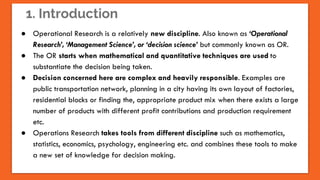
1. Introduction
● Operational Research is a relatively new discipline. Also known as ‘Operational
Research’, ‘Management Science’, or ‘decision science’ but commonly known as OR.
● The OR starts when mathematical and quantitative techniques are used to
substantiate the decision being taken.
● Decision concerned here are complex and heavily responsible. Examples are
public transportation network, planning in a city having its own layout of factories,
residential blocks or finding the, appropriate product mix when there exists a large
number of products with different profit contributions and production requirement
etc.
● Operations Research takes tools from different discipline such as mathematics,
statistics, economics, psychology, engineering etc. and combines these tools to make
a new set of knowledge for decision making.
1. Meaning and Definition of OR
● Operations Research can also be treated as science in the sense it describing,
understanding and predicting the systems behaviour, especially man-machine
system.
● According to the Operational Research Society of Great Britain, Operational
Research is the attack of modern science on complex problems arising in the direction
and management of large systems of men, machines, materials and money in industry,
business, government and defense. The purpose is to help management determine its
policy and actions scientifically.
● Randy Robinson stresses that Operations Research is the application of scientific
methods to improve the effectiveness of operations, decisions and management.
● Morse and Kimball have described it as “ a scientific method of providing executive
departments with a quantitative basis for decisions regarding the operations under their
control”
1. History of OR
● Early in 1936- the British Air Ministry established Bawdsey Research Station, on
the east coast, near Felixstowe, Suffolk, as the centre where all pre-war radar
experiments for both the Air Force and the Army would be carried out.
● It was also in 1936 that Royal Air Force (RAF) Fighter Command, charged
specifically with the air defense of Britain, was first created.
● In the summer of 1939 Britain held what was to be its last pre-war air defense
exercise. It involved some 33,000 men, 1,300 aircraft, 110 antiaircraft guns, 700
searchlights, and 100 barrage balloons. This exercise showed a great improvement
in the operation of the air defence warning and control system.
● In 1941, an Operational Research Section (ORS) was established in Coastal
Command which was to carry out some of the most well-known OR work in World
War II.
History of
OR…
Thus the Operation Research
started just before World War II
in Britain with the establishment of
teams of scientists to study the
strategic and tactical problems
involved in military operations.
The objective was to find the most
effective utilization of limited
military resources by the use of
quantitative techniques.
1. History
It was really only in the late 1930's
that operational research began in a
systematic fashion.
➔ British Army in World War 2
British Military had limited resources.
➔ Group of Scientists
They called the scientists to prepare
A way to use resources effectively.
➔ Scientific Approach
It lead to best utilisation of resources
and further win in the war.
➔ Success of Operations Research
in army attracted the attention
of the industrial mangers who
were seeking solutions to their
complex business problems.
➔ use of operations research in
government has spread from
military to wide variety of
departments at all levels.
History….
Characteristics of OR!
● Use of Interdisciplinary Teams
● Complete System Orientation
● Scientific Methods
● Quality in Decisions
● Uncovering hidden problems
Tip
Remember. If something
sounds like common
sense, people will
ignore it.
Highlight what is
unexpected about
your topic.
STAGES of
DEVELOPMENT OF
OPERATION RESEARCH or
OR MODEL
1. Observe the problem
Environment
2. Analyse and define the
problem
3. Develop a Model
4. Select appropriate data
input
5. Provide a solution and Test
its Reasonableness
6. Implement the solution
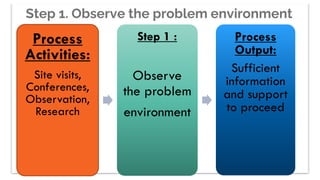
Step 1. Observe the problem environment
Process
Activities:
Site visits,
Conferences,
Observation,
Research
Step 1 :
Observe
the problem
environment
Process
Output:
Sufficient
information
and support
to proceed
Step 2. Analyze and define the problem
Process
Activities:
Define:
Use,
Objectives
,
limitations
Step 2 :
Analyze
and define
the problem
Process
Output:
Clear grasp
of need for
and
nature of
solution
requested
Step 3. Develop a Model
Process
Activities:
Define
interrelationships,
Formulate
equations,
Use known O.R.
Model ,
Search alternate
Model
Step 3 :
Develop a
Model
Process
Output:
Models that
works under
stated
environmental
constraints
Step 4. Select appropriate data input
Process
Activities:
Analyze:
internal-
external data,
Collect options,
Use computer
data banks
Step 4 :
Select
appropriate
data
input
Process
Output:
Sufficient
inputs to
operate
and
test model
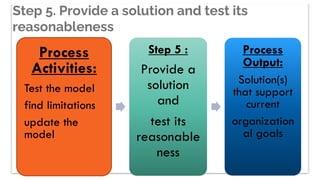
Step 5. Provide a solution and test its
reasonableness
Process
Activities:
Test the model
find limitations
update the
model
Step 5 :
Provide a
solution
and
test its
reasonable
ness
Process
Output:
Solution(s)
that support
current
organization
al goals
Step 6. Implement the solution
Process
Activities:
Resolve
behavioural issues
Sell the idea
Give explanations
Management
involvement
Step 6 :
Implement
the
solution
Process
Output:
Improved
working and
Management
support for
longer
run operation
of model
Manager
➔ Makes
Decision
Relationship between the Manager and O.R.
Specialist
O.R Specialist
➔ Helps manager to make
better decision
Manager
Relationship between the Manager and O.R. Specialist
Recognize from organizational
symptoms that a problem exists.
Manager and
OR Specialist
Decide what variables are involved; state
the problem in quantitative relationships
among the variables.
OR Specialist
Investigate methods for solving the
problems as stated above; determine
appropriate quantitative tools to be used.
OR
Specialist
Relationship between the Manager and O.R. Specialist
Attempt solutions to the problems; find
various solutions; state assumptions
underlying these solutions; test alternative
solutions.
Manager
and OR
Specialist
Determine which solution is most
effective because of practical constraints
within the organization; decide what the
solution means for the organization.
Manager
Relationship between the Manager and O.R. Specialist
Choose the solution to be used.
Manager
and OR
Specialist
Sell’ the decision to operating managers;
get their understanding and cooperation.
O.R. Tools
and
Techniques
● Linear Programming
● Game Theory
● Decision Analysis
● Queuing Theory
● Inventory Models
● Simulation
● Network Analysis
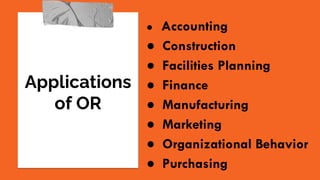
Applications
of OR
● Accounting
● Construction
● Facilities Planning
● Finance
● Manufacturing
● Marketing
● Organizational Behavior
● Purchasing
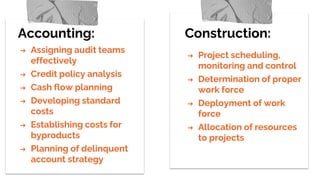
Accounting:
➔ Assigning audit teams
effectively
➔ Credit policy analysis
➔ Cash flow planning
➔ Developing standard
costs
➔ Establishing costs for
byproducts
➔ Planning of delinquent
account strategy
➔ Project scheduling,
monitoring and control
➔ Determination of proper
work force
➔ Deployment of work
force
➔ Allocation of resources
to projects
Construction:
Facilities Planning:
➔ Factory location and size
decision
➔ Estimation of number of
facilities required
➔ Hospital planning
➔ International logistic
system design
➔ Transportation loading
and unloading
➔ Warehouse location
decision
➔ Building cash
management models
➔ Allocating capital
among various
alternatives
➔ Building financial
planning models
➔ Investment analysis
➔ Portfolio analysis
➔ Dividend policy making
Finance:
Manufacturing:
➔ Inventory control
➔ Marketing balance
projection
➔ Production scheduling
➔ Production smoothing
➔ Advertising budget
allocation
➔ Product introduction
timing
➔ Selection of Product
mix
➔ Deciding most effective
packaging alternative
Marketing:
OB / HR
➔ Personnel planning
➔ Recruitment of
employees
➔ Skill balancing
➔ Training program
scheduling
➔ Designing organizational
structure more
effectively
➔ Optimal buying
➔ Optimal reordering
➔ Materials transfer
Purchasing:
LIMITATIONS OF OR
1. Distance between O.R. specialist and
Manager
2. Magnitude of Calculations
3. Money and Time Costs
4. Non-quantifiable Factors
5. Implementation

Operation Research Intro unit 1.pptx

  • 1.
  • 3.
    Definition and Meaning the use ofmathematical and analytical methods to study complex systems and processes, and to develop solutions that maximize efficiency, reduce costs, and improve overall performance
  • 4.
    • Study ofscientific approaches to decision making through mathematical modeling Study of mathematical tools , powerful modeling and solution techniques for decision making used by many successful companies Course Description
  • 5.
    Chapters Included ● LinearProgramming Problem ● Transportation and Assignment Problem ● Queuing Theory ● Inventory Control ● Replacement Theory Game Theory
  • 7.
  • 8.
    Topics  Introduction,  Historyof Operations Research,  Stages of Development of Operations Research,  Relationship between Manager and OR Specialist,  OR Tools and Techniques,  Applications of Operations Research,  Limitations of Operations Research
  • 9.
    1. Introduction ● OperationalResearch is a relatively new discipline. Also known as ‘Operational Research’, ‘Management Science’, or ‘decision science’ but commonly known as OR. ● The OR starts when mathematical and quantitative techniques are used to substantiate the decision being taken. ● Decision concerned here are complex and heavily responsible. Examples are public transportation network, planning in a city having its own layout of factories, residential blocks or finding the, appropriate product mix when there exists a large number of products with different profit contributions and production requirement etc. ● Operations Research takes tools from different discipline such as mathematics, statistics, economics, psychology, engineering etc. and combines these tools to make a new set of knowledge for decision making.
  • 10.
    1. Meaning andDefinition of OR ● Operations Research can also be treated as science in the sense it describing, understanding and predicting the systems behaviour, especially man-machine system. ● According to the Operational Research Society of Great Britain, Operational Research is the attack of modern science on complex problems arising in the direction and management of large systems of men, machines, materials and money in industry, business, government and defense. The purpose is to help management determine its policy and actions scientifically. ● Randy Robinson stresses that Operations Research is the application of scientific methods to improve the effectiveness of operations, decisions and management. ● Morse and Kimball have described it as “ a scientific method of providing executive departments with a quantitative basis for decisions regarding the operations under their control”
  • 11.
    1. History ofOR ● Early in 1936- the British Air Ministry established Bawdsey Research Station, on the east coast, near Felixstowe, Suffolk, as the centre where all pre-war radar experiments for both the Air Force and the Army would be carried out. ● It was also in 1936 that Royal Air Force (RAF) Fighter Command, charged specifically with the air defense of Britain, was first created. ● In the summer of 1939 Britain held what was to be its last pre-war air defense exercise. It involved some 33,000 men, 1,300 aircraft, 110 antiaircraft guns, 700 searchlights, and 100 barrage balloons. This exercise showed a great improvement in the operation of the air defence warning and control system. ● In 1941, an Operational Research Section (ORS) was established in Coastal Command which was to carry out some of the most well-known OR work in World War II.
  • 12.
    History of OR… Thus theOperation Research started just before World War II in Britain with the establishment of teams of scientists to study the strategic and tactical problems involved in military operations. The objective was to find the most effective utilization of limited military resources by the use of quantitative techniques.
  • 13.
    1. History It wasreally only in the late 1930's that operational research began in a systematic fashion. ➔ British Army in World War 2 British Military had limited resources. ➔ Group of Scientists They called the scientists to prepare A way to use resources effectively. ➔ Scientific Approach It lead to best utilisation of resources and further win in the war. ➔ Success of Operations Research in army attracted the attention of the industrial mangers who were seeking solutions to their complex business problems. ➔ use of operations research in government has spread from military to wide variety of departments at all levels. History….
  • 14.
    Characteristics of OR! ●Use of Interdisciplinary Teams ● Complete System Orientation ● Scientific Methods ● Quality in Decisions ● Uncovering hidden problems Tip Remember. If something sounds like common sense, people will ignore it. Highlight what is unexpected about your topic.
  • 15.
    STAGES of DEVELOPMENT OF OPERATIONRESEARCH or OR MODEL 1. Observe the problem Environment 2. Analyse and define the problem 3. Develop a Model 4. Select appropriate data input 5. Provide a solution and Test its Reasonableness 6. Implement the solution
  • 16.
    Step 1. Observethe problem environment Process Activities: Site visits, Conferences, Observation, Research Step 1 : Observe the problem environment Process Output: Sufficient information and support to proceed
  • 17.
    Step 2. Analyzeand define the problem Process Activities: Define: Use, Objectives , limitations Step 2 : Analyze and define the problem Process Output: Clear grasp of need for and nature of solution requested
  • 18.
    Step 3. Developa Model Process Activities: Define interrelationships, Formulate equations, Use known O.R. Model , Search alternate Model Step 3 : Develop a Model Process Output: Models that works under stated environmental constraints
  • 19.
    Step 4. Selectappropriate data input Process Activities: Analyze: internal- external data, Collect options, Use computer data banks Step 4 : Select appropriate data input Process Output: Sufficient inputs to operate and test model
  • 20.
    Step 5. Providea solution and test its reasonableness Process Activities: Test the model find limitations update the model Step 5 : Provide a solution and test its reasonable ness Process Output: Solution(s) that support current organization al goals
  • 21.
    Step 6. Implementthe solution Process Activities: Resolve behavioural issues Sell the idea Give explanations Management involvement Step 6 : Implement the solution Process Output: Improved working and Management support for longer run operation of model
  • 22.
    Manager ➔ Makes Decision Relationship betweenthe Manager and O.R. Specialist O.R Specialist ➔ Helps manager to make better decision
  • 23.
    Manager Relationship between theManager and O.R. Specialist Recognize from organizational symptoms that a problem exists. Manager and OR Specialist Decide what variables are involved; state the problem in quantitative relationships among the variables. OR Specialist Investigate methods for solving the problems as stated above; determine appropriate quantitative tools to be used.
  • 24.
    OR Specialist Relationship between theManager and O.R. Specialist Attempt solutions to the problems; find various solutions; state assumptions underlying these solutions; test alternative solutions. Manager and OR Specialist Determine which solution is most effective because of practical constraints within the organization; decide what the solution means for the organization.
  • 25.
    Manager Relationship between theManager and O.R. Specialist Choose the solution to be used. Manager and OR Specialist Sell’ the decision to operating managers; get their understanding and cooperation.
  • 26.
    O.R. Tools and Techniques ● LinearProgramming ● Game Theory ● Decision Analysis ● Queuing Theory ● Inventory Models ● Simulation ● Network Analysis
  • 27.
    Applications of OR ● Accounting ●Construction ● Facilities Planning ● Finance ● Manufacturing ● Marketing ● Organizational Behavior ● Purchasing
  • 28.
    Accounting: ➔ Assigning auditteams effectively ➔ Credit policy analysis ➔ Cash flow planning ➔ Developing standard costs ➔ Establishing costs for byproducts ➔ Planning of delinquent account strategy ➔ Project scheduling, monitoring and control ➔ Determination of proper work force ➔ Deployment of work force ➔ Allocation of resources to projects Construction:
  • 29.
    Facilities Planning: ➔ Factorylocation and size decision ➔ Estimation of number of facilities required ➔ Hospital planning ➔ International logistic system design ➔ Transportation loading and unloading ➔ Warehouse location decision ➔ Building cash management models ➔ Allocating capital among various alternatives ➔ Building financial planning models ➔ Investment analysis ➔ Portfolio analysis ➔ Dividend policy making Finance:
  • 30.
    Manufacturing: ➔ Inventory control ➔Marketing balance projection ➔ Production scheduling ➔ Production smoothing ➔ Advertising budget allocation ➔ Product introduction timing ➔ Selection of Product mix ➔ Deciding most effective packaging alternative Marketing:
  • 31.
    OB / HR ➔Personnel planning ➔ Recruitment of employees ➔ Skill balancing ➔ Training program scheduling ➔ Designing organizational structure more effectively ➔ Optimal buying ➔ Optimal reordering ➔ Materials transfer Purchasing:
  • 32.
    LIMITATIONS OF OR 1.Distance between O.R. specialist and Manager 2. Magnitude of Calculations 3. Money and Time Costs 4. Non-quantifiable Factors 5. Implementation