OPERATIONS
RESEARCH
INTRODUCTION
AND IT’S
APPLICATION
J. MANJULA
ASSISTANT PROFESSOR OF
MATHEMATICS ,
BON SECOURS COLLEGE FOR WOMEN
INTRODUCTION
 The term “Operation Research” was coined in 1940 by McCloskey and Trefethen in a small town of
Bawdsey in England.
 The term "operational research" was originally used in Britain during World War II to connote
scientific research done to integrate new radar technologies into Royal Air Force tactics.
 By 1941 the term had expanded to encompass research done to assist military officers in
developing tactics and planning combat operations, whether or not technology played a critical
role in the analysis. Much of this work simply involved gathering empirical data and conducting
basic statistical analyses. While some wartime work, such as the development of search theory,
was more mathematically advanced, OR would only become focused on sophisticated
mathematical methods when it emerged as a civilian profession in the post war era.
 Hence OR can be termed as ‘ art of winning war without actually fighting it’.
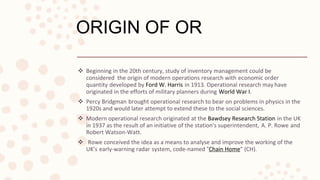
ORIGIN OF OR
 Beginning in the 20th century, study of inventory management could be
considered the origin of modern operations research with economic order
quantity developed by Ford W. Harris in 1913. Operational research may have
originated in the efforts of military planners during World War I.
 Percy Bridgman brought operational research to bear on problems in physics in the
1920s and would later attempt to extend these to the social sciences.
 Modern operational research originated at the Bawdsey Research Station in the UK
in 1937 as the result of an initiative of the station's superintendent, A. P. Rowe and
Robert Watson-Watt.
 Rowe conceived the idea as a means to analyse and improve the working of the
UK's early-warning radar system, code-named “Chain Home" (CH).
OPERATIONS RESEARCH’S
OTHER NAMES
– Operations Research is also known as
 Decision Science
 Management Science
 Quantitative Techniques
 Operation Management
DEFINITIONS
 Operations Research is the Art of giving Bad answers to the problems to which otherwise worse
answers are given - T.L. SATTY, 1958
 Operations Research is a Scientific approach to problem solving for Executive Management
– H.M.WAGNER.
 Operations is the scientific Knowledge through inter disciplinary team efforts for the purpose of
determining the best utilization of limited resources - H.A. TAHA.
 Operations Research is the scientific method of providing executive with an analytical and objective
basis for decisions - P.M.S. BLACKETT, 1948
SCOPE OF OR
 Agriculture
 Finance
 Industry
 Marketing
 Personal Management
 Research and Development
 Military operations
 Production Management
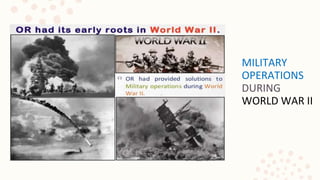
MILITARY
OPERATIONS
DURING
WORLD WAR II
USES OF OR
 It provides a logical and systematic approach to the problem.
 It allows modification of mathematical solution before they put to use.
 It facilitates improved quality of decision.
 It leads to optimum use of managers production factor.
 It indicates the scope as well as limitation of a problem.
 It suggests all the alternate courses of action for the same management.
LIMITATION OF OR
 Operation Research requires huge calculations. Which cannot be handled
manually and require computers, resulting in heavy costs.
 The validity model, for a particular situation, can be ascertained only by
conducting experiments on it.
 Models are the only idealized representations of reality and cannot be regarded
as absolute in any case.
 The implementation of OR mainly depends on the person who provides the
solution and the person (Manager) who uses the solution.
CHARACTERISTICS OF
OPERATIONS RESEARCH
 OR is a system approach
 OR is an inter-disciplinary team approach
 OR increases creative ability of the decision maker
 OR is scientific approach
• Defining
• Observing
• Formulating
• Testing
• Analyzing
OR APPLIES THE FOLLOWING
PROCESS TO PROBLEMS
 Orientation
 Problem Definition
 Data Collection
 Model Formulation
 Model Solution
 Validation and Analysis
 Implementation and Monitoring
APPLICATION OF OR
 Scheduling(of air lines, trains, buses, etc.)
 Facility location (deciding most appropriate location for new
facilities such as warehouse; factory or fire station)
 Game Theory (Identifying, understanding; developing strategies
adopted by companies)
 Computer Network Engineering (Packet routing; timing;
analysis)
 Telecom & Data Communication Engineering (Packet routing;
timing; analysis)
 Health Services (Information and supply chain management)
 Assignment (assigning crew to flights, trains or buses; employees to projects;
commitment and dispatch of power generation facilities)
 Hydraulics & Piping Engineering (managing flow of water from reservoirs)
 Urban Design
 Marketing (Selection of advertising media, ad budget allocation)
THANK YOU

Operations Research

  • 1.
    OPERATIONS RESEARCH INTRODUCTION AND IT’S APPLICATION J. MANJULA ASSISTANTPROFESSOR OF MATHEMATICS , BON SECOURS COLLEGE FOR WOMEN
  • 2.
    INTRODUCTION  The term“Operation Research” was coined in 1940 by McCloskey and Trefethen in a small town of Bawdsey in England.  The term "operational research" was originally used in Britain during World War II to connote scientific research done to integrate new radar technologies into Royal Air Force tactics.  By 1941 the term had expanded to encompass research done to assist military officers in developing tactics and planning combat operations, whether or not technology played a critical role in the analysis. Much of this work simply involved gathering empirical data and conducting basic statistical analyses. While some wartime work, such as the development of search theory, was more mathematically advanced, OR would only become focused on sophisticated mathematical methods when it emerged as a civilian profession in the post war era.  Hence OR can be termed as ‘ art of winning war without actually fighting it’.
  • 3.
    ORIGIN OF OR Beginning in the 20th century, study of inventory management could be considered the origin of modern operations research with economic order quantity developed by Ford W. Harris in 1913. Operational research may have originated in the efforts of military planners during World War I.  Percy Bridgman brought operational research to bear on problems in physics in the 1920s and would later attempt to extend these to the social sciences.  Modern operational research originated at the Bawdsey Research Station in the UK in 1937 as the result of an initiative of the station's superintendent, A. P. Rowe and Robert Watson-Watt.  Rowe conceived the idea as a means to analyse and improve the working of the UK's early-warning radar system, code-named “Chain Home" (CH).
  • 4.
    OPERATIONS RESEARCH’S OTHER NAMES –Operations Research is also known as  Decision Science  Management Science  Quantitative Techniques  Operation Management
  • 5.
    DEFINITIONS  Operations Researchis the Art of giving Bad answers to the problems to which otherwise worse answers are given - T.L. SATTY, 1958  Operations Research is a Scientific approach to problem solving for Executive Management – H.M.WAGNER.  Operations is the scientific Knowledge through inter disciplinary team efforts for the purpose of determining the best utilization of limited resources - H.A. TAHA.  Operations Research is the scientific method of providing executive with an analytical and objective basis for decisions - P.M.S. BLACKETT, 1948
  • 6.
    SCOPE OF OR Agriculture  Finance  Industry  Marketing  Personal Management  Research and Development  Military operations  Production Management
  • 7.
  • 8.
    USES OF OR It provides a logical and systematic approach to the problem.  It allows modification of mathematical solution before they put to use.  It facilitates improved quality of decision.  It leads to optimum use of managers production factor.  It indicates the scope as well as limitation of a problem.  It suggests all the alternate courses of action for the same management.
  • 9.
    LIMITATION OF OR Operation Research requires huge calculations. Which cannot be handled manually and require computers, resulting in heavy costs.  The validity model, for a particular situation, can be ascertained only by conducting experiments on it.  Models are the only idealized representations of reality and cannot be regarded as absolute in any case.  The implementation of OR mainly depends on the person who provides the solution and the person (Manager) who uses the solution.
  • 10.
    CHARACTERISTICS OF OPERATIONS RESEARCH OR is a system approach  OR is an inter-disciplinary team approach  OR increases creative ability of the decision maker  OR is scientific approach • Defining • Observing • Formulating • Testing • Analyzing
  • 11.
    OR APPLIES THEFOLLOWING PROCESS TO PROBLEMS  Orientation  Problem Definition  Data Collection  Model Formulation  Model Solution  Validation and Analysis  Implementation and Monitoring
  • 12.
    APPLICATION OF OR Scheduling(of air lines, trains, buses, etc.)  Facility location (deciding most appropriate location for new facilities such as warehouse; factory or fire station)  Game Theory (Identifying, understanding; developing strategies adopted by companies)  Computer Network Engineering (Packet routing; timing; analysis)
  • 13.
     Telecom &Data Communication Engineering (Packet routing; timing; analysis)  Health Services (Information and supply chain management)  Assignment (assigning crew to flights, trains or buses; employees to projects; commitment and dispatch of power generation facilities)  Hydraulics & Piping Engineering (managing flow of water from reservoirs)  Urban Design  Marketing (Selection of advertising media, ad budget allocation)
  • 14.