INTRODUCTION TO
OPERATIONS
RESEARCH
INTRODUCTION
“Operations research is the application of
scientific methods, techniques and tools to
problems involving the operations of a
system so as to provide those in control of
the system with optimum solution to the
problem” C.W Churchman
O.R is the art of finding bad answers where
worse exist.
Meaning and History
 In order to understand ‘What operations research is today' we must
know something its history.
 HISTORY:-The main origin of OR was during the SecondWorld-War . At
that time the military management in England called upon a team of
scientists to study the strategic and tactical problems related to air and land
defence of the country. since they were having very limited military
resources, it was necessary to decide upon the most effective utilisation of
them.
The OR teams were not actually engaged in military operations and in
fighting theWar. But , they were only advisors and significantly instrumental
in winning the war.The work of this team of scientist was named as
OPERATIONAL RESEARCH in England. Hence OR can be associated with
“an art of winning the war without actually fighting it”
 The first mathematical technique was developed in 1947 by American
Mathematician, George B. Dantzig.
Operations research in INDIA
 OR came into existence in India in 1949, Regional research
laboratory, Hyderabad.
 In INDIA OR society founded in 1959, , also became a member of
international Federation of OR societies in 1959.The Journal
OPSEARCH was published for the first time in 1963.
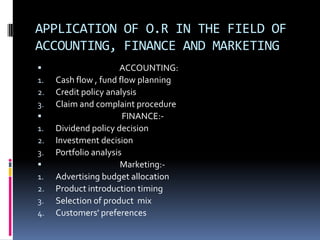
APPLICATION OF O.R IN THE FIELD OF
ACCOUNTING, FINANCE AND MARKETING
 ACCOUNTING:
1. Cash flow , fund flow planning
2. Credit policy analysis
3. Claim and complaint procedure
 FINANCE:-
1. Dividend policy decision
2. Investment decision
3. Portfolio analysis
 Marketing:-
1. Advertising budget allocation
2. Product introduction timing
3. Selection of product mix
4. Customers' preferences
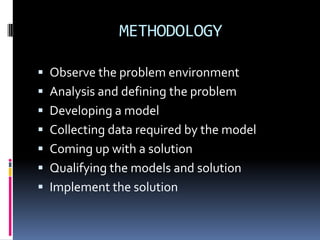
METHODOLOGY
 Observe the problem environment
 Analysis and defining the problem
 Developing a model
 Collecting data required by the model
 Coming up with a solution
 Qualifying the models and solution
 Implement the solution
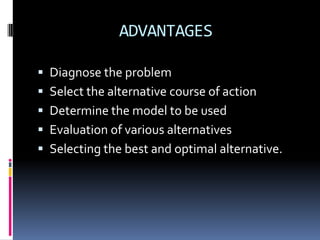
ADVANTAGES
 Diagnose the problem
 Select the alternative course of action
 Determine the model to be used
 Evaluation of various alternatives
 Selecting the best and optimal alternative.
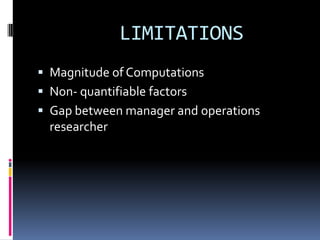
LIMITATIONS
 Magnitude of Computations
 Non- quantifiable factors
 Gap between manager and operations
researcher

Chapter 1 operations research (2)

  • 1.
  • 2.
    INTRODUCTION “Operations research isthe application of scientific methods, techniques and tools to problems involving the operations of a system so as to provide those in control of the system with optimum solution to the problem” C.W Churchman O.R is the art of finding bad answers where worse exist.
  • 3.
    Meaning and History In order to understand ‘What operations research is today' we must know something its history.  HISTORY:-The main origin of OR was during the SecondWorld-War . At that time the military management in England called upon a team of scientists to study the strategic and tactical problems related to air and land defence of the country. since they were having very limited military resources, it was necessary to decide upon the most effective utilisation of them. The OR teams were not actually engaged in military operations and in fighting theWar. But , they were only advisors and significantly instrumental in winning the war.The work of this team of scientist was named as OPERATIONAL RESEARCH in England. Hence OR can be associated with “an art of winning the war without actually fighting it”  The first mathematical technique was developed in 1947 by American Mathematician, George B. Dantzig.
  • 4.
    Operations research inINDIA  OR came into existence in India in 1949, Regional research laboratory, Hyderabad.  In INDIA OR society founded in 1959, , also became a member of international Federation of OR societies in 1959.The Journal OPSEARCH was published for the first time in 1963.
  • 5.
    APPLICATION OF O.RIN THE FIELD OF ACCOUNTING, FINANCE AND MARKETING  ACCOUNTING: 1. Cash flow , fund flow planning 2. Credit policy analysis 3. Claim and complaint procedure  FINANCE:- 1. Dividend policy decision 2. Investment decision 3. Portfolio analysis  Marketing:- 1. Advertising budget allocation 2. Product introduction timing 3. Selection of product mix 4. Customers' preferences
  • 6.
    METHODOLOGY  Observe theproblem environment  Analysis and defining the problem  Developing a model  Collecting data required by the model  Coming up with a solution  Qualifying the models and solution  Implement the solution
  • 7.
    ADVANTAGES  Diagnose theproblem  Select the alternative course of action  Determine the model to be used  Evaluation of various alternatives  Selecting the best and optimal alternative.
  • 8.
    LIMITATIONS  Magnitude ofComputations  Non- quantifiable factors  Gap between manager and operations researcher