EDM 205
HUMAN BEHAVIOR IN
ORGANIZATION
MOTIVATING EMPLOYEE
PERFORMANCE
THROUGH REWARDS
Motivating employee performance through rewards involves designing and implementing
a system that recognizes and incentivizes desirable behavior and high performance.
By thoughtfully designing a reward system that recognizes and incentivizes desired
behaviors, organizations can enhance employee performance, satisfaction, and retention.
GOAL SETTING AND
MOTIVATION
Goal setting is a powerful tool for enhancing motivation
and performance. When done effectively, it provides
employees with clear direction, a sense of purpose, and
measurable targets to strive towards
Goal Setting
 is a process that starts with careful consideration of
what you want to achieve, and ends with a lot of hard
work to actually do it.
 is a process of identifying something that you want to
accomplish and establishing measurable goals and time
frames.
Goal setting is indeed a process that begins with thoughtful consideration of what you want to
achieve and culminates in dedicated effort to make it happen.
This process helps clarify your ambitions, provides a roadmap for achieving them, and
allows for tracking progress along the way. By defining clear goals with measurable
outcomes and specific timelines, you increase your chances of success and maintain focus
throughout your pursuit
Motivation
 can be defined as “the stimulation of any emotion or
desire operating upon one’s will and promoting or
driving it to action.”
It causes people to act – whether switching off the
television or changing your career path.
It highlights how motivation involves the activation of emotions or desires that influence
and energize a person's behavior towards achieving specific goals or outcomes.
Absolutely! Motivation serves as the driving force behind people's actions and decisions. It
can compel individuals to take a wide range of actions, from simple daily tasks like turning
off the television to significant life-changing decisions such as pursuing a new career path.
Motivation
 In fact, motivation is the driving force behind
our actions. In other words, it can energize a
person and compels him/her to act in a
certain way.
Understanding motivation enables individuals to effectively manage their own
motivation levels and cultivate environments within organizations that foster high levels
of motivation among employees.
Goal-Setting Theory
A social learning theory that provides insights into why and
how goals can motivate behavior.
I think a Social learning Theory that is the Theory of Albert
Banduras
It also help us understand how different people cope with
failure to reach their goals.
Edwin Locke’s goal-setting theory of motivation assumes
that behavior is a result of conscious goals and intentions.
Albert Bandura's social learning theory provides valuable insights into how goals
can motivate behavior through the process of observational learning and self-
regulation.
By applying social learning theory, individuals and organizations can better understand how
people cope with failure and support them in developing resilience, persistence, and adaptive
strategies to achieve their goals over time.
highlighting how setting and striving towards specific objectives
can significantly enhance motivation and performance.
Goal-Setting Theory
By setting goals for people in the organization, a manager
should be able to influence their behavior.
Develop a through understanding of the process by which
people set their goals and then work to reach them.
By effectively setting and managing goals, managers can influence employee behavior in a positive
way, fostering motivation, productivity, and alignment with organizational goals. Goal setting serves
as a powerful tool for driving individual and collective performance within the organization.
By understanding these processes and factors, individuals and organizations can better
support goal achievement, enhance motivation, and foster personal and professional
development.
Goal Setting Theory of Motivation
Goal
Difficulty
Goal
Specificity
Goal
Commitment
Goal
Acceptance
Goal-
Directed
Effort
Organizational
Support
Individual
Abilities
and Traits
Performance
Intrinsic
Reward
Satisfaction
Extrinsic
Reward
By: Locke and Gary Latham
The expanded theory
argues that Goal-
Directed Effort is a
function of four(4) good
attributes:
Goal difficulty
Goal specificity
Goal acceptance
Goal commitment
Goal Difficulty This refers to the level of challenge presented by the
goal.
Goal Specificity: This pertains to how clearly and
precisely the goal is defined.
Goal Acceptance: This involves the extent to which individuals agree
with and accept the goals set for them.
Goal Commitment This refers to the degree to which individuals are
dedicated to achieving the goal.
By focusing on these four attributes, organizations and individuals can enhance
Goal-Directed Effort, leading to improved performance and achievement of desired
outcomes.
1. Goal Difficulty
Goal difficulty is the extent to which a goal is
challenging and requires effort.Difficult goals typically
demand more effort and persistence. When goals are
challenging, individuals are motivated to invest more
energy and resources to meet these higher standards.
If people work to achieve goals, it is reasonable to
assume that they will work harder to achieve more
difficult goals.
This is a core principle of goal-setting theory, which suggests that
challenging goals can lead to higher performance, provided that the goals
are perceived as attainable and the individuals are committed to them.
2. Goal Specificity
Goal specificity is the clarity and precision of the goal.
refers to how clearly and precisely a goal is defined. Specific
goals outline exactly what is expected, how much, and by
when.By ensuring that goals are specific, individuals and organizations can
enhance clarity, focus, and performance, leading to better outcomes and higher
levels of achievement.
Some goals, such as those involving costs, output,
profitability, and growth can easily be states in clear and
precise terms.Yes, goals related to costs, output, profitability, and growth
are often well-suited to being stated in clear and precise terms. These types of
goals can typically be quantified and measured, making them easier to track
and manage.
3. Goal Acceptance
Is the extent to which a person accepts a goal as his or her
own.
By fostering goal acceptance, organizations can enhance employee
motivation, commitment, and performance, leading to more successful goal
achievement and overall organizational effectiveness.
4. Goal Commitment
Is the extent to which he or she personally interested in
reaching the goal.
By understanding and fostering goal commitment, organizations and
individuals can enhance motivation, persistence, and overall performance,
leading to successful goal achievement and personal satisfaction
Goal Setting Theory of Motivation
Goal
Difficulty
Goal
Specificity
Goal
Commitment
Goal
Acceptance
Goal-
Directed
Effort
Organizational
Support
Individual
Abilities
and Traits
Performance
Intrinsic
Reward
Satisfaction
Extrinsic
Reward
The interaction of
Goal- Directed
Effort,
Organizational
Support and
Individual
Abilities
determines actual
Performance.
By: Locke and Gary Latham
Goal-Directed Effort: This refers to the amount of energy and focus an
individual dedicates to achieving specific goals.
Organizational Support: This includes the resources, training, and
encouragement provided by the organization.
Individual Abilities: These are the skills, knowledge,
and competencies that an individual possesses.
Organizational Support
Is whatever the organization does to have better
performance.
Individual Abilities and Traits
Are the skills and other personal characteristics
necessary to do a job.
Yes, organizational efforts to improve performance often
involve a combination of strategies aimed at enhancing goal-
directed effort, organizational support, and individual abilities.
Yes, the skills and other personal characteristics necessary to perform a job
effectively are commonly referred to as competencies. Competencies
encompass a wide range of attributes that contribute to successful job
performance.
Goal Setting Theory of Motivation
Goal
Difficulty
Goal
Specificity
Goal
Commitment
Goal
Acceptance
Goal-
Directed
Effort
Organizational
Support
Individual
Abilities
and Traits
Performance
Intrinsic
Reward
Satisfaction
Extrinsic
Reward
By: Locke and Gary Latham As a result of
performance, a
person receives a
various intrinsic
and extrinsic
rewards that, in
turn, influence
satisfaction
Intrinsic Rewards:Recognition and
Feedback
Job Enjoyment
extrinsic Rewards: Compensation,
Intrinsic Reward
 An internal reward that employees achieve from
completing their tasks or projects successfully.Exactly! An
intrinsic reward is an internal satisfaction or sense of
fulfillment that individuals experience when they engage
in and complete tasks or projects. These rewards come
from within the person and are not dependent on external
factors such as money or praise from others
 Mostly psychological and are based on the effort and
abilities of a person.
Extrinsic Reward
 Mostly financial or tangible rewards given to
employees, such as pay raises, bonuses, and
benefits.
 They are extrinsic because they are external to
completing work itself and are controlled by the
people other than the employee.
Management By Objectives (MBO)
 Is essentially a collaborative goal-setting process
through which organization goals systematically
cascade down through the organization.
 Starts with top managers establishing overall goals for
the organization.
 Managers and employees throughout the organization
collaborate to set subsidiary goals.
 An annual performance review will be done at the end
of the specified time period.
PERFORMANCE
MANAGEMENT IN
ORGANIZATIONS
The Nature of Performance Management
Performance measurement or performance appraisal
is the process by which someone
1) Evaluates an employee’s work behaviors by
measurement and comparison with previously
established standards,
2) Documents the results,
3) Communicates the results to the employee.
Organizational Processes and Activities
Total Quality Management
The Nature of Performance Management
A Performance Management System (PMS) compromises the
processes and activities involved in performance appraisals.
Timing and
Frequency of
Evaluation
Determination of
Who Appraises
Whom
Measurement
Procedure
Storage of
Distribution of
Information
Recording
Methods
Performance Measurement
Manager Employee
Purposes Of Performance Measurement
Providing job performance feedback is the primary use of
appraisal information.
Judgement of Past Performance
• Provide basis for reward allocation.
• Provide basis for promotions, transfer, layoff, and so on.
• Identify high-potential employees.
• Validate selection procedures.
• Evaluate previous training program.
Development of Future Performance
• Faster work improvement.
• Identify training and development opportunities.
• Develop ways to overcome obstacles and performance.
• Establish supervisor-employee agreement on expectations.
Purposes Of Performance Measurement
Providing job performance feedback is the primary use of
appraisal information.
Performance Measurement Basics
The Appraiser
• Supervisor
• Multiple-rater system
• 360-degree feedback
Frequency
• Regular basis,
typically once a year
• “as needed” basis
Measuring Performance
• Must be valid, reliable and
free of bias
• Graphic rating scale,
checklists, essays or diaries,
behaviorally anchored
rating scales, and force-
choice systems
INDIVIDUAL REWARDS IN
ORGANIZATION
 The rewarding system consist of all
organizational components, including people,
processes, rules and procedures, and decision-
making activities, involved in allocating
compensation and benefits to employees in
exchange for their contributions to the
organization.
 The purpose of the reward in most
organizations is to attract, retain and motivate
qualified employees.
 The organization’s compensation structure must
be equitable and consistent to ensure equality of
treatment and compliance with the law.
 Compensation should be also be a fair reward to
the individual’s contribution to the organization.
 The organization needs to decide of what type
of behavior or performance it wants to
encourage with a reward system because what
is rewarded tend to recur.
Meaning of Rewards to Employees
 The surface value of a reward to an employee is its
objective meaning or worth.
 The symbolic value of a reward to an employee is its
subjective and personal meaning or worth.
Types of Reward
An individual’s compensation package is
the total array of money (wages, salary,
commissions) incentives, benefits, perquisites, and
awards provided by the organizations.
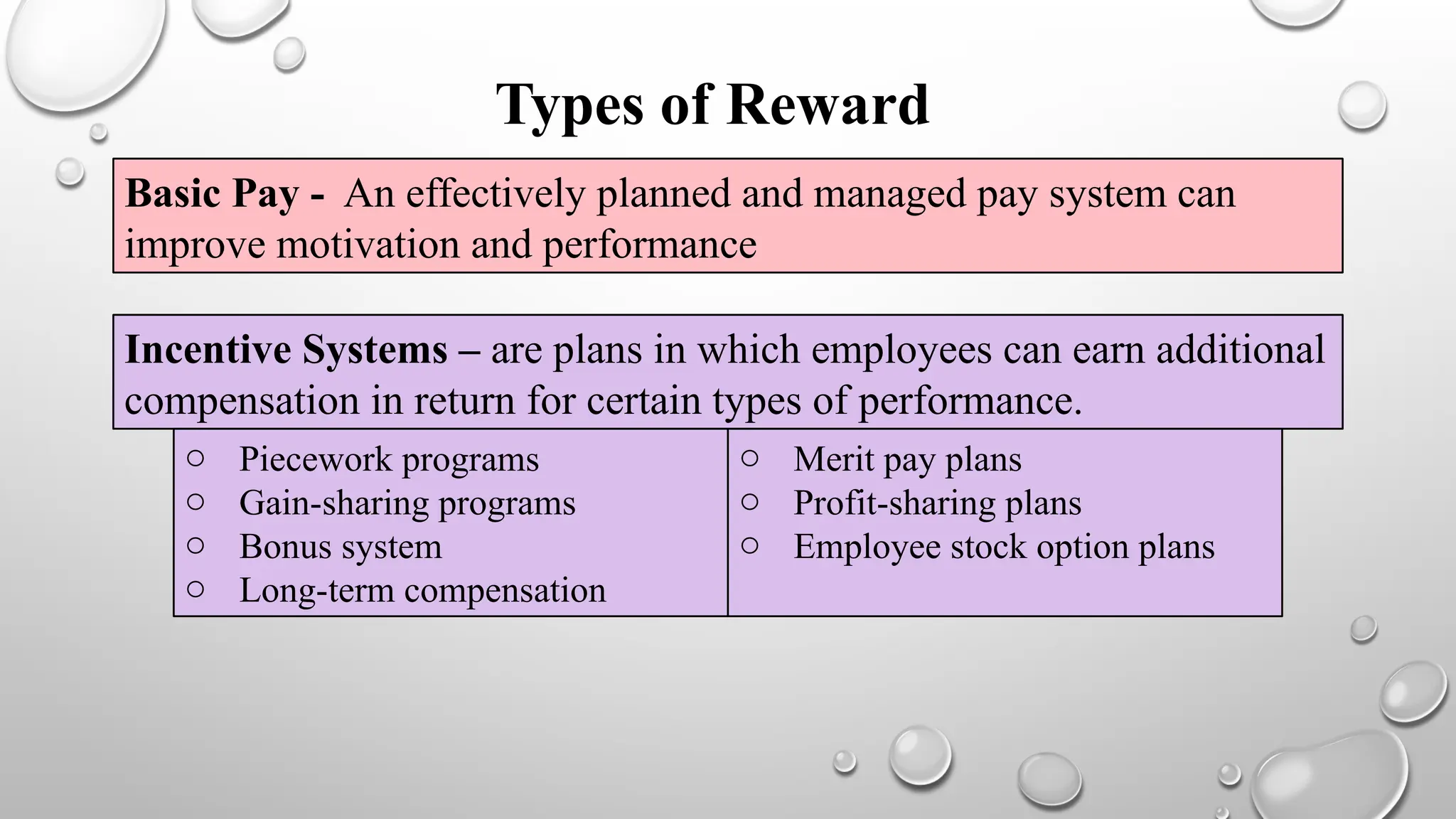
Types of Reward
Basic Pay - An effectively planned and managed pay system can
improve motivation and performance
Incentive Systems – are plans in which employees can earn additional
compensation in return for certain types of performance.
o Piecework programs
o Gain-sharing programs
o Bonus system
o Long-term compensation
o Merit pay plans
o Profit-sharing plans
o Employee stock option plans
Indirect Compensation – another major component of the compensation
package which also commonly referred to as the employee benefit plan
Types of Reward
o Payment for time not worked
o Social Security contributions
o Unemployment compensation
o Disability and worker’s compensation
benefits
o Life and health insurance program
o Pension or retirement
Perquisites – are special privileges awarded to selected members of
an organization usually top managers.
Awards – at many companies, employees receive awards for anything
from seniority to perfect attendance, from zero defects (quality work)
to cost reduction suggestions.
Managing Reward System
Issues to consider in Developing Reward System:
Pay Secrecy Employee
Participation
Expatriate
Compensation
Ability to
pay
Impact on
Organizational
Performance
Economic
and Labor
Market
Factors
Flexible
System
Thank you!

3.-MOTIVATING-EMPLOYEE-PERFORMANCE-THROUGH-REWARDS.pptx

  • 1.
    EDM 205 HUMAN BEHAVIORIN ORGANIZATION
  • 2.
    MOTIVATING EMPLOYEE PERFORMANCE THROUGH REWARDS Motivatingemployee performance through rewards involves designing and implementing a system that recognizes and incentivizes desirable behavior and high performance. By thoughtfully designing a reward system that recognizes and incentivizes desired behaviors, organizations can enhance employee performance, satisfaction, and retention.
  • 3.
    GOAL SETTING AND MOTIVATION Goalsetting is a powerful tool for enhancing motivation and performance. When done effectively, it provides employees with clear direction, a sense of purpose, and measurable targets to strive towards
  • 4.
    Goal Setting  isa process that starts with careful consideration of what you want to achieve, and ends with a lot of hard work to actually do it.  is a process of identifying something that you want to accomplish and establishing measurable goals and time frames. Goal setting is indeed a process that begins with thoughtful consideration of what you want to achieve and culminates in dedicated effort to make it happen. This process helps clarify your ambitions, provides a roadmap for achieving them, and allows for tracking progress along the way. By defining clear goals with measurable outcomes and specific timelines, you increase your chances of success and maintain focus throughout your pursuit
  • 5.
    Motivation  can bedefined as “the stimulation of any emotion or desire operating upon one’s will and promoting or driving it to action.” It causes people to act – whether switching off the television or changing your career path. It highlights how motivation involves the activation of emotions or desires that influence and energize a person's behavior towards achieving specific goals or outcomes. Absolutely! Motivation serves as the driving force behind people's actions and decisions. It can compel individuals to take a wide range of actions, from simple daily tasks like turning off the television to significant life-changing decisions such as pursuing a new career path.
  • 6.
    Motivation  In fact,motivation is the driving force behind our actions. In other words, it can energize a person and compels him/her to act in a certain way. Understanding motivation enables individuals to effectively manage their own motivation levels and cultivate environments within organizations that foster high levels of motivation among employees.
  • 7.
    Goal-Setting Theory A sociallearning theory that provides insights into why and how goals can motivate behavior. I think a Social learning Theory that is the Theory of Albert Banduras It also help us understand how different people cope with failure to reach their goals. Edwin Locke’s goal-setting theory of motivation assumes that behavior is a result of conscious goals and intentions. Albert Bandura's social learning theory provides valuable insights into how goals can motivate behavior through the process of observational learning and self- regulation. By applying social learning theory, individuals and organizations can better understand how people cope with failure and support them in developing resilience, persistence, and adaptive strategies to achieve their goals over time. highlighting how setting and striving towards specific objectives can significantly enhance motivation and performance.
  • 8.
    Goal-Setting Theory By settinggoals for people in the organization, a manager should be able to influence their behavior. Develop a through understanding of the process by which people set their goals and then work to reach them. By effectively setting and managing goals, managers can influence employee behavior in a positive way, fostering motivation, productivity, and alignment with organizational goals. Goal setting serves as a powerful tool for driving individual and collective performance within the organization. By understanding these processes and factors, individuals and organizations can better support goal achievement, enhance motivation, and foster personal and professional development.
  • 9.
    Goal Setting Theoryof Motivation Goal Difficulty Goal Specificity Goal Commitment Goal Acceptance Goal- Directed Effort Organizational Support Individual Abilities and Traits Performance Intrinsic Reward Satisfaction Extrinsic Reward By: Locke and Gary Latham The expanded theory argues that Goal- Directed Effort is a function of four(4) good attributes: Goal difficulty Goal specificity Goal acceptance Goal commitment
  • 10.
    Goal Difficulty Thisrefers to the level of challenge presented by the goal. Goal Specificity: This pertains to how clearly and precisely the goal is defined. Goal Acceptance: This involves the extent to which individuals agree with and accept the goals set for them. Goal Commitment This refers to the degree to which individuals are dedicated to achieving the goal. By focusing on these four attributes, organizations and individuals can enhance Goal-Directed Effort, leading to improved performance and achievement of desired outcomes.
  • 11.
    1. Goal Difficulty Goaldifficulty is the extent to which a goal is challenging and requires effort.Difficult goals typically demand more effort and persistence. When goals are challenging, individuals are motivated to invest more energy and resources to meet these higher standards. If people work to achieve goals, it is reasonable to assume that they will work harder to achieve more difficult goals. This is a core principle of goal-setting theory, which suggests that challenging goals can lead to higher performance, provided that the goals are perceived as attainable and the individuals are committed to them.
  • 12.
    2. Goal Specificity Goalspecificity is the clarity and precision of the goal. refers to how clearly and precisely a goal is defined. Specific goals outline exactly what is expected, how much, and by when.By ensuring that goals are specific, individuals and organizations can enhance clarity, focus, and performance, leading to better outcomes and higher levels of achievement. Some goals, such as those involving costs, output, profitability, and growth can easily be states in clear and precise terms.Yes, goals related to costs, output, profitability, and growth are often well-suited to being stated in clear and precise terms. These types of goals can typically be quantified and measured, making them easier to track and manage.
  • 13.
    3. Goal Acceptance Isthe extent to which a person accepts a goal as his or her own. By fostering goal acceptance, organizations can enhance employee motivation, commitment, and performance, leading to more successful goal achievement and overall organizational effectiveness. 4. Goal Commitment Is the extent to which he or she personally interested in reaching the goal. By understanding and fostering goal commitment, organizations and individuals can enhance motivation, persistence, and overall performance, leading to successful goal achievement and personal satisfaction
  • 14.
    Goal Setting Theoryof Motivation Goal Difficulty Goal Specificity Goal Commitment Goal Acceptance Goal- Directed Effort Organizational Support Individual Abilities and Traits Performance Intrinsic Reward Satisfaction Extrinsic Reward The interaction of Goal- Directed Effort, Organizational Support and Individual Abilities determines actual Performance. By: Locke and Gary Latham
  • 15.
    Goal-Directed Effort: Thisrefers to the amount of energy and focus an individual dedicates to achieving specific goals. Organizational Support: This includes the resources, training, and encouragement provided by the organization. Individual Abilities: These are the skills, knowledge, and competencies that an individual possesses.
  • 16.
    Organizational Support Is whateverthe organization does to have better performance. Individual Abilities and Traits Are the skills and other personal characteristics necessary to do a job. Yes, organizational efforts to improve performance often involve a combination of strategies aimed at enhancing goal- directed effort, organizational support, and individual abilities. Yes, the skills and other personal characteristics necessary to perform a job effectively are commonly referred to as competencies. Competencies encompass a wide range of attributes that contribute to successful job performance.
  • 17.
    Goal Setting Theoryof Motivation Goal Difficulty Goal Specificity Goal Commitment Goal Acceptance Goal- Directed Effort Organizational Support Individual Abilities and Traits Performance Intrinsic Reward Satisfaction Extrinsic Reward By: Locke and Gary Latham As a result of performance, a person receives a various intrinsic and extrinsic rewards that, in turn, influence satisfaction Intrinsic Rewards:Recognition and Feedback Job Enjoyment extrinsic Rewards: Compensation,
  • 18.
    Intrinsic Reward  Aninternal reward that employees achieve from completing their tasks or projects successfully.Exactly! An intrinsic reward is an internal satisfaction or sense of fulfillment that individuals experience when they engage in and complete tasks or projects. These rewards come from within the person and are not dependent on external factors such as money or praise from others  Mostly psychological and are based on the effort and abilities of a person.
  • 19.
    Extrinsic Reward  Mostlyfinancial or tangible rewards given to employees, such as pay raises, bonuses, and benefits.  They are extrinsic because they are external to completing work itself and are controlled by the people other than the employee.
  • 20.
    Management By Objectives(MBO)  Is essentially a collaborative goal-setting process through which organization goals systematically cascade down through the organization.  Starts with top managers establishing overall goals for the organization.  Managers and employees throughout the organization collaborate to set subsidiary goals.  An annual performance review will be done at the end of the specified time period.
  • 21.
  • 22.
    The Nature ofPerformance Management Performance measurement or performance appraisal is the process by which someone 1) Evaluates an employee’s work behaviors by measurement and comparison with previously established standards, 2) Documents the results, 3) Communicates the results to the employee.
  • 23.
    Organizational Processes andActivities Total Quality Management The Nature of Performance Management A Performance Management System (PMS) compromises the processes and activities involved in performance appraisals. Timing and Frequency of Evaluation Determination of Who Appraises Whom Measurement Procedure Storage of Distribution of Information Recording Methods Performance Measurement Manager Employee
  • 24.
    Purposes Of PerformanceMeasurement Providing job performance feedback is the primary use of appraisal information. Judgement of Past Performance • Provide basis for reward allocation. • Provide basis for promotions, transfer, layoff, and so on. • Identify high-potential employees. • Validate selection procedures. • Evaluate previous training program.
  • 25.
    Development of FuturePerformance • Faster work improvement. • Identify training and development opportunities. • Develop ways to overcome obstacles and performance. • Establish supervisor-employee agreement on expectations. Purposes Of Performance Measurement Providing job performance feedback is the primary use of appraisal information.
  • 26.
    Performance Measurement Basics TheAppraiser • Supervisor • Multiple-rater system • 360-degree feedback Frequency • Regular basis, typically once a year • “as needed” basis Measuring Performance • Must be valid, reliable and free of bias • Graphic rating scale, checklists, essays or diaries, behaviorally anchored rating scales, and force- choice systems
  • 27.
  • 28.
     The rewardingsystem consist of all organizational components, including people, processes, rules and procedures, and decision- making activities, involved in allocating compensation and benefits to employees in exchange for their contributions to the organization.
  • 29.
     The purposeof the reward in most organizations is to attract, retain and motivate qualified employees.  The organization’s compensation structure must be equitable and consistent to ensure equality of treatment and compliance with the law.  Compensation should be also be a fair reward to the individual’s contribution to the organization.
  • 30.
     The organizationneeds to decide of what type of behavior or performance it wants to encourage with a reward system because what is rewarded tend to recur.
  • 31.
    Meaning of Rewardsto Employees  The surface value of a reward to an employee is its objective meaning or worth.  The symbolic value of a reward to an employee is its subjective and personal meaning or worth.
  • 32.
    Types of Reward Anindividual’s compensation package is the total array of money (wages, salary, commissions) incentives, benefits, perquisites, and awards provided by the organizations.
  • 33.
    Types of Reward BasicPay - An effectively planned and managed pay system can improve motivation and performance Incentive Systems – are plans in which employees can earn additional compensation in return for certain types of performance. o Piecework programs o Gain-sharing programs o Bonus system o Long-term compensation o Merit pay plans o Profit-sharing plans o Employee stock option plans
  • 34.
    Indirect Compensation –another major component of the compensation package which also commonly referred to as the employee benefit plan Types of Reward o Payment for time not worked o Social Security contributions o Unemployment compensation o Disability and worker’s compensation benefits o Life and health insurance program o Pension or retirement Perquisites – are special privileges awarded to selected members of an organization usually top managers. Awards – at many companies, employees receive awards for anything from seniority to perfect attendance, from zero defects (quality work) to cost reduction suggestions.
  • 35.
    Managing Reward System Issuesto consider in Developing Reward System: Pay Secrecy Employee Participation Expatriate Compensation Ability to pay Impact on Organizational Performance Economic and Labor Market Factors Flexible System
  • 36.