TRAINING & DEVELOPMENT Training Objective and Focus on Trainee (Motivation, Reinforcement & Goal Setting) By: Mansi jain Neha Bajaj Swati Aggarwal
Definition: A training objective is the specific knowledge, skills, or attitudes that the trainees are to gain as a result of the training activity.  Purpose:   to state as clearly as possible what trainees are expected to be able to do at the end of their training  the conditions under which they will demonstrate their learning standards that must be reached to confirm their level of competence
Training Objective should specify The Change Intended Conditions  Standards How learners   will demonstrate the   extent of learning Time Constraints
SMART Objectives Objectives should be  SMART : S pecific  (linked to rate, no., %) M easurable  (tracking & recording of behaviour/action) A chievable  (capable of being reached) R elevant  (importance to individual & organization) T ime Based
Types of Training Objective Trainee reaction Objective Learning Objective Transfer of training objective Organizational objective
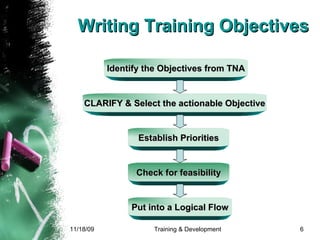
Writing Training Objectives Identify the Objectives from TNA CLARIFY & Select the actionable Objective Establish Priorities Put into a Logical Flow Check for feasibility
Benefits from Training Objectives  The Trainee- Reduce anxiety related to the unknown Focus attention Increase likelihood that trainees will be successful Provide link between training needs & training which is delivered
Benefits from Training Objectives The Trainer- More effective learning process Prevent teaching too much or too little Easy to determine trainees progress Keep the trainers on right track
Examples of Well-Written Learning Objectives  Topic: Communication  explain four basic principles of communication (verbal and non-verbal) and active, empathetic listening. outline four barriers and bridges to communication list at least four ways communication skills which encourage staff involvement will help crate a positive work environment  Topic: Conflict resolution explain at least five basic principles of empathetic communication to handle conflict develop policy that gives current front-line leaders the permission and expectation to work with other staff on conflict resolution develop policy for progressive discipline and explain how this works to current front line leaders
Example : Motorola Six Sigma® e-Foundations Training   moto-sixsigma.pdf
Facilitation Of Learning: Focus On The Trainee KSAs Motivation of trainee Conditioning & Reinforcement Goal Setting
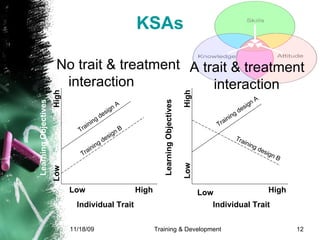
KSAs No trait & treatment interaction A trait & treatment  interaction Individual Trait Individual Trait Learning Objectives Learning Objectives Low Low Low Low High High High High Training design A Training design A Training design B Training design B
Motivation of Trainee Motivation is simply  -  The reason for an action - That which gives purpose and direction to behaviour.
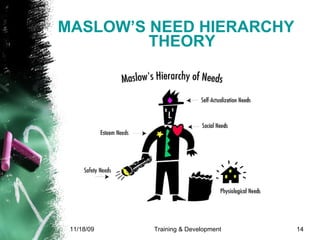
MASLOW’S NEED HIERARCHY THEORY
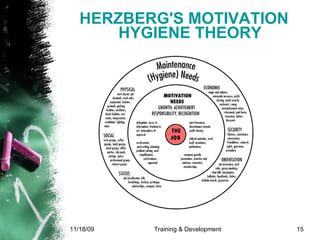
HERZBERG'S MOTIVATION HYGIENE THEORY
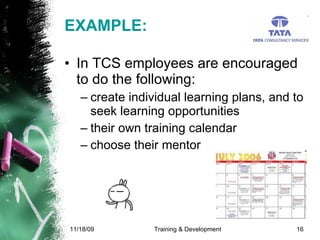
EXAMPLE: In TCS employees are encouraged to do the following:  create individual learning plans, and to seek learning opportunities  their own training calendar  choose their mentor
Expectations towards training Positive expectations Negative expectations
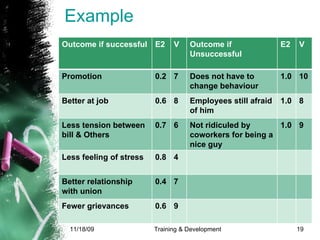
Expectancy Theory E1= the belief that effort will lead to desired performance E2= the belief that desired performance will lead to desired outcomes V1 = the emotional orientations people hold with respect to outcomes  Formula: E1[( E2outcome1  x V outcome1 )+(E2 outcome2  X V outcome2 )+…  …+(E2 outcome6  X V outcome6 )]
Example   Outcome if successful E2 V Outcome if Unsuccessful E2 V Promotion 0.2 7 Does not have to change behaviour 1.0 10 Better at job 0.6 8 Employees still afraid of him 1.0 8 Less tension between bill & Others 0.7 6 Not ridiculed by coworkers for being a nice guy 1.0 9 Less feeling of stress 0.8 4 Better relationship with union 0.4 7 Fewer grievances 0.6 9
Conditioning & Reinforcement Classical Conditioning Operant Conditioning
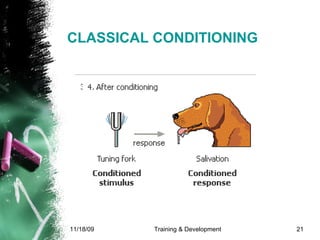
CLASSICAL CONDITIONING
OPERANT CONDITIONING Positive reinforcement  - give an organism a pleasant stimulus when the operant response is made.  Negative reinforcement  - take away an unpleasant stimulus when the operant response is made.  Positive Punishment   presentation of an aversive stimulus to decrease the probability of an operant response occurring again. Negative Punishment  -  the removal of a pleasant stimulus to decrease the probability of an operant response occurring again.
Reinforcement methods & tools •  A process for Managers/Supervisors to follow in preparing their staff members for training and in following up once the training is completed • Podcasts done in "talk radio" style clips to reinforce skills taught in the classroom. • Pocket-sized skill checklists for use by Managers as they observe their people on the job • Training for Managers on how to coach and give tailored feedback to their staff members  • Laminated wallet-sized skill reminder cards for participants • Skill reinforcement on CD or DVD • One-on-one observation and coaching of participants by Global Learning Link • Online knowledge quizzes coupled with incentive programs
Goal setting Specific goals lead to better performance & more predictable effects Goals must match to the individual’s ability Feedback concerning the degree to which the goal is being achieved is necessary for goal setting to have the desired effect For goal setting to be effective, the individual needs to accept the goal that is set
Ten Steps for Goal Setting Establish goals. Include your supervisee in selecting goals  Customise your plan.  Write out goals.  Make goals as specific, clear, objective, realistic, and obtainable as possible.  Create a hierarchy of objectives.  Divide goals into competency areas:  Knowledge and theory Practice and skill Personal self-awareness  Select methods and techniques to best accomplish goals.  Tie goals to evaluation.  Revisit and review goals periodically.
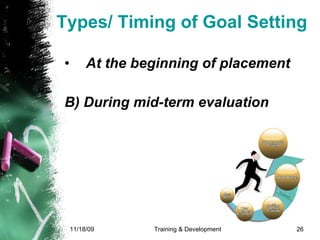
Types/ Timing of Goal Setting   At the beginning of placement  B) During mid-term evaluation
REFERENCES Blanchard& Thacker   Effective Training: Systems, Strategies & Practices Aparna Rai en.wikipedia.org www.onlinelearning.novations.com   www.tcs.com
Thank You

Training & Development

  • 1.
    TRAINING & DEVELOPMENTTraining Objective and Focus on Trainee (Motivation, Reinforcement & Goal Setting) By: Mansi jain Neha Bajaj Swati Aggarwal
  • 2.
    Definition: A trainingobjective is the specific knowledge, skills, or attitudes that the trainees are to gain as a result of the training activity. Purpose: to state as clearly as possible what trainees are expected to be able to do at the end of their training the conditions under which they will demonstrate their learning standards that must be reached to confirm their level of competence
  • 3.
    Training Objective shouldspecify The Change Intended Conditions Standards How learners will demonstrate the extent of learning Time Constraints
  • 4.
    SMART Objectives Objectivesshould be SMART : S pecific (linked to rate, no., %) M easurable (tracking & recording of behaviour/action) A chievable (capable of being reached) R elevant (importance to individual & organization) T ime Based
  • 5.
    Types of TrainingObjective Trainee reaction Objective Learning Objective Transfer of training objective Organizational objective
  • 6.
    Writing Training ObjectivesIdentify the Objectives from TNA CLARIFY & Select the actionable Objective Establish Priorities Put into a Logical Flow Check for feasibility
  • 7.
    Benefits from TrainingObjectives The Trainee- Reduce anxiety related to the unknown Focus attention Increase likelihood that trainees will be successful Provide link between training needs & training which is delivered
  • 8.
    Benefits from TrainingObjectives The Trainer- More effective learning process Prevent teaching too much or too little Easy to determine trainees progress Keep the trainers on right track
  • 9.
    Examples of Well-WrittenLearning Objectives Topic: Communication explain four basic principles of communication (verbal and non-verbal) and active, empathetic listening. outline four barriers and bridges to communication list at least four ways communication skills which encourage staff involvement will help crate a positive work environment Topic: Conflict resolution explain at least five basic principles of empathetic communication to handle conflict develop policy that gives current front-line leaders the permission and expectation to work with other staff on conflict resolution develop policy for progressive discipline and explain how this works to current front line leaders
  • 10.
    Example : MotorolaSix Sigma® e-Foundations Training moto-sixsigma.pdf
  • 11.
    Facilitation Of Learning:Focus On The Trainee KSAs Motivation of trainee Conditioning & Reinforcement Goal Setting
  • 12.
    KSAs No trait& treatment interaction A trait & treatment interaction Individual Trait Individual Trait Learning Objectives Learning Objectives Low Low Low Low High High High High Training design A Training design A Training design B Training design B
  • 13.
    Motivation of TraineeMotivation is simply - The reason for an action - That which gives purpose and direction to behaviour.
  • 14.
  • 15.
  • 16.
    EXAMPLE: In TCSemployees are encouraged to do the following: create individual learning plans, and to seek learning opportunities their own training calendar choose their mentor
  • 17.
    Expectations towards trainingPositive expectations Negative expectations
  • 18.
    Expectancy Theory E1=the belief that effort will lead to desired performance E2= the belief that desired performance will lead to desired outcomes V1 = the emotional orientations people hold with respect to outcomes Formula: E1[( E2outcome1 x V outcome1 )+(E2 outcome2 X V outcome2 )+… …+(E2 outcome6 X V outcome6 )]
  • 19.
    Example Outcome if successful E2 V Outcome if Unsuccessful E2 V Promotion 0.2 7 Does not have to change behaviour 1.0 10 Better at job 0.6 8 Employees still afraid of him 1.0 8 Less tension between bill & Others 0.7 6 Not ridiculed by coworkers for being a nice guy 1.0 9 Less feeling of stress 0.8 4 Better relationship with union 0.4 7 Fewer grievances 0.6 9
  • 20.
    Conditioning & ReinforcementClassical Conditioning Operant Conditioning
  • 21.
  • 22.
    OPERANT CONDITIONING Positivereinforcement - give an organism a pleasant stimulus when the operant response is made. Negative reinforcement - take away an unpleasant stimulus when the operant response is made. Positive Punishment presentation of an aversive stimulus to decrease the probability of an operant response occurring again. Negative Punishment - the removal of a pleasant stimulus to decrease the probability of an operant response occurring again.
  • 23.
    Reinforcement methods &tools • A process for Managers/Supervisors to follow in preparing their staff members for training and in following up once the training is completed • Podcasts done in "talk radio" style clips to reinforce skills taught in the classroom. • Pocket-sized skill checklists for use by Managers as they observe their people on the job • Training for Managers on how to coach and give tailored feedback to their staff members • Laminated wallet-sized skill reminder cards for participants • Skill reinforcement on CD or DVD • One-on-one observation and coaching of participants by Global Learning Link • Online knowledge quizzes coupled with incentive programs
  • 24.
    Goal setting Specificgoals lead to better performance & more predictable effects Goals must match to the individual’s ability Feedback concerning the degree to which the goal is being achieved is necessary for goal setting to have the desired effect For goal setting to be effective, the individual needs to accept the goal that is set
  • 25.
    Ten Steps forGoal Setting Establish goals. Include your supervisee in selecting goals Customise your plan. Write out goals. Make goals as specific, clear, objective, realistic, and obtainable as possible. Create a hierarchy of objectives. Divide goals into competency areas: Knowledge and theory Practice and skill Personal self-awareness Select methods and techniques to best accomplish goals. Tie goals to evaluation. Revisit and review goals periodically.
  • 26.
    Types/ Timing ofGoal Setting At the beginning of placement B) During mid-term evaluation
  • 27.
    REFERENCES Blanchard& Thacker Effective Training: Systems, Strategies & Practices Aparna Rai en.wikipedia.org www.onlinelearning.novations.com www.tcs.com
  • 28.

Editor's Notes

  • #26 Ten Steps for Goal Setting and Planning 1. Establish goals. Decide what competencies to focus on in supervision. 2. Include your supervisee in selecting goals and in planning. 3. Customise your plan. Consider the developmental level of the supervisee, their needs and desires, as well as the needs of the system and population served. 4. Write out goals. 5. Make goals as specific, clear, objective, realistic, and obtainable as possible. 6. Create a hierarchy of objectives. Recognize that some goals and competencies need to be addressed first while others can be addressed later in time. 7. Divide goals into competency areas: • Knowledge and theory • Practice and skill • Personal self-awareness 8. Select methods and techniques to best accomplish goals. Expand repertory. 9. Tie goals to evaluation. Come up with one or two indicators of successful completion in each goal area. 10. Revisit and review goals periodically. Update and make changes as necessary.
  • #27 A) At the beginning of placement Setting new and general goals for learning, according to the special characteristics of the placement setting , and the developmental level of the trainee . B) During mid-term evaluation Setting specific remedial goals if the trainee is lacking certain competencies to fulfill the placement requirements