MB 103
Lecture 2
Principals of Communication-Types, Models and Barriers of
Communication
Prof. Krishna Roy
Types of communication
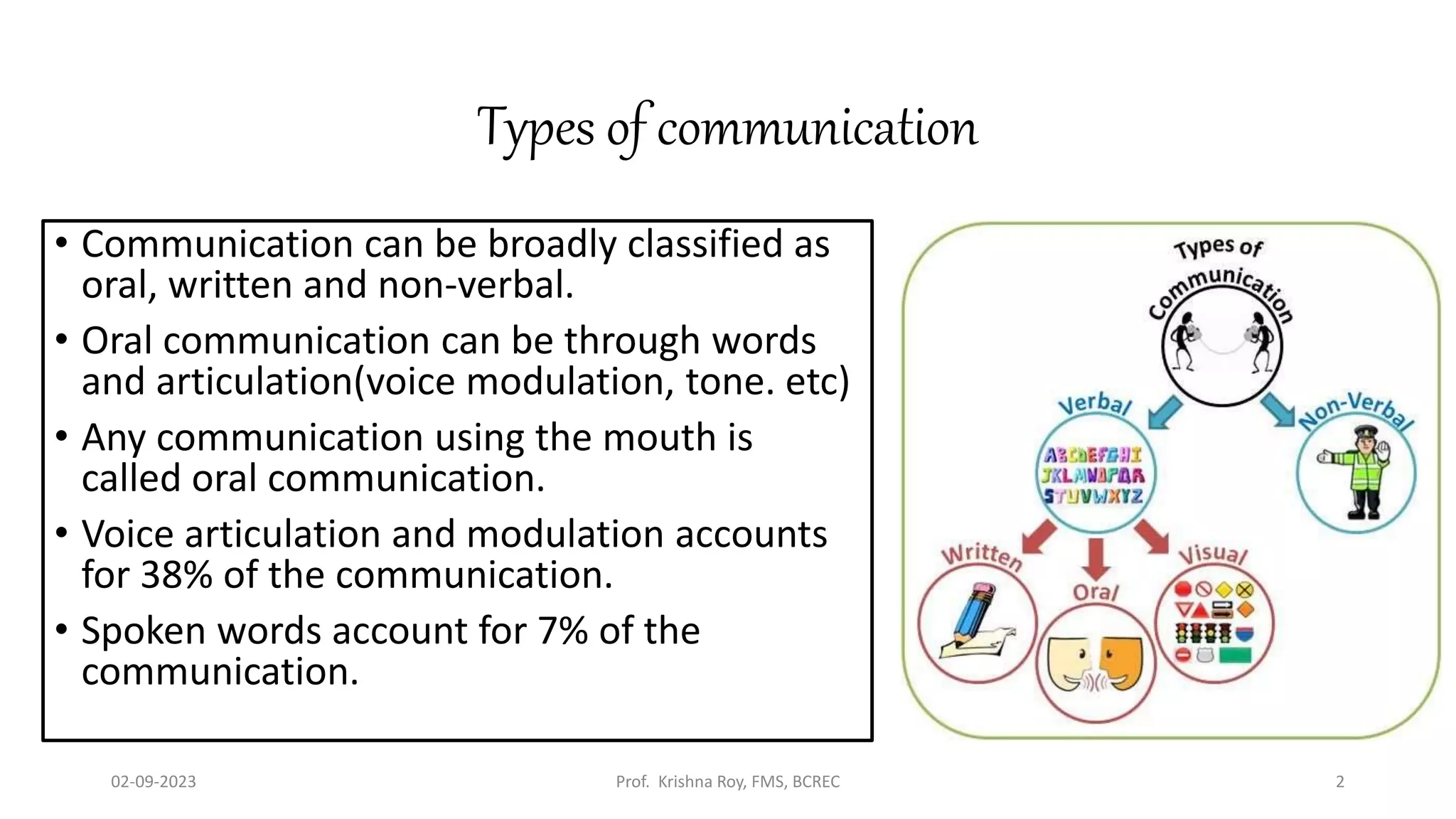
• Communication can be broadly classified as
oral, written and non-verbal.
• Oral communication can be through words
and articulation(voice modulation, tone. etc)
• Any communication using the mouth is
called oral communication.
• Voice articulation and modulation accounts
for 38% of the communication.
• Spoken words account for 7% of the
communication.
02-09-2023 Prof. Krishna Roy, FMS, BCREC 2
Types of communication
• Written communication comprises of reports,
illustrations, memos, telegrams, facsimiles(FAX),
emails, tenders, etc.
• Written communication is documented
communication.
• It is the most formal out of all types of
communication.
• Oral communication is interactive but written
communication is not.
• Written communication consumes more time than
oral communication.
• Feedback in oral communication is instantaneous
but in case of written communication, it may be
delayed.
02-09-2023 Prof. Krishna Roy, FMS, BCREC 3
Types of communication
• Nonverbal communication refers to
expressions, body positioning and
movement, distance between
communicaters, etc that form a part of
communication.
• Nonverbal communication accounts for 55%
of the communication.
• Sometimes nonverbal communication is
involuntary.
02-09-2023 Prof. Krishna Roy, FMS, BCREC 4
Models of communication
1. Shannon and Weaver’s Model(1949)
sender  receiver
2. Berlo(1960)
sendermessagechannelreceiver
3. Barnlund(1970)
He gave the transactional model of
communication recognizing two way
communication
sender message channel receiver
02-09-2023 Prof. Krishna Roy, FMS, BCREC 5
Models of communication
4. Constructionist Model( by Goffman and
others)
This theory recognizes the presence of
noise, decode, encode, channel and feedback
When sender communicates with receiver
only, the communication is linear
When there is a response to the
communication, the communication
becomes nonlinear
02-09-2023 Prof. Krishna Roy, FMS, BCREC 6
Barriers and filters in communication
message
Barriers/Filters Barriers/Filters
SENDER RECEIVER
Encoding Decoding
response/acknowledgement/feedback
This is a perpetual (infinite) process unless one of the two die
02-09-2023 Prof. Krishna Roy, FMS, BCREC 7
Filters in communication
• Filters help in interpreting a message i.e. finding meaning.
• Interpretation depends on filters used.
• Examples of filters are knowledge, status, culture, emotions,
context, gender, age, etc.
• Same stimulus can generate different types of responses based on
the above filters.
02-09-2023 Prof. Krishna Roy, FMS, BCREC 8
barriers in communication
• Barriers are anything that obstruct or disrupt communication
• Barriers may be internal or external.
• Internal barriers include dogma, emotions, beliefs, etc.
• External barriers may include noise, interference, etc
02-09-2023 Prof. Krishna Roy, FMS, BCREC 9
• Till we meet again in the next class……….
PROF. KRISHNA ROY, FMS, BCREC 10
02-09-2023

MB 103 business communication 2.pptx

  • 1.
    MB 103 Lecture 2 Principalsof Communication-Types, Models and Barriers of Communication Prof. Krishna Roy
  • 2.
    Types of communication •Communication can be broadly classified as oral, written and non-verbal. • Oral communication can be through words and articulation(voice modulation, tone. etc) • Any communication using the mouth is called oral communication. • Voice articulation and modulation accounts for 38% of the communication. • Spoken words account for 7% of the communication. 02-09-2023 Prof. Krishna Roy, FMS, BCREC 2
  • 3.
    Types of communication •Written communication comprises of reports, illustrations, memos, telegrams, facsimiles(FAX), emails, tenders, etc. • Written communication is documented communication. • It is the most formal out of all types of communication. • Oral communication is interactive but written communication is not. • Written communication consumes more time than oral communication. • Feedback in oral communication is instantaneous but in case of written communication, it may be delayed. 02-09-2023 Prof. Krishna Roy, FMS, BCREC 3
  • 4.
    Types of communication •Nonverbal communication refers to expressions, body positioning and movement, distance between communicaters, etc that form a part of communication. • Nonverbal communication accounts for 55% of the communication. • Sometimes nonverbal communication is involuntary. 02-09-2023 Prof. Krishna Roy, FMS, BCREC 4
  • 5.
    Models of communication 1.Shannon and Weaver’s Model(1949) sender  receiver 2. Berlo(1960) sendermessagechannelreceiver 3. Barnlund(1970) He gave the transactional model of communication recognizing two way communication sender message channel receiver 02-09-2023 Prof. Krishna Roy, FMS, BCREC 5
  • 6.
    Models of communication 4.Constructionist Model( by Goffman and others) This theory recognizes the presence of noise, decode, encode, channel and feedback When sender communicates with receiver only, the communication is linear When there is a response to the communication, the communication becomes nonlinear 02-09-2023 Prof. Krishna Roy, FMS, BCREC 6
  • 7.
    Barriers and filtersin communication message Barriers/Filters Barriers/Filters SENDER RECEIVER Encoding Decoding response/acknowledgement/feedback This is a perpetual (infinite) process unless one of the two die 02-09-2023 Prof. Krishna Roy, FMS, BCREC 7
  • 8.
    Filters in communication •Filters help in interpreting a message i.e. finding meaning. • Interpretation depends on filters used. • Examples of filters are knowledge, status, culture, emotions, context, gender, age, etc. • Same stimulus can generate different types of responses based on the above filters. 02-09-2023 Prof. Krishna Roy, FMS, BCREC 8
  • 9.
    barriers in communication •Barriers are anything that obstruct or disrupt communication • Barriers may be internal or external. • Internal barriers include dogma, emotions, beliefs, etc. • External barriers may include noise, interference, etc 02-09-2023 Prof. Krishna Roy, FMS, BCREC 9
  • 10.
    • Till wemeet again in the next class………. PROF. KRISHNA ROY, FMS, BCREC 10 02-09-2023