MB 103
Lecture 3&4
7Cs, 4Ss, Noise and more about communication barriers
Prof. Krishna Roy
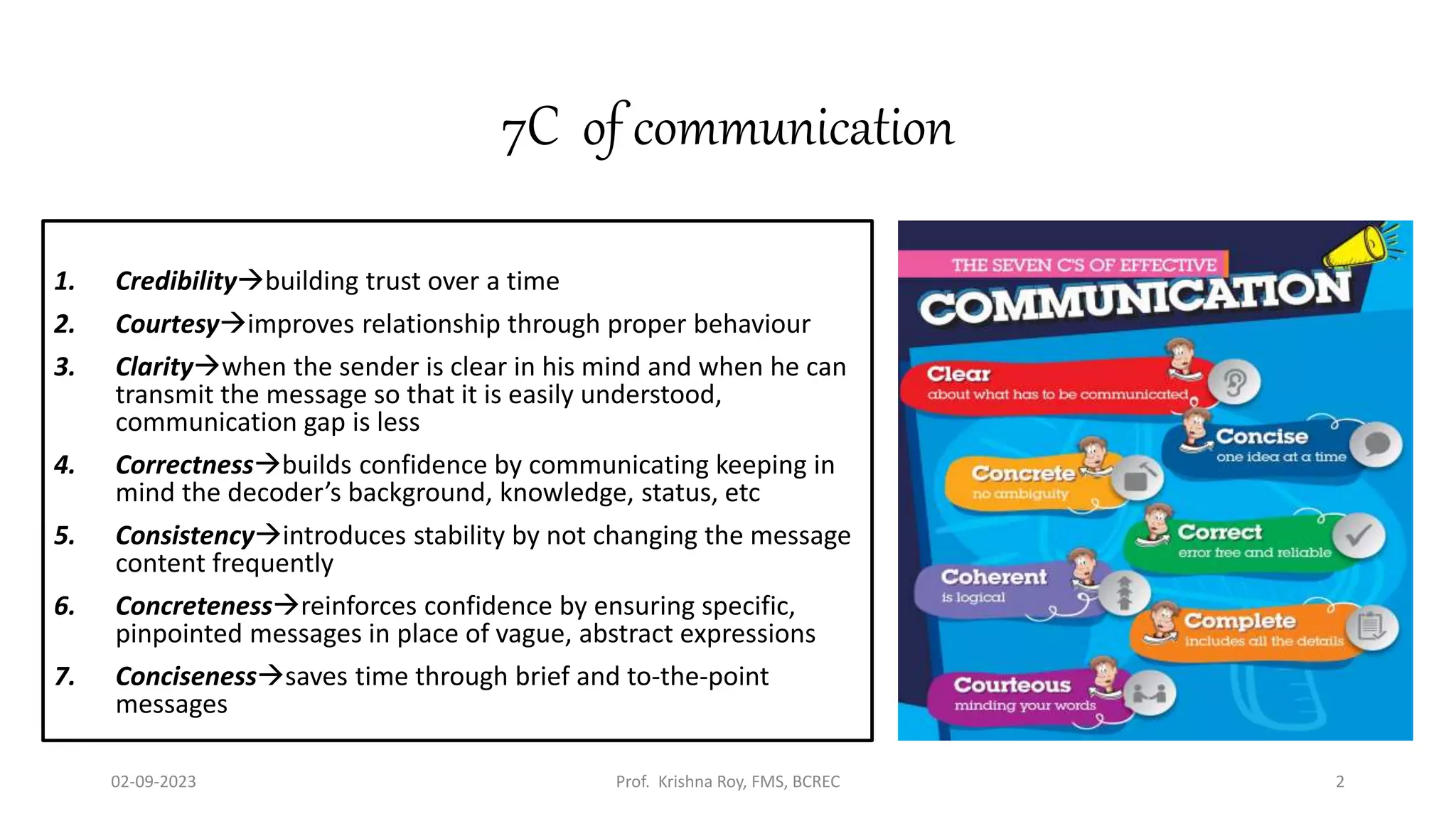
7C of communication
1. Credibilitybuilding trust over a time
2. Courtesyimproves relationship through proper behaviour
3. Claritywhen the sender is clear in his mind and when he can
transmit the message so that it is easily understood,
communication gap is less
4. Correctnessbuilds confidence by communicating keeping in
mind the decoder’s background, knowledge, status, etc
5. Consistencyintroduces stability by not changing the message
content frequently
6. Concretenessreinforces confidence by ensuring specific,
pinpointed messages in place of vague, abstract expressions
7. Concisenesssaves time through brief and to-the-point
messages
02-09-2023 Prof. Krishna Roy, FMS, BCREC 2
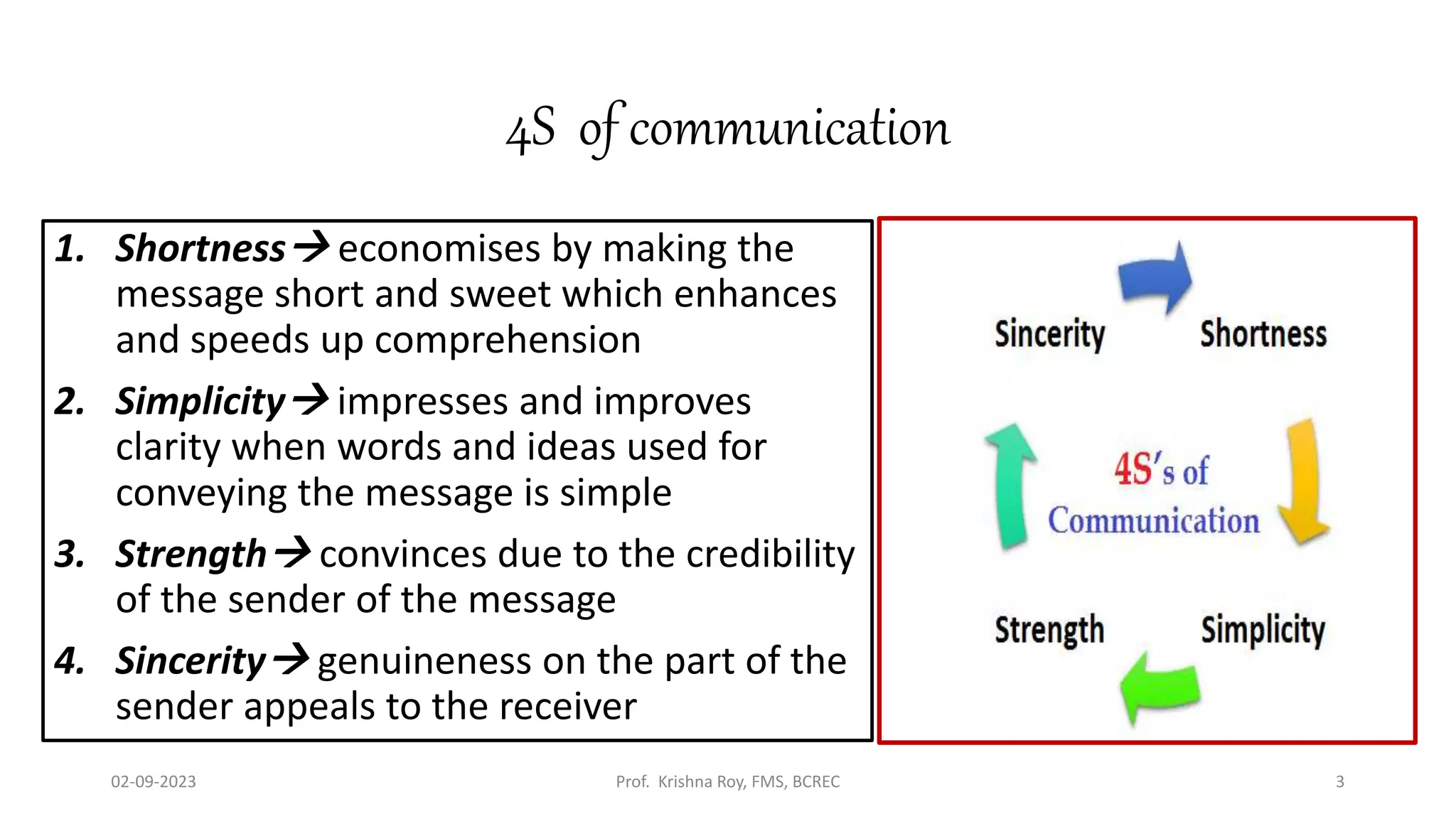
4S of communication
1. Shortness economises by making the
message short and sweet which enhances
and speeds up comprehension
2. Simplicity impresses and improves
clarity when words and ideas used for
conveying the message is simple
3. Strength convinces due to the credibility
of the sender of the message
4. Sincerity genuineness on the part of the
sender appeals to the receiver
02-09-2023 Prof. Krishna Roy, FMS, BCREC 3
noise
• Noise is a physical sound or mental status that disrupts the flow of
communication as the sender or receiver gets distracted.
• Noise can be classified as physical and psychological
• Physical noise is the unwanted sound from the surrounding that
disturbs the listening process
• Psychological noise occurs due to preoccupation, ego, anxiety, mental
disturbance of the receiver or sender due to which mind is unable to
concentrate on the communication at hand.
• Physical noise is easier to remove than psychological noise.
02-09-2023 Prof. Krishna Roy, FMS, BCREC 4
More about communication barriers
sender oriented barriers
• Communication barriers are either sender-oriented or receiver-
oriented
• Sender oriented barriers may be voluntary or involuntary.
• sender oriented barriers could be
1. badly expressed message-what one wants to express and
what one actually expresses may not match
2. loss of transmission-usually a physical noise
3. semantic problem-use of technical or complicated terms
beyond the comprehension of the receiver
02-09-2023 Prof. Krishna Roy, FMS, BCREC 5
More about communication barriers
sender oriented barriers
4. overt/under-communication-too much information confuses
and too little information leaves a gap in comprehension
5. I-attitude or strong personal biases- such people are not
receptive to suggestions from receiver
6. prejudices-when communication starts with preconceived
prejudices, it may hamper the communication and its intent.
02-09-2023 Prof. Krishna Roy, FMS, BCREC 6
More about communication barriers
receiver oriented barriers
1. poor retention-if receiver loses part of the message due to poor
retention, he may not be able to grasp the message in its entirety.
2. inattentive listening- if the receiver gets distracted during
communication, communication gaps will be created
3. tendency to evaluate-being judgemental leads to miscommunication.
4. lack of interest-lack of interest in subject of communication i.e.
indifference may hamper communication
02-09-2023 Prof. Krishna Roy, FMS, BCREC 7
More about communication barriers
receiver oriented barriers
5. conflicting information-if information available with the receiver is in
conflict with the information being sent, the received message may be lost.
6. differing status and position- ignoring the message of the sender due to his
lower position in hierarchy may lead to disruption in communication
7. resistance to change –unwillingness to adapt to new ideas may be a
deterrent in communication.
8. argumentative nature-contradictions need to be eliminated through
discussions and not unpleasant arguments which hamper proper communication.
02-09-2023 Prof. Krishna Roy, FMS, BCREC 8
• Till we meet again in the next class……….
PROF. KRISHNA ROY, FMS, BCREC 9
02-09-2023

MB 103 business communication 3_4.pptx

  • 1.
    MB 103 Lecture 3&4 7Cs,4Ss, Noise and more about communication barriers Prof. Krishna Roy
  • 2.
    7C of communication 1.Credibilitybuilding trust over a time 2. Courtesyimproves relationship through proper behaviour 3. Claritywhen the sender is clear in his mind and when he can transmit the message so that it is easily understood, communication gap is less 4. Correctnessbuilds confidence by communicating keeping in mind the decoder’s background, knowledge, status, etc 5. Consistencyintroduces stability by not changing the message content frequently 6. Concretenessreinforces confidence by ensuring specific, pinpointed messages in place of vague, abstract expressions 7. Concisenesssaves time through brief and to-the-point messages 02-09-2023 Prof. Krishna Roy, FMS, BCREC 2
  • 3.
    4S of communication 1.Shortness economises by making the message short and sweet which enhances and speeds up comprehension 2. Simplicity impresses and improves clarity when words and ideas used for conveying the message is simple 3. Strength convinces due to the credibility of the sender of the message 4. Sincerity genuineness on the part of the sender appeals to the receiver 02-09-2023 Prof. Krishna Roy, FMS, BCREC 3
  • 4.
    noise • Noise isa physical sound or mental status that disrupts the flow of communication as the sender or receiver gets distracted. • Noise can be classified as physical and psychological • Physical noise is the unwanted sound from the surrounding that disturbs the listening process • Psychological noise occurs due to preoccupation, ego, anxiety, mental disturbance of the receiver or sender due to which mind is unable to concentrate on the communication at hand. • Physical noise is easier to remove than psychological noise. 02-09-2023 Prof. Krishna Roy, FMS, BCREC 4
  • 5.
    More about communicationbarriers sender oriented barriers • Communication barriers are either sender-oriented or receiver- oriented • Sender oriented barriers may be voluntary or involuntary. • sender oriented barriers could be 1. badly expressed message-what one wants to express and what one actually expresses may not match 2. loss of transmission-usually a physical noise 3. semantic problem-use of technical or complicated terms beyond the comprehension of the receiver 02-09-2023 Prof. Krishna Roy, FMS, BCREC 5
  • 6.
    More about communicationbarriers sender oriented barriers 4. overt/under-communication-too much information confuses and too little information leaves a gap in comprehension 5. I-attitude or strong personal biases- such people are not receptive to suggestions from receiver 6. prejudices-when communication starts with preconceived prejudices, it may hamper the communication and its intent. 02-09-2023 Prof. Krishna Roy, FMS, BCREC 6
  • 7.
    More about communicationbarriers receiver oriented barriers 1. poor retention-if receiver loses part of the message due to poor retention, he may not be able to grasp the message in its entirety. 2. inattentive listening- if the receiver gets distracted during communication, communication gaps will be created 3. tendency to evaluate-being judgemental leads to miscommunication. 4. lack of interest-lack of interest in subject of communication i.e. indifference may hamper communication 02-09-2023 Prof. Krishna Roy, FMS, BCREC 7
  • 8.
    More about communicationbarriers receiver oriented barriers 5. conflicting information-if information available with the receiver is in conflict with the information being sent, the received message may be lost. 6. differing status and position- ignoring the message of the sender due to his lower position in hierarchy may lead to disruption in communication 7. resistance to change –unwillingness to adapt to new ideas may be a deterrent in communication. 8. argumentative nature-contradictions need to be eliminated through discussions and not unpleasant arguments which hamper proper communication. 02-09-2023 Prof. Krishna Roy, FMS, BCREC 8
  • 9.
    • Till wemeet again in the next class………. PROF. KRISHNA ROY, FMS, BCREC 9 02-09-2023