MIS 301 RELATIONAL DATABASE
MANAGEMENT SYSTEM
DATABASE MANAGEMENT SYSTEM
Concepts of tables, records, attributes, keys, integrity constraints, data independence
LECTURES 2&3
PROF. KRISHNA ROY
PROF. KRISHNA ROY, FMS, BCREC 1
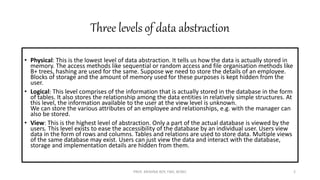
Three levels of data abstraction
• Physical: This is the lowest level of data abstraction. It tells us how the data is actually stored in
memory. The access methods like sequential or random access and file organisation methods like
B+ trees, hashing are used for the same. Suppose we need to store the details of an employee.
Blocks of storage and the amount of memory used for these purposes is kept hidden from the
user.
• Logical: This level comprises of the information that is actually stored in the database in the form
of tables. It also stores the relationship among the data entities in relatively simple structures. At
this level, the information available to the user at the view level is unknown.
We can store the various attributes of an employee and relationships, e.g. with the manager can
also be stored.
• View: This is the highest level of abstraction. Only a part of the actual database is viewed by the
users. This level exists to ease the accessibility of the database by an individual user. Users view
data in the form of rows and columns. Tables and relations are used to store data. Multiple views
of the same database may exist. Users can just view the data and interact with the database,
storage and implementation details are hidden from them.
PROF. KRISHNA ROY, FMS, BCREC 2
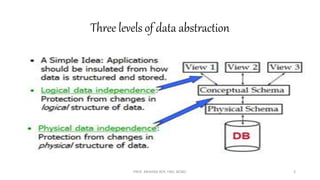
Three levels of data abstraction
PROF. KRISHNA ROY, FMS, BCREC 3
Data independence
• Physical Data Independence :
Physical Data Independence is defined as the ability to make changes
in the structure of the lowest level of the Database Management
System (DBMS) without affecting the higher-level schemas. Hence,
modification in the Physical level should not result in any changes in
the Logical or View levels.
• Logical Data Independence :
Logical Data Independence is defined as the ability to make changes
in the structure of the middle level of the Database Management
System (DBMS) without affecting the highest-level schema or
application programs. Hence, modification in the logical level should
not result in any changes in the view levels or application programs.
PROF. KRISHNA ROY, FMS, BCREC 4
Concepts of tables, records, attributes, keys
PROF. KRISHNA ROY, FMS, BCREC 5
relations
PROF. KRISHNA ROY, FMS, BCREC 6
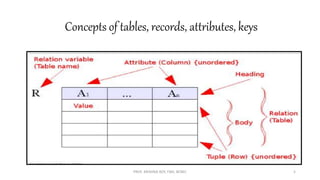
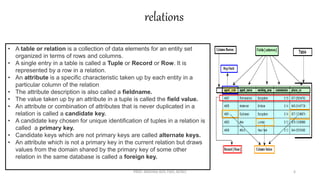
• A table or relation is a collection of data elements for an entity set
organized in terms of rows and columns.
• A single entry in a table is called a Tuple or Record or Row. It is
represented by a row in a relation.
• An attribute is a specific characteristic taken up by each entity in a
particular column of the relation
• The attribute description is also called a fieldname.
• The value taken up by an attribute in a tuple is called the field value.
• An attribute or combination of attributes that is never duplicated in a
relation is called a candidate key.
• A candidate key chosen for unique identification of tuples in a relation is
called a primary key.
• Candidate keys which are not primary keys are called alternate keys.
• An attribute which is not a primary key in the current relation but draws
values from the domain shared by the primary key of some other
relation in the same database is called a foreign key.
Integrity constraints
PROF. KRISHNA ROY, FMS, BCREC 7
Integrity constraints
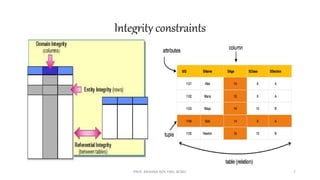
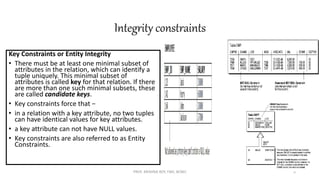
Key Constraints or Entity Integrity
• There must be at least one minimal subset of
attributes in the relation, which can identify a
tuple uniquely. This minimal subset of
attributes is called key for that relation. If there
are more than one such minimal subsets, these
are called candidate keys.
• Key constraints force that −
• in a relation with a key attribute, no two tuples
can have identical values for key attributes.
• a key attribute can not have NULL values.
• Key constraints are also referred to as Entity
Constraints.
PROF. KRISHNA ROY, FMS, BCREC 8
Integrity constraints
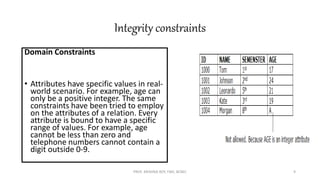
Domain Constraints
• Attributes have specific values in real-
world scenario. For example, age can
only be a positive integer. The same
constraints have been tried to employ
on the attributes of a relation. Every
attribute is bound to have a specific
range of values. For example, age
cannot be less than zero and
telephone numbers cannot contain a
digit outside 0-9.
PROF. KRISHNA ROY, FMS, BCREC 9
Integrity constraints
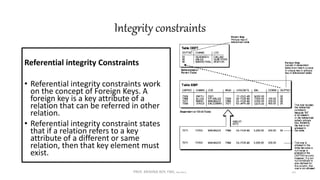
Referential integrity Constraints
• Referential integrity constraints work
on the concept of Foreign Keys. A
foreign key is a key attribute of a
relation that can be referred in other
relation.
• Referential integrity constraint states
that if a relation refers to a key
attribute of a different or same
relation, then that key element must
exist.
PROF. KRISHNA ROY, FMS, BCREC 10
• Till we meet again in the next class……….
PROF. KRISHNA ROY, FMS, BCREC 11

MIS 301 RELATIONAL DATABASE MANAGEMENT SYSTEM 2&3.pptx

  • 1.
    MIS 301 RELATIONALDATABASE MANAGEMENT SYSTEM DATABASE MANAGEMENT SYSTEM Concepts of tables, records, attributes, keys, integrity constraints, data independence LECTURES 2&3 PROF. KRISHNA ROY PROF. KRISHNA ROY, FMS, BCREC 1
  • 2.
    Three levels ofdata abstraction • Physical: This is the lowest level of data abstraction. It tells us how the data is actually stored in memory. The access methods like sequential or random access and file organisation methods like B+ trees, hashing are used for the same. Suppose we need to store the details of an employee. Blocks of storage and the amount of memory used for these purposes is kept hidden from the user. • Logical: This level comprises of the information that is actually stored in the database in the form of tables. It also stores the relationship among the data entities in relatively simple structures. At this level, the information available to the user at the view level is unknown. We can store the various attributes of an employee and relationships, e.g. with the manager can also be stored. • View: This is the highest level of abstraction. Only a part of the actual database is viewed by the users. This level exists to ease the accessibility of the database by an individual user. Users view data in the form of rows and columns. Tables and relations are used to store data. Multiple views of the same database may exist. Users can just view the data and interact with the database, storage and implementation details are hidden from them. PROF. KRISHNA ROY, FMS, BCREC 2
  • 3.
    Three levels ofdata abstraction PROF. KRISHNA ROY, FMS, BCREC 3
  • 4.
    Data independence • PhysicalData Independence : Physical Data Independence is defined as the ability to make changes in the structure of the lowest level of the Database Management System (DBMS) without affecting the higher-level schemas. Hence, modification in the Physical level should not result in any changes in the Logical or View levels. • Logical Data Independence : Logical Data Independence is defined as the ability to make changes in the structure of the middle level of the Database Management System (DBMS) without affecting the highest-level schema or application programs. Hence, modification in the logical level should not result in any changes in the view levels or application programs. PROF. KRISHNA ROY, FMS, BCREC 4
  • 5.
    Concepts of tables,records, attributes, keys PROF. KRISHNA ROY, FMS, BCREC 5
  • 6.
    relations PROF. KRISHNA ROY,FMS, BCREC 6 • A table or relation is a collection of data elements for an entity set organized in terms of rows and columns. • A single entry in a table is called a Tuple or Record or Row. It is represented by a row in a relation. • An attribute is a specific characteristic taken up by each entity in a particular column of the relation • The attribute description is also called a fieldname. • The value taken up by an attribute in a tuple is called the field value. • An attribute or combination of attributes that is never duplicated in a relation is called a candidate key. • A candidate key chosen for unique identification of tuples in a relation is called a primary key. • Candidate keys which are not primary keys are called alternate keys. • An attribute which is not a primary key in the current relation but draws values from the domain shared by the primary key of some other relation in the same database is called a foreign key.
  • 7.
  • 8.
    Integrity constraints Key Constraintsor Entity Integrity • There must be at least one minimal subset of attributes in the relation, which can identify a tuple uniquely. This minimal subset of attributes is called key for that relation. If there are more than one such minimal subsets, these are called candidate keys. • Key constraints force that − • in a relation with a key attribute, no two tuples can have identical values for key attributes. • a key attribute can not have NULL values. • Key constraints are also referred to as Entity Constraints. PROF. KRISHNA ROY, FMS, BCREC 8
  • 9.
    Integrity constraints Domain Constraints •Attributes have specific values in real- world scenario. For example, age can only be a positive integer. The same constraints have been tried to employ on the attributes of a relation. Every attribute is bound to have a specific range of values. For example, age cannot be less than zero and telephone numbers cannot contain a digit outside 0-9. PROF. KRISHNA ROY, FMS, BCREC 9
  • 10.
    Integrity constraints Referential integrityConstraints • Referential integrity constraints work on the concept of Foreign Keys. A foreign key is a key attribute of a relation that can be referred in other relation. • Referential integrity constraint states that if a relation refers to a key attribute of a different or same relation, then that key element must exist. PROF. KRISHNA ROY, FMS, BCREC 10
  • 11.
    • Till wemeet again in the next class………. PROF. KRISHNA ROY, FMS, BCREC 11