Electromagnetism is a branch of physics which involves the study of the electromagnetic
force, a type of physical interaction that occurs between electrically charged particles. The
electromagnetic force usually exhibits electromagnetic fields, such as electric fields, magnetic
fields, and light.
Ampere’s law states that the line integral of the magnetic field around any closed circuit is
equal to μo (permeability constant) times the total current ‘I’ threading or passing through this
closed circuit. The closed circuit is called the Amperean loop. Mathematically,
= μo I … (1)
In classical electromagnetism, Ampere’s circuital law relates the integrated magnetic
field around a closed loop to the electric current passing through the loop. James Clerk
Maxwell (not Ampere) derived it using hydrodynamics in 1861 and it is now one of the Maxwell
equations, which form the basis of classical electromagnetism.
Ampere’s law finds its applications in deriving the magnetic field intensity of certain loops,
solenoids, straight conductors, etc.
Inconsistency of Ampere’s Circuital Law:
According to Ampere’s Circuital Law, the line integral of the magnetic field along any closed
loop C is proportional to current ‘I’ passing through the closed loop.
In 1864, Maxwell showed that the above equation (1) is logically inconsistent. To prove this
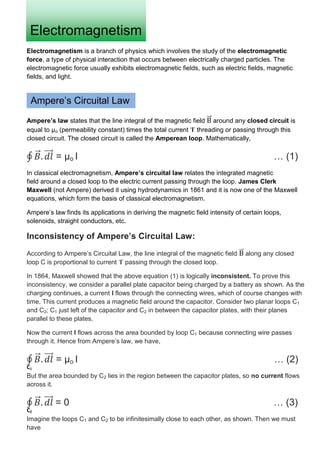
inconsistency, we consider a parallel plate capacitor being charged by a battery as shown. As the
charging continues, a current I flows through the connecting wires, which of course changes with
time. This current produces a magnetic field around the capacitor. Consider two planar loops C1
and C2; C1 just left of the capacitor and C2 in between the capacitor plates, with their planes
parallel to these plates.
Now the current I flows across the area bounded by loop C1 because connecting wire passes
through it. Hence from Ampere’s law, we have,
= μo I … (2)
But the area bounded by C2 lies in the region between the capacitor plates, so no current flows
across it.
= 0 … (3)
Imagine the loops C1 and C2 to be infinitesimally close to each other, as shown. Then we must
have
C1
C2
Electromagnetism
Ampere’s Circuital Law
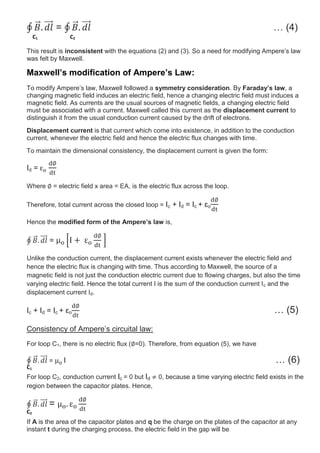
= … (4)
This result is inconsistent with the equations (2) and (3). So a need for modifying Ampere’s law
was felt by Maxwell.
Maxwell’s modification of Ampere’s Law:
To modify Ampere’s law, Maxwell followed a symmetry consideration. By Faraday’s law, a
changing magnetic field induces an electric field, hence a changing electric field must induces a
magnetic field. As currents are the usual sources of magnetic fields, a changing electric field
must be associated with a current. Maxwell called this current as the displacement current to
distinguish it from the usual conduction current caused by the drift of electrons.
Displacement current is that current which come into existence, in addition to the conduction
current, whenever the electric field and hence the electric flux changes with time.
To maintain the dimensional consistency, the displacement current is given the form:
Id =
Where = electric field x area = EA, is the electric flux across the loop.
Therefore, total current across the closed loop = Ic + Id = Ic + ɛo
Hence the modified form of the Ampere’s law is,
=
Unlike the conduction current, the displacement current exists whenever the electric field and
hence the electric flux is changing with time. Thus according to Maxwell, the source of a
magnetic field is not just the conduction electric current due to flowing charges, but also the time
varying electric field. Hence the total current I is the sum of the conduction current Ic and the
displacement current Id.
Ic + Id = Ic + ɛo … (5)
Consistency of Ampere’s circuital law:
For loop C1, there is no electric flux ( =0). Therefore, from equation (5), we have
= I … (6)
For loop C2, conduction current Ic = 0 but Id 0, because a time varying electric field exists in the
region between the capacitor plates. Hence,
=
If A is the area of the capacitor plates and q be the charge on the plates of the capacitor at any
instant t during the charging process, the electric field in the gap will be
C1 C2
C1
C2
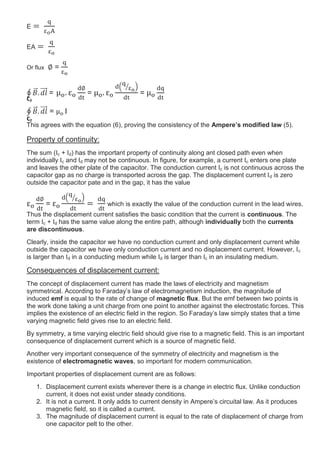
E
EA
Or flux =
= = =
= I
This agrees with the equation (6), proving the consistency of the Ampere’s modified law (5).
Property of continuity:
The sum (Ic + Id) has the important property of continuity along ant closed path even when
individually Ic and Id may not be continuous. In figure, for example, a current Ic enters one plate
and leaves the other plate of the capacitor. The conduction current Ic is not continuous across the
capacitor gap as no charge is transported across the gap. The displacement current Id is zero
outside the capacitor pate and in the gap, it has the value
= which is exactly the value of the conduction current in the lead wires.
Thus the displacement current satisfies the basic condition that the current is continuous. The
term Ic + Id has the same value along the entire path, although individually both the currents
are discontinuous.
Clearly, inside the capacitor we have no conduction current and only displacement current while
outside the capacitor we have only conduction current and no displacement current. However, Ic
is larger than Id in a conducting medium while Id is larger than Ic in an insulating medium.
Consequences of displacement current:
The concept of displacement current has made the laws of electricity and magnetism
symmetrical. According to Faraday’s law of electromagnetism induction, the magnitude of
induced emf is equal to the rate of change of magnetic flux. But the emf between two points is
the work done taking a unit charge from one point to another against the electrostatic forces. This
implies the existence of an electric field in the region. So Faraday’s law simply states that a time
varying magnetic field gives rise to an electric field.
By symmetry, a time varying electric field should give rise to a magnetic field. This is an important
consequence of displacement current which is a source of magnetic field.
Another very important consequence of the symmetry of electricity and magnetism is the
existence of electromagnetic waves, so important for modern communication.
Important properties of displacement current are as follows:
1. Displacement current exists wherever there is a change in electric flux. Unlike conduction
current, it does not exist under steady conditions.
2. It is not a current. It only adds to current density in Ampere’s circuital law. As it produces
magnetic field, so it is called a current.
3. The magnitude of displacement current is equal to the rate of displacement of charge from
one capacitor pelt to the other.
C2
C2
4. Together with the conduction current, displacement current satisfies the property of
continuity.
Maxwell found that all the basic principles of electromagnetism can be formulated in terms of
four fundamental equations called the Maxwell’s Equations. Assuming that no magnetic or
dielectric material; is present, the four basic equations can be stated as follows:
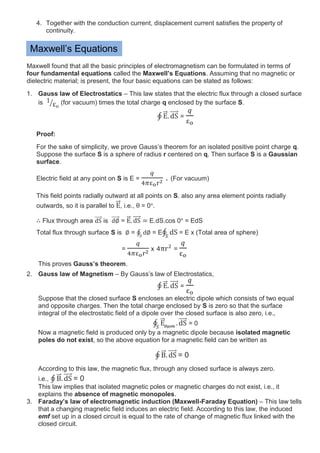
1. Gauss law of Electrostatics – This law states that the electric flux through a closed surface
is (for vacuum) times the total charge q enclosed by the surface S.
=
Proof:
For the sake of simplicity, we prove Gauss’s theorem for an isolated positive point charge q.
Suppose the surface S is a sphere of radius r centered on q. Then surface S is a Gaussian
surface.
Electric field at any point on S is E = . (For vacuum)
This field points radially outward at all points on S. also any area element points radially
outwards, so it is parallel to , i.e., = 0 .
Flux through area is = E.dS.cos 0 = EdS
Total flux through surface S is = = E = E x (Total area of sphere)
= x 4 =
This proves Gauss’s theorem.
2. Gauss law of Magnetism – By Gauss’s law of Electrostatics,
=
Suppose that the closed surface S encloses an electric dipole which consists of two equal
and opposite charges. Then the total charge enclosed by S is zero so that the surface
integral of the electrostatic field of a dipole over the closed surface is also zero, i.e.,
= 0
Now a magnetic field is produced only by a magnetic dipole because isolated magnetic
poles do not exist, so the above equation for a magnetic field can be written as
= 0
According to this law, the magnetic flux, through any closed surface is always zero.
i.e., = 0
This law implies that isolated magnetic poles or magnetic charges do not exist, i.e., it
explains the absence of magnetic monopoles.
3. Faraday’s law of electromagnetic induction (Maxwell-Faraday Equation) – This law tells
that a changing magnetic field induces an electric field. According to this law, the induced
emf set up in a closed circuit is equal to the rate of change of magnetic flux linked with the
closed circuit.
dipole
Maxwell’s Equations
= -
ξ (emf) = -
The negative sign here is in accordance with the Lenz’s law. It states that the direction of the
induced current in a circuit is such that it opposes the cause or the change which produces it.
4. Modified Ampere’s Law – This law states that the surface integral of the magnetic field
around any closed circuit is equal to times the total current (the sum of conduction and
displacement current) threading the closed circuit.
=
This law implies that both conduction as well as displacement current produces a magnetic
field.
Let us consider an electromagnetic wave travelling along the x-axis with the magnetic and
electric fields H and E confined in the transmission planes along z and y-axis respectively. This
wave thus propagates along the direction of propagation vector (E x H). Taking the divergence of
Poynting vector in free space, i.e.
= H. E.
=
=
=
=
=
Considering that surface S bounds a volume V and integrating the above relation over the
volume V, we get
On applying divergence theorem to the left hand side term of above relation, we get
Poynting Vector Theorem
The term on the right hand side within the integral of the above equation represents the sum of
energies of electric and magnetic fields. Hence the right hand side of the above equation
represents the amount of energy transferred over the volume V in one second i.e., it represents
the rate of flow of energy over the volume V.
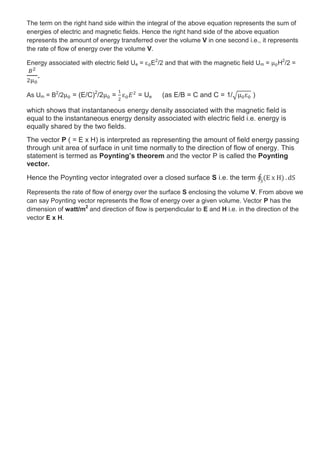
Energy associated with electric field Ue = E2
/2 and that with the magnetic field Um = H2
/2 =
.
As Um = B2
/2 = (E/C)2
/2 = = Ue (as E/B = C and C = 1/ )
which shows that instantaneous energy density associated with the magnetic field is
equal to the instantaneous energy density associated with electric field i.e. energy is
equally shared by the two fields.
The vector P ( = E x H) is interpreted as representing the amount of field energy passing
through unit area of surface in unit time normally to the direction of flow of energy. This
statement is termed as Poynting’s theorem and the vector P is called the Poynting
vector.
Hence the Poynting vector integrated over a closed surface S i.e. the term
Represents the rate of flow of energy over the surface S enclosing the volume V. From above we
can say Poynting vector represents the flow of energy over a given volume. Vector P has the
dimension of watt/m2
and direction of flow is perpendicular to E and H i.e. in the direction of the
vector E x H.
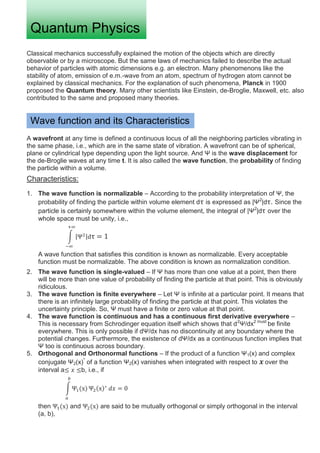
Classical mechanics successfully explained the motion of the objects which are directly
observable or by a microscope. But the same laws of mechanics failed to describe the actual
behavior of particles with atomic dimensions e.g. an electron. Many phenomenons like the
stability of atom, emission of e.m.-wave from an atom, spectrum of hydrogen atom cannot be
explained by classical mechanics. For the explanation of such phenomena, Planck in 1900
proposed the Quantum theory. Many other scientists like Einstein, de-Broglie, Maxwell, etc. also
contributed to the same and proposed many theories.
A wavefront at any time is defined a continuous locus of all the neighboring particles vibrating in
the same phase, i.e., which are in the same state of vibration. A wavefront can be of spherical,
plane or cylindrical type depending upon the light source. And Ψ is the wave displacement for
the de-Broglie waves at any time t. It is also called the wave function, the probability of finding
the particle within a volume.
Characteristics:
1. The wave function is normalizable – According to the probability interpretation of Ψ, the
probability of finding the particle within volume element d is expressed as |Ψ2
|d . Since the
particle is certainly somewhere within the volume element, the integral of |Ψ2
|d over the
whole space must be unity, i.e.,
A wave function that satisfies this condition is known as normalizable. Every acceptable
function must be normalizable. The above condition is known as normalization condition.
2. The wave function is single-valued – If Ψ has more than one value at a point, then there
will be more than one value of probability of finding the particle at that point. This is obviously
ridiculous.
3. The wave function is finite everywhere – Let Ψ is infinite at a particular point. It means that
there is an infinitely large probability of finding the particle at that point. This violates the
uncertainty principle. So, Ψ must have a finite or zero value at that point.
4. The wave function is continuous and has a continuous first derivative everywhere –
This is necessary from Schrodinger equation itself which shows that d2
Ψ/dx2 must
be finite
everywhere. This is only possible if dΨ/dx has no discontinuity at any boundary where the
potential changes. Furthermore, the existence of dΨ/dx as a continuous function implies that
Ψ too is continuous across boundary.
5. Orthogonal and Orthonormal functions – If the product of a function Ψ1(x) and complex
conjugate Ψ2(x)*
of a function Ψ2(x) vanishes when integrated with respect to over the
interval a b, i.e., if
then and are said to be mutually orthogonal or simply orthogonal in the interval
(a, b),
Quantum Physics
Wave function and its Characteristics
then function is said to be normalized. The functions which are orthogonal and also
normalized are called as orthonormal.
A set of functions Ψ2(x), Ψ2(x), Ψ2(x) ….. Ψ2(x) is orthonormal when
6. Degenerate Eigen values – If corresponding to a single eigen value, there is only one eigen
function, then it is known as non-degenerate eigen function. If corresponding to a single
eigen value, there are a number of eigen functions, then these functions are known as
degenerate eigen functions.
Schrodinger time-dependent wave equation:
According to the de-Broglie theory, a particle of mass m is always associated with a wave
whose wavelength is given by λ = h/mv. If the particle has wave properties, it is expected that
there should be some sort of equation which describes the behavior of the particle. Consider a
system of stationary waves associated with a particle. Let x, y, z be the coordinates of the
particle, and Ψ, the wave displacement for the de-Broglie waves at any time t. The classical
differential equation of a wave motion is given by
… (1)
Where .
[ being the Laplacian operator and is the wave velocity.]
The solution of equation (1) gives Ψ as a particle displacement in terms of time, i.e.,
Ψ (x, y, z, t) = Ψ0 (x, y, z) … (2)
where Ψ0 (x, y, z) is a function of x, y, z and gives the amplitude at the point considered.
Equation (2) can also be expressed as
Ψ ( , t) = Ψ0 ( ) … (3)
Differentiating equation (3) twice we get
= - = - Ψ
Substituting the value of in equation (1), we have
= 0 … (4)
But = 2 = 2
Schrodinger’s Wave Equations
Substituting the value of in equation (4), we have
= 0
Ψ + = 0 … (5)
Now from the de-Broglie relation = .
Ψ + = 0 … (6)
If E and V be the total and potential energies of the particle respectively, then its kinetic energy
1/2mv2
is given by
or … (7)
From equations (6) and (7), we have
Ψ + = 0
or Ψ + (E V) Ψ = 0 … (8)
Equation (8) is known as Schrodinger time independent wave equation.
Substituting ћ = h/2 in equation (8), the Schrodinger wave equation can be written as
Ψ + (E V) Ψ = 0 … (9)
For a free particle V = 0, hence the Schrodinger wave equation for a free particle can be
expressed as
Ψ + Ψ = 0 … (10)
Schrodinger time-independent wave equation:
The Schrodinger time dependent wave equation may be obtained from Schrodinger time
independent wave equation by eliminating E.
Differentiating equation (3) with respect to t, we get
=
= 2 = 2 ( E = or = E/ )
EΨ = … (11)
Substituting the value of EΨ in Schrodinger time dependent wave equation, we get
Ψ + = 0
Ψ =
= … (12)
This equation is known as Schrodinger time-independent wave equation.
Equation (12) can be written as
Ψ =
or H = E … (13)
where H = and E = .
Equation (13) describes the motion of a non-relativistic material particle.
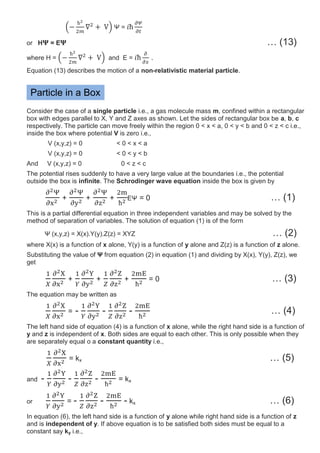
Consider the case of a single particle i.e., a gas molecule mass m, confined within a rectangular
box with edges parallel to X, Y and Z axes as shown. Let the sides of rectangular box be a, b, c
respectively. The particle can move freely within the region 0 < x < a, 0 < y < b and 0 < z < c i.e.,
inside the box where potential V is zero i.e.,
V (x,y,z) = 0 < 0 < x < a
V (x,y,z) = 0 < 0 < y < b
And V (x,y,z) = 0 0 < z < c
The potential rises suddenly to have a very large value at the boundaries i.e., the potential
outside the box is infinite. The Schrodinger wave equation inside the box is given by
+ + + EΨ = 0 … (1)
This is a partial differential equation in three independent variables and may be solved by the
method of separation of variables. The solution of equation (1) is of the form
Ψ (x,y,z) = X(x).Y(y).Z(z) = XYZ … (2)
where X(x) is a function of x alone, Y(y) is a function of y alone and Z(z) is a function of z alone.
Substituting the value of Ψ from equation (2) in equation (1) and dividing by X(x), Y(y), Z(z), we
get
+ + + = 0 … (3)
The equation may be written as
= - - - … (4)
The left hand side of equation (4) is a function of x alone, while the right hand side is a function of
y and z is independent of x. Both sides are equal to each other. This is only possible when they
are separately equal o a constant quantity i.e.,
= kx … (5)
and - - - = kx
or = - - - kx … (6)
In equation (6), the left hand side is a function of y alone while right hand side is a function of z
and is independent of y. If above equation is to be satisfied both sides must be equal to a
constant say ky i.e.,
Particle in a Box
= ky … (7)
and - - - kx = ky
= - - kx - ky … (8)
Again we have = kz … (9)
And - - kx - ky = kz
- = kx + ky + kz … (10)
For convenience, we introduce
- = kx , - = ky , - = kz
Now the differential equations in x, y and z coordinates may be written as
+ X = 0 … (11a)
+ Y = 0 … (11b)
+ Z = 0 … (11c)
The general solution of equation (11a) will be a sine function of arbitrary amplitude, frequency
and phase, i.e.,
X(x) = A sin (Bx+C) … (12)
Where A, B and C are constants whose values are determined by boundary conditions.
We know that |Ψ|2
, represents the probability of finding the particle at any point within the box.
Therefore, |X(x)|2
which is a function of x coordinates only, represents the probability of finding
the particle at any point along the x-axis. As the potential is very high at the walls of the box, the
probability of finding the particle at the walls will be zero, i.e.,
|X(x)| = 0 when x = 0 and x = a
or X(x) = 0 when x = 0 and x = a
Using these boundary conditions in equation (12), we have
0 = A sin (0 + C) A 0
Sin C = 0 and 0 = A sin(Ba + C)
Which yields sin(Ba)= 0 or Ba = nx
or B = where is a positive integer.
X(x) = A sin … (13)
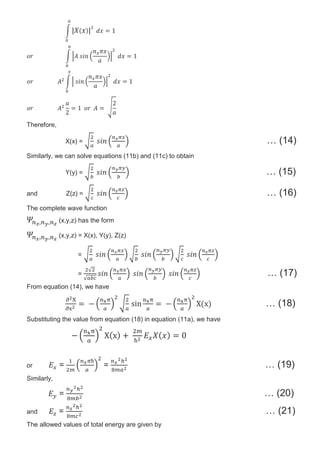
Applying the normalization condition between x = 0 to x = a, we have
Therefore,
X(x) = … (14)
Similarly, we can solve equations (11b) and (11c) to obtain
Y(y) = … (15)
and Z(z) = … (16)
The complete wave function
(x,y,z) has the form
(x,y,z) = X(x), Y(y), Z(z)
=
= … (17)
From equation (14), we have
… (18)
Substituting the value from equation (18) in equation (11a), we have
or = = … (19)
Similarly,
= … (20)
and = … (21)
The allowed values of total energy are given by
E = = … (22)
Where , denote any set of three positive numbers.

Electromagnetism- Maxwell Equation .pdf

  • 1.
    Electromagnetism is abranch of physics which involves the study of the electromagnetic force, a type of physical interaction that occurs between electrically charged particles. The electromagnetic force usually exhibits electromagnetic fields, such as electric fields, magnetic fields, and light. Ampere’s law states that the line integral of the magnetic field around any closed circuit is equal to μo (permeability constant) times the total current ‘I’ threading or passing through this closed circuit. The closed circuit is called the Amperean loop. Mathematically, = μo I … (1) In classical electromagnetism, Ampere’s circuital law relates the integrated magnetic field around a closed loop to the electric current passing through the loop. James Clerk Maxwell (not Ampere) derived it using hydrodynamics in 1861 and it is now one of the Maxwell equations, which form the basis of classical electromagnetism. Ampere’s law finds its applications in deriving the magnetic field intensity of certain loops, solenoids, straight conductors, etc. Inconsistency of Ampere’s Circuital Law: According to Ampere’s Circuital Law, the line integral of the magnetic field along any closed loop C is proportional to current ‘I’ passing through the closed loop. In 1864, Maxwell showed that the above equation (1) is logically inconsistent. To prove this inconsistency, we consider a parallel plate capacitor being charged by a battery as shown. As the charging continues, a current I flows through the connecting wires, which of course changes with time. This current produces a magnetic field around the capacitor. Consider two planar loops C1 and C2; C1 just left of the capacitor and C2 in between the capacitor plates, with their planes parallel to these plates. Now the current I flows across the area bounded by loop C1 because connecting wire passes through it. Hence from Ampere’s law, we have, = μo I … (2) But the area bounded by C2 lies in the region between the capacitor plates, so no current flows across it. = 0 … (3) Imagine the loops C1 and C2 to be infinitesimally close to each other, as shown. Then we must have C1 C2 Electromagnetism Ampere’s Circuital Law
  • 2.
    = … (4) Thisresult is inconsistent with the equations (2) and (3). So a need for modifying Ampere’s law was felt by Maxwell. Maxwell’s modification of Ampere’s Law: To modify Ampere’s law, Maxwell followed a symmetry consideration. By Faraday’s law, a changing magnetic field induces an electric field, hence a changing electric field must induces a magnetic field. As currents are the usual sources of magnetic fields, a changing electric field must be associated with a current. Maxwell called this current as the displacement current to distinguish it from the usual conduction current caused by the drift of electrons. Displacement current is that current which come into existence, in addition to the conduction current, whenever the electric field and hence the electric flux changes with time. To maintain the dimensional consistency, the displacement current is given the form: Id = Where = electric field x area = EA, is the electric flux across the loop. Therefore, total current across the closed loop = Ic + Id = Ic + ɛo Hence the modified form of the Ampere’s law is, = Unlike the conduction current, the displacement current exists whenever the electric field and hence the electric flux is changing with time. Thus according to Maxwell, the source of a magnetic field is not just the conduction electric current due to flowing charges, but also the time varying electric field. Hence the total current I is the sum of the conduction current Ic and the displacement current Id. Ic + Id = Ic + ɛo … (5) Consistency of Ampere’s circuital law: For loop C1, there is no electric flux ( =0). Therefore, from equation (5), we have = I … (6) For loop C2, conduction current Ic = 0 but Id 0, because a time varying electric field exists in the region between the capacitor plates. Hence, = If A is the area of the capacitor plates and q be the charge on the plates of the capacitor at any instant t during the charging process, the electric field in the gap will be C1 C2 C1 C2
  • 3.
    E EA Or flux = == = = I This agrees with the equation (6), proving the consistency of the Ampere’s modified law (5). Property of continuity: The sum (Ic + Id) has the important property of continuity along ant closed path even when individually Ic and Id may not be continuous. In figure, for example, a current Ic enters one plate and leaves the other plate of the capacitor. The conduction current Ic is not continuous across the capacitor gap as no charge is transported across the gap. The displacement current Id is zero outside the capacitor pate and in the gap, it has the value = which is exactly the value of the conduction current in the lead wires. Thus the displacement current satisfies the basic condition that the current is continuous. The term Ic + Id has the same value along the entire path, although individually both the currents are discontinuous. Clearly, inside the capacitor we have no conduction current and only displacement current while outside the capacitor we have only conduction current and no displacement current. However, Ic is larger than Id in a conducting medium while Id is larger than Ic in an insulating medium. Consequences of displacement current: The concept of displacement current has made the laws of electricity and magnetism symmetrical. According to Faraday’s law of electromagnetism induction, the magnitude of induced emf is equal to the rate of change of magnetic flux. But the emf between two points is the work done taking a unit charge from one point to another against the electrostatic forces. This implies the existence of an electric field in the region. So Faraday’s law simply states that a time varying magnetic field gives rise to an electric field. By symmetry, a time varying electric field should give rise to a magnetic field. This is an important consequence of displacement current which is a source of magnetic field. Another very important consequence of the symmetry of electricity and magnetism is the existence of electromagnetic waves, so important for modern communication. Important properties of displacement current are as follows: 1. Displacement current exists wherever there is a change in electric flux. Unlike conduction current, it does not exist under steady conditions. 2. It is not a current. It only adds to current density in Ampere’s circuital law. As it produces magnetic field, so it is called a current. 3. The magnitude of displacement current is equal to the rate of displacement of charge from one capacitor pelt to the other. C2 C2
  • 4.
    4. Together withthe conduction current, displacement current satisfies the property of continuity. Maxwell found that all the basic principles of electromagnetism can be formulated in terms of four fundamental equations called the Maxwell’s Equations. Assuming that no magnetic or dielectric material; is present, the four basic equations can be stated as follows: 1. Gauss law of Electrostatics – This law states that the electric flux through a closed surface is (for vacuum) times the total charge q enclosed by the surface S. = Proof: For the sake of simplicity, we prove Gauss’s theorem for an isolated positive point charge q. Suppose the surface S is a sphere of radius r centered on q. Then surface S is a Gaussian surface. Electric field at any point on S is E = . (For vacuum) This field points radially outward at all points on S. also any area element points radially outwards, so it is parallel to , i.e., = 0 . Flux through area is = E.dS.cos 0 = EdS Total flux through surface S is = = E = E x (Total area of sphere) = x 4 = This proves Gauss’s theorem. 2. Gauss law of Magnetism – By Gauss’s law of Electrostatics, = Suppose that the closed surface S encloses an electric dipole which consists of two equal and opposite charges. Then the total charge enclosed by S is zero so that the surface integral of the electrostatic field of a dipole over the closed surface is also zero, i.e., = 0 Now a magnetic field is produced only by a magnetic dipole because isolated magnetic poles do not exist, so the above equation for a magnetic field can be written as = 0 According to this law, the magnetic flux, through any closed surface is always zero. i.e., = 0 This law implies that isolated magnetic poles or magnetic charges do not exist, i.e., it explains the absence of magnetic monopoles. 3. Faraday’s law of electromagnetic induction (Maxwell-Faraday Equation) – This law tells that a changing magnetic field induces an electric field. According to this law, the induced emf set up in a closed circuit is equal to the rate of change of magnetic flux linked with the closed circuit. dipole Maxwell’s Equations
  • 5.
    = - ξ (emf)= - The negative sign here is in accordance with the Lenz’s law. It states that the direction of the induced current in a circuit is such that it opposes the cause or the change which produces it. 4. Modified Ampere’s Law – This law states that the surface integral of the magnetic field around any closed circuit is equal to times the total current (the sum of conduction and displacement current) threading the closed circuit. = This law implies that both conduction as well as displacement current produces a magnetic field. Let us consider an electromagnetic wave travelling along the x-axis with the magnetic and electric fields H and E confined in the transmission planes along z and y-axis respectively. This wave thus propagates along the direction of propagation vector (E x H). Taking the divergence of Poynting vector in free space, i.e. = H. E. = = = = = Considering that surface S bounds a volume V and integrating the above relation over the volume V, we get On applying divergence theorem to the left hand side term of above relation, we get Poynting Vector Theorem
  • 6.
    The term onthe right hand side within the integral of the above equation represents the sum of energies of electric and magnetic fields. Hence the right hand side of the above equation represents the amount of energy transferred over the volume V in one second i.e., it represents the rate of flow of energy over the volume V. Energy associated with electric field Ue = E2 /2 and that with the magnetic field Um = H2 /2 = . As Um = B2 /2 = (E/C)2 /2 = = Ue (as E/B = C and C = 1/ ) which shows that instantaneous energy density associated with the magnetic field is equal to the instantaneous energy density associated with electric field i.e. energy is equally shared by the two fields. The vector P ( = E x H) is interpreted as representing the amount of field energy passing through unit area of surface in unit time normally to the direction of flow of energy. This statement is termed as Poynting’s theorem and the vector P is called the Poynting vector. Hence the Poynting vector integrated over a closed surface S i.e. the term Represents the rate of flow of energy over the surface S enclosing the volume V. From above we can say Poynting vector represents the flow of energy over a given volume. Vector P has the dimension of watt/m2 and direction of flow is perpendicular to E and H i.e. in the direction of the vector E x H.
  • 7.
    Classical mechanics successfullyexplained the motion of the objects which are directly observable or by a microscope. But the same laws of mechanics failed to describe the actual behavior of particles with atomic dimensions e.g. an electron. Many phenomenons like the stability of atom, emission of e.m.-wave from an atom, spectrum of hydrogen atom cannot be explained by classical mechanics. For the explanation of such phenomena, Planck in 1900 proposed the Quantum theory. Many other scientists like Einstein, de-Broglie, Maxwell, etc. also contributed to the same and proposed many theories. A wavefront at any time is defined a continuous locus of all the neighboring particles vibrating in the same phase, i.e., which are in the same state of vibration. A wavefront can be of spherical, plane or cylindrical type depending upon the light source. And Ψ is the wave displacement for the de-Broglie waves at any time t. It is also called the wave function, the probability of finding the particle within a volume. Characteristics: 1. The wave function is normalizable – According to the probability interpretation of Ψ, the probability of finding the particle within volume element d is expressed as |Ψ2 |d . Since the particle is certainly somewhere within the volume element, the integral of |Ψ2 |d over the whole space must be unity, i.e., A wave function that satisfies this condition is known as normalizable. Every acceptable function must be normalizable. The above condition is known as normalization condition. 2. The wave function is single-valued – If Ψ has more than one value at a point, then there will be more than one value of probability of finding the particle at that point. This is obviously ridiculous. 3. The wave function is finite everywhere – Let Ψ is infinite at a particular point. It means that there is an infinitely large probability of finding the particle at that point. This violates the uncertainty principle. So, Ψ must have a finite or zero value at that point. 4. The wave function is continuous and has a continuous first derivative everywhere – This is necessary from Schrodinger equation itself which shows that d2 Ψ/dx2 must be finite everywhere. This is only possible if dΨ/dx has no discontinuity at any boundary where the potential changes. Furthermore, the existence of dΨ/dx as a continuous function implies that Ψ too is continuous across boundary. 5. Orthogonal and Orthonormal functions – If the product of a function Ψ1(x) and complex conjugate Ψ2(x)* of a function Ψ2(x) vanishes when integrated with respect to over the interval a b, i.e., if then and are said to be mutually orthogonal or simply orthogonal in the interval (a, b), Quantum Physics Wave function and its Characteristics
  • 8.
    then function issaid to be normalized. The functions which are orthogonal and also normalized are called as orthonormal. A set of functions Ψ2(x), Ψ2(x), Ψ2(x) ….. Ψ2(x) is orthonormal when 6. Degenerate Eigen values – If corresponding to a single eigen value, there is only one eigen function, then it is known as non-degenerate eigen function. If corresponding to a single eigen value, there are a number of eigen functions, then these functions are known as degenerate eigen functions. Schrodinger time-dependent wave equation: According to the de-Broglie theory, a particle of mass m is always associated with a wave whose wavelength is given by λ = h/mv. If the particle has wave properties, it is expected that there should be some sort of equation which describes the behavior of the particle. Consider a system of stationary waves associated with a particle. Let x, y, z be the coordinates of the particle, and Ψ, the wave displacement for the de-Broglie waves at any time t. The classical differential equation of a wave motion is given by … (1) Where . [ being the Laplacian operator and is the wave velocity.] The solution of equation (1) gives Ψ as a particle displacement in terms of time, i.e., Ψ (x, y, z, t) = Ψ0 (x, y, z) … (2) where Ψ0 (x, y, z) is a function of x, y, z and gives the amplitude at the point considered. Equation (2) can also be expressed as Ψ ( , t) = Ψ0 ( ) … (3) Differentiating equation (3) twice we get = - = - Ψ Substituting the value of in equation (1), we have = 0 … (4) But = 2 = 2 Schrodinger’s Wave Equations
  • 9.
    Substituting the valueof in equation (4), we have = 0 Ψ + = 0 … (5) Now from the de-Broglie relation = . Ψ + = 0 … (6) If E and V be the total and potential energies of the particle respectively, then its kinetic energy 1/2mv2 is given by or … (7) From equations (6) and (7), we have Ψ + = 0 or Ψ + (E V) Ψ = 0 … (8) Equation (8) is known as Schrodinger time independent wave equation. Substituting ћ = h/2 in equation (8), the Schrodinger wave equation can be written as Ψ + (E V) Ψ = 0 … (9) For a free particle V = 0, hence the Schrodinger wave equation for a free particle can be expressed as Ψ + Ψ = 0 … (10) Schrodinger time-independent wave equation: The Schrodinger time dependent wave equation may be obtained from Schrodinger time independent wave equation by eliminating E. Differentiating equation (3) with respect to t, we get = = 2 = 2 ( E = or = E/ ) EΨ = … (11) Substituting the value of EΨ in Schrodinger time dependent wave equation, we get Ψ + = 0 Ψ = = … (12) This equation is known as Schrodinger time-independent wave equation. Equation (12) can be written as
  • 10.
    Ψ = or H= E … (13) where H = and E = . Equation (13) describes the motion of a non-relativistic material particle. Consider the case of a single particle i.e., a gas molecule mass m, confined within a rectangular box with edges parallel to X, Y and Z axes as shown. Let the sides of rectangular box be a, b, c respectively. The particle can move freely within the region 0 < x < a, 0 < y < b and 0 < z < c i.e., inside the box where potential V is zero i.e., V (x,y,z) = 0 < 0 < x < a V (x,y,z) = 0 < 0 < y < b And V (x,y,z) = 0 0 < z < c The potential rises suddenly to have a very large value at the boundaries i.e., the potential outside the box is infinite. The Schrodinger wave equation inside the box is given by + + + EΨ = 0 … (1) This is a partial differential equation in three independent variables and may be solved by the method of separation of variables. The solution of equation (1) is of the form Ψ (x,y,z) = X(x).Y(y).Z(z) = XYZ … (2) where X(x) is a function of x alone, Y(y) is a function of y alone and Z(z) is a function of z alone. Substituting the value of Ψ from equation (2) in equation (1) and dividing by X(x), Y(y), Z(z), we get + + + = 0 … (3) The equation may be written as = - - - … (4) The left hand side of equation (4) is a function of x alone, while the right hand side is a function of y and z is independent of x. Both sides are equal to each other. This is only possible when they are separately equal o a constant quantity i.e., = kx … (5) and - - - = kx or = - - - kx … (6) In equation (6), the left hand side is a function of y alone while right hand side is a function of z and is independent of y. If above equation is to be satisfied both sides must be equal to a constant say ky i.e., Particle in a Box
  • 11.
    = ky …(7) and - - - kx = ky = - - kx - ky … (8) Again we have = kz … (9) And - - kx - ky = kz - = kx + ky + kz … (10) For convenience, we introduce - = kx , - = ky , - = kz Now the differential equations in x, y and z coordinates may be written as + X = 0 … (11a) + Y = 0 … (11b) + Z = 0 … (11c) The general solution of equation (11a) will be a sine function of arbitrary amplitude, frequency and phase, i.e., X(x) = A sin (Bx+C) … (12) Where A, B and C are constants whose values are determined by boundary conditions. We know that |Ψ|2 , represents the probability of finding the particle at any point within the box. Therefore, |X(x)|2 which is a function of x coordinates only, represents the probability of finding the particle at any point along the x-axis. As the potential is very high at the walls of the box, the probability of finding the particle at the walls will be zero, i.e., |X(x)| = 0 when x = 0 and x = a or X(x) = 0 when x = 0 and x = a Using these boundary conditions in equation (12), we have 0 = A sin (0 + C) A 0 Sin C = 0 and 0 = A sin(Ba + C) Which yields sin(Ba)= 0 or Ba = nx or B = where is a positive integer. X(x) = A sin … (13) Applying the normalization condition between x = 0 to x = a, we have
  • 12.
    Therefore, X(x) = …(14) Similarly, we can solve equations (11b) and (11c) to obtain Y(y) = … (15) and Z(z) = … (16) The complete wave function (x,y,z) has the form (x,y,z) = X(x), Y(y), Z(z) = = … (17) From equation (14), we have … (18) Substituting the value from equation (18) in equation (11a), we have or = = … (19) Similarly, = … (20) and = … (21) The allowed values of total energy are given by
  • 13.
    E = =… (22) Where , denote any set of three positive numbers.