Maxwell Equation
• Maxwell equations are compilation
of basic laws of electromagnetics.
• These basic laws are Gauss law, the
Ampere’s circuital law and the
Faraday’s law.
• These equations describes the world
of electromagnetics.
• Some of these laws were directly
used and some were modified by
Maxwell while compiling the
equations.
James clerk Maxwell
(scottish physicist)
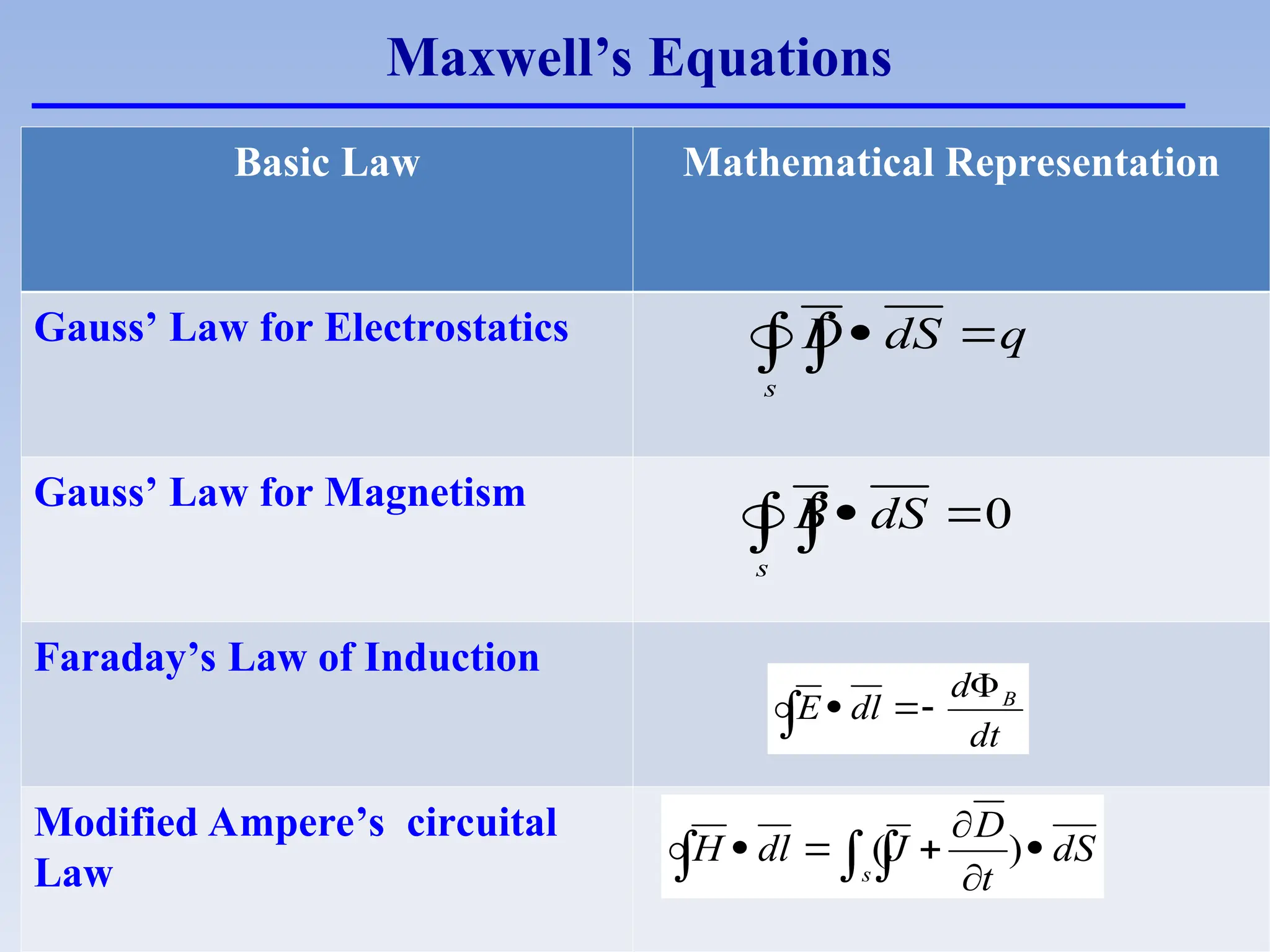
Maxwell’s Equations
Basic Law Mathematical Representation
Gauss’ Law for Electrostatics
Gauss’ Law for Magnetism
Faraday’s Law of Induction
Modified Ampere’s circuital
Law
q
dS
D
s



0


 dS
B
s
dt
d
dl
E B





dS
t
D
J
dl
H
s





 
 )
(
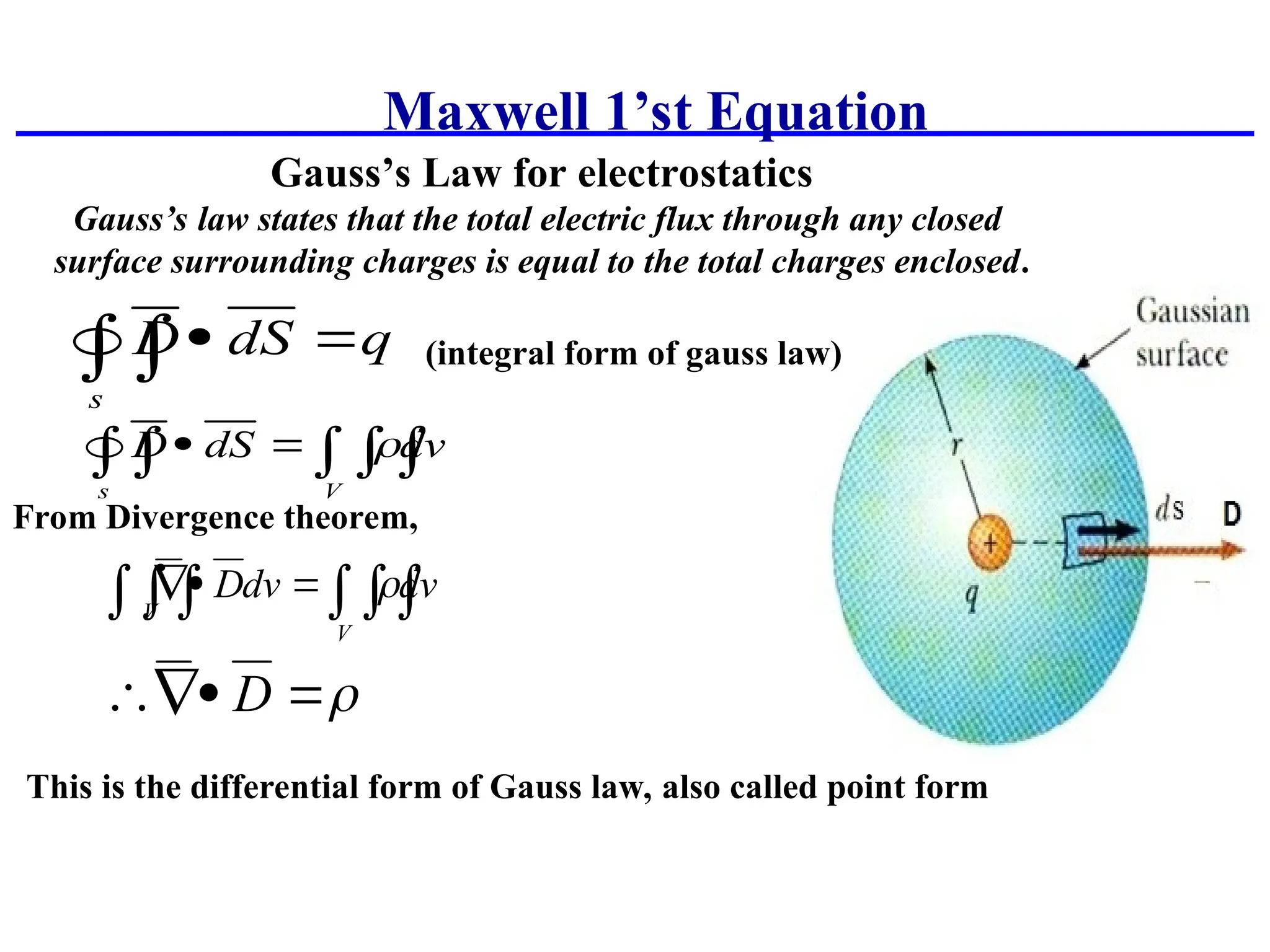
This is the differential form of Gauss law, also called point form
Gauss’s Law for electrostatics
Gauss’s law states that the total electric flux through any closed
surface surrounding charges is equal to the total charges enclosed.
q
dS
D
s



From Divergence theorem,

 

V
s
dv
dS
D 

 


V
V
dv
dv
D 




 D
Maxwell 1’st Equation
(integral form of gauss law)
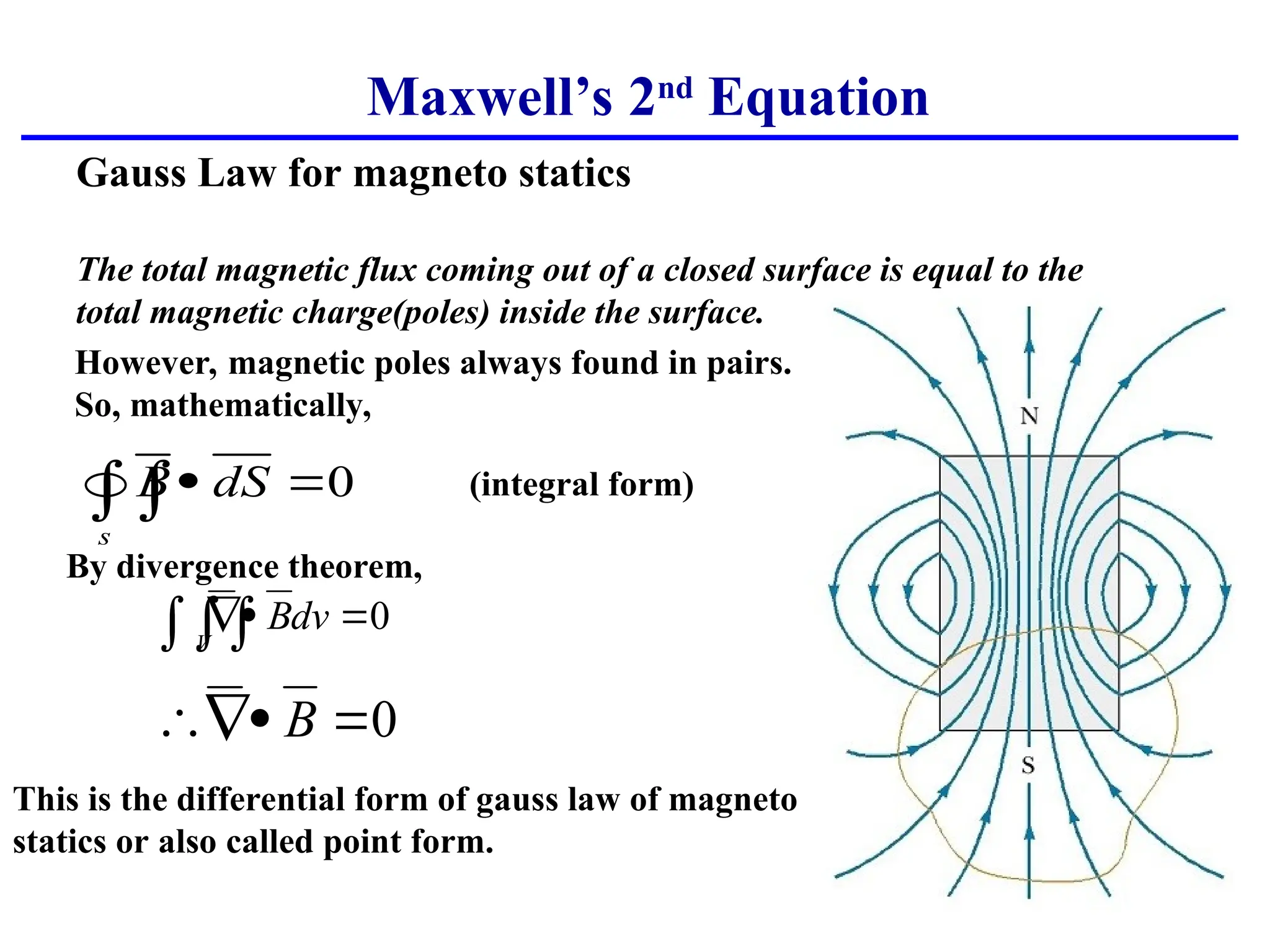
Gauss Law for magneto statics
The total magnetic flux coming out of a closed surface is equal to the
total magnetic charge(poles) inside the surface.
Maxwell’s 2nd
Equation
However, magnetic poles always found in pairs.
So, mathematically,
0


 dS
B
s
(integral form)
By divergence theorem,
0



 dv
B
V
0



 B
This is the differential form of gauss law of magneto
statics or also called point form.
Maxwell 3rd
Equation
Faraday’s Law of Electromagnetic Induction
•Biot savart law tells us that the magnetic field is produced by a current.
•Whether the reverse is true i.e. whether the magnetic field would produce
electricity.
• Faraday’s experiments demonstrated that the static magnetic field produce no
current but a time varying magnetic field produce a E.M.F. in a close loop causes
a current to flow.
According to Faraday’s law, the net electromotive force (EMF) in a close loop is
equal to the rate of change of magnetic flux ( ( )enclosed by the loop.
Mathematically,
EMF=
B
dt
d
dl
E B





The negative sign is due to the Lenz’s law.
If the loop has magnetic field density B, the
total flux enclosed by the loop is,
dS
B
s
B



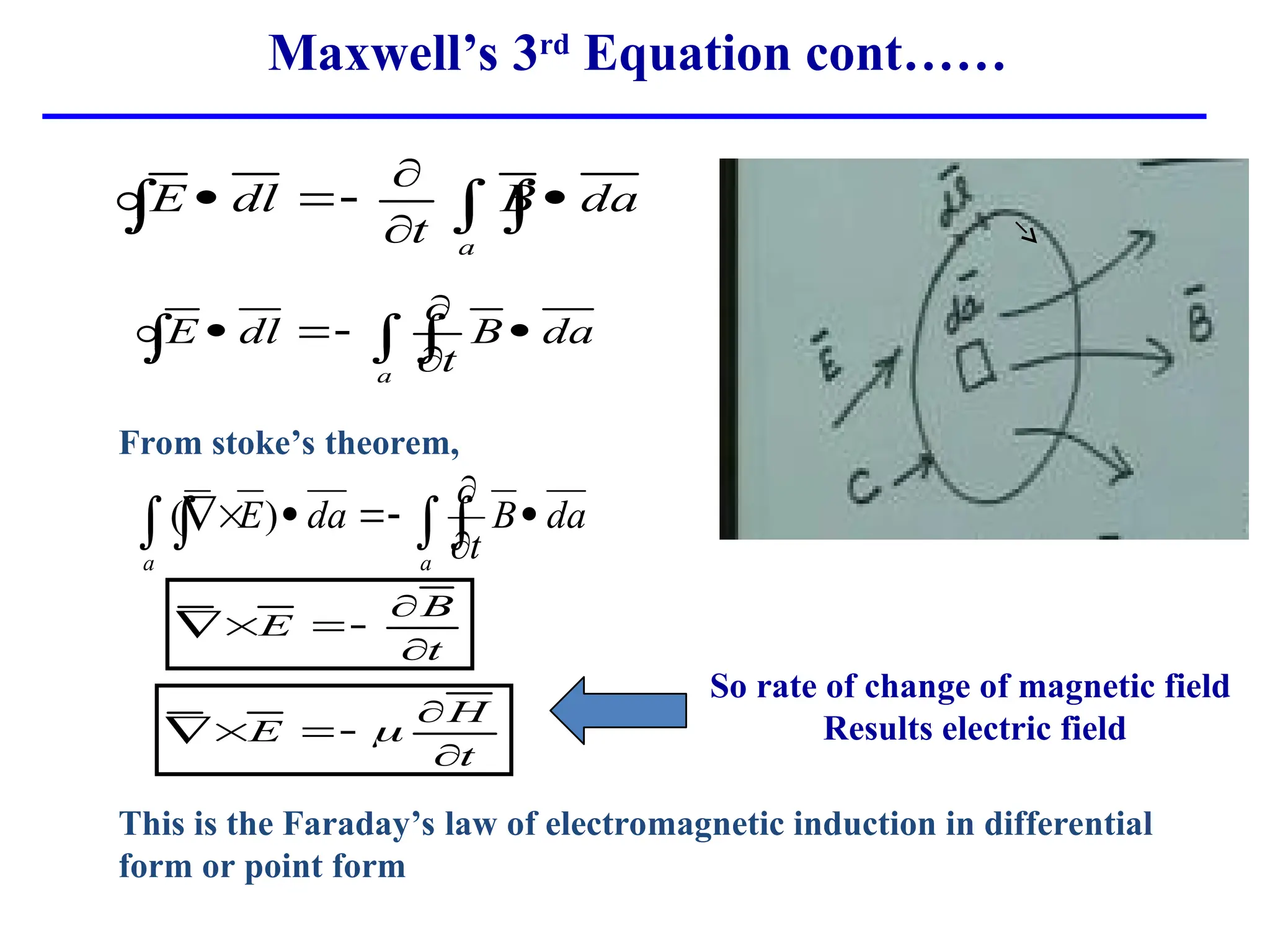
Maxwell’s 3rd
Equation cont……
From stoke’s theorem,
t
B
E






This is the Faraday’s law of electromagnetic induction in differential
form or point form
So rate of change of magnetic field
Results electric field

 





a
l
da
B
t
dl
E

 





a
l
da
B
t
dl
E

 







a
a
da
B
t
da
E)
(
t
H
E





 
Maxwell 4th
Equation
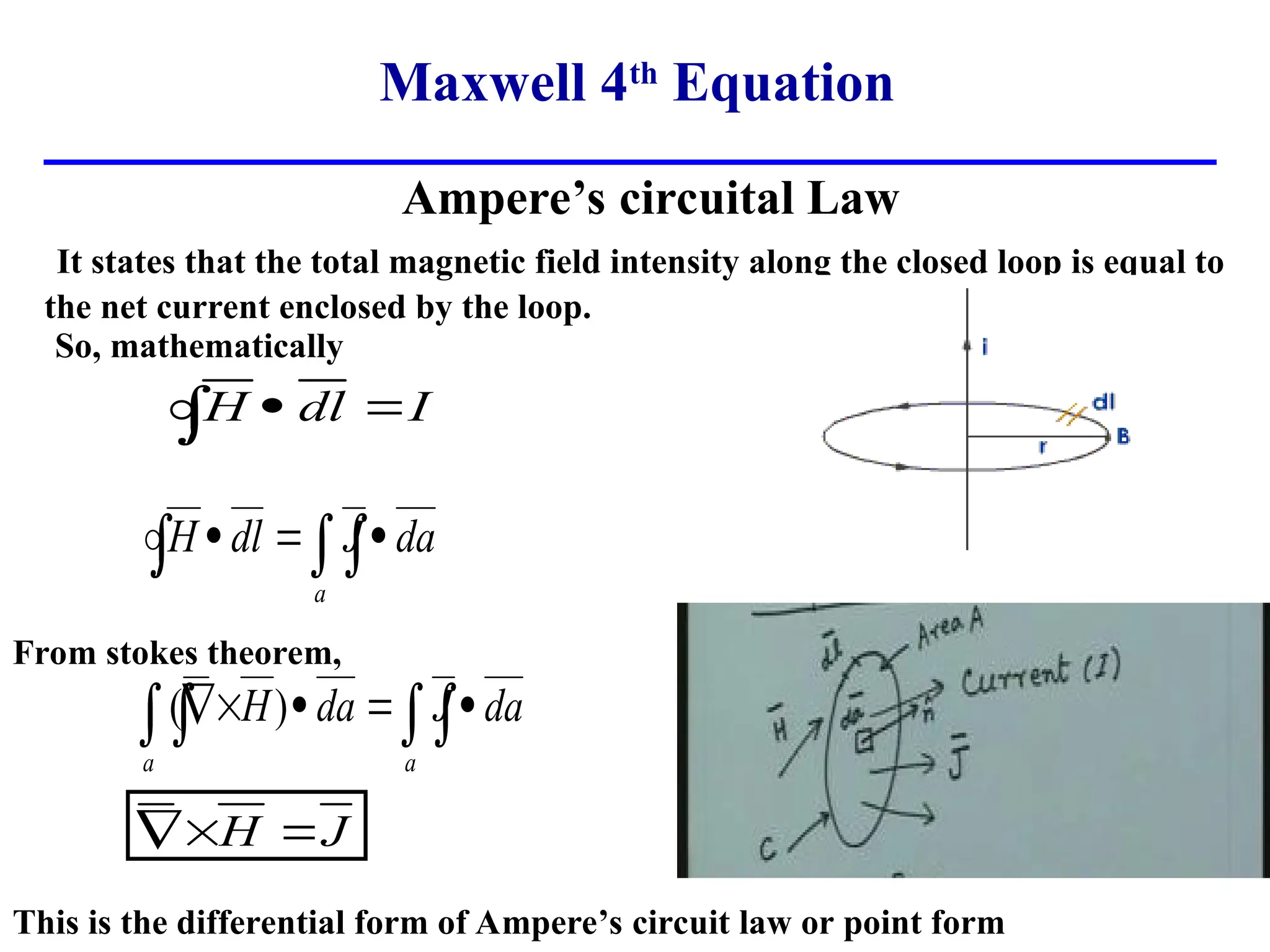
Ampere’s circuital Law
It states that the total magnetic field intensity along the closed loop is equal to
the net current enclosed by the loop.
So, mathematically
From stokes theorem,
J
H 


This is the differential form of Ampere’s circuit law or point form
I
dl
H
l



da
J
dl
H
a
l


 

da
J
da
H
a
a




 
 )
(
Maxwell 4th
Equation cont…
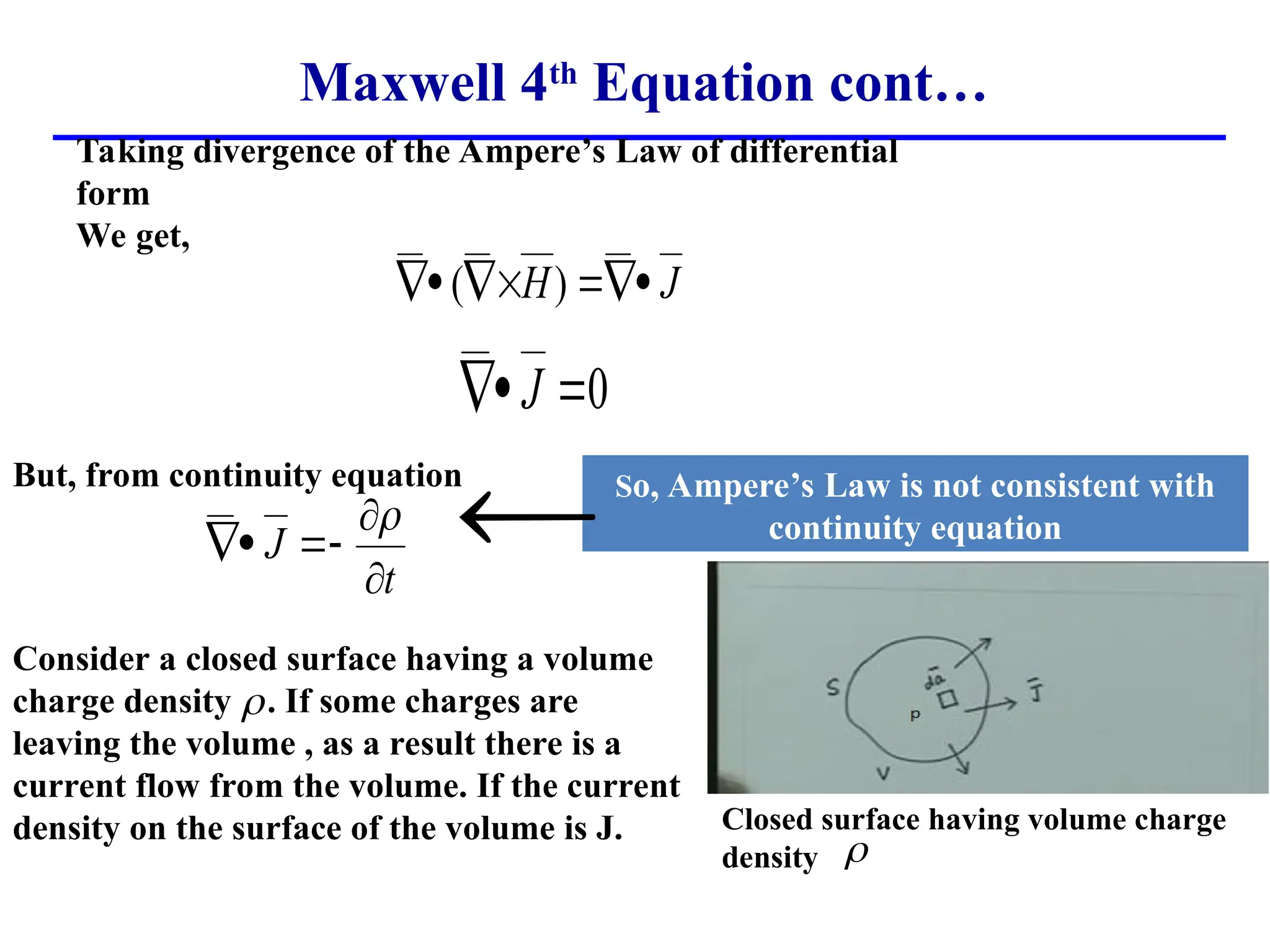
Taking divergence of the Ampere’s Law of differential
form
We get,
But, from continuity equation
Closed surface having volume charge
density 
Consider a closed surface having a volume
charge density . If some charges are
leaving the volume , as a result there is a
current flow from the volume. If the current
density on the surface of the volume is J.

So, Ampere’s Law is not consistent with
continuity equation

J
H 





 )
(
0


 J
t
J







Maxwell 4th
Equation cont…
The net outward current =
Rate of
decrease of
charges
Applying divergence theorem,

( from gauss law)



 D
So, in amperes law if we regard as the total current enclosed by the
loop law becomes consistent with the continuity equation.
And the term is called the displacement current density

 




v
a
dv
t
da
J 

 





v
v
dv
t
dv
J 
)
( 0






t
J

0
)
( 






t
D
J
t
D
J



t
D


Maxwell 4th
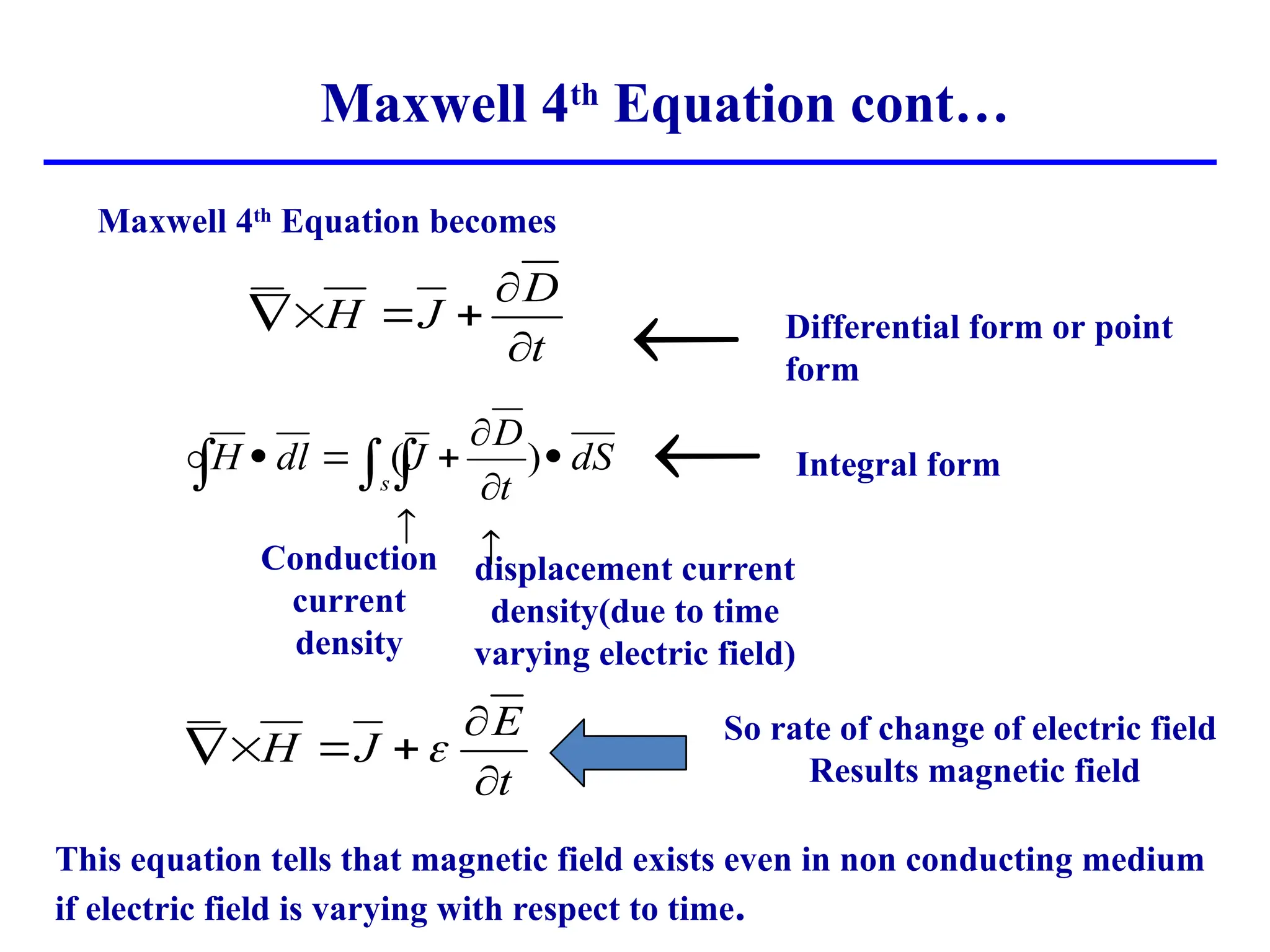
Equation becomes
Maxwell 4th
Equation cont…
Differential form or point
form

dS
t
D
J
dl
H
s





 
 )
(
t
D
J
H






Integral form

Conduction
current
density
displacement current
density(due to time
varying electric field)
 
This equation tells that magnetic field exists even in non conducting medium
if electric field is varying with respect to time.
t
E
J
H





  So rate of change of electric field
Results magnetic field

Maxwell-Equations Theory and Derivation.ppt

  • 1.
    Maxwell Equation • Maxwellequations are compilation of basic laws of electromagnetics. • These basic laws are Gauss law, the Ampere’s circuital law and the Faraday’s law. • These equations describes the world of electromagnetics. • Some of these laws were directly used and some were modified by Maxwell while compiling the equations. James clerk Maxwell (scottish physicist)
  • 2.
    Maxwell’s Equations Basic LawMathematical Representation Gauss’ Law for Electrostatics Gauss’ Law for Magnetism Faraday’s Law of Induction Modified Ampere’s circuital Law q dS D s    0    dS B s dt d dl E B      dS t D J dl H s         ) (
  • 3.
    This is thedifferential form of Gauss law, also called point form Gauss’s Law for electrostatics Gauss’s law states that the total electric flux through any closed surface surrounding charges is equal to the total charges enclosed. q dS D s    From Divergence theorem,     V s dv dS D       V V dv dv D       D Maxwell 1’st Equation (integral form of gauss law)
  • 4.
    Gauss Law formagneto statics The total magnetic flux coming out of a closed surface is equal to the total magnetic charge(poles) inside the surface. Maxwell’s 2nd Equation However, magnetic poles always found in pairs. So, mathematically, 0    dS B s (integral form) By divergence theorem, 0     dv B V 0     B This is the differential form of gauss law of magneto statics or also called point form.
  • 5.
    Maxwell 3rd Equation Faraday’s Lawof Electromagnetic Induction •Biot savart law tells us that the magnetic field is produced by a current. •Whether the reverse is true i.e. whether the magnetic field would produce electricity. • Faraday’s experiments demonstrated that the static magnetic field produce no current but a time varying magnetic field produce a E.M.F. in a close loop causes a current to flow. According to Faraday’s law, the net electromotive force (EMF) in a close loop is equal to the rate of change of magnetic flux ( ( )enclosed by the loop. Mathematically, EMF= B dt d dl E B      The negative sign is due to the Lenz’s law. If the loop has magnetic field density B, the total flux enclosed by the loop is, dS B s B   
  • 6.
    Maxwell’s 3rd Equation cont…… Fromstoke’s theorem, t B E       This is the Faraday’s law of electromagnetic induction in differential form or point form So rate of change of magnetic field Results electric field         a l da B t dl E         a l da B t dl E           a a da B t da E) ( t H E       
  • 7.
    Maxwell 4th Equation Ampere’s circuitalLaw It states that the total magnetic field intensity along the closed loop is equal to the net current enclosed by the loop. So, mathematically From stokes theorem, J H    This is the differential form of Ampere’s circuit law or point form I dl H l    da J dl H a l      da J da H a a        ) (
  • 8.
    Maxwell 4th Equation cont… Takingdivergence of the Ampere’s Law of differential form We get, But, from continuity equation Closed surface having volume charge density  Consider a closed surface having a volume charge density . If some charges are leaving the volume , as a result there is a current flow from the volume. If the current density on the surface of the volume is J.  So, Ampere’s Law is not consistent with continuity equation  J H        ) ( 0    J t J       
  • 9.
    Maxwell 4th Equation cont… Thenet outward current = Rate of decrease of charges Applying divergence theorem,  ( from gauss law)     D So, in amperes law if we regard as the total current enclosed by the loop law becomes consistent with the continuity equation. And the term is called the displacement current density        v a dv t da J          v v dv t dv J  ) ( 0       t J  0 ) (        t D J t D J    t D  
  • 10.
    Maxwell 4th Equation becomes Maxwell4th Equation cont… Differential form or point form  dS t D J dl H s         ) ( t D J H       Integral form  Conduction current density displacement current density(due to time varying electric field)   This equation tells that magnetic field exists even in non conducting medium if electric field is varying with respect to time. t E J H        So rate of change of electric field Results magnetic field