Maxwell’s contribution to
physics
Presented By:
Mayank panchal & Suhrid Mathur
Topics that will be covered:
About Maxwell
Maxwell’s Equations
Displacement current
Integral Form
Poynting Theorm
Time Harmonic Electric Field
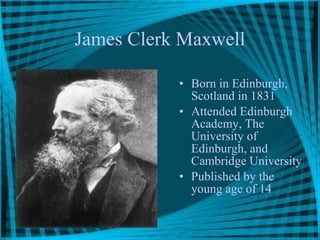
James Clerk Maxwell
• Born in Edinburgh,
Scotland in 1831
• Attended Edinburgh
Academy, The
University of
Edinburgh, and
Cambridge University
• Published by the
young age of 14
More on Maxwell
• Maxwell differed from his contemporaries
in the nineteenth century
• Faraday & Ampere contributed to
Maxwell’s theories
• Much of his important work was
accomplished between the ages of 29 and
35
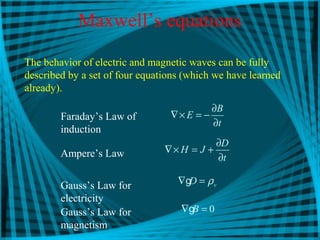
Maxwell’s equations
The behavior of electric and magnetic waves can be fully
described by a set of four equations (which we have learned
already).
B
E
t
∂
∇× = −
∂
D
H J
t
∂
∇× = +
∂
vD ρ∇ =g
0B∇ =gGauss’s Law for
magnetism
Gauss’s Law for
electricity
Ampere’s Law
Faraday’s Law of
induction
And the constitutive relations:
D Eε=
B Hµ=
J Eσ=
They relate the electromagnetic field to the properties of the material, in which
the field exists. Together with the Maxwell’s equations, the constitutive
relations completely describe the electromagnetic field.
Even the EM fields in a nonlinear media can be described through a
nonlinearity existing in the constitutive relations.
Conflict could be resolved by modifying Ampere’s
Law so that both electric current and displacement
current generate the magnetic field:
Displacement Current
For a time dependent electric field, a material medium
would become polarized, just as a dielectric does
- +
E
 For a constant E field, each pair of charges soon
equilibrates as shown above
 If the E field varies with time, then the charge
configurations are constantly in motion – displacement
current
L s
B
E dl ds
t∆ ∆
∂
= −
∂∫ ∫g gÑ
Gauss’s Law for
magnetism
Gauss’s Law for
electricity
Ampere’s Law
Faraday’s Law of
induction
Integral form
L s
D
H dl J ds
t∆ ∆
∂ 
= − + ÷
∂ 
∫ ∫g gÑ
v
S v
D ds dvρ
∆ ∆
=∫ ∫gÑ
0
S
B ds
∆
=∫ gÑ
It is frequently needed to determine the direction the power is
flowing. The Poynting’s Theorem is the tool for such tasks.
We consider an arbitrary
shaped volume:
B
E
t
∂
∇× = −
∂
D
H J
t
∂
∇× = +
∂
Recall:
We take the scalar product of E and subtract it from the scalar
product of H. B D
H E E H H E J
t t
∂ ∂ 
∇× − ∇× = − − + ÷
∂ ∂ 
g g g g
(6.9.1)
(6.9.2)
Poynting’s Theorem
Using the vector identity
( )A B B A A B∇ × = ∇× − ∇×g g g
Therefore:
( )
B D
E H H E E J
t t
∂ ∂
∇ × = − − −
∂ ∂
g g g g
( ) ( )2 21 1
2 2
B D
H E H H E E H E
t t t t
µ ε µ ε
∂ ∂ ∂ ∂
− − = − + = − +
∂ ∂ ∂ ∂
g g g g
( )2 21
( )
2v v v
E H dv H E dv E Jdv
t
µ ε
∂
∇ × = − + −
∂∫ ∫ ∫V V V
g g
Application of divergence theorem and the Ohm’s law lead
to the PT:
( )2 2 21
( )
2s v v
E H ds H E dv E dv
t
µ ε σ
∂
× = − + −
∂∫ ∫ ∫V V V
gÑ
Here S E H= ×
is the Poynting vector – the power density
and the direction of the radiated EM fields
in W/m2
.
(6.11.3)
The Poynting’s Theorem states that the power that leaves a region is equal to
the temporal decay in the energy that is stored within the volume minus the
power that is dissipated as heat within it – energy conservation.
EM energy density is 2 21
2
w H Eµ ε = + 
Power loss density is 2
Lp Eσ=
The differential form of the Poynting’s
Theorem:
L
w
S p
t
∂
∇ + = −
∂
g
Time-harmonic EM fields
Frequently, a temporal variation of EM fields is harmonic; therefore, we
may use a phasor representation:
( , , , ) Re ( , , )
j t
j t
E x y z t E x y z e
H x y z t H x y z e
ω
ω
 =  
 =  
It may be a phase angle between the electric and the magnetic
fields incorporated into E(x,y,z) and H(x,y,z).
Maxwell’s Eqn in
phasor form:
( ) ( )E r j H rωµ∇× = −
( ) ( ) ( )H r j E r J rωε∇× = +
( ) ( )vE r rρ ε∇ =g
( ) 0B r∇ =g
Power is a real quantity and, keeping in mind
that: Re ( ) Re ( ) Re ( ) ( )j t j t j t j t
E r e H r e E r e H r eω ω ω ω
     × ≠ ×     
Since [ ]
*
Re
2
A A
A
+
=
complex conjugate
[ ] [ ]
* *
* * * *
( ) ( ) ( ) ( )
Re ( ) Re ( )
2 2
( ) ( ) ( ) ( ) ( ) ( ) ( ) ( )
4
E r E r H r H r
E r H r
E r H r E r H r E r H r E r H r
   + +
× = × ÷  ÷
   
× + × + × + ×
=
Taking the time average, we obtain the average
power as: *1
( ) Re ( ) ( )
2
avS r E r H r = × 
Therefore, the Poynting’s theorem in phasors is:
( ) ( )* 2 2 2
( ) ( )
s v v
E r H r ds j H E dv E dvω µ ε σ× = − − −∫ ∫ ∫V V V
gÑ
Total power radiated
from the volume
The power dissipated
within the volume
The energy stored
within the volume
Indicates that the power (energy) is reactive
Conclusion
• Maxwell provided us with modern physical
and mathematical equations
• Many contributions to physics even though
his belief in the existence of aether was not
valid
• Michelson-Morley experiment proved aether
wrong
• LIGO today uses similar apparatus and
encounters similar problems
Presented By:
Mayank panchal
Suhrid mathur

Maxwell's contribution to physics

  • 1.
    Maxwell’s contribution to physics PresentedBy: Mayank panchal & Suhrid Mathur Topics that will be covered: About Maxwell Maxwell’s Equations Displacement current Integral Form Poynting Theorm Time Harmonic Electric Field
  • 2.
    James Clerk Maxwell •Born in Edinburgh, Scotland in 1831 • Attended Edinburgh Academy, The University of Edinburgh, and Cambridge University • Published by the young age of 14
  • 3.
    More on Maxwell •Maxwell differed from his contemporaries in the nineteenth century • Faraday & Ampere contributed to Maxwell’s theories • Much of his important work was accomplished between the ages of 29 and 35
  • 4.
    Maxwell’s equations The behaviorof electric and magnetic waves can be fully described by a set of four equations (which we have learned already). B E t ∂ ∇× = − ∂ D H J t ∂ ∇× = + ∂ vD ρ∇ =g 0B∇ =gGauss’s Law for magnetism Gauss’s Law for electricity Ampere’s Law Faraday’s Law of induction
  • 5.
    And the constitutiverelations: D Eε= B Hµ= J Eσ= They relate the electromagnetic field to the properties of the material, in which the field exists. Together with the Maxwell’s equations, the constitutive relations completely describe the electromagnetic field. Even the EM fields in a nonlinear media can be described through a nonlinearity existing in the constitutive relations.
  • 6.
    Conflict could beresolved by modifying Ampere’s Law so that both electric current and displacement current generate the magnetic field: Displacement Current
  • 7.
    For a timedependent electric field, a material medium would become polarized, just as a dielectric does - + E  For a constant E field, each pair of charges soon equilibrates as shown above  If the E field varies with time, then the charge configurations are constantly in motion – displacement current
  • 8.
    L s B E dlds t∆ ∆ ∂ = − ∂∫ ∫g gÑ Gauss’s Law for magnetism Gauss’s Law for electricity Ampere’s Law Faraday’s Law of induction Integral form L s D H dl J ds t∆ ∆ ∂  = − + ÷ ∂  ∫ ∫g gÑ v S v D ds dvρ ∆ ∆ =∫ ∫gÑ 0 S B ds ∆ =∫ gÑ
  • 9.
    It is frequentlyneeded to determine the direction the power is flowing. The Poynting’s Theorem is the tool for such tasks. We consider an arbitrary shaped volume: B E t ∂ ∇× = − ∂ D H J t ∂ ∇× = + ∂ Recall: We take the scalar product of E and subtract it from the scalar product of H. B D H E E H H E J t t ∂ ∂  ∇× − ∇× = − − + ÷ ∂ ∂  g g g g (6.9.1) (6.9.2) Poynting’s Theorem
  • 10.
    Using the vectoridentity ( )A B B A A B∇ × = ∇× − ∇×g g g Therefore: ( ) B D E H H E E J t t ∂ ∂ ∇ × = − − − ∂ ∂ g g g g ( ) ( )2 21 1 2 2 B D H E H H E E H E t t t t µ ε µ ε ∂ ∂ ∂ ∂ − − = − + = − + ∂ ∂ ∂ ∂ g g g g
  • 11.
    ( )2 21 () 2v v v E H dv H E dv E Jdv t µ ε ∂ ∇ × = − + − ∂∫ ∫ ∫V V V g g Application of divergence theorem and the Ohm’s law lead to the PT: ( )2 2 21 ( ) 2s v v E H ds H E dv E dv t µ ε σ ∂ × = − + − ∂∫ ∫ ∫V V V gÑ Here S E H= × is the Poynting vector – the power density and the direction of the radiated EM fields in W/m2 . (6.11.3)
  • 12.
    The Poynting’s Theoremstates that the power that leaves a region is equal to the temporal decay in the energy that is stored within the volume minus the power that is dissipated as heat within it – energy conservation. EM energy density is 2 21 2 w H Eµ ε = +  Power loss density is 2 Lp Eσ= The differential form of the Poynting’s Theorem: L w S p t ∂ ∇ + = − ∂ g
  • 13.
    Time-harmonic EM fields Frequently,a temporal variation of EM fields is harmonic; therefore, we may use a phasor representation: ( , , , ) Re ( , , ) ( , , , ) Re ( , , ) j t j t E x y z t E x y z e H x y z t H x y z e ω ω  =    =   It may be a phase angle between the electric and the magnetic fields incorporated into E(x,y,z) and H(x,y,z). Maxwell’s Eqn in phasor form: ( ) ( )E r j H rωµ∇× = − ( ) ( ) ( )H r j E r J rωε∇× = + ( ) ( )vE r rρ ε∇ =g ( ) 0B r∇ =g
  • 14.
    Power is areal quantity and, keeping in mind that: Re ( ) Re ( ) Re ( ) ( )j t j t j t j t E r e H r e E r e H r eω ω ω ω      × ≠ ×      Since [ ] * Re 2 A A A + = complex conjugate [ ] [ ] * * * * * * ( ) ( ) ( ) ( ) Re ( ) Re ( ) 2 2 ( ) ( ) ( ) ( ) ( ) ( ) ( ) ( ) 4 E r E r H r H r E r H r E r H r E r H r E r H r E r H r    + + × = × ÷  ÷     × + × + × + × = Taking the time average, we obtain the average power as: *1 ( ) Re ( ) ( ) 2 avS r E r H r = × 
  • 15.
    Therefore, the Poynting’stheorem in phasors is: ( ) ( )* 2 2 2 ( ) ( ) s v v E r H r ds j H E dv E dvω µ ε σ× = − − −∫ ∫ ∫V V V gÑ Total power radiated from the volume The power dissipated within the volume The energy stored within the volume Indicates that the power (energy) is reactive
  • 16.
    Conclusion • Maxwell providedus with modern physical and mathematical equations • Many contributions to physics even though his belief in the existence of aether was not valid • Michelson-Morley experiment proved aether wrong • LIGO today uses similar apparatus and encounters similar problems
  • 17.

Editor's Notes

  • #5 Moving idle wheels with vortices “The mathematics of these “moveable particles” turned out very neatly, but Maxwell nevertheless had to admit that the hypothesis could be regarded only as ‘provisional’ He conceded that the conception was awkward and did not bring it forward as a mode of connection existing in nature or ever as that which he would willingly assent to as an electrical hypothesis - from Siegel book