Maximum Likelihood Sequence
Detection
& the Viterbi Algorithm
EE-242 Digital Communications & Coding
•Miguel Ángel Galicia
•Ismail AlQerm
EE-242 Digital Communications & Coding
• Why using MLSD?
EE-242 Digital Communications & Coding
•Outline
•Viterbi Algorithm
•MLSD
EE-242 Digital Communications & Coding
Viterbi Algorithm
• What is Viterbi Algorithm?
• Viterbi Algorithm (VA) is an algorithm implemented
using dynamic programming to detect and estimate
sequence of symbols in digital communication and
signal processing.
EE-242 Digital Communications & Coding
Viterbi Algorithm in Sequence
Detection
• Basic Tools Needed:
• State diagram to represent transmitted
signals.
EE-242 Digital Communications & Coding
Tools Needed
• The Trellis:
EE-242 Digital Communications & Coding
Viterbi Algorithm Description
• Main principle:
• Finding a noiseless output sequence with
minimum distance from the detected noisy
sequence of symbols.
• It consists of certain number of Recursion
(Stages)
EE-242 Digital Communications & Coding
At each recursion, there are three
main steps that must be done to
achieve MLSD using VA:
• Branch Metric Generation:
Bi,j,n = (Xn – Ci,j)2
Survivor path and path metrics update.
• The path metric is the sum of all branch metrics at a
given state.
• The survivor path at recursion n:
Mj,n = min[Mi,n-1 + Bi,j,n]
Most likely path traced back.
EE-242 Digital Communications & Coding
VA Example (1/4)
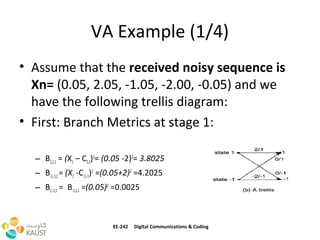
• Assume that the received noisy sequence is
Xn= (0.05, 2.05, -1.05, -2.00, -0.05) and we
have the following trellis diagram:
• First: Branch Metrics at stage 1:
– B1,1,1 = (X1 – C1,1)2
= (0.05 -2)2
= 3.8025
– B-1,-1,1= (X1 -C-1,-1)2
=(0.05+2)2
=4.2025
– B1,-1,1 = B-1,1,1 =(0.05)2
=0.0025
EE-242 Digital Communications & Coding
VA Example (2/4)
• Second: Finding the survivor path for each
state:
i= 2 states.
M1,0 = M-1,0 = 0
M1,1= min[Mi,0+Bi,1] from state -1 to 1
([M1,0 + B1,1] = 3.8025) > ([M-1,0 + B-1,1]=0+0.0025)
For state -1 similarly :
M-1,1= min[Mi,0+Bi,1] from state 1 to -1
EE-242 Digital Communications & Coding
VA Example (3/4)
• Stage 2:
B1,1,2= (X1 – C1,1)^2= (2.05 -2)^2= 0.0025
B-1,-1,2 =(X1 -C-l,-l)^2 =(2.05+2)^2 =16.402
B1,-1,2 =B-1,1,2 =(2.05)^2 =4.202
Survivor path selection:
For state1
M1,1 = M-1,1 = 0.0025 from state 1 to 1
M1,2= min[Mi,0+Bi,2]= ([M1,1+B1,2]=0.005<[M-1,1+B-1,2]= 4.2045)
For state -1:
M-1,2= min[Mi,0+Bi,2]= ([M-1,1+B1,2]=4.2045<[M-1,1+B-1,2]= 16.4045)
From state 1 to -1
EE-242 Digital Communications & Coding
VA Example (4/4)
• After 5 recursions:
The path trace back as shown with the most
likely inputs an outputs
EE-242 Digital Communications & Coding
MLSD Algorithm
EE-242 Digital Communications & Coding
• Searches the minimum Euclidean distance path through the trellis
• memory of transmitted signal of k symbols and r(t)
• Optimal Detection Rule becomes:
MLSD – NRZI Example (1/4)
• NRZI transmitted signal (binary modulation - PAM)
– corresponding to the points S1 = -S2 =
– Reduce the number of 2k
sequences in the trellis
• using the Viterbi algorithm
– State Diagram representation:
EE-242 Digital Communications & Coding
,
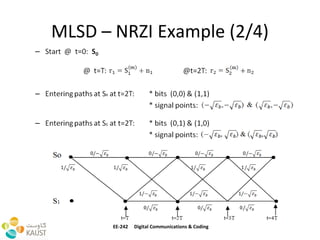
MLSD – NRZI Example (2/4)
EE-242 Digital Communications & Coding
MLSD – NRZI Example (3/4)
• Euclidean distance @ S0
• Outputs r1 and r2 from the demodulator:
• Euclidean distance @ S0
• Outputs r1 and r2:
EE-242 Digital Communications & Coding
* 2 survivors: D0(1,1) & D1(1,0)
MLSD – NRZI Example (4/4)
EE-242 Digital Communications & Coding
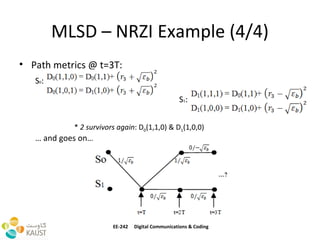
• Path metrics @ t=3T:
S0:
S1:
… and goes on…
* 2 survivors again: D0(1,1,0) & D1(1,0,0)
MLSD – M-ary Extension
EE-242 Digital Communications & Coding
• M=4 signals
– Four-state trellis:
– 2 signal paths enter & 2 leave each node
– 4 survivors @ each stage
– 1 / 2 signal paths is eliminated @ each stage
– Minimize the number of trellis’ paths
EE-242 Digital Communications & Coding
References:
• Tor M. Aulin, Breadth-First Maximum Likelihood Sequence Detection: Basics,
IEEE Transactions on Communications, Vol. 47, No. 2, February 1999.
•Hui-Ling Lou, Implementing the Viterbi Algorithm: Fundamental and real-time
issues for processor designers, IEEE Signal Processing Magazine, September 1995.
•X. Zhu and J. M. Kahn, Markov Chain Model in Maximum Likelihood Sequence
Detection for Free-Space Optical Communication Through Atmospheric Turbulence
Channels, IEEE Transactions on Communications, Vol. 51, No. 3, March 2003.
•J. R. Barry, E. A. Lee and David G. Messershmitt, Digital Communication, 3rd
ed.,
Ed. NY, USA: Springer-Verlag, 2004.
•J. G. Proakis and M. Salehi, Digital Communications, 5th
ed., Mc-Graw Hill, 2008.
EE-242 Digital Communications & Coding
Thank you!
Q & A

Maximum likelihood sequence detection with the viterbi algorithm

  • 1.
    Maximum Likelihood Sequence Detection &the Viterbi Algorithm EE-242 Digital Communications & Coding •Miguel Ángel Galicia •Ismail AlQerm EE-242 Digital Communications & Coding
  • 2.
    • Why usingMLSD? EE-242 Digital Communications & Coding
  • 3.
  • 4.
    Viterbi Algorithm • Whatis Viterbi Algorithm? • Viterbi Algorithm (VA) is an algorithm implemented using dynamic programming to detect and estimate sequence of symbols in digital communication and signal processing. EE-242 Digital Communications & Coding
  • 5.
    Viterbi Algorithm inSequence Detection • Basic Tools Needed: • State diagram to represent transmitted signals. EE-242 Digital Communications & Coding
  • 6.
    Tools Needed • TheTrellis: EE-242 Digital Communications & Coding
  • 7.
    Viterbi Algorithm Description •Main principle: • Finding a noiseless output sequence with minimum distance from the detected noisy sequence of symbols. • It consists of certain number of Recursion (Stages) EE-242 Digital Communications & Coding
  • 8.
    At each recursion,there are three main steps that must be done to achieve MLSD using VA: • Branch Metric Generation: Bi,j,n = (Xn – Ci,j)2 Survivor path and path metrics update. • The path metric is the sum of all branch metrics at a given state. • The survivor path at recursion n: Mj,n = min[Mi,n-1 + Bi,j,n] Most likely path traced back. EE-242 Digital Communications & Coding
  • 9.
    VA Example (1/4) •Assume that the received noisy sequence is Xn= (0.05, 2.05, -1.05, -2.00, -0.05) and we have the following trellis diagram: • First: Branch Metrics at stage 1: – B1,1,1 = (X1 – C1,1)2 = (0.05 -2)2 = 3.8025 – B-1,-1,1= (X1 -C-1,-1)2 =(0.05+2)2 =4.2025 – B1,-1,1 = B-1,1,1 =(0.05)2 =0.0025 EE-242 Digital Communications & Coding
  • 10.
    VA Example (2/4) •Second: Finding the survivor path for each state: i= 2 states. M1,0 = M-1,0 = 0 M1,1= min[Mi,0+Bi,1] from state -1 to 1 ([M1,0 + B1,1] = 3.8025) > ([M-1,0 + B-1,1]=0+0.0025) For state -1 similarly : M-1,1= min[Mi,0+Bi,1] from state 1 to -1 EE-242 Digital Communications & Coding
  • 11.
    VA Example (3/4) •Stage 2: B1,1,2= (X1 – C1,1)^2= (2.05 -2)^2= 0.0025 B-1,-1,2 =(X1 -C-l,-l)^2 =(2.05+2)^2 =16.402 B1,-1,2 =B-1,1,2 =(2.05)^2 =4.202 Survivor path selection: For state1 M1,1 = M-1,1 = 0.0025 from state 1 to 1 M1,2= min[Mi,0+Bi,2]= ([M1,1+B1,2]=0.005<[M-1,1+B-1,2]= 4.2045) For state -1: M-1,2= min[Mi,0+Bi,2]= ([M-1,1+B1,2]=4.2045<[M-1,1+B-1,2]= 16.4045) From state 1 to -1 EE-242 Digital Communications & Coding
  • 12.
    VA Example (4/4) •After 5 recursions: The path trace back as shown with the most likely inputs an outputs EE-242 Digital Communications & Coding
  • 13.
    MLSD Algorithm EE-242 DigitalCommunications & Coding • Searches the minimum Euclidean distance path through the trellis • memory of transmitted signal of k symbols and r(t) • Optimal Detection Rule becomes:
  • 14.
    MLSD – NRZIExample (1/4) • NRZI transmitted signal (binary modulation - PAM) – corresponding to the points S1 = -S2 = – Reduce the number of 2k sequences in the trellis • using the Viterbi algorithm – State Diagram representation: EE-242 Digital Communications & Coding ,
  • 15.
    MLSD – NRZIExample (2/4) EE-242 Digital Communications & Coding
  • 16.
    MLSD – NRZIExample (3/4) • Euclidean distance @ S0 • Outputs r1 and r2 from the demodulator: • Euclidean distance @ S0 • Outputs r1 and r2: EE-242 Digital Communications & Coding * 2 survivors: D0(1,1) & D1(1,0)
  • 17.
    MLSD – NRZIExample (4/4) EE-242 Digital Communications & Coding • Path metrics @ t=3T: S0: S1: … and goes on… * 2 survivors again: D0(1,1,0) & D1(1,0,0)
  • 18.
    MLSD – M-aryExtension EE-242 Digital Communications & Coding • M=4 signals – Four-state trellis: – 2 signal paths enter & 2 leave each node – 4 survivors @ each stage – 1 / 2 signal paths is eliminated @ each stage – Minimize the number of trellis’ paths
  • 19.
    EE-242 Digital Communications& Coding References: • Tor M. Aulin, Breadth-First Maximum Likelihood Sequence Detection: Basics, IEEE Transactions on Communications, Vol. 47, No. 2, February 1999. •Hui-Ling Lou, Implementing the Viterbi Algorithm: Fundamental and real-time issues for processor designers, IEEE Signal Processing Magazine, September 1995. •X. Zhu and J. M. Kahn, Markov Chain Model in Maximum Likelihood Sequence Detection for Free-Space Optical Communication Through Atmospheric Turbulence Channels, IEEE Transactions on Communications, Vol. 51, No. 3, March 2003. •J. R. Barry, E. A. Lee and David G. Messershmitt, Digital Communication, 3rd ed., Ed. NY, USA: Springer-Verlag, 2004. •J. G. Proakis and M. Salehi, Digital Communications, 5th ed., Mc-Graw Hill, 2008.
  • 20.
    EE-242 Digital Communications& Coding Thank you! Q & A