MAX WEBER
DAC I R * H O S O N O * P I N E DA
R A M I R O * S A R E N A S * TA N TOY
B A L
I. BRIEF BIOGRAPHY
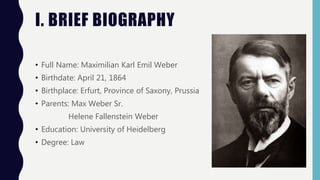
• Full Name: Maximilian Karl Emil Weber
• Birthdate: April 21, 1864
• Birthplace: Erfurt, Province of Saxony, Prussia
• Parents: Max Weber Sr.
Helene Fallenstein Weber
• Education: University of Heidelberg
• Degree: Law
I. BRIEF BIOGRAPHY
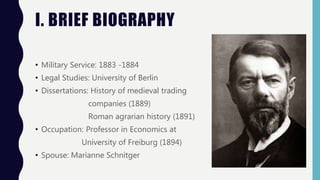
• Military Service: 1883 -1884
• Legal Studies: University of Berlin
• Dissertations: History of medieval trading
companies (1889)
Roman agrarian history (1891)
• Occupation: Professor in Economics at
University of Freiburg (1894)
• Spouse: Marianne Schnitger
I. BRIEF BIOGRAPHY
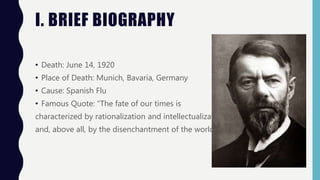
• Death: June 14, 1920
• Place of Death: Munich, Bavaria, Germany
• Cause: Spanish Flu
• Famous Quote: “The fate of our times is
characterized by rationalization and intellectualization
and, above all, by the disenchantment of the world.”
FAMOUS WORKS
• Archiv for SozialwissenschaJt und Sozialpolitik
• The Protestant Ethic
• Economy and Society
• Essays in Sociology
• The Vocation Lectures: Science as a Vocation/Politics as a Vocation
III. THEORIES OF MAX WEBER
• PROTESTANT ETHICS AND THE SPIRIT OF CAPITALISM
- Weber argued that a set of religious ideas were responsible for
the emergence of capitalism in Northern Europe in the 16th – 17th century.
- Protestantism offers a concept of the worldly “calling”, and gives
worldly activities a religious character. Weber was more focused on a
particular branch of Protestantism called Calvinism.
- Calvinists believe in predestination, that God has already
determined who is saved and damned. As Calvinism developed, a deep
psychological need for clues about whether one was actually saved arose,
and Calvinists looked to their success in worldly activities for those clues.
Thus, they came to value profit and material success as signs of God’s
favor.
III. THEORIES OF MAX WEBER
• WEBERIAN STRATIFICATION
- Weber argued that power can take a variety of forms. A person’s
power can be shown in the social order through their status, in the
economic order through their class, and in the political order through
their party. Thus, class, status, and party are each aspects of the
distribution of power within a community.
POWER: A person’s ability to get their way despite the resistance of
others.
CLASS: A person’s economic position in society.
STATUS: A person’s prestige, social honor, or popularity in society.
III. THEORIES OF MAX WEBER
• BUREAUCRATIC (MANAGEMENT) THEORY
- Bureaucracy is an organizational structure that is characterized by
many rules, standardized processes, procedures, and requirements,
number of desks, meticulous division of labor and responsibility, clear
hierarchies and professional, almost impersonal interactions between
employees.
6 PRINCIPLES:
1. Task Specialization
2. Hierarchal Authority
3. Formal Selection
4. Rules and Requirements
5. Impersonal
6. Career Orientation
III. THEORIES OF MAX WEBER
• IRON CAGE THEORY
- A term coined by Max Weber for the increased rationalization
inherent in social life, particularly in Western capitalist societies.
- Traps individuals in systems based purely on teleological
efficiency, rational calculation, and control.
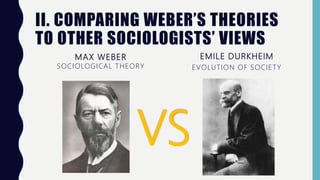
II. COMPARING WEBER’S THEORIES
TO OTHER SOCIOLOGISTS’ VIEWS
MAX WEBER
SOCIOLOGICAL THEORY
EMILE DURKHEIM
EVOLUTION OF SOCIETY
VS
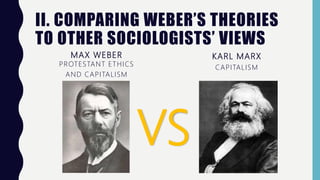
II. COMPARING WEBER’S THEORIES
TO OTHER SOCIOLOGISTS’ VIEWS
MAX WEBER
PROTESTANT ETHICS
AND CAPITALISM
KARL MARX
CAPITALISM
VS
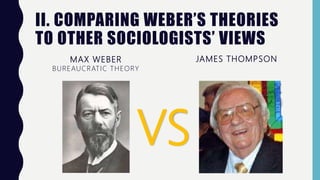
II. COMPARING WEBER’S THEORIES
TO OTHER SOCIOLOGISTS’ VIEWS
MAX WEBER
BUREAUCRATIC THEORY
JAMES THOMPSON
VS
II. COMPARING WEBER’S THEORIES
TO OTHER SOCIOLOGISTS’ VIEWS
MAX WEBER
STRATIFICATION
KARL MARX
HISTORICAL MATERIALISM
VS
IV. APPLICATION IN
THE PHILIPPINE
SETTING
PROTESTANT ETHIC THEORY: PROTESTANTISM AND
FILIPINO CULTURE VALUE A GOOD WORK ETHIC.
IRON CAGE THEORY: TREND WHEREIN STUDENTS
CHOOSE COURSES WITH THE HIGHEST POTENTIAL
BENEFITS.
BUREAUCRATIC THEORY: EXCESSIVE RED TAPE IN
PHILIPPINE GOVERNMENT AGENCIES.
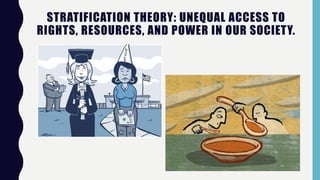
STRATIFICATION THEORY: UNEQUAL ACCESS TO
RIGHTS, RESOURCES, AND POWER IN OUR SOCIETY.
THE END.

Max Weber's Background and Theories

  • 1.
    MAX WEBER DAC IR * H O S O N O * P I N E DA R A M I R O * S A R E N A S * TA N TOY B A L
  • 2.
    I. BRIEF BIOGRAPHY •Full Name: Maximilian Karl Emil Weber • Birthdate: April 21, 1864 • Birthplace: Erfurt, Province of Saxony, Prussia • Parents: Max Weber Sr. Helene Fallenstein Weber • Education: University of Heidelberg • Degree: Law
  • 3.
    I. BRIEF BIOGRAPHY •Military Service: 1883 -1884 • Legal Studies: University of Berlin • Dissertations: History of medieval trading companies (1889) Roman agrarian history (1891) • Occupation: Professor in Economics at University of Freiburg (1894) • Spouse: Marianne Schnitger
  • 4.
    I. BRIEF BIOGRAPHY •Death: June 14, 1920 • Place of Death: Munich, Bavaria, Germany • Cause: Spanish Flu • Famous Quote: “The fate of our times is characterized by rationalization and intellectualization and, above all, by the disenchantment of the world.”
  • 5.
    FAMOUS WORKS • Archivfor SozialwissenschaJt und Sozialpolitik • The Protestant Ethic • Economy and Society • Essays in Sociology • The Vocation Lectures: Science as a Vocation/Politics as a Vocation
  • 6.
    III. THEORIES OFMAX WEBER • PROTESTANT ETHICS AND THE SPIRIT OF CAPITALISM - Weber argued that a set of religious ideas were responsible for the emergence of capitalism in Northern Europe in the 16th – 17th century. - Protestantism offers a concept of the worldly “calling”, and gives worldly activities a religious character. Weber was more focused on a particular branch of Protestantism called Calvinism. - Calvinists believe in predestination, that God has already determined who is saved and damned. As Calvinism developed, a deep psychological need for clues about whether one was actually saved arose, and Calvinists looked to their success in worldly activities for those clues. Thus, they came to value profit and material success as signs of God’s favor.
  • 7.
    III. THEORIES OFMAX WEBER • WEBERIAN STRATIFICATION - Weber argued that power can take a variety of forms. A person’s power can be shown in the social order through their status, in the economic order through their class, and in the political order through their party. Thus, class, status, and party are each aspects of the distribution of power within a community. POWER: A person’s ability to get their way despite the resistance of others. CLASS: A person’s economic position in society. STATUS: A person’s prestige, social honor, or popularity in society.
  • 8.
    III. THEORIES OFMAX WEBER • BUREAUCRATIC (MANAGEMENT) THEORY - Bureaucracy is an organizational structure that is characterized by many rules, standardized processes, procedures, and requirements, number of desks, meticulous division of labor and responsibility, clear hierarchies and professional, almost impersonal interactions between employees. 6 PRINCIPLES: 1. Task Specialization 2. Hierarchal Authority 3. Formal Selection 4. Rules and Requirements 5. Impersonal 6. Career Orientation
  • 9.
    III. THEORIES OFMAX WEBER • IRON CAGE THEORY - A term coined by Max Weber for the increased rationalization inherent in social life, particularly in Western capitalist societies. - Traps individuals in systems based purely on teleological efficiency, rational calculation, and control.
  • 10.
    II. COMPARING WEBER’STHEORIES TO OTHER SOCIOLOGISTS’ VIEWS MAX WEBER SOCIOLOGICAL THEORY EMILE DURKHEIM EVOLUTION OF SOCIETY VS
  • 11.
    II. COMPARING WEBER’STHEORIES TO OTHER SOCIOLOGISTS’ VIEWS MAX WEBER PROTESTANT ETHICS AND CAPITALISM KARL MARX CAPITALISM VS
  • 12.
    II. COMPARING WEBER’STHEORIES TO OTHER SOCIOLOGISTS’ VIEWS MAX WEBER BUREAUCRATIC THEORY JAMES THOMPSON VS
  • 13.
    II. COMPARING WEBER’STHEORIES TO OTHER SOCIOLOGISTS’ VIEWS MAX WEBER STRATIFICATION KARL MARX HISTORICAL MATERIALISM VS
  • 14.
    IV. APPLICATION IN THEPHILIPPINE SETTING
  • 15.
    PROTESTANT ETHIC THEORY:PROTESTANTISM AND FILIPINO CULTURE VALUE A GOOD WORK ETHIC.
  • 16.
    IRON CAGE THEORY:TREND WHEREIN STUDENTS CHOOSE COURSES WITH THE HIGHEST POTENTIAL BENEFITS.
  • 17.
    BUREAUCRATIC THEORY: EXCESSIVERED TAPE IN PHILIPPINE GOVERNMENT AGENCIES.
  • 18.
    STRATIFICATION THEORY: UNEQUALACCESS TO RIGHTS, RESOURCES, AND POWER IN OUR SOCIETY.
  • 19.