SOC444 Sociological
  Theory:


  Auguste Comte
Sunday, October 21, 2012
                     © 1998-2006 by Ronald Keith Bolender
                                               1
Auguste Comte

                        References
Comte, Auguste. 1896. The Positive Philosophy of Auguste Comte.
Comte, Auguste. 1912. Systeme de Politque Positive. 4th ed.
Coser, Lewis A. 1971. Masters of Sociological Thought: Ideas in
  Historical and Social Context. New York: Harcourt Brace
  Jovanovich.
Hoult, Thomas Ford. 1974. Dictionary of Modern Sociology. Totowa,
  NJ: Littlefield, Adams & Company.
Perdue, William D. 1986. Sociological Theory: Explanation, Paradigm,
  and Ideology. Palo Alto, CA: Mayfield Publishing Company.
Rapoport, Anatol. 1953. Operational Philosophy: Integrating
  Knowledge and Action. New York: Harper & Brother Publishers.
Sunday, October 21, 2012
                     © 1998-2006 by Ronald Keith Bolender
                                               2
Auguste Comte

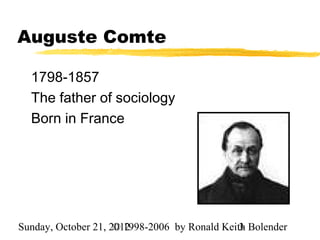
  1798-1857
  The father of sociology
  Born in France


Sunday, October 21, 2012
                     © 1998-2006 by Ronald Keith Bolender
                                               3
Auguste Comte

  The new social science that Comte sought to
  establish was first called social physics but he
  later found the term stolen by another
  intellectual so he coined the word sociology , a
  hybrid term compounded of Latin and Greek
  parts (Coser 1971:3).
  Comte first used the term sociology in print in
  1838 (Perdue 1986:37).


Sunday, October 21, 2012
                     © 1998-2006 by Ronald Keith Bolender
                                               4
Auguste Comte
The “father of sociology;” French philosopher who asserted
   . . . that the fate of mankind depends in many respects
     upon the development of a science of human social
    relationships, that establish scientific disciplines have
      progressed only to the degree that they have been
  grounded in facts and experience, and that therefore the
    needed new science of human social relationships (a
      science which Comte suggested naming sociology)
   should adopt the study and experimental techniques of
               the physical sciences (Hoult 1974:76).


Sunday, October 21, 2012
                     © 1998-2006 by Ronald Keith Bolender
                                               5
Auguste Comte: Positivism

  August Comte’s philosophy based on his
     conclusion that an intellectual discipline
     progresses only to the degree that it is
     grounded in facts and experience, I.e.,
   rests on information about which one can
    reasonably make positive statements. . .
                      (Hoult 1974:243-244)


Sunday, October 21, 2012
                     © 1998-2006 by Ronald Keith Bolender
                                               6
Auguste Comte: Positivism

 Positivism . . . seeks to describe only what
    “obviously” is, what one can really be
  positive about, that is, sense data. A strict
     positivist, seeing a black sheep on a
   meadow could not say, “There is a black
  sheep.” He could only say, “I see a sheep,
          one side of which is black.”
                     (Rapoport 1953:74)


Sunday, October 21, 2012
                     © 1998-2006 by Ronald Keith Bolender
                                               7
Auguste Comte: The Law of Human
Progress (or The Law of Three Stages)


   As early as 1822, when he was still an
     apprentice to Saint-Simon, Comte set
  himself the task “to discover through what
  fixed series of successive transformations
   the human race, starting from a state not
       superior to that of the great apes,
  gradually led to the point at which civilized
       finds itself today” (Comte 1912:Appendix).
Sunday, October 21, 2012
                     © 1998-2006 by Ronald Keith Bolender
                                               8
Auguste Comte: The Law of Human
Progress (or The Law of Three Stages)


Applying what he conceived to be a method
   of scientific comparison through time,
       Comte emerged with his central
  conception, The of Human Progress
      or The Law of Three Stages .
                       (Coser 1971:7)


Sunday, October 21, 2012
                     © 1998-2006 by Ronald Keith Bolender
                                               9
Auguste Comte: The Law of Human
Progress (or The Law of Three Stages)


    Each of our leading conceptions--each
        branch of our knowledge, passes
       successively through three different
    theoretical conditions: the Theological or
     fictitious; the Metaphysical or abstract;
          and the Scientific or positive. . .
                      (Comte 1912:1-2)


Sunday, October 21, 2012
                     © 1998-2006 by Ronald Keith Bolender
                                               10
Auguste Comte: The Law of Human
Progress (or The Law of Three Stages)


       , , , Comte insists repeatedly that
   “intellectual evolution is the preponderant
      principle” of his explanation of human
                    progress . . .
                       (Coser 1971:8)


Sunday, October 21, 2012
                     © 1998-2006 by Ronald Keith Bolender
                                               11
Auguste Comte: The Law of Human
Progress (or The Law of Three Stages)

    St age       Tim e Period             Ruled or         Dom inat e
                                         Dom inat ed       Social Unit
Theological    From the dawn of       Priest             Family
--Fictitious   man
                                      Military
Metaphysical Middle Ages              Churchmen          State
--Abstract
             Renaissance              Lawyers
Scientific   Industrialization        Industrial         Entire Human
--Positive                            Administrators     Race

                                      Scientific Moral
                                      Guides
                                 (Coser 1971:7-8)
Sunday, October 21, 2012
                     © 1998-2006 by Ronald Keith Bolender
                                               12
Auguste Comte:
Hierarchy of the Sciences

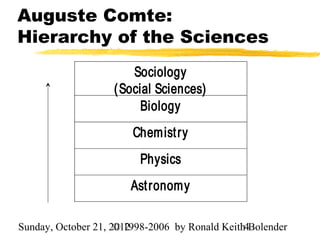
    Comte’s second best known theory,
   Hierarchy of the Sciences, is connected
       with the Law of Human Progress.
 The social sciences, the most complex and
   the most dependent for their emergence
   on the development of all others, are the
           “highest” in the hierarchy.
                       (Coser 1971:9)


Sunday, October 21, 2012
                     © 1998-2006 by Ronald Keith Bolender
                                               13
Auguste Comte:
Hierarchy of the Sciences
                       Sociology
                    (Social Sciences)
                         Biology
                        Chemist ry
                         Physics
                       Ast ronomy

Sunday, October 21, 2012
                     © 1998-2006 by Ronald Keith Bolender
                                               14
Auguste Comte:
Social Statics and Social Dynamics


              Social Statics
  The study of the conditions and pre-
  conditions of social order
             Social Dynamics
  The study of human progress and
  evolution
                     (Coser 1971:10-12)


Sunday, October 21, 2012
                     © 1998-2006 by Ronald Keith Bolender
                                               15
Auguste Comte:
Social Statics and Social Dynamics


                   Social Statics
  Family
     True social unit
        Smallest unit of social study in sociology
     The individual is not a legitimate component
     for research in sociology
     Families become tribes and tribes become
     nations

Sunday, October 21, 2012
                     © 1998-2006 by Ronald Keith Bolender
                                               16
Auguste Comte:
Social Statics and Social Dynamics


  It is within the family that the elementary
     egotistical propensities are curbed and
  harnessed to social purposes. “It is by the
     avenue [of the family] that man comes
  forth from his mere personality, and learns
   to live in another, while obeying his most
                powerful instincts.”
             Comte (1896:281) and Coser (1971:10)


Sunday, October 21, 2012
                     © 1998-2006 by Ronald Keith Bolender
                                               17
Auguste Comte:
Social Statics and Social Dynamics


  The family is the most elementary social
   unit and the prototype of all other human
  associations, for these evolve from family
              and kinship groups.
                       Coser (1971:10)


Sunday, October 21, 2012
                     © 1998-2006 by Ronald Keith Bolender
                                               18
Auguste Comte:
Social Statics and Social Dynamics


      Three Factors of Social Statics
  Language
     The means of storing the thought and culture
     of preceding generations
     Without a common language men could
     never have attained solidarity and consensus
     Without this collective tool no social order is
     possible

Sunday, October 21, 2012
                     © 1998-2006 by Ronald Keith Bolender
                                               19
Auguste Comte:
Social Statics and Social Dynamics


  Religion
     A common religious belief provides a guide for
     behavior
     Religion furnishes the unifying principle, the common
     ground without which individual differences would
     tear society apart.
     Religion is the root of social order
     It is indispensable for making legitimate the
     commands of government. No temporal power can
     endure without the support of spiritual power.

Sunday, October 21, 2012
                     © 1998-2006 by Ronald Keith Bolender
                                               20
Auguste Comte:
Social Statics and Social Dynamics


  Division of Labor
     Creates interdependence among members of
     the society
     Society ultimately benefits from a properly
     functioning division of labor
     As societies become more complex, the
     division of labor is the only means to properly
     adjust to that complexity

Sunday, October 21, 2012
                     © 1998-2006 by Ronald Keith Bolender
                                               21
Auguste Comte:
Social Statics and Social Dynamics


              Social Dynamics
 If the Social Statics are correctly balanced
    within a society, Social Dynamics can be
         orderly and positive for society.


Sunday, October 21, 2012
                     © 1998-2006 by Ronald Keith Bolender
                                               22
Auguste Comte:
Normative Doctrine

              Normative Doctrine
Comte developed a complex blueprint of the good positive
   society of the future, a society directed by the spiritual
 power of priests of the new positive religion and leaders
   of banking and industry. These scientific sociologists-
   priests would be the moral guides and censors of the
  community, using the force of their superior knowledge
  to recall men to their duties and obligations; they would
  be the directors of education and the supreme judges of
           the abilities of each member of society.
                     Coser (1971:12-13)
Sunday, October 21, 2012
                     © 1998-2006 by Ronald Keith Bolender
                                               23
Auguste Comte:
Normative Doctrine

  Comte’s New Positive Order
     Love as its Principle
     Order as its Basis
     Propress as its Aim
     Altruism
        Live for Others


Sunday, October 21, 2012
                     © 1998-2006 by Ronald Keith Bolender
                                               24

Auguste comte

  • 1.
    SOC444 Sociological Theory: Auguste Comte Sunday, October 21, 2012 © 1998-2006 by Ronald Keith Bolender 1
  • 2.
    Auguste Comte References Comte, Auguste. 1896. The Positive Philosophy of Auguste Comte. Comte, Auguste. 1912. Systeme de Politque Positive. 4th ed. Coser, Lewis A. 1971. Masters of Sociological Thought: Ideas in Historical and Social Context. New York: Harcourt Brace Jovanovich. Hoult, Thomas Ford. 1974. Dictionary of Modern Sociology. Totowa, NJ: Littlefield, Adams & Company. Perdue, William D. 1986. Sociological Theory: Explanation, Paradigm, and Ideology. Palo Alto, CA: Mayfield Publishing Company. Rapoport, Anatol. 1953. Operational Philosophy: Integrating Knowledge and Action. New York: Harper & Brother Publishers. Sunday, October 21, 2012 © 1998-2006 by Ronald Keith Bolender 2
  • 3.
    Auguste Comte 1798-1857 The father of sociology Born in France Sunday, October 21, 2012 © 1998-2006 by Ronald Keith Bolender 3
  • 4.
    Auguste Comte The new social science that Comte sought to establish was first called social physics but he later found the term stolen by another intellectual so he coined the word sociology , a hybrid term compounded of Latin and Greek parts (Coser 1971:3). Comte first used the term sociology in print in 1838 (Perdue 1986:37). Sunday, October 21, 2012 © 1998-2006 by Ronald Keith Bolender 4
  • 5.
    Auguste Comte The “fatherof sociology;” French philosopher who asserted . . . that the fate of mankind depends in many respects upon the development of a science of human social relationships, that establish scientific disciplines have progressed only to the degree that they have been grounded in facts and experience, and that therefore the needed new science of human social relationships (a science which Comte suggested naming sociology) should adopt the study and experimental techniques of the physical sciences (Hoult 1974:76). Sunday, October 21, 2012 © 1998-2006 by Ronald Keith Bolender 5
  • 6.
    Auguste Comte: Positivism August Comte’s philosophy based on his conclusion that an intellectual discipline progresses only to the degree that it is grounded in facts and experience, I.e., rests on information about which one can reasonably make positive statements. . . (Hoult 1974:243-244) Sunday, October 21, 2012 © 1998-2006 by Ronald Keith Bolender 6
  • 7.
    Auguste Comte: Positivism Positivism . . . seeks to describe only what “obviously” is, what one can really be positive about, that is, sense data. A strict positivist, seeing a black sheep on a meadow could not say, “There is a black sheep.” He could only say, “I see a sheep, one side of which is black.” (Rapoport 1953:74) Sunday, October 21, 2012 © 1998-2006 by Ronald Keith Bolender 7
  • 8.
    Auguste Comte: TheLaw of Human Progress (or The Law of Three Stages) As early as 1822, when he was still an apprentice to Saint-Simon, Comte set himself the task “to discover through what fixed series of successive transformations the human race, starting from a state not superior to that of the great apes, gradually led to the point at which civilized finds itself today” (Comte 1912:Appendix). Sunday, October 21, 2012 © 1998-2006 by Ronald Keith Bolender 8
  • 9.
    Auguste Comte: TheLaw of Human Progress (or The Law of Three Stages) Applying what he conceived to be a method of scientific comparison through time, Comte emerged with his central conception, The of Human Progress or The Law of Three Stages . (Coser 1971:7) Sunday, October 21, 2012 © 1998-2006 by Ronald Keith Bolender 9
  • 10.
    Auguste Comte: TheLaw of Human Progress (or The Law of Three Stages) Each of our leading conceptions--each branch of our knowledge, passes successively through three different theoretical conditions: the Theological or fictitious; the Metaphysical or abstract; and the Scientific or positive. . . (Comte 1912:1-2) Sunday, October 21, 2012 © 1998-2006 by Ronald Keith Bolender 10
  • 11.
    Auguste Comte: TheLaw of Human Progress (or The Law of Three Stages) , , , Comte insists repeatedly that “intellectual evolution is the preponderant principle” of his explanation of human progress . . . (Coser 1971:8) Sunday, October 21, 2012 © 1998-2006 by Ronald Keith Bolender 11
  • 12.
    Auguste Comte: TheLaw of Human Progress (or The Law of Three Stages) St age Tim e Period Ruled or Dom inat e Dom inat ed Social Unit Theological From the dawn of Priest Family --Fictitious man Military Metaphysical Middle Ages Churchmen State --Abstract Renaissance Lawyers Scientific Industrialization Industrial Entire Human --Positive Administrators Race Scientific Moral Guides (Coser 1971:7-8) Sunday, October 21, 2012 © 1998-2006 by Ronald Keith Bolender 12
  • 13.
    Auguste Comte: Hierarchy ofthe Sciences Comte’s second best known theory, Hierarchy of the Sciences, is connected with the Law of Human Progress. The social sciences, the most complex and the most dependent for their emergence on the development of all others, are the “highest” in the hierarchy. (Coser 1971:9) Sunday, October 21, 2012 © 1998-2006 by Ronald Keith Bolender 13
  • 14.
    Auguste Comte: Hierarchy ofthe Sciences Sociology (Social Sciences) Biology Chemist ry Physics Ast ronomy Sunday, October 21, 2012 © 1998-2006 by Ronald Keith Bolender 14
  • 15.
    Auguste Comte: Social Staticsand Social Dynamics Social Statics The study of the conditions and pre- conditions of social order Social Dynamics The study of human progress and evolution (Coser 1971:10-12) Sunday, October 21, 2012 © 1998-2006 by Ronald Keith Bolender 15
  • 16.
    Auguste Comte: Social Staticsand Social Dynamics Social Statics Family True social unit Smallest unit of social study in sociology The individual is not a legitimate component for research in sociology Families become tribes and tribes become nations Sunday, October 21, 2012 © 1998-2006 by Ronald Keith Bolender 16
  • 17.
    Auguste Comte: Social Staticsand Social Dynamics It is within the family that the elementary egotistical propensities are curbed and harnessed to social purposes. “It is by the avenue [of the family] that man comes forth from his mere personality, and learns to live in another, while obeying his most powerful instincts.” Comte (1896:281) and Coser (1971:10) Sunday, October 21, 2012 © 1998-2006 by Ronald Keith Bolender 17
  • 18.
    Auguste Comte: Social Staticsand Social Dynamics The family is the most elementary social unit and the prototype of all other human associations, for these evolve from family and kinship groups. Coser (1971:10) Sunday, October 21, 2012 © 1998-2006 by Ronald Keith Bolender 18
  • 19.
    Auguste Comte: Social Staticsand Social Dynamics Three Factors of Social Statics Language The means of storing the thought and culture of preceding generations Without a common language men could never have attained solidarity and consensus Without this collective tool no social order is possible Sunday, October 21, 2012 © 1998-2006 by Ronald Keith Bolender 19
  • 20.
    Auguste Comte: Social Staticsand Social Dynamics Religion A common religious belief provides a guide for behavior Religion furnishes the unifying principle, the common ground without which individual differences would tear society apart. Religion is the root of social order It is indispensable for making legitimate the commands of government. No temporal power can endure without the support of spiritual power. Sunday, October 21, 2012 © 1998-2006 by Ronald Keith Bolender 20
  • 21.
    Auguste Comte: Social Staticsand Social Dynamics Division of Labor Creates interdependence among members of the society Society ultimately benefits from a properly functioning division of labor As societies become more complex, the division of labor is the only means to properly adjust to that complexity Sunday, October 21, 2012 © 1998-2006 by Ronald Keith Bolender 21
  • 22.
    Auguste Comte: Social Staticsand Social Dynamics Social Dynamics If the Social Statics are correctly balanced within a society, Social Dynamics can be orderly and positive for society. Sunday, October 21, 2012 © 1998-2006 by Ronald Keith Bolender 22
  • 23.
    Auguste Comte: Normative Doctrine Normative Doctrine Comte developed a complex blueprint of the good positive society of the future, a society directed by the spiritual power of priests of the new positive religion and leaders of banking and industry. These scientific sociologists- priests would be the moral guides and censors of the community, using the force of their superior knowledge to recall men to their duties and obligations; they would be the directors of education and the supreme judges of the abilities of each member of society. Coser (1971:12-13) Sunday, October 21, 2012 © 1998-2006 by Ronald Keith Bolender 23
  • 24.
    Auguste Comte: Normative Doctrine Comte’s New Positive Order Love as its Principle Order as its Basis Propress as its Aim Altruism Live for Others Sunday, October 21, 2012 © 1998-2006 by Ronald Keith Bolender 24