SAY620
Theory of Social Survey Methodology
Institute of Population Studies
Hacettepe University
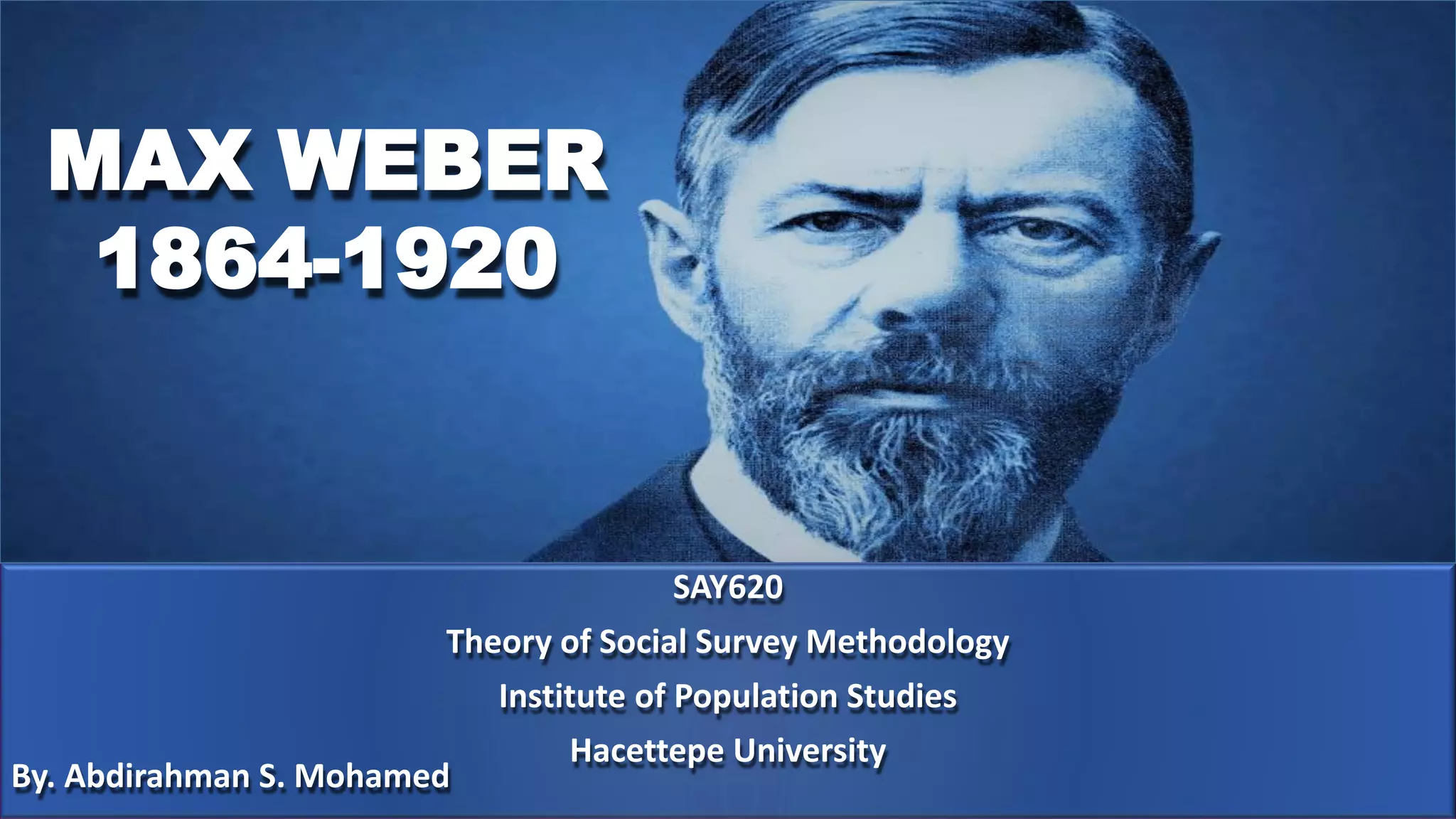
MAX WEBER
1864-1920
By. Abdirahman S. Mohamed
Max Weber
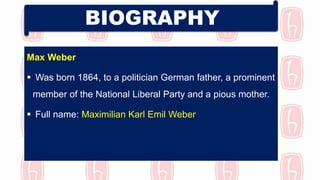
 Was born 1864, to a politician German father, a prominent
member of the National Liberal Party and a pious mother.
 Full name: Maximilian Karl Emil Weber
BIOGRAPHY
EARLY LIFE
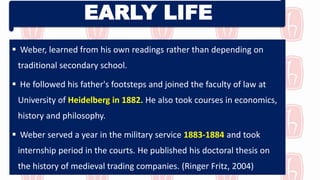
 Weber, learned from his own readings rather than depending on
traditional secondary school.
 He followed his father's footsteps and joined the faculty of law at
University of Heidelberg in 1882. He also took courses in economics,
history and philosophy.
 Weber served a year in the military service 1883-1884 and took
internship period in the courts. He published his doctoral thesis on
the history of medieval trading companies. (Ringer Fritz, 2004)
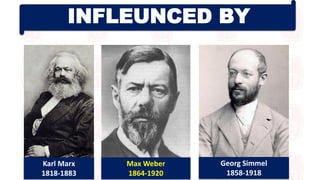
INFLEUNCED BY
Karl Marx
1818-1883
Max Weber
1864-1920
Georg Simmel
1858-1918
The PROTESTANT ETHIC AND THE
SPIRIT OF CAPITALISM
 His essay entitled, The Protestant Ethic and the Spirit of Capitalism
was his most famous work. Some suggested that not be considered as
a detailed study of Protestantism, but an introduction to his
subsequent works especially his various works on various religions.
 He noted that countries with Protestant beliefs are has more
developed capitalist economy.
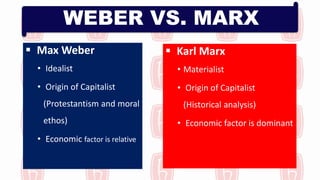
 Max Weber
• Idealist
• Origin of Capitalist
(Protestantism and moral
ethos)
• Economic factor is relative
 Karl Marx
• Materialist
• Origin of Capitalist
(Historical analysis)
• Economic factor is dominant
WEBER VS. MARX
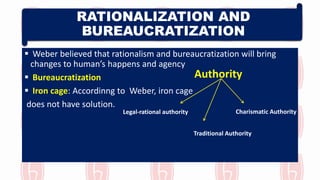
RATIONALIZATION AND
BUREAUCRATIZATION
 Weber believed that rationalism and bureaucratization will bring
changes to human’s happens and agency
 Bureaucratization
 Iron cage: Accordinng to Weber, iron cage
does not have solution.
Charismatic AuthorityLegal-rational authority
Traditional Authority
Authority
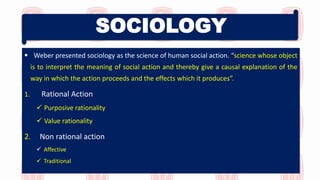
SOCIOLOGY
 Weber presented sociology as the science of human social action. “science whose object
is to interpret the meaning of social action and thereby give a causal explanation of the
way in which the action proceeds and the effects which it produces”.
1. Rational Action
 Purposive rationality
 Value rationality
2. Non rational action
 Affective
 Traditional
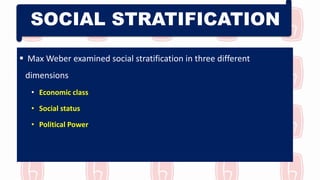
SOCIAL STRATIFICATION
 Max Weber examined social stratification in three different
dimensions
• Economic class
• Social status
• Political Power
VERSTEHEN
 Weber used this German word (Verstehen) to give social explanations
to develop empathetic understanding of the subjective meanings and
motives of social action.
 Anti-Positivist, Wilhelm Dilthey and Heinrich Rickert.
WEBER’S METHODOLOGY
 Weber tried bring together two divergent approaches that have
divided theorists of the social and historical sciences, namely the
explanatory and the interpretive approaches.
 Singular Causal Analysis, In this approach, he proposed that the
phenomena or events should be traced to their antecedents.
BIBLIOGRAPHY
1. Abel Theodore. (1948). The Operation Called Verstehen. American Journal of
Sociology, Vol. 54, No. 3 (Nov., 1948), pp. 211-218. Chicago, USA. The
university of Chicago Press.
2. Biography. Editors (n.d). Max Weber Biography. A&E Television Networks.
Retrieved from https://www.biography.com/people/max-weber-9526066
3. Freiermuth M. Timothy. (n.d). Max Weber and Karl Marx: The Origins of
Capitalism
4. Introduction to sociology. (2006). From Wikibooks, the open-content
textbooks collection. http://en.wikibooks.org/wiki/introduction to sociology
5. Max Weber Retrieved from
https://www.google.com.tr/url?sa=t&rct=j&q=&esrc=s&source=web&cd=1&c
ad=rja&uact=8&ved=0ahUKEwjgy7OFuvrXAhXDXBQKHVjYD1oQFggnMAA&ur
l=http%3A%2F%2Ffaculty.lahoreschool.edu.pk%2FAcademics%2FLectures%2F
anis%2FWeber.pdf&usg=AOvVaw23OGG7LlFJpcQB2qBBYz-k
BILIOGRAPHY
•
6. Koch, Andrew M. (1994) . The ontological assumption of Max Weber's
methodology. Texas Journal of Political Studies, 17:1 (Winter 1994-95), 5-21.
(ISSN: 0191-0930) [Journal discontinued in 1999.
7. Ringer Fritz. (2004). Max Weber: An intellectual biography. Chicago, USA. The
University of Chicago Press.
8. https://redice.tv/news/should-the-protestant-ethic-become-the-spirit-of-the-
alt-right (Source of Cover photo)
THANK
YOU

Max Weber

  • 1.
    SAY620 Theory of SocialSurvey Methodology Institute of Population Studies Hacettepe University MAX WEBER 1864-1920 By. Abdirahman S. Mohamed
  • 2.
    Max Weber  Wasborn 1864, to a politician German father, a prominent member of the National Liberal Party and a pious mother.  Full name: Maximilian Karl Emil Weber BIOGRAPHY
  • 3.
    EARLY LIFE  Weber,learned from his own readings rather than depending on traditional secondary school.  He followed his father's footsteps and joined the faculty of law at University of Heidelberg in 1882. He also took courses in economics, history and philosophy.  Weber served a year in the military service 1883-1884 and took internship period in the courts. He published his doctoral thesis on the history of medieval trading companies. (Ringer Fritz, 2004)
  • 4.
    INFLEUNCED BY Karl Marx 1818-1883 MaxWeber 1864-1920 Georg Simmel 1858-1918
  • 5.
    The PROTESTANT ETHICAND THE SPIRIT OF CAPITALISM  His essay entitled, The Protestant Ethic and the Spirit of Capitalism was his most famous work. Some suggested that not be considered as a detailed study of Protestantism, but an introduction to his subsequent works especially his various works on various religions.  He noted that countries with Protestant beliefs are has more developed capitalist economy.
  • 6.
     Max Weber •Idealist • Origin of Capitalist (Protestantism and moral ethos) • Economic factor is relative  Karl Marx • Materialist • Origin of Capitalist (Historical analysis) • Economic factor is dominant WEBER VS. MARX
  • 7.
    RATIONALIZATION AND BUREAUCRATIZATION  Weberbelieved that rationalism and bureaucratization will bring changes to human’s happens and agency  Bureaucratization  Iron cage: Accordinng to Weber, iron cage does not have solution. Charismatic AuthorityLegal-rational authority Traditional Authority Authority
  • 8.
    SOCIOLOGY  Weber presentedsociology as the science of human social action. “science whose object is to interpret the meaning of social action and thereby give a causal explanation of the way in which the action proceeds and the effects which it produces”. 1. Rational Action  Purposive rationality  Value rationality 2. Non rational action  Affective  Traditional
  • 9.
    SOCIAL STRATIFICATION  MaxWeber examined social stratification in three different dimensions • Economic class • Social status • Political Power
  • 10.
    VERSTEHEN  Weber usedthis German word (Verstehen) to give social explanations to develop empathetic understanding of the subjective meanings and motives of social action.  Anti-Positivist, Wilhelm Dilthey and Heinrich Rickert.
  • 11.
    WEBER’S METHODOLOGY  Webertried bring together two divergent approaches that have divided theorists of the social and historical sciences, namely the explanatory and the interpretive approaches.  Singular Causal Analysis, In this approach, he proposed that the phenomena or events should be traced to their antecedents.
  • 12.
    BIBLIOGRAPHY 1. Abel Theodore.(1948). The Operation Called Verstehen. American Journal of Sociology, Vol. 54, No. 3 (Nov., 1948), pp. 211-218. Chicago, USA. The university of Chicago Press. 2. Biography. Editors (n.d). Max Weber Biography. A&E Television Networks. Retrieved from https://www.biography.com/people/max-weber-9526066 3. Freiermuth M. Timothy. (n.d). Max Weber and Karl Marx: The Origins of Capitalism 4. Introduction to sociology. (2006). From Wikibooks, the open-content textbooks collection. http://en.wikibooks.org/wiki/introduction to sociology 5. Max Weber Retrieved from https://www.google.com.tr/url?sa=t&rct=j&q=&esrc=s&source=web&cd=1&c ad=rja&uact=8&ved=0ahUKEwjgy7OFuvrXAhXDXBQKHVjYD1oQFggnMAA&ur l=http%3A%2F%2Ffaculty.lahoreschool.edu.pk%2FAcademics%2FLectures%2F anis%2FWeber.pdf&usg=AOvVaw23OGG7LlFJpcQB2qBBYz-k
  • 13.
    BILIOGRAPHY • 6. Koch, AndrewM. (1994) . The ontological assumption of Max Weber's methodology. Texas Journal of Political Studies, 17:1 (Winter 1994-95), 5-21. (ISSN: 0191-0930) [Journal discontinued in 1999. 7. Ringer Fritz. (2004). Max Weber: An intellectual biography. Chicago, USA. The University of Chicago Press. 8. https://redice.tv/news/should-the-protestant-ethic-become-the-spirit-of-the- alt-right (Source of Cover photo)
  • 14.