Origins of
Sociology
From Europe to the United States:The Minds
Behind the Theories
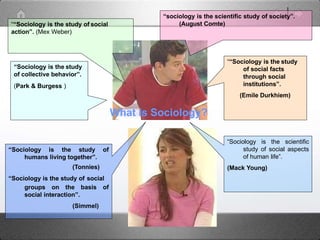
What Is Sociology?
““Sociology is the study of social
action”. (Mex Weber)
“sociology is the scientific study of society”.
(August Comte)
““Sociology is the study
of social facts
through social
institutions”.
(Emile Durkhiem)
“Sociology is the scientific
study of social aspects
of human life”.
(Mack Young)
“Sociology is the study of
humans living together”.
(Tonnies)
“Sociology is the study of social
groups on the basis of
social interaction”.
(Simmel)
“Sociology is the study
of collective behavior”.
(Park & Burgess )
MEANING OF SOCIOLOGY:
The term has been derived from
two words. The Latin “Socious”
mean companionship and the
Greek “logos” mean study.
So the term literally means the
study of human companionship
or association or society.
ORIGIN / HISTORICAL
BACKGROUND OF SOCIOLOGY:
Systematic study of Sociology
started with Greeks, they
considered men as a social animal
and the need of society. The
modern sociology was coined by
August Comte. He is considered as
the founder of modern sociology.
He called it “Social Physics”.
Conclusion: On the basis of above definitions, we can
conclude that sociology is the science of society,
human behavior, human interaction and relationships.
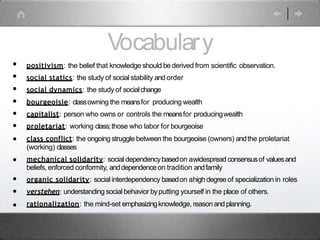
Vocabulary
•
•
•
•
•
•
•
•
•
•
•
positivism: the belief that knowledge should bederived from scientific observation.
social statics: the study of social stability and order
social dynamics: the study of socialchange
bourgeoisie: classowning the meansfor producing wealth
capitalist: person who owns or controls the meansfor producingwealth
proletariat: working class;those who labor for bourgeoise
class conflict: the ongoingstruggle between the bourgeoise (owners) andthe proletariat
(working) classes
mechanical solidarity: social dependencybasedon awidespread consensusof valuesand
beliefs, enforced conformity, anddependenceon tradition andfamily
organic solidarity: social interdependency basedon ahighdegreeof specialization in roles
verstehen: understanding social behavior byputting yourself in the place of others.
rationalization: the mind-set emphasizingknowledge, reasonand planning.
European Origins
• Relatively new science - late 1800s
• Heavily influenced byindustrial revolution
• Intellectuals desired to better understand
changesto society as more andmore
people moved from the farms to facto
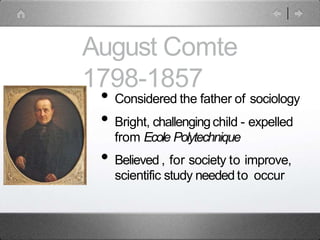
August Comte
1798-1857
• Considered the father of sociology
• Bright, challengingchild - expelled
from Ecole Polytechnique
• Believed , for society to improve,
scientific study needed to occur
Positivism
• Comte wanted to usescientific observation to study
social behavior
• He called this positivism (1848)- should bea
scienceon knowledge of which we canbe
“positive”, or sure
• He also distinguished between studying social stability
andorder (social statics) andstudy of social
change(social dynamics)
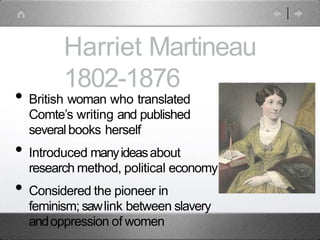
Harriet Martineau
1802-1876
• British woman who translated
Comte’s writing and published
severalbooks herself
• Introduced manyideasabout
research method, political economy
• Considered the pioneer in
feminism; sawlink between slavery
andoppression of women
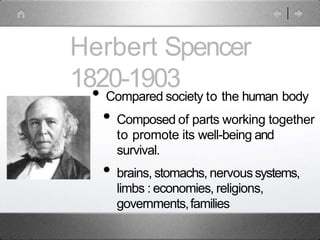
Herbert Spencer
1820-1903
• Compared society to the human body
• Composed of parts working together
to promote its well-being and
survival.
• brains, stomachs, nervoussystems,
limbs : economies, religions,
governments,families
Social Darwinism
• Modeled after Darwin’s theory of evolution, Spencer
thought that evolutionary social changeled to
progress (aslong aspeople didn’t interfere)
• Survival of the fittest (for societies)
• He opposed social reform: poor deserved to bepoor
andthe rich to berich - let evolution sort it out
• Supported in America in 1882 - bycorporate leaders
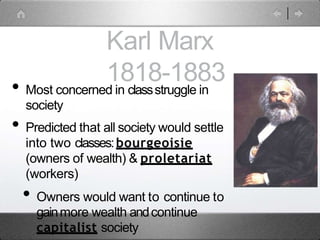
Karl Marx
1818-1883
• Most concerned in classstruggle in
society
• Predicted that all society would settle
into two classes:bourgeoisie
(owners of wealth) & proletariat
(workers)
• Owners would want to continue to
gainmore wealth andcontinue
capitalist society
Marxism
Marxist Sociology is "a form of conflict
theory associated with…marxism's objective of
developing a positive (empirical) science
of capitalist society as part of the mobilization of
a revolutionary working class."
Class Conflict
• The different interests of the different
classesleadsto constant class conflict
• Marx predicted that eventually proletariate
would rise up againstbourgeoise and
overtake the capitalists
• Create aclasslesssociety where no one
would be powerless
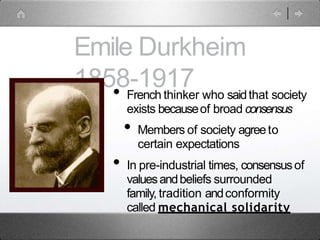
Emile Durkheim
1858-1917
• French thinker who saidthat society
exists becauseof broad consensus
• Members of society agreeto
certain expectations
• In pre-industrial times, consensusof
valuesandbeliefs surrounded
family, tradition andconformity
called mechanical solidarity
Post-Industrial Society
• Changehappenedwith industrial revolution
•Organic solidarity - social
interdependence basedon a web of
specialized roles.
•These specialized roles make members
of society rely on each other for goods
and services
Scientific Methodology
• Durkheim helped to develop research
techniques to validate theories
• Replacespeculation with observation,
collect andclassifydata andusethat data
for testing social theory
• Durkheim introduced useof statistical
techniques in research (suicide research)
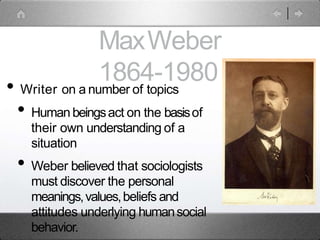
MaxWeber
1864-1980
• Writer on a number of topics
• Human beingsact on the basisof
their own understanding of a
situation
• Weber believed that sociologists
must discover the personal
meanings,values,beliefs and
attitudes underlying humansocial
behavior.
Verstehen
• Weber’s concept of versteheninvolved an
understanding of the personal intentions of
people in groups canbeaccomplished
through empathy
• By‘putting yourself in someones’shoes’,
you cantemporarily shedyour values
andseethings from adifferent point of
view
Rationalization
• Weber also identified rationalization asa
keyinfluence in the changeto an
industrialized society
• Tradition, emotion, superstition➭
knowledge, reason and planning
• Agriculture: belief in luck, fate or magic ➭
grounded science
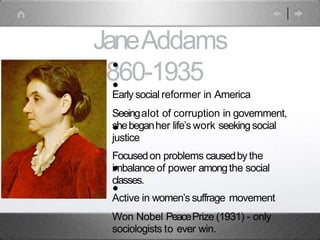
JaneAddams
1860-1935
•
•
•
•
•
Early social reformer in America
Seeingalot of corruption in government,
shebeganher life’s work seekingsocial
justice
Focusedon problems causedby the
imbalanceof power amongthe social
classes.
Active in women’s suffrage movement
Won Nobel PeacePrize (1931) - only
sociologists to ever win.
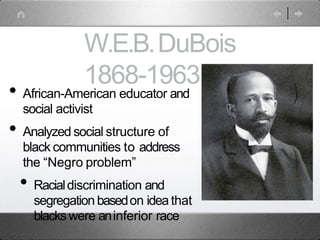
W.E.B.DuBois
1868-1963
• African-American educator and
social activist
• Analyzed social structure of
black communities to address
the “Negro problem”
• Racialdiscrimination and
segregation basedon idea that
blackswere aninferior race

Unit1.1

  • 1.
    Origins of Sociology From Europeto the United States:The Minds Behind the Theories
  • 2.
    What Is Sociology? ““Sociologyis the study of social action”. (Mex Weber) “sociology is the scientific study of society”. (August Comte) ““Sociology is the study of social facts through social institutions”. (Emile Durkhiem) “Sociology is the scientific study of social aspects of human life”. (Mack Young) “Sociology is the study of humans living together”. (Tonnies) “Sociology is the study of social groups on the basis of social interaction”. (Simmel) “Sociology is the study of collective behavior”. (Park & Burgess )
  • 3.
    MEANING OF SOCIOLOGY: Theterm has been derived from two words. The Latin “Socious” mean companionship and the Greek “logos” mean study. So the term literally means the study of human companionship or association or society. ORIGIN / HISTORICAL BACKGROUND OF SOCIOLOGY: Systematic study of Sociology started with Greeks, they considered men as a social animal and the need of society. The modern sociology was coined by August Comte. He is considered as the founder of modern sociology. He called it “Social Physics”. Conclusion: On the basis of above definitions, we can conclude that sociology is the science of society, human behavior, human interaction and relationships.
  • 4.
    Vocabulary • • • • • • • • • • • positivism: the beliefthat knowledge should bederived from scientific observation. social statics: the study of social stability and order social dynamics: the study of socialchange bourgeoisie: classowning the meansfor producing wealth capitalist: person who owns or controls the meansfor producingwealth proletariat: working class;those who labor for bourgeoise class conflict: the ongoingstruggle between the bourgeoise (owners) andthe proletariat (working) classes mechanical solidarity: social dependencybasedon awidespread consensusof valuesand beliefs, enforced conformity, anddependenceon tradition andfamily organic solidarity: social interdependency basedon ahighdegreeof specialization in roles verstehen: understanding social behavior byputting yourself in the place of others. rationalization: the mind-set emphasizingknowledge, reasonand planning.
  • 5.
    European Origins • Relativelynew science - late 1800s • Heavily influenced byindustrial revolution • Intellectuals desired to better understand changesto society as more andmore people moved from the farms to facto
  • 6.
    August Comte 1798-1857 • Consideredthe father of sociology • Bright, challengingchild - expelled from Ecole Polytechnique • Believed , for society to improve, scientific study needed to occur
  • 7.
    Positivism • Comte wantedto usescientific observation to study social behavior • He called this positivism (1848)- should bea scienceon knowledge of which we canbe “positive”, or sure • He also distinguished between studying social stability andorder (social statics) andstudy of social change(social dynamics)
  • 8.
    Harriet Martineau 1802-1876 • Britishwoman who translated Comte’s writing and published severalbooks herself • Introduced manyideasabout research method, political economy • Considered the pioneer in feminism; sawlink between slavery andoppression of women
  • 9.
    Herbert Spencer 1820-1903 • Comparedsociety to the human body • Composed of parts working together to promote its well-being and survival. • brains, stomachs, nervoussystems, limbs : economies, religions, governments,families
  • 10.
    Social Darwinism • Modeledafter Darwin’s theory of evolution, Spencer thought that evolutionary social changeled to progress (aslong aspeople didn’t interfere) • Survival of the fittest (for societies) • He opposed social reform: poor deserved to bepoor andthe rich to berich - let evolution sort it out • Supported in America in 1882 - bycorporate leaders
  • 11.
    Karl Marx 1818-1883 • Mostconcerned in classstruggle in society • Predicted that all society would settle into two classes:bourgeoisie (owners of wealth) & proletariat (workers) • Owners would want to continue to gainmore wealth andcontinue capitalist society
  • 12.
    Marxism Marxist Sociology is"a form of conflict theory associated with…marxism's objective of developing a positive (empirical) science of capitalist society as part of the mobilization of a revolutionary working class."
  • 13.
    Class Conflict • Thedifferent interests of the different classesleadsto constant class conflict • Marx predicted that eventually proletariate would rise up againstbourgeoise and overtake the capitalists • Create aclasslesssociety where no one would be powerless
  • 14.
    Emile Durkheim 1858-1917 • Frenchthinker who saidthat society exists becauseof broad consensus • Members of society agreeto certain expectations • In pre-industrial times, consensusof valuesandbeliefs surrounded family, tradition andconformity called mechanical solidarity
  • 15.
    Post-Industrial Society • Changehappenedwithindustrial revolution •Organic solidarity - social interdependence basedon a web of specialized roles. •These specialized roles make members of society rely on each other for goods and services
  • 16.
    Scientific Methodology • Durkheimhelped to develop research techniques to validate theories • Replacespeculation with observation, collect andclassifydata andusethat data for testing social theory • Durkheim introduced useof statistical techniques in research (suicide research)
  • 17.
    MaxWeber 1864-1980 • Writer ona number of topics • Human beingsact on the basisof their own understanding of a situation • Weber believed that sociologists must discover the personal meanings,values,beliefs and attitudes underlying humansocial behavior.
  • 18.
    Verstehen • Weber’s conceptof versteheninvolved an understanding of the personal intentions of people in groups canbeaccomplished through empathy • By‘putting yourself in someones’shoes’, you cantemporarily shedyour values andseethings from adifferent point of view
  • 19.
    Rationalization • Weber alsoidentified rationalization asa keyinfluence in the changeto an industrialized society • Tradition, emotion, superstition➭ knowledge, reason and planning • Agriculture: belief in luck, fate or magic ➭ grounded science
  • 20.
    JaneAddams 1860-1935 • • • • • Early social reformerin America Seeingalot of corruption in government, shebeganher life’s work seekingsocial justice Focusedon problems causedby the imbalanceof power amongthe social classes. Active in women’s suffrage movement Won Nobel PeacePrize (1931) - only sociologists to ever win.
  • 21.
    W.E.B.DuBois 1868-1963 • African-American educatorand social activist • Analyzed social structure of black communities to address the “Negro problem” • Racialdiscrimination and segregation basedon idea that blackswere aninferior race