Some Male
        Olympians
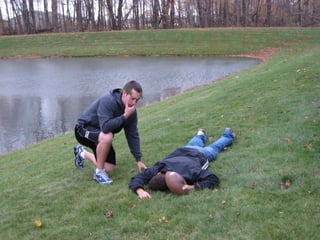
But before we get to this, take the next two
slides together, as an updated version of a
Classical Myth. I’m merely planting a seed
  here for a future assignment. This is a
    modern take on Apollo and Hyacinth
          throwing the discus…
Ares
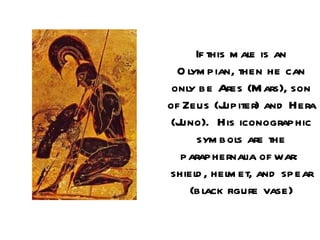
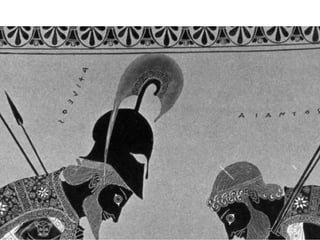
If this m ale is an
  O lym pian, then he can
 only be Ares (M ars), son
of Zeus (J   upiter) and Hera
(Juno). His iconographic
      sym bols are the
  paraphernalia of war:
shield , helm et, and spear
     (bl figure vase)
        ack
Quick FYI:
   There are two types of art on
 ancient Greek pottery, red figure
(below) and black figure (above).
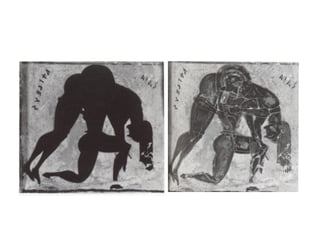
    To create a black figure the
 artist would paint a silhouette on
clay (here, left, Ajax carrying the
  dead Achilles from the Trojan
            battlefield)
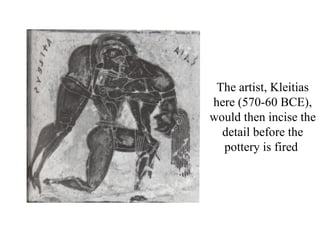
The artist, Kleitias
here (570-60 BCE),
would then incise the
  detail before the
  pottery is fired
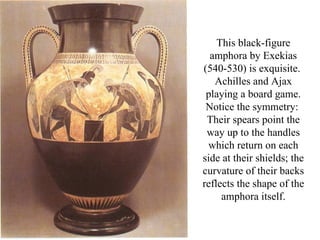
This black-figure
  amphora by Exekias
(540-530) is exquisite.
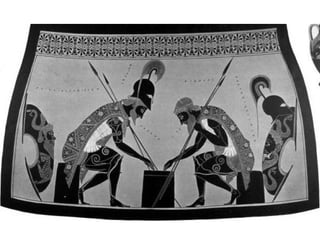
   Achilles and Ajax
 playing a board game.
 Notice the symmetry:
 Their spears point the
 way up to the handles
 which return on each
side at their shields; the
curvature of their backs
reflects the shape of the
     amphora itself.
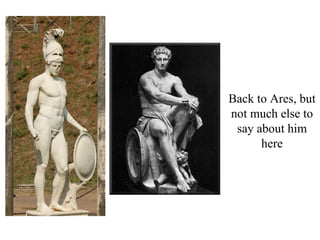
Back to Ares, but
not much else to
 say about him
      here
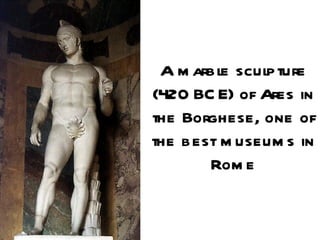
A m arble sculpture
(420 BC E) of Ares in
the Borghese, one of
the best m useum s in
       Rom e
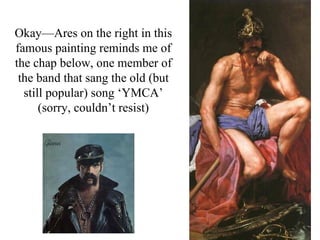
Okay—Ares on the right in this
famous painting reminds me of
the chap below, one member of
 the band that sang the old (but
  still popular) song ‘YMCA’
      (sorry, couldn’t resist)
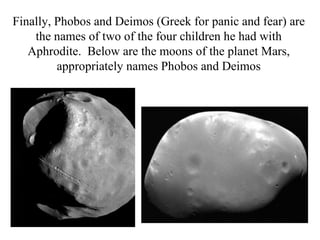
Finally, Phobos and Deimos (Greek for panic and fear) are
    the names of two of the four children he had with
   Aphrodite. Below are the moons of the planet Mars,
         appropriately names Phobos and Deimos
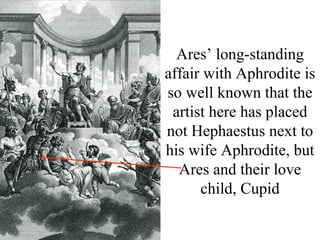
Ares’ long-standing
affair with Aphrodite is
so well known that the
 artist here has placed
not Hephaestus next to
his wife Aphrodite, but
  Ares and their love
      child, Cupid
Hephaestus
(Roman name Vulcan)
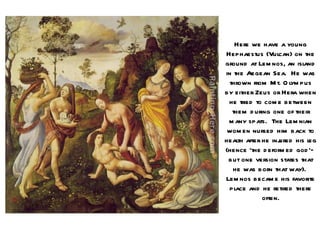
Here we have a young
Hephaestus (Vulcan) on the
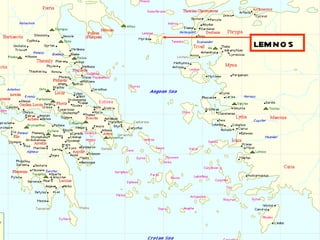
ground at Lem nos, an isl  and
in the Aegean Sea. He was
  thrown from M t. O l pus
                      ym
by either Zeus or Hera when
 he tried to com e between
   them d uring one of their
 m any spats. The Lem nian
 wom en nursed him back to
health after he injured his l
                            eg
(hence ‘the d eform ed god ’—
 but one version states that
   he was born that way).
Lem nos becam e his favorite
  pl and he retired there
    ace
             often.
LEM NO S
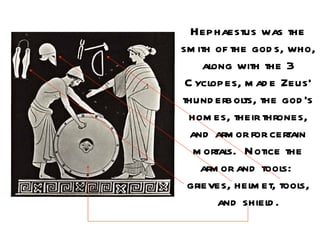
Hephaestus was the
sm ith of the god s, who,
    along with the 3
 C yclopes, m ad e Zeus’
thund erbolts, the god ’s
  hom es, their thrones,
  and arm or for certain
   m ortals. Notice the
    arm or and tools:
 grieves, helm et, tools,
        and shield .
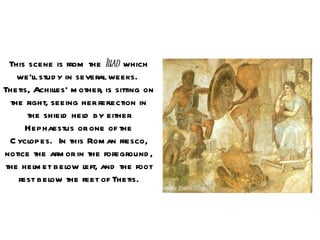
This scene is from the Il which
                            iad
    we’ll stud y in several weeks.
Thetis, Achilles’ m other, is sitting on
  the right, seeing her refl ection in
       the shiel hel by either
                d     d
      Hephaestus or one of the
  C yclopes. In this Rom an fresco,
notice the arm or in the foreground ,
 the helm et bel left, and the foot
                  ow
    rest below the feet of Thetis.
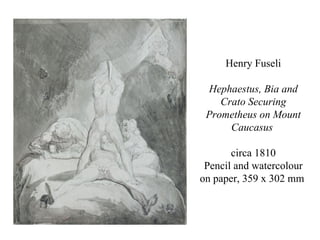
Henry Fuseli

 Hephaestus, Bia and
    Crato Securing
 Prometheus on Mount
      Caucasus

       circa 1810
 Pencil and watercolour
on paper, 359 x 302 mm
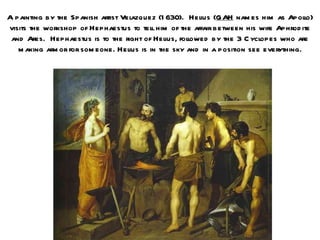
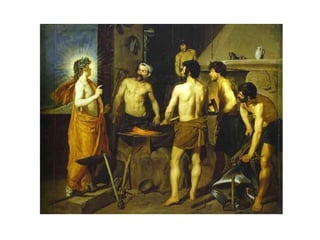
A painting by the Spanish artist Velazquez (1 630). Hel (GAH nam es him as Apolo)
                                                         ius                           l
visits the workshop of Hephaestus to tel him of the affair between his wife Aphrod ite
                                           l
 and Ares. Hephaestus is to the right of Hel folowed by the 3 C ycl
                                               ius, l                     opes who are
   m aking arm or for som eone. Helius is in the sky and in a position see everything.
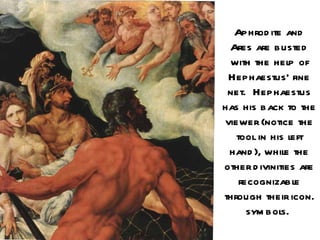
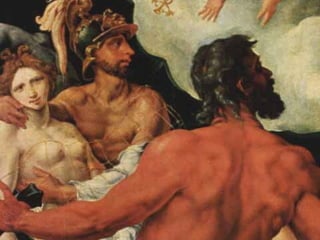
Aphrod ite and
 Ares are busted
 with the help of
 Hephaestus’ fine
 net. Hephaestus
has his back to the
viewer (notice the
   tool in his left
 hand ), while the
other d ivinities are
    recognizable
through their icon.
      sym bols.
A d rawing from a M ed ieval m anuscript (look closely and you can see the
 letters on the other sid e of the page). This d rawing d epicts two scenes
from the affair of Aph. and Ares. O n the left we see the pair on the bed
und er the net of Hephaestus. O n the right Helius, with his sun rays, talks
                      to Hephaestus in his workshop.
Saturn Jupiter M ercury Neptune Vul
                                  can   Hel
                                          ius   Vul
                                                  can
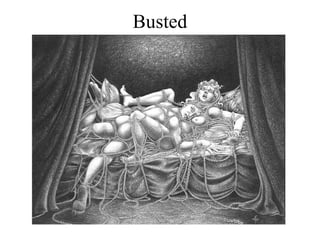
The following drawing is by
Nancy Farmer (no relation), one
 of my favourite modern artists
who is often inspired by Classical
              Myth
Busted
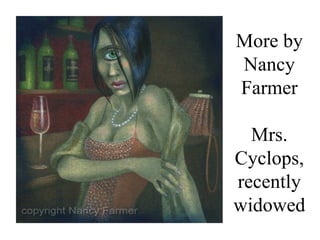
More by
Nancy
Farmer

  Mrs.
Cyclops,
recently
widowed
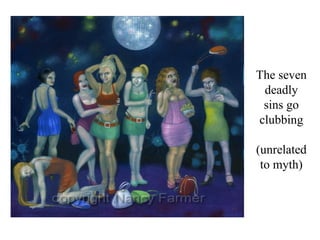
The seven
 deadly
 sins go
clubbing

(unrelated
 to myth)
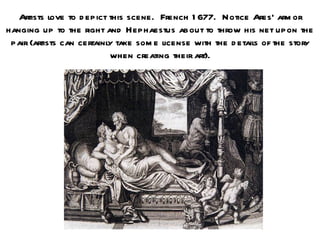
Artists love to d epict this scene. French 1 677. Notice Ares’ arm or
hanging up to the right and Hephaestus about to throw his net upon the
 pair (artists can certainly take som e license with the d etails of the story
                           when creating their art).
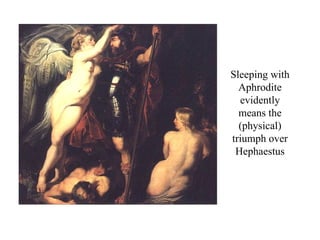
Sleeping with
  Aphrodite
  evidently
  means the
  (physical)
triumph over
 Hephaestus
Hermes
(Roman Mercury)
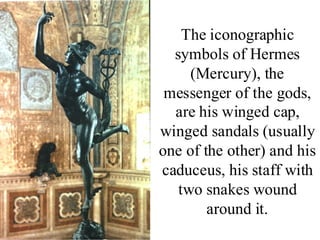
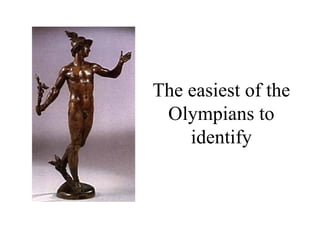
The iconographic
  symbols of Hermes
     (Mercury), the
 messenger of the gods,
  are his winged cap,
winged sandals (usually
one of the other) and his
caduceus, his staff with
   two snakes wound
        around it.
The easiest of the
 Olympians to
    identify
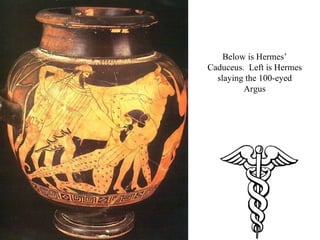
Below is Hermes’
Caduceus. Left is Hermes
  slaying the 100-eyed
         Argus
(speakers on?)

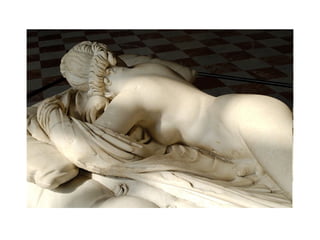
Hermes had a brief affair with
 Aphrodite, resulting in a male
 child named Hermaphroditus
   (conflation of both of their
 names). Salmacis, a nymph,
saw him bathing in a pond one
day; she jumped into the water,
  embraced the beautiful boy,
 and prayed that they never be
            parted…

A wish come true. Etiology for
       a hermaphrodite

     Spranger, 1546-1611
Josonia Palaitis’ (2007) modern
 interpretation of Salmacis and
        Hermaphroditus
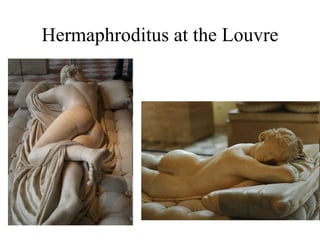
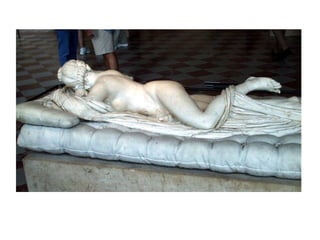
Hermaphroditus at the Louvre
A statue of Herm es, call a Herm s, sim ilar to
                            ed
  this one, was usual found in front of m ost
                       ly
   resid ences in the city of Athens. The god
    protected the resid ents from thieves and
burglars. O nce on the m orning of a big naval
  exped ition to Sicily, the resid ents of Athens
 awoke to find that m ost of the phalloi on their
Herm s had been broken off by vand als. There
was a huge d ebate on whether or not to send
the ships--was it a bad om en? The Athenians
sent the ships, and the naval exped ition was a
           huge d isaster. Hard lesson.
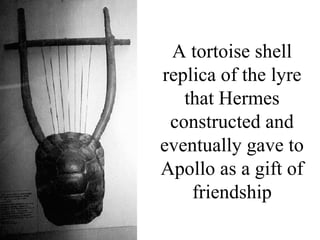
A tortoise shell
replica of the lyre
   that Hermes
 constructed and
eventually gave to
Apollo as a gift of
    friendship
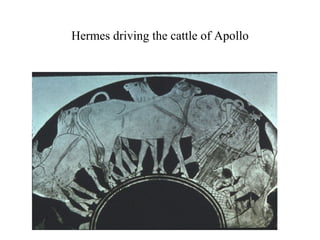
Hermes driving the cattle of Apollo
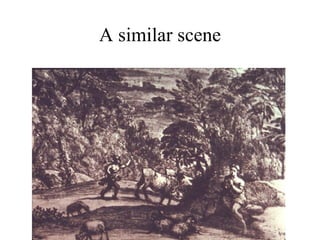
A similar scene
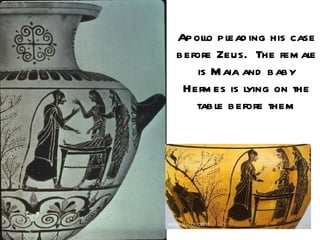
Apollo pl ing his case
          ead
before Zeus. The fem ale
    is M aia and baby
 Herm es is l ying on the
   table before them
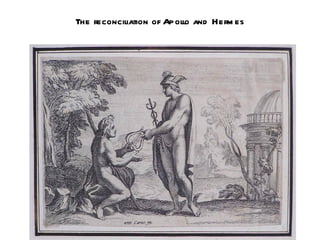
The reconciliation of Apol and Herm es
                         lo
Poseidon
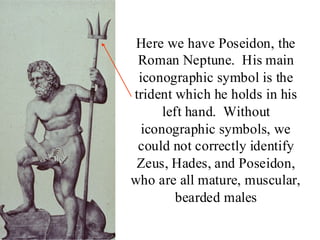
Here we have Poseidon, the
 Roman Neptune. His main
 iconographic symbol is the
trident which he holds in his
      left hand. Without
  iconographic symbols, we
 could not correctly identify
 Zeus, Hades, and Poseidon,
who are all mature, muscular,
         bearded males
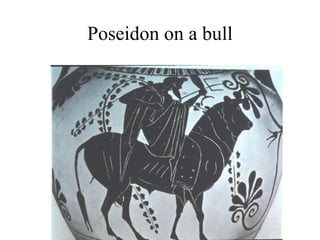
Poseidon on a bull
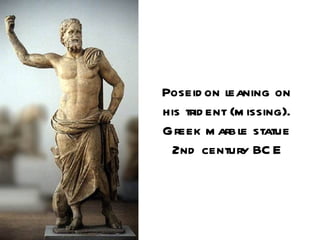
Poseid on l eaning on
his trid ent (m issing).
Greek m arbl statue
               e
 2nd century BC E
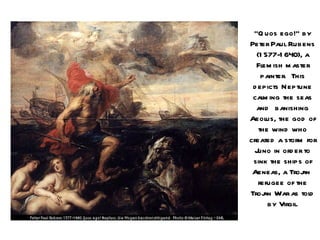
“Q uos ego!” by
Peter Paul Rubens
  (1 577-1 640), a
  Flem ish m aster
    painter. This
 d epicts Neptune
 cal ing the seas
     m
  and banishing
Aeol the god of
      us,
   the wind who
created a storm for
  Juno in ord er to
 sink the ships of
 Aeneas, a Troj  an
   refugee of the
Troj War as tol
     an            d
      by Virgil.
Finis

Some male_olympians_summer_2012

  • 1.
    Some Male Olympians But before we get to this, take the next two slides together, as an updated version of a Classical Myth. I’m merely planting a seed here for a future assignment. This is a modern take on Apollo and Hyacinth throwing the discus…
  • 4.
  • 5.
    If this male is an O lym pian, then he can only be Ares (M ars), son of Zeus (J upiter) and Hera (Juno). His iconographic sym bols are the paraphernalia of war: shield , helm et, and spear (bl figure vase) ack
  • 6.
    Quick FYI: There are two types of art on ancient Greek pottery, red figure (below) and black figure (above). To create a black figure the artist would paint a silhouette on clay (here, left, Ajax carrying the dead Achilles from the Trojan battlefield)
  • 7.
    The artist, Kleitias here(570-60 BCE), would then incise the detail before the pottery is fired
  • 9.
    This black-figure amphora by Exekias (540-530) is exquisite. Achilles and Ajax playing a board game. Notice the symmetry: Their spears point the way up to the handles which return on each side at their shields; the curvature of their backs reflects the shape of the amphora itself.
  • 12.
    Back to Ares,but not much else to say about him here
  • 13.
    A m arblesculpture (420 BC E) of Ares in the Borghese, one of the best m useum s in Rom e
  • 14.
    Okay—Ares on theright in this famous painting reminds me of the chap below, one member of the band that sang the old (but still popular) song ‘YMCA’ (sorry, couldn’t resist)
  • 15.
    Finally, Phobos andDeimos (Greek for panic and fear) are the names of two of the four children he had with Aphrodite. Below are the moons of the planet Mars, appropriately names Phobos and Deimos
  • 16.
    Ares’ long-standing affair withAphrodite is so well known that the artist here has placed not Hephaestus next to his wife Aphrodite, but Ares and their love child, Cupid
  • 17.
  • 18.
    Here we havea young Hephaestus (Vulcan) on the ground at Lem nos, an isl and in the Aegean Sea. He was thrown from M t. O l pus ym by either Zeus or Hera when he tried to com e between them d uring one of their m any spats. The Lem nian wom en nursed him back to health after he injured his l eg (hence ‘the d eform ed god ’— but one version states that he was born that way). Lem nos becam e his favorite pl and he retired there ace often.
  • 19.
  • 20.
    Hephaestus was the smith of the god s, who, along with the 3 C yclopes, m ad e Zeus’ thund erbolts, the god ’s hom es, their thrones, and arm or for certain m ortals. Notice the arm or and tools: grieves, helm et, tools, and shield .
  • 21.
    This scene isfrom the Il which iad we’ll stud y in several weeks. Thetis, Achilles’ m other, is sitting on the right, seeing her refl ection in the shiel hel by either d d Hephaestus or one of the C yclopes. In this Rom an fresco, notice the arm or in the foreground , the helm et bel left, and the foot ow rest below the feet of Thetis.
  • 22.
    Henry Fuseli Hephaestus,Bia and Crato Securing Prometheus on Mount Caucasus circa 1810 Pencil and watercolour on paper, 359 x 302 mm
  • 23.
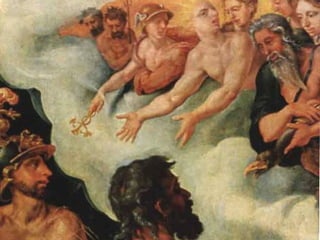
    A painting bythe Spanish artist Velazquez (1 630). Hel (GAH nam es him as Apolo) ius l visits the workshop of Hephaestus to tel him of the affair between his wife Aphrod ite l and Ares. Hephaestus is to the right of Hel folowed by the 3 C ycl ius, l opes who are m aking arm or for som eone. Helius is in the sky and in a position see everything.
  • 25.
    Aphrod ite and Ares are busted with the help of Hephaestus’ fine net. Hephaestus has his back to the viewer (notice the tool in his left hand ), while the other d ivinities are recognizable through their icon. sym bols.
  • 28.
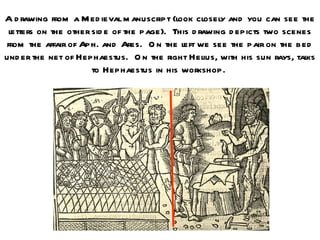
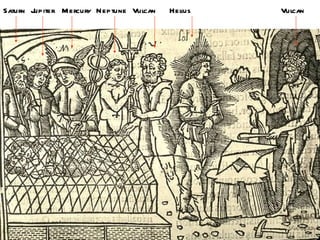
    A d rawingfrom a M ed ieval m anuscript (look closely and you can see the letters on the other sid e of the page). This d rawing d epicts two scenes from the affair of Aph. and Ares. O n the left we see the pair on the bed und er the net of Hephaestus. O n the right Helius, with his sun rays, talks to Hephaestus in his workshop.
  • 29.
    Saturn Jupiter Mercury Neptune Vul can Hel ius Vul can
  • 30.
    The following drawingis by Nancy Farmer (no relation), one of my favourite modern artists who is often inspired by Classical Myth
  • 31.
  • 32.
    More by Nancy Farmer Mrs. Cyclops, recently widowed
  • 33.
    The seven deadly sins go clubbing (unrelated to myth)
  • 34.
    Artists love tod epict this scene. French 1 677. Notice Ares’ arm or hanging up to the right and Hephaestus about to throw his net upon the pair (artists can certainly take som e license with the d etails of the story when creating their art).
  • 35.
    Sleeping with Aphrodite evidently means the (physical) triumph over Hephaestus
  • 36.
  • 37.
    The iconographic symbols of Hermes (Mercury), the messenger of the gods, are his winged cap, winged sandals (usually one of the other) and his caduceus, his staff with two snakes wound around it.
  • 38.
    The easiest ofthe Olympians to identify
  • 39.
    Below is Hermes’ Caduceus.Left is Hermes slaying the 100-eyed Argus
  • 40.
    (speakers on?) Hermes hada brief affair with Aphrodite, resulting in a male child named Hermaphroditus (conflation of both of their names). Salmacis, a nymph, saw him bathing in a pond one day; she jumped into the water, embraced the beautiful boy, and prayed that they never be parted… A wish come true. Etiology for a hermaphrodite Spranger, 1546-1611
  • 41.
    Josonia Palaitis’ (2007)modern interpretation of Salmacis and Hermaphroditus
  • 42.
  • 45.
    A statue ofHerm es, call a Herm s, sim ilar to ed this one, was usual found in front of m ost ly resid ences in the city of Athens. The god protected the resid ents from thieves and burglars. O nce on the m orning of a big naval exped ition to Sicily, the resid ents of Athens awoke to find that m ost of the phalloi on their Herm s had been broken off by vand als. There was a huge d ebate on whether or not to send the ships--was it a bad om en? The Athenians sent the ships, and the naval exped ition was a huge d isaster. Hard lesson.
  • 46.
    A tortoise shell replicaof the lyre that Hermes constructed and eventually gave to Apollo as a gift of friendship
  • 47.
    Hermes driving thecattle of Apollo
  • 48.
  • 49.
    Apollo pl inghis case ead before Zeus. The fem ale is M aia and baby Herm es is l ying on the table before them
  • 50.
    The reconciliation ofApol and Herm es lo
  • 51.
  • 52.
    Here we havePoseidon, the Roman Neptune. His main iconographic symbol is the trident which he holds in his left hand. Without iconographic symbols, we could not correctly identify Zeus, Hades, and Poseidon, who are all mature, muscular, bearded males
  • 53.
  • 54.
    Poseid on leaning on his trid ent (m issing). Greek m arbl statue e 2nd century BC E
  • 55.
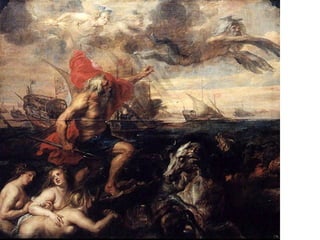
    “Q uos ego!”by Peter Paul Rubens (1 577-1 640), a Flem ish m aster painter. This d epicts Neptune cal ing the seas m and banishing Aeol the god of us, the wind who created a storm for Juno in ord er to sink the ships of Aeneas, a Troj an refugee of the Troj War as tol an d by Virgil.
  • 57.