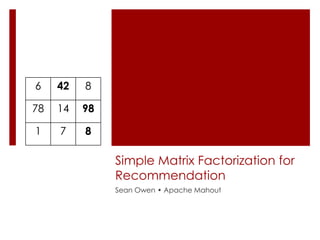
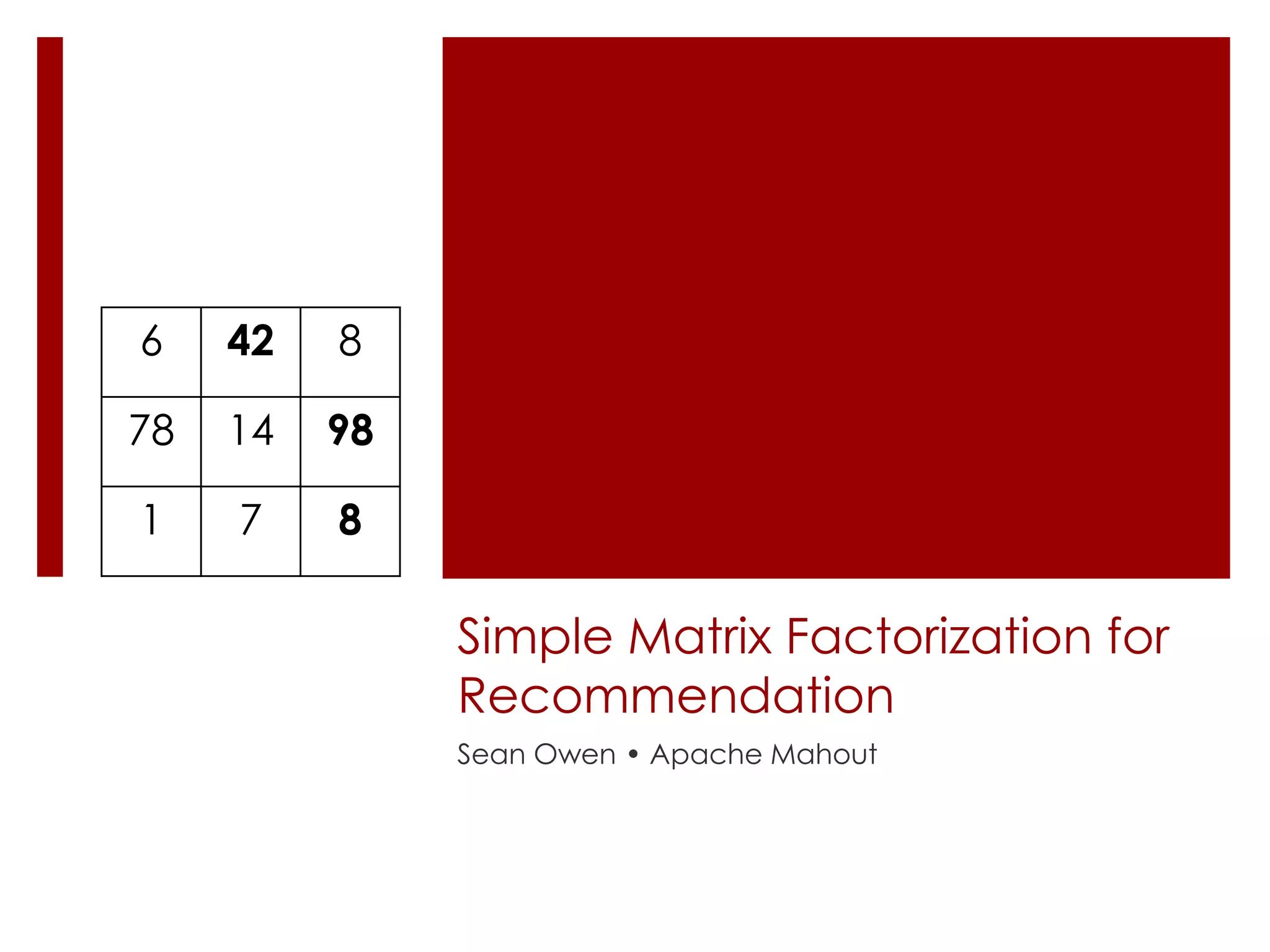




6    42   8

78   14   98

1    7    8

               Simple Matrix Factorization for
               Recommendation
               Sean Owen • Apache Mahout
Apache Mahout
•   Scalable machine learning
•   (Mostly) Hadoop-based
•   Clustering, classification and
    recommender engines


•   Nearest-neighbor
     •   User-based                  mahout.apache.org
     •   Item-based
     •   Slope-one
     •   Clustering-based

•   Latent factor
     •   SVD-based
     •   ALS
     •   More!
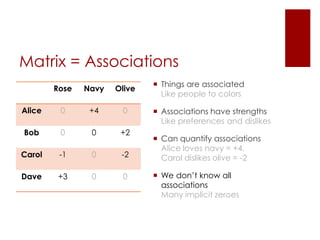
Matrix = Associations
                               Things are associated
        Rose   Navy   Olive
                                Like people to colors

Alice    0      +4     0       Associations have strengths
                                Like preferences and dislikes
Bob      0      0      +2
                               Can quantify associations
                                Alice loves navy = +4,
Carol    -1     0      -2       Carol dislikes olive = -2

Dave    +3      0      0       We don’t know all
                                associations
                                Many implicit zeroes
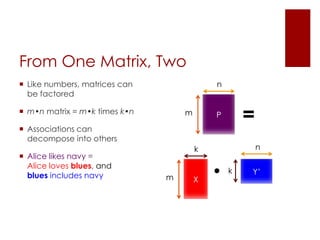
From One Matrix, Two
 Like numbers, matrices can               n
  be factored

 m•n matrix = m•k times k•n

 Associations can
                                   m       P
                                                   =
  decompose into others
                                       k               n
 Alice likes navy =

                                           •
  Alice loves blues, and
                                               k   Y’
  blues includes navy          m       X
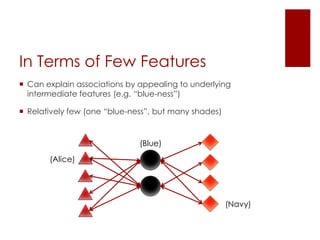
In Terms of Few Features
 Can explain associations by appealing to underlying
  intermediate features (e.g. “blue-ness”)

 Relatively few (one “blue-ness”, but many shades)


                              (Blue)
       (Alice)


                                                      (Navy)
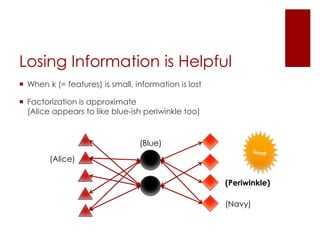
Losing Information is Helpful
 When k (= features) is small, information is lost

 Factorization is approximate
  (Alice appears to like blue-ish periwinkle too)


                                 (Blue)
        (Alice)

                                                      (Periwinkle)

                                                      (Navy)
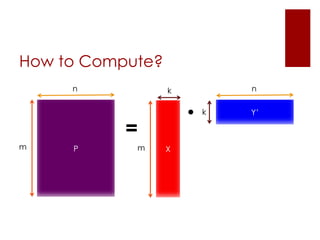
How to Compute?
     n            k           n


                      •   k   Y’

           =
m    P      m     X
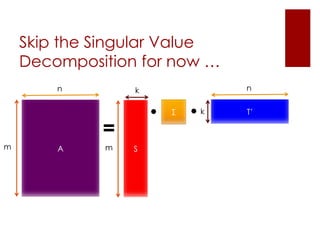
Skip the Singular Value
    Decomposition for now …
        n        k                n


                     •   Σ   •k   T’

             =
m       A    m   S
Alternating Least Squares
 Collaborative Filtering for Implicit Feedback Datasets
  www2.research.att.com/~yifanhu/PUB/cf.pdf
 R = matrix of user-item interactions “strengths”
 P = R reduced to 0 and 1
 Factor as approximate P ≈ X•Y’
   Start with random Y
   Compute X such that X•Y’ best approximates P
    (Frobenius / L2 norm)            (Least Squares)
   Repeat for Y         (Alternating)
   Iterate, Iterate, Iterate

 Large values in X•Y’ are good recommendations
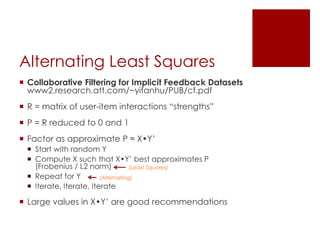
Example


    1   4   3           1   1   1   0   0
            3           0   0   1   0   0
        4       3   2   0   1   0   1   1
R                                           P
    5       2       3   1   0   1   0   1
                5       0   0   0   1   0
    2   4               1   1   0   0   0
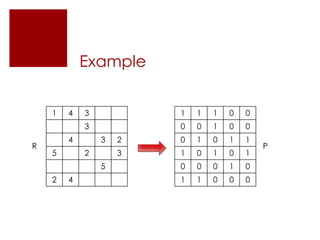
k = 3, λ=2, α=40
            1 iteration


1   1   1    0   0       2.18   -0.01   0.35        0.43    0.48    0.48    0.16    0.10


0   0   1    0   0       1.83   -0.11   -0.68       -0.27   0.39    -0.13   0.03    0.05


                     ≈
0   1   0    1   1       0.79   1.15    -1.80       -0.03   -0.09   -0.13   -0.47   -0.47


1   0   1    0   1       0.97   -1.90   -2.12
                                                                                      Y’
0   0   0    1   0       1.01   -0.25   -1.77


1   1   0    0   0       2.33   -8.00   1.06
                                                X
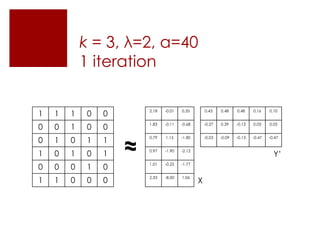
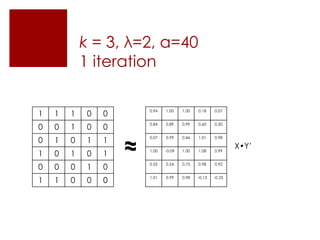
k = 3, λ=2, α=40
            1 iteration


1   1   1    0   0
                         0.94   1.00    1.00   0.18    0.07


0   0   1    0   0       0.84   0.89    0.99   0.60    0.50


                     ≈
0   1   0    1   1       0.07   0.99    0.46   1.01    0.98

                                                               X•Y’
1   0   1    0   1       1.00   -0.09   1.00   1.08    0.99


0   0   0    1   0       0.55   0.54    0.75   0.98    0.92


1   1   0    0   0       1.01   0.99    0.98   -0.13   -0.25
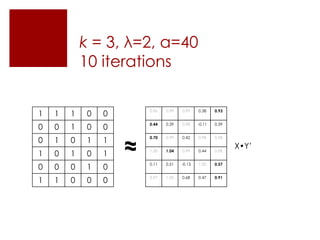
k = 3, λ=2, α=40
            10 iterations


1   1   1    0   0
                         0.96   0.99   0.99    0.38    0.93


0   0   1    0   0       0.44   0.39   0.98    -0.11   0.39


                     ≈
0   1   0    1   1       0.70   0.99   0.42    0.98    0.98

                                                              X•Y’
1   0   1    0   1       1.00   1.04   0.99    0.44    0.98


0   0   0    1   0       0.11   0.51   -0.13   1.00    0.57


1   1   0    0   0       0.97   1.00   0.68    0.47    0.91
Interesting Because…


 This is all very
 parallelizable
by row, column
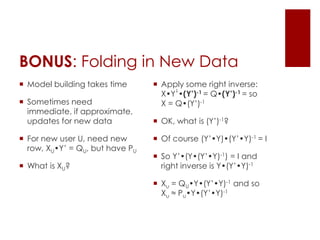
BONUS: Folding in New Data
 Model building takes time       Apply some right inverse:
                                       ⌃
                                   X•Y’•(Y’)-1 = Q•(Y’)-1 = so
 Sometimes need                   X = Q•(Y’)-1
  immediate, if approximate,
  updates for new data            OK, what is (Y’)-1?

 For new user U, need new        Of course (Y’•Y)•(Y’•Y)-1 = I
  row, XU•Y’ = QU, but have PU
                                  So Y’•(Y•(Y’•Y)-1) = I and
 What is XU?                      right inverse is Y•(Y’•Y)-1

                                  Xu = QU•Y•(Y’•Y)-1 and so
                                   Xu ≈ Pu•Y•(Y’•Y)-1
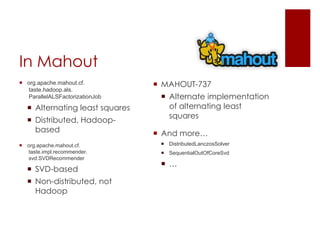
In Mahout
 org.apache.mahout.cf.          MAHOUT-737
  taste.hadoop.als.
  ParallelALSFactorizationJob     Alternate implementation
   Alternating least squares      of alternating least
                                   squares
   Distributed, Hadoop-
    based                        And more…
 org.apache.mahout.cf.           DistributedLanczosSolver
  taste.impl.recommender.         SequentialOutOfCoreSvd
  svd.SVDRecommender
                                  …
   SVD-based
   Non-distributed, not
    Hadoop
 Complete product
            Real-time Serving Layer
Myrrix      Hadoop-based
             Computation Layer
            Tuned, documented

          Free / open: Serving Layer,
           for small data

          Commercial: add
           Computation Layer for big
           data; Hosting

          Matrix factorization-based,
           attractive properties

          http://myrrix.com
Thank You
srowen at myrrix.com
mahout.apache.org

Simple Matrix Factorization for Recommendation in Mahout

  • 1.
    6 42 8 78 14 98 1 7 8 Simple Matrix Factorization for Recommendation Sean Owen • Apache Mahout
  • 2.
    Apache Mahout • Scalable machine learning • (Mostly) Hadoop-based • Clustering, classification and recommender engines • Nearest-neighbor • User-based mahout.apache.org • Item-based • Slope-one • Clustering-based • Latent factor • SVD-based • ALS • More!
  • 3.
    Matrix = Associations  Things are associated Rose Navy Olive Like people to colors Alice 0 +4 0  Associations have strengths Like preferences and dislikes Bob 0 0 +2  Can quantify associations Alice loves navy = +4, Carol -1 0 -2 Carol dislikes olive = -2 Dave +3 0 0  We don’t know all associations Many implicit zeroes
  • 4.
    From One Matrix,Two  Like numbers, matrices can n be factored  m•n matrix = m•k times k•n  Associations can m P = decompose into others k n  Alice likes navy = • Alice loves blues, and k Y’ blues includes navy m X
  • 5.
    In Terms ofFew Features  Can explain associations by appealing to underlying intermediate features (e.g. “blue-ness”)  Relatively few (one “blue-ness”, but many shades) (Blue) (Alice) (Navy)
  • 6.
    Losing Information isHelpful  When k (= features) is small, information is lost  Factorization is approximate (Alice appears to like blue-ish periwinkle too) (Blue) (Alice) (Periwinkle) (Navy)
  • 7.
    How to Compute? n k n • k Y’ = m P m X
  • 8.
    Skip the SingularValue Decomposition for now … n k n • Σ •k T’ = m A m S
  • 9.
    Alternating Least Squares Collaborative Filtering for Implicit Feedback Datasets www2.research.att.com/~yifanhu/PUB/cf.pdf  R = matrix of user-item interactions “strengths”  P = R reduced to 0 and 1  Factor as approximate P ≈ X•Y’  Start with random Y  Compute X such that X•Y’ best approximates P (Frobenius / L2 norm) (Least Squares)  Repeat for Y (Alternating)  Iterate, Iterate, Iterate  Large values in X•Y’ are good recommendations
  • 10.
    Example 1 4 3 1 1 1 0 0 3 0 0 1 0 0 4 3 2 0 1 0 1 1 R P 5 2 3 1 0 1 0 1 5 0 0 0 1 0 2 4 1 1 0 0 0
  • 11.
    k = 3,λ=2, α=40 1 iteration 1 1 1 0 0 2.18 -0.01 0.35 0.43 0.48 0.48 0.16 0.10 0 0 1 0 0 1.83 -0.11 -0.68 -0.27 0.39 -0.13 0.03 0.05 ≈ 0 1 0 1 1 0.79 1.15 -1.80 -0.03 -0.09 -0.13 -0.47 -0.47 1 0 1 0 1 0.97 -1.90 -2.12 Y’ 0 0 0 1 0 1.01 -0.25 -1.77 1 1 0 0 0 2.33 -8.00 1.06 X
  • 12.
    k = 3,λ=2, α=40 1 iteration 1 1 1 0 0 0.94 1.00 1.00 0.18 0.07 0 0 1 0 0 0.84 0.89 0.99 0.60 0.50 ≈ 0 1 0 1 1 0.07 0.99 0.46 1.01 0.98 X•Y’ 1 0 1 0 1 1.00 -0.09 1.00 1.08 0.99 0 0 0 1 0 0.55 0.54 0.75 0.98 0.92 1 1 0 0 0 1.01 0.99 0.98 -0.13 -0.25
  • 13.
    k = 3,λ=2, α=40 10 iterations 1 1 1 0 0 0.96 0.99 0.99 0.38 0.93 0 0 1 0 0 0.44 0.39 0.98 -0.11 0.39 ≈ 0 1 0 1 1 0.70 0.99 0.42 0.98 0.98 X•Y’ 1 0 1 0 1 1.00 1.04 0.99 0.44 0.98 0 0 0 1 0 0.11 0.51 -0.13 1.00 0.57 1 1 0 0 0 0.97 1.00 0.68 0.47 0.91
  • 14.
    Interesting Because… Thisis all very parallelizable by row, column
  • 15.
    BONUS: Folding inNew Data  Model building takes time  Apply some right inverse: ⌃ X•Y’•(Y’)-1 = Q•(Y’)-1 = so  Sometimes need X = Q•(Y’)-1 immediate, if approximate, updates for new data  OK, what is (Y’)-1?  For new user U, need new  Of course (Y’•Y)•(Y’•Y)-1 = I row, XU•Y’ = QU, but have PU  So Y’•(Y•(Y’•Y)-1) = I and  What is XU? right inverse is Y•(Y’•Y)-1  Xu = QU•Y•(Y’•Y)-1 and so Xu ≈ Pu•Y•(Y’•Y)-1
  • 16.
    In Mahout  org.apache.mahout.cf.  MAHOUT-737 taste.hadoop.als. ParallelALSFactorizationJob  Alternate implementation  Alternating least squares of alternating least squares  Distributed, Hadoop- based  And more…  org.apache.mahout.cf.  DistributedLanczosSolver taste.impl.recommender.  SequentialOutOfCoreSvd svd.SVDRecommender  …  SVD-based  Non-distributed, not Hadoop
  • 17.
     Complete product  Real-time Serving Layer Myrrix  Hadoop-based Computation Layer  Tuned, documented  Free / open: Serving Layer, for small data  Commercial: add Computation Layer for big data; Hosting  Matrix factorization-based, attractive properties  http://myrrix.com
  • 18.
    Thank You srowen atmyrrix.com mahout.apache.org